
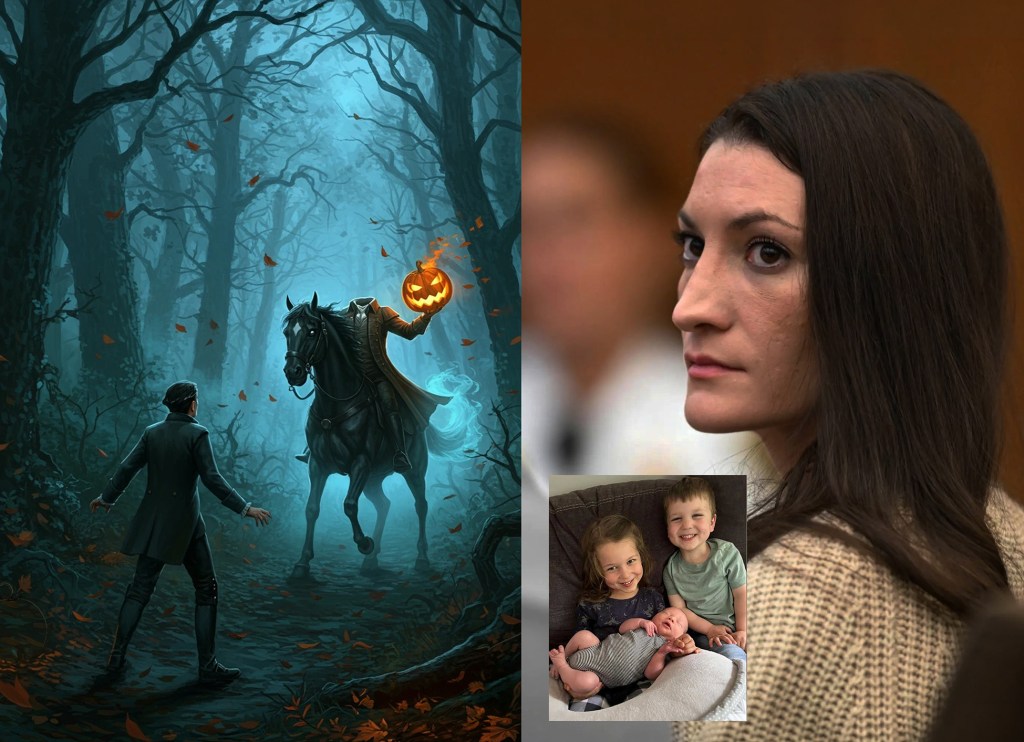
The Legend of Hollow Clancy

Not all that long ago, I told my son Harrison that I almost certainly produce more reading material than I consume. Don’t get me wrong. I read a lot. And yet, regardless of my intake levels, I never seem to run out of things to say. A person only needs to look around. There’s always something to observe, analyze, and describe if you’re willing to take the time.

Still, I should read more than I do, if only to expand my repertoire. It’s true I have a habit of revisiting books I’ve already read. Doing so always proves fruitful. It seems there’s always something new a person can take away from repeat visits with a favorite volume. For example, I’ve read Charles Dickens’ The Cricket on the Hearth more times than I can count, and I always notice something new. The same goes for C.S. Lewis’ The Screwtape Letters. Interestingly, when I see folks online posting supposed meme-form quotations from Screwtape as prophetic musings applicable today, I can usually tell whether the quotation is genuine. Most of the time, it isn’t. You’ve heard the saying “Familiarity breeds likeability.” Well, familiarity also breeds discernibility.

Another book I read at least once a year is Washington Irving’s The Legend of Sleepy Hollow. I crack it open every autumn. Indeed, when the Michigan sky begins gathering its grays, when temperatures begin dipping lower, and the chlorophyll in the leaves begins breaking down, leaving behind the colors my wife enjoys so much more than I ever could, it’s right about then that I start sensing the story’s draw.

I can’t say for sure how long I’ve been doing this. It’s been at least fifteen years or so. Before that, it was only occasionally.

I first fell in love with the story as a kid in Illinois. An older gentleman, one of the librarians at the Danville Public Library, saw me reading Stephen King’s Cycle of the Werewolf and thought I might enjoy it. He was right. Since the story is in the public domain, I took the liberty of publishing my own hardcover version in 2019 under my personal imprint, Angels’ Portion Books. I designed an elegantly eerie cover, scribbled a description designed to draw even the least interested reader’s attention, and then inserted my own introduction at the beginning of the manuscript, explaining why the story owned my devotion—and why it deserves everyone else’s, too. I did the same for a few other volumes I’ve always enjoyed, such as The Call of the Wild, Treasure Island, and, as you might expect, The Cricket on the Hearth. Each has a cover blurb and an introduction meant to lift what lives in my heart and set it into another’s.

Since I’ve written thousands of pages about thousands of things, odds are I’ve likely shared with you before the one line from The Legend of Sleepy Hollow that captured me so many years ago.

Very near the end of the story, just after Ichabod goes missing and the townsfolk do what townsfolk do—which is gossip—there’s a passage that explains how they “shook their heads and came to the conclusion that Ichabod had been carried off by the Galloping Hessian.” Contextually, this means most in the community accepted that, in a moment of sheer terror, their schoolteacher, Ichabod Crane, had been captured by an otherworldly specter and likely hauled away screaming into a terrible world between worlds.

How dreadful for Ichabod!

But then, the very next sentence is, in my opinion, the volume’s most frightening. It reads: “As he was a bachelor, and in nobody’s debt, nobody troubled his head any more about him.”

Wait, what?

For the record, headless horsemen don’t scare me. Werewolves and vampires don’t scare me, either. Aliens? Ghosts? Psychos in hockey masks with machetes? Yawn. Just ask my family. They’ll confirm I’m yet to discover a book or movie that has what it takes to put me on edge in the traditionally frightful sense. And also for the record, I’ve been reading and watching this genre since I was very young.

Still, there’s something different about the terror The Legend of Sleepy Hollow ultimately stirs. Since I already mentioned C.S. Lewis, it’s somewhat reminiscent of the very first line of his must-read volume A Grief Observed. The sentence reads: “No one ever told me that grief felt so like fear.”

What I mean is that it’s not so much Irving’s well-described spectral eeriness that puts a reader on the edge. It’s not even the headless Hessian who, as the majority of the Hollow’s residents superstitiously suspect, returned from the grave to carry someone away. It’s the grief of knowing Ichabod Crane evaporated from a community—the kind where everyone knows everyone—and no one cared in the least. They simply went about their lives as if he never existed in the first place.

That’s the real terror in the story. And even as a kid, I remember sensing it. I remember reading that one line and thinking, “How could it be that no one cares about what happened to Ichabod?” I know he was more or less an outsider. I know he didn’t necessarily even love the woman he was pursuing, Katrina Van Tassel, but was more interested in her father’s wealth. Still, that particular sentence is so distinct compared to everything else around it. It had me wondering what it would be like to disappear without even the slightest concern from anyone who knew me.

Although I suppose people did pay some attention to Ichabod’s disappearance. But it was all the wrong kind. Never mind Ichabod. Individual community members were concerned only to check their accounts to make sure he didn’t have any outstanding debts on their books. Han Van Ripper, acting as his executor, worried only about what to do with what few effects he’d left behind. And finally, without a splinter of memory for the missing man, the people immediately hired a new teacher and established a new schoolhouse in a different quarter of the Hollow.

In short, they cared about anything and everything surrounding Ichabod, but not Ichabod himself. Imagine that. Imagine in a tragedy’s aftermath being concerned with everything but the victim.

I’m pretty sure Irving’s narrative only pretends to be a ghost story. Really, it’s a commentary on something else. With that, for some reason, what I said before about familiarity breeding discernability has come back to mind.

Imagine if Irving would’ve gone further with his callous conclusion. Imagine if he’d given moral space to the headless Hessian’s actions, excusing them because, well, the angry ghost was struggling with a hyperfixation disorder. I mean, his head was taken off by a cannonball during the Revolution, resulting in a seemingly uncontrollable desire to wreak havoc while searching for it. Imagine if, rather than focusing on justice for Ichabod, the community aimed its investigation at understanding and proving the Hessian’s condition to help others living within the phantom plane avoid the same behavior.

By the way, anyone familiar with the story also knows Irving lets us wonder if it wasn’t actually the Hessian ghost who took Ichabod, but rather Brom Bones, Ichabod’s rival for Katrina Van Tassel’s love. Irving describes Brom as appearing “exceedingly knowing whenever the story of Ichabod was related,” even laughing when the pumpkin found at the scene is mentioned.

Imagine if Irving added additional material excusing Brom as suffering from some sort of maladaptive disorder, which he clearly does. Along the way, Brom is described as a “roistering blade” who looks for opportunities to fight pretty much everyone. He even leads a gang of young men Irving calls the “Sleepy Hollow Boys.” If Brom were alive today, he’d almost certainly be tagged with an impulse-control disorder—or maybe clinical narcissism—something likely caused by childhood trauma.

Imagine if Irving left the reader to assume that no matter what happened to Ichabod, whether it was the Hessian or Brom who offed him, it wasn’t either of their fault. Not really. They were both mentally ill. Which means they didn’t do it. Their conditions did.

Yeah, I know, technically, those imaginings aren’t in the story. And yet, they aren’t far removed from Irving’s own trajectory. He certainly framed the impulse that inspired them.

And so, I say once again, familiarity breeds discernibility. Admittedly, there’s something awfully familiar about all this. But I can’t quite put my finger on it. I mean, aside from a clinical diagnosis of the story’s villains, what’s so familiar about the people of Sleepy Hollow finding plenty to discuss after Ichabod’s demise—that is, everything except Ichabod himself?

The only thing I can think to say is that, for some reason, Irving’s tale feels less like an old ghost story than it should. It’s almost as if something happened relatively recently, and whatever it was, it proved that three centuries later, human beings still have a remarkable talent for making the victim the least interesting part of the tragedy.


A Break from the Ugliness

As you might expect, I watched the recent interview with the three jurors from the Clancy trial. An NBC 10 Boston reporter sat with them last week.

It wasn’t long into the interview that my stomach started to turn, if only because the three women seemed so much more concerned for the pathology of Lindsay’s crimes than the crime itself. For example, considering the sheer brutality of the murders, my heart sank when one of the three jurors, Kellie Farina, spoke disappointedly, almost condescendingly, of the lone juror (a black man now getting doxxed by the media) who refused to agree to a not-guilty verdict. She said, “He had the hardest time getting off the fact that Lindsay viciously killed her children.”

Of course, for the relatively sane among us, that seems to be the quotation getting all the attention. Go figure. It really is dreadfully backward.

And then, even with Farina’s comment still hovering like sulfuric fog, another of the three, Roni Carlson, said, “I wish we would’ve come through for Lindsay,” as if Lindsay truly was the victim during those terrible moments in the basement with the exercise bands pulled so tightly around each of her children’s throats that their necks pretty much collapsed.

But if I remember the order of things, I’d barely gotten to these comments before tasting the first bit of my stomach’s sour. Another of the three, Paula Devlin, described the resistant juror as “arrogant.” More precisely, she said, “He was very arrogant. He really did not take anything that anybody said.”

When I heard that, my first instinct was to open Facebook in my nearby laptop’s browser and start tapping into that little gray space beside my profile picture that reads, “What’s on your mind, Christopher?”

What’s on my mind, you ask?

Well, first, I typed out Devlin’s exact words for context. By the way, is it me, or is the name Devlin eerily ironic—as if hell’s ambassadors are just toying with us? It’s like the fiends, normally keeping to the shadows, aren’t as interested as they used to be in hiding their identity. It sort of reminds me of the antagonist in the ’80s film Angel Heart. Literally Satan, he went by the name Louis Cyphre. Get it? Yeah, Lucifer. “Devlin” looks and sounds like something you’d see on Satan’s license plate when he’s out and around doing what he does.

Deviling. Dev’lin’. I wonder.

Anyway, after sharing Devlin’s words, I continued with a short bit of commentary. I wrote something like, “Arrogant? He held fast and wouldn’t surrender the case’s essential truth, which is that three children were murdered.” I ended with, “Courage looks an awful lot like arrogance from the devil’s side of the room.”

Now, you’ll notice above that I used the words “with something like.” That’s because I was only remembering what I wrote. If you scroll through my personal page, you won’t find the comment anywhere. I didn’t post it. As soon as I wrote it, I deleted it and closed my laptop.

Why?

Well, the day before I watched the interview, I shared a short piece on my personal page about needing a break from observing, analyzing, and commenting on these kinds of things. I admitted that even with my practice of posting and ghosting—which means I write something and then leave it behind, avoiding all comments entirely—the ugliness still finds a way through. Believe it or not, people read what I write, and no matter what it’s about, someone almost always seeks me out just to insult me. They find my email. They use Private Messenger. Some have even chased down my cell phone to text me. The twisted devotion in all this is rather astounding.

Of course, I’ve long understood that both praise and hatred are swirling in this territory. People who write for public consumption should expect both positive and negative reactions. But that doesn’t make any of it any less tiresome, especially since it’s not like I get paid to do it. Maybe if I made a few bucks here and there, it would be easier. But I don’t.

That said, and perhaps more importantly, I wrote in that short piece that no human being is meant to be pierced with hatefulness so frequently. I understand that life’s occasional conflicts can lead to hostile words. I mean, things happen, and unkind words are spoken. But I’m pretty sure none of us are designed to be verbally accosted multiple times a week all year-round. And for over a decade and a half, which is about how long I’ve been doing this.

I know this might sound like whining to some. I’m just telling you this has become my “normal.” And some days, it’s just too much.

Add to all this that it’s not as easy as it used to be. I’m having some trouble with my eyesight, which is making everything you’re reading right now so much more difficult to produce. What used to be relatively easy to tippety-tap onto the screen is becoming considerably harder. Sermons take longer. Preparations for almost anything I do as a pastor take longer. This takes longer. I used to just wake up on Sundays and start writing these things. I started this one on Friday and finished it this morning.

But enough whining. Although what I’m describing explains what happened immediately after I deleted the comment and closed the laptop. Instead of writing something, I finished listening to what remained of the half-hour interview clip, and then I picked up my daughter’s guitar, which was leaning against the back of a chair nearby, and started playing.

It’s an interesting guitar, actually. Evelyn found it lying on the side of the road not far from the high school last autumn. It was pretty beat up. The strings had snapped. A few tuning pegs were missing. It was cracked in places—punctured and scarred from whatever had happened to it before she found it. Nothing about its condition suggested it had any particular value anymore.

Still, she brought it home, and we tried to find its owner. We posted about it in different forums and waited to see whether someone would claim it. No one did. After a couple of weeks of waiting, with a mind to get rid of it, I eventually took it outside and leaned it against the trash can.

The next day, before rolling the cans to the street, I reconsidered and carried it back inside. I ended up spending some time over the Thanksgiving weekend doing what I could to repair it physically. I fixed the cracks and sanded the body. Eventually I painted it black. I replaced the tuning pegs and even added a rosette around the sound hole, with a new pickguard beneath. Essentially, I worked through everything that needed attention until the ugly guitar destined for a landfill—something somebody lost, or deliberately tossed on the side of the road—became an instrument again.

Admittedly, it struggles somewhat to keep a tune. But it’s been through a lot. And I’m certain it was likely never a virtuoso’s choice to begin with. Still, after some love, it’s singing again. And it’s really quite lovely.

I reached for that guitar after I closed the laptop. In fact, because Jennifer was away for the weekend in Rogers City, and I knew she’d be coming home soon, I decided to spend the next few hours listening to and working through a few Zach Bryan songs to play for her when she got back. She and Evelyn are both huge fans. So, I spent a little time strumming along and whispering lyrics, at least until my fingers, mouth, and memory began cooperating with each other.

There was something wonderfully refreshing about it. I wasn’t analyzing another ugly thing happening somewhere in the world, all the while anticipating the responses I’d almost certainly get from ratchety folks, whether actively or passive-aggressively, offended that I think Clancy deserves a millstone rather than a diagnosis. Listening and strumming and half-singing, I wasn’t wondering which stranger would eventually hunt down my contact information or find their way into my private messages. I was sitting with something I’d restored, learning songs for someone I love more than anything else in the whole world.

When Jen got home, after visiting for a while, I grabbed the once-broken guitar and played a few of her favorite songs. Evelyn, who’d just gotten home from volleyball practice—and who adores such moments—joined us. She even pulled out her phone and set it beside me to record a few, memorializing the moment for herself. One song they wanted to hear, “I Remember Everything,” I didn’t know it particularly well, so I wasn’t especially confident about how it would go. Strangely enough, it turned out pretty nicely. I suppose the thing about guitarists is that once a song gets going, often you can anticipate the next chord and fall right into it.

Now, with all of this in mind, looking backward to remember that humans aren’t meant to experience loathing in steady streams, I’m even more committed to the premise. I also think that escaping the ugliness requires more than closing the laptop and refusing to look at the screen for a while. Ultimately, the space left open has to be filled with something good and beautiful.

It’s true there will always be another cultural event to dissect. There will always be another “something” begging for commentary rendered through the Gospel’s lens—which means I will undoubtedly end up back in the saddle, likely sooner than later. Indeed, certain things deserve to be said, and there are times when silence carries a much heavier cost than the hatred I know I’ll receive.

Still, there’s something worth remembering about those moments with the guitar. I could’ve spent those hours immersed in another of this world’s messes, writing about one more broken thing that too many others seem hesitant to approach. I chose instead to take something that had already been broken—something I had repaired with my own hands—and I used it to make music for my wife, and I suppose my daughter, also.

I guess what I’m saying is that, yes, sometimes we should speak about ugly things. Some moments require someone to say what’s being left unsaid. But maybe there are also those moments when the better answer to a wrecked world is to just turn off the screen, pick up something broken, and make it beautiful again.

If you want to hear a couple of those moments, I’m happy to share. Evelyn texted me two of the recordings she made. Again, she set her phone right next to me, so the guitar you’re hearing is the one in my hands—the one left for dead on the side of the road, but now beautiful.

I uploaded the recordings. You can listen to them here. Note: I’m playing along with the actual songs.

https://cruciformstuff.com/wp-content/uploads/2026/09/sito-thoma.mp3

https://cruciformstuff.com/wp-content/uploads/2026/09/ire-thoma.mp3

Culpability Obscured

Did you hear about the student at Concordia Theological Seminary in Fort Wayne? Josiah Junkin is his name. He’s a former vicar in the South Wisconsin District of The Lutheran Church—Missouri Synod (LCMS). He was arrested a few weeks ago. August 20, to be exact. He was charged with molesting a two-month-old girl. Reports say he did this while changing the child’s diaper. Once investigators got involved, it seems he admitted to molesting the child more than once. And if that wasn’t enough, investigators took pictures of pages in Junkin’s journal, which apparently was a recovery resource from the “7 Pillars of Freedom” sex-addiction program. In the journal, in his own words, he knew that what he was doing was wrong, and that it could get him arrested if anyone ever found out. Still, he continued. He also managed to continue scribbling into his journal disturbing fantasies about children, some involving sexual violence.

Of course, this is all still pretty fresh, so it remains only a criminal allegation. Still, he did confess to the crime. And it seems they have some pretty grotesque pages from his journal. They even have testimony from his wife.

Someone asked me on Wednesday afternoon what I think should happen to him. I answered that he’s entitled to due process. But that wasn’t the question, was it? Just know I say things like that on my wife’s advice. It helps me avoid saying what I’d really do to him if I were in charge. He hurt children. Anyone who hurts children should be very glad I’m not king of the world. I’d definitely build a millstone factory.

Maybe I should ask you. What do you think should happen to him? Although before you answer that question for yourself, I should mention that the first news report I read described Junkin as a “Lutheran church leader.” Interestingly, in the comments that followed, some LCMS folks insisted Junkin shouldn’t be called a leader in the LCMS because he wasn’t ordained. He was a vicar, being supervised by an ordained pastor.

I was intrigued by that weird clarification. In context, it felt a bit like they were trying to shave off an edge of the story. I mean, yes, Junkin was a vicar. But common sense says that a store manager is supervised by a district manager and so on, and yet both are leaders in the business. Vicars are supervised, and yet they’re placed into the life of congregations to preach, teach, visit shut-ins, lead activities, and do so much of what a pastor does. Relative to the Church, that’s leadership in any ordinary sense of the word. Add to this that the South Wisconsin District said Junkin was assigned a substantial role in church planting in Viroqua, even describing him as the person who would “captain” the process. That’s leadership language. On top of that, Concordia Theological Seminary in Fort Wayne, my alma mater, described him as a church planter and evangelist.

So, yeah, insist on the distinction between a vicar and ordained pastor if you want. But let’s not pretend the word “leader” doesn’t apply. It does.

I bring this up because I’m interested in the instinct that prompted the comment. My opinion? I think something horrific happened, and because it hit close to home for some LCMSers, before the smoke really even cleared, they were reaching for a qualification. In other words, they were looking to put a little room for an explanation between the horror of what happened and the church body to which they belong. Maybe that impulse is understandable. Sometimes the instinct to circle the wagons is stronger than the will to face the trouble squarely.

I think I’m right about this because I experienced it somewhat recently. I wrote a short piece a few weeks ago about how it hurt to see Stephanie White, the coach of the Indiana Fever, and also my cousin, get bashed so publicly for what she said—or maybe didn’t say—about the men-in-women’s sports situation. I never said I agreed with her. In fact, I’m pretty sure I said I didn’t. But the point was that it hurt to watch her get pummeled, if only because she’s family. And I admitted to wanting to help her however I could. I was instinctively willing to soften her situation.

Now, I’ve distracted you long enough. What should happen to Junkin, an LCMS vicar who sexually assaulted a two-month-old baby? And before answering, consider that the evidence more than suggests he’s a profoundly troubled man. His own writings betray a serious mental illness. Does that affect your first reaction? Does it make you want the charges dropped? Does it make you think that because of his mental illness he is no longer fully culpable and prison would be unfair? Does his form of crazy make the baby any less violated, or his actions any less his actions?

My guess is that most folks are answering no to all these questions. Whatever was wrong with Junkin, something in us still insists that a line was crossed and that crossing it must have serious consequences.

Now, keep your answer about Junkin in your pocket for just one more minute.

Lindsay Clancy was mentally ill, too.

I won’t relitigate the case here. Anybody and everybody knows she’s the mother who killed all three of her children—five-year-old Cora, three-year-old Dawson, and eight-month-old Callan. She strangled them with an exercise band, pulling so hard that she collapsed their throats to mere inches. There’s no question about whether Clancy killed the children. She admitted to it. The question being debated right now by the same anyones and everyones, even after the mistrial, is whether she was criminally responsible and therefore deserves punishment. Her attorney argued that her mental illness—postpartum psychosis—removes her responsibility.

So now, the instinct. Interestingly, Clancy has attracted an extraordinary amount of sympathy. Women had been showing up at the courthouse wearing pink in a show of support. Her defenders point to her history of psychiatric treatment, medications, and the possibility that she experienced postpartum psychosis. For Clancy’s supporters, these things have become the controlling facts of the case. They’re insisting Clancy was sick, and regardless of what she did, the whole dreadful scene must be viewed entirely through the lens of her mental illness.

Okay. Now take Junkin back out of your pocket. He’s sick, too. Apparently, profoundly so. A mentally healthy man doesn’t molest children. A mentally healthy man doesn’t scribble out sexual fantasies about children, let alone his imagination about violent sexual encounters with kids. Whatever diagnosis eventually gets attached to Junkin, something was obviously very wrong with him. That said, I haven’t seen or heard anything about anyone lining up to support him. I haven’t heard anything about anyone wearing matching shirts for Vicar Junkin.

Why not? I guess that’s at least part of the question bothering me. In Junkin’s case, mental illness is being used to explain his culpability. In Clancy’s case, it’s a magic eraser. It’s presented as something capable of swallowing her culpability whole. In other words, it seems for Junkin, the thought is, “Yes, he’s mentally ill, but he still did it, and that makes him responsible,” while, for Clancy, it’s, “Yes, she did it, but she was mentally ill, so she’s not responsible.”

For me, the only thing that helps any of this make sense is the instinct I mentioned.

With Junkin, some LCMS folks saw an ugly headline striking close to home and immediately reached for something to soften it. Stephanie is my cousin, so I felt extra sadness for what she was enduring, and rather than steer into her wrongness, I was willing to soften it. With Clancy, the instinct is the same. For the countless women supporting her, the postpartum aspect is personal. Some have endured postpartum depression and anxiety, or they know someone who has. And so, they reached for the qualifier “Clancy was mentally ill.”

But again, while that qualification may be true, it isn’t the point. The point is there’s at least one two-month-old girl that we know of at the center of Junkin’s story. Who knows if there will be more. With Clancy, there are three dead children—Cora, Dawson, and Callan. If anything, the children in both circumstances must be first and foremost in our consideration. I mean, in the truest sense of the word, justice begins with what was done to the victim. Maybe that’s part of what it means when we say a criminal must be brought to justice. In a moral sense, the offender is brought back to the scene of the crime—to the place where the victim still exists relative to the offense—and made to answer for the harm. The offender is brought there to make things right, not to be diagnosed.

Now, before my critics start piling on, of course, of all people, Christians ought to understand compassion for broken people. Mental illness is a real thing. Seasonal affective disorder is real, too. (Wink wink.) Empathy for folks with these conditions is good. Indeed, we should pray for Junkin. We should pray for Clancy. We should pray that whatever is diseased in either of them is treated. Most of all, we should pray for their repentance. But we’re not praying for these people while wearing moral blinders. Along with repentance, we’re praying for justice. That’s because Christian love understands reconciliation and divine forgiveness while also recognizing that, for certain crimes, prison doors sometimes need to be slammed shut and electric chair switches need to be flipped (Matthew 5:25-26).

If Junkin did what he confessed to doing, his mental illness doesn’t make the baby less violated. Clancy strangled her children. Postpartum psychosis doesn’t make Cora, Dawson, and Callan any less dead. Junkin’s and Clancy’s mental illness may help us understand why they did what they did. But it doesn’t exonerate them.

And perhaps more to my point, neither does our proximity.

So, in the end, I guess at least one thing I’m saying is to keep an eye on that tendency. When something hits close to home, whatever you do, don’t let your proximity to the villain obscure your sightline of the victim.