Stopping Short of the Line

For the record, and regardless of your preferred method of information reception, I’m going to do what I do every Sunday morning. I’m going to start tapping away at the keyboard until I’m done. And when I’m finished, I’ll find an image that fits the eventual message, copy and paste the text into the media streams that normally deliver it for me, and then go about preparing for the rest of my day, which promises to be long.

Admittedly, I do have an agenda this morning. Perhaps the previous paragraph is already a noticeable wink toward it. But first, something I see more often than I prefer.

Every now and then, I pull up to a stoplight and find myself behind or beside someone who has stopped a car length from the line. For some reason, it happens a lot at the light at the end of the off-ramp from southbound US-23 onto M-59. People approach that light, sometimes stopping fifteen or twenty feet from where the front bumper belongs, leaving a stretch of perfectly usable pavement in front of them. A.J. Hurley was at my home on Friday evening. Over a whisky and cigar, I shared with him how frustrated I get when I see this, especially when every second matters at particular intersections—and that’s an intersection that matters, the light being relatively short. Twenty feet makes a difference there.

But no matter the light, the practice makes no sense to me.

That said, I assume there may be explanations for the behavior. What those explanations are, I don’t know. Perhaps those drivers have depth-perception issues. Or maybe they’re simply overly cautious, having been rear-ended and shoved into oncoming traffic at some point in the past.

Whatever the reason, it doesn’t change the fact that the whole point of the line is to tell you where to stop your car. It’s the appointed place. It’s where the law, the road, and everybody else’s expectations meet. And I would think it’s more dangerous when someone ignores that normal expectation. The person behind you might expect you to stop in the appointed place. If you stop a car and a half length before it, you’re more likely to get rear-ended.

I drive a two-door Jeep Wrangler, which is relatively short. Admittedly, I’ve sometimes been tempted to simply pull around (even going onto the median if necessary) to park in that unused space. I’ve confessed this sinful inclination to my wife. Rest assured, I’ve never done it. I’ve only imagined it. Plenty of sins have had long and satisfying lives in my imagination while being denied a body in the real world. I’m grateful when the Holy Spirit keeps them there.

Even so, the thought arrives because it feels like a ridiculous, almost rude, waste of space. It feels as though someone came all the way to the place where the decision needed to be made and then refused to complete the approach.

This is right about the time in my writing when the skimmers start getting irritated.

I know this because some people don’t like that I tell stories in my writing. They hear an opening about lines at traffic lights and immediately want to know why I have not already made the point. They would prefer the thesis statement in the first sentence, the conclusion in the second, and the whole thing finished before the coffee cools. They want the truth in a line. Even better, a meme.

I understand the instinct. We live in a skimming age. We skim headlines. We skim articles. We skim emails. We skim the terms and conditions when we buy a car. We do the same in our mobile phone contracts, pretending to accept responsibly. We skim because there is too much to read, too much to answer, too much to carry, and too much demanding our attention.

So, in other words, skimming has become sort of a survival skill.

Again, I get it. Still, skimming has a cost. A skimmer gets the icing. A reader gets the cake. A reader can savor the truth, having received it by patience, observation, memory, humor, discomfort, recognition, and whatever other tool the writer employs in his narrative. A reader is brought to and led through the ordinary world until the ordinary world gives up something worth seeing—and then a reader understands that worth.

That’s why I often begin with the everyday things. I begin with the odd driver at the stoplight because the odd driver at the stoplight might be relatable to you. It might even be you. I begin with the useless gap in traffic because the senseless gap in traffic might become a way of seeing the senseless gaps in your own life. I begin with something small because small things have a way of carrying larger truths.

And this is where I would expect Christians to be more tolerant of the method, because Jesus Himself taught this way.

The Lord certainly spoke plainly. He said, “I am the way, and the truth, and the life” (John 14:6). He said, “Repent, for the kingdom of heaven is at hand” (Matthew 4:17). He said, “Love your enemies and pray for those who persecute you” (Matthew 5:44). There were times when the truth came directly.

And yet, again and again, Jesus taught by making people listen and watch something happen. He told them about a man beaten and left half dead on the road, while religious men passed by and a Samaritan stopped to show mercy (Luke 10:25-37). He told them about a younger son who wasted his inheritance, a father who ran to welcome the lost boy home, and an older son who resented that father’s grace (Luke 15:11-32). He told them about a sower scattering seed on the path, the rocks, the thorns, and the good soil (Matthew 13:1-23). He told them about a Pharisee and a tax collector who went up to the temple to pray, and the one who went home justified was the one beating his breast and begging for mercy (Luke 18:9-14).

Jesus could have summarized each lesson in a sentence. He could have reduced the Prodigal Son to a doctrinal claim and the Pharisee and tax collector to a warning against spiritual pride. Instead, He made His hearers walk through the scene. He brought them into what today’s skimmers would call irrelevant details, making them stand on the road, in the field, at the house, near the temple, beside the wounded man, beside the angry brother, beside the seed that failed, beside the sinner who had nothing to offer except a quiet plea for mercy in darkness’s corner.

But here’s the thing. Like it or not, a story slows us down. Yes, it requires our time. But in the same way Jesus understood, a story is sometimes the only thing that gets past the gate we set up to protect ourselves from confronting something we might otherwise avoid. It gets past our efforts to avoid being corrected. A story lets us nod along until we suddenly realize we have been implicated. Nathan understood this when he came to David with the story of a rich man, a poor man, and a beloved little lamb. David burned with anger against the man in the story, and then Nathan said, “You are the man” (2 Samuel 12:1-7). The story is what Nathan used to help lead David across the distance he’d placed between himself and truth.

In that sense, here’s where the story of the stoplight can make each of us stop and think. The driver who stops a car length from the line has become, in my mind, a small parable of stopping short. He’s near the appointed place—the location he should be occupying. He can see the line. Everyone else can see the line. The whole intersection is arranged around the expectation that he will move to the line. And yet he sits back from it.

We all live this way on occasion in normal, everyday life.

We know we’ve done wrong, and yet, we stop short of saying it out loud. We come near to forgiving someone but stop short, preferring instead to continue rehearsing the details of the person’s offense. We see our talents and treasure and understand faithful stewardship, but we stop short of actually engaging in it. We confess God’s Word as the sole source for faith, life, and practice, but then stop short of letting that be true in our lives.

We leave gaps in so many places. For whatever reason or excuse, we sit back from the line. Meanwhile, the place of faithfulness sits in front of us, visible and empty.

Again, the skimmer, if still with us, is reading and thinking all of this could’ve been stated simply and plainly. The reader—who also happens to be the deeper thinker—knows why the stoplight story helped. And yes, this is absolutely true. Neuroscientists have long understood that readers are this world’s critical thinkers. That’s because genuine understanding that leads to betterment is a process that takes time. On the flip side, a skimmer’s chief tool is not his brain, but rather, his eyes. They use what some neuroscientists have labeled the “F” pattern of reading, which means a skimmer scans a line, then another, before scrolling down, hoping to find a word that attracts their attention. Then the process starts again. A line. Another line. Then scroll. The point is that, by default, skimmers look for things that already make sense to them. That inhibits a skimmer’s ability to grow beyond the self-protective boundaries I described earlier.

But again, readers are engaged in a longer, slower process that expands—and actually strengthens—their cognitive abilities. They’re the ones who can see the driver sitting back from the line and recognize themselves. I dare say, they’re the ones who, once they’ve felt my temptation to drive up and onto a median to pull my Jeep into the gap, can understand how the Holy Spirit fights the flesh in even the simplest moments.

That’s the benefit of storytelling. It does more than state the truth. It gives the truth room to approach. It lets the hearer live with the matter for a while. It gives the conscience time to wake up. It teaches without sounding like a scolding lecture, even when the teaching finally becomes sharp.

Jesus knew all of this before neuroscience was even a thing. That’s because He knows us. He knows that we can defend ourselves against a single sentence or meme. He knows that a story can lead us to the line before we realize where we’ve been going.

So, I will keep noticing the cars that stop too far back at red lights. I will probably keep wondering why they do it. By God’s grace, I hope to continue resisting the urge to drive my Jeep onto the median and dropping into the gap to make a point.

I’ll also keep writing this way, regardless of anyone’s criticism, if only because the world is full of little parables. Some are found in vineyards and fields. Some are found beside wounded men on roads between Jerusalem and Jericho. Some are even found at a traffic light, where someone has come toward the line and stopped short.

Again, a reader will understand. A skimmer will be irritated, and most likely, have already moved on. But if he stayed, perhaps the next time he sees that empty space at the light, he’ll think about the places where he has done the same. And for me, that’ll always be worth the extra paragraphs.

Duty Remains

For the past thirteen years, I’ve led a monthly worship service at a care facility in Brighton. This past Tuesday, when I arrived, the room we normally use was already occupied. Before frustration could get the best of me, if only because the activities manager is no stranger to leaving me off the schedule by mistake, I returned to the front desk to ask what was happening. The woman there had a flash of memory, recalling that the facility manager was leading orientation for a group of new hires—and it would last all day.

Well, okay. So, where do I go? And who will ensure that the regular attendees can find me?

Not to worry. We sorted it out. But just a quick word about something I noticed before moving into a new space.

The room where we normally gather is set up like a movie theater. It is by no means massive, but it is large enough that distance can make a difference. When I looked in, the manager was leading the session from a chair near the front of the room, almost in the corner. The new employees were all sitting in random chairs in the very back row.

I found it both strange and humorous. She wasn’t showing a video. The projector wasn’t on, so there was no screen they needed to see from that angle. There was no obvious reason to be that far away. They had simply chosen to sit as far from the person in charge as possible. And the manager hadn’t asked them to move closer, which means they remained at least thirty feet from her while she spoke. Not to mention, they were divided by multiple rows of empty chairs. I joked with the woman at the front desk that the new hires must all be Lutherans. An elderly woman beside me volleyed that they could just as well be Baptists.

I suppose I really can’t point my finger at the people in that room. Anyone who has led a meeting or something similar has seen some version of this before. In truth, I already understand it from the participant’s perspective. Whenever I attend any sort of gathering, whether it’s a class, a conference, or whatever, I always sit in the back—and I usually sit at the end of the row. I can tell you why I do it.

Although maybe I shouldn’t. Well, I guess it’s okay.

For starters, I never quite feel like I fit in. When that’s the case, I remain on the outskirts. Second, in such gatherings, I’m more inclined to listen and learn than contribute. I can accomplish that goal well enough from a distance. Third, I don’t like people sitting behind me. I want to see everyone and everything that’s happening, especially when the gathering is informational.

All of this is to say that I’m wired to prefer participation with an escape route. I’m present, but carefully so.

So, why tell you this? On the same day that I noticed the strangeness of the orientation meeting, primary elections were held. Some things that happened after certain races were called reminded me of what I saw in the orientation meeting.

One of the more notable results from Tuesday’s primaries was that Thomas Massie lost his seat. When the results came in, social media lit up with folks upset by this, and understandably so. Regardless of how Massie is often painted by his friends or foes (and I expect plenty to pounce when they read this), he has, on the one hand, been one of the few in Washington willing to speak plainly about government spending, foreign entanglements, and the bipartisan machinery that always seems to move in the same direction, no matter who claims to be driving it. And yet, he has taken up positions that made plenty of conservatives uneasy, especially when his instincts for restraint were too much like indifference toward very real evils in the world. Add to this that he received official endorsements from groups like Code Pink, not to mention regular applause from extreme corners of the left that spend most of their time opposing nearly everything a Christian guy like me believes. For me, that made the picture less tidy than the outrage suggested.

Part of the point was that for Massie, there was plenty to admire and plenty to question. But is that not true of most who step into public life?

The point here is neither to accept nor reject Massie. I liked some of his positions. I didn’t like others. What interested me was the response from some Christians after his loss. Their disappointment became immediate resignation. Some renounced engagement in the public square altogether. Their conclusion seemed to be that Massie’s loss proved the whole enterprise was pointless. These are often the same people who warn that Trump supporters behave like cultists, as though political loyalty has swallowed up all logic and common sense. And yet, the moment their preferred candidate/leader lost, their strict devotion led to a complete recantation of political engagement altogether. That, too, is a kind of cultish response. The justification, in their minds, was that the system is obviously too corrupt, so contending in the public square is nothing but a huge waste of time.

I get the frustration. Trust me when I say that I share it on occasion. For the record, I should add I’ve never held official membership in a political party. And I never will. I hold membership in the body of Christ, and as such, my life in the public square extends from that membership. This naturally means my vote goes to the people who most closely align with the will of God as He has revealed it in His Word.

That said, I’ve been participating in elections for 36 years and have never once voted for a Democrat. My vote is always Republican. That’s because the Republican platform, and therefore most of its candidates, is still the most palatable to Christianity. The Democrat platform and its candidates are the furthest thing from anything godly in our public life. And the thing is, they really don’t even hide it. They are openly opposed to nearly everything Christianity holds sacred. That is simply where things stand. The Democrat party supports and perpetuates abortion, sexual confusion, the mutilation of children, hostility toward the natural family, and a long list of things the Bible plainly condemns.

So, what does this mean? Well, for one, a Christian doesn’t need to pretend both parties are morally equivalent in order to sound thoughtful. They are not morally equivalent. I remember back in 2021, the efforts of the Satanic Church in Texas were touted by Democrats as the best hope for stopping the Heartbeat Bill. With that, to say that in a two-party system, the Democrat Party is the one Satan aligns with best, leaving only the Republican Party as the viable choice, is by no means to endorse the Republican Party as righteous. It’s simply being honest about the choices actually before us. In every election, we are dealing with sinners, platforms, priorities, and consequences. Sometimes the choices are deeply imperfect. Sometimes one side is plainly committed to evils Christians are duty-bound to resist. When that is the case, pretending the difference is negligible is not wisdom. At best, it’s an excuse to keep one’s hands clean. Or maybe something worse, a cultish tantrum dressed up as sophistication.

At the same time, I think Christians need to remember that political faithfulness is not the same thing as political triumph. We are called to confess the truth, to love our neighbor, to defend the weak, to restrain evil where we can, and to act according to God’s Word. We are not promised that every candidate we prefer most will win. We are not promised that every righteous cause will prevail in our lifetime. We are not even promised that our efforts will be, or even appear to be, effective.

That’s where the back row at the orientation comes to mind.

I’ll admit, it is tempting to move to the back row of the public square. It’s tempting to stay technically present while keeping as much distance as possible from the discomfort of engagement—even leaving an escape route. I won’t even begin to tell you how often I consider that approach. In the back row, we can watch. We can complain. We can mutter about how bad everything has become. We can say that politics is dirty, which is true enough. We can say that the system is broken, which is also true enough. And then, when things don’t go our way, we can congratulate ourselves for being above it all.

But that doesn’t change the fact that the people who despise God’s moral and natural law will continue using the machinery of government to erase all of it, all to the inevitable harm of our society.

I’m sorry to have to break it to you, but Christians are not permitted to retreat to the seat at the end of the last row. We are citizens of heaven (Philippians 3:20), and because of that, we are called to be the preeminent citizens on earth, and we do it from a seat in the center. We already know that Caesar is not Lord. But we also know that Caesar still has a sword. Here in America, we have a say in who the Caesar will be. That means we’re also responsible when the sword is used in ways that are opposite to its divine ordination—when it’s used to protect evil and punish good. No matter its use, a Christian cannot simply shrug and pretend politics has nothing to do with him.

Again, I get it. A lost primary is discouraging. It may even be clarifying. It may show us how deep certain loyalties run, how powerful certain interests are, and how easily voters can be moved by money, pressure, and personality. My point is that one election result does not release any of us from duty.

Faithfulness remains faithfulness when the results go the wrong way. Courage remains courage when our candidate loses. The unborn still need defenders. Children still need protection from predatory ideologies. Families still need advocates. Churches still need the freedom to speak, teach, gather, and serve.

Your neighbors, whether they realize it or not, still need Christians who understand that Godly citizenship does not disappear from public life the moment we experience a political setback.

I’ll always choose the back row in any physical gathering. But never in the public square. The back row in the public square may feel safer. It may even feel wiser and more virtuous for a while. But Christians have not been called to sit as far away as possible while the keynote speaker works to convince the room to hate God. We engage. We stay in the mix, letting our voices be heard and our efforts be seen.

In short, we endure.

We do so without illusions and without despair. As I already said, we may lose sometimes. We may actually lose more than we win. It was Jesus who asked His disciples rhetorically, “When the son of man returns, will he find faith on the earth?” (Luke 18:8). Of course, the answer to that question is yes. But the point is not lost on other categories beneath Christ’s rule, which is every category. The point is that things may get worse. But again, the results do not release us from responsibility. We are called to faithfulness. That’s it. No one in the divine spheres will ask any of us if we were applauded for our successes. But as the scriptures declare rather plainly, “it is required of stewards that they be found faithful” (1 Corinthians 4:2). That’s the measure. The Lord has placed us here, in this moment, with these neighbors, these duties, these votes, these voices, and these opportunities.

So, we refuse the back row and take the seats that belong to us. From right in the middle of all of it, we speak the truth. We defend what is good. We resist what is evil. We serve our neighbor. We pray. We vote. We endure, even when it seems pointless. We endure even when our guy loses.

Ashtray On An Airplane? Bypass My PIN?

The Thoma family is counting down the days until our annual Florida vacation. It’s a little over a month away. For the record: I. Can’t. Wait.

For me, it is a time of refreshment like none other, even though I’m no fan of traveling. If someone ever perfects teleportation, I’ll be first in line to invest. Step into a pod, hit a button, and step out beside a palm tree? Here, take my money.

On second thought, I just contradicted a formal Thoma decree. Florida’s distance is part of the point. Years ago, we decided as a family that vacations needed to happen somewhere far enough away that any return for a pastoral emergency would be impossible. Traverse City was too close. Florida isn’t. Once we’re in Florida, we’re there until the return flight.

Ah, the return flight. That’s the post-vacation moment God uses to help me brace for the real world. Indeed, the world shrinks around me. For example, I remember a brief conversation I had with Jen during the flight home last year. During the flight, I went to use the lavatory. I returned having noticed one of sin’s subtle fingerprints on the plane: the ashtray built into the lavatory’s folding door.

There it was in that tiny room behind the cockpit of our giant compression chamber with wings.

Before the flight even began, as the stewardess did her best to smile while demonstrating emergency instructions that no one cared to know, a voice came over the loudspeaker stating very plainly that Federal law prohibits smoking. Not to mention, there are a whole bunch of signs everywhere, most of them illuminated, telling you that smoking is prohibited. Then there are the smoke detectors above all our heads, alarms ready to scream.

Still, there’s the ridiculous ashtray tucked into the bathroom door.

There must be a practical reason for it. The only thing I can think of is that the airlines, perhaps without meaning to, have built a tiny doctrine of original sin into the lavatory door. They know people break rules. If someone is foolish enough to light up, the airline would rather the cigarette be put out in an ashtray than dropped into a trash bin full of paper towels. So, maybe the ashtray is proof of the Bible’s credibility. The airline, like the Bible, knows human beings are self-centered, addicted, defiant, and occasionally dangerous. An ashtray in an airplane makes no sense until you remember the doctrine of original sin. Then it makes perfect sense.

Come to think of it, I noticed something similar this past week while getting gas..

Essentially, no matter which gas station I use, when I pay with my debit card at the pump, there’s always an option to bypass my PIN. The same thing happens at most grocery stores. But the card has a PIN for a reason. It’s supposed to protect against unauthorized use. The whole point of the PIN is to prove that the person holding the card has knowledge only the cardholder would have. Still, if someone stole my card, he could pull into a gas station, swipe it at the pump, bypass the PIN, fill his tank, and drive away.

Unlike the ashtray, I can’t think of an explanation for this one. I only remember standing there with the nozzle in my hand, staring at the ridiculous GSTV commercial about giving the COVID vaccine to babies, and thinking, “The ‘Bypass PIN’ option sort of feels like having a deadbolt on my front door with a button beside it that says ‘Skip Deadbolt.’”

I guess what I’m saying is that some things just don’t make sense, and yet they exist anyway. I suppose one reason for this is that we’ve more than made peace with contradiction. As a pastor, I’ve met plenty of folks who insist on principles and then give wiggle room to the wants or personal preferences that negate them entirely. Truth be told, I’m guilty of such things myself. We all are.

That said, it was demonstrated in full bloom here at Our Savior last Sunday.

A woman came forward during the Lord’s Supper. Because I’d never seen her before in my life, and because the Lord’s Supper is much more than a religious snack shared among generally spiritual people, I discreetly asked at the altar, as I always do, the appropriate questions relative to participation, and when she openly admitted to being apart from what we believe, teach, and confess, I offered her a blessing and asked for a little bit of her time to chat after worship so we could talk in more detail.

I understand that many Christians come from churches where the Lord’s Supper is offered openly to anyone who comes forward. In those settings, withholding it from someone at the altar may seem unthinkable, and I understand why someone formed by that practice would be bothered. Not angry. Bothered. Still, 1 Corinthians 10 and 11 are especially important here. They teach us that Holy Communion is participation in Christ’s body and blood, and that those who commune together are also confessing something together. They also warn that eating and drinking without discernment is spiritually dangerous. That means the Lord’s Supper is never an open-ended religious gesture. It’s Christ’s gift, and because it’s Christ’s gift, pastors are called to steward it faithfully (1 Corinthians 4). That stewardship includes care for the person approaching the altar, care for the congregation gathered at the altar, and care for the confession being made at the altar.

So, again, before offering her a blessing, I asked to speak with her after worship. I did so gently. A conversation like that belongs somewhere better than a few whispered seconds at the rail. When she became angry, others nearby were gentle, too. No one tried to humiliate her. No one raised a voice at her. No one treated her with contempt. The goal was exactly what it should have been: kindness joined to faithfulness.

But she wasn’t having any of it. In her mind, she was owed the Sacrament, regardless of any reason we might give for instruction toward altar unity first.

The result? After a scene at the altar, rather than returning to her seat by way of the side aisles with the rest, she went down the center aisle alone, if only to display her anger to everyone. At her pew, she lifted her hands and called out that she had been refused communion with her God, continuing to disrupt the reverence around her.

There’s a lot wrapped up in all of this. Some of it was anger. Some of it was embarrassment. I don’t doubt for one second that she felt wronged. But why? Well, at least in part because much of American Christianity has trained people to think of the Lord’s Supper this way. If someone has been taught that the altar should receive anyone who comes forward, then a pastor’s hesitation will almost certainly feel like offense. I understand that. Still, taking offense does not mean offense was actually given. The reality is that she walked into a church whose altar she didn’t know, whose doctrine and practice she didn’t know, and whose confession she had not yet learned, and then expected the altar to operate according to assumptions carried in from the outside.

It was as though a stranger walked into someone’s house at dinnertime, sat down at the table, objected to the menu, rebuked the host, and then announced to everyone present that she had been denied what was rightly hers because they would not rewrite the order of their home to accommodate her.

That sounds absurd in ordinary life. And yet, in American Christianity, it seems to happen all the time.

Open or closed communion is not necessarily the point here. Although I should at least say that the churches practicing open communion usually recognize some boundary, even if they draw it differently. Suppose a pastor knew beforehand that someone intended to receive the bread and wine only to throw them on the floor and trample them. I doubt many would actually say, “Well, if he comes forward, I have to commune him.” At that point, the issue would be obvious. The pastor would guard the Lord’s Supper against open contempt. My point is not that every case is that blatant. Most are not. My point is simply that once we admit the Lord’s Supper can be profaned, the pastoral question is no longer whether reverent boundaries may exist. The question is where those boundaries belong, and whether the pastor is willing to bear the burden of applying them faithfully.

I suppose another point here is that, on the other end of the exchange, too many have been trained to believe that individual sincerity outranks truth, desire outranks doctrine, and personal offense outweighs pastoral responsibility. We have been trained to think that anything with the name “Jesus” on it is automatically boundaryless. And if it does have boundaries—things a worshipping community may have in place to prevent profaning Christ—then those boundaries are automatically loveless and offensive. We have been trained to imagine the Church as a spiritual convenience store, open to everyone on each person’s preferred terms.

That’s like a “Bypass PIN” option at the gas pump. It makes very little sense to me, and yet, it exists anyway. A person can say, “This is communion with God,” and then become furious when the pastor takes seriously what God has said about His meal. A person can say, “This matters deeply,” and then refuse the very care that proves the Church actually agrees with the statement. In other words, we say the thing is serious, and then we resent the safeguards that seriousness requires, acting as though doctrines are rude whenever they slow us to self-inspection and the possibility that we could be wrong.

One of the biggest itches in my craw is that so many say they want churches to stand for something, only to be shocked when we do. But the thing is, they’re really only shocked because the stance affected them personally.

You should know, she took me up on the offer to chat after worship.

Most people who are unhappy with our practice usually go through the greeting line, tell me what a rotten person I am, and then leave. She stood off to the side and waited. I did my best to speak calmly about what God’s Word says, and why what I did was an act of care rather than cruelty.

But again, she was having none of it, thereby demonstrating one more contradiction.

She stayed to chat. But like so many in our culture who claim to want discussion, when the time came for it, the “Skip Dialogue” button was pressed, and she talked over me, doing her best to lather me in condemnation and insults. I barely got a few sentences out. Instead, I was tongue-lashed by someone who wanted order, so long as it was her order. She wanted a church with an altar, but that altar could not be misaligned with what she already believed about altars.

So, why am I telling you these things? Well, for starters, you should know this isn’t necessarily an unfamiliar experience. It does happen more than people know, just not necessarily to this degree. I suppose I’m also sharing it because, at a minimum, it’s time, once again, to remind folks that the Church is not a restaurant where the customer is always right. The pastor is not a waiter taking custom orders. Above all—and recognizing that other Christians order this differently—my Synod, the Lutheran Church Missouri Synod, believes the Lord’s Supper is sacred in a way that requires altar fellowship to be taken seriously. Sacred things require reverence, and reverence requires pastors and congregations to ground the Lord’s Supper in faithful practices born of God’s Word rather than in the increasingly common internet-assembled expectations of whoever happens to approach the altar.

This is where the theological lesson in all of this becomes unavoidable. We need to realize that sin does more than make people bad. It also makes us incoherent. It teaches us to demand gifts while rejecting the giver’s terms. It teaches us to call something holy while treating it like it isn’t. It teaches us to interpret pastoral care as hatred.

I think I just figured out why the PIN bypass option exists. Again, when you remember the nature of sin, these things make sense. The PIN bypass exists because the world wants what it wants. For businesses, in most cases, it’s profit. To get at your dollars, most businesses prefer convenience. Convenience often wins the argument before security even gets to speak. Scenes like the one that happened last Sunday prove the same thing. Any obstacle to personal preference is inconvenient. A person with this mindset will only ever see a pastor as hateful when he says, “I need to speak with you first, because what’s happening here is far too precious to be handled carelessly.”

Unfortunately, that’s the world we live in. It’s even more unfortunate that anger can rise so quickly when a pastor is trying to be pastoral. Still, the pastor’s task remains what it has always been. We preach Christ crucified. We call sinners to repentance. We give the gifts as Christ instituted them. We guard what He has entrusted to His Church. We speak gently when gentleness is possible, and we remain faithful even when gentleness is mistaken for hate. We do this because, in the end, we already know that the real contradiction at the heart of all this is, quite simply, us. Sinners want God near enough for comfort, but also far enough away to leave us in charge.

The thing is, the Christian Faith doesn’t actually allow that arrangement. Christ draws near on His terms. And because He is no divine pushover, letting anyone do whatever he or she wants with His things, He also doesn’t ordain undershepherds to accommodate terms other than what Christ has established. That’s not cruelty on Christ’s part. That’s not cruelty on the pastor’s part, either. That’s care. One would hope that even an atom-sized splinter of Christian humility would be enough to help any of us press “Pause” instead of “Bypass” before assuming that a church’s reverent boundary is an act of cruelty.

What Else Is There To Say?

I did a quick calculation this morning. I’ve done the calculation before, if only to remember how long it’s been.

Essentially, I looked back into the folders where I keep all these Sunday morning eNews messages. The first folder is labeled “2015.” However, there really should be a 2014 folder, too, because there are five in there that belong to the previous year.

Doing the math, that means that this coming November, I’ll have maintained this weekly practice for twelve years straight, never once missing a Sunday, even during the Thoma family’s two-week vacation. Every year on vacation, I tell myself I’m not going to do it. But then I do, anyway.

Well, that changes this year. Yeah, right. But I mean it this time. Okay, let’s just wait and see.

This morning’s note is number 654. Again, looking at the date of the very first one, and then doing a little math, it seems I’ve written a good number more than a year allows. That’s because I’ve also been writing them for special days throughout the year. For example, I write something at Thanksgiving. I write one on Christmas Eve and then again on Christmas Day. Things like that. When there are national tragedies, I try to observe and then say something worthwhile—something that can nudge a reader toward Christ. We’ve had our fair share of those in the last twelve years.

The COVID years never seemed to run dry of one’s need to observe critically through the Gospel’s lens.

But whether or not anything I’ve ever scribbled has been worth anyone’s while, at some point along the way, these little jaunts became less an opportunity to communicate about a particular topic and more a habit. And by habit, I not only mean the nagging urge to type something, but also the urge to observe the world in a certain way and do what I can to bring others into that observation.

I’ve said it before. There’s always something going on. A person needs only to open his eyes and look around. We live in a world that is both wonderful and foolish all at the same time. How a person prefers to interpret what’s seen is another question altogether. I suppose in a sense, this weekly habit—my clinical need to lift the looking glass of God’s Word to my eyes, sweep the moment’s horizon, and then describe the details for public consumption—has been a way for my habit to shape the habits of others.

Habits—good ones—are necessary, especially when the world’s darker things impose. I suppose that’s one of the strange benefits of good habits. In a way, they carry us when we can’t carry ourselves. They’re there to help put things in order when chaos threatens the moment.

For example, here I am at 654. I’ve scanned the morning’s horizon. What did the world impose? What chaos loomed?

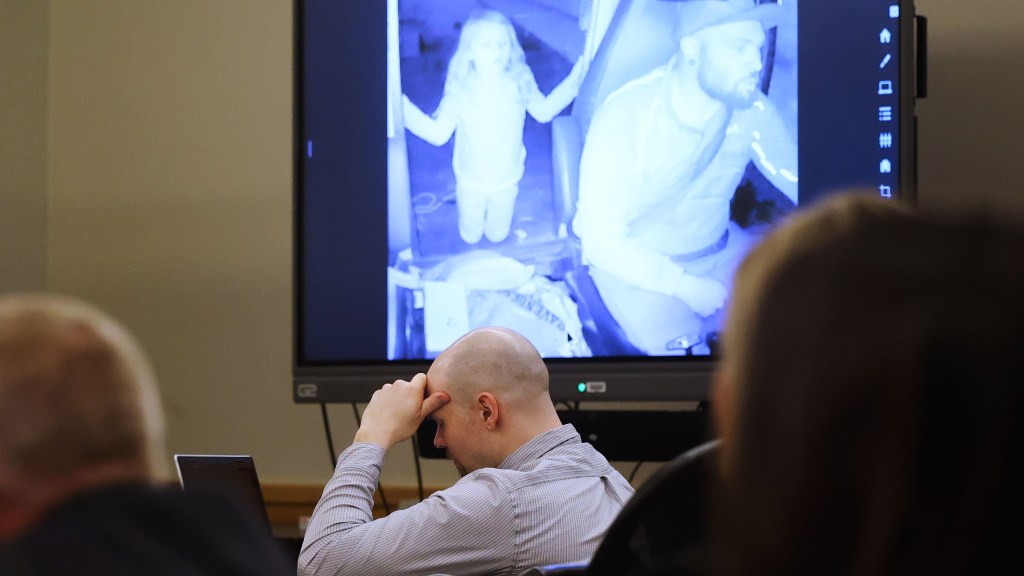
A seven-year-old girl, Athena Strand, was kidnapped and murdered in Texas by a FedEx driver, Tanner Horner, who came to her home with a delivery. He saw her, and when no one was looking, he took her.

The images from the delivery truck’s interior dash cam video are dreadful, even though the ones I’ve seen don’t show the murder itself. One in particular shows her on her knees behind him in the narrow space between the cab and the packages, small enough to be hidden there, looking over his shoulder with a face that still belonged to childhood. To me, she seems caught between confusion and trust, as though some part of her was still trying to understand whether this was strange or frightening, whether she had won an unexpected contest, and the prize was a ride in a FedEx truck, or she was actually being carried past the last safe moment of her life. Her hair, her posture, the helpless nearness to the man driving her away—it all makes the scene almost unbearable. He was taking her toward a dreadful end, and she was still too young to know how terrified she needed to be.

Horner was sentenced to death by lethal injection last week. This does not bother me. There will be time between the verdict and the needle for the kind of forgiveness that can preserve Horner through mortality and into immortality. Let’s hope that happens while understanding that such hope feels foreign to our human sense. And so, in the meantime, let the government’s sword be removed from its sheath and wielded as God has ordained (Romans 13:4), lest more monsters act on the urge to do what Horner has done.

Beyond these things, it’s stories like these that make commentary feel useless. What is there to say after all this? What sentence can bear the weight of a seven-year-old child taken while playing in her driveway? What moral observation can see clearly enough through the fog of a little girl being abducted, violated, strangled, and dumped like trash a few miles from the safety of her home? What polished paragraph can stand near her mother and father, people who’ve had to keep breathing in a world where their daughter no longer does?

Some people reach for words because silence feels a lot like surrender. Still, in certain circumstances, it feels as though human language fails us miserably because some evils are just too plain for explanation. Some things that happen don’t need analysis or interpretation. They need tears. They need the kind of groaning St. Paul says creation has been doing since the fall (Romans 8:22).

A little girl is dead. A family is shattered. A man has been condemned. And all the world’s surrounding talk feels tritely thin.

That said, I humbly suggest we let the habit carry us here. When we do—when the lens is lifted—we may not fully understand what happened, but we’ll at least see it clearly. If anything, we’ll get a sense of just how different the Christian faith is from the world’s sentiment. The Christian faith—established by the Holy Spirit through the Gospel—is incapable of pretending evil is smaller than it is. It certainly doesn’t try to convince the believer that every tragedy is secretly beautiful if we just look at it from the right angle. Personally, a little bit of crazy stirs in me when the best anyone can offer to moments like these is that everything happens for a reason.

Yeah, okay. That’s not helpful. But then again, the world is ridiculous that way.

The Word of God observes these things and calls them what they are. It sees death and calls it an enemy (1 Corinthians 15:26). It beholds murder and describes it as an act that screams to God from the ground (Genesis 4:10). It sees children and then warns against their harm, reminding ill-minded adults that their angels always see the face of the Father in heaven (Matthew 18:6 &10). It looks at dreadfulness and says God does not hold the guilty guiltless (Exodus 34:7 and Nahum 1:3).

And then, suddenly, right in the middle of all of it, it points us to a cross.

Why would it do this? Because the cross is where God shows us that He is serious about sin, death, and the devil’s awful and seemingly never-ending creativity (Hebrews 2:14-15 and 1 John 3:8). The cross doesn’t make evil less evil. It reveals how deep the evil goes. The Son of God is betrayed, mocked, beaten, condemned, and killed. Innocence is nailed to wood. The world does what the world does, and God takes all of it into Himself.

Then, on the third day, Jesus rises. That’s what matters most in situations like this. And only through the Gospel’s lens can this be seen. Only through Christ and His complete and perfect work, ultimately proven by His resurrection, can we take one more breath through moments that feel like all the earth’s oxygen suddenly dissipated into space. It has to matter in situations like this, or it doesn’t matter anywhere.

If Easter is only for clean grief and manageable sadness, it’s way too small. If the resurrection is as the world is minimally willing to consider it—a springtime metaphor—then it has nothing to say beside a child’s grave. Or, if Christ is raised merely to improve our mood, so that we can say things like, “Well, everything happens for a reason,” then He is useless in the face of real horrors.

But Christ is risen from the dead.

That means death doesn’t get the final word over Athena Strand. It doesn’t get the final word over the tears of her family. It doesn’t get the final word over the courtroom, the sentence, the headlines, or the long years of grief that remain after everyone else stops reading.

The final word belongs to the One who said, “Let the little children come to me” (Mark 10:14). It belongs to the One whose hands still bear the wounds of what human beings do to the innocent (John 20:27).

Admittedly, even those words don’t make the grief tidy. I can promise you that. I’ve never shared them at a funeral and seen all the tears suddenly dry up. But it doesn’t change the fact that they’re Gospel words, and only the Gospel truly soothes (whether or not we realize it) in moments of sadness and anger, and during times of rage. In fact, it’s the Gospel that gives  Christians permission to weep. The Lord sanctified our tears when He cried at Lazarus’s tomb (John 11:33-36). The Gospel reminds Christians that they are also allowed to want justice (Psalm 10:17-18 and Revelation 6:10). And while doing so, the Gospel calls for Christians to know they are more than permitted to cry out in the face of this world’s atrocities, “How long, O Lord?” (Psalm 13:1 and Revelation 6:10).

God gave us those words because He knew we’d need them. They’re meant to be spoken often. Indeed, they make for a good habit of words—the kind we need when it feels like there isn’t anything worth saying. Because often, there just isn’t.

And so, the Church’s habits emerge from God’s Word. We pray. We confess. We sing. We gather. We speak the Creed. We hear the Word. We eat and drink the body and blood of Christ. We bury our dead in hope. We say “Lord, have mercy” when there’s nothing left to say in the presence of grief.

Considering the story I shared, the only thing left worth saying is Lord, have mercy on Athena’s family. Lord, bring justice to the wicked. Lord, protect the little ones. Lord, grant us faith to hold fast to you, even as you hold fast to us. And Lord, please, come quickly (Revelation 22:20).

No Right to Complain If You Don’t Engage

A few years back, maybe six or seven years ago, a member here at Our Savior (or, I should say, former member) approached me to let me know in his passive-aggressive way that my friend Charlie Kirk had been listed in the Southern Poverty Law Center’s “Extremist Files.” In response, I gleefully pointed out that while Charlie himself had not yet received such a badge of honor, his organization, TPUSA, had indeed made SPLC’s “Hate Map” as an “anti-government extremist group.”

That particular conversation, like so many with him before it, did not end well, especially since I implied that being targeted by the SPLC, a group that claims to fight racial hatred, could be a good thing.

But I meant every word.

I wonder what my former friend’s thoughts are now that the SPLC’s guts have been exposed. Although I may be getting a little ahead of myself. Have you even heard the news?

If not, the essentials are that the Department of Justice leveled three charges against the SPLC, namely, wire fraud, making false statements, and conspiracy to commit money laundering. It seems that between 2014 and 2023, the SPLC’s leadership secretly funneled more than $3 million in donor money to racist extremist groups, most notably, the Ku Klux Klan, as well as other neo-Nazi groups. I just read some of Todd Blanche’s comments on the situation. He’s the acting Attorney General. In summary, he put it rather bluntly, saying the SPLC was “manufacturing racism to justify its existence.”

I tried not to laugh when I read his words. Most reasonable people who’ve ever crossed paths with the SPLC already knew that. Charlie certainly did. That’s because it’s an easily discernible M.O. for most of the groups out there claiming to fight racial inequality. In fact, it’s written into the DNA of almost any progressive protest you see on the news. From BLM to “No Kings” to LGBTQ, Inc., the only way these groups have managed to stay in business is to ensure that the “hatred” angle relative to their particular organization’s needs persists. And so, that’s what they do. They foment rage.

I wouldn’t be surprised if we learn that other organizations, like the ones I’ve named, have been doing the same thing the SPLC has been doing. Of course, the SPLC denies the charges. Still, it’s not looking good for them. It’s becoming undeniably plain that the SPLC, which raised money by warning Americans about hate, was shelling out major cash to keep the machinery of hate in motion.

Wow. Shocking.

As I said before, most reasonable people already knew the SPLC to be less a sober civil-rights watchdog and more a moral-licensing agency. It has always acted with an assumed authority to decide who was hateful, who was dangerous, who belonged on the outside of acceptable society, and perhaps worst of all, who needed to be marked for public suspicion, all toward the goal of organic cancellation. Of course, to remain somewhat veritable, the usual suspects, like the KKK, were tagged. In the meantime, the rest of SLPC’s cash was being spent tagging and fighting against Christians, conservatives, and a whole host of ordinary people who held unfashionable views about marriage, gender, education, immigration, or religious liberty.

I suppose that’s what happens when an organization discovers that condemnation can become a business model. The more standards it can create and identify as hate, the more necessary it becomes to fight that hate. The longer its list of enemies grows—the more fear it creates—the more urgently it can ask donors for money.

But again, I say sarcastically, “Wow. Shocking.” That’s because none of this was lost on reasonable people—or at least the people paying attention. And I don’t offer those words lightly, especially to the folks here in Michigan. There’s an angle to this that requires some attention because it lands very close to home.

Jocelyn Benson, Michigan’s current Secretary of State and a candidate for governor, served on the SPLC board during the time period covered by the indictment. She was named to the board of directors in 2014. Her campaign has publicly confirmed that she served for four years. That does not, by itself, prove what she knew or when she knew it. Still, the indictment accuses leadership. That includes the board.

I suppose one thought here is that if someone seeks the governorship of Michigan, then that person’s associations and moral discernment should matter. I’m the Executive Director for an organization. My role exists alongside a board of directors. That board isn’t a ceremonial thing. It exists for governance. It exists for accountability. It exists to understand the organization’s mission, finances, and a whole host of other matters that help ensure the effort is acting faithfully and lawfully.

Now, having said all this, a seemingly random thought must be considered.

Not long after that image of Trump was shared—the one in which he looked an awful lot like Jesus stretching out his hand to heal someone—I read plentiful commentary from fellow Christians on social media saying things like, “This is exactly why Christians need to stay out of politics. The separation of Church and State!”

I get the aversion to the image. Regardless of Trump’s wobbly explanation, it was ridiculous. But it’s precisely because Christians have adopted that kind of retreat that organizations like the SPLC continue to get as far as they do. Yes, there are foolish and cringeworthy things that our elected officials do in the public square. But the answer to these things is never political indifference, or worse, monasticism. It’s never to leave the arena, leaving the gates open, and allowing the lions to feast on whatever they prefer.

It’s true, the government is not the Church. It cannot preach the Gospel, administer the Sacraments, or forgive sins. It cannot make Christians. Only Christ does that through the means He has established. But the government is still Christ’s servant for earthly order (Romans 13:1–4). It is still given to punish evil and protect the neighbor. And when people who hate Christ, hate His design, hate His Word, and hate anyone who confesses His truth, are the only ones willing to enter the public square, willfully disengaged Christians should not complain when the public square becomes hostile to the things of God.

On the contrary, Christians must get in the game and push back. At a minimum, that means Christians cannot shrug at elections. Even more importantly, we cannot simply vote for president while neglecting the midterms, or worse, our local elections. In fact, I’d be willing to say that the folks in charge of the local library or the people elected to your local school board matter more than anyone may realize. Even there, a Christian cannot pretend that a candidate’s beliefs and alliances will have no bearing on our lives. They do, and in the most immediately impactful ways. A school board candidate who sat on the board for an organization that believes 2 plus 2 equals 7 is not someone you want spearheading a community’s educational efforts.

And yet, concerning even greater, more life-altering things, there remain those Christians who sprinkle so foolishly across social media, “Stay out of it! God will handle it!” Those Christians absolutely own the blame when their community’s children cannot do simple math.

Yes, God will handle it. He’ll handle it through your vocation as a citizen, upholding your God-given responsibilities (Jeremiah 29:7 and Matthew 22:21). He’ll bless His world through your faithfulness, which is already something He works in us by the power of the Holy Spirit for faith. We’re already inclined to do what He wants. When we vote, we’ll be inclined to seek candidates who most closely align with Him and His Word.

In this day and age, that pretty much means choosing leaders who protect life, embrace natural law, honor the family, respect religious liberty, and understand the limits of government in light of Two Kingdoms theology.

By the way, Christians engage in the process, recognizing that no candidate will be perfect. No election will usher in the kingdom of God. And anyone who believes these things has lost grip on what the Word of God teaches. For those who hold to God’s Word, they’ll know, by faith, that Christ has already won the victory that no ballot can win (1 Corinthians 15:57 and Colossians 2:15). He lives and reigns now, and His kingdom will have no end (Luke 1:33).

They’ll also know that until He returns, we live here. We serve our neighbors here. We raise our children here. We confess the truth here. And part of that earthly calling is to engage in the public square in ways that not only protect what’s Godly, but also to act with wisdom to preserve it. One of the most powerful ways to do that is in the voting booth.

So, returning somewhat to where I began, I’d encourage you to pay attention. Do some reading. Don’t skim. Read. This is an important way to measure candidates against the Christian Faith, namely, the Word of God. Campaign slogans won’t tell you anything. Not anything of real value, that is. Most would never have learned about Jocelyn Benson’s association with the SPLC had certain folks not dug deeper and written in ways that exposed it.

Read up on it. Also, study the candidates’ voting records. Read their speeches. Look into their associations. Doing even these things, it won’t be hard to figure out who’s who.

Then, as a Christian, take that “who’s who” stuff into the voting booth and flex the muscle of your responsibility. Because if you can, but don’t, as I said before, you have no reason to complain.