Easter 2026

Last night’s Easter Vigil service here at Our Savior was, as always, extraordinary. For one, most of the service occurs in the dark. No lights. Only candles. Until a particular moment. Then, there’s nothing quite like having gone nearly nine weeks without speaking the word “Alleluia,” as is the tradition for the churches embracing the better traditions, when suddenly, after the Gospel Proclamation “Christ is risen!”, all of the lights come on in a blaring flash as the congregation shouts, “He is risen, indeed! Alleluia!”

It’s a splendid moment, to be sure, adorned with Christian hymnody, as the congregation continues directly—powerfully—into the Hymn of Praise, singing, “This is the feast of victory for our God!”

And yet, what is it that makes the moment so arresting? I think part of it is located in the Church’s historic wisdom, in the sense that worshippers are meant to experience the very real contrast between darkness and light. And maybe even mourning silence and jubilant song. It’s so startling that it’s hard to ignore.

Although I suppose it isn’t just these contrasts. I think, in the Church’s wisdom, she grew to understand, through the centuries, the weight of what was carried during the days before the Resurrection vigil. That first Alleluia, after weeks of somber reflection, doesn’t return cheaply. It’s not like it’s merely added back into the service. We certainly don’t just stumble upon it. It has literally been buried—intentionally silenced—because the Church has spent her time walking in solemnity with Christ to the cross. In that moment when the lights come on, and the Christians shout “Alleluia,” we understand that the absence has done its work. It has trained the heart to actually sense the cost of our redemption.

In other words, even during the Easter celebration, we don’t lose sight of what sits at the heart of our confession. Good Friday lingers behind every note. The echo of the hammer, the finality of “It is finished,” the stillness of a tomb sealed and guarded—all of it locks arms with the Easter proclamation. Which, again, I’m guessing, is precisely why the joy is not thin, nor is it merely sentimental. It’s a sense, maybe even a microscopic taste, of joy that has passed through death and come out the other side carrying something indestructible. When the lights blaze on, and the Alleluias return, they do so as defiance to sin, death, and all of hell’s battalions.

Jesus won. They lost. There’s the proof—a living, breathing Jesus. My Jesus. Alleluia!

I won’t speak for the folks who attend our Easter Vigil service, but for me, it’s not some sort of reenactment or merely a highly liturgical remembrance. It’s more of a participation. I’m not even a spectator to what I’m seeing. I’m a direct recipient of the Resurrection’s ongoing reality. Because of Christ’s Easter victory, sin not only lost, but it can never have the last word. Death and hell not only lost, but they no longer have a final claim on me—on any believer! The grave was not the end of the story for Christ, and therefore it isn’t for those who are in Him.

I suppose that’s why the joy feels almost too large for the room where it all happened last night. And if you’ve ever been to Our Savior in Hartland, it’s a big, wonderful space. Still, no matter how many are in attendance at the Vigil, the joy spills over into the kind of thunderous song I’m willing to bet leaves the devil without question. When the Vigil bunch starts singing, the old evil foe knows for certain that his house has been ransacked, that what was lost has been found, and more than found—redeemed and restored.

Admittedly, when it comes to the emotion of it all, there’s no earthly Good Friday or Easter service that will match the scale of what Christ accomplished. And after looking back at everything I just wrote, I should be careful to mention one more thing—something I already made a point of clarifying during the Good Friday Tre Ore service.

Keep in mind, no matter the century, the goal of genuine Christian worship has never been about making you feel something. At least, not worship born from a biblical understanding. That’s partly because genuine Christian worship doesn’t begin with you—with what you do for God. It approaches God with empty hands extended, knowing there’s nothing we can bring into worship that He needs, but instead, we need everything He can give.

I like how Rev. Dr. Norman Nagel explained it in the Introduction to Lutheran Worship, the LCMS’s hymnal prior to Lutheran Service Book. He wrote so crisply: “Our Lord speaks, and we listen. His Word bestows what it says. Faith that is born from what is heard acknowledges the gifts received with eager thankfulness and praise. … Saying back to Him what He has said to us, we repeat what is most true and sure. … The rhythm of our worship is from Him to us, and then from us back to Him. He gives His gifts, and together we receive and extol them” (LW, p. 6).

Unfortunately, many churches have it the other way around, inevitably falling into a trap. And when they do, they lose sight of something important. The goal of worship is always to deliver something: Christ for you, crucified and risen! This happens through a Law and Gospel message that establishes the need and then delivers the means to overcome it! They’re means that are placed into ears by the preached Word, and into our mouths by the Lord’s very body and blood, given and shed for the forgiveness of sins.

When this is our understanding of worship, that it’s about God serving us, rather than the other way around—not from the moment’s emotion, but from the divine means; not from what we bring into the space, but from what He gives objectively, concretely, outside of us—when this is the understanding, Christian joy holds. It holds even when the lights go out again, we get into our cars and drive home, and the alleluias fade into the ordinary days that follow Easter’s exceptional festivities.

And so, with that, I pray the Lord’s blessings upon you and yours as you celebrate this wonderful day. May it be for you a day of days, one that fills you to the brim with Christ’s merciful love. It was a hard-fought fight. But it wasn’t hopeless. Again, there He is. He is risen! He is risen, indeed! Alleluia!

Good Friday 2026

Here at Our Savior in Hartland, we spend Holy Monday, Holy Tuesday, and Holy Wednesday making our way through John 12:20-50. The context of the reading is Palm Sunday. It’s the Lord’s immediate beginnings in the temple after He entered the city to fast-fleeting fanfare. He’s there teaching.

We handle the reading in sections. Monday considers verses 20-36. Tuesday, we hear 37-43. On Wednesday, we digest 44-50. I’ve been doing it this way for a while. It works, if only because the Lord’s words here are wonderfully bottomless. And their point? His truest glory. His death on the cross for sinners.

Right now, I’m thinking about Tuesday’s reading. It ended with John telling us, almost in passing, that “many even of the authorities believed in Him, but for fear of the Pharisees they did not confess it, so that they would not be put out of the synagogue; for they loved the glory that comes from man more than the glory that comes from God” (vv. 42-43).

As a pastor, those words are familiar. I’m not trying to be negative. However, the plain truth is that there is a kind of belief that teeters dangerously at the edge of unbelief. John more or less describes it as the kind that never quite finds its voice, but instead, stays hidden. His words are a passing indictment of something that’s far more dangerous than we may realize.

Most often, we might assume things like open hostility to God’s Word or flat-out rebellion against this or that are the real dangers leading to unbelief. Maybe they’re the worst of the bunch. But they’re not the only pavers on the path to destruction. Some are much subtler. Here, John references the deadly nature of self-preserving hesitation. He describes the kind of faith that remains hidden because it’ll cost too much if it’s seen.

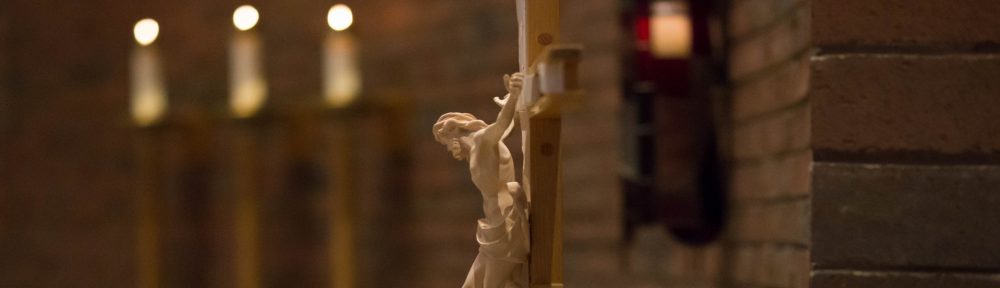
Today is Good Friday. Good Friday presses directly into that space. That’s because, regardless of those in the churches who’d prefer to keep the crucifixes hidden because they seem offensive, the fact is, the cross doesn’t allow for a private allegiance. It doesn’t leave room for a faith that exists only in the interior life, safely insulated from consequence. The crucifixion of Jesus was public. It was out in the open and very public.

That’s right where it belonged, making it, in every sense of the word, costly.

I think that’s the real reason some churches, even some here in my neighborhood, shrink from displaying crosses in their buildings—and why they jump from Palm Sunday straight to Easter, without even the slightest glance toward Good Friday. It’s not that they don’t believe. I won’t go that far. John was clear. They did believe. Something in them knew and recognized the Savior. Something in them was drawn to Him. But belief—the kind refusing to confess the glory Jesus had been describing all along—it began to bend. It began to accommodate. It learned how to survive without ever having to embrace Christ entirely. It might not be unbelief, but it’s really darn close.

“They loved the glory that comes from man more than the glory that comes from God.”

That’s the fault line right there. And it should sound familiar. It describes competing loves, and we all know that sensation. Jesus warned against this in the Sermon on the Mount. He preached, “No one can serve two masters, for either he will hate the one and love the other, or he will be devoted to the one and despise the other” (Matthew 6:24).

But what does this look like in a practical sense? I already mentioned the churches near me that have openly expressed disdain for displaying crosses, one in particular having been quoted in a local newspaper a few years back. For the rest of us, the reasons are not far removed. Christ takes a back seat to the desire to be thought well of. He’s pushed aside by the instinct to remain inside the popular circle. We do quiet calculations that weigh what faithfulness might cost against what acceptance provides. And when those scales tip—even just a little—keeping quiet about our faith in Jesus begins to feel reasonable, or in certain circumstances, maybe even necessary.

“If they know, I’ll never get the promotion.”

Good Friday weeps over this reasoning even as it refuses to let it stand. Because on this day, the One in whom they believed is no longer teaching in parables or confounding His critics in the temple courts. He’s lifted up in the open. He’s stripped of all dignity before the crowds. He’s nailed to wood while the masses mock Him. He’s cast entirely from everyone and everything. He’s openly and publicly rejected by every man-made structure this world uses to define belonging. Indeed, it is as Isaiah foretold: “He was despised and rejected by men, a man of sorrows and acquainted with grief; and as one from whom men hide their faces he was despised, and we esteemed him not” (Isaiah 53:3).

I know it couldn’t have been an easy scene. Of course some people hid their eyes from it. But that doesn’t change the fact that the crucifixion of Jesus was the “hour for the Son of Man to be glorified” (John 12:23), and that according to that hour, as Jesus continued, “And I, when I am lifted up from the earth, will draw all people to myself” (v. 32). John explains, “He said this to show by what kind of death He was going to die” (v. 33).

The Christian Church has no more important day than today. Yes, the Resurrection is crucial. But in a sense, it’s proof of today’s significance. The crucifixion of Jesus is the moment of moments for the Christian faith. It’s where the Son of God exacted what was necessary for your salvation. And in that moment, every believer, open or hidden, is forced to reckon with something the world will never embrace. Behold what the Christian faith finds so beautiful! The death of God’s Son for me!

The devil hates everything about the crucifixion, most importantly, what it earned for us. He’d love for it to become something we avoid, interpreting it as little more than jewelry-worthy while, at the same time, convincing us to prefer a version of faith that never disrupts our place in the world.

As is often the case, the Bible provides real-life examples so we know better. John 12 is just such an example. Some of the Jewish authorities believed, but they stopped short of faith’s confession. And in stopping short, they forfeited something essential. Because faith that never speaks or moves or risks anything—it almost always conforms to the very pressures it fears. It becomes quiet enough to coexist. It remains safe enough to go unnoticed and, as a result, steps away from Christ’s insistence that believers have been recreated by faith as salt of the earth and lights in the world. Christ would have us as recognizable conduits—a means for the unbelieving world to see and meet Him and, ultimately, give glory to the Father in heaven (Matthew 5:13-16).

Good Friday stands entirely against the kind of belief John described—the kind that’s weak enough to disappear in every crowd. Again, John doesn’t scold it in his account. He simply presents it as a dangerous reality that we shouldn’t ignore, if only because the One preaching in the temple at that moment didn’t remain hidden to preserve His standing. He didn’t adjust His mission to avoid trouble. He embraced the hour of true glory—His death for sinners. And lest you doubt what I’ve said about the hour of His glorification being His death, read our Lord’s passionate announcement in verse 27: “Now is my soul troubled. And what shall I say? ‘Father, save me from this hour’? But for this purpose I have come to this hour.”

I suppose part of my point this morning is to invite you to step a little closer to the Lord’s hour. Go to church today. Make time—not as a formality, or as an obligation squeezed into an already crowded day—but as a deliberate act of open alignment. Ask your boss. Invite a friend. Make time and go to the place where so many others in your church family are going, a place where the cross is not background noise, but the central reality of the faith we are to live before others each and every day.

Today—especially today—go! Refuse to remain at a distance from what stands at the center of history. The intense Gospel rendering of this day strips away the lesser things you’re prone to holding onto, even the ridiculously simple things like the need for approval, the fear of exclusion, or the quiet compromises you’ve made to keep everything around you safely intact.

Let Good Friday interrupt you and give you something better. Let it press on you. Let it ask more of you than is comfortable. Let it show you more than what you’re willing to see.

If you don’t have a church home, or your church does not offer Good Friday services, I’m sorry. Rest assured, you’re welcome to join us here at Our Savior in Hartland. Our first Good Friday service, Tre Ore, is at 1:00 PM. The next, Tenebrae, is at 6:30 PM. I’m preaching at the 1:00 service. Our headmaster, Pastor Scheer, so graciously offered to help by preaching at the 6:30 PM service. Attending either or both, I promise you’ll be blessed with all that’s necessary for a faith that can stretch its legs beyond the borders of anything this world might call belonging.

Ash Wednesday 2026

The Church now stands at the threshold of one of her most searching seasons. Lent is not just another stretch of the calendar. In fact, if ever there was a Church season that could see through the masks we wear all year long, it’s Lent. It’s a season that presses upon us who we really are. In that sense, it’s recalibrating. It calls us back to better clarity.

But first, Ash Wednesday, the gateway into Lent.

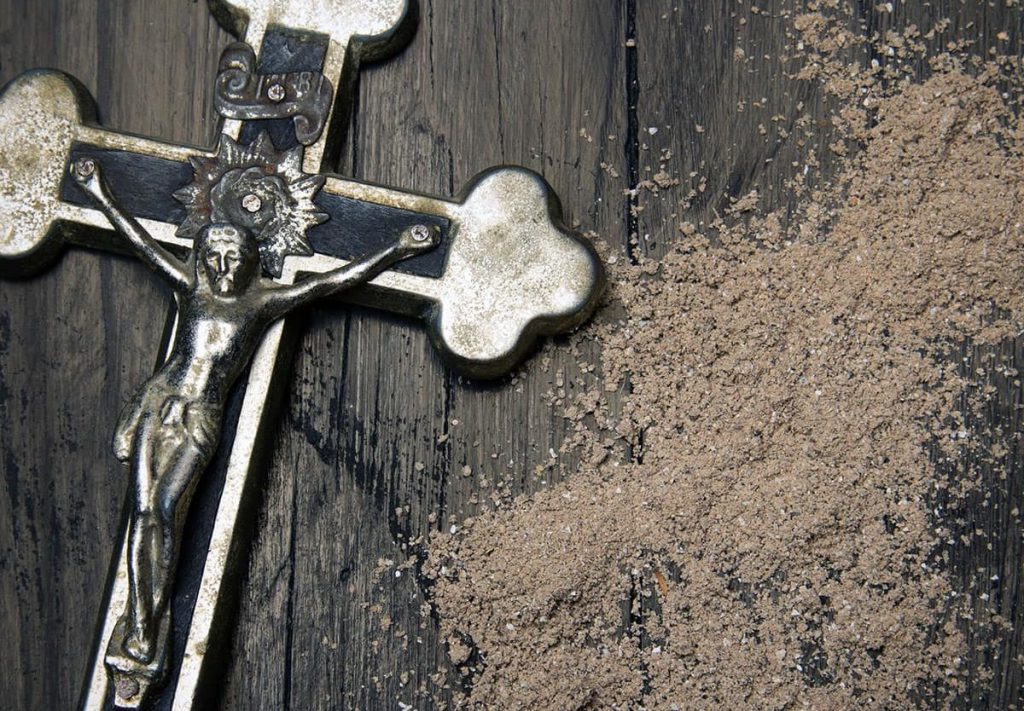
In Ash Wednesday’s solemn liturgy, cooled cinders are placed upon our foreheads—the remains of what fire has consumed, the residue of destruction. As they’re smeared, you are told, “Remember that you are dust, and to dust you shall return.” This is the biblical origin of the philosophers’ ancient phrase “Memento mori”—remember that you must die.

If, for some reason, you miss these words, rest assured, the ashes themselves will preach them. They are rough to the touch, pitch black, and stubborn to remove. They insist that death is no abstraction. It is the wage of sin, and it leaves its mark on every human life. There is nothing delicate about it. It is brutal consequence.

If you’ve ever stood in line to receive those ashes, then perhaps you already know the quiet gravity of it. One person steps forward, then another, and then another, until at last it’s your turn. You are dust. Memento mori. Each of us must face the same end. Each of us must reckon with the same truth. The Divine finger of God’s unalterable Law presses heavily against our hearts, corralling us into the fellowship of Adam, who heard God say through him to all of us, because of what we’ve done, “cursed is the ground because of you” (Genesis 3:17).

And yet, there is something else to know in these moments. Pay attention. If possible, watch the finger applying the ashes. If you can’t see it, look around you. See the same mark you bear being borne by everyone else around you. The mark is in the form of a cross. However uneven the lines may be, that shape is unmistakable.

See that mark and know you are a child of promise. Yes, memento mori. But also, memento Christus—remember Christ! You were claimed by the One who has entered death and overcome it. The cross traced in ashes declares that the end of Man is not the end of Christ, and therefore it is not the end of those who belong to Him.

Scripture teaches that we carry in our bodies not only the death of Jesus but also His life (2 Corinthians 4:10-11). His death was no defeat. On the contrary, it was the death of death itself. By His resurrection, the grave has lost its dominion, and its sting has been taken away (1 Corinthians 15:54-57). We are children of that promise!

Regardless of how other churches prefer to enter into Lent, this is how Our Savior Evangelical Lutheran Church and School in Hartland, Michigan, begins it. We keep Ash Wednesday. We need the reminder. Left to ourselves, we grow comfortable. We begin to imagine that life in this fallen world is stable, predictable, maybe even secure. Ash Wednesday strips away those illusions. It teaches us to see clearly what sin has wrought, and at the same time it directs us to the only refuge that endures—to Christ, who has entered the darkness and shattered it from within.

And then we go forth into the season. We meet the great struggle at the heart of our redemption. The contest between Christ and death will appear, for a time, to be no contest at all. Our Lord will be mocked, beaten, scourged, and crucified. He will yield Himself fully into the hands of His enemies. To every earthly calculation, it will look like utter ruin.

Yet that is precisely where the victory is won. And we will receive it as it truly is, even when it appears weak or foolish by the world’s measure. We know it’s a kingdom established by a crucified King.

The cross, in all its horror, stands at the center of the Gospel. It is harsh to behold, and yet it is good—profoundly good—because there the Son of God bore the sin of the world and reconciled us to the Father. And so, Saint Paul writes with fervor, “We preach Christ crucified” (1 Corinthians 1:23). Indeed, we do, and without shame. The Gospel is and remains the power of God unto salvation for all who believe (Romans 1:16-17).

For all of these reasons, I encourage you, if you’ve never attended the Ash Wednesday liturgy, make the effort to do so. Receive the ashes. Hear the Word. Begin the Lenten journey as the Church has long begun it—with repentance, with sobriety, and with hope fixed firmly on Christ.

Here at Our Savior, we’ll gather on Ash Wednesday for worship at 8:10 a.m. and then again at 6:30 p.m. You are welcome to come. Indeed, join with the faithful. Be reminded of life’s frailty, and—far more importantly—to hear again the promise of the One who said, “I am the resurrection and the life. Whoever believes in Me, though he die, yet shall he live” (John 11:25-26).

New Year’s Day 2026

I wasn’t going to write and send anything out today. But then, here I am at my computer, tapping away. This morning’s worship service isn’t until 10:00 a.m., and so, apart from other preparations, I guess I do have some time. Besides, it felt wrong not to reach out and at least share something that might help with your first day of 2026.

I suppose I can start by telling you that the first words out of my mouth when I woke up this morning were a prayer of thanksgiving. I thanked the Lord for my family. I thanked the Lord for the congregation I serve. I thanked the Lord for all the blessings He has granted to me—both known and unknown in my past, present, and future. Then I got up, took a shower, got dressed, and headed out into the familiar but unpleasant Michigan tundra.

Waking up and praying is always a good way to start one’s day. But my first meal, that was something else. Despite my secret intentions for the new year, which is to try eating better, the first thing I consumed was a greasy hashbrown from McDonald’s at 5:55 a.m., followed later by my usual bowl of cereal here at my desk. Most mornings, a bowl of cereal in my office is part of my routine before I get started on anything else. But I don’t usually eat McDonald’s hashbrowns. However, I saw that the Hartland McDonald’s was open, so I stopped for coffee. The hashbrown sounded good. With that, I slid backward in my intentions before I even got started. So much for a perfect start. Well, we win some and lose some. Although anyone who thinks personal growth means instant consistency has never tried to live faithfully for more than a few hours at a time. Saint Paul understood this well when he spoke of the conflict within us—the desire to do what is good, set against the pull of the flesh that resists it (Romans 7:15-19).

And yet, Paul’s point isn’t perfection. It is a right knowledge combined with willful direction. It is choosing, again and again, to fight against the worst desires and to embrace the better ones. Paul writes that the flesh and the Spirit are opposed to one another. (Galatians 5:16-17). He doesn’t share this critical detail so we can excuse our failures. He wants us to be aware. Awareness allows for preparation and action. For starters, it grants that the Christian life is not the absence of temptation, but the daily, often quiet decision to walk by the Spirit rather than surrender to what comes most naturally. When, by the power of the Holy Spirit, we’re aware of the sinner/saint struggle, we can embrace prayer before complaint. We can lean toward obedience before personal comfort. We can know to do the better thing even when we don’t feel like doing anything at all. I suppose in one sense, sometimes faithfulness looks less like complete victory and more like simply showing up and trying, all by God’s grace, of course (Romans 8:1-4).

It is also worth remembering that even this willingness—to try, to lean in, to turn toward what’s better—it’s not something we manufacture. Again, it’s the Holy Spirit who creates willing hearts. And He does so by the Gospel (Philippians 2:13, Romans 10:17).

Now, you know what I’m going to say next, don’t you? Well, since you already know, I won’t dress it up.

Go to church. Being present where the Gospel gifts are given matters more than anything else at any time of any given year. God has promised to strengthen and sustain His people through His visible and verbal Word. That means if one really wants to step in and fight the flesh, being where Christ is preached and His gifts are administered should not be a second thought but a priority all year long (Hebrews 10:24-25).

So, if your year has already begun imperfectly, take heart. The only flawless beginning or ending we require is securely located in Jesus Christ, the crucified and risen Savior. By His person and work, the perfection that saves was accomplished. Through faith in Him, by the power of the Holy Spirit at work through the Gospel, our hearts are recrafted to trust Him, and thereby to receive the merits of His incredible work.

And then into the daily struggle we go. As we do, we remember that while the outer self may scrap against the sin-nature, God is at work within us, shaping endurance, humility, and hope right there in the middle of the fight (2 Corinthians 4:16). Indeed, “it is God who works in you, both to will and to work for his good pleasure” (Philippians 2:13).

With that, I encourage you not to become downhearted in the new year when you fall short. Remember, an all-important muscle in the struggle is repentance itself. Keep choosing the better things. Keep turning toward what’s good. And when you stumble, don’t quit. Repent, receive Christ’s forgiveness, and then rise and keep going, mindful of the divine encouragement, “Let us not grow weary of doing good, for in due season we will reap, if we do not give up” (Galatians 6:9).

I’m praying for you. I trust you’ll be praying for me, too.

A blessed New Year to you!

New Year’s Eve 2025

I don’t know about you, but the older I get, the more New Year’s Eve loses its luster. It feels less like a party and more like a bedtime challenge. Can I make it to midnight? Can I even make it past 9:30? I think William Vaughn said it best, “Youth is when you’re allowed to stay up late on New Year’s Eve. Middle age is when you’re forced to.”

For the record, I stopped trying for midnight years ago, especially with a worship service in the morning. Still, the moment has never been lost on me. New Year’s Eve—the day itself—has always been a moment to pause. It can be sort of a held breath between what was and what will be, if only we’ll take the opportunity to consider it. Right now, I’m sitting at my dining room table. Even with a quick glance around the room, I’m reminded of just how quickly things can change.

For example, right across from where I’m sitting, a poster-sized photo hangs on the wall. Jennifer snapped the picture. Essentially, she captured a moment we can never revisit.

The photo was taken on a beautiful, sun-washed day at a beachside restaurant near Lemon Bay, Florida—one we visited with some relatively newfound friends at the time who knew the place and loved it. In the image, there’s a wooden post planted in the sand with forty or so signs nailed to it, each pointing somewhere else—cities across the United States, and a few beyond its borders, all measured in miles from that very spot. A bird is perched on one of the top signs, palled by a nearby palm tree’s shadow. It’s as if the bird’s deciding which of the cities he’ll choose to visit next. The sky is bright blue, interrupted only by a handful of clouds. Everything about the picture feels calm, steady, and permanent.

But permanence is a lie we tell ourselves when the sun is shining and things are easy. Hurricane Ian erased everything in that photo back in 2022. The sign, the restaurant, the familiar stretch of beach, it was all pretty much gone overnight. It was reduced to ocean-soaked debris and memory.

That said, I can promise you, the Thoma family loves the image all the more, if only because everything in it is gone. In a way, it’s not just a photograph for us anymore. It’s a reminder that certain moments don’t ask our permission before they become history. We will never stand there again. We will never see that post in the sand exactly as it was. We’ll never be able to visit that restaurant and relive that moment.

New Year’s Eve has a way of turning our attention toward that same kind of truth. We look back at the year behind us and realize how much of it has vanished without much ceremony. I think of my dear Christian friend, Alex Bak, who died just before Christmas. We had recent conversations together that I never suspected would be our last. Like the signs near the beachfront restaurant, I lived as though Alex would always be there. I just assumed I’d always see Alex sitting in his same pew near the post on the pulpit side of the church’s nave. Indeed, plenty of other things have happened all around me that felt ordinary at the time but now feel sacred because they’re gone.

I suppose the point I’m trying to make is that time moves forward with or without my consent. The clock ticks with absolute indifference to my nostalgia.

But I have an upper hand on the clock’s cruelty. As a Christian, I know Christ is present in every moment. “Behold,” He said, “I am with you always, to the end of the age” (Matthew 28:20).

Everything we love in this world is fragile. I’ve been known to say from the pulpit from time to time that everything has an expiration date. Everything is subject to wind, water, decay, and time. But the thing is, Christ stands right in the middle of the storms. He’s a fixed anchor right in the middle of all our victories and losses. He’s unshaken and unchanging. He does not promise that the signposts will remain standing. He doesn’t promise that the forthcoming year and its moments will be gentle. But He does promise Himself. And with that promise comes the impenetrable truth of a kingdom that cannot be washed away, grasped by a hope-filled strength that does not weaken or erode.

So as 2025 becomes 2026, just as I won’t cling to the misapprehension that I can stay up until midnight, I won’t hold to the illusion that the coming year will somehow be free from struggle or loss. Time has cured me of that naiveté. There will be storms I didn’t see coming, moments I assumed would last that didn’t, and conversations I didn’t realize were final until they already were. But those potential realities are not hollow or hopeless when viewed through the lens of the Gospel. The calendar can change all it wants. Christ remains the same—yesterday, today, and forever (Hebrews 13:8).

Indeed, the world may lose its landmarks. Favorite places and moments may disappear into the Gulf, maybe even becoming portraits on our dining room walls. But in the middle of all of it, the cross still stands, unmoved by this world’s winds and waves, untouched by time’s inevitable erosion. And that’s enough for me. I have everything I need in Jesus, which means I’ll have everything I need in 2026. My prayer is that He’ll be enough for you in the new year, too.

By the way, if your church doesn’t offer a New Year’s Eve service, stop by Our Savior Evangelical Lutheran Church in Hartland, Michigan. Ours is at 4:30 pm. For the record, I’ve never met anyone who was disappointed they went to church on New Year’s Eve.