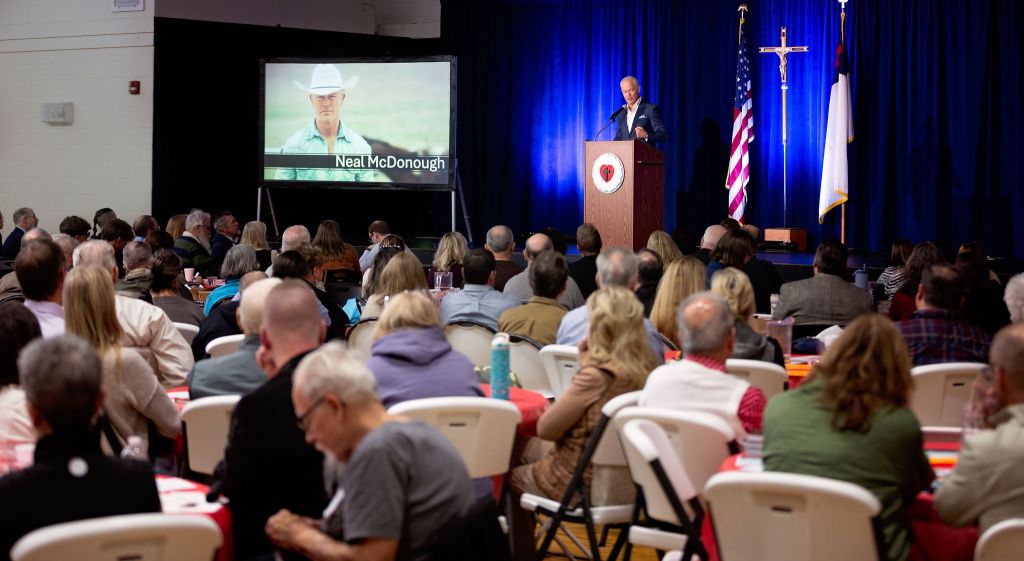
As is always the case in mid-October, I’m required to attend an English District regional conference. It just wrapped up this past Wednesday in Fort Wayne, Indiana. The goal of the mandatory gathering is not only to handle regional business, but also to bring pastors and district leaders together for fellowship and learning.
Before I go in the direction I feel like going this morning, there are three contextual details you need to know. First, for those who don’t know what I mean by “English District,” you need to know that the Lutheran Church-Missouri Synod (LCMS) is divided into districts, and some districts divide themselves into regions. But unlike the Michigan District or the Northern Illinois District, the English District is non-geographical and has congregations throughout the continental United States and Canada.
That’s the second thing you need to know, the Canada part. Essentially, when we gather for business in our various regions throughout the country, it sometimes includes Canadians. In fact, for the first time in our district’s history, our Bishop, Reverend Jefferey Miskus, is Canadian.
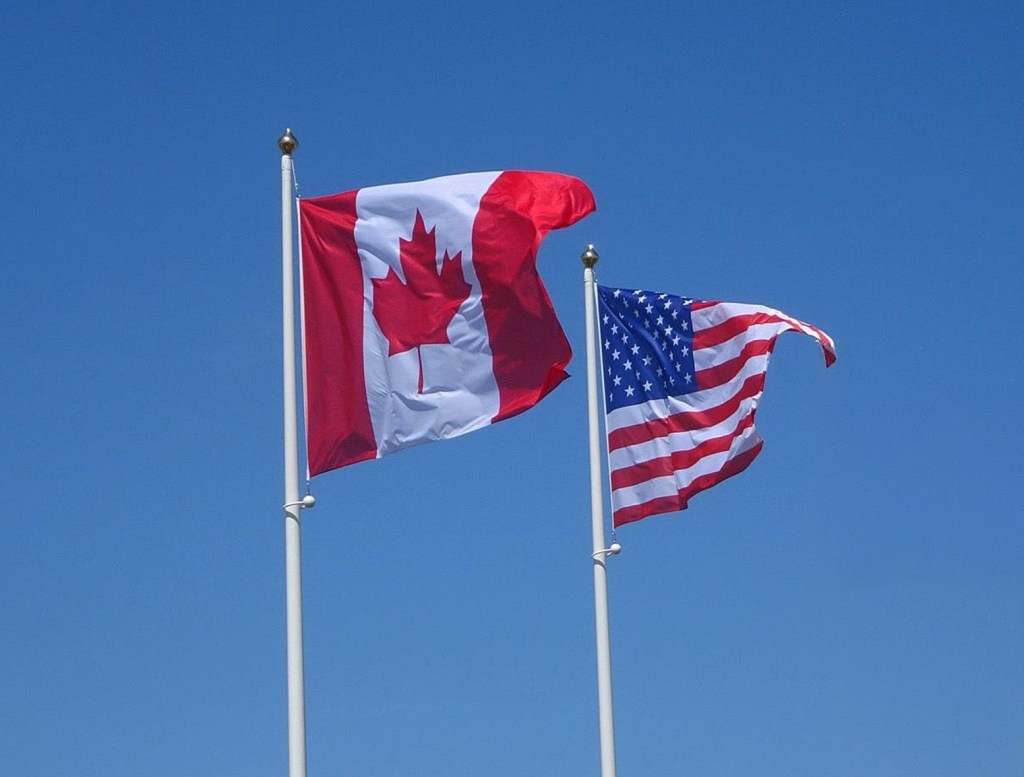
Third, and I could be wrong about this, but I think my particular regional conference is the one most of the Canadian pastors in the English District attend. Again, I could be wrong about that. Either way, it’s been our region’s practice before the first meal to pray and then to sing both the Canadian and American national anthems. And I suppose that’s where I want to go this morning.
On my part, I’ve always found this tradition interesting, especially since nearly everyone in the group sings both anthems. Notice I said “nearly everyone.” I don’t sing the Canadian anthem. I never have. I only sing the American national anthem. Of course, I stand respectfully for the Canadian anthem, but I leave any musical devotion to Canada to the Canadians.
My reason? I’m an American. I’m devoted to and love my country. Sure, I appreciate Canada. But when it comes down to it, I’m grateful to God for the extraordinary freedoms I’ve inherited on this side of the border, ones purchased and preserved at considerable cost by generations of Americans who came before me and knew liberty’s value.
Now, don’t get me wrong. I have no trouble respecting another nation’s affection for its homeland. I’m glad they do, and I admire them for it. Still, patriotism isn’t just a word to me. It actually means something. It’s definitely more than a polite gesture of putting my hand over my heart and singing along with everyone else because that’s what we do before getting down to conference business. In truth, whether I’m at one of my daughter’s volleyball games or I’m at an English District conference, when I sing our national anthem, I’m very nearly moved to tears sometimes, especially in that moment we sing “our flag was still there,” which I’ll get back to in a second.
In the meantime, when I’m singing America’s national anthem, I’m making a declaration about my homeland. I’m acknowledging its foundation and history, and I’m saying it stands above all others as best.
And I’m devoted to it in all its bestness.
Now, for the easily offended among us, nothing I’ve said should convince you that I don’t like Canadians. The first proof of this is that during breakfast on the last day of the conference, having my choice of seating in the hotel dining area, I went and sat among a group of gathered Canadians, me being the lone American at the two tables. And why wouldn’t I sit there? They’re brothers in Christ. They’re good, godly folks serving our Lord faithfully.
That said, it didn’t take long for the international diplomacy to deteriorate.
I don’t remember how it came up, but someone revisited the fact that our district bishop, who, again, is Canadian, couldn’t attend the conference because he couldn’t get into the country. Somehow, his visa had been frozen, or something like that, and no one at either table seemed to know the reasons why. Through humor’s filter, the conversation turned to border policies, with at least one in the group noting that Americans apparently have a much easier time traveling back and forth between the two countries—which was to say, somewhat tongue-in-cheek, that Canada is a much friendlier and more welcoming country than the U.S. and that its border policies were proof.
After that, someone graciously acknowledged that the United States is free to establish and enforce its own immigration policies. But then, almost immediately, another fellow remarked, again, somewhat tongue-in-cheek, that Canadians sometimes forget that “Second Canada” has its own laws.
Second Canada. I’d never heard that descriptor before.
In all fairness, the comment was probably an involuntary response to Trump’s sometimes wacky commentary about annexing and renaming this or that part of North America’s geography. Still, the way it came out, it sure seemed like there might be a longstanding joke among our northern neighbors, one suggesting that the United States is considered a sort of southern annex, or maybe a lesser province in Canada, one requiring occasional supervision from its wiser, more sophisticated older brother.
I know it was just friendly ribbing. And I chuckled a little, of course. But my patriotism got the better of me, and since I’d been handed an opportunity, I decided to return the favor.
Having just experienced the anthems side-by-side a few days prior, I reminded them that our nations’ hymns tell very different stories about who’s more capable than the other, especially when it comes to big and little brother relationships. I didn’t say it in so many words. And yet, inherent to my jab was that Canada remains safe, if only because we’re their immediate neighbor, not the other way around. Indeed, it’s silly to think that anyone would avoid attacking the U.S. out of concern for Canada. We’re definitely the big brother in the relationship, not Canada.
Again, I didn’t say it so many words. But assuming the one who made the comment got the gist of my point, I did add a little extra sauce to the conversation, making it clear that I never have and I never will sing the Canadian national anthem, if only because ours sings of the visceral courage needed to be the big brother and theirs doesn’t. Had there been appropriate room for more, I would’ve given the history. I would’ve said that Francis Scott Key wrote our anthem after witnessing the British bombardment of Fort McHenry during the War of 1812. I would’ve told them about what our anthem actually describes. It speaks of rockets streaking through darkness and bombs exploding over us during an attack. I might’ve posed the rhetorical question inherent to our nation’s hymn, which was whether the Americans had what it took to win the day, let alone survive, or whether the American flag would even be flying when morning came.
But the American anthem sings with great vigor, essentially, “There it is! The flag still stands.” Which also means the patriots defending that flag were still standing, too. In other words, yes, they had what it took. And lest anyone forget, listen to our anthem and know we still do.
In short, our anthem remembers a nation enduring the violence of war and emerging with its liberty intact. Its whole point is to remind every generation across the globe that freedom requires courage, vigilance, and occasionally, tremendous sacrifice.
Now, consider Canada’s anthem.
It’s a pleasant and flowery song. It speaks of patriotic love and glowing hearts. It even asks God to keep Canada glorious and free. That’s commendable, especially the reference to God. However, there’s a rather obvious difference between America’s and Canada’s anthems. Ours recalls the very real cost of defending liberty. Theirs merely celebrates the enjoyment of it.
Now, pitching that against some of Canada’s more recent political adventures, I actually did wonder aloud during one of the conference’s sessions just how much freedom our friends to the north are still enjoying, especially when the group recommended that we consider holding next year’s regional conference in Canada.
My vote? No way, if only because I like to say what needs saying, especially on social media. But the Canadian government has demonstrated an alarming willingness to go after guys who speak online as I do. Ironically, they restrict the very liberties they claim to celebrate in their anthem. Not to mention, I have friends in Canada, pastors, who’ve been arrested for faithfulness to Christ and His people. Look up Artur Pawlowski. And then look into his son. You’ll see.
Or maybe think back to the Canadian government’s treatment of the Freedom Convoy protesters in 2022. Heck, in January of this year, Canada’s Federal Court of Appeal finally affirmed that the government’s invocation of emergency powers was unlawful and infringed constitutional rights. And yet, almost paradoxically, the country’s speech laws—actual laws on the actual books—already permit certain restrictions that ultimately criminalize biblical fidelity, especially when it comes to life and human sexuality.
In other words, the Canadian government has decided which sincerely held convictions are acceptable for public expression and which ones are not. And as you might expect, it just so happens that Christian convictions have been deemed some of the most dangerous.
Of course, America has its own problems. We certainly have our share of politicians who’d gladly trade all our constitutional liberties for the same kind of governmental control that Canada demonstrates. There’s Talarico in Texas. Here in Michigan, we have folks like Abdul El-Sayed and Jocelyn Benson who are fully aligned with that kind of Marxist thinking.
Nevertheless, while the speech laws I described are on the books in Canada, they’re not on the books here in the United States. Our nation’s First Amendment has proven itself incredibly resilient in that regard. As it relates to the anthem discussion, our anthem reminds us that those protections aren’t just something we celebrate sentimentally, but they require continual defense in the here and now, lest they eventually become something protected and preserved through bloodshed.
Because patriots will shed their blood. That’s what lines like “through the perilous fight” and “gave proof through the night” and “the land of the free and the home of the brave” all mean. We’ll fight for liberty if we have to.
So maybe that answers the next logical question, which might be, “How did this even happen in Canada?”
Well, I have a theory, and it concerns another significant difference between the United States and Canada, which I think resonates in our anthem when we sing of battle.
We have a Second Amendment. Canada doesn’t. There’s no constitutionally protected right in Canada to keep and bear arms. Canadians can legally own certain firearms, but firearm ownership is treated as a regulated privilege rather than an essential constitutional right. In other words, the Canadian government grants the right and its permissions. In America, the Second Amendment acknowledges firearm ownership as a fundamental right that precedes any and all government permissions. It’s a right the government does not grant and cannot take away. Thankfully, our nation’s Founding Fathers understood that the First Amendment—the right to speak freely and worship according to conscience—means a whole lot more when the government knows its citizens retain the necessary means for defending their God-given rights.
Now, I’ve already wandered away from where I started. And honestly, I’m not entirely sure how to get back. So, I guess I’ll just steer away from where my reasons for not singing the Canadian anthem have led me and aim toward a conclusion. To do this, let me at least add one final thing. And know it’s something that’s far more important to remember than trading friendly collegial insults and anthems.
I’ll simply close by saying that the people sitting together at those two breakfast tables in Fort Wayne belong to Christ. We’re brothers fixed to the One who accomplished something infinitely greater than any of our country’s founding documents ever could. Christ reconciled us to God, ultimately making each one of us a citizen of a kingdom in which no earthly government will ever hold jurisdiction (Philippians 3:20).
And so, I guess what I’m saying is that regardless of our national allegiances, we claim one King, and He’s Christ, and that makes us patriots in service to a better spilled blood. Looking back at the discussion through that lens, for as brief as it really was, I can assure you there was no confusion among us in that regard. And that’s good.
Still, none of this means I’m going to start singing the Canadian national anthem when we’re together at our regional conference. Nope. Not going to do it.