
The Thoma family is counting down the days until our annual Florida vacation. It’s a little over a month away. For the record: I. Can’t. Wait.
For me, it is a time of refreshment like none other, even though I’m no fan of traveling. If someone ever perfects teleportation, I’ll be first in line to invest. Step into a pod, hit a button, and step out beside a palm tree? Here, take my money.
On second thought, I just contradicted a formal Thoma decree. Florida’s distance is part of the point. Years ago, we decided as a family that vacations needed to happen somewhere far enough away that any return for a pastoral emergency would be impossible. Traverse City was too close. Florida isn’t. Once we’re in Florida, we’re there until the return flight.
Ah, the return flight. That’s the post-vacation moment God uses to help me brace for the real world. Indeed, the world shrinks around me. For example, I remember a brief conversation I had with Jen during the flight home last year. During the flight, I went to use the lavatory. I returned having noticed one of sin’s subtle fingerprints on the plane: the ashtray built into the lavatory’s folding door.
There it was in that tiny room behind the cockpit of our giant compression chamber with wings.
Before the flight even began, as the stewardess did her best to smile while demonstrating emergency instructions that no one cared to know, a voice came over the loudspeaker stating very plainly that Federal law prohibits smoking. Not to mention, there are a whole bunch of signs everywhere, most of them illuminated, telling you that smoking is prohibited. Then there are the smoke detectors above all our heads, alarms ready to scream.
Still, there’s the ridiculous ashtray tucked into the bathroom door.
There must be a practical reason for it. The only thing I can think of is that the airlines, perhaps without meaning to, have built a tiny doctrine of original sin into the lavatory door. They know people break rules. If someone is foolish enough to light up, the airline would rather the cigarette be put out in an ashtray than dropped into a trash bin full of paper towels. So, maybe the ashtray is proof of the Bible’s credibility. The airline, like the Bible, knows human beings are self-centered, addicted, defiant, and occasionally dangerous. An ashtray in an airplane makes no sense until you remember the doctrine of original sin. Then it makes perfect sense.
Come to think of it, I noticed something similar this past week while getting gas..
Essentially, no matter which gas station I use, when I pay with my debit card at the pump, there’s always an option to bypass my PIN. The same thing happens at most grocery stores. But the card has a PIN for a reason. It’s supposed to protect against unauthorized use. The whole point of the PIN is to prove that the person holding the card has knowledge only the cardholder would have. Still, if someone stole my card, he could pull into a gas station, swipe it at the pump, bypass the PIN, fill his tank, and drive away.
Unlike the ashtray, I can’t think of an explanation for this one. I only remember standing there with the nozzle in my hand, staring at the ridiculous GSTV commercial about giving the COVID vaccine to babies, and thinking, “The ‘Bypass PIN’ option sort of feels like having a deadbolt on my front door with a button beside it that says ‘Skip Deadbolt.’”
I guess what I’m saying is that some things just don’t make sense, and yet they exist anyway. I suppose one reason for this is that we’ve more than made peace with contradiction. As a pastor, I’ve met plenty of folks who insist on principles and then give wiggle room to the wants or personal preferences that negate them entirely. Truth be told, I’m guilty of such things myself. We all are.
That said, it was demonstrated in full bloom here at Our Savior last Sunday.
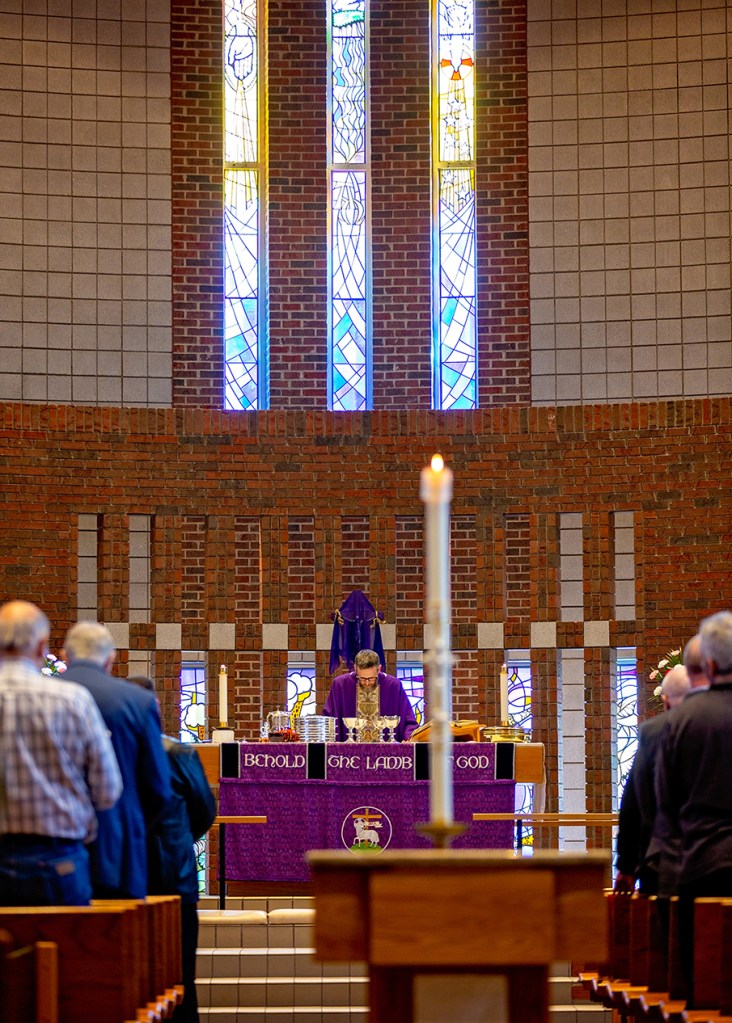
A woman came forward during the Lord’s Supper. Because I’d never seen her before in my life, and because the Lord’s Supper is much more than a religious snack shared among generally spiritual people, I discreetly asked at the altar, as I always do, the appropriate questions relative to participation, and when she openly admitted to being apart from what we believe, teach, and confess, I offered her a blessing and asked for a little bit of her time to chat after worship so we could talk in more detail.
I understand that many Christians come from churches where the Lord’s Supper is offered openly to anyone who comes forward. In those settings, withholding it from someone at the altar may seem unthinkable, and I understand why someone formed by that practice would be bothered. Not angry. Bothered. Still, 1 Corinthians 10 and 11 are especially important here. They teach us that Holy Communion is participation in Christ’s body and blood, and that those who commune together are also confessing something together. They also warn that eating and drinking without discernment is spiritually dangerous. That means the Lord’s Supper is never an open-ended religious gesture. It’s Christ’s gift, and because it’s Christ’s gift, pastors are called to steward it faithfully (1 Corinthians 4). That stewardship includes care for the person approaching the altar, care for the congregation gathered at the altar, and care for the confession being made at the altar.
So, again, before offering her a blessing, I asked to speak with her after worship. I did so gently. A conversation like that belongs somewhere better than a few whispered seconds at the rail. When she became angry, others nearby were gentle, too. No one tried to humiliate her. No one raised a voice at her. No one treated her with contempt. The goal was exactly what it should have been: kindness joined to faithfulness.
But she wasn’t having any of it. In her mind, she was owed the Sacrament, regardless of any reason we might give for instruction toward altar unity first.
The result? After a scene at the altar, rather than returning to her seat by way of the side aisles with the rest, she went down the center aisle alone, if only to display her anger to everyone. At her pew, she lifted her hands and called out that she had been refused communion with her God, continuing to disrupt the reverence around her.
There’s a lot wrapped up in all of this. Some of it was anger. Some of it was embarrassment. I don’t doubt for one second that she felt wronged. But why? Well, at least in part because much of American Christianity has trained people to think of the Lord’s Supper this way. If someone has been taught that the altar should receive anyone who comes forward, then a pastor’s hesitation will almost certainly feel like offense. I understand that. Still, taking offense does not mean offense was actually given. The reality is that she walked into a church whose altar she didn’t know, whose doctrine and practice she didn’t know, and whose confession she had not yet learned, and then expected the altar to operate according to assumptions carried in from the outside.
It was as though a stranger walked into someone’s house at dinnertime, sat down at the table, objected to the menu, rebuked the host, and then announced to everyone present that she had been denied what was rightly hers because they would not rewrite the order of their home to accommodate her.
That sounds absurd in ordinary life. And yet, in American Christianity, it seems to happen all the time.
Open or closed communion is not necessarily the point here. Although I should at least say that the churches practicing open communion usually recognize some boundary, even if they draw it differently. Suppose a pastor knew beforehand that someone intended to receive the bread and wine only to throw them on the floor and trample them. I doubt many would actually say, “Well, if he comes forward, I have to commune him.” At that point, the issue would be obvious. The pastor would guard the Lord’s Supper against open contempt. My point is not that every case is that blatant. Most are not. My point is simply that once we admit the Lord’s Supper can be profaned, the pastoral question is no longer whether reverent boundaries may exist. The question is where those boundaries belong, and whether the pastor is willing to bear the burden of applying them faithfully.
I suppose another point here is that, on the other end of the exchange, too many have been trained to believe that individual sincerity outranks truth, desire outranks doctrine, and personal offense outweighs pastoral responsibility. We have been trained to think that anything with the name “Jesus” on it is automatically boundaryless. And if it does have boundaries—things a worshipping community may have in place to prevent profaning Christ—then those boundaries are automatically loveless and offensive. We have been trained to imagine the Church as a spiritual convenience store, open to everyone on each person’s preferred terms.
That’s like a “Bypass PIN” option at the gas pump. It makes very little sense to me, and yet, it exists anyway. A person can say, “This is communion with God,” and then become furious when the pastor takes seriously what God has said about His meal. A person can say, “This matters deeply,” and then refuse the very care that proves the Church actually agrees with the statement. In other words, we say the thing is serious, and then we resent the safeguards that seriousness requires, acting as though doctrines are rude whenever they slow us to self-inspection and the possibility that we could be wrong.
One of the biggest itches in my craw is that so many say they want churches to stand for something, only to be shocked when we do. But the thing is, they’re really only shocked because the stance affected them personally.
You should know, she took me up on the offer to chat after worship.
Most people who are unhappy with our practice usually go through the greeting line, tell me what a rotten person I am, and then leave. She stood off to the side and waited. I did my best to speak calmly about what God’s Word says, and why what I did was an act of care rather than cruelty.
But again, she was having none of it, thereby demonstrating one more contradiction.
She stayed to chat. But like so many in our culture who claim to want discussion, when the time came for it, the “Skip Dialogue” button was pressed, and she talked over me, doing her best to lather me in condemnation and insults. I barely got a few sentences out. Instead, I was tongue-lashed by someone who wanted order, so long as it was her order. She wanted a church with an altar, but that altar could not be misaligned with what she already believed about altars.
So, why am I telling you these things? Well, for starters, you should know this isn’t necessarily an unfamiliar experience. It does happen more than people know, just not necessarily to this degree. I suppose I’m also sharing it because, at a minimum, it’s time, once again, to remind folks that the Church is not a restaurant where the customer is always right. The pastor is not a waiter taking custom orders. Above all—and recognizing that other Christians order this differently—my Synod, the Lutheran Church Missouri Synod, believes the Lord’s Supper is sacred in a way that requires altar fellowship to be taken seriously. Sacred things require reverence, and reverence requires pastors and congregations to ground the Lord’s Supper in faithful practices born of God’s Word rather than in the increasingly common internet-assembled expectations of whoever happens to approach the altar.
This is where the theological lesson in all of this becomes unavoidable. We need to realize that sin does more than make people bad. It also makes us incoherent. It teaches us to demand gifts while rejecting the giver’s terms. It teaches us to call something holy while treating it like it isn’t. It teaches us to interpret pastoral care as hatred.
I think I just figured out why the PIN bypass option exists. Again, when you remember the nature of sin, these things make sense. The PIN bypass exists because the world wants what it wants. For businesses, in most cases, it’s profit. To get at your dollars, most businesses prefer convenience. Convenience often wins the argument before security even gets to speak. Scenes like the one that happened last Sunday prove the same thing. Any obstacle to personal preference is inconvenient. A person with this mindset will only ever see a pastor as hateful when he says, “I need to speak with you first, because what’s happening here is far too precious to be handled carelessly.”
Unfortunately, that’s the world we live in. It’s even more unfortunate that anger can rise so quickly when a pastor is trying to be pastoral. Still, the pastor’s task remains what it has always been. We preach Christ crucified. We call sinners to repentance. We give the gifts as Christ instituted them. We guard what He has entrusted to His Church. We speak gently when gentleness is possible, and we remain faithful even when gentleness is mistaken for hate. We do this because, in the end, we already know that the real contradiction at the heart of all this is, quite simply, us. Sinners want God near enough for comfort, but also far enough away to leave us in charge.
The thing is, the Christian Faith doesn’t actually allow that arrangement. Christ draws near on His terms. And because He is no divine pushover, letting anyone do whatever he or she wants with His things, He also doesn’t ordain undershepherds to accommodate terms other than what Christ has established. That’s not cruelty on Christ’s part. That’s not cruelty on the pastor’s part, either. That’s care. One would hope that even an atom-sized splinter of Christian humility would be enough to help any of us press “Pause” instead of “Bypass” before assuming that a church’s reverent boundary is an act of cruelty.


