
No Right to Complain If You Don’t Engage

A few years back, maybe six or seven years ago, a member here at Our Savior (or, I should say, former member) approached me to let me know in his passive-aggressive way that my friend Charlie Kirk had been listed in the Southern Poverty Law Center’s “Extremist Files.” In response, I gleefully pointed out that while Charlie himself had not yet received such a badge of honor, his organization, TPUSA, had indeed made SPLC’s “Hate Map” as an “anti-government extremist group.”

That particular conversation, like so many with him before it, did not end well, especially since I implied that being targeted by the SPLC, a group that claims to fight racial hatred, could be a good thing.

But I meant every word.

I wonder what my former friend’s thoughts are now that the SPLC’s guts have been exposed. Although I may be getting a little ahead of myself. Have you even heard the news?

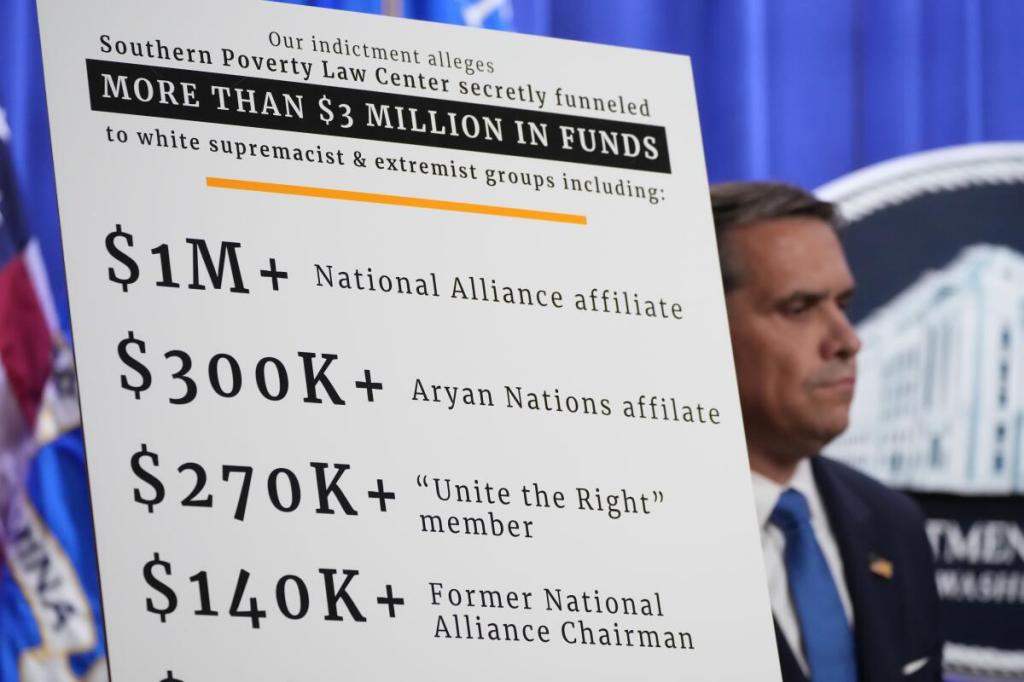
If not, the essentials are that the Department of Justice leveled three charges against the SPLC, namely, wire fraud, making false statements, and conspiracy to commit money laundering. It seems that between 2014 and 2023, the SPLC’s leadership secretly funneled more than $3 million in donor money to racist extremist groups, most notably, the Ku Klux Klan, as well as other neo-Nazi groups. I just read some of Todd Blanche’s comments on the situation. He’s the acting Attorney General. In summary, he put it rather bluntly, saying the SPLC was “manufacturing racism to justify its existence.”

I tried not to laugh when I read his words. Most reasonable people who’ve ever crossed paths with the SPLC already knew that. Charlie certainly did. That’s because it’s an easily discernible M.O. for most of the groups out there claiming to fight racial inequality. In fact, it’s written into the DNA of almost any progressive protest you see on the news. From BLM to “No Kings” to LGBTQ, Inc., the only way these groups have managed to stay in business is to ensure that the “hatred” angle relative to their particular organization’s needs persists. And so, that’s what they do. They foment rage.

I wouldn’t be surprised if we learn that other organizations, like the ones I’ve named, have been doing the same thing the SPLC has been doing. Of course, the SPLC denies the charges. Still, it’s not looking good for them. It’s becoming undeniably plain that the SPLC, which raised money by warning Americans about hate, was shelling out major cash to keep the machinery of hate in motion.

Wow. Shocking.

As I said before, most reasonable people already knew the SPLC to be less a sober civil-rights watchdog and more a moral-licensing agency. It has always acted with an assumed authority to decide who was hateful, who was dangerous, who belonged on the outside of acceptable society, and perhaps worst of all, who needed to be marked for public suspicion, all toward the goal of organic cancellation. Of course, to remain somewhat veritable, the usual suspects, like the KKK, were tagged. In the meantime, the rest of SLPC’s cash was being spent tagging and fighting against Christians, conservatives, and a whole host of ordinary people who held unfashionable views about marriage, gender, education, immigration, or religious liberty.

I suppose that’s what happens when an organization discovers that condemnation can become a business model. The more standards it can create and identify as hate, the more necessary it becomes to fight that hate. The longer its list of enemies grows—the more fear it creates—the more urgently it can ask donors for money.

But again, I say sarcastically, “Wow. Shocking.” That’s because none of this was lost on reasonable people—or at least the people paying attention. And I don’t offer those words lightly, especially to the folks here in Michigan. There’s an angle to this that requires some attention because it lands very close to home.

Jocelyn Benson, Michigan’s current Secretary of State and a candidate for governor, served on the SPLC board during the time period covered by the indictment. She was named to the board of directors in 2014. Her campaign has publicly confirmed that she served for four years. That does not, by itself, prove what she knew or when she knew it. Still, the indictment accuses leadership. That includes the board.

I suppose one thought here is that if someone seeks the governorship of Michigan, then that person’s associations and moral discernment should matter. I’m the Executive Director for an organization. My role exists alongside a board of directors. That board isn’t a ceremonial thing. It exists for governance. It exists for accountability. It exists to understand the organization’s mission, finances, and a whole host of other matters that help ensure the effort is acting faithfully and lawfully.

Now, having said all this, a seemingly random thought must be considered.

Not long after that image of Trump was shared—the one in which he looked an awful lot like Jesus stretching out his hand to heal someone—I read plentiful commentary from fellow Christians on social media saying things like, “This is exactly why Christians need to stay out of politics. The separation of Church and State!”

I get the aversion to the image. Regardless of Trump’s wobbly explanation, it was ridiculous. But it’s precisely because Christians have adopted that kind of retreat that organizations like the SPLC continue to get as far as they do. Yes, there are foolish and cringeworthy things that our elected officials do in the public square. But the answer to these things is never political indifference, or worse, monasticism. It’s never to leave the arena, leaving the gates open, and allowing the lions to feast on whatever they prefer.

It’s true, the government is not the Church. It cannot preach the Gospel, administer the Sacraments, or forgive sins. It cannot make Christians. Only Christ does that through the means He has established. But the government is still Christ’s servant for earthly order (Romans 13:1–4). It is still given to punish evil and protect the neighbor. And when people who hate Christ, hate His design, hate His Word, and hate anyone who confesses His truth, are the only ones willing to enter the public square, willfully disengaged Christians should not complain when the public square becomes hostile to the things of God.

On the contrary, Christians must get in the game and push back. At a minimum, that means Christians cannot shrug at elections. Even more importantly, we cannot simply vote for president while neglecting the midterms, or worse, our local elections. In fact, I’d be willing to say that the folks in charge of the local library or the people elected to your local school board matter more than anyone may realize. Even there, a Christian cannot pretend that a candidate’s beliefs and alliances will have no bearing on our lives. They do, and in the most immediately impactful ways. A school board candidate who sat on the board for an organization that believes 2 plus 2 equals 7 is not someone you want spearheading a community’s educational efforts.

And yet, concerning even greater, more life-altering things, there remain those Christians who sprinkle so foolishly across social media, “Stay out of it! God will handle it!” Those Christians absolutely own the blame when their community’s children cannot do simple math.

Yes, God will handle it. He’ll handle it through your vocation as a citizen, upholding your God-given responsibilities (Jeremiah 29:7 and Matthew 22:21). He’ll bless His world through your faithfulness, which is already something He works in us by the power of the Holy Spirit for faith. We’re already inclined to do what He wants. When we vote, we’ll be inclined to seek candidates who most closely align with Him and His Word.

In this day and age, that pretty much means choosing leaders who protect life, embrace natural law, honor the family, respect religious liberty, and understand the limits of government in light of Two Kingdoms theology.

By the way, Christians engage in the process, recognizing that no candidate will be perfect. No election will usher in the kingdom of God. And anyone who believes these things has lost grip on what the Word of God teaches. For those who hold to God’s Word, they’ll know, by faith, that Christ has already won the victory that no ballot can win (1 Corinthians 15:57 and Colossians 2:15). He lives and reigns now, and His kingdom will have no end (Luke 1:33).

They’ll also know that until He returns, we live here. We serve our neighbors here. We raise our children here. We confess the truth here. And part of that earthly calling is to engage in the public square in ways that not only protect what’s Godly, but also to act with wisdom to preserve it. One of the most powerful ways to do that is in the voting booth.

So, returning somewhat to where I began, I’d encourage you to pay attention. Do some reading. Don’t skim. Read. This is an important way to measure candidates against the Christian Faith, namely, the Word of God. Campaign slogans won’t tell you anything. Not anything of real value, that is. Most would never have learned about Jocelyn Benson’s association with the SPLC had certain folks not dug deeper and written in ways that exposed it.

Read up on it. Also, study the candidates’ voting records. Read their speeches. Look into their associations. Doing even these things, it won’t be hard to figure out who’s who.

Then, as a Christian, take that “who’s who” stuff into the voting booth and flex the muscle of your responsibility. Because if you can, but don’t, as I said before, you have no reason to complain.

Mid-term Elections, 2022

I would imagine some of you are expecting me to weigh in on the recent election. I suppose one thing I learned this past Tuesday was best described in a parallel way by Thomas Henry Huxley. He labeled science’s greatest tragedy as “the slaying of a beautiful hypothesis by an ugly fact.” I went to bed on Tuesday evening bearing a hypothesis—a hopeful estimation—that Michigan wasn’t capable of enshrining murder in its Constitution, that the majority of people in this state would know better than to hallow death in this way. I also expected that one plus one would continue to equal two; that people would be more inclined to embrace candidates intent on upholding natural law while refusing candidates proffering wokist foolishness, backward science, and “for-me-but-not-for-thee” principles of governance.

Ugly facts slew those hypotheses. The passing of Proposal 3 is proof. The re-election of Gretchen Whitmer and her demonic associates is, too. For the first time in forty years, the worst of the worst—the ones who openly despise all things Godly—own the governor’s chair and both chambers.

So, what now? Well, something else comes to mind.

For starters, it must be realized that God ordains civil government as an extension of His purposeful authority to humanity through humanity. According to His design, the offices established are not ones of self-serving privilege, nor are they to be abused through tyranny. They are established for the well-being of the citizenry—to maintain order and protect the ones they serve. The ordination is not limited to Christians. Unbelievers can occupy the seats, too. However, the leader must remain within God’s framework to keep the ordination. When he or she doesn’t, the relationship between the government and the governed changes. Saint Paul shows his understanding of this in 1 Timothy 2:2, explaining that we pray to God and intercede with all in authority so that we can live peaceful, reverent, and godly lives. God does not want these things to be disjointed. Verses 3 and 4 provide the reason for this desired harmony: “This is good, and it is pleasing in the sight of God our Savior, who desires all people to be saved and to come to the knowledge of the truth.” In other words, a government within the boundaries of its ordination provides the best context for the Gospel’s perpetuation in the world. When the Gospel is free to go forth, the salvation of souls is the result.

This is religious liberty.

The word “religious” seems far from Michigan right now—unless, by the term, we mean self-devotion. Religion requires the determination of good and evil, right and wrong. This discernment is necessary for measuring government. I’m willing to concede that most in Michigan appear disinterested in doing this, let alone capable. Instead, they regard government as a power to be harnessed for personal gain. As long as they get what they want, the government is good. When they don’t, the government is bad.

So again, now what?

Well, technically, as ones owning the corner market on good and evil, Christians face a grave theological question here in Michigan. By writing into the Michigan Constitution a person’s right to murder another person, the document has, in a sense, become invalidated. The Magdeburg Confession, a remarkable document published in 1550 and born from clear-thinking Lutherans, offers something worth considering:

And so, by the force of this precept [Matthew 22:22], the things which are God’s are not to be rendered unto Caesar, just as the Apostles hand down this rule and precept, “We must obey God rather than men.” And by refusing obedience to superiors in those things which are contrary to God, they do not violate the majesty of their superiors, nor can they be judged obstinate or rebellious, as Daniel says, “I have committed no crime against you, O king.” For two reasons free them from this charge: First, because those who wield the magistracy do not demand this obedience as magistrates by the ordinance of God, but as men, that is, having no superiority from the Word of God. The Apostles appear to have wanted to judge this case by their own dictum. Then, even if they remained true magistrates, even still, as in human ranks, the law of the superior power trumps the law of the inferior, so divine laws necessarily trump human ones. Secondly, as Christ does not want the things of God to be ascribed to Caesar, so He does not want to see any things ascribed to him [Caesar] that are others’ and not his, whether according to divine laws or even the laws of his own empire. If, contrary to these laws, Caesar should demand my life or some other man’s life, or the chastity of a wife or daughter, or property etc., I ought not to allow them to him. (The Second Argument, 63.)

So, there’s this. I know some will argue this point. They’ll rub their Church-and-State lamp and out will pop the genie named “Obey!” with the text of Romans 13 in hand. That’s fine. When that ill-interpreting apparition emerges, hand him the following rhetorical discussion from the faithful men of God who scribed The Magdeburg Confession:

If God wanted superior magistrates who have become tyrants to be inviolable because of his ordinance [Romans 13] and commandment [The Fourth Commandment], how many impious and absurd things would follow from this? Chiefly it would follow that God, by his own ordinance and command, is strengthening, nay, honoring and abetting evil works, and is hindering, nay, destroying good works; that there are contraries in the nature of God Himself, and in this ordinance by which He has instituted the magistrate; that God is no less against his own ordinance than he is for the human race. All these things are most plain, nor can they be denied by anyone: If God has granted such great impunity to the greatest tyrant by His own ordinance and commandment, who will prevent him from laying waste all of nature, even if he could, and being innocent before God? Who will not provide his substance, his body, and even his life itself to the one who demands them for the occasions, ends, and nourishment of tyranny, because of the commandment of God? Who will do what is right contrary to the will of a tyrant, and be a survivor? Who will be left of all men as the only one doing right? (The Second Argument, 67.)

Again, sometimes a Christian cannot obey. This is not promoting rebellious anarchy. It is being faithful. It is to accept the fact that a document enshrining a person’s right to murder another person has swerved beyond the boundaries of the government’s ordination, leaving the faithful in a terrifying predicament. The Lutheran pastor, Rev. Dietrich Bonhoeffer, understood just how scary it was. Of course, he learned the hard way what it really means to apply oneself wholly to the challenge. A gentle and mindful man, he was hung for his resistance to Hitler. His faith was forced into action, and he discovered a willingness to say, “You’ve gone too far, and I intend to stop you, even if it costs my life.” Are we as courageous as Bonhoeffer? The question begs another hypothesis that will, like the others, be tested and slayed by facts.

On Wednesday morning, I shared these heavy concerns in conversation with Bishop Hardy. Wisely, he asked the probing questions, “Why dissent now? What has changed between the era of Roe V. Wade and the passing of Proposal 3?” As Christians, we need to be prepared to answer. For starters, Roe V. Wade was not law. It was an interpretation of law. Here in Michigan, we have laws on the books relative to abortion’s prohibition. Admittedly, the interpretation tripped up their application, yet it did not nullify them. When Roe V. Wade was overturned, these laws engaged. Laws that defend and protect life are fundamental to the government’s ordination. In that sense, Michigan was already poised to exist in stride with Godliness. On November 8, the Michigan citizenry voted to amend the Michigan Constitution. As a result, the highest legal authority for a representative republic gives license for murder, thereby nullifying the previous laws of prohibition. All statutes established in our state must be in agreement with the Constitution. If they do not, the statutes are abolished. This means that even if one day we were to have a pro-life governor supported by a 100% pro-life legislature, any law they could formulate outlawing abortion would be illegal by default and, ultimately, unenforceable. As of November 8, 2022, the Michigan Constitution establishes unrestricted access to abortion at every stage of pregnancy. Period.

Again, now what?

Well, there’s plenty of discussion to be had. That will come in time. Meanwhile, we do what we’ve always done. We pray. And when we’re done, we get up, dust ourselves off, and get back to work. Hopelessness is not on the menu. Neither is quitting. Faithful endurance is the order of the day. A cause is only ruined when its fighters determine they can’t go on. We can go on. And why? Not because of anything relevant to us. We’re humans. Humans are limited. We can go on because the One we trust—Jesus Christ—goes on. This same Savior has promised His believers an enduring strength that surpasses the might and muscle of the temporal spheres (2 Corinthians 4:7-18). Existing in these realms, with eyes fixed on Christ’s ghastly but all-encompassing victory on the cross, with hearts attuned to the eternal glory Christ promises to those who love Him, the passing terrors of this world and its monsters seem less problematic, less fierce.

And we can go on.

Trusting Christ, I intend to keep at it. It’s going to be more complicated now, but that’s okay. I’m a pastor. I’m more than familiar with complicated. There’s a saying that the success of most things depends upon knowing how long it will take to succeed. Proposal 3 is a significant setback. It’s going to take a while to change what’s happened. Still, I’m playing the long game. I’ve set aside the rest of my life, however long that may be, to do what it takes to move the ball down the field. Will I see us score before the divine Coach decides to put me on the bench? I don’t know. But until He does, I’ll continue to show up for practice, study the fundamentals, learn the plays, research the opposition, and eventually, when it’s game time, come ready to play the game and to play it hard.

Consider this your invitation to the tryouts.