I did a quick calculation this morning. I’ve done the calculation before, if only to remember how long it’s been.
Essentially, I looked back into the folders where I keep all these Sunday morning eNews messages. The first folder is labeled “2015.” However, there really should be a 2014 folder, too, because there are five in there that belong to the previous year.
Doing the math, that means that this coming November, I’ll have maintained this weekly practice for twelve years straight, never once missing a Sunday, even during the Thoma family’s two-week vacation. Every year on vacation, I tell myself I’m not going to do it. But then I do, anyway.
Well, that changes this year. Yeah, right. But I mean it this time. Okay, let’s just wait and see.
This morning’s note is number 654. Again, looking at the date of the very first one, and then doing a little math, it seems I’ve written a good number more than a year allows. That’s because I’ve also been writing them for special days throughout the year. For example, I write something at Thanksgiving. I write one on Christmas Eve and then again on Christmas Day. Things like that. When there are national tragedies, I try to observe and then say something worthwhile—something that can nudge a reader toward Christ. We’ve had our fair share of those in the last twelve years.
The COVID years never seemed to run dry of one’s need to observe critically through the Gospel’s lens.
But whether or not anything I’ve ever scribbled has been worth anyone’s while, at some point along the way, these little jaunts became less an opportunity to communicate about a particular topic and more a habit. And by habit, I not only mean the nagging urge to type something, but also the urge to observe the world in a certain way and do what I can to bring others into that observation.
I’ve said it before. There’s always something going on. A person needs only to open his eyes and look around. We live in a world that is both wonderful and foolish all at the same time. How a person prefers to interpret what’s seen is another question altogether. I suppose in a sense, this weekly habit—my clinical need to lift the looking glass of God’s Word to my eyes, sweep the moment’s horizon, and then describe the details for public consumption—has been a way for my habit to shape the habits of others.
Habits—good ones—are necessary, especially when the world’s darker things impose. I suppose that’s one of the strange benefits of good habits. In a way, they carry us when we can’t carry ourselves. They’re there to help put things in order when chaos threatens the moment.
For example, here I am at 654. I’ve scanned the morning’s horizon. What did the world impose? What chaos loomed?
A seven-year-old girl, Athena Strand, was kidnapped and murdered in Texas by a FedEx driver, Tanner Horner, who came to her home with a delivery. He saw her, and when no one was looking, he took her.
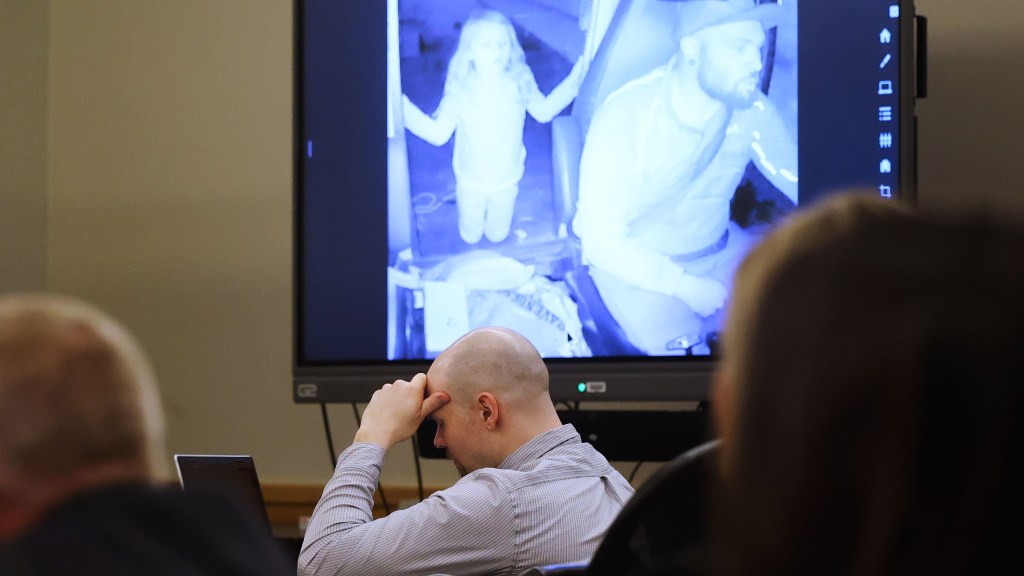
The images from the delivery truck’s interior dash cam video are dreadful, even though the ones I’ve seen don’t show the murder itself. One in particular shows her on her knees behind him in the narrow space between the cab and the packages, small enough to be hidden there, looking over his shoulder with a face that still belonged to childhood. To me, she seems caught between confusion and trust, as though some part of her was still trying to understand whether this was strange or frightening, whether she had won an unexpected contest, and the prize was a ride in a FedEx truck, or she was actually being carried past the last safe moment of her life. Her hair, her posture, the helpless nearness to the man driving her away—it all makes the scene almost unbearable. He was taking her toward a dreadful end, and she was still too young to know how terrified she needed to be.
Horner was sentenced to death by lethal injection last week. This does not bother me. There will be time between the verdict and the needle for the kind of forgiveness that can preserve Horner through mortality and into immortality. Let’s hope that happens while understanding that such hope feels foreign to our human sense. And so, in the meantime, let the government’s sword be removed from its sheath and wielded as God has ordained (Romans 13:4), lest more monsters act on the urge to do what Horner has done.
Beyond these things, it’s stories like these that make commentary feel useless. What is there to say after all this? What sentence can bear the weight of a seven-year-old child taken while playing in her driveway? What moral observation can see clearly enough through the fog of a little girl being abducted, violated, strangled, and dumped like trash a few miles from the safety of her home? What polished paragraph can stand near her mother and father, people who’ve had to keep breathing in a world where their daughter no longer does?
Some people reach for words because silence feels a lot like surrender. Still, in certain circumstances, it feels as though human language fails us miserably because some evils are just too plain for explanation. Some things that happen don’t need analysis or interpretation. They need tears. They need the kind of groaning St. Paul says creation has been doing since the fall (Romans 8:22).
A little girl is dead. A family is shattered. A man has been condemned. And all the world’s surrounding talk feels tritely thin.
That said, I humbly suggest we let the habit carry us here. When we do—when the lens is lifted—we may not fully understand what happened, but we’ll at least see it clearly. If anything, we’ll get a sense of just how different the Christian faith is from the world’s sentiment. The Christian faith—established by the Holy Spirit through the Gospel—is incapable of pretending evil is smaller than it is. It certainly doesn’t try to convince the believer that every tragedy is secretly beautiful if we just look at it from the right angle. Personally, a little bit of crazy stirs in me when the best anyone can offer to moments like these is that everything happens for a reason.
Yeah, okay. That’s not helpful. But then again, the world is ridiculous that way.
The Word of God observes these things and calls them what they are. It sees death and calls it an enemy (1 Corinthians 15:26). It beholds murder and describes it as an act that screams to God from the ground (Genesis 4:10). It sees children and then warns against their harm, reminding ill-minded adults that their angels always see the face of the Father in heaven (Matthew 18:6 &10). It looks at dreadfulness and says God does not hold the guilty guiltless (Exodus 34:7 and Nahum 1:3).
And then, suddenly, right in the middle of all of it, it points us to a cross.
Why would it do this? Because the cross is where God shows us that He is serious about sin, death, and the devil’s awful and seemingly never-ending creativity (Hebrews 2:14-15 and 1 John 3:8). The cross doesn’t make evil less evil. It reveals how deep the evil goes. The Son of God is betrayed, mocked, beaten, condemned, and killed. Innocence is nailed to wood. The world does what the world does, and God takes all of it into Himself.
Then, on the third day, Jesus rises. That’s what matters most in situations like this. And only through the Gospel’s lens can this be seen. Only through Christ and His complete and perfect work, ultimately proven by His resurrection, can we take one more breath through moments that feel like all the earth’s oxygen suddenly dissipated into space. It has to matter in situations like this, or it doesn’t matter anywhere.
If Easter is only for clean grief and manageable sadness, it’s way too small. If the resurrection is as the world is minimally willing to consider it—a springtime metaphor—then it has nothing to say beside a child’s grave. Or, if Christ is raised merely to improve our mood, so that we can say things like, “Well, everything happens for a reason,” then He is useless in the face of real horrors.
But Christ is risen from the dead.
That means death doesn’t get the final word over Athena Strand. It doesn’t get the final word over the tears of her family. It doesn’t get the final word over the courtroom, the sentence, the headlines, or the long years of grief that remain after everyone else stops reading.
The final word belongs to the One who said, “Let the little children come to me” (Mark 10:14). It belongs to the One whose hands still bear the wounds of what human beings do to the innocent (John 20:27).
Admittedly, even those words don’t make the grief tidy. I can promise you that. I’ve never shared them at a funeral and seen all the tears suddenly dry up. But it doesn’t change the fact that they’re Gospel words, and only the Gospel truly soothes (whether or not we realize it) in moments of sadness and anger, and during times of rage. In fact, it’s the Gospel that gives Christians permission to weep. The Lord sanctified our tears when He cried at Lazarus’s tomb (John 11:33-36). The Gospel reminds Christians that they are also allowed to want justice (Psalm 10:17-18 and Revelation 6:10). And while doing so, the Gospel calls for Christians to know they are more than permitted to cry out in the face of this world’s atrocities, “How long, O Lord?” (Psalm 13:1 and Revelation 6:10).
God gave us those words because He knew we’d need them. They’re meant to be spoken often. Indeed, they make for a good habit of words—the kind we need when it feels like there isn’t anything worth saying. Because often, there just isn’t.
And so, the Church’s habits emerge from God’s Word. We pray. We confess. We sing. We gather. We speak the Creed. We hear the Word. We eat and drink the body and blood of Christ. We bury our dead in hope. We say “Lord, have mercy” when there’s nothing left to say in the presence of grief.
Considering the story I shared, the only thing left worth saying is Lord, have mercy on Athena’s family. Lord, bring justice to the wicked. Lord, protect the little ones. Lord, grant us faith to hold fast to you, even as you hold fast to us. And Lord, please, come quickly (Revelation 22:20).

