
Only One Anthem for Me

As is always the case in mid-October, I’m required to attend an English District regional conference. It just wrapped up this past Wednesday in Fort Wayne, Indiana. The goal of the mandatory gathering is not only to handle regional business, but also to bring pastors and district leaders together for fellowship and learning.

Before I go in the direction I feel like going this morning, there are three contextual details you need to know. First, for those who don’t know what I mean by “English District,” you need to know that the Lutheran Church-Missouri Synod (LCMS) is divided into districts, and some districts divide themselves into regions. But unlike the Michigan District or the Northern Illinois District, the English District is non-geographical and has congregations throughout the continental United States and Canada.

That’s the second thing you need to know, the Canada part. Essentially, when we gather for business in our various regions throughout the country, it sometimes includes Canadians. In fact, for the first time in our district’s history, our Bishop, Reverend Jefferey Miskus, is Canadian.

Third, and I could be wrong about this, but I think my particular regional conference is the one most of the Canadian pastors in the English District attend. Again, I could be wrong about that. Either way, it’s been our region’s practice before the first meal to pray and then to sing both the Canadian and American national anthems. And I suppose that’s where I want to go this morning.

On my part, I’ve always found this tradition interesting, especially since nearly everyone in the group sings both anthems. Notice I said “nearly everyone.” I don’t sing the Canadian anthem. I never have. I only sing the American national anthem. Of course, I stand respectfully for the Canadian anthem, but I leave any musical devotion to Canada to the Canadians.

My reason? I’m an American. I’m devoted to and love my country. Sure, I appreciate Canada. But when it comes down to it, I’m grateful to God for the extraordinary freedoms I’ve inherited on this side of the border, ones purchased and preserved at considerable cost by generations of Americans who came before me and knew liberty’s value.

Now, don’t get me wrong. I have no trouble respecting another nation’s affection for its homeland. I’m glad they do, and I admire them for it. Still, patriotism isn’t just a word to me. It actually means something. It’s definitely more than a polite gesture of putting my hand over my heart and singing along with everyone else because that’s what we do before getting down to conference business. In truth, whether I’m at one of my daughter’s volleyball games or I’m at an English District conference, when I sing our national anthem, I’m very nearly moved to tears sometimes, especially in that moment we sing “our flag was still there,” which I’ll get back to in a second.

In the meantime, when I’m singing America’s national anthem, I’m making a declaration about my homeland. I’m acknowledging its foundation and history, and I’m saying it stands above all others as best.

And I’m devoted to it in all its bestness.

Now, for the easily offended among us, nothing I’ve said should convince you that I don’t like Canadians. The first proof of this is that during breakfast on the last day of the conference, having my choice of seating in the hotel dining area, I went and sat among a group of gathered Canadians, me being the lone American at the two tables. And why wouldn’t I sit there? They’re brothers in Christ. They’re good, godly folks serving our Lord faithfully.

That said, it didn’t take long for the international diplomacy to deteriorate.

I don’t remember how it came up, but someone revisited the fact that our district bishop, who, again, is Canadian, couldn’t attend the conference because he couldn’t get into the country. Somehow, his visa had been frozen, or something like that, and no one at either table seemed to know the reasons why. Through humor’s filter, the conversation turned to border policies, with at least one in the group noting that Americans apparently have a much easier time traveling back and forth between the two countries—which was to say, somewhat tongue-in-cheek, that Canada is a much friendlier and more welcoming country than the U.S. and that its border policies were proof.

After that, someone graciously acknowledged that the United States is free to establish and enforce its own immigration policies. But then, almost immediately, another fellow remarked, again, somewhat tongue-in-cheek, that Canadians sometimes forget that “Second Canada” has its own laws.

Second Canada. I’d never heard that descriptor before.

In all fairness, the comment was probably an involuntary response to Trump’s sometimes wacky commentary about annexing and renaming this or that part of North America’s geography. Still, the way it came out, it sure seemed like there might be a longstanding joke among our northern neighbors, one suggesting that the United States is considered a sort of southern annex, or maybe a lesser province in Canada, one requiring occasional supervision from its wiser, more sophisticated older brother.

I know it was just friendly ribbing. And I chuckled a little, of course. But my patriotism got the better of me, and since I’d been handed an opportunity, I decided to return the favor.

Having just experienced the anthems side-by-side a few days prior, I reminded them that our nations’ hymns tell very different stories about who’s more capable than the other, especially when it comes to big and little brother relationships. I didn’t say it in so many words. And yet, inherent to my jab was that Canada remains safe, if only because we’re their immediate neighbor, not the other way around. Indeed, it’s silly to think that anyone would avoid attacking the U.S. out of concern for Canada. We’re definitely the big brother in the relationship, not Canada.

Again, I didn’t say it so many words. But assuming the one who made the comment got the gist of my point, I did add a little extra sauce to the conversation, making it clear that I never have and I never will sing the Canadian national anthem, if only because ours sings of the visceral courage needed to be the big brother and theirs doesn’t. Had there been appropriate room for more, I would’ve given the history. I would’ve said that Francis Scott Key wrote our anthem after witnessing the British bombardment of Fort McHenry during the War of 1812. I would’ve told them about what our anthem actually describes. It speaks of rockets streaking through darkness and bombs exploding over us during an attack. I might’ve posed the rhetorical question inherent to our nation’s hymn, which was whether the Americans had what it took to win the day, let alone survive, or whether the American flag would even be flying when morning came.

But the American anthem sings with great vigor, essentially, “There it is! The flag still stands.” Which also means the patriots defending that flag were still standing, too. In other words, yes, they had what it took. And lest anyone forget, listen to our anthem and know we still do.

In short, our anthem remembers a nation enduring the violence of war and emerging with its liberty intact. Its whole point is to remind every generation across the globe that freedom requires courage, vigilance, and occasionally, tremendous sacrifice.

Now, consider Canada’s anthem.

It’s a pleasant and flowery song. It speaks of patriotic love and glowing hearts. It even asks God to keep Canada glorious and free. That’s commendable, especially the reference to God. However, there’s a rather obvious difference between America’s and Canada’s anthems. Ours recalls the very real cost of defending liberty. Theirs merely celebrates the enjoyment of it.

Now, pitching that against some of Canada’s more recent political adventures, I actually did wonder aloud during one of the conference’s sessions just how much freedom our friends to the north are still enjoying, especially when the group recommended that we consider holding next year’s regional conference in Canada.

My vote? No way, if only because I like to say what needs saying, especially on social media. But the Canadian government has demonstrated an alarming willingness to go after guys who speak online as I do. Ironically, they restrict the very liberties they claim to celebrate in their anthem. Not to mention, I have friends in Canada, pastors, who’ve been arrested for faithfulness to Christ and His people. Look up Artur Pawlowski. And then look into his son. You’ll see.

Or maybe think back to the Canadian government’s treatment of the Freedom Convoy protesters in 2022. Heck, in January of this year, Canada’s Federal Court of Appeal finally affirmed that the government’s invocation of emergency powers was unlawful and infringed constitutional rights. And yet, almost paradoxically, the country’s speech laws—actual laws on the actual books—already permit certain restrictions that ultimately criminalize biblical fidelity, especially when it comes to life and human sexuality.

In other words, the Canadian government has decided which sincerely held convictions are acceptable for public expression and which ones are not. And as you might expect, it just so happens that Christian convictions have been deemed some of the most dangerous.

Of course, America has its own problems. We certainly have our share of politicians who’d gladly trade all our constitutional liberties for the same kind of governmental control that Canada demonstrates. There’s Talarico in Texas. Here in Michigan, we have folks like Abdul El-Sayed and Jocelyn Benson who are fully aligned with that kind of Marxist thinking.

Nevertheless, while the speech laws I described are on the books in Canada, they’re not on the books here in the United States. Our nation’s First Amendment has proven itself incredibly resilient in that regard. As it relates to the anthem discussion, our anthem reminds us that those protections aren’t just something we celebrate sentimentally, but they require continual defense in the here and now, lest they eventually become something protected and preserved through bloodshed.

Because patriots will shed their blood. That’s what lines like “through the perilous fight” and “gave proof through the night” and “the land of the free and the home of the brave” all mean. We’ll fight for liberty if we have to.

So maybe that answers the next logical question, which might be, “How did this even happen in Canada?”

Well, I have a theory, and it concerns another significant difference between the United States and Canada, which I think resonates in our anthem when we sing of battle.

We have a Second Amendment. Canada doesn’t. There’s no constitutionally protected right in Canada to keep and bear arms. Canadians can legally own certain firearms, but firearm ownership is treated as a regulated privilege rather than an essential constitutional right. In other words, the Canadian government grants the right and its permissions. In America, the Second Amendment acknowledges firearm ownership as a fundamental right that precedes any and all government permissions. It’s a right the government does not grant and cannot take away. Thankfully, our nation’s Founding Fathers understood that the First Amendment—the right to speak freely and worship according to conscience—means a whole lot more when the government knows its citizens retain the necessary means for defending their God-given rights.

Now, I’ve already wandered away from where I started. And honestly, I’m not entirely sure how to get back. So, I guess I’ll just steer away from where my reasons for not singing the Canadian anthem have led me and aim toward a conclusion. To do this, let me at least add one final thing. And know it’s something that’s far more important to remember than trading friendly collegial insults and anthems.

I’ll simply close by saying that the people sitting together at those two breakfast tables in Fort Wayne belong to Christ. We’re brothers fixed to the One who accomplished something infinitely greater than any of our country’s founding documents ever could. Christ reconciled us to God, ultimately making each one of us a citizen of a kingdom in which no earthly government will ever hold jurisdiction (Philippians 3:20).

And so, I guess what I’m saying is that regardless of our national allegiances, we claim one King, and He’s Christ, and that makes us patriots in service to a better spilled blood. Looking back at the discussion through that lens, for as brief as it really was, I can assure you there was no confusion among us in that regard. And that’s good.

Still, none of this means I’m going to start singing the Canadian national anthem when we’re together at our regional conference. Nope. Not going to do it.

Moral Elitism

A friend of mine, Rev. Dr. Peter Scaer, recently wrote and posted a piece arguing that Christians should be willing to vote for the lesser of two evils. His central concern was pretty straightforward. Essentially, he wrote in his thoughtful way that Christians sometimes become so preoccupied with the personal shortcomings of a political candidate that they lose sight of what the candidate might actually accomplish in office, or what the alternative might mean for the people who’ll ultimately be affected by the election.

As usual, his points were good. And yet, for as sensible as they were, moral elitism found its way into the comment section. And by “moral elitism,” I mean the kind of thinking that declares all doors to the public square closed to the Christian because behind each one stand equally unsupportable evil-doers. Unfortunately, such a position usually ends up believing its refusal to participate in the political process as evidence of superior Christian faithfulness. Never mind the practical degrees involved in pretty much every decision the person makes about anything else in this fallen world, which includes the evil associated with the companies that make the products he buys, or the schools he sends his children to, or the evil in his own self. And perhaps worse, never mind that both decision and indecision will have profound consequences for his neighbor. But apparently, once a person has declared every choice morally unacceptable, the harder work involved with caring about what comes next is no longer an issue anymore.

Now, I don’t intend to reproduce Dr. Scaer’s argument. It stands securely on its own. But what I will do is at least explore this moral-elitism thing. I’ve never really handled it before, and so close to the midterms, I think it deserves examination, especially by Christians who take seriously their responsibility to live faithfully in the public square.

So, where to start?

Well, for starters, I suppose I should remind you that I’m a Lutheran. A confessional one. With that, I can promise you that Confessional Lutheranism understands vocational responsibility better than most. At least, we’re supposed to. Although onlookers might not be able to tell sometimes. I know a “Confessional” Lutheran pastor who, before the 2020 presidential election, wrote on his page that any Christian choosing to do what he planned to do—which was to stay home and rearrange his sock drawer—was just as faithful, if not more so, than the Christian who ventured out to vote.

Yeah, well, whatever.

Regardless of the confused among us, Confessional Lutheranism actually does have in its theological repertoire the teaching that God works through ordinary people occupying ordinary offices to accomplish His purposes in the world. Parents, teachers, legislators, employers, school board members, you name it—they all serve as instruments through which God works to preserve order in His world, restrain wickedness, and provide for His creation.

This is the doctrine of vocation, and within its framework, each role’s responsibilities are naturally determined, at least in part, by the very office itself. A teacher teaches. An employer employs. A legislator legislates. A wife marries.

But that’s not all there is to it. Who does the teacher teach and the employer employ and the wife marry?

Other people.

In other words, most, if not all, vocations include concern for the neighbor. And many of those vocations aren’t ones we just go and take for ourselves, but rather are ones entrusted to us by someone else. For example, my wife, Jennifer, entrusted me with the offices of husband and father when she said yes to my marriage proposal. When making her choice, her yes or no weighed what I might do or not do in those roles. That’s because she knew my service in those roles would inevitably affect her—that they’d affect her children and grandchildren, too. A similar principle applies to our responsibilities as citizens.

This is where things start getting complicated for the moral elitists.

We live in a fallen world, which means our choices will always involve fallen people. Thankfully, Jennifer was no moral elitist, because I am by no means a perfect husband or father. With equal thanksgiving, I’m glad she was still willing to cast her vote for me, knowing that no man steps into the vocation of spouse without weakness. Come to think of it, someone should design a study aimed at figuring out what percentage of moral elitists are single. I mean, if they really are true to their principles, applying their standards to all aspects of life, I’ll bet we’d discover most of them are probably still unmarried. After all, it’s awfully difficult to find a spouse when everyone who might legitimately qualify has already been disqualified by imperfection.

Now, before someone comes along arguing that I’ve disregarded a person’s character from vocation’s calculus entirely, stop right here and go back and read what I already wrote. Be honest. You know that’s not what I’m saying at all. Of course we have an obligation to consider character when entrusting roles to other people. But I hope you’ve at least grasped that all our choices belong within the larger responsibility of Christian discernment. No matter the choice, as Christians, we’ll choose what most closely aligns with the will of God according to His holy Word. We’ll apply that standard whether choosing a spouse or a governor. But when we elect a governor, we’re choosing someone to govern, not bear our children. Each vocation carries particular responsibilities, and the qualities necessary for carrying them out faithfully are not always the same. And so, our calculus accounts for various considerations relative to the actual roles being sought. But no matter the role, vocation never loses sight of its concern for neighbor. It’s always a part of the math.

Read that again. The choices we make, no matter how intently we’ve discerned, will have consequences that affect other people. That’s just how things work in this world. As this meets where we started, the Christian who turns up his nose, announcing to the world his dissatisfaction with the available choices and his plan to sit the election out, imagines that he’s somehow settling every moral question. But really, it’s little more than lifting oneself above the fray while leaving the neighbor in the mess.

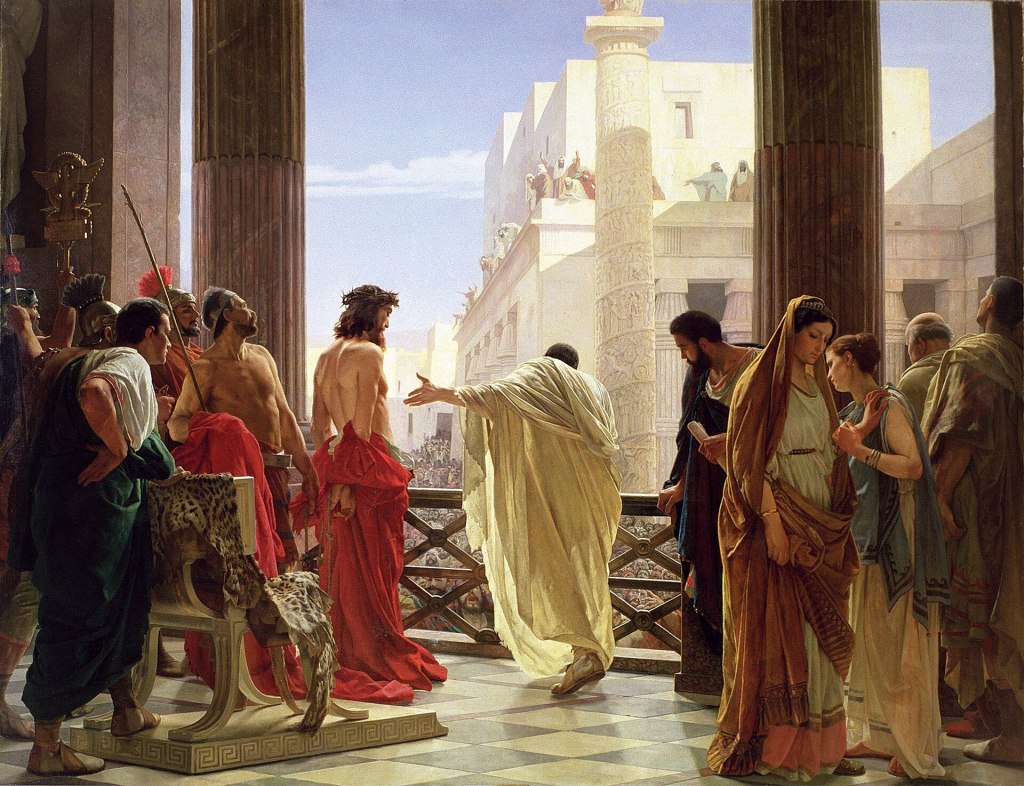
The rest of us might be tempted to call such people “pompous citizens.” I prefer to call them “Pontius citizens.” That’s because when I observe moral elitists in the wild, my mind immediately goes to Pontius Pilate. Pilate found himself at a crossroads that particular Friday two thousand years ago. He had to decide what to do with Jesus. He knew Jesus was innocent. He knew the crowd wanted blood. And so, his decision? To sit it out. He washed his hands before the crowd, declaring himself innocent of anything that might happen to the Lord by refusing to decide at all.

And yet, his indecision was a decision, ultimately giving power to the ones who’d kill the innocent Lord. By the way, that’s almost always how it works. And history rarely forgets it. We certainly remember Pilate’s refusal to choose. Even though he wanted nothing to do with the event, two millennia later, he’s the only one the Christians remember by name. That’s right. All around the world, Christians remember Pilate whenever they confess the events of Christ’s trial and crucifixion in the Apostles’ or Nicene Creed. It happened “under Pontius Pilate.” Embrace that for what it is. Apparently, washing one’s hands of a decision in the public square does very little to remove responsibility for what follows.

And the principle still stands today. I mean, what does washing your hands of an election do to protect an unborn child against laws that make it a right to tear her into pieces in the womb?

And so, I guess what I’m trying to say is that folks, especially Christians, should be careful about confusing a fear of somehow being culpable with getting one’s hands dirty engaging in faithfulness. The Lord has placed us in this world. We exist in community with others, and when it comes to vocation, there’s no dividing us from our neighbors. Not really. Their lives will be affected by both the decisions we make and the decisions we refuse to make. Our task in all this is to discern as best we can according to God’s Word and then to act with courage within the framework of the “citizen” vocation.

We do this knowing we’ll never have the luxury of choosing between perfection and imperfection. Most often, we’ll be choosing between competing degrees of imperfection, with real people standing to benefit or suffer from our decision. That’s not always an easy thing to stomach. Still, when that moment comes, we can find peace within the boundaries of grace—which is what drives Christian discernment anyway. Grace leads us to Christian discernment’s most important questions, which do not change. The first asks, according to the proposition Peter Scaer put before us, which option before me most closely aligns with the will of God as given in His holy Word. The next most important question asks what love for the neighbor requires of a Christian in the decision. We ask both questions aware that our neighbor isn’t served by us standing at a comfortable distance, congratulating ourselves for having clean hands. Our neighbor needs us willing to roll up our sleeves and use them.

I was going to end there, but I had another quick thought. I’m willing to bet some are already applying this principle in a way that pits it against itself. In other words, and thinking back to the issue of life I inserted before, they might ask, “Well, what if the only option is not between life or death, but between death and death, with the only choice being not if an unborn child is terminated, but how the child is terminated?”

First, again, no one said this would be easy. But second, of course there will be occasions when abstaining from a particular choice is a genuinely conscientious decision. If Jennifer’s only choices for a husband were a man who beats women and another who molests children, then she must not choose either. In other words, there may be occasions when a choice is really no choice at all. So, why ask a question like this at all? Because that’s what people looking for excuses to maintain a faulty position do. They do whatever they can to turn a legitimate exception into a universal excuse that makes everything into a choice between two equally wicked outcomes. This is called a false equivalence, and it’s a particularly convenient way to avoid making tough decisions, if only because it eliminates the need to examine meaningful differences between the available choices. Of course, that doesn’t mean for one second that declaring two things morally equivalent establishes that they actually are.

Inherent to Dr. Scaer’s post is that Christian faithfulness requires more than being able to explain why everyone else falls short of our standards. It requires the wisdom to distinguish between competing goods and evils, and then the courage to act for the sake of our neighbors even when the available options leave something to be desired.

That said, there will always be that one guy on the job site criticizing the folks hard at work in the ditch doing the best they can to make things better. I say, let them remember Pontius Pilate. When all was said and done, his hands were the cleanest in the place. But we haven’t forgotten that the innocent Son of God was still murdered under his watch.

Truth Doesn’t Change Jerseys

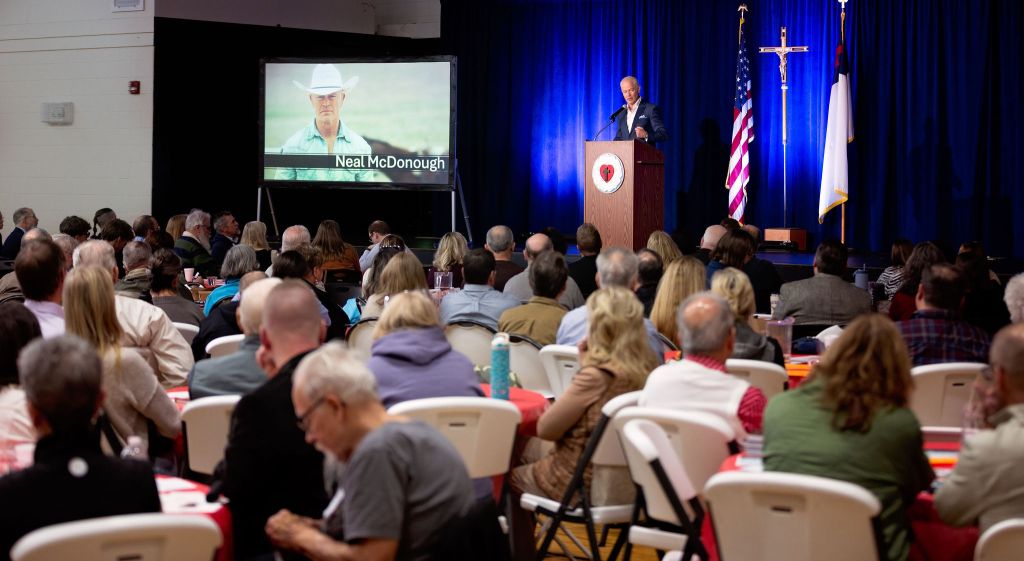
As many of you likely already know, last week we enjoyed our annual “The Body of Christ and the Public Square” (BOCPS) conference here at Our Savior in Hartland. For me, personally, what made the day truly extraordinary was not only that each speaker’s topic worked well with the others, ultimately building a stronger structure along the way, but that each used the mortar of encouragement while they worked. In other words, each made clear the importance of engagement in the public square. But then they also reminded listeners that God has promised the necessary courage for doing so. Resting in that promise, the encouragement became, “Go and be who you are in Christ. Go and be who He’s made you to be by His truth.”

I was the first to speak that morning. I’ll let you in on a little secret. My speech was a whole lot longer than what the attendees actually heard. Go figure, right? Well, just know that I skipped over a section for the sake of time.

If you were there, you’ll remember I shared a seconds-long video I thought captured something hopeful concerning the forthcoming generation. It showed the Hartland and Brighton football teams kneeling together in prayer after their game a week earlier. In context, these were young men who’d spent the evening in competition, and yet, even after beating each other up for an hour, they gathered together at center field, bowed their heads, and acknowledged something greater than the competition—the truth of Christ.

The primary thrust of my speech was allegiance to truth no matter what. And so, the video worked. It showed the importance of truth in a divided world. But then there was the section immediately afterward that I skipped—a story I was going to tell but didn’t. Had I shared it, it would’ve shown a striking contrast to the previous video.

Essentially, the Thursday before the BOCPS conference, my wife Jennifer and I attended our daughter Evelyn’s volleyball game. She plays varsity for Linden. It was a home game against Swartz Creek. While there, we sat maybe four or five rows from the floor, directly behind a group of about ten Linden football players who had come to watch the girls play.

Near the end of the final match, a parent—the father of one of the Swartz Creek players—walked past the group of boys, as anyone might when heading to concessions or the bathroom or stepping out to make a phone call. But as he walked by, one of the boys made a crass remark about him to the others, loud enough that Jennifer and I could hear it over the gym’s noise. The other boys erupted in laughter.

The man paused, looked back, paused again, but then decided to keep walking. There’s no question he’d heard what they said. Unfortunately, they kept looking and laughing, so he knew they were mocking him too. He glanced backward a few more times as he left the gym, as if he wanted to return and say something. But he didn’t.

Eventually, he did return. The boys started back up again. Walking by, he gave a few looks, showing he’d heard them the first time, but he still didn’t say anything and went straight to his seat. In my humble opinion, he showed incredible restraint, especially since he didn’t make a scene during the game. However, when he finally sat down a section and a half away, he didn’t position himself to watch his daughter play. He positioned himself toward the boys. In other words, he sat and stared them down the rest of the game. The boys saw him, but only did what they were doing before.

Now, Jennifer and I were not the only ones aware of what was happening. The group of parents just to our right saw the whole thing, too. At one point, one of them, one of our team’s bigger, more muscular dads (a man I thought at first was one of the Linden wrestling coaches but learned later wasn’t), moved down several rows and positioned himself directly in the offended man’s line of sight, effectively shielding the boys from his stare. Of course, the boys kept at it.

When the game ended, the Swartz Creek dad immediately went to the boys to confront them—as any man would. But here’s the thing. The Linden dad got up just as immediately, and no matter how the Swartz Creek man maneuvered, he positioned himself between him and the boys. As you might expect, the man inevitably started speaking his mind with some volume. The Linden dad finally told the man, in no uncertain terms, to get lost. Then he turned to the boys and assured them they had nothing to worry about because, in his words, the man was “obviously a goofball.”

Those were his words. Jennifer and I heard it all. And we couldn’t believe it.

I went straight down the rows, cutting between the boys, to the Linden dad who, again, I thought at the time was one of our coaches who might correct them, and said very plainly in front of all of them that the Swartz Creek man was in the right. I told him the man had every reason to be upset for what our team’s boys had said and done. I told him my wife and I were sitting right behind them, and that we’d heard and seen it all.

Interestingly, the Linden dad didn’t suddenly reverse course or see error in his efforts. He sort of laughed it off. Even worse, he seemed genuinely surprised that I would defend someone from the opposing team rather than the boys from our own.

Now, I suppose someone might argue that the Linden dad was simply trying to defuse the situation. Maybe that’s what he thought he was doing. But I don’t think he defused anything. In fact, I think he made matters worse, especially by turning to the boys and calling the man a name, just as they’d been doing. First, by participating in the behavior—the name-calling—he reinforced it and added insult to injury. And second, by shielding the boys from the consequences, he gave them permission to do it again.

As for how I know he didn’t defuse the situation, when Jennifer and I got outside, the Swartz Creek dad was still in the parking lot. And by the way, I haven’t mentioned that he was by no means a non-intimidating gent by appearance. Inside the gym, he had clearly been limiting himself. But here he was now, waiting in the parking lot, stewing furiously. His wife was furious, too, as were two other people who were with them. I can promise you, the situation was far from over.

Nevertheless, Jennifer and I went to him anyway. And listening through some extreme profanity, we eventually told him we saw what happened and that he had every reason to be upset. We told him Linden had been a terrible host, and we apologized for how he was treated.

After a few minutes of conversation, guess what happened next.

He was grateful for the understanding, the temperature dropped, and the tension finally dissipated. Essentially, what was about to become an uglier confrontation in the Linden parking lot ended with a measure of control.

We finally parted ways, thanking each other for the time. They all got into their cars. We got into ours. And we all went home. End of story.

Now, I realize this may seem like no big deal to some. I’ll bet some of you are even reading this and thinking, “Boys will be boys, and that man was an adult. He should’ve known better and just ignored them. Sticks and stones and all that.” I suppose if that’s your position, then you definitely need to keep reading. Yes, teenage boys will do stupid things. I’ve raised two of them, so I understand immaturity as a sign of teenage territory. What’s more, I know this in myself. Looking back on my own life as a young man, as the meme goes, I’m glad smartphones didn’t exist.

That said, the situation is a troubling one, and not only because of what the boys did, but because of what none of the parents seemed willing to do.

Here was an opportunity for Linden parents, at least the ones who knew what had happened, to teach their own a little something about respect, decency, and personal responsibility. It was a chance to remind them that wearing a Linden jersey—bearing the community name—carries with it a responsibility to represent their own honorably. Even better, it was a moment to experience the heavy, but also quite valuable, weight of apologizing for being in the wrong.

Instead, those boys learned something that I believe is terribly dangerous for our society as a whole. They were taught to defend their own regardless of what their own have done. When we as adults do this, in a sense, we’re teaching them that truth only matters when it serves them—and that’s a very bad lesson to carry into adulthood. It’s one that the rest of society will pay for in the end, because ultimately, it teaches that right and wrong depend on our own established loyalties. This is the absolute opposite of what I talked about in my already lengthy speech last Saturday. I made the point that objective truth doesn’t belong to us. We belong to it. We did not invent it. We are not its authors. We are its witnesses and, at crucial moments along the way, we are called to be its unflinching servants, even when that means we’ll have to eat some crow.

I suppose this is maybe where the whole thing extends beyond a varsity volleyball game and into the rest of our individual lives. We all tend to excuse behavior in people we like that we would almost certainly condemn in people we dislike. Indeed, we all have an innate tendency to defend those who share our convictions, even when they have plainly violated the very convictions we claim to hold.

I started my speech at the BOCPS conference talking about how parents bear the most responsibility in a society. Considering what I just shared, I’m not so sure we can, as parents, expect our children to develop the moral courage our society so desperately needs if we’re going to excuse moments like the one beside the volleyball court in Linden—especially if that behavior is the rule more so than the exception. We need kids who can speak truth to anyone, even when the wrongdoer is wearing the same jersey.

Now, do you see why I cut this from the speech? There’s a lot here. Still, the contrasting images remain relatively immediate for me. I watched that video of those Hartland and Brighton football players kneeling together in prayer two days before I experienced what I did at the volleyball game. The first was a moment when young men from opposing teams acknowledged something that superseded their loyalties. Then along came the second, one demonstrating the exact opposite.

I suppose I’ll leave it there. Or, at least, I’ll close by saying that if we want our boys to become good men, we’d better, as parents, have the courage to teach them what that means. In this case, it means standing against our own, especially when our own are clearly in the wrong.

The world already has plenty of people willing to throw their whole selves into defending their side. What it desperately needs is people willing to throw their whole selves into defending what’s actually true, even when it comes at a personal cost.

That kind of courage, no matter what anyone else might say, always begins at home.

Work that Matters

I’m not going to lie. There’s a particular kind of exhaustion that follows our “The Body of Christ and the Public Square” conference here at Our Savior every year. As usual, I definitely felt it when my head hit the pillow last night. I suppose I’m feeling it right now as I type this while also knowing I need to finish the sermon for this morning.

I’ll get to it. In the meantime, a few quick thoughts need to materialize.

For starters, the people here at Our Savior who come together to make the event happen are not strangers to the same exhaustion I described. They already know that by the time the guest speakers have been delivered to airports and all the attendees have gone home, a year’s worth of work will have just coalesced into an eight-hour event. And when I say “a year’s worth of work,” I mean it. I started conversations with next year’s potential speakers a few weeks ago.

By the way, this year marked our twelfth year doing this and our twenty-fifth conference. Our MC, Dr. Chad Savage, has been with us since very near the beginning. He mentioned something during the event that caught my attention. He said he read that most conferences of this sort last about four or five years, holding one event per year, before eventually running out of steam and disappearing. If that’s true, then what we have here—the partnerships we’ve cultivated and the opportunities we’ve been given to influence—well, it’s all pretty special. If anything, it says something about the people here who keep showing up to do the work. Year after year, they take on arduous tasks, having already decided that the work is worth doing.

But I need to admit something to you. Within the last two or three years, I’ve told myself the forthcoming conference would be the last. This back-and-forth conversation with myself typically happens the week before. I know why. Because the pre-conference week is no different than every other already over-scheduled and under-accommodated week. Except this one has a thousand additional things from a year’s worth of planning to execute.

And yet, having said that, when I experience the congregation members around me smiling and serving and commending the effort to the Lord, as if they’re privileged rather than taxed by the burden, the thought of calling it quits dissipates.

Every year, the people here pull together to accomplish something that requires considerable time, patience, and dedication. They make room in their already busy lives. They accept responsibilities and fulfill them, knowing that few of the attendees, if any at all, will ever know or see how much they gave of themselves to make the experience possible. They do all this without expecting anyone to remember the part they played.

But their faithfulness takes shape in an event that makes it possible for people to gather, listen, think, and leave better prepared to engage in the world around them. It truly is a glorious demonstration of service, and again, I want you to know that ours happens because Christians in this place have decided the work is worth doing, even when nobody knows who’s doing it.

This year, Neal McDonough, Nick Freitas, Timothy Goeglein, and Father Calvin Robinson joined us as speakers. I spoke, too, as I always do. But that’s not important, because I already know and love this congregation, so I’m willing to do what needs to be done to see her double down against an encroaching world.

But the speakers don’t necessarily know or understand this place’s commitment to her Lord and what He has cultivated here. At least, not the first-timers. But then they arrive and get close to us—they’re brought into the trenches beside us—and suddenly, they understand.

In a way, you know that understanding has taken hold when the relationship for them is no longer celebrity to fan, or speaker to audience, but when they give up that distance backstage, letting their very real humanness show. That’s when you realize they see the value of a place like this just as much as you do.

I don’t know if that makes any sense. Maybe think of it from the other direction. A person’s public reputation can sometimes make it easy to forget the person himself. There’s a distance there. We recognize a face, associate it with a podcast or a movie we’ve seen or whatever, and we begin thinking of someone almost entirely in terms of what he represents. The same probably goes for the guest speaker. He gets an invitation and understands the relationship from a distance.

But then he reaches a moment when he’s willing to light up a cigar, sip a whisky on your deck, and talk about everything and nothing conference-related. That, for example, was my time with my friend, Father Robinson.

Or maybe, rather than requiring a limousine service to catch his flight, he prefers to climb into your Jeep Wrangler and spend an hour together with a new friend, talking about everything and nothing, during the hour-long drive to the airport. That was my experience with Neal.

Even better, when I dropped him off at the airport, I told him that even though I hadn’t met his family, I hoped someday I would. I barely got the thought out before he interrupted me, gave me a hug, and said, “You will.”

Neal became more than a speaker at our conference. He has become a friend. And friends are more interested in continuing the work together than getting an honorarium check and then saying goodbye.

And for the record, Neal’s expressed sentiment wasn’t meant only for me. He made it clear that his affection extends to the people here at Our Savior, too—to what we’re doing in this place. While driving, the more he learned about us—the intensity of our biblical fidelity, rich and reverent liturgy, creedal faithfulness, and the muscle we put into providing a tuition-free Christian school to the community—the more he insisted that when he comes back to Michigan (and he has every reason to do so since his son attends college here), he wants to stop by to say hello.

Believe it or not, that didn’t surprise me. I’ve already experienced it a hundred times with other speakers who’ve joined us here, some actually asking to return over the years. Like so many others, this place got under Neal’s skin in the best possible way.

As an aside to my critics, let me just say that it’s in moments like these that you’re reminded how much gets lost when we know people only from a distance. It’s not until you’re side by side that you can understand how we’re both human beings concerned with human things. But we’re also concerned about things that mean so much more—things like faith, how that faith is communicated to and maintained in the world around us, the well-being of our neighbors, family, and the kind of world our children will inherit after everything we’ve lived for is finally represented by that little line between the dates on our headstone.

It was a delight visiting with Neal about this stuff. It was a pleasure getting to know Nick. Of course, I never regret my time with Father Robinson or Tim Goeglein. They are men I respect deeply.

But regardless of the speaker, anyone who has ever taken a chance and cultivated a relationship with our efforts here in the middle of nowhere Michigan has left the place knowing there’s a group of diligent people more than willing to take responsibility for the things worth caring about.

In a way, that’s pretty much what our conference is meant to encourage.

Engagement in the public square begins with understanding that the people affected by public decisions are our neighbors. Questions concerning human life, religious liberty, education, family, and the freedom to speak truth reach into actual homes. They shape what parents can do, what children are taught, and how freely Christians can live according to their convictions.

I firmly believe that sincere faith in Christ, vividly shown through love for God and for their neighbors, is what moves the people in this place to care about these things. It most certainly moves them to participate when participation becomes uncomfortable. And why wouldn’t it? Christ told His Christians that we bear responsibilities toward the world around us.

I mentioned in my speech yesterday that the public square will be occupied by someone. The people who made it possible for Neal McDonough, Nick Freitas, Timothy Goeglein, Father Robinson, and me to give speeches are convinced that the Church’s absence in the public square is a bad thing. And so, they’re making sure Christians know they belong there. Even better, they want Christians to know they can serve on a school board, or speak at a public meeting, or talk to a friend about what God’s Word says about a topic deemed too political, or maybe even help organize a conference that, over the course of twelve years and twenty-five events, has equipped and strengthened thousands of Christians to do these things and so much more.

Since I already mentioned the critics, as some of you already know, an event like ours draws both good and bad attention. Every year, there are those who belittle the effort, including some within my own Lutheran Church—Missouri Synod’s circles. But whatever. I deal with it every year, and I expect I’ll be dealing with it for as long as we choose to continue the effort. I mean, if I made my critics’ approval a condition of service, then I’d already have my reason to quit.

But the people here at Our Savior doing the work deserve better than that. And so does the community benefiting from it.

I’ve already rambled on for long enough. So, to close, just know that I’m thankful for our speakers, our attendees, and especially the people of God here at Our Savior whose dedication makes this gathering possible year after year. Their service equates to a bright-beaming light of encouragement. Their willingness reminds me that preserving what’s good involves people from all walks of life who are willing to do what needs doing—especially when the work is hard.

As I said, I expect I’ll hear from the critics again. But in the meantime, there are good things worth defending, and there are Christians and neighbors who need to know what those things are and how to get in the game and defend them.