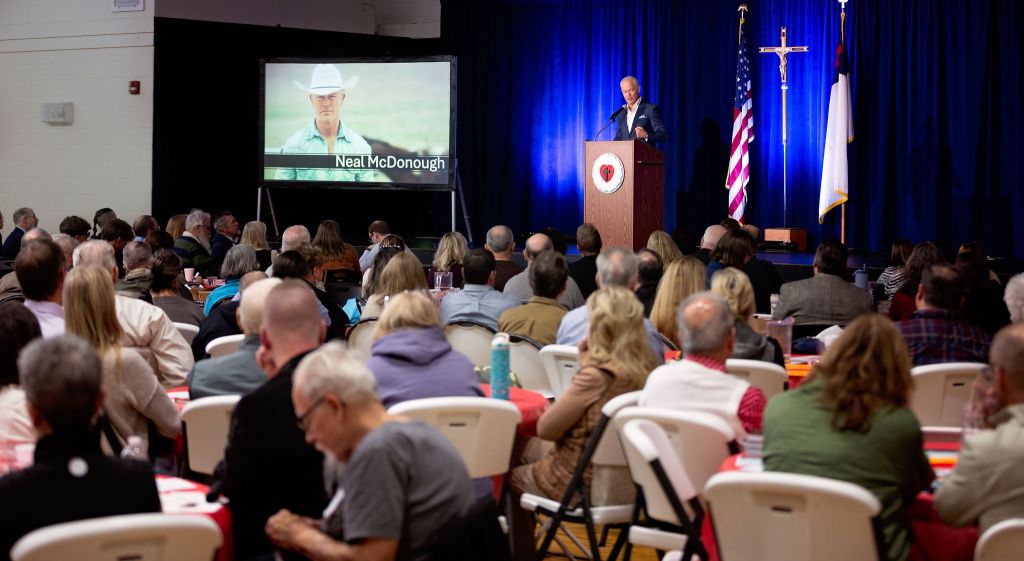
I’m not going to lie. There’s a particular kind of exhaustion that follows our “The Body of Christ and the Public Square” conference here at Our Savior every year. As usual, I definitely felt it when my head hit the pillow last night. I suppose I’m feeling it right now as I type this while also knowing I need to finish the sermon for this morning.
I’ll get to it. In the meantime, a few quick thoughts need to materialize.
For starters, the people here at Our Savior who come together to make the event happen are not strangers to the same exhaustion I described. They already know that by the time the guest speakers have been delivered to airports and all the attendees have gone home, a year’s worth of work will have just coalesced into an eight-hour event. And when I say “a year’s worth of work,” I mean it. I started conversations with next year’s potential speakers a few weeks ago.
By the way, this year marked our twelfth year doing this and our twenty-fifth conference. Our MC, Dr. Chad Savage, has been with us since very near the beginning. He mentioned something during the event that caught my attention. He said he read that most conferences of this sort last about four or five years, holding one event per year, before eventually running out of steam and disappearing. If that’s true, then what we have here—the partnerships we’ve cultivated and the opportunities we’ve been given to influence—well, it’s all pretty special. If anything, it says something about the people here who keep showing up to do the work. Year after year, they take on arduous tasks, having already decided that the work is worth doing.
But I need to admit something to you. Within the last two or three years, I’ve told myself the forthcoming conference would be the last. This back-and-forth conversation with myself typically happens the week before. I know why. Because the pre-conference week is no different than every other already over-scheduled and under-accommodated week. Except this one has a thousand additional things from a year’s worth of planning to execute.
And yet, having said that, when I experience the congregation members around me smiling and serving and commending the effort to the Lord, as if they’re privileged rather than taxed by the burden, the thought of calling it quits dissipates.
Every year, the people here pull together to accomplish something that requires considerable time, patience, and dedication. They make room in their already busy lives. They accept responsibilities and fulfill them, knowing that few of the attendees, if any at all, will ever know or see how much they gave of themselves to make the experience possible. They do all this without expecting anyone to remember the part they played.
But their faithfulness takes shape in an event that makes it possible for people to gather, listen, think, and leave better prepared to engage in the world around them. It truly is a glorious demonstration of service, and again, I want you to know that ours happens because Christians in this place have decided the work is worth doing, even when nobody knows who’s doing it.
This year, Neal McDonough, Nick Freitas, Timothy Goeglein, and Father Calvin Robinson joined us as speakers. I spoke, too, as I always do. But that’s not important, because I already know and love this congregation, so I’m willing to do what needs to be done to see her double down against an encroaching world.
But the speakers don’t necessarily know or understand this place’s commitment to her Lord and what He has cultivated here. At least, not the first-timers. But then they arrive and get close to us—they’re brought into the trenches beside us—and suddenly, they understand.
In a way, you know that understanding has taken hold when the relationship for them is no longer celebrity to fan, or speaker to audience, but when they give up that distance backstage, letting their very real humanness show. That’s when you realize they see the value of a place like this just as much as you do.
I don’t know if that makes any sense. Maybe think of it from the other direction. A person’s public reputation can sometimes make it easy to forget the person himself. There’s a distance there. We recognize a face, associate it with a podcast or a movie we’ve seen or whatever, and we begin thinking of someone almost entirely in terms of what he represents. The same probably goes for the guest speaker. He gets an invitation and understands the relationship from a distance.
But then he reaches a moment when he’s willing to light up a cigar, sip a whisky on your deck, and talk about everything and nothing conference-related. That, for example, was my time with my friend, Father Robinson.
Or maybe, rather than requiring a limousine service to catch his flight, he prefers to climb into your Jeep Wrangler and spend an hour together with a new friend, talking about everything and nothing, during the hour-long drive to the airport. That was my experience with Neal.
Even better, when I dropped him off at the airport, I told him that even though I hadn’t met his family, I hoped someday I would. I barely got the thought out before he interrupted me, gave me a hug, and said, “You will.”
Neal became more than a speaker at our conference. He has become a friend. And friends are more interested in continuing the work together than getting an honorarium check and then saying goodbye.
And for the record, Neal’s expressed sentiment wasn’t meant only for me. He made it clear that his affection extends to the people here at Our Savior, too—to what we’re doing in this place. While driving, the more he learned about us—the intensity of our biblical fidelity, rich and reverent liturgy, creedal faithfulness, and the muscle we put into providing a tuition-free Christian school to the community—the more he insisted that when he comes back to Michigan (and he has every reason to do so since his son attends college here), he wants to stop by to say hello.
Believe it or not, that didn’t surprise me. I’ve already experienced it a hundred times with other speakers who’ve joined us here, some actually asking to return over the years. Like so many others, this place got under Neal’s skin in the best possible way.
As an aside to my critics, let me just say that it’s in moments like these that you’re reminded how much gets lost when we know people only from a distance. It’s not until you’re side by side that you can understand how we’re both human beings concerned with human things. But we’re also concerned about things that mean so much more—things like faith, how that faith is communicated to and maintained in the world around us, the well-being of our neighbors, family, and the kind of world our children will inherit after everything we’ve lived for is finally represented by that little line between the dates on our headstone.
It was a delight visiting with Neal about this stuff. It was a pleasure getting to know Nick. Of course, I never regret my time with Father Robinson or Tim Goeglein. They are men I respect deeply.
But regardless of the speaker, anyone who has ever taken a chance and cultivated a relationship with our efforts here in the middle of nowhere Michigan has left the place knowing there’s a group of diligent people more than willing to take responsibility for the things worth caring about.
In a way, that’s pretty much what our conference is meant to encourage.
Engagement in the public square begins with understanding that the people affected by public decisions are our neighbors. Questions concerning human life, religious liberty, education, family, and the freedom to speak truth reach into actual homes. They shape what parents can do, what children are taught, and how freely Christians can live according to their convictions.
I firmly believe that sincere faith in Christ, vividly shown through love for God and for their neighbors, is what moves the people in this place to care about these things. It most certainly moves them to participate when participation becomes uncomfortable. And why wouldn’t it? Christ told His Christians that we bear responsibilities toward the world around us.
I mentioned in my speech yesterday that the public square will be occupied by someone. The people who made it possible for Neal McDonough, Nick Freitas, Timothy Goeglein, Father Robinson, and me to give speeches are convinced that the Church’s absence in the public square is a bad thing. And so, they’re making sure Christians know they belong there. Even better, they want Christians to know they can serve on a school board, or speak at a public meeting, or talk to a friend about what God’s Word says about a topic deemed too political, or maybe even help organize a conference that, over the course of twelve years and twenty-five events, has equipped and strengthened thousands of Christians to do these things and so much more.
Since I already mentioned the critics, as some of you already know, an event like ours draws both good and bad attention. Every year, there are those who belittle the effort, including some within my own Lutheran Church—Missouri Synod’s circles. But whatever. I deal with it every year, and I expect I’ll be dealing with it for as long as we choose to continue the effort. I mean, if I made my critics’ approval a condition of service, then I’d already have my reason to quit.
But the people here at Our Savior doing the work deserve better than that. And so does the community benefiting from it.
I’ve already rambled on for long enough. So, to close, just know that I’m thankful for our speakers, our attendees, and especially the people of God here at Our Savior whose dedication makes this gathering possible year after year. Their service equates to a bright-beaming light of encouragement. Their willingness reminds me that preserving what’s good involves people from all walks of life who are willing to do what needs doing—especially when the work is hard.
As I said, I expect I’ll hear from the critics again. But in the meantime, there are good things worth defending, and there are Christians and neighbors who need to know what those things are and how to get in the game and defend them.

