
Not all that long ago, I told my son Harrison that I almost certainly produce more reading material than I consume. Don’t get me wrong. I read a lot. And yet, regardless of my intake levels, I never seem to run out of things to say. A person only needs to look around. There’s always something to observe, analyze, and describe if you’re willing to take the time.
Still, I should read more than I do, if only to expand my repertoire. It’s true I have a habit of revisiting books I’ve already read. Doing so always proves fruitful. It seems there’s always something new a person can take away from repeat visits with a favorite volume. For example, I’ve read Charles Dickens’ The Cricket on the Hearth more times than I can count, and I always notice something new. The same goes for C.S. Lewis’ The Screwtape Letters. Interestingly, when I see folks online posting supposed meme-form quotations from Screwtape as prophetic musings applicable today, I can usually tell whether the quotation is genuine. Most of the time, it isn’t. You’ve heard the saying “Familiarity breeds likeability.” Well, familiarity also breeds discernibility.
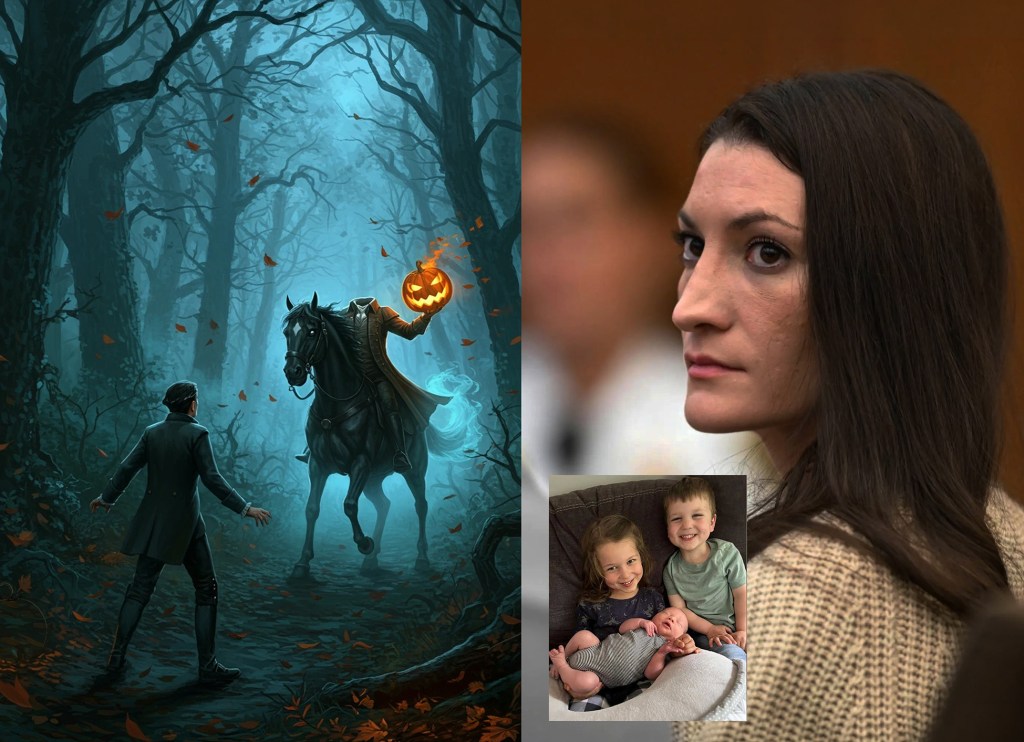
Another book I read at least once a year is Washington Irving’s The Legend of Sleepy Hollow. I crack it open every autumn. Indeed, when the Michigan sky begins gathering its grays, when temperatures begin dipping lower, and the chlorophyll in the leaves begins breaking down, leaving behind the colors my wife enjoys so much more than I ever could, it’s right about then that I start sensing the story’s draw.
I can’t say for sure how long I’ve been doing this. It’s been at least fifteen years or so. Before that, it was only occasionally.
I first fell in love with the story as a kid in Illinois. An older gentleman, one of the librarians at the Danville Public Library, saw me reading Stephen King’s Cycle of the Werewolf and thought I might enjoy it. He was right. Since the story is in the public domain, I took the liberty of publishing my own hardcover version in 2019 under my personal imprint, Angels’ Portion Books. I designed an elegantly eerie cover, scribbled a description designed to draw even the least interested reader’s attention, and then inserted my own introduction at the beginning of the manuscript, explaining why the story owned my devotion—and why it deserves everyone else’s, too. I did the same for a few other volumes I’ve always enjoyed, such as The Call of the Wild, Treasure Island, and, as you might expect, The Cricket on the Hearth. Each has a cover blurb and an introduction meant to lift what lives in my heart and set it into another’s.
Since I’ve written thousands of pages about thousands of things, odds are I’ve likely shared with you before the one line from The Legend of Sleepy Hollow that captured me so many years ago.
Very near the end of the story, just after Ichabod goes missing and the townsfolk do what townsfolk do—which is gossip—there’s a passage that explains how they “shook their heads and came to the conclusion that Ichabod had been carried off by the Galloping Hessian.” Contextually, this means most in the community accepted that, in a moment of sheer terror, their schoolteacher, Ichabod Crane, had been captured by an otherworldly specter and likely hauled away screaming into a terrible world between worlds.
How dreadful for Ichabod!
But then, the very next sentence is, in my opinion, the volume’s most frightening. It reads: “As he was a bachelor, and in nobody’s debt, nobody troubled his head any more about him.”
Wait, what?
For the record, headless horsemen don’t scare me. Werewolves and vampires don’t scare me, either. Aliens? Ghosts? Psychos in hockey masks with machetes? Yawn. Just ask my family. They’ll confirm I’m yet to discover a book or movie that has what it takes to put me on edge in the traditionally frightful sense. And also for the record, I’ve been reading and watching this genre since I was very young.
Still, there’s something different about the terror The Legend of Sleepy Hollow ultimately stirs. Since I already mentioned C.S. Lewis, it’s somewhat reminiscent of the very first line of his must-read volume A Grief Observed. The sentence reads: “No one ever told me that grief felt so like fear.”
What I mean is that it’s not so much Irving’s well-described spectral eeriness that puts a reader on the edge. It’s not even the headless Hessian who, as the majority of the Hollow’s residents superstitiously suspect, returned from the grave to carry someone away. It’s the grief of knowing Ichabod Crane evaporated from a community—the kind where everyone knows everyone—and no one cared in the least. They simply went about their lives as if he never existed in the first place.
That’s the real terror in the story. And even as a kid, I remember sensing it. I remember reading that one line and thinking, “How could it be that no one cares about what happened to Ichabod?” I know he was more or less an outsider. I know he didn’t necessarily even love the woman he was pursuing, Katrina Van Tassel, but was more interested in her father’s wealth. Still, that particular sentence is so distinct compared to everything else around it. It had me wondering what it would be like to disappear without even the slightest concern from anyone who knew me.
Although I suppose people did pay some attention to Ichabod’s disappearance. But it was all the wrong kind. Never mind Ichabod. Individual community members were concerned only to check their accounts to make sure he didn’t have any outstanding debts on their books. Han Van Ripper, acting as his executor, worried only about what to do with what few effects he’d left behind. And finally, without a splinter of memory for the missing man, the people immediately hired a new teacher and established a new schoolhouse in a different quarter of the Hollow.
In short, they cared about anything and everything surrounding Ichabod, but not Ichabod himself. Imagine that. Imagine in a tragedy’s aftermath being concerned with everything but the victim.
I’m pretty sure Irving’s narrative only pretends to be a ghost story. Really, it’s a commentary on something else. With that, for some reason, what I said before about familiarity breeding discernability has come back to mind.
Imagine if Irving would’ve gone further with his callous conclusion. Imagine if he’d given moral space to the headless Hessian’s actions, excusing them because, well, the angry ghost was struggling with a hyperfixation disorder. I mean, his head was taken off by a cannonball during the Revolution, resulting in a seemingly uncontrollable desire to wreak havoc while searching for it. Imagine if, rather than focusing on justice for Ichabod, the community aimed its investigation at understanding and proving the Hessian’s condition to help others living within the phantom plane avoid the same behavior.
By the way, anyone familiar with the story also knows Irving lets us wonder if it wasn’t actually the Hessian ghost who took Ichabod, but rather Brom Bones, Ichabod’s rival for Katrina Van Tassel’s love. Irving describes Brom as appearing “exceedingly knowing whenever the story of Ichabod was related,” even laughing when the pumpkin found at the scene is mentioned.
Imagine if Irving added additional material excusing Brom as suffering from some sort of maladaptive disorder, which he clearly does. Along the way, Brom is described as a “roistering blade” who looks for opportunities to fight pretty much everyone. He even leads a gang of young men Irving calls the “Sleepy Hollow Boys.” If Brom were alive today, he’d almost certainly be tagged with an impulse-control disorder—or maybe clinical narcissism—something likely caused by childhood trauma.
Imagine if Irving left the reader to assume that no matter what happened to Ichabod, whether it was the Hessian or Brom who offed him, it wasn’t either of their fault. Not really. They were both mentally ill. Which means they didn’t do it. Their conditions did.
Yeah, I know, technically, those imaginings aren’t in the story. And yet, they aren’t far removed from Irving’s own trajectory. He certainly framed the impulse that inspired them.
And so, I say once again, familiarity breeds discernibility. Admittedly, there’s something awfully familiar about all this. But I can’t quite put my finger on it. I mean, aside from a clinical diagnosis of the story’s villains, what’s so familiar about the people of Sleepy Hollow finding plenty to discuss after Ichabod’s demise—that is, everything except Ichabod himself?
The only thing I can think to say is that, for some reason, Irving’s tale feels less like an old ghost story than it should. It’s almost as if something happened relatively recently, and whatever it was, it proved that three centuries later, human beings still have a remarkable talent for making the victim the least interesting part of the tragedy.

