Slander Is Not Conversation

I try very hard not to block people. I really do. I can tolerate disagreement, argument, and even a fair amount of foolishness. But when someone shows up with a chip on his shoulder and a disposition aimed mainly at stirring the pot, and when he offers nothing that helps anyone understand the matter more deeply than before he arrived, such a visitor becomes tiresome. Even further, if a person continues to perpetuate the lies told about Charlie Kirk—the lies that helped make the hatred that got him killed seem permissible—that has become an absolute line for me. I have no obligation to keep handing a microphone to slanderers, no matter who they are. Again, I can tolerate disagreement. I can even put up with trolls for a little while. However, I am entirely uninterested in pretending that slandering my friend is conversation.

Charlie Is A Martyr

It pretty much goes without saying that many Christians grow uneasy when the conversation turns to politics. They hear words like life, marriage, family, manhood, womanhood, religious liberty, and natural law, and they instinctively hesitate. Why is this?

I give speeches about this on occasion. I do so because, unfortunately, Christians have been incessantly told these are political issues. Perhaps worse, their pastors were trained to think of them that way, too. Admittedly, while I don’t remember a single lesson in Two Kingdoms theology at the seminary, I do remember being told to avoid talking politics with my people. And so, for many years, I didn’t, which meant I naturally avoided any topic labeled as political. The ill-fated result was a type of absolute separationism that the Founding Fathers did not intend. Still, somehow the Church was convinced to leave the state to its dealings and the Church to hers. Indeed, we churchmen have far more important things to do—Word and Sacrament things. Local, state, and federal policy is none of our business.

Are you sure about that?

I suppose there’s a reasonable measure of piety to be found in the concern, if only because the Christian pulpit should never become a place where the Gospel is reduced to an election strategy. I certainly didn’t endure seminary training to become little more than an appendage of Washington, Lansing, or any other earthly capital.

So, I suppose in one sense, I agree with the concern. Still, the piety as defined is incredibly incomplete.

Life in the parish has taught me a few things. For starters, I’ve learned that the devil is quite happy to be in charge of deciding what belongs in whatever category. He convinces a husband that watching porn doesn’t equate to cheating on his wife. He convinces a believer that he can still call himself a Christian while refusing to attend worship. Yeah, okay. Similarly, in this instance, Satan is more than pleased to slap the label “political” onto something if, by doing so, that means the Church will steer clear of it, if only because the label marks its object as out of bounds. I’ve been told by countless Christians that the topic of abortion is political. I’ve been told by just as many that marriage laws and LGBTQ Inc.’s efforts are civil issues—political issues—and therefore, none of the Church’s business. I’ve had fingers wagged at me for saying from the pulpit that transgender surgery for children is ungodly child-mutilation, and that to insert that into a sermon was political.

The devil is also quite content to corral us into using only Bible-y words. He’s more than happy to let us talk about peace and forgiveness and love for the neighbor in the abstract while the unborn child is treated as disposable—while marriage is completely redefined, families are destroyed, and children are handed over to ideologies that teach them to despise the bodies God gave them. The devil is quite pleased to have us speak in generalities from the pulpits and in Bible studies about God’s beautiful creation while male and female are legislated into costumes, religious liberty is recast as bigotry, and natural law is openly mocked as though that same beautiful creation has no say whatsoever.

So yes, call them political issues if you want. I suppose, at a minimum, doing so helps a person see where the fight is actually taking place. It helps you see that life is debated in legislatures. It shows you that marriage is being defined by the courts, and that family is being shaped by school boards and bureaucracies. It reveals that religious liberty is currently being defended or surrendered through public pressure, leading to ungodly statutes lathered in dreadful policies that persecute rather than preserve. Natural law is suffering the same. Have you noticed how it’s essentially being buried under a mountain of slogans?

Quite frankly, the devil prefers these topics to be fixed in the political sphere. The kingdom of the left—the civil government—is the one place where human beings can be forced to submit under threat. It’s in the kingdom of the left where humans can either formalize reality or rebel against it.

I learned years ago to narrow my eyes at anyone who equates biblical fidelity with political speech. That’s because I’ve since learned that many, even in the Church—especially in the Church—have it backward.

The first thing to keep in mind is that politics was second to the discussion. Christ was here first. With that, I’m willing to say that almost every major cultural issue in our world today is already Christological in nature, especially the ones I already mentioned. They do not belong first to politics. They belong to Christ. That means they belong to the Church. That also means the world cannot tell us when, where, and how we ought to speak of or engage with them. We own them.

The topic of life belongs to us because Christ is the Author of life, the One in whom was life and through whom all things were made (John 1:3-4, Acts 3:15). Marriage belongs to us because God’s Word makes clear that Christ is the epicenter of its mystery from the beginning (Ephesians 5:25-32). He is the Bridegroom. We are the bride. Family belongs to us because Christ has revealed God as Father and has made us His children through Baptism (Matthew 6:9, Galatians 3:26-27, and Ephesians 3:14-15). Manhood belongs to us because of Christ’s incarnation. He is the eternal Word made flesh and is the one mediator between God and men, the man Christ Jesus (John 1:14, 1 Timothy 2:5, and Hebrews 2:14-17). Womanhood belongs to us for the same reason. Christ took upon Himself flesh from the Virgin Mary and honored motherhood in the economy of salvation (Luke 1:30-35, 42-43 and Galatians 4:4). Religious liberty belongs to us because Christ alone is Lord of the Christian conscience, and we must obey God rather than men (Acts 5:29, Romans 14:4, and 1 Corinthians 7:23). Natural law—which pretty much touches everything in the entire world—belongs to us because all things were created through Christ and for Christ (Romans 11:36). Not only that, but the law written on the heart still bears witness to the Creator’s order (Romans 2:14-15 and Colossians 1:16-17).

Having said this, and considering recent rumblings in the Lutheran Church—Missouri Synod as it heads into convention this summer, I should add that this is also where the objection to calling Charlie Kirk a martyr begins to come undone.

Some Christians insist he died as a result of political speech. Some will go still further and say it was divisive political speech, maybe even bigoted. And then, like clockwork, they’ll regurgitate some of the more popular fabrications. For example, even though he regularly had black female guests as experts on his show and as speakers at TPUSA events, some quote him as saying, “Black women do not have the processing power to be taken seriously.” He never said that. Ever. The line is an outright invention, and yet it keeps getting passed around, if only because it does exactly what his enemies need it to do. As another example, people say he called LGBTQ people a “contagion.” He didn’t call anyone a contagion. But he did point to reliable statistics, referring to the rising numbers of gay and transgender children as demonstrating “social contagion” metrics, and from there, he warned against the increased ideological capture of children through the rejection of God’s natural law and the deliberate confusion of the body God gives.

Ultimately, fabricated quotations, mangled summaries, and phrases ripped from context will never define anyone, most especially Charlie. He was a crisp speaker, arguing from the lordship of Christ over all things. To his enemies, he was horrifyingly effective. Therefore, it became necessary to recast Charlie’s perspectives into “racism,” “hatred,” or “bigotry.”

But Christians know better. We know the real point is what he actually confessed and why he confessed it, not what his opponents needed him to have confessed in order to despise him. Ultimately, Charlie engaged every topic as a Christian, openly insisting that his listeners first understand faith in Christ as his point of origin in every discussion or debate. In other words, he did everything as an emissary of Jesus. He observed each and every topic through the lens of the Gospel, and then went straight into public conversation as one who already knew Christ owned any topic he chose to confront.

If a Christian is killed because he publicly confessed Christ’s claim over life, the body, marriage, the home, conscience, liberty, the order God has written into creation, and all the extraneous points extending from these things, simply calling it political speech just doesn’t work. If anything, it merely proves how successful the devil’s tactics have been. It shows how deeply politics has trespassed onto the Church’s property—onto holy ground.

In the end, the simplest point here is that heaven gives no permission to the Church to surrender these things. Caesar may regulate them. Courts will distort them. Activists from every strange perspective will weaponize them. Political parties of every persuasion will almost certainly exploit them. Still, they’re the Church’s property. The Church owns them all. She has received them from the hand of God, and with that, she goes forth into the world as their guardian, being sure to hold the government to its ordination relative to them.

I will always enter the public square without apology. Even as a pastor, I belong there. Of course, I don’t go there because politics is my ultimate. I go there because Christ is.

So, again, call all these things political if you want. But just remember what politics is actually doing. It’s merely trying to handle what Christ already owns.

Fear’s Ambiguity

There are moments when a church body betrays itself more by what it avoids saying than by what it actually says. Of course, you need more context to understand what I mean by this.

Essentially, I wrote and submitted an overture asking the Lutheran Church-Missouri Synod, in convention this summer, to acknowledge Charlie Kirk as a modern Christian martyr, establish September 10 as a Day of Prayer for Faithful Witnesses in Our Time, and call the Church to renewed courage in public confession under the cross. Two other similar overtures were submitted, both supported by multiple districts and circuits. Admittedly, mine was the more aggressive of them in asking the Synod to establish a specific day of prayer and remembrance. Still, the fact that there were three shows that the concern was shared by countless others. (You may read the original overtures on pages 330 and 331 in the Convention Workbook, which is found at https://files.lcms.org/file/preview/2026-convention-workbook.)

The floor committees responsible for handling the overtures have met. Their task was to review submitted overtures, combine related matters where they saw fit, and present final resolutions for action. In this case, they produced a generic omnibus resolution condemning political violence and encouraging public service while avoiding Charlie Kirk entirely. (You may read the replacement overture on page 91 by visiting  https://files.lcms.org/file/preview/2026-todays-business-issue-1.)

I’ll speak plainly for myself. The replacement overture currently on its way to the convention is a fine example of institutional evasiveness. It condemns political violence. It encourages peaceful participation in public life. It quotes Scripture. It even cites the Confessions. From there, it commends Lutheran resources on church and state. But together, it has the all-too-familiar scent of committee caution. The whole effort has been scrubbed clean of Charlie.

The whole reason this replacement overture even exists is that something concrete happened nine months ago. Charlie Kirk was murdered. It happened publicly. He was shot and killed for Christian conviction—for speaking in defense of life, marriage, family, manhood, womanhood, religious liberty, and the lordship of Christ over all things. These are all things treated with open contempt by very powerful forces in American life. His death was therefore more than another entry in the tragic ledger of political violence, as the new overture implies by withholding any and all references to him. Charlie’s death exposed what so many Christians in the trenches already know, and what many institutional churchmen still seem desperate to avoid—or at a minimum, soften. And it’s simply this: Confession of Christ in the public square has a cost.

Charlie paid it.

And yet, the replacement overture refuses to even mention his name. That alone tells me almost everything I need to know. By the way, I should make it clear that I am not accusing Committee Chairman Christopher Esget or Vice-Chairman Lucas Woodford of having a hand in this. I know them both. They were clearly outnumbered by both opponents and institutional cautionaries. The result? Smoothing the matter into a generic condemnation of political violence in order to lessen the risk of offending the more left-leaning elements in the LCMS, which I know exist. Back in March, I gave a speech seasoned with elements of my relationship with Charlie to a relatively large LCMS gathering. No sooner did I begin mentioning his name in a positive way than at least ten of the fifty-plus tables got up and walked out in protest.

How dare an LCMS pastor say anything positive about such a public figure espousing divisive rhetoric?! By divisive rhetoric, do you mean his fearless defense of what we LCMS Lutherans believe, teach, and confess in unity—in synod—in our supposed walking together?

Well, whatever. People getting up and walking out of one of my speeches doesn’t bother me. And it doesn’t change the central fact. Charlie confessed the true Christ, and with that, he was a public Christian figure who labored in defense of truths that Scripture teaches and the Church confesses. He spoke in the open. He did so knowing that, for one reason or another, many would hate him for it. Still, he went. And he was ultimately killed for that public confession and for no other reason. That is martyrdom in the truest sense of the word, and as I said, he’s the only reason we’re having this conversation.

Relative to the original three overtures, it seems a no-brainer that, throughout history, the Church has remembered her notable martyrs. That’s because we know with certainty that Christ sustained their confession under the cross. And so, naturally, the Church remembers them because their blood preaches with otherworldly eloquence to the living. And she says their names because she knows that nameless remembrance becomes abstraction.

Unfortunately, abstraction is almost always the first refuge of fearfulness. I’ve seen it a thousand times in the political sphere. We may be seeing it here, if only because the omnibus overture takes Charlie’s death and dissolves it into “multiple assassination attempts,” “violent conflicts,” and “many other sad examples of division.” Those things are real, and political violence should be condemned wherever it appears. However, the whole force of the matter is lost when the Synod is asked to speak about everything in general because it lacks the willingness to name Charlie in particular.

But again, we’ve seen this a thousand times. History teaches that’s exactly how bureaucracies mourn. They widen the lens until the real issue disappears into ambiguity.

Now, I know some are reading this and already objecting, assuming Charlie should be excluded from remembrance because his theology was not exclusively Lutheran. That brings to mind something I wrote and shared with the men in my own circuit with the same concerns when I first introduced the overture. At one point along the way, I wrote to them:

“Something came to mind during our Children’s Christmas service rehearsal yesterday morning. While we were singing Hark! The Herald Angels Sing, I was reminded that the hymn comes to us from Charles Wesley. As LCMS Lutherans, we are far from Charles Wesley doctrinally. We do not share his theology of the sacraments, ministry, or conversion. And yet, without hesitation, we sing his words, teach them to our children, and gladly receive the hymn as a faithful witness to the incarnation of Christ. We do this not because we endorse Wesley wholesale, but because we recognize that God’s truth can be confessed clearly and beautifully even through someone with whom we have real theological differences. We’re capable of distinguishing between honoring a faithful confession at a particular point and canonizing the entire theological system of the person who made it. At least, I believe we’re capable of making and maintaining that distinction within the Church. Either way, that’s the distinction I was reaching for with Charlie, who, many of you know, was my personal friend. The epicentral point of alignment is not that he was Lutheran, or that we would affirm every position he held, but that he died confessing Christ. His death was, in that sense, a confession of Christ to the end, and that confession stands on its own. Memorializing him by name need not imply doctrinal agreement any more than singing Wesley’s hymn does. Overture or hymn, in both cases, the Church is not saying, ‘This person was right about everything,’ but rather, ‘Here, Christ was confessed.’ That, it seems to me, is something we have long known how to recognize as Confessional Lutherans.”

Now, had I thought to do it at the time, I might even have added some of the names we recall formally in the Lutheran Service Book. Ironically, we remember Gregory the Great on September 3, which would be seven days before the date I’m recommending for Charlie. Gregory the Great played a role in developing the theology of purgatory in the Western church, a doctrine that Lutherans explicitly reject as dangerously false. Still, we remember him for other reasons, one of which is his Regula Pastoralis, a timeless exposition of pastoral care. Meanwhile, Charlie openly confessed himself a Christian according to the Nicene Creed, which I know firsthand served as a rudder for his public and private confession of Christ. Not to mention, he began events saying as much.

Apart from these things, indeed, this remains a teachable moment for our churches. In an age that requires bold confession—even as the replacement overture quotes Luther’s Large Catechism, rightly saying that the devil seeks to destroy peace through contention, murder, sedition, and war—I can assure you that Satan also appreciates bureaucratic fog, the kind that insists the best way through controversy is through safe and inoffensive generalities.

The Synod had before it three concrete opportunities to teach clearly about martyrdom, vocation, public witness, and the cost of confessing Christ in an increasingly hostile age. At a minimum, it could’ve edited those, easily showing, without causing any division, that Charlie Kirk’s death matters because public Christian confession matters. His death became a holy opportunity for the Church to preach Christ crucified while teaching her children that those joined to Christ should expect opposition. When a public Christian is murdered amid rising hatred for Christian truth, the Church should have enough nerve to call it what it is. She should at least have enough wits about her to understand that the real human being at the event’s center ought not go unnamed.

In the end, I don’t really care which of the three overtures the committee might choose to handle. Personally, the Wyoming overture is probably the best of the three. But either way, choose one. Cultivate it, if necessary. And as you do, leave its core alone. Leave Charlie Kirk in it. He must be named. His witness should be acknowledged. His death should be interpreted theologically. His murder should be condemned concretely. His example should summon the Church to the courage she’ll need in the forthcoming era.

If we cannot do that, the failure will say more than the replacement overture ever could. And I dare say that, since I was working with TPUSA leaders to attend the convention, arranging for them to be present and to listen as Charlie’s name is spoken by one of the last remaining denominations of biblical fidelity, this could be a huge black eye for LCMS Lutheranism. It doesn’t have to be. But it could be.

The Church must do better. The Church, in convention, must say Charlie’s name. His blood is still very fresh in Utah’s soil, and the forthcoming generation of Christians—one that overwhelmingly claims him as its own—will remember this moment.

Two Kinds of Time

There are moments in my life when the world seems to divide itself into two kinds of time. There are times of noise. And by noise, I mean the ceaseless insistence that I give my attention to this or that thing. It feels like I live in that time most of my waking hours. But then there are times of silence. Those are moments for thinking. Well, maybe not just thinking. Maybe they’re more about paying attention to the right thing, and memory is one of attention-to-the-right-thing’s accessible wells.

Admittedly, these two kinds of time rarely coexist comfortably. One tends to drive out the other.

I didn’t watch the Super Bowl. I most certainly didn’t watch the halftime show. The great machinery of American sports moved on without me a very long time ago. And the thing is, I do not feel poorer for it. What may be a national ritual for pretty much everyone else has never really been a ritual for me. Call me a fuddy duddy. That’s fine. There was a time when I followed this stuff. And I’m not judging anyone who does. I’m just saying that I don’t have the time required for proper devotion.

“But the quarterback is the youngest to ever go to the Super Bowl,” someone might say. That’s completely lost on me. “But Bad Bunny is the halftime show, and he just won like fifty Grammys or something.” Yawn. All I know about him is that he doesn’t sing in English, which means I couldn’t sing along if I wanted to. And then there’s the plain weirdness of a guy known for performing in women’s clothing. Yeah. No thanks.

And then there’s Charlie.

For Charlie, Jennifer and I watched the TPUSA halftime tribute. The performances were not what I would normally choose. Modern country is not my native tongue musically any more than the seemingly talentless, autotuned, largely digitally-created pop anthems of the stadium might be. But the songs were not the point. The point was where I began—the noise versus memory. I miss Charlie. I wanted to watch what TPUSA put together, if only for him.

When the videos and images of Charlie played at the end of the TPSUA halftime show, the weight of his absence landed pretty squarely on me again. I know I said audibly to Jennifer, “I can’t believe he’s gone.” Probably more than once. I haven’t watched any videos of Charlie since his death. I’ve avoided them. But then, suddenly, I was watching him in clips. In that moment, it was hard to just keep him safely in the category of someone I once knew but is now gone. There he was, moving and smiling and pointing. For me, that was a flashback to my times with him—laughing, talking, leaning forward in conversation about something he insisted that I know and remember. Again, as I always have to clarify, we were not besties. But he was legitimately a friend.

There was my friend. Ugh. Life is by no means an abstraction. It’s motion and voice and presence. And then, all of a sudden, it’s little more than memory.

I’ve never been a fan of Kid Rock. Not really. I struggle to see how he can sit in an interview, every other word from his mouth being the f-word, and then stand on stage and sing of Jesus. That doesn’t make sense to me. That said, fewer and fewer people actually do make sense to me. Most seem like they’re barely hanging on in faith, so I suppose Kid Rock needs some space, too. Still, the Gospel changes people. We’re not who we were before it found us. We want to be better. That said, it pays to keep in mind that the person bringing the message doesn’t empower the message. As Saint Paul made clear, the Gospel is the power of God unto salvation (Romans 1:16). We don’t save people. God does. And He does it by His Gospel.

I only mention Kid Rock because of the song he sang. “Til You Can’t,” hit pretty hard, not for its added theology, but for the deeply human reality it presented. Again, it’s all motion and voice and presence, until it’s only a memory. That’s how I was feeling about Charlie when I saw those videos and images.

Beyond these things, from what others are saying, the contrast between what I watched and what I didn’t watch was unquestionable. One performance, as usual, was built to be a worldly spectacle, teaching spectators how to worship pleasure. I believe the halftime show I watched was built, not just to compete with or protest this, but for remembrance. And not just to remember Charlie, even though that’s what I spent most of the time doing. It was an attempt to remember what makes America worthy of our concern—and perhaps even our active participation—enough to stir us to lift a finger to help.

Either way, whatever you took from whichever you watched, I’m pretty sure the world has probably moved on to other things already, as it always does. Still, I took something unforgettable from it. I was able to remember a life that had touched mine. And I was able to find thirty-five minutes of cultural rest as an American who just wants to “cut my grass, feed my dogs, wear my boots,” as Lee Brice sang, and not hear the world preach another sermon about how I’m irredeemable, backward, or somehow shame-worthy for thinking a man can’t be a woman, or for loving what America used to be. I suppose, unlike Super Bowls of the past, I walked away from this one feeling better, not worse—like maybe we still have a chance. The viewership numbers coming out certainly seem to suggest the possibility. It seems that as many as 22 million of us feel this way.

Maybe that’s the real story. Maybe Charlie’s legacy organization did what he’d have wanted it to do. Maybe millions of ordinary people experienced something more than a time of noisy spectacle. Maybe they experienced a time of memory. Maybe they were given a moment to ponder what’s good.

If that’s what happened, then perhaps the world hasn’t moved on quite as much as it thinks it has.

Not A Barrier. A Bridge.

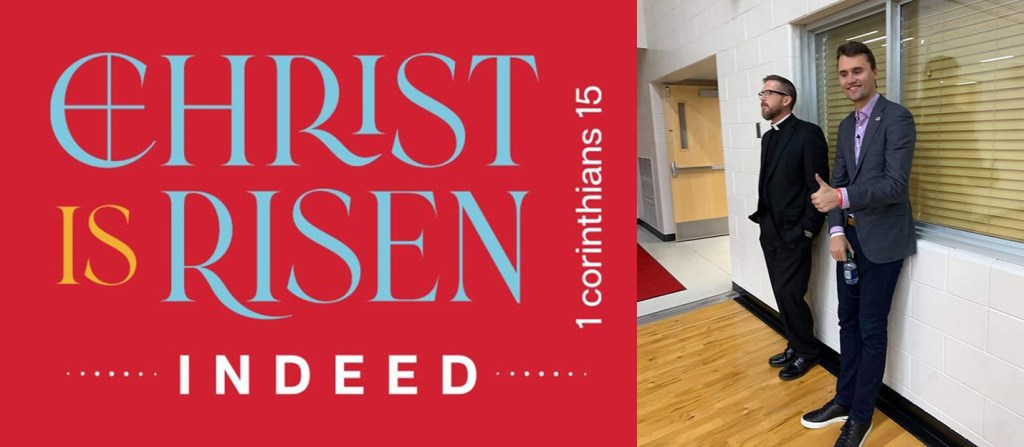
As you may already know, I was asked to give the opening prayer and speak a few words at the rally for my friend Charlie Kirk on the steps of the Capitol in Lansing last Monday. Regardless of the resulting criticisms, both from some in my own ranks who believed I shouldn’t have participated and from those in the progressive media who broadcast my words, stirring a plethora of vulgar comments against me online, I considered it a privilege.

Indeed, it was a genuine honor to stand before thousands and speak of the hope we have in Christ (1 Peter 3:15), while at the same time urging all to take up truth’s torch and go forth with courage. This was something I was compelled to do—something I needed to do—if only because I owed it to Charlie.

And yet, there’s another debt I owed to Charlie. Not only was it the debt of friendship, but also the responsibility of being seen and accessible in public, as he always was. Charlie never hid from the people he knew needed him, and in his own way, he taught so many to step forward with the same openness, to stand where those who are searching might actually find them. I’ve tried to follow that same pattern of visibility, even when it sometimes comes with risks.

And yet, there is a memory from this past Monday that will stay with me forever.

Long before I stood atop the steps at the microphone, I learned my better destiny on Monday was down among the brokenhearted (Psalm 34:18). During the forty-plus minutes before the event started, a handful of men and women—not many, just a few, but still complete strangers to me—saw me near the Capitol steps and wanted to talk.

A few were heavy with grief. Some were burdened by anger. One was carrying both to extremes. But all wanted to know the “why” behind what happened to Charlie. They wanted answers. They wanted hope.

But here’s the thing. How did they know to talk to me? These people who approached me didn’t know me from the next person. They didn’t know my role in the event. Still, they felt somehow that they did know me, that they could step forward and ask to talk, to ask me for help with whatever burdens they were experiencing.

How was this possible? Before I answer that question, let me tell you what happened during those private interactions.

One-on-one, each told me his or her story, and I responded with God’s Word. I gave the Gospel. I reminded each that death does not get the final word, that Charlie’s faith was not in vain, and that for all who dwell in Christ, there is victory over the grave (1 Corinthians 15:54–57). Those conversations—private interactions near the Capitol steps—are what I remember most.

This brings me closer to an answer to the question. But still, a little more first.

Not all that long ago, a brother pastor shared with me an August email from his LCMS District President discouraging pastors from wearing the clerical collar. In his own words, he suggested that clerical collars create “the wrong kind of distance” between pastors and people, and that perhaps a suit, tie, or even casual clothes would be better—maybe even more approachable.

I couldn’t disagree more. To diminish or even discard the pastoral uniform—the visible sign of the pastoral office—is to hide the very thing that helps the hurting and the searching find us when we’re out and about in the world.

Maybe think of it this way. If someone is in crisis and they need a police officer, they don’t want to guess who in the crowd might be one. They look for the badge, the hat, the uniform. In the same way, the clerical collar doesn’t confuse us with the rest of the crowd. It doesn’t conceal. It’s not necessarily concerned with approachability. People will find every excuse imaginable to avoid anyone for any reason, anyway. But the only way to know to approach or avoid is first to find.

That said, I do recognize that for some, the sight of a clerical collar does not bring comfort but instead stirs painful memories of being hurt by someone who once wore it. And yet, the uniform’s meaning is apart from the wound. In the same way, one corrupt police officer does not redefine the badge for every officer, nor does one corrupt person in uniform—whether a doctor, a soldier, or anyone else—undo the purpose of the uniform itself. The failures of individuals do not erase what the uniform is meant to signify, nor do they invalidate the faithful who continue to wear it rightly. For those who would never know us from the next man in the crowd, the collar gives a clear answer. It identifies us, unmistakably, as shepherds of Christ, and that is often all the invitation a suffering soul needs to step forward.

Admittedly, in today’s America, a pastor’s findability (if that’s a word) can be a dangerous thing. For example, I was with a group of pastors in Washington, DC, several years ago. I was the only one wearing a clerical collar. Passing near a group of protestors in front of the Supreme Court building on our way to the Capitol, I was the only one in the group that the protestors chose to spit on. Yes, it was a dreadful thing in the moment. And yet, I know why it happened. They could see me. And like it or not, they knew whose servant I was and what I stood for just by looking at me (John 15:18–19). The other pastors were not similarly persecuted, but that’s because they were entirely indistinguishable.

But even in those kinds of moments, the Lord has sometimes turned what was meant for harm into something surprisingly good. More than once, the hostility directed my way has ended up sparking conversations with people who would otherwise despise Christianity from a safe distance. They approached me precisely because they could tell who I was, and while some came ready to argue, others stayed long enough to hear the Gospel. Those exchanges, often uncomfortable, would never have happened if I had simply blended into the crowd.

This past Monday in Lansing demonstrated the best of these possibilities, certifying for me that wearing the clerical collar is valuable all the time, because you just don’t know. And so, I wear the collar everywhere I go. I always have, if only to be found in a crowd by whoever needs to find me. Contrary to the discouragement my friend’s district president mentioned before, the collar doesn’t put distance between me and the people. It actually closes the distance. It signals, immediately and unmistakably, that I represent Christ. It’s a sign that Christ still sends His servants into the world. Like Him or hate Him, like me or hate me, it doesn’t matter. Here I am. Let’s talk (Romans 10:14).

By the way, regardless of what people think the collar means, for generations, the pastor’s clerical collar has always been this kind of visible sign. Although at one time, Christians were more literate in this regard and didn’t need the explanation. Traditionally, the clerical collar was and is a wordless sermon. The black garment represents sin, death, and the brokenness of this fallen world—our human condition. The white tab or ring at the collar represents Christ and His righteousness, surpassing all the darkness. But even better, the collar is near the pastor’s throat, indicating the Gospel message that is to be preached and taught from that same man’s throat to a world in dreadful need of rescue. What’s more, even as the man speaking is covered in the black garments, showing his equal need for a Savior, that white collar insists that when he speaks as a called and ordained servant in faithfulness to Christ, regardless of his frailties, it is not ultimately his voice you are hearing, but Christ through him (Luke 10:16; 2 Corinthians 5:20).

Those who approached me before the event had no idea who I was, but they saw the collar and knew I was an emissary of Someone who could help. If I had been dressed like any other man in the crowd that day, they might have walked past, their grief locked inside. But because they could tell just by looking at me, they didn’t pass by. They stopped. They cried. We prayed. They received the comfort of God’s powerful Gospel (Romans 1:16). And by God’s grace, they left with the only kind of hope that will see them through this life’s storms, even ones of national import.

And so, as you can see, the most memorable part of that day was not necessarily speaking to thousands in memory of Charlie but consoling a handful in service to Jesus. But it only happened because, regardless of what you’ve been told, the clerical collar was by no means a barrier, but rather a bridge—a silent invitation to come and be comforted by Jesus.