
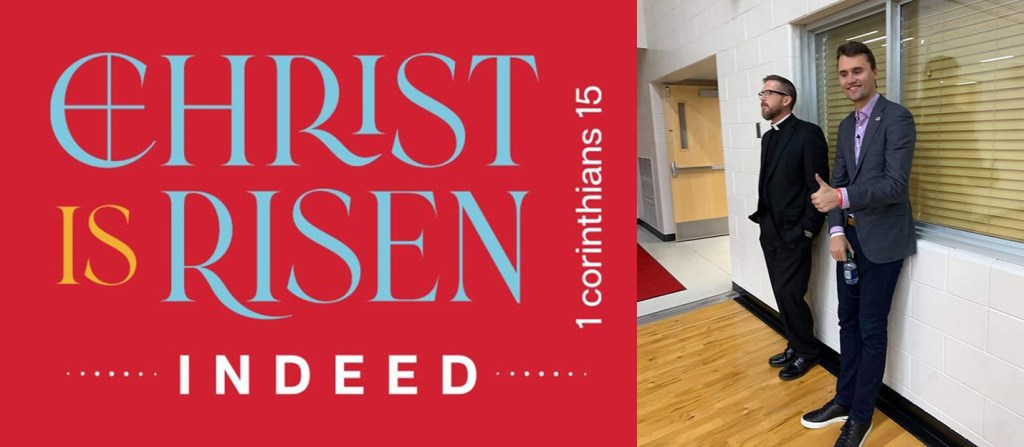
There are moments when a church body betrays itself more by what it avoids saying than by what it actually says. Of course, you need more context to understand what I mean by this.
Essentially, I wrote and submitted an overture asking the Lutheran Church-Missouri Synod, in convention this summer, to acknowledge Charlie Kirk as a modern Christian martyr, establish September 10 as a Day of Prayer for Faithful Witnesses in Our Time, and call the Church to renewed courage in public confession under the cross. Two other similar overtures were submitted, both supported by multiple districts and circuits. Admittedly, mine was the more aggressive of them in asking the Synod to establish a specific day of prayer and remembrance. Still, the fact that there were three shows that the concern was shared by countless others. (You may read the original overtures on pages 330 and 331 in the Convention Workbook, which is found at https://files.lcms.org/file/preview/2026-convention-workbook.)
The floor committees responsible for handling the overtures have met. Their task was to review submitted overtures, combine related matters where they saw fit, and present final resolutions for action. In this case, they produced a generic omnibus resolution condemning political violence and encouraging public service while avoiding Charlie Kirk entirely. (You may read the replacement overture on page 91 by visiting https://files.lcms.org/file/preview/2026-todays-business-issue-1.)
I’ll speak plainly for myself. The replacement overture currently on its way to the convention is a fine example of institutional evasiveness. It condemns political violence. It encourages peaceful participation in public life. It quotes Scripture. It even cites the Confessions. From there, it commends Lutheran resources on church and state. But together, it has the all-too-familiar scent of committee caution. The whole effort has been scrubbed clean of Charlie.
The whole reason this replacement overture even exists is that something concrete happened nine months ago. Charlie Kirk was murdered. It happened publicly. He was shot and killed for Christian conviction—for speaking in defense of life, marriage, family, manhood, womanhood, religious liberty, and the lordship of Christ over all things. These are all things treated with open contempt by very powerful forces in American life. His death was therefore more than another entry in the tragic ledger of political violence, as the new overture implies by withholding any and all references to him. Charlie’s death exposed what so many Christians in the trenches already know, and what many institutional churchmen still seem desperate to avoid—or at a minimum, soften. And it’s simply this: Confession of Christ in the public square has a cost.
Charlie paid it.
And yet, the replacement overture refuses to even mention his name. That alone tells me almost everything I need to know. By the way, I should make it clear that I am not accusing Committee Chairman Christopher Esget or Vice-Chairman Lucas Woodford of having a hand in this. I know them both. They were clearly outnumbered by both opponents and institutional cautionaries. The result? Smoothing the matter into a generic condemnation of political violence in order to lessen the risk of offending the more left-leaning elements in the LCMS, which I know exist. Back in March, I gave a speech seasoned with elements of my relationship with Charlie to a relatively large LCMS gathering. No sooner did I begin mentioning his name in a positive way than at least ten of the fifty-plus tables got up and walked out in protest.
How dare an LCMS pastor say anything positive about such a public figure espousing divisive rhetoric?! By divisive rhetoric, do you mean his fearless defense of what we LCMS Lutherans believe, teach, and confess in unity—in synod—in our supposed walking together?
Well, whatever. People getting up and walking out of one of my speeches doesn’t bother me. And it doesn’t change the central fact. Charlie confessed the true Christ, and with that, he was a public Christian figure who labored in defense of truths that Scripture teaches and the Church confesses. He spoke in the open. He did so knowing that, for one reason or another, many would hate him for it. Still, he went. And he was ultimately killed for that public confession and for no other reason. That is martyrdom in the truest sense of the word, and as I said, he’s the only reason we’re having this conversation.
Relative to the original three overtures, it seems a no-brainer that, throughout history, the Church has remembered her notable martyrs. That’s because we know with certainty that Christ sustained their confession under the cross. And so, naturally, the Church remembers them because their blood preaches with otherworldly eloquence to the living. And she says their names because she knows that nameless remembrance becomes abstraction.
Unfortunately, abstraction is almost always the first refuge of fearfulness. I’ve seen it a thousand times in the political sphere. We may be seeing it here, if only because the omnibus overture takes Charlie’s death and dissolves it into “multiple assassination attempts,” “violent conflicts,” and “many other sad examples of division.” Those things are real, and political violence should be condemned wherever it appears. However, the whole force of the matter is lost when the Synod is asked to speak about everything in general because it lacks the willingness to name Charlie in particular.
But again, we’ve seen this a thousand times. History teaches that’s exactly how bureaucracies mourn. They widen the lens until the real issue disappears into ambiguity.
Now, I know some are reading this and already objecting, assuming Charlie should be excluded from remembrance because his theology was not exclusively Lutheran. That brings to mind something I wrote and shared with the men in my own circuit with the same concerns when I first introduced the overture. At one point along the way, I wrote to them:
“Something came to mind during our Children’s Christmas service rehearsal yesterday morning. While we were singing Hark! The Herald Angels Sing, I was reminded that the hymn comes to us from Charles Wesley. As LCMS Lutherans, we are far from Charles Wesley doctrinally. We do not share his theology of the sacraments, ministry, or conversion. And yet, without hesitation, we sing his words, teach them to our children, and gladly receive the hymn as a faithful witness to the incarnation of Christ. We do this not because we endorse Wesley wholesale, but because we recognize that God’s truth can be confessed clearly and beautifully even through someone with whom we have real theological differences. We’re capable of distinguishing between honoring a faithful confession at a particular point and canonizing the entire theological system of the person who made it. At least, I believe we’re capable of making and maintaining that distinction within the Church. Either way, that’s the distinction I was reaching for with Charlie, who, many of you know, was my personal friend. The epicentral point of alignment is not that he was Lutheran, or that we would affirm every position he held, but that he died confessing Christ. His death was, in that sense, a confession of Christ to the end, and that confession stands on its own. Memorializing him by name need not imply doctrinal agreement any more than singing Wesley’s hymn does. Overture or hymn, in both cases, the Church is not saying, ‘This person was right about everything,’ but rather, ‘Here, Christ was confessed.’ That, it seems to me, is something we have long known how to recognize as Confessional Lutherans.”
Now, had I thought to do it at the time, I might even have added some of the names we recall formally in the Lutheran Service Book. Ironically, we remember Gregory the Great on September 3, which would be seven days before the date I’m recommending for Charlie. Gregory the Great played a role in developing the theology of purgatory in the Western church, a doctrine that Lutherans explicitly reject as dangerously false. Still, we remember him for other reasons, one of which is his Regula Pastoralis, a timeless exposition of pastoral care. Meanwhile, Charlie openly confessed himself a Christian according to the Nicene Creed, which I know firsthand served as a rudder for his public and private confession of Christ. Not to mention, he began events saying as much.
Apart from these things, indeed, this remains a teachable moment for our churches. In an age that requires bold confession—even as the replacement overture quotes Luther’s Large Catechism, rightly saying that the devil seeks to destroy peace through contention, murder, sedition, and war—I can assure you that Satan also appreciates bureaucratic fog, the kind that insists the best way through controversy is through safe and inoffensive generalities.
The Synod had before it three concrete opportunities to teach clearly about martyrdom, vocation, public witness, and the cost of confessing Christ in an increasingly hostile age. At a minimum, it could’ve edited those, easily showing, without causing any division, that Charlie Kirk’s death matters because public Christian confession matters. His death became a holy opportunity for the Church to preach Christ crucified while teaching her children that those joined to Christ should expect opposition. When a public Christian is murdered amid rising hatred for Christian truth, the Church should have enough nerve to call it what it is. She should at least have enough wits about her to understand that the real human being at the event’s center ought not go unnamed.
In the end, I don’t really care which of the three overtures the committee might choose to handle. Personally, the Wyoming overture is probably the best of the three. But either way, choose one. Cultivate it, if necessary. And as you do, leave its core alone. Leave Charlie Kirk in it. He must be named. His witness should be acknowledged. His death should be interpreted theologically. His murder should be condemned concretely. His example should summon the Church to the courage she’ll need in the forthcoming era.
If we cannot do that, the failure will say more than the replacement overture ever could. And I dare say that, since I was working with TPUSA leaders to attend the convention, arranging for them to be present and to listen as Charlie’s name is spoken by one of the last remaining denominations of biblical fidelity, this could be a huge black eye for LCMS Lutheranism. It doesn’t have to be. But it could be.
The Church must do better. The Church, in convention, must say Charlie’s name. His blood is still very fresh in Utah’s soil, and the forthcoming generation of Christians—one that overwhelmingly claims him as its own—will remember this moment.

