
The Shape of the Gospel — Ash Wednesday

The penitential season of Lent is soon to be upon us. It begins this week with Ash Wednesday.

So, who cares? Christians do. At least, they should. Although, it would seem many Christians—even some of the clergy—are preaching and teaching against it. I don’t know why. I did hear one say it’s some sort of innovation to the Church Year and therefore to be avoided. I heard another suggest it hinders the Christian’s ability to prepare for Easter with joy. That’s sad. One sure way to rob the victory of its joy is to be ignorant of what’s at stake in the war. Ash Wednesday offers a much-needed glimpse of the battlefield.

I find it strangely interesting that even the sensual (though unofficial) liturgies of something like Mardi Gras would portray a better awareness and care for Ash Wednesday and Lent, whether their partakers actually realize it or not. Even in the midst of a celebration that holds the well-deserved reputation for overindulgent debauchery, there is the sense that it must and will come to an end.

“Live it up,” its rites and ceremonies proclaim, “for after Fat Tuesday, it must all expire.”

And it does. What once was gives way to the ashen dust of death remembered by Ash Wednesday. Ash Wednesday is the proper headstone for all things carnal.

A day in the Church Year in which believers’ foreheads are marked with the ashes of what were once lively and verdant branches (the palms from the previous year’s Palm Sunday celebration), Ash Wednesday reveals that the Christian Church knows something of this world that the world itself cannot fully fathom. It knows the wage for Sin is Death—real and eternal Death. It knows this as it recalls God’s terrifying words to Adam and Eve after the fall into Sin. These words still reverberating, it hears the truth in them. It knows the necessity for their honest contemplation so that we would see the world as it ought to be seen. It knows to immerse itself in the depths of a solemnity that acknowledges the horror of the very real predicament that the entire human race is facing. The Church knows there’s so much more than just an end to things, but there’s also a terrible dreadfulness just over that end’s border for those who remain enslaved to the mess.

You can’t ignore it.

You can’t hide from it.

You can’t outrun it.

You can’t overpower it.

The inevitability of its reach is woven into the very fleshly fabric of every man, woman, and child who was ever born in the natural way.

It was with divine, and yet heartbroken, authority that God announced this to His world and its first inhabitants: “Because you have done this, cursed is the ground because of you…” (Genesis 3:17). Cursed things are put away from God. By this curse—this self-inflicted and permanent vexation—“you will return to the ground, since from it you were taken; for dust you are and to dust you shall return” (Genesis 3:19).

The thing about Ash Wednesday is that you can’t make your way into and through Lent without contemplating the veracity of the curse. Ash Wednesday has become a guardian of sorts at Lent’s contrite door, and it won’t let you into the forthcoming events without being stamped. The stamp it reaches out to give, it goes on your head and not your hand. Its dust crowns the human frame as the only appropriate coronation for someone born into the un-royal lineage of the Sin-nature. It adorns the skull that shields the corrupted human mind, the organ fed by a sinful heart so that it would calculate and then initiate every ungodly act of thought, word, or deed. The mark’s dirty-cold embers are the kind that distinguish Cain from Abel, openly identifying the murderer and reminding him of the dusty ground that opened up to swallow Godly innocence.

And yet, even as Ash Wednesday won’t let you forget the seriousness of the disease, it will be just as fervent with the cure.

Remember: That filthy mark is in the shape of a cross. It’s smeared onto the penitently-postured foreheads of Ash Wednesday’s observers who know their need for a Savior. It serves as a silent proclamation of God’s truest inclinations in our darkness. It’s the shape of the Gospel—the death of the Savior, Jesus Christ, for a cursed world. The Great Exchange—His righteousness for our unrighteousness. It tells of a birthright, not earned, but given in love. It beams through dusty grime the truth of an imperishable crown of blamelessness, not earned by the wearer, but won and granted by the Savior. Cain is marked and no one can touch him. God has been gracious. For us, even in that smeared cross’ quiet, there thunders above every human wearing it an otherworldly hope for eternal life through faith in the Savior who was nailed to it on Good Friday. The booming crack of its message drowns out the devil, the world, and the sinful flesh’s accusations to the contrary.

Ash Wednesday’s mark serves as a gentle reminder of something else in particular. It heralds rebirth.

That cross of ash will dot the same place where God first made the sign of the cross upon His Christians in Holy Baptism. If only for a few hours, it will make visible the invisible, leading each of its bearers back to the moment when God He put His own name on them, claiming them as His through the washing of water and the Word, thereby grafting them into the entirety of Christ’s self-submitting work to accomplish Mankind’s redemption (Romans 6:1-10).

It’s been said that the best opportunities are seldom labeled. This “best opportunity” of Ash Wednesday is, in fact, labeled. Its tag may be grimy, but it happens to be one of the most condensed opportunities in the entirety of the Church Year for a right understanding of our condition in Sin and our glorious rescue by the Son of God. Don’t keep it at arm’s length, but rather embrace the opportunity to gather with the faithful and sing as we do in the appointed tract, “He does not deal with us according to our sins, nor repay us according to our iniquities” (Psalm 103:10).

If you have any say in your evening activities, I encourage you to participate. Set aside 7:00pm this Wednesday. Make your way to Our Savior in Hartland, Michigan. Or go to your own church if it is offering a service. Either way, just don’t make the mistake of missing out on the powerful manner and message of the Ash Wednesday proclamation. You’ll be given the opportunity to look Sin and Death square in the eyes. You’ll see your mortality there. But you’ll see so very brightly and hear so very clearly the Good News of your brand new beginning through faith in the life, death, and resurrection of Jesus Christ, the compassion of God who took upon Himself human flesh and made His dwelling among us for our rescue.

Your Light is Important

Right now, my office is a mess. Before I left it yesterday afternoon, as I turned to close the door, I scanned the room and could see the disaster to which I’d be returning. My desk is buried beneath papers. And that’s not the half of it. I have books all over the floor, countless sticky notes hanging from this or that shelf, and a number of other things strewn throughout the entirety of the space. It’s enough to give any visitor the impression I’m about as disheveled as they get.

But the thing is, I’m just not a messy person.

Of course I’m not perfectly tidy by any means. The scene I just described is proof. Still, I’m convinced I’m really not a messy person. Keeping things clean is unquestionably a part of my personality and general routine. Even at home, with anything that pertains to me personally, you’ll seldom find a trail. Of the few things I can actually call my own, I’ll rarely leave them lying around. It’s the same for my office. I prefer to work in an orderly space. And I do my best to keep it organized. It might sound somewhat neurotic, but I don’t even like my computer desktop adorned with working files or shortcuts. I keep the desktop relatively bare, with most files—working or completed—in a folder somewhere on an external hard drive that’s being automatically backed up to two other hard drives right next to it.

Having said all this, there is a particular bit of disorder in my office—at first glance, a clutter of sorts—that I don’t mind at all. It’s the vast scattering of handwritten notes and greeting cards lining my bookshelves. Each is a message I’ve received in the last twelve months from someone either within or without of Our Savior Lutheran Church and School. Right about this time each year, I begin the process of clearing these personal messages from the shelves, being sure to tuck them into a bin for safe keeping. I do this to make room for what I expect will be a new year’s stream of scribbled kindnesses.

Over the course of my twenty-five years of serving in the Church, this has been my routine, and let me tell you, it sure is something to go back and read from some of the older notes I’ve kept.

Why do I keep the old ones? Because they mean the world to me. They are dispatches from the trenches of life, communiques portraying various aspects of what it means to be God’s people existing together in the divine love established by His gracious hand at different moments on the timeline. That’s one reason. But there’s another reason, too.

Each message is a tangible reminder to me of what it means for Godly sentiment to become action. Here’s what I mean.

I teach my children never to miss the opportunity to offer a compliment. For example, I’ll tell my kids that if they think a woman’s dress is pretty, go ahead and tell her. What good is to be had by the dress being pretty if no one is willing to acknowledge it? I’ll tell my kids that if they think a friend did something well, let the friend know. How does it benefit the friendship by keeping your appreciation silent?

Sentiments that result in action can make things better, stronger. Go ahead and test me on this. A single thought that results in a spoken word or gesture of kindness has more gravity than an entire galaxy filled with unspoken sentiments. One notecard, one kind word, one genuine compliment will always raise the scale’s opposing plate stacked with unspoken sentiments.

I awoke this morning thinking the same goes for the Christian faith as it meets with the world around us.

It’s one thing to know and believe that Christ is the Savior. It’s another thing to live this faith before the world—to engage when others remain idle, to lean in when others lean back, to speak when everyone else is silent.

Action is by far the best eloquence. Shakespeare said something like that. And I agree. Still, Jesus said something even better.

“You are the light of the world. A city set on a hill cannot be hidden. Nor do people light a lamp and put it under a basket, but on a stand, and it gives light to all in the house. In the same way, let your light shine before others, so that they may see your good works and give glory to your Father who is in heaven” (Matthew 5:14-16).

Since I preached on the text from Romans 12:9-21 yesterday, naturally Saint Paul’s words come to mind.

“Let love be genuine. Abhor what is evil; hold fast to what is good. Love one another with brotherly affection. Outdo one another in showing honor. Do not be slothful in zeal, be fervent in spirit, serve the Lord. Rejoice in hope, be patient in tribulation, be constant in prayer. Contribute to the needs of the saints and seek to show hospitality. Bless those who persecute you; bless and do not curse them. Rejoice with those who rejoice, weep with those who weep. Live in harmony with one another. Do not be haughty, but associate with the lowly. Never be wise in your own sight. Repay no one evil for evil, but give thought to do what is honorable in the sight of all. If possible, so far as it depends on you, live peaceably with all. Beloved, never avenge yourselves, but leave it to the wrath of God, for it is written, ‘Vengeance is mine, I will repay, says the Lord.’ To the contrary, ‘if your enemy is hungry, feed him; if he is thirsty, give him something to drink; for by so doing you will heap burning coals on his head.’ Do not be overcome by evil, but overcome evil with good.”

That’s one particular place where the Apostle takes time to describe what Christian sentiment—the Christian light of faith—actually looks like when it becomes something tangible. It sounds like a list of “do this but not this” kind of stuff, but it really isn’t. Because of the re-creating work of the Gospel for faith that Paul described in the preceding chapters, this is now more of a commending of Christians to actually be who God has already made them to be. It might not have been the best analogy, but in the sermon I compared it to the caretaker of an apple orchard going out into its rows and telling the trees to produce apples.

There are plenty of other texts like this in the Bible. Another great one comes to mind. It’s James 2:14-18.

“What good is it, my brothers, if someone says he has faith but does not have works? Can that faith save him? If a brother or sister is poorly clothed and lacking in daily food, and one of you says to them, ‘Go in peace, be warmed and filled,’ without giving them the things needed for the body, what good is that? So also faith by itself, if it does not have works, is dead. But someone will say, ‘You have faith and I have works.’ Show me your faith apart from your works, and I will show you my faith by my works.”

With even a sliver of honesty, James’ argument is convincing. It’s hard to argue against faith being a skeletal creature if not for the musculature of Christian deeds. With what’s going on in our world, it’s even harder to argue against your role as a light-beaming Christian being incredibly important.

The days before us are very dark. Joe Biden, the President-elect (or whatever) said those particular words. He meant them with regard to COVID-19, but I can assure you from what he has pledged to do in his first 100 days, for the Church, his words mean something else. Unrelenting persecution is about to be let off the leash. Basic Christian teaching is about to be labeled as bigotry at the federal level. I’ve not been one to get too worked up about 501c3 restrictions, but I do realize how helpful they are to some. Just know tax-exempt status will likely disappear under a Biden presidency, and many of the churches already hovering at the cliff of financial disaster will almost certainly be nudged over its edge by their property taxes alone. Churches are going to close. The people they serve will suffer. The curriculums of Christian schools will draw even more spiteful ire. Their hiring and firing practices will come under vicious assault. We can expect countless new lawsuits to be leveled against anyone seeking to do business under the title “Christian.” I’m certain our own Governor Whitmer and Attorney General Dana Nessel will be the first ones to hound these organizations, being eager to press the button of prosecution.

More and more, Christianity will find itself existing in the shadows.

But keeping our Christian sentiment to ourselves—believing quietly—will be about the worst thing we can do. Christian action will be required, both as a formal organization and as individuals. The plain truth is that we’re going to need more people who not only know and understand just what James meant when he wrote that faith without works is dead, but we’ll need those same people to be courageous enough to believe and act on these words, people who take Jesus seriously when He calls for His believers to let their lights shine before men.

I suppose my innermost sentiment this morning is that you will be one of those people. And this message, like the messages currently adorning my bookshelves, is a materialized dispatch from the trenches by a friend who loves and appreciates you in the Lord and wants to encourage you in your faithfulness. Let this message be a virtual notecard resting on the bookshelf of your mind, one commending you as God’s child, and heartening you to continue to be who God made you to be—a person who knows what it means to be a city on a hill that cannot be hidden.

Jacob’s Ladder

We’re only a few days into 2021. Still, I pray all is well with you so far.
Interestingly, because of my daughter Madeline’s fondness for all things 80s, I crossed into the New Year having reconnected with some favorite music from my youth. While I’m more of a hard rock kind of guy—AC/DC being the typical go-to playlist at any given moment—I found myself emptying the dishwasher to some familiars by Huey Lewis and the News.

“I Want a New Drug.” “The Heart of Rock and Roll.” “Heart and Soul.” “Back in Time.” Let me tell you, I forgot how much I appreciated these songs. They had a memorable style.

For me, I think I found the combination of catchy rhythm guitar riffs and the rasp of Huey Lewis’ voice to be a welcome change to the poppy synthesizers that were saturating the airwaves and making the 80s music scene little more than canned cheese. When it came to skill, it felt lazy, and it was almost unendurable at times. Yes, Huey Lewis and the News used keyboards. But they used them the right way—in a bluesy rock way.

Of course, I don’t mean to insult any of my friends who remain huge fans of shoulder pads and “Bonnie Tyler” hairstyles. I most definitely don’t hold anything against those of you who tap down the road listening to the Pet Shop Boys, Culture Club, or Cyndi Lauper. But truthfully, there were only so many times I could be riding along with someone listening to A-Ha’s “Take On Me” before I actually felt like climbing into whichever comic book I might have been reading, even if it meant being accosted by a couple of brutes wielding chains and a monkey wrench. Seriously. If it weren’t for bands led by the likes of Angus Young, Eddie Van Halen, Joe Elliot, and yes, Huey Lewis, the radio would’ve, for the most part, been dead to me.

Of course I hear these songs through different filters, now. As a kid, it’s the music I remember most. But now I’m listening to the lyrics more intently, and oftentimes, I’m discovering things I missed.

Again, speaking of Huey Lewis and the News, I was listening to the song “Jacob’s Ladder.” There’s no arguing it’s sort of a “works righteousness” song. Lewis sings about being put off by the TV preachers and the aggressive Law-wielding Bible-thumpers. Good for him. They are off-putting to me, too. But because this is now his interpretation of Christianity, he turns to the even less certain spirituality of trying to figure it out on his own. He sings about striving to be a good person, and day by day, doing his best to climb his way to heaven. The insinuation is that ultimately God will smile on him when he finally arrives.

“Step by step, one by one. Higher and higher. Step by step, rung by rung. Climbing Jacob’s ladder.”

It’s a sad premise. The Word of God is pretty clear that no one will gain entrance to heaven by their works. In fact, Saint Paul couldn’t have said it any more straightforwardly than when he scribed:

“For by works of the law no human being will be justified in his sight, since through the law comes knowledge of sin” (Romans 3:20).

On the contrary, God’s Word makes clear that mankind is saved by grace through faith in Jesus Christ alone. Good works are a fruit of saving faith, and even as we do them, it is God at work through His believers. In other words, we can’t even take credit for our good deeds (Ephesians 2:8-10). It’s one reason why you’ll hear so many Christians, namely Lutherans, say the phrase, “Soli Deo gloria,” that is, to God alone be the glory.

I must confess, however, right in the middle of Huey’s messy (but also very popular) theology, he says something of value. By value, I mean it’s genuine, and I’m guessing it resonates with most normal people:

“All I want from tomorrow is to get it better than today.”

As a person, he honestly wants to improve. He just wants tomorrow to be better than the day before it.

I get that. As I said, I think most folks do, especially at this time each year. When the month of December has changed to January, and the old year has become a new one, many are hoping for better days—better relationships, better habits, better character, better selves.

There’s nothing wrong with working to be a better person. I say, if you can make those New Year’s resolutions and actually keep them, great. I made my own, and I intend to charge forth. Just keep in mind that as so many are striving to be what the world would consider better—wealthier, the most popular, the most intelligent and most talented in every way—to be any of these or none of these is as nothing if your innermost hope isn’t built on Christ. Without Him, you will be poor no matter the size of your holdings. Without Him, you are to be pitied no matter how many fawn in your presence. Without Him, you are the most foolish, no matter how many degrees you have on your wall; the most bumbling no matter the trophies.

Whatever comes your way in 2021, let your aim in every circumstance be fixed on Christ and His work to rescue you from Sin. He’s the only One with the divine strength for climbing the rungs of perfection, and He did it in your place. He’s the only One who took every step with perfect precision, and He did it all for your sake. He’s the only One who could take a righteous stand before the Father, and He did so as both your mediator and substitute. The Christmas season we just enjoyed is the foretelling of these things. Christmas preaches the Good News that after the fall into Sin, God didn’t turn away from His rebelliously imperfect world in disgust even as He knew we’d never be able to fix what we’d broken. Instead, He sent Jesus—the Son of God having become Man—who submitted Himself to all that we are and must endure. By His perfect work, He fixed what was broken. Now there is peace between God and man. Now, by faith, we are counted as righteous.

Because of Christ, your eternal tomorrow is guaranteed to be better than today.

The Wind Just Keeps On Blowing

Isn’t it strange how we do what we do as humans, and still the earth just continues to spin, doing what nature does?

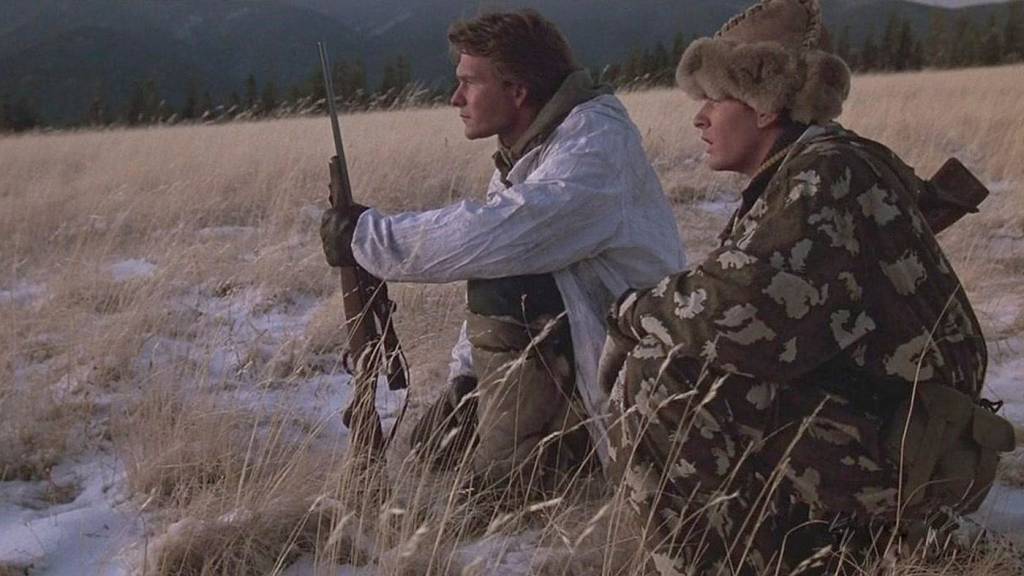
I live in Michigan where it can get pretty cold in the winter. But just a few days ago, the wind chill was registering at -35 degrees, and because so many were forced to run their furnaces non-stop, the entire state was facing a natural gas crisis of catastrophic proportion. The whole scene reminded me of a line in one of my favorite movies as a kid, Red Dawn. During a brief moment of quiet from what has already been a long and exhausting war to take back their home soil from invading forces, the character Matt says to his older brother Jed:

“It’s kind of strange, isn’t it, how the mountains pay us no attention at all? You laugh or you cry, and the wind just keeps on blowing.”

The wind just keeps on blowing.

During those very cold days, while I managed to make it out and around to visit a few folks, I found it necessary to be home with my family to help tend to their needs. During the quiet times, I took the opportunity to do something I’ve been meaning to do for a very long time.

I tackled the ever-piling messages in my email inbox.

I spent an entire afternoon reading through countless email notes, many new and just as many old. I saved some. I deleted most. To be honest, across three accounts, I deleted no less than six hundred or so.

There was one older message I discovered that I decided not to delete—and I don’t think I ever will.

The message I saved was from a dear friend, Lorraine Haas. She sent it on January 26 of 2017, and it was in response to the eNews she’d received the day before. Little did I know that a few weeks later I’d be preaching and presiding at her funeral.

The thing is, Lorraine responded to almost every single eNews message she ever received from me. Had I kept all of her messages throughout the years, I’d have hundreds. And what was common to them all (at least the ones related to what I would initially send to her) is that, firstly, she commented on this or that news item, making sure that I knew that she’d read the entire email; and secondly, by her words, she was sure to have a brightness of commendation for all the great things the Lord was allowing her home congregation to do. She was a perpetual encourager of the Gospel. She knew all of the volunteers and staff were working as hard as they could to accomplish the mission, and with that, she never spoke a negatively critical word.

Well, I should probably rephrase that. She never spoke a negatively critical word by way of an email. In private, face to face, and with a little bit of whisky in our glasses, she more than shared her mind on things. I always knew what mattered to Lorraine. But still, the written word remains for far longer than the spoken word. I’m pretty sure Lorraine knew that, and so whatever she put into print, you could be assured that it would always be an uplifting bit of phraseology meant to make your day better and not worse.

This particular (and unfortunately only remaining) email I kept from Lorraine was very short. I share it with you exactly as I received it. Visiting with it, I know why I’ve kept it sitting in my inbox for so long. It’s only a few sentences long, but it’s a tome of God’s grace.

And the Lord be with You also dear Pastor. May God Bless and Keep You, with Courage and Strength in the coming Day. He loves You, and Me and our Church. His Church! Blessings dear Pastor, and to your dear Family! Lorraine

It’s kind of strange, isn’t it, how the mountains pay us no attention at all? You laugh or you cry, and the wind just keeps on blowing.

Actually, no. The mountains, as sturdy as they are, will pass away. The winds of this world will eventually cease. The laughing and crying of this life will one day be left to the archives of what once was. But the Word of the Lord stands forever. Even now, by way of an email sent by a friend who died years ago, that Word of the Gospel alive in her continues to breathe life into a guy like me—and now into you, too.

It’s as if it reaches to us from the sphere of the divine. In a sense, it does.

Analyzing her sentences, I sometimes wonder if she capitalized words for the same reason I capitalize certain words. I do it in sermons all the time. I tend to capitalize words that are either incredibly important or are in some way an extension of God’s divine work. For example, in a sermon, I always capitalize the letters “d” and “s” in the words “death” and “sin.” I capitalize them because they’re no small thing to us. They’re dreadful powers in this world. If they weren’t, then Jesus’ work on the cross would be less needful to any of us. Equally, I’ll sometimes capitalize words like “redeem” or “love” or “salvation,” especially when they are connected to the person or work of Jesus.

I could be overanalyzing Lorraine’s note, but I wonder if she did the same thing for similar reasons. For example, she capitalized words like “bless” and “keep.” She also emphasized the first letters of “courage” and “strength.” Most interestingly, she capitalized the words “day,” “you,” “me,” and “church.” Why? Well, as peculiar as it may seem, I’d say that each of those words is an offshoot of the vine of Christ. He blesses and keeps us. The courage and strength we need from day to day come from Him alone. And with that, each one of those days belongs to Him. Each one holds the promise of His great love that is carrying you, me, and the whole Church to the Last Day.

With this perspective, go back and read Lorraine’s message one more time. Take it in carefully. I’m sure you’ll get a sense of the ever-living faith that surpasses all understanding, a faith built upon and strengthened for eternal resonation by the powerful Word of God that keeps hearts and minds in Christ Jesus; a Word so powerful that, in fact, not even death can silence it.

Yes, the wind just keeps on blowing. But the war will eventually end. And when it does, when the wind rustles its last leaf, we’ll be gathered into the nearer presence of Christ. In that place, we’ll see all those who’ve died in the faith—all those for whom we’ve shed a tear while the mountains looked on with disinterest and the breezes continued to blow.

I’ll see Lorraine again.

Most importantly, we’ll all see our Lord, the Giver of Life, and it’ll be a face-to-face encounter. Until then, as long as I can help it, I’m never going to delete that email from Lorraine. I’m going to store it away with a few others that are like it that I’ve received from another dearly departed friend, Reverend Dr. Jakob Heckert. As Gospel-driven notes, these messages are far too valuable as divine sources of encouragement to end up in the virtual trash bin.