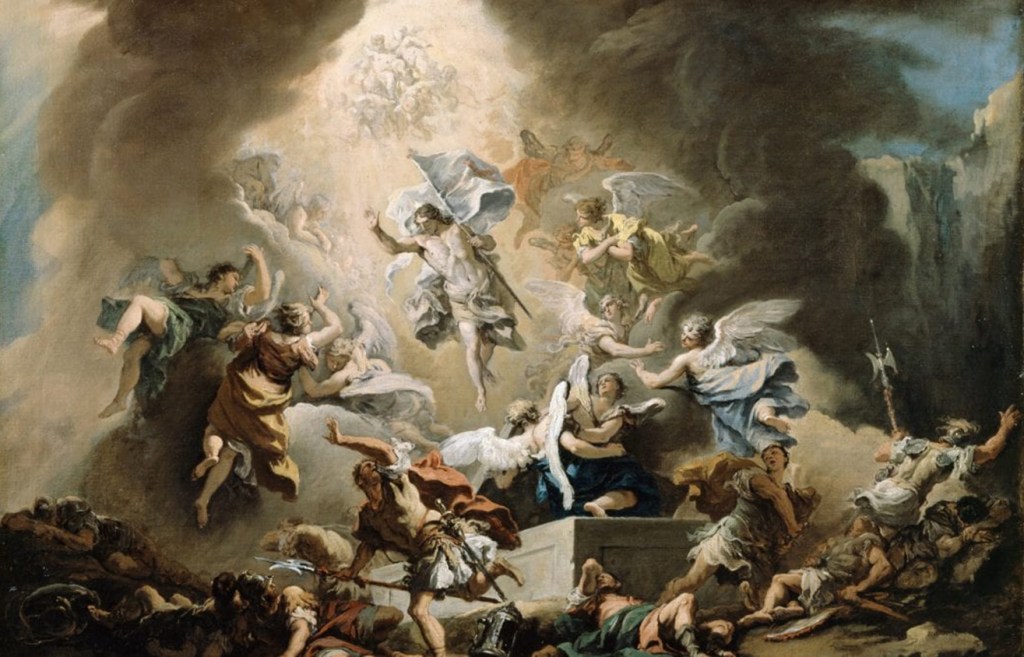
What else is there to say except, “Christ is risen!” Indeed, He is no longer dead but alive, and because this is true, Death no longer holds sway for those who put their faith in Him!
But there’s more to the Lord’s resurrection than knowing Death is no longer our brutal master. Now that He has throttled and subdued it, the fear Death seeks to impose upon every man, woman, and child continually is now rendered silly. We no longer have any reason to fear Death, and so Saint Paul can say full-throated, “For me to live is Christ, and to die is gain” (Philippians 1:21). He can call out with certainty, “Death is swallowed up in victory. O death, where is your victory? O death, where is your sting? The sting of death is sin, and the power of sin is the law. But thanks be to God, who gives us the victory through our Lord Jesus Christ” (1 Corinthians 15:54-57).
Even better, the risen Lord Himself can say to Martha at Lazarus’s tomb, “I am the resurrection and the life. Whoever believes in me, though he die, yet shall he live, and everyone who lives and believes in me shall never die” (John 11:25-26).
But that’s not all Jesus said to her. Before calling her brother from his tomb, He asked Marth a final question, “Do you believe this?” (v. 26). Doing so, He looks to her while also looking up from the page at all of us, prompting a moment of contemplation. In other words, just what does it mean for you that, through faith in Jesus, Death can never claim you? The answer isn’t a lonely point on the Christological map. It is a vast frontier of wonderfulness that reaches into life in this world with an aim for the world to come.
Its topography is comprised of valleys and mountain peaks, bogs and beaches, deserts and dense forests. Steering into and through each, it understands that if Christ has conquered Death, then what else is there to fear in any circumstance? The same power that shattered the grave empowers God’s people to withstand all tyrannies and endure every terror the mortal world could ever think to conjure. Even further, a life lived in the resurrection of Christ is capably bold. It does not cower before worldly powers or bow to the culture’s demands. It does not shrink from faithfulness to the Word of God but instead stands up straight, lifts its head, and keeps an eye open for the One who is coming again in glory to judge both the living and the dead.
Indeed, the frontier of faith is lived fearlessly. Again, if Death holds no claim, then neither do its troubling underlings of persecution or suffering or loss. They may shake their fists in a rage, threatening trouble. But the threats will forever be empty. Christ is risen! Everything else is decaying transience.
Now, the Church—God’s people—marches forward toward the final and eternal day when everything else reaches its expiration. We go there, not in trembling hesitation, but with the confidence of battle-hardened soldiers who know the war has already been won, and have been, all along, awaiting the victory celebration with their King.
Christ is risen! Do you believe this? I do. Therefore, let the world (and everything in it) threaten me as it sees fit. My hope is in Jesus, the conqueror. I will not be silenced, stilled, or afraid.
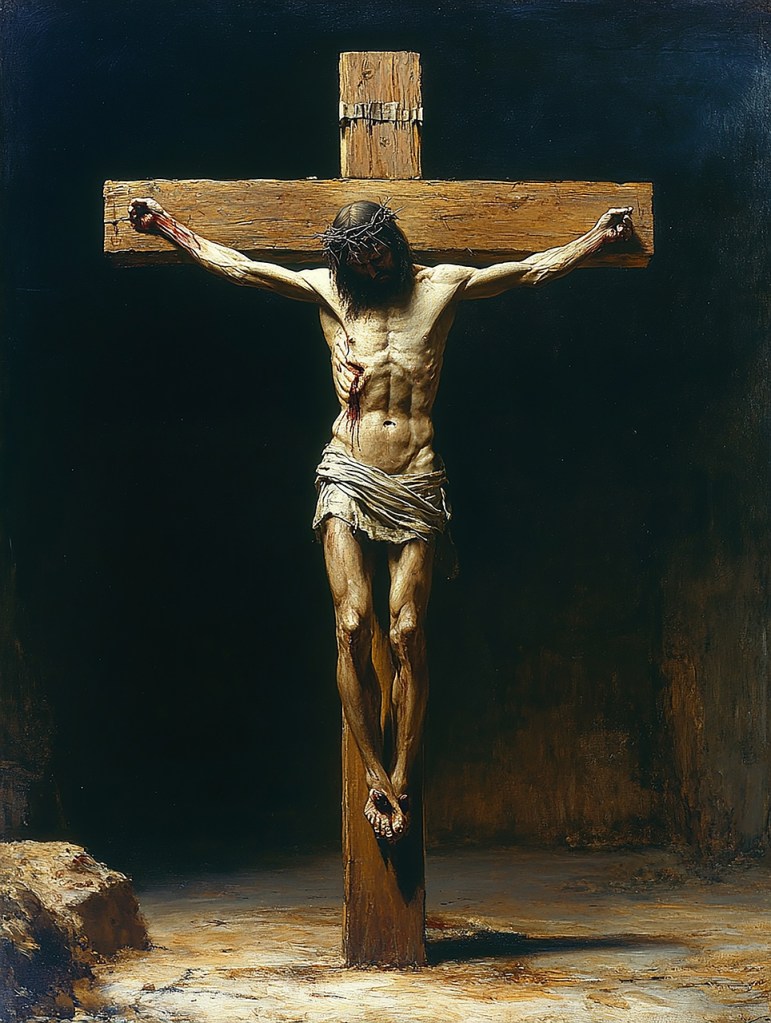
Today, the Church remembers with solemn devotion the day our Lord stormed into and invaded the enemy’s territory with great power. The invasion certainly didn’t look very commanding. In fact, it appeared dreadfully weak and pathetically insufficient. A bloodied and beaten man nailed to a cross, his head hanging low while gurgling His final words through strained breaths.
Behold, the Conqueror.
The world scoffs at such things. It looks to the cross and sees little more than a long-forgotten event that may or may not have happened. If it did happen, it certainly wasn’t anything of consequence. Consequential conquerors—genuine victors—are not captured and killed. They certainly do not submit to their captors and die willingly.
And yet, all around the world, Christians gather on Good Friday in somber reverence. They kneel in humility before their crucified King. They do so with a bizarre mixture of holy sadness and joy. The sadness comes as they acknowledge this King is innocent—that He’s paying a price He does not owe. We owe it. We’re the guilty ones. And yet, He suffers this world’s sin, bearing it fully, taking it into Himself in every way (2 Corinthians 5:21), and He does so for those who can only be counted as enemies for their crimes (Romans 5:6,10). The joy comes as they understand and embrace that He does this because He loves them. The joy emerges from a Gospel that declares He does what He’s doing without any strings attached. He does not hand the believer a bill for services and say, “Now, you owe me.” He does what He does by grace, and He bestows the merits of this world-altering effort from a heart of love.
Only the eyes of faith can see what Jesus is doing on Golgotha’s hill for what it is and receive the merits. Only the eyes of faith can behold the Lord’s divine love being poured out in a way that defeats Death at its own game. Only the eyes of faith can behold the suffering servant as the valiant destroyer of Sin and Satan—as the One turning back a world trapped in dreadfulness and ushering in the life to come. Only the eyes of faith can look upon this holiest act in all of history and desire faithfulness to the One who gave His everything for everyone.
My hope for you on this sacred day of days is that, as you have the opportunity, you’ll join your Christian family in worship. Go to the house of the Lord. Join with the multitudes of believers who know the immensity of sin’s cost and yet rejoice in the payment being made by the only One strong enough to make it—the Conqueror, Jesus Christ—the Son of God and Savior of the world.
I write and share the following because it happened yesterday during our Palm Sunday Divine Service. Admittedly, it does happen occasionally throughout the year. However, it is most prevalent during the Christmas and Easter seasons. What happened? Allow me to explain it this way.
Reverence is a hard thing. I say this because it requires a unique balance of self-awareness and others-focus that the sin-nature does not naturally possess. The sin-nature takes what it believes it deserves. It situates its environment to suit its comfortability and is enraged when it must accommodate something else. It abhors barriers, especially the creedal kinds that protect from self-destruction. It chafes against authority, despises order, and scoffs at sacredness.
Reverence respects the environment into which it has entered, knowing it does not deserve to be there but instead was invited. Reverence is humble. It bows. It quiets the self. It does so to learn, which is far more than merely taking in information. It desires betterment. And so, it listens before it speaks and measures its words with care. It sees holiness and does not demand immediate access but observes with trembling gratitude. It acknowledges mystery and does not rush to assume it understands.
Reverence is hard because it calls a person to submit—to kneel when he would rather stand, to cover his mouth when he would rather impose opinions, and to adore when he would rather be adored.
That said, if you walk into a stranger’s house irreverently demanding what is the family’s to receive and are refused, you are the offender, not the offended. It is the same when you visit a church with which you are not in altar fellowship. The Lord’s Supper is not a right to be presumed but a gift to be received in unity of confession (1 Corinthians 10:14-24; 11:23-29). Reverence understands this. It does not stride to the rail unexamined or uninvited. It does not treat holy things as common, nor does it force participation where spiritual bonds have not been established.
Irreverence, however, is quick to call the stewardship (1 Corinthians 4:1) of these things unkindness and to label fidelity as arrogance (Galatians 1:10). It reframes faithful creedal boundaries as barriers and assumes hospitality demands compromise. But the Church—her doctrines and practices—is not ours to reshape (Hebrews 13:8-9; 1 Timothy 3:15). She is Christ’s (Ephesians 5:25-27)—and reverence knows this. It approaches with open hands, not grasping or demanding fists. Reverence waits until it can say “Amen” with integrity (1 Corinthians 14:16), because it knows that to kneel and receive without understanding is not only dishonest, it is dangerous (once again, 1 Corinthians 11:29).
Reverence is hard because it requires restraint in a doctrinally shallow American Christendom obsessed with the “self.” But it is precisely this restraint (established by the Holy Spirit) that helps human hearts receive what God gives on His terms. It trusts that the faith once delivered to the saints (Jude 1:3) is sufficient, and it takes seriously the apostolic call to “stand firm and hold to the traditions” handed down (2 Thessalonians 2:15). Reverence is not offended by these things, but accepts them as gifts meant to preserve and protect the Church in every age. And so, while the sin-nature storms out of a worship service offended that the pastor refused it communion, offering instead a brief blessing and an opportunity to chat afterward, reverence kneels and receives the blessing with gratitude, and then looks forward to the post-service conversation with a man intent on maintaining faithfulness rather than perpetuating spiritual harm.
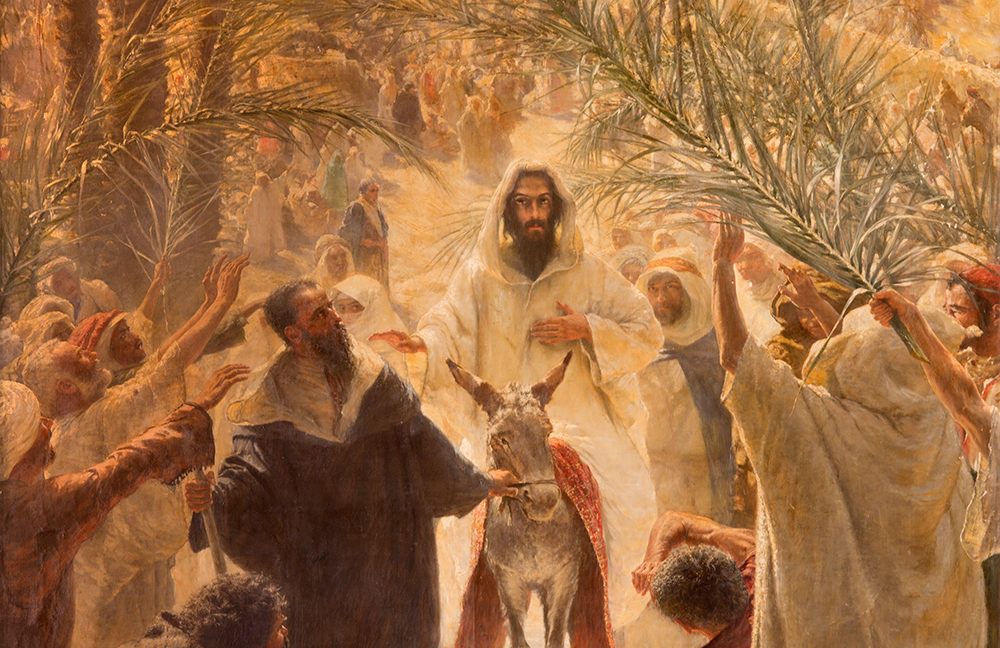
For the Church, Holy Week begins today. Christ is in His final approach. The excitement is thick. The gates are open. Nothing obstructs His entrance. The crowds have gathered. Their songs of Hosanna ricochet and resonate from the narrow pathway’s structures. Some have laid one of their few possessions on the road. A colorful mosaic of cloaks paves His way. Others scurried up nearby trees and then down again, having cut palm branches to share. The people wave them in celebration. Men, women, and children—all are praising His arrival. His disciples go before and after the Lord. A donkey carries Him.
Why isn’t He smiling? Why are His eyes bloodshot and swollen? The Gospel writer, Luke, tells us the celebration within the city had already begun on the outside road going down from the Mount of Olives. Making His way, Jesus came to a place before the city’s entrance where He could see Jerusalem in its fullest landscape. Luke records:
“As he approached Jerusalem and saw the city, he wept over it and said, ‘If you, even you, had only known on this day what would bring you peace—but now it is hidden from your eyes. The days will come upon you when your enemies will build an embankment against you and encircle you and hem you in on every side. They will dash you to the ground, you and the children within your walls. They will not leave one stone on another, because you did not recognize the time of God’s coming to you’” (Luke 19:41-44).
The Lord sees what the onlookers cannot, and He is troubled. They hoot and they holler without the slightest awareness of the peace He comes to exact. He’s traveling into and through the “hour and the power of darkness” (Luke 22:53) that erupts when He’s arrested and beaten, when the people will call for His sentencing and death. For them, at this moment, He is a bread king. They’re expecting Him to ride through and into the courts of the powerful—to rid Jerusalem of the Romans and restore Israel’s might among the nations. But that’s not what He has come to do. He is in His final approach toward something magnificently gruesome, and few, if any at all, will know what’s happening when it finally arrives. Oh, its dreadful midpoint on Golgotha’s hill. The ground will shake, the sky will become nighttime at noonday, the temple veil will tear, the rocks will split, and tombs will open, and still, they will not see. A centurion and a handful of guards will exclaim, “Surely, this man was the Son of God” (Matthew 27:54, Mark 15:39, Luke 23:47), but the rest will leave the horrific scene wagging their heads in disgust.
There’s more Jesus sees in that panoramic moment coming down from the Mount of Olives. He knows more as He rides into and through the crowds. He weeps because of it. He knows that a demonstration of the Last Day’s unbearable judgment for unbelief is coming. It will be awful, and yet, it will be little more than an atom-sized ember of rejection’s blue-hot reward, a recompense He does not want to bring.
In the very near future, in A.D. 70, Emperor Titus, the Caesar, will surround and level the city. The historian Flavius Josephus would one day describe the aftermath:
“Now, as soon as the army had no one left to kill or to plunder because no one was left to be objects of their fury (for they would not have spared any had there remained more work to be done), Caesar gave orders that they should now demolish the entire city and temple… much of the wall as enclosed the city on the west side, this wall was spared, in order to afford a camp for the remaining garrison. The towers were also spared, in order to demonstrate to posterity what kind of city it was, and how well fortified, which the Roman valor had subdued; but for all the rest of the wall, it was so thoroughly laid even with the ground by those that dug it up to the foundation, that there was left nothing to make those who came to see believe it had ever been inhabited. This was the end which Jerusalem came to… a city otherwise of great magnificence, and of mighty fame among all mankind” (Wars VII:1-4).
And so, Jesus weeps this first day of Holy Week. His Lenten travelers weep with Him. But our tears are a strange amalgamation of sorrow and joy.
We cry with our Lord in His sadness. We cry for those who remain in darkness and in the shadow of death. We cry because we know the inevitable wage for sin—eternal Death and separation from God—is entirely avoidable. Christ has made a way through. He has redeemed the world! Still, we cry because we know ourselves. Even as He would have us as friends, in our inherent sinfulness, we are at enmity with God. And so, we know our need. We know, by faith, He does for us what we would never think to do for Him.
But therein lies our Palm Sunday joy. He’s the only One who can do it. He’s the only One who would. And we’re so happy that He did. We watch Him make His way, and we’re thankful. He does not necessarily ride on in majesty because He has to, but because He wants to. He loves His world. He loves all of humanity, and as Saint John will very soon experience and then record from the forthcoming Maundy Thursday night in the upper room, “He loved them to the end” (John 13:1).
The end will very soon be upon Him. Follow Him there. Watch what He does. Listen to His words along the way. Turn an ear toward the cross and hear Him remain completely others-focused until His very last breath.
But how will you watch and listen if you do not follow Him there?
The Word carries you (John 1:1-2,14; Luke 24:27; John 6:68; Isaiah 55:10-11; Romans 10:17; Hebrews 4:12; and others). Do not be divided from it. The Word of God—both the person of Christ and the Scriptures that testify to Him—is what leads believers to the cross, sustains them in faith, and delivers the message that is the power of God unto salvation that reveals the depths of Christ’s love (Romans 1:16).
Let it carry you now. Let it lead you through the hosannas and into the coming darkness, that you would not be found unbelieving, but believing, that you would ultimately see—really see!—and rejoice in the light of His resurrection victory. He went there for you. Go with Him and see.
Here at Our Savior Evangelical Lutheran Church in Hartland, we have opportunities every day in Holy Week to be carried by God’s Word through the Lord’s Passion—Holy Monday, Holy Tuesday, Holy Wednesday, and Maundy Thursday at 6:30 pm, Good Friday Tre Ore at 1:00 pm and Tenebrae at 6:30 pm, Holy Saturday’s Great Vigil of Easter at 6:30 pm, and of course, the Resurrection of Our Lord, Easter Sunday, at 9:30 am.
Now, if I might make a suggestion. Please take a chance and share this eNews message with someone you care about.
To the person who just received it: If you don’t have a church home—a place and a people among whom you can regularly receive and give the care of God’s blessed Word—if ever there was a time to consider finding one, Holy Week is that time. You’ll know the theological heart of a congregation from the way it navigates the Lord’s Passion. Beyond this encouragement, there are other things to know. First, the Scriptures mandate this fellowship; it is not optional (Hebrews 10:24–25, Acts 2:42, 1 Corinthians 12:25–27, and others). And speaking practically, look at the titles of Paul’s Epistles. They are written to congregations in places like Ephesus, Corinth, and Rome. Consider the content of each. Apart from teaching, he provides instruction for good order and sound doctrine in a precise locale—a congregation—established for the Gospel’s perpetuation. Second, and perhaps the best reason to join a faithful congregation: you will be blessed (Psalm 133:1-3, Matthew 18:20, Galatians 6:9–10), just as the Lord has promised.
I had an interesting conversation with my soon-to-be 20-year-old daughter, Madeline, a few weeks ago before leaving for the office. Wondering what she had planned, I asked her about her day. She’s in school. She’s also nearing the end of her efforts toward a well-earned private pilot’s license. That particular day, she had a lesson at Bishop Airport, followed by an evening shift at work. Knowing she was close to finishing, I asked her if there was a final test of some sort. She said she’d already aced the knowledge tests but that she’d soon go up with an instructor who, apart from testing and observing her skills, would put her through a barrage of questioning. In her words, she said, “It’ll be like the Great Confession, except it’ll be a lot harder because I didn’t grow up in it.”
First, by Great Confession, she means what I put our young catechumens through prior to Confirmation. In other words, to be confirmed, you must present yourself for interrogation before the congregation, and I’m the chief inquisitor. It happens the Saturday before Palm Sunday, with the Rite of Confirmation occurring the very next day. Essentially, I ask the catechumens questions—a lot of theological questions—and then, if they answer them sufficiently, they must each recite Article IV of the Augsburg Confession. Article IV iterates the doctrine of Justification. It’s crucial that they do this. Justification has been long understood as the doctrine by which the Church stands or falls. If the Church gets the doctrine of Justification wrong, it ceases to be the Church.
This is the Great Confession, and to be confirmed at Our Savior Evangelical Lutheran Church in Hartland, Michigan, you must endure it successfully. Some haven’t, and they weren’t confirmed; not many, but some.
Understandably, the kids preparing for the Great Confession get a little worked up over it. Of course, I’m not questioning them in a way that seeks their failure. I want them to succeed. But I also want them to dig deeply, think through, and confess what they believe before taking their place at the Lord’s altar to confirm that same baptismal faith. Too many kids are confirmed just because that’s what mom and dad want or because that’s just what happens in their church at this age. Not here. There will be kids of various ages, some much younger than you’d expect. There will be kids who’ve been at it longer than others. This year, there are five students. Next year, there could be as many as sixteen. But no matter how many present themselves for examination, none will be confirmed apart from this process. It has proven itself reliable, and I have no plans ever to change it.
To understand why I’m sharing this requires returning to what Madeline said about it that morning a few weeks ago. She is five years past her Great Confession. Still, she remembers it. It was challenging. Still, she claimed that compared to her experience enduring the Great Confession, her final flight exams would be much harder. Again, her words: “It’ll be harder because I didn’t grow up in it.” Her point was that the Christian Faith has occupied her since she was born. This is true not only because she never misses worship and Bible study or because she attended her church’s Christian day school, but because she remains immersed in it all the other moments of her life—having conversations with her family at dinner, in the pool on vacation, out shopping with her mom, riding in the car with dad, and so many others of life’s usual moments. For her, whether it’s the Great Confession with her dad or a stranger’s casual interest, she can confess Christian truths as readily as tying her shoes.
But what about others her age who’ve fallen away? What happened? Perhaps their faith was never truly integrated into their daily lives. Maybe church and doctrine were compartmentalized—reserved for Sunday mornings or the occasional youth event—rather than woven into the fabric of their everyday experiences. Of course, suppose faith is treated as just one activity among many, or worse, a burdensome obligation rather than a life-giving necessity. In that case, it becomes all too easy to set it aside for what seems more important. The world is already relentless in offering distractions and alternatives that seem more appealing or more immediately rewarding. It’s certainly hard to argue the culture’s influence, with its constant noise and competing narratives.
Here’s something else to consider.
A 2020 study in “Education Week” reported that around 27% of public school teachers considered themselves ideologically conservative. Compared with another survey from Pew Research, about half of that same group considered themselves conservative Christians. A conservative Christian is defined as someone who attends worship regularly and believes the Bible is God’s inspired and inerrant Word. The assumption is that anywhere from 10% to 15% of all public school teachers are Bible-believing educators. When you figure that the average student with a bachelor’s degree had as many as 115 different teachers throughout their public school life, it’s likely that only 17 of those teachers were being steered by Christian faithfulness. However, studies also show that most Christian teachers prefer to remain thoroughly neutral, neither teaching to the left nor the right, while ideologically liberal teachers are twice as likely to insert their beliefs into their lessons. When these are the contours of our children’s learning environment, and we figure that a third of their waking life is spent in it, no wonder so many of our children end up in rainbow-colored ditches.
Continuing, someone asked me not all that long ago what they should do to help steer their adult child back toward the faith. With a few insights relative to the context, essentially, I gave this person the same answer I give to others who’ve asked the same question.
First, don’t lose heart. The Word of the Lord does not return void (Isaiah 55:11). The seeds of faith, once planted, remain, even if buried beneath the weeds of worldly temptations.
Second, are we talking about a baptized child of God? If so, then instead of despair, parents should almost certainly remain steadfast in prayer, trusting in the Holy Spirit’s work. One of the great things about baptism is the promise associated with God’s name. A child baptized in the name of the Father, the Son, and the Holy Spirit, just as Jesus mandated, is a child upon whom the Triune God’s name has been placed. For starters, in the Old Testament, God explicitly ties His name to the temple, saying that where He puts His name, He promises to dwell (2 Samuel 7:13, 1 Kings 8:29, 1 Kings 9:3, 2 Chronicles 7:16). In Numbers 6:24-27, God’s personal name (YaHWeH) is invoked three times in the Priestly Blessing (unsurprisingly in a trinitarian way), and in so doing, He promises that His name is thereby placed on His people resulting in blessing.
All of this more than carries over into the New Testament theology of baptism. I don’t have time for all of it, but we certainly get the sense in Matthew 28:19-20, Galatians 3:27, and Acts 2:38-39. Even further, just as God placed His name upon the temple in the Old Testament, Saint Paul tells us that God places His name on His people, the baptized Church. We learn this explicitly in 1 Corinthians 3:16-17, 2 Corinthians 6:16, and Ephesians 2:19-22. Even better, this naming extends into the heavenly realms. God’s name is on people there, too, marking them as His own. Revelation 3:12 presents this. Revelation 22:4 does, too. Even better, I think it’s equally interesting that Revelation 7:14 describes these marked believers before the throne as those who “have washed their robes and made them white in the blood of the Lamb.” That’s an interesting way to describe the people upon whom God’s name has been placed. I wonder what it could mean. Perhaps the answer to this rhetorical wondering is given elsewhere, in places like Acts 22:16, for example.
My point: a baptized child bears the Triune God’s name, and God isn’t so easily separated from His name. There’s hope in this divine reality.
Third, I recommend keeping the doors open. Engage them in meaningful conversations about life and faith, and most importantly, model unwavering devotion to Christ. If you go to visit for a weekend, start simply. For example, pray before meals. Make plans to attend worship on Sunday. Invite them to join you in both. Be a fixed point of faithful devotion to Christ no matter where you are or what you’re doing. They’ll see this. And then, keep in mind that the prodigal son returned because he knew where home was fixed, and he knew his merciful father was there waiting (Luke 15:11-32). Likewise, those who have been immersed in the faith, even when they stray, can recall the way home, especially when they see the way home through you.
I’ve noticed that when people share what I write, they often do it with the caveat, “Be warned, this is a long read.” I smile when I see that.
I should preface by saying (as I have in plenty of past articles) that to learn anything, more than snippet-reading is required—or as I said in my 2/12/25 article about active and passive learning, “Genuine learning isn’t lazy. It’s an active process. It takes work…. Most often, controversial or challenging topics are not easily digestible. They take a little extra work, especially if the intent is to understand the argument and then formulate a barrier of truth relative to it.”
Sixty-second reads and meme-learning may be all we think we have time for. Still, it just won’t do. You have to dig in and examine the strata. I tend to believe that when a society prefers only the easy reads, we’re in trouble. Ideological capture only increases, along with the inability to engage in dialogue, resulting in divisions deepening.
Let me show what I mean.
A friend of mine shared a recent NBC article on his timeline. It is a perfect example of how selective framing, couched in brevity, presents an incomplete argument that ultimately hinders understanding and furthers the divide.
Now, before I get into this, I don’t want you to think that every short article is inherently dishonest. Shakespeare indeed said, “Brevity is the soul of wit.” But perhaps better, wisdom produces wit. Wisdom doesn’t become the substantive force that it is by feeding off of nothing but sugary catchphrases and ideological sayings. More in tune with my point, I’m saying that brevity requires the omission of complexity, and when that happens, because we’re already working with inherent beliefs, a reader’s ideology naturally fills the void.
Considering the article at hand, for starters, keep in mind that the opening sentences in any article are the ones that typically establish its tone. The first and second sentences do this. But starting with the second: “It’s the latest attack from Republicans on the federal judiciary….” The word “attack” is an emotionally loaded term. It implies irrational aggression. In other words, the Republicans are not engaging with the judiciary as though it is good. They are attacking it with the intent of tearing it down altogether. With this at the article’s beginning, the topic is already buried by negative connotations, ultimately undermining neutrality. This is precisely what’s lost in snippet culture. The tone is set with a single word rather than requiring a fuller explanation that shows why that word is appropriate. Without considering these implications more deeply, when this happens, a reader can absorb the writer’s bias without even knowing it. If the writer provides reasoning, it’s harder to trick the reader. It may even become harder to trick himself.
With that, before going further, I should go back to the article’s first sentence, which begins, “Facing pressure from his right flank….” This implies Speaker Johnson isn’t acting on principle. He’s certainly not employing constitutional reasoning. Instead, he is being pressured by extremists—the “right flank.” This sets the stage for the reader to assume (as the article leads them along) that Johnson and others are by no means doing what they’re doing because they genuinely believe and can prove that the courts are overreaching. This is ad hominem in the mineral sense. It dismisses someone’s fuller argument based on presumed motivation rather than engaging with the argument itself. There’s a reason people use ad hominem attacks. Doing so creates a narrative imbalance. But what happens to that imbalance when the bones of the argument are given more flesh? Again, it becomes a lot harder to trick a reader when they have more of the details.
Another observation might be that the article quotes Johnson, who said, “We do have the authority over the federal courts….” However, this is essentially all you get. Rather than exploring or explaining the GOP’s constitutional reasoning, their entire argument is undercut and reframed as nothing more than extremism-fueled overreach with a sprinkling of political theater. This is an example of selective omission. Anyone familiar with debate tactics and language will attest that debaters/writers do this for the same reason ad hominem is used: to create narrative imbalance. What would happen to this imbalance if the constitutional reasoning were presented, even in part?
Something else I noticed, while it could be considered speculative on my part, sure was suspect. The author uses snippets of Republican voices to show disunity within what is, in reality, an incredibly unified party right now. For example, there’s the following selective quotation: “Sen. Josh Hawley… said eliminating a district court would create ‘massive backlogs.’” He’s probably right. But knowing Hawley, that’s likely not all he said. Even further, for balanced reporting, why not include dissenting Democrats who have criticized judicial overreach or supported curbing judicial activism? While not directly supporting Johnson here, someone like Senator Fetterman has pushed back against his own party on similar rhetorical excesses. But no such nuance is offered. We’re left with a false dichotomy by contrast, using only Republican critics to discredit other Republicans without showing similar disagreement from the other side. Imagine if the broader argument—the similar concerns from Democrats—were included in the article.
But that would take more time to read.
Continuing on, I think the greatest disservice given by this short article was the apparent lack of equivalent historical framing concerning Johnson’s mentioning of Congress eliminating courts in 1913 and 1982. Some facts are included, but only briefly and in a way that relies on the already established premise of irrational hostility. Doing so, the article completely distances those previous eliminations from the current efforts, teeing up the implication, “But that was entirely different back then,” or worse, that Johnson is saying, “Well, they did it so why can’t we?” This is another crucial omission of some essential information. The reader is given minimal historical context to assess whether what’s happening right now is genuinely unprecedented or not.
These are just a few examples among many in this article. Indeed, when it comes to information that can actually help a reader understand the issue, this article is thin. Realistically, it is pure speculation, riddled with logical fallacies meant to keep ideological silos intact. It may resemble journalism, but it functions like slanted editorializing. And its ultimate goal is not to keep a reader informed concerning a complex issue that affects him. It is to show that Republicans are extremists and Democrats are reasonable.
Admittedly, both sides do this. Still, if more information were provided—if the article wasn’t flawed from the beginning, designed in snippet fashion—the reader might be able to form a more reliably accurate conclusion, even if the article is clearly biased.
And so, returning to my original premise, this is why long reads matter. This is why my notes are longer than most. I want to think the issues through. I don’t necessarily know where I’ll end. Nevertheless, I try to give ample space for nuance, context, and complexity—things that snippet-writing simply can’t hold. On the flip side, the deeper a reader can go, the more equipped he is to challenge a writer’s faulty logic while at the same time navigating various issues with greater discernment. In an age of curated outrage packaged in sixty-second reads, longer reads foster more thoughtful engagement. Besides, we can’t always get along with less information; sometimes we need more. And the thing is, I don’t think truth minds the long road. I think it only asks that we keep walking.
The Ten Commandments—God’s holy Law—are not complicated. Don’t have other gods. Don’t murder. Don’t commit adultery. Don’t steal. Of course, God’s Word insists that human beings cannot perfectly fulfill God’s holy Law, which is why we need Jesus. Still, while God’s Law may be impossible to enact perfectly, it’s not entirely impossible to understand.
Admittedly, part of the problem with perfectly keeping God’s Law is that human beings are profoundly ignorant. Also, admittedly, we live in a complex world thoroughly infected by sin. Together, this means navigating the world’s complexities and applying God’s Law can be challenging.
And so, a thought.
I had a conversation a few weeks ago in my office with a member of my congregation, a lawyer. A devout Lutheran Christian, he stopped by to ask my theological opinion concerning polygamy. I gave it. During the conversation, he shared with me what prompted his concern.
He listens to Lutheran podcasts regularly. He shared his concerns about something he heard a Lutheran pastor say concerning polygamy during an interview on a recent podcast. In fairness, I’ve yet to listen to the actual podcast. With that, I won’t go into the details. Nevertheless, I trust this member’s concerns. Why? Well, again, if only because he’s a courtroom litigator. He listens, analyzes language (which is the carriage of thought and intention), and measures appropriate insight relative to law. What’s more, I’ve known him for a long time. My guess is that he didn’t squeak past the bar exam. In other words, he’s no intellectual or theological lightweight.
Essentially, this member shared how the pastor played theological word games, ultimately resulting in polygamy’s acceptability. He noted that the podcast host’s better sense appeared to detect this, and yet, he did not push back but instead let the interviewee continue down what was already a fundamentally flawed theological trail, one that dismissed the fuller systematic of scriptural influence relative to the topic.
In other words, he made a determination based on one or two texts without employing countless others that give precise contours for the topic. In the end, polygamy was placed in a gray space, ultimately judged acceptable in certain circumstances, opening a theoretical door to Christians to practice it today.
Our conversation continued. I offered a brief explanation of a frustration I often experience as a pastor. I experience it with couples seeking divorce. I experience it with people teetering at the edge of significant life decisions—such as a job change or countless other challenges this involved world throws our way. Essentially, I explained that between the clarity of God’s Law and the impossible complexities experienced in life, a gray space often emerges. In that space, something unfortunate happens: sinful human beings prove a dark and inherent tendency to blur the lines between right and wrong, ultimately confusing truth with untruth. Why does this happen? I think it’s a sign of the sinful nature’s muscle for sidestepping faithfulness.
And what is the chief excuse in most of these situations? Necessity. Specifically, people claim their actions were necessary and that they had no choice.
I shared a quotation with my visitor during the conversation. I mentioned that Ralph Waldo Emerson wrote, “We do what we must and call it by the best names.” This is to say it’s far too easy for us to defend, reframe, and rename our actions until they seem not only justifiably acceptable but even virtuous. A stinging word of sarcasm meant to harm is explained away as merely tough love. A betrayal of trust is redefined as an essential compromise. A moral lapse becomes an act of practicality or common sense. Gossip is framed as concern or a necessary sharing of information. Cowardice in the face of truth is rationalized as maintaining peace or staying in one’s lane. Greed is spun as laudable ambition, and selfishness is recast as self-care.
In the extremes, polygamy becomes weirdly acceptable.
Saint Augustine said something about necessity. He wrote, “Necessity has no law.” When he wrote this, he was not commending Christians to whatever is deemed necessary in any situation. He was warning against thinking in such ways in situations that take serious discernment. He was concerned that once we believe necessity permits us, we risk losing sight of genuine faithfulness—not just what we must do, but what we ought to do.
What we feel we must do—or are being forced to do—is not the same as what we ought to do. I remember a time in my own family, not long after my brother died, his wife met another man, and he moved in to live with her and the two small children. Interestingly, far too many in my family saw it as a good thing, saying gray stuff like, “Well, in this circumstance, at least the children will have a father figure.”
Indeed, my brother’s death was a terribly complicated situation. Nevertheless, no. Living together outside of marriage is a sin. Father or no father does not complicate what’s right.
Again, don’t get me wrong. Life’s complications are real. Genuine dilemmas do arise, and with them comes the need to discern carefully. Still, be careful that the corrupted human will isn’t outmuscling the genuine discernment. The complexity of a situation never grants us the liberty to rewrite God’s Law according to personal preferences, steering our perceived necessities. God’s Law is not gray. The thing is, we all know it. It’s written onto our hearts (Jeremiah 31:33, Romans 2:15). It is a clear light in the darkness, revealing sin for what it truly is and illuminating the path of righteousness (Psalm 119:105). And so, by the power of the Holy Spirit at work within us for faithfulness, we guard against trying to justify sin by emotional reasoning or convenience, all beneath the banner of necessity. Faithfulness does not rationalize its choices, maneuvering to get what it wants. It clings to God’s Word of truth—even when it is difficult, even when it costs us something, even when that cost hurts.
My recommendation: When facing a complicated situation, before making any decisions, first look at the cross. Test the backwardness of what Jesus is doing there—the innocent One suffering and dying for the guilty. From there, settle into trusting that God’s way is always best, even when our wits are suggesting otherwise. There’s a clarifying freedom to be had in that trust. It resists the temptation to bend God’s Word to our opinions or circumstances, choosing instead to humble ourselves and be conformed to His will. Indeed, Saint Paul insists, “Do not be conformed to this world but be transformed by the renewal of your mind, that by testing you may discern what is the will of God, what is good and acceptable and perfect” (Romans 12:2).
How can Paul say this? Because after everything he endured personally (which he thoroughly expounds in 2 Corinthians 11:16-33), he learned God’s will is always good, right, and ultimately for our salvation.
Welcome to Lent. Well, technically, Lent began last Wednesday, and traditionally, Sundays are considered “in Lent but not of Lent.” Maybe I should say instead, “Welcome to Daylight Savings Time.” I should also say, “Be careful out there.” I heard a Fox News story on the way into the office this morning about a study out of Michigan showing that heart attacks increase 24% the Monday after Daylight Savings Time. The researchers affirmed the change’s very real shock to the body’s internal clock and recommended taking it slowly, going to bed earlier, and not drinking too much caffeine. Unfortunately, I heard the story only after my morning routine of stopping for a large coffee at the Hartland McDonald’s.
We’ll see what happens.
But again, welcome to Lent. We’ve officially entered into an unmistakable time in the Church Year. It’s a 40-day pathway paved with penitent reflection leading to Easter. Many of Lent’s travelers make fasting or abstaining a part of their devotion. Fasting takes different forms. Abstaining does, too. Some will avoid certain things they enjoy, such as coffee or sweets. Others make a deliberate attempt to wrestle and pin a bad habit. Still, others up the ante on their Christian devotion, electing to read their Bible or pray more often. I appreciate the practice of all-around betterment. I’ve decided to do a little bit of everything. I won’t share the details. Just know that if you’re observing Lent in one or more of these ways, I’m in it with you, and I’m rooting for you. I hope you’re rooting for me, too.
One thing for sure is that I’ve never heard anyone say they wish they hadn’t observed Lent in these ways. You might know someone who has felt that way, but in all my years of Lenten fealty, I haven’t. That’s probably because the people who do it eventually realize something. Lent’s visceral preparatory nature has a way of juxtaposing the “before” self with the “after” self. Win or lose, a person who takes a deliberate look at Christ’s sacrifice for sin and then deliberately pits himself against an unseemly tendency is not the same person who emerges on the other side of the bout.
This is no surprise to me. Human beings have a consolidated sense of the before and after of moments—events, struggles, times in our lives—rather than the details of any particular day. We look back on these moments, and we see the before and after—who we were and how things changed. The weekend of Good Friday and Easter was a pivotal moment. That’s what Saint Paul meant when he said, “Besides this, you know the time, that the hour has come for you to wake from sleep” (Romans 13:11). For “time,” he uses the word καιρόν—the period of events or a moment among moments. Paul, the Apostle who was not ashamed of the Gospel of the crucified Savior (Romans 1:16-17, 1 Corinthians 1:23) and was determined to know nothing among anyone but Christ crucified (1 Corinthians 2:2), he implies in Romans 13:11 that the world is not what it once was before the death and resurrection of Jesus. He insists that believers have been awakened—that they are not who they were before their faith in the crucified and risen Savior.
For Christians, everything is different now following Good Friday and Easter. Lent takes us by the hand and walks us back to the moment’s precipice. It wants us to revisit and understand it more deeply. It wants us to never lose sight of it.
In a world of uncertainty, you know as well as I do how critical it is to keep our eyes fixed on Jesus (Hebrews 2:2). Every day brings new crises. Indeed, time’s pace is relentless. Chaucer said, “Time and tide wait for no man.”
But there was a moment in time that met with and beyond time itself. Lent seeks to remind us that because of that moment, we are not meant to be swept along with the tides of the world. Instead, we are fixed to Christ, the One who has already overcome the world, which includes the time that encapsulates it (John 16:33). We do this keeping in mind that Lent’s disciplines—the self-examination, the penitent recalibration, the consecrating view—these are not acts of disengagement from time, but of proper reorientation. They turn our gaze from the fleeting anxieties of the age to the eternal victory of the cross.
No matter how chaotic the present moment may be, the defining moment has already come. As Christians, we are awake to this, and now, the καιρόν—the moment of all moments—is the lens through which we view all things. It shows us the before and after. Before, we were lost. But then Golgotha and the empty tomb. Now, we’re in the after of something completely different—something better. We’re in the after of faith in the One who endured the moment of moments. We’re in the after of Christ’s glorious and eternal victory.
A critical season in the Church’s life begins this Wednesday. It starts with a defining moment, one that communicates the Church’s identity in ways that the other Church seasons do not. The season before us—Lent—pits itself against all temptations to loosen our grip on who we are and what we are called to believe, teach, and confess.
Epiphany and the Gesima Sundays (Septuagesima, Sexagesima, and Quinquagesima) led us to this moment. Epiphany showed us who Christ is relative to His claims. The Gesima Sundays urged us to embrace His Gospel work, no matter how backward a divine but crucified King might seem.
From there, we enter Lent. We do so through Ash Wednesday’s liturgy.
As we pass, our foreheads are marked with all that remains from fire’s insatiable judgment. Remnant cinders are smeared on Christian foreheads, but only as we’re also told by the one applying them, “Remember you are dust, and to dust you shall return” (Genesis 3:19), or as the early Latin saying eventually summarized, “Memento mori”—remember, you must die. The ashen smear is a messy mark—grittily filthy and hard to wash off. That alone speaks volumes. Death is Sin’s wage, and it will be paid. The payment is not an easy thing. It is tenaciously dirty. It is impossibly thick.
If you’re paying attention, another thought might come to mind in that moment. Anyone participating in the Ash Wednesday liturgy likely does so by first standing in a line. One will go before another and then another and then another. Eventually, it’s your turn to confront death’s dreadfulness.
We all will. We all do.
However, if you can, watch the motion of the one applying the ashes. Even if the resulting mark is crassly formed, you’ll at least see it was done so in the shape of a cross. You’re not remembering death in terror. Ash Wednesday’s liturgy is not condemning you. Neither is the vested one at the end of the line who’s marking your face. You’re being readied, reinforced, and sent into Lent well-equipped.
Yes, Death is Sin’s wage. But the believer bears in his body both the death and resurrected life of Jesus, the One in whom his faith is founded (2 Corinthians 4:10-11). Indeed, Christ’s death on the cross was the all-sufficient payment that thwarted Death’s reign. It is swallowed up in His resurrection victory, having forever lost its sting (1 Corinthians 15:54-57).
I’ve insisted on countless occasions that, if anything, Ash Wednesday’s liturgy reinforces what the Christian Church is to know of Death, lest it become too comfortable with what’s really going on behind the scenes in this life. It does this while, at the same time, redirecting the penitent heart to the only One who can give hope—the One who met death in its own lair, nullifying its power.
Ash Wednesday draws the believer in, ultimately calibrating Him for Lent’s deepest message. And what is that message?
The battle between Christ and Death will be brutal. Death will not surrender us easily. And so, the war will be fierce. At first glance, it will appear all too easy for Death. Christ will not fight back, but instead, will surrender Himself entirely and in every way, ultimately coming to a miserably horrific and mutilated end on a cross drenched in his own bloody agony and dejection. It will be quite the backward sight, one that makes little sense relative to this world’s calculus.
Ash Wednesday and Lent lead us to Golgotha’s happenings. Indeed, they’re raw and unpleasant. And yet, they’re good—thoroughly good. That’s because they’re the muscle fibers that form the Gospel’s heart. Amen, we preach Christ crucified (1 Corinthians 1:23)! Indeed, we are not afraid of Death because we are not ashamed or afraid of the Gospel! It is the power of God for salvation (Romans 1:16-17).
As always, I’m inclined to encourage you: If you have never attended an Ash Wednesday service, consider doing so. If you receive this note and your church does not offer one, find a church that does.
Here at Our Savior in Hartland, Michigan, we offer two Ash Wednesday services: one at 8:10 AM and another at 6:30 PM. You are welcome to join us in the line. You are welcome to remember Death’s concern rightly. But even better, you are welcome to hear the Good News that converts and convinces human hearts to faith—to hear that Jesus is the resurrection and the life, and that whoever believes in Him, though he die, yet shall he live (John 11:25-26).
God bless and keep you in this faith now and always.
The Thoma family wandered into a discussion about President’s Day this past week at dinner. The nerd that I am, I interrupted the conversation with, “Did you know that Presidents’ Day is not the official name of the holiday?” I went on to nerdily explain that since its inception in the 1880s, it’s only ever been officially recognized legislatively as “Washington’s Birthday.” It wasn’t until the 1960s that a bill was introduced to move all federal holidays to Mondays, and one of the discussion points was to combine Abraham Lincoln’s birthday (February 12, which many states were already celebrating) and Washington’s birthday (February 22, which the whole country had long been celebrating) into a standard date. The combination was successful, becoming the third Monday in February. However, the name change for the holiday failed to pass. Officially, it’s still on the books as “Washington’s Birthday.”
I went on to ask, “Do you know why Congress ultimately failed to associate Lincoln’s name with the holiday formally?” I knew the answer to this question because I’d read some of the congressional floor discussions that encapsulated the essential argument.
As expected, there remained a strong ideological and regional opposition to Lincoln from southern Democrats. While the nation’s 16th president was revered by pretty much all of the northern states, he was still controversial throughout most of the South, even a hundred years after the Civil War. Essentially, and almost unanimously among Democrats, there remained a harbored resentment for Lincoln relative to the war and the national reconstruction that followed. In short, he wasn’t as beloved as you’d think, and it was often instinctual for the Democrats to slight his legacy whenever the opportunity presented itself.
As a result, while the bill’s consolidation efforts succeeded, any on-the-books remembrance of Lincoln failed. That said, the nation’s citizens adopted the name “Presidents’ Day” anyway, and when promoting and celebrating it, both Washington and Lincoln are almost always represented in its imagery. Stop by a furniture store that’s having a President’s Day sale. You’ll likely see images of Lincoln and Washington in its promotional posters.
I like that this is true. It speaks volumes. It’s a nod toward history’s eventual disregard for a government’s ideological foolishness, and it’s a defiant wink to the nitwits at the helm.
The Christian Church understands this contentious existence well, especially when it comes to its holidays. It seems the historical revisionists and liberal progressives have forever attempted to forget Christ, doing what they can to reshape or redefine the origins of Christian holidays. One needs only to consider Christmas and the forthcoming Easter celebration. Year after year, the Church anticipates attempts to impose confused narratives that diminish these holidays’ Christian foundations. In the end, the perpetrators only end up betraying their real intentions: an innate hatred for Christ; at least, it’s betrayed to those of us who’ve studied Christian history. That same history displays a pattern. Christ’s opponents either repackage His celebrations as pagan festivals or distract from them with secular innovations, coming up with goofy activist holidays like Kwanza.
And yet, despite these seemingly never-ending efforts, the revisionist interpretations put forth by truth’s opponents never seem to catch on. Human beings continue to celebrate Christmas as the birth of Christ and Easter as His resurrection, just as they have for centuries upon centuries. Across the world, they still say “Merry Christmas” and call to one another with “He is risen!”
While not precisely the same, this tendency is at least somewhat reflected in the Presidents’ Day celebration. No matter how much the overarching goodness inherent in Lincoln’s efforts was deliberately opposed, the American people appeared to know better, and as a nation, we have instinctively maintained a healthier understanding of the holiday, even calling it by its unofficial and ultimately rejected name.
I suppose one particularly worthwhile angle emerging from today’s rambling is that some things, it seems, are too deeply ingrained in the fabric of tradition and truth to be rewritten by ideological trends. Indeed, truth always has its day.
Are we experiencing this right now as a nation? Maybe. It sure seems like President Trump, a man who was accosted by unjust lawfare for years, is having his day. Musk and the Department of Government Efficiency certainly are having their day relative to long-hidden deviance in government. But that’s just it. Truth has a way of resurfacing and pushing back against worldly foolishness. This should be no surprise for Christians. Truth’s strength figures into our hope. Indeed, Jesus already told us, “For nothing is hidden that will not be made manifest, nor is anything secret that will not be known and come to light” (Luke 8:17). And so, whether in the Church’s steadfast preservation of its holy days or in the American people’s instinct to honor history rightly, truth remains a feisty contender. It refuses to be buried beneath the agendas of the moment.
I find this to be somewhat comforting. I know I live in a world bent on obscuring what is good, hoping to reshape reality itself. It calls a man a woman. It prefers workers based on gender (if they can figure out how to define it) and skin color rather than skill. It rewards liars and penalizes honesty. That said, history continues testifying that such efforts eventually fall short.
Again, this doesn’t surprise Christians. We have God’s Word, and so we know the “grass withers, the flower fades, but the word of our God will stand forever” (Isaiah 40:8). We know we “are afflicted in every way, but not crushed; perplexed, but not driven to despair; persecuted, but not forsaken; struck down, but not destroyed” (2 Corinthians 4:8-9). In other words, we know God’s Word remains, His truth prevails, and His people endure.
Applying this to life, whether it be the remembrance of faithful leaders, the celebration of our Lord’s birth and resurrection, or the whole of the very Gospel itself, no earthly power can rewrite what God has already written or undo what God has done. Jesus said, “It is finished” (John 19:30). And it is.