I wasn’t going to write anything this morning relative to the Fourth of July celebration. I intended to wake up, get some coffee, and just relax.
However, just a few minutes ago, I read an online piece about what actually went into planning and executing particular liberty-securing special military operations in early American history. It was dangerous. It was the embodiment of diligence. It was the deliberate offering of one’s own life for the sake of others. It was early mornings without the certainty of evening rest. It was calculated suffering, guided by conviction, and sustained by the hope that a freer nation might actually be built—brick by brick, battle by battle, prayer by prayer.
In other words, for our Founding Fathers, it was anything but waking up, drinking coffee, and relaxing.
Maybe we should set aside our barbecues and eat turkey instead. It sure feels a little like the Fourth of July could be interchangeable with Thanksgiving Day. We could sing our anthems, light our fireworks, and gather around tables not because we have earned this freedom, but because God has so graciously granted it, and for that, we are incredibly thankful.
The Apostle Paul wrote, “For freedom Christ has set us free; stand firm therefore, and do not submit again to a yoke of slavery” (Galatians 5:1). He wasn’t talking about national liberty. He was talking about freedom in Jesus. This is freedom from sin, death, and Satan. Still, where Christian liberty exists, there is true liberty in every sense of the word. It makes sense, then, that we would give thanks for the national freedom to gather and to worship our Lord without fear.
This is, in fact, a place where Church and State meet—not by confusion of their roles, but by acknowledgment that God rules over both. By His rule, we have the greatest freedom secured by a Savior, and another freedom He has so graciously given, made sure by patriots.
That carries me to something else.
Liberty rightly understood is not license. It is a gift to be stewarded, not an idol to be polished. God’s Word reminds us: “Live as people who are free, not using your freedom as a cover-up for evil, but living as servants of God” (1 Peter 2:16). In other words, liberty is not measured by the expanse of its seemingly endless boundaries. A person is not truly free if freedom means indulging in that which destroys. You are not living in liberty if you believe a person is free to murder an unborn child or redefine human sexuality. Genuine liberty pursues what is good, right, and true.
So, I guess what I’m saying this morning is that I’m thankful for liberty and the price paid for it, both on the cross and the mortal trenches. And yet, looking up from the trenches, I’m thankful for the preservation of this nation only insofar as she continues to understand liberty rightly, that she repents where needed, and that she pursues righteousness where lacking.
Yesterday, I was on a national phone call with Dr. Ben Carson. He asked me to speak. Of course, I agreed. One thing I said was that, in a sense, any nation with Christians living in it is blessed. That’s because they know what to pray for. Not only that, but they can hold the line on truth (1 Corinthians 16:13), and they can speak that truth in love (Ephesians 4:15). Their love for Christ always supersedes their love of country, and in that sense, they serve as purifying elements, whether they realize it or not.
Now, I don’t mean these things in a dominionist way—as if to say only Christians should run the government. What I mean is that when Christians live in faithfulness to Christ and therefore live faithfully according to their vocations, loving their neighbor and fearing God, the nation is naturally enriched, even when it doesn’t know why. Christians truly are any nation’s salt and light (Matthew 5:13-16).
I suppose I’ll close with that.
Remember that as Christians, we are dual citizens. While we walk the soil of this great republic, we belong to a Kingdom not of this world (John 18:36). And yet, when considering America by comparison to so many other nations, we are bound to be thankful for both. In such thankfulness, keep the proper perspective. When you see the fireworks booming, remember the thunderous response of the dark sky and cracking rocks at the Lord’s crucifixion. He won your truest freedom there. When you see the fireworks flashing, remember that His divine light has shattered the darkness. When you see the flag waving, remember that the banner of Christ’s cross is forever raised over every nation, tribe, and tongue. And by the power of the Holy Spirit alive in you by the Gospel, you go forth in service to Him with a bit of extraordinary insight. You know, “Blessed is the nation whose God is the Lord” (Psalm 33:12).
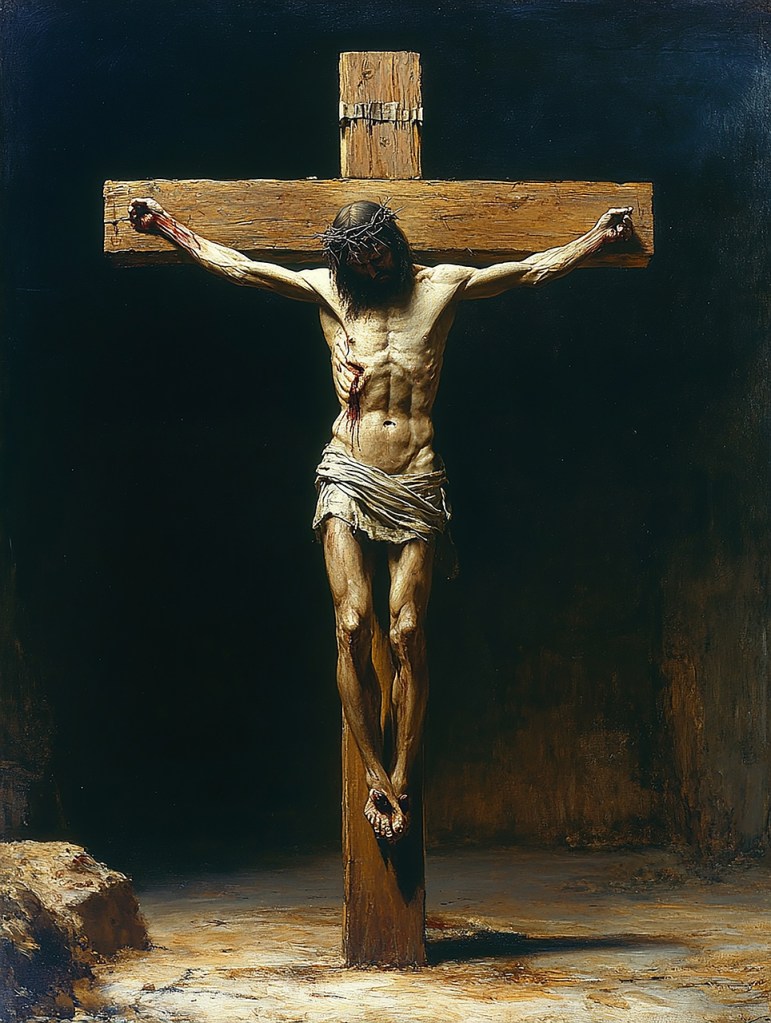
Today, the Church remembers with solemn devotion the day our Lord stormed into and invaded the enemy’s territory with great power. The invasion certainly didn’t look very commanding. In fact, it appeared dreadfully weak and pathetically insufficient. A bloodied and beaten man nailed to a cross, his head hanging low while gurgling His final words through strained breaths.
Behold, the Conqueror.
The world scoffs at such things. It looks to the cross and sees little more than a long-forgotten event that may or may not have happened. If it did happen, it certainly wasn’t anything of consequence. Consequential conquerors—genuine victors—are not captured and killed. They certainly do not submit to their captors and die willingly.
And yet, all around the world, Christians gather on Good Friday in somber reverence. They kneel in humility before their crucified King. They do so with a bizarre mixture of holy sadness and joy. The sadness comes as they acknowledge this King is innocent—that He’s paying a price He does not owe. We owe it. We’re the guilty ones. And yet, He suffers this world’s sin, bearing it fully, taking it into Himself in every way (2 Corinthians 5:21), and He does so for those who can only be counted as enemies for their crimes (Romans 5:6,10). The joy comes as they understand and embrace that He does this because He loves them. The joy emerges from a Gospel that declares He does what He’s doing without any strings attached. He does not hand the believer a bill for services and say, “Now, you owe me.” He does what He does by grace, and He bestows the merits of this world-altering effort from a heart of love.
Only the eyes of faith can see what Jesus is doing on Golgotha’s hill for what it is and receive the merits. Only the eyes of faith can behold the Lord’s divine love being poured out in a way that defeats Death at its own game. Only the eyes of faith can behold the suffering servant as the valiant destroyer of Sin and Satan—as the One turning back a world trapped in dreadfulness and ushering in the life to come. Only the eyes of faith can look upon this holiest act in all of history and desire faithfulness to the One who gave His everything for everyone.
My hope for you on this sacred day of days is that, as you have the opportunity, you’ll join your Christian family in worship. Go to the house of the Lord. Join with the multitudes of believers who know the immensity of sin’s cost and yet rejoice in the payment being made by the only One strong enough to make it—the Conqueror, Jesus Christ—the Son of God and Savior of the world.
It’s Maundy Thursday. It’s an important day for the Church. It is the day our Lord instituted His Holy Supper, establishing and giving His very body and blood for the forgiveness of sins. It is the night He stooped to wash His disciples’ feet, demonstrating an immeasurable love for sinners. It’s also the beginning of His Passion—the night of betrayal, sorrow, and the deep descent into suffering for the sake of the world.
Unfortunately, on this day every year, I notice that folks on social media lean into the premise that Judas was present at the Lord’s Supper. They do this for various reasons, one of which is support for the practice of open communion. Essentially, their point is that everyone is welcome at the Lord’s table, even unbelievers.
Not only does Saint Paul speak rather crisply to this issue in 1 Corinthians 10 and 11, but my sense is that the premise actually arises from more of the pop-spiritual mushy Jesus perspective than the Jesus who demands order among the holy things (1 Corinthians 14:33). The mushy Jesus lets everything slip by, preferring your comfortability. He’s always friendly. He certainly doesn’t accuse or offend. He doesn’t draw lines and say, “Whoever is not with me is against me” (Matthew 12:30). He doesn’t overturn tables (Luke 19:45-46). He doesn’t rebuke anyone for approaching sacred things in an unworthy manner (Matthew 7:6, 23:16-22).
In truth, the mushy Jesus is more mascot than Messiah—an ever-smiling accessory to whatever people already believe. Unfortunately, faith in that particular Jesus isn’t going to end well (Matthew 7:21-23).
The real Jesus is the Lord of the Church. Even as He loves us as no one ever could, He still mandates reverence. He establishes objectively true things, instituting with clarity and consequence (1 Corinthians 11:27-29). He draws sharp lines between belief and betrayal, between holy and profane (Matthew 10:33). That’s the Jesus who is present on Maundy Thursday. That Jesus doesn’t accommodate disorder among the holy things. If anything, He exposes and names it, even though the observing disciples may not have fully understood what was happening.
Back in 2017, I worked the controversial topic of Judas’ presence at the Lord’s Supper into a whisky review at AngelsPortion.com. I just reread what I wrote. I’d say it was sufficient for that moment’s task. Still, there’s more I could’ve said. I want to take some time to lay it out in a fuller way.
For starters, the open/closed communion debate is vast. Here, I’m simply addressing the “Judas was there” premise. The simple truth is, he wasn’t. Judas left before the institution of the Lord’s Supper. The Gospel writers, when read together, give a coherent timeline. With that, relative to the open communion debate, the premise falls flat.
In John 13:18–30, Judas is identified as the betrayer and then leaves. That happens before the Supper is instituted in Matthew 26:26–30 and Mark 14:22–26. But what about Luke? I’ll get to that in a second. But again, the sequence is pretty straightforward: John 13—Jesus identifies Judas; Judas departs. Matthew 26 and Mark 14—Jesus institutes the Supper after Judas is already gone.
Now, before going any further, there are four things we should keep in mind. First, it’s important to distinguish between the Passover meal and the Lord’s Supper. Yes, Judas was there at the start of the Passover meal. That’s when Jesus handed him the dipped morsel of bread (John 13:26–27). But after Judas left, Jesus transitioned from the Old Covenant Passover to the New Covenant meal—the Lord’s Supper.
Next, the dipped morsel is not proof that the Lord’s Supper had already begun. In context, the dipped morsel is a symbolic gesture that occurred during the Passover meal. In this instance, Jesus did it to signal who the betrayer would be. Interestingly, the action wasn’t an unusual one. It was a familiar gesture during a shared meal, typically meant as a motion of kindness. Reading the other accounts, that’s how the observing disciples appear to have interpreted it. For us, knowing what’s about to happen, the fact that Jesus does this to Judas shows the depth of the Lord’s profound heartbreak at that moment.
Third, some folks might point to Luke 22:14-23, where the Supper and the betrayer are mentioned together (“But behold, the hand of him who betrays me is with me on the table” v. 21). Folks might single this verse out as supporting Judas’ attendance during the institution. However, not only does this not fit the order, but as most students of the Bible know, Luke tends to arrange material by theme rather than sequence. This mention is a reflective comment, not a timestamp, and it by no means contradicts John’s incredibly detailed chronology. Luke’s inspired literary point emphasizes betrayal as central to the night’s dreadful events.
Fourth, logistics matter. Judas wasn’t a supervillain with superspeed or teleportation powers. If he had stayed through the entire meal and then followed Jesus and the disciples to Gethsemane, he would have had to backtrack into the city, find and organize the temple guard, and return to the garden, all without being seen and without any Gospel writer thinking to mention it. That defies both common sense and the plain reading of the text.
In the end, I think John 13:30 settles it: “So, after receiving the morsel of bread, he immediately went out. And it was night.” Judas left immediately. He did not stick around for the institution of the Lord’s Supper. Any suggestion that he was present is in error.
To close, I hope this brief survey helps you. I had some time this afternoon to tap it out, and so I thought, “Why not?” even if only to equip you for conversations that might turn in this direction. As you might expect, it does happen to me on occasion. Of course, that goes with the pastoral territory. Pastors are called to be “stewards of the mysteries [sacramentum] of God” (1 Corinthians 4:1).
I write and share the following because it happened yesterday during our Palm Sunday Divine Service. Admittedly, it does happen occasionally throughout the year. However, it is most prevalent during the Christmas and Easter seasons. What happened? Allow me to explain it this way.
Reverence is a hard thing. I say this because it requires a unique balance of self-awareness and others-focus that the sin-nature does not naturally possess. The sin-nature takes what it believes it deserves. It situates its environment to suit its comfortability and is enraged when it must accommodate something else. It abhors barriers, especially the creedal kinds that protect from self-destruction. It chafes against authority, despises order, and scoffs at sacredness.
Reverence respects the environment into which it has entered, knowing it does not deserve to be there but instead was invited. Reverence is humble. It bows. It quiets the self. It does so to learn, which is far more than merely taking in information. It desires betterment. And so, it listens before it speaks and measures its words with care. It sees holiness and does not demand immediate access but observes with trembling gratitude. It acknowledges mystery and does not rush to assume it understands.
Reverence is hard because it calls a person to submit—to kneel when he would rather stand, to cover his mouth when he would rather impose opinions, and to adore when he would rather be adored.
That said, if you walk into a stranger’s house irreverently demanding what is the family’s to receive and are refused, you are the offender, not the offended. It is the same when you visit a church with which you are not in altar fellowship. The Lord’s Supper is not a right to be presumed but a gift to be received in unity of confession (1 Corinthians 10:14-24; 11:23-29). Reverence understands this. It does not stride to the rail unexamined or uninvited. It does not treat holy things as common, nor does it force participation where spiritual bonds have not been established.
Irreverence, however, is quick to call the stewardship (1 Corinthians 4:1) of these things unkindness and to label fidelity as arrogance (Galatians 1:10). It reframes faithful creedal boundaries as barriers and assumes hospitality demands compromise. But the Church—her doctrines and practices—is not ours to reshape (Hebrews 13:8-9; 1 Timothy 3:15). She is Christ’s (Ephesians 5:25-27)—and reverence knows this. It approaches with open hands, not grasping or demanding fists. Reverence waits until it can say “Amen” with integrity (1 Corinthians 14:16), because it knows that to kneel and receive without understanding is not only dishonest, it is dangerous (once again, 1 Corinthians 11:29).
Reverence is hard because it requires restraint in a doctrinally shallow American Christendom obsessed with the “self.” But it is precisely this restraint (established by the Holy Spirit) that helps human hearts receive what God gives on His terms. It trusts that the faith once delivered to the saints (Jude 1:3) is sufficient, and it takes seriously the apostolic call to “stand firm and hold to the traditions” handed down (2 Thessalonians 2:15). Reverence is not offended by these things, but accepts them as gifts meant to preserve and protect the Church in every age. And so, while the sin-nature storms out of a worship service offended that the pastor refused it communion, offering instead a brief blessing and an opportunity to chat afterward, reverence kneels and receives the blessing with gratitude, and then looks forward to the post-service conversation with a man intent on maintaining faithfulness rather than perpetuating spiritual harm.
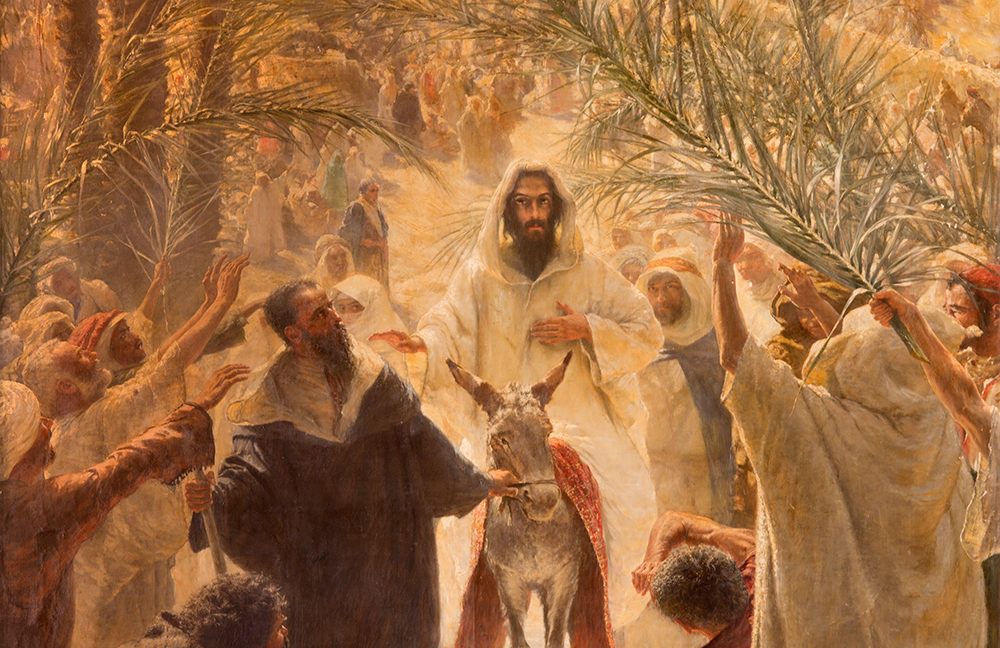
For the Church, Holy Week begins today. Christ is in His final approach. The excitement is thick. The gates are open. Nothing obstructs His entrance. The crowds have gathered. Their songs of Hosanna ricochet and resonate from the narrow pathway’s structures. Some have laid one of their few possessions on the road. A colorful mosaic of cloaks paves His way. Others scurried up nearby trees and then down again, having cut palm branches to share. The people wave them in celebration. Men, women, and children—all are praising His arrival. His disciples go before and after the Lord. A donkey carries Him.
Why isn’t He smiling? Why are His eyes bloodshot and swollen? The Gospel writer, Luke, tells us the celebration within the city had already begun on the outside road going down from the Mount of Olives. Making His way, Jesus came to a place before the city’s entrance where He could see Jerusalem in its fullest landscape. Luke records:
“As he approached Jerusalem and saw the city, he wept over it and said, ‘If you, even you, had only known on this day what would bring you peace—but now it is hidden from your eyes. The days will come upon you when your enemies will build an embankment against you and encircle you and hem you in on every side. They will dash you to the ground, you and the children within your walls. They will not leave one stone on another, because you did not recognize the time of God’s coming to you’” (Luke 19:41-44).
The Lord sees what the onlookers cannot, and He is troubled. They hoot and they holler without the slightest awareness of the peace He comes to exact. He’s traveling into and through the “hour and the power of darkness” (Luke 22:53) that erupts when He’s arrested and beaten, when the people will call for His sentencing and death. For them, at this moment, He is a bread king. They’re expecting Him to ride through and into the courts of the powerful—to rid Jerusalem of the Romans and restore Israel’s might among the nations. But that’s not what He has come to do. He is in His final approach toward something magnificently gruesome, and few, if any at all, will know what’s happening when it finally arrives. Oh, its dreadful midpoint on Golgotha’s hill. The ground will shake, the sky will become nighttime at noonday, the temple veil will tear, the rocks will split, and tombs will open, and still, they will not see. A centurion and a handful of guards will exclaim, “Surely, this man was the Son of God” (Matthew 27:54, Mark 15:39, Luke 23:47), but the rest will leave the horrific scene wagging their heads in disgust.
There’s more Jesus sees in that panoramic moment coming down from the Mount of Olives. He knows more as He rides into and through the crowds. He weeps because of it. He knows that a demonstration of the Last Day’s unbearable judgment for unbelief is coming. It will be awful, and yet, it will be little more than an atom-sized ember of rejection’s blue-hot reward, a recompense He does not want to bring.
In the very near future, in A.D. 70, Emperor Titus, the Caesar, will surround and level the city. The historian Flavius Josephus would one day describe the aftermath:
“Now, as soon as the army had no one left to kill or to plunder because no one was left to be objects of their fury (for they would not have spared any had there remained more work to be done), Caesar gave orders that they should now demolish the entire city and temple… much of the wall as enclosed the city on the west side, this wall was spared, in order to afford a camp for the remaining garrison. The towers were also spared, in order to demonstrate to posterity what kind of city it was, and how well fortified, which the Roman valor had subdued; but for all the rest of the wall, it was so thoroughly laid even with the ground by those that dug it up to the foundation, that there was left nothing to make those who came to see believe it had ever been inhabited. This was the end which Jerusalem came to… a city otherwise of great magnificence, and of mighty fame among all mankind” (Wars VII:1-4).
And so, Jesus weeps this first day of Holy Week. His Lenten travelers weep with Him. But our tears are a strange amalgamation of sorrow and joy.
We cry with our Lord in His sadness. We cry for those who remain in darkness and in the shadow of death. We cry because we know the inevitable wage for sin—eternal Death and separation from God—is entirely avoidable. Christ has made a way through. He has redeemed the world! Still, we cry because we know ourselves. Even as He would have us as friends, in our inherent sinfulness, we are at enmity with God. And so, we know our need. We know, by faith, He does for us what we would never think to do for Him.
But therein lies our Palm Sunday joy. He’s the only One who can do it. He’s the only One who would. And we’re so happy that He did. We watch Him make His way, and we’re thankful. He does not necessarily ride on in majesty because He has to, but because He wants to. He loves His world. He loves all of humanity, and as Saint John will very soon experience and then record from the forthcoming Maundy Thursday night in the upper room, “He loved them to the end” (John 13:1).
The end will very soon be upon Him. Follow Him there. Watch what He does. Listen to His words along the way. Turn an ear toward the cross and hear Him remain completely others-focused until His very last breath.
But how will you watch and listen if you do not follow Him there?
The Word carries you (John 1:1-2,14; Luke 24:27; John 6:68; Isaiah 55:10-11; Romans 10:17; Hebrews 4:12; and others). Do not be divided from it. The Word of God—both the person of Christ and the Scriptures that testify to Him—is what leads believers to the cross, sustains them in faith, and delivers the message that is the power of God unto salvation that reveals the depths of Christ’s love (Romans 1:16).
Let it carry you now. Let it lead you through the hosannas and into the coming darkness, that you would not be found unbelieving, but believing, that you would ultimately see—really see!—and rejoice in the light of His resurrection victory. He went there for you. Go with Him and see.
Here at Our Savior Evangelical Lutheran Church in Hartland, we have opportunities every day in Holy Week to be carried by God’s Word through the Lord’s Passion—Holy Monday, Holy Tuesday, Holy Wednesday, and Maundy Thursday at 6:30 pm, Good Friday Tre Ore at 1:00 pm and Tenebrae at 6:30 pm, Holy Saturday’s Great Vigil of Easter at 6:30 pm, and of course, the Resurrection of Our Lord, Easter Sunday, at 9:30 am.
Now, if I might make a suggestion. Please take a chance and share this eNews message with someone you care about.
To the person who just received it: If you don’t have a church home—a place and a people among whom you can regularly receive and give the care of God’s blessed Word—if ever there was a time to consider finding one, Holy Week is that time. You’ll know the theological heart of a congregation from the way it navigates the Lord’s Passion. Beyond this encouragement, there are other things to know. First, the Scriptures mandate this fellowship; it is not optional (Hebrews 10:24–25, Acts 2:42, 1 Corinthians 12:25–27, and others). And speaking practically, look at the titles of Paul’s Epistles. They are written to congregations in places like Ephesus, Corinth, and Rome. Consider the content of each. Apart from teaching, he provides instruction for good order and sound doctrine in a precise locale—a congregation—established for the Gospel’s perpetuation. Second, and perhaps the best reason to join a faithful congregation: you will be blessed (Psalm 133:1-3, Matthew 18:20, Galatians 6:9–10), just as the Lord has promised.
I had an interesting conversation with my soon-to-be 20-year-old daughter, Madeline, a few weeks ago before leaving for the office. Wondering what she had planned, I asked her about her day. She’s in school. She’s also nearing the end of her efforts toward a well-earned private pilot’s license. That particular day, she had a lesson at Bishop Airport, followed by an evening shift at work. Knowing she was close to finishing, I asked her if there was a final test of some sort. She said she’d already aced the knowledge tests but that she’d soon go up with an instructor who, apart from testing and observing her skills, would put her through a barrage of questioning. In her words, she said, “It’ll be like the Great Confession, except it’ll be a lot harder because I didn’t grow up in it.”
First, by Great Confession, she means what I put our young catechumens through prior to Confirmation. In other words, to be confirmed, you must present yourself for interrogation before the congregation, and I’m the chief inquisitor. It happens the Saturday before Palm Sunday, with the Rite of Confirmation occurring the very next day. Essentially, I ask the catechumens questions—a lot of theological questions—and then, if they answer them sufficiently, they must each recite Article IV of the Augsburg Confession. Article IV iterates the doctrine of Justification. It’s crucial that they do this. Justification has been long understood as the doctrine by which the Church stands or falls. If the Church gets the doctrine of Justification wrong, it ceases to be the Church.
This is the Great Confession, and to be confirmed at Our Savior Evangelical Lutheran Church in Hartland, Michigan, you must endure it successfully. Some haven’t, and they weren’t confirmed; not many, but some.
Understandably, the kids preparing for the Great Confession get a little worked up over it. Of course, I’m not questioning them in a way that seeks their failure. I want them to succeed. But I also want them to dig deeply, think through, and confess what they believe before taking their place at the Lord’s altar to confirm that same baptismal faith. Too many kids are confirmed just because that’s what mom and dad want or because that’s just what happens in their church at this age. Not here. There will be kids of various ages, some much younger than you’d expect. There will be kids who’ve been at it longer than others. This year, there are five students. Next year, there could be as many as sixteen. But no matter how many present themselves for examination, none will be confirmed apart from this process. It has proven itself reliable, and I have no plans ever to change it.
To understand why I’m sharing this requires returning to what Madeline said about it that morning a few weeks ago. She is five years past her Great Confession. Still, she remembers it. It was challenging. Still, she claimed that compared to her experience enduring the Great Confession, her final flight exams would be much harder. Again, her words: “It’ll be harder because I didn’t grow up in it.” Her point was that the Christian Faith has occupied her since she was born. This is true not only because she never misses worship and Bible study or because she attended her church’s Christian day school, but because she remains immersed in it all the other moments of her life—having conversations with her family at dinner, in the pool on vacation, out shopping with her mom, riding in the car with dad, and so many others of life’s usual moments. For her, whether it’s the Great Confession with her dad or a stranger’s casual interest, she can confess Christian truths as readily as tying her shoes.
But what about others her age who’ve fallen away? What happened? Perhaps their faith was never truly integrated into their daily lives. Maybe church and doctrine were compartmentalized—reserved for Sunday mornings or the occasional youth event—rather than woven into the fabric of their everyday experiences. Of course, suppose faith is treated as just one activity among many, or worse, a burdensome obligation rather than a life-giving necessity. In that case, it becomes all too easy to set it aside for what seems more important. The world is already relentless in offering distractions and alternatives that seem more appealing or more immediately rewarding. It’s certainly hard to argue the culture’s influence, with its constant noise and competing narratives.
Here’s something else to consider.
A 2020 study in “Education Week” reported that around 27% of public school teachers considered themselves ideologically conservative. Compared with another survey from Pew Research, about half of that same group considered themselves conservative Christians. A conservative Christian is defined as someone who attends worship regularly and believes the Bible is God’s inspired and inerrant Word. The assumption is that anywhere from 10% to 15% of all public school teachers are Bible-believing educators. When you figure that the average student with a bachelor’s degree had as many as 115 different teachers throughout their public school life, it’s likely that only 17 of those teachers were being steered by Christian faithfulness. However, studies also show that most Christian teachers prefer to remain thoroughly neutral, neither teaching to the left nor the right, while ideologically liberal teachers are twice as likely to insert their beliefs into their lessons. When these are the contours of our children’s learning environment, and we figure that a third of their waking life is spent in it, no wonder so many of our children end up in rainbow-colored ditches.
Continuing, someone asked me not all that long ago what they should do to help steer their adult child back toward the faith. With a few insights relative to the context, essentially, I gave this person the same answer I give to others who’ve asked the same question.
First, don’t lose heart. The Word of the Lord does not return void (Isaiah 55:11). The seeds of faith, once planted, remain, even if buried beneath the weeds of worldly temptations.
Second, are we talking about a baptized child of God? If so, then instead of despair, parents should almost certainly remain steadfast in prayer, trusting in the Holy Spirit’s work. One of the great things about baptism is the promise associated with God’s name. A child baptized in the name of the Father, the Son, and the Holy Spirit, just as Jesus mandated, is a child upon whom the Triune God’s name has been placed. For starters, in the Old Testament, God explicitly ties His name to the temple, saying that where He puts His name, He promises to dwell (2 Samuel 7:13, 1 Kings 8:29, 1 Kings 9:3, 2 Chronicles 7:16). In Numbers 6:24-27, God’s personal name (YaHWeH) is invoked three times in the Priestly Blessing (unsurprisingly in a trinitarian way), and in so doing, He promises that His name is thereby placed on His people resulting in blessing.
All of this more than carries over into the New Testament theology of baptism. I don’t have time for all of it, but we certainly get the sense in Matthew 28:19-20, Galatians 3:27, and Acts 2:38-39. Even further, just as God placed His name upon the temple in the Old Testament, Saint Paul tells us that God places His name on His people, the baptized Church. We learn this explicitly in 1 Corinthians 3:16-17, 2 Corinthians 6:16, and Ephesians 2:19-22. Even better, this naming extends into the heavenly realms. God’s name is on people there, too, marking them as His own. Revelation 3:12 presents this. Revelation 22:4 does, too. Even better, I think it’s equally interesting that Revelation 7:14 describes these marked believers before the throne as those who “have washed their robes and made them white in the blood of the Lamb.” That’s an interesting way to describe the people upon whom God’s name has been placed. I wonder what it could mean. Perhaps the answer to this rhetorical wondering is given elsewhere, in places like Acts 22:16, for example.
My point: a baptized child bears the Triune God’s name, and God isn’t so easily separated from His name. There’s hope in this divine reality.
Third, I recommend keeping the doors open. Engage them in meaningful conversations about life and faith, and most importantly, model unwavering devotion to Christ. If you go to visit for a weekend, start simply. For example, pray before meals. Make plans to attend worship on Sunday. Invite them to join you in both. Be a fixed point of faithful devotion to Christ no matter where you are or what you’re doing. They’ll see this. And then, keep in mind that the prodigal son returned because he knew where home was fixed, and he knew his merciful father was there waiting (Luke 15:11-32). Likewise, those who have been immersed in the faith, even when they stray, can recall the way home, especially when they see the way home through you.
A critical season in the Church’s life begins this Wednesday. It starts with a defining moment, one that communicates the Church’s identity in ways that the other Church seasons do not. The season before us—Lent—pits itself against all temptations to loosen our grip on who we are and what we are called to believe, teach, and confess.
Epiphany and the Gesima Sundays (Septuagesima, Sexagesima, and Quinquagesima) led us to this moment. Epiphany showed us who Christ is relative to His claims. The Gesima Sundays urged us to embrace His Gospel work, no matter how backward a divine but crucified King might seem.
From there, we enter Lent. We do so through Ash Wednesday’s liturgy.
As we pass, our foreheads are marked with all that remains from fire’s insatiable judgment. Remnant cinders are smeared on Christian foreheads, but only as we’re also told by the one applying them, “Remember you are dust, and to dust you shall return” (Genesis 3:19), or as the early Latin saying eventually summarized, “Memento mori”—remember, you must die. The ashen smear is a messy mark—grittily filthy and hard to wash off. That alone speaks volumes. Death is Sin’s wage, and it will be paid. The payment is not an easy thing. It is tenaciously dirty. It is impossibly thick.
If you’re paying attention, another thought might come to mind in that moment. Anyone participating in the Ash Wednesday liturgy likely does so by first standing in a line. One will go before another and then another and then another. Eventually, it’s your turn to confront death’s dreadfulness.
We all will. We all do.
However, if you can, watch the motion of the one applying the ashes. Even if the resulting mark is crassly formed, you’ll at least see it was done so in the shape of a cross. You’re not remembering death in terror. Ash Wednesday’s liturgy is not condemning you. Neither is the vested one at the end of the line who’s marking your face. You’re being readied, reinforced, and sent into Lent well-equipped.
Yes, Death is Sin’s wage. But the believer bears in his body both the death and resurrected life of Jesus, the One in whom his faith is founded (2 Corinthians 4:10-11). Indeed, Christ’s death on the cross was the all-sufficient payment that thwarted Death’s reign. It is swallowed up in His resurrection victory, having forever lost its sting (1 Corinthians 15:54-57).
I’ve insisted on countless occasions that, if anything, Ash Wednesday’s liturgy reinforces what the Christian Church is to know of Death, lest it become too comfortable with what’s really going on behind the scenes in this life. It does this while, at the same time, redirecting the penitent heart to the only One who can give hope—the One who met death in its own lair, nullifying its power.
Ash Wednesday draws the believer in, ultimately calibrating Him for Lent’s deepest message. And what is that message?
The battle between Christ and Death will be brutal. Death will not surrender us easily. And so, the war will be fierce. At first glance, it will appear all too easy for Death. Christ will not fight back, but instead, will surrender Himself entirely and in every way, ultimately coming to a miserably horrific and mutilated end on a cross drenched in his own bloody agony and dejection. It will be quite the backward sight, one that makes little sense relative to this world’s calculus.
Ash Wednesday and Lent lead us to Golgotha’s happenings. Indeed, they’re raw and unpleasant. And yet, they’re good—thoroughly good. That’s because they’re the muscle fibers that form the Gospel’s heart. Amen, we preach Christ crucified (1 Corinthians 1:23)! Indeed, we are not afraid of Death because we are not ashamed or afraid of the Gospel! It is the power of God for salvation (Romans 1:16-17).
As always, I’m inclined to encourage you: If you have never attended an Ash Wednesday service, consider doing so. If you receive this note and your church does not offer one, find a church that does.
Here at Our Savior in Hartland, Michigan, we offer two Ash Wednesday services: one at 8:10 AM and another at 6:30 PM. You are welcome to join us in the line. You are welcome to remember Death’s concern rightly. But even better, you are welcome to hear the Good News that converts and convinces human hearts to faith—to hear that Jesus is the resurrection and the life, and that whoever believes in Him, though he die, yet shall he live (John 11:25-26).
God bless and keep you in this faith now and always.
As you may already know, the Life Team here at Our Savior in Hartland, Michigan, (along with some help from “The Body of Christ and the Public Square”) orchestrated a substantial event entitled “An Evening for Life” featuring Seth Gruber. If you know anything about Seth, then you know he’s a caffeinated firehose of valuable information. That’s why it only took a little more than three weeks of promotion to get 206 attendees from all around the state on a cold Thursday evening, some willing to drive a few hours to be with us. However, referring to these visitors as “attendees” seems insufficient. “Active learners” is more appropriate. Craving information, they actually got into their cars and drove to an event.
Conversely, if there’s one thing that bothers me about typical information exchanges, it’s the tendency some folks have toward spoon-feeding. For example, I wrote and shared something on Facebook a few weeks back in which I discussed a somewhat controversial theological topic. Sometime afterward, I received a private message from someone asking me to explain some unfamiliar terms I used in the post. First, the person wasn’t on my friend list, so I elected not to reply. If you know anything about Facebook Messenger, then you know that if you reply to someone outside your network, you are granting him full Messenger access. I try not to do that. Ever. The times I have, I’ve inevitably needed to block the person.
Second, and putting the best construction on things, my guess is that the person asking for the explanations must live in a place without adequate internet time or resources. Perhaps he lives in a Kath Kuni in the Himalayas or a cave in Afghanistan? However, if neither of these describes his actual plight, then I assume he can research the terms for himself. With a few taps at the computer, followed by a click or two with the mouse, he’d be on his way to learning anything and everything he’d ever hoped to know about the terms he’d never heard before. Instead, he wanted me to spend time writing it all out for him.
He wanted to be spoon-fed.
Now, before I go any further, I’ll admit to doing the same thing on occasion. The Thoma family has a family calendar. It’s synced to my phone. Still, rather than looking at the calendar, I’ll ask my wife, Jennifer, “Is there anything on tonight’s schedule that I should know about?” When I do this, I’m demonstrating passive learning. I have access to the information, but rather than doing my own investigating, I make the mistake of expecting her just to tell me. It’s lazy practice. I admit it.
Genuine learning isn’t lazy. It’s an active process. It takes work. Sure, there are things we learn passively, which is to say, we learn them without active engagement. Infants learn many things that way. They’re human sponges. I suppose there’s an element of passive learning for infants relative to language. They learn to speak as language is brought to them. But it doesn’t take long for the infant to become an active learner in the process, eventually engaging in language exploration. They begin making noises and sounding out words. Indeed, any parent will tell you that infants are the epitome of active learning in almost everything. They see something and, no matter what it is, reach out to explore it in every way they can. And none of their five senses is off limits, not even taste. My grandson, Preston, when he discovered his toes, guess where he eventually decided to put them?
Thinkers are active learners. There’s a chance I’m not dealing with an active learner when, let’s say, I post on Facebook, “William Federer will be one of the speakers at our upcoming conference,” and someone replies, “I’ve never heard of him? Who is he?” A reply like this irritates me because it expects me to present a detailed biography. I certainly could have provided a link to one in the post. However, not every hand needs to be held.
This leads me to something else.
Relative to intellectual lethargy, could it be that we’ve arrived at a time in history where it’s no longer possible to actually convince or convert anyone to a position other than the ones they already hold? What I’m saying is that, for virtue’s sake, I get the sense that most people consider themselves open-minded. And yet, are they passively or actively open-minded?
A passively open-minded person listens to whatever is being said but is only willing to consider and embrace those parts that align with what they already believe is true. They don’t want to do any thinking work. They don’t want to get up from their mental couch to answer another perspective’s knocks at the door. An actively open-minded person knows what they believe, and yet, while listening, searches for breakdowns, loopholes, or contradictions in not only the speaker’s argument but also their own belief system relative to the argument. In other words, they get up from the couch, open the door, and let the perspective into the house for a conversation. As they do, they put in the interrogative work. They ask questions. They offer content and counterpoints. They examine the topic from more than just their perspective, giving and taking along the way.
I think active learning also insists on active open-mindedness.
I guess what I’m wondering out loud right now is why so many seem to lean so heavily on passive learning styles, especially at a time in history when having a grasp on what’s going on is not only incredibly important but, at the same time, we have instant access to so much information. A few weeks back, I shared some of these thoughts with the teachers in our congregation’s school during our regular study of the Book of Concord. One teacher supposed part of the problem could be the overwhelming flood of content we encounter daily. With so many things happening at once and so much content to process, it’s easy to choose the spoon-fed route, preferring extracts from trusted sources rather than taking the time to do a deeper dive. Considering the person I mentioned at the beginning of this particular meandering, perhaps he wanted me to feed him the information because he trusts me. If so, I’m flattered. But my gut tells me it’s more likely that because social media is so overrun with memes, news snippets, and soundbites, he’s been trained to skim rather than study. But therein lies part of the problem.
Dependency on others to think for you—to distill complex ideas into more easily digestible pieces—robs a person of genuine growth.
Most often, controversial or challenging topics are not easily digestible. They take a little extra work, especially if the intent is to understand the argument and then formulate a barrier of truth relative to it. Sure, you can have a sense that transgenderism is weird. You can even know that the Bible stands against it as a perversion. But do you know where the Bible says this, and can you provide a convincing argument for why the Bible might speak this way? Do you know the topic’s relation to natural law, essential societal structures, the nature of male and female, terms like Imago Dei, or the fertile imagery of the mystery of Christ, the Groom, and the Church, His bride? There’s a lot more to the discussion than saying, “I think it’s weird, and I’m against it.”
I know my writings are longer than most you’d find on the internet. But regardless of the “less is more” inclination, I prefer a thorough wrestling with most topics. Snippets are fun, but they rarely close the loopholes.
Again, passivity in learning can be problematic. It’s happy enough to pursue the “tell me what to think” approach rather than investigating and thinking through something for oneself. The first results in echo chambers that never go anywhere. The second is intent on locating truth while buffeted with a firmer grasp on what makes it true.
The distinction between these two approaches has a blast radius that ripples out into the broader cultural landscape. I’m sure, like me, you’ve experienced those conversations with people that have devolved into name-calling, mainly because the debaters couldn’t get any deeper than their emotions. For example, as soon as I mentioned that James Lindsay would be a speaker at this year’s conference, I had someone essentially calling me a rotten pastor for “platforming” someone he deemed an enemy of Christ. But James isn’t an enemy of Christ. Of course, snippets won’t teach this. A deeper dive will. Even better, an interrogative conversation with the man reveals his person. That said, I’ve eaten meals and consumed whisky with the man in my own home. We’ve talked about lots of things, many of which were faith-related. If anything, he’s more open to an introduction to Christ than most. Passive learning is self-centered, and it won’t learn this about James Lindsay.
By contrast, it seems to me that active learning is born from a sense of humility. It approaches others from the perspective, “I’m not perfect, and I don’t know everything. What can I learn from you?” It begins with knowing that objective truth is real, but to truly discover it means admitting oneself is flawed. From there, it’s willing to hear from others. In James’ case, formerly atheistic but now more so agnostic, he’s willing to sit at a clergy friend’s bar in his basement and entertain things of God, while simultaneously, that same friend is willing to hear from his expertise relative to various topics of interest. I’ve learned a lot from James Lindsay about how mainstream Christianity got to a condition in which rock shows are considered worship and lesbian bishops are ordained. If I’d written him off as merely an enemy of Christ, I’d never have learned these things, and my theological prowess would be far lesser.
Of course, as with most things, Christians always have the upper hand on humble learning. We know by faith that objective truth exists. We understand that every human being is terminally flawed in sin, and as a result, objective truth will never be discovered from within. From there, we can say that active learning is fundamental to the Christian life. It’s not like the Bible rarely encourages believers to seek wisdom and understanding. It does so throughout its pages. For example, a ready text is Proverbs 2:2-5. Here, Solomon actually emphasizes active learning, urging us to incline our ears to wisdom and seek it as one searches for hidden treasure. Treasure hunting requires effort. It requires digging deep into the strata. Relative to God’s Word, when we dig deeply, we are not only better equipped to defend the faith (1 Peter 3:15), but there’s something else that happens. Speaking only for myself, the more I dig into the Word of God, the more I sense my mind is attuned to the mind of Christ that Saint Paul talks about in Philippians 2:5.
Circling back to where I started, you need to know the Bible warns against intellectual laziness and the dangers of relying solely on others for understanding. Another prime example is found in Saint Paul’s commendation of the Bereans in Acts 17:11. He praises them for examining and measuring the Scriptures against everything they’ve been taught. By doing so, they were successful in verifying what was true and avoiding what was false. This is a demonstration of active learning, which is in sharp contrast with the passive learners who risk falling into deception or shallow thinking (Ephesians 4:14).
Don’t be a passive learner. Instead, with diligence, embrace your responsibility to think deeply, both for the sake of personal growth and, more importantly, for carrying the Gospel to the world around you in thoughtful, persuasive, and respectful ways, just as the Bible portrays the Apostles and Evangelists before us (1 Peter 3:15-16, 2 Timothy 2:24-25, Colossians 4:5-6, Acts 17:2-3, Jude 1:22-23, Proverbs 16:21, and so many more).
What’s on your mind this morning? Something likely is. Or better said, “somethings.” On my part, I just got some weightier news this morning, and so I have a lot on my mind. Still, I’ll try to keep this light, practical, and worth your while.
For starters, I’m overjoyed by President Trump’s inauguration. And his speech—wow! What an indictment of the Biden administration, even as the former president and his associates were sitting just over Trump’s left shoulder. Trump’s words were bold in the best way. While listening to the speech, I tried to imagine what Biden, Inc. was thinking. Considering what Trump said, I’m sure several in the bunch were just wondering how much longer it would be until they could leave.
I was also overjoyed this past week by President Trump’s pardoning of the pro-life protesters who were jailed last year. One of them, Heather Idoni, lives in my hometown of Linden, Michigan. She’s a 60-year-old grandmother who was indicted and sentenced by the Biden Justice Department to two years in prison for protesting at an abortion clinic. However, sentencing came only after having already sat in jail for five months. As you’d guess, the pro-abortion opponents have falsely accused this gentle woman, a mother of five and adoptive mother of ten, of outlandish viciousness. But then again, the Devil is a liar. Abortion is his holiest sacrament. He will do what he must to protect it.
Nevertheless, Heather was freed on Friday. Praise God for this. I’ll be talking with her soon. I indeed wonder what she was thinking while in prison. When it comes to someone willing to go to jail for faithfulness to Christ, such a person’s innermost thoughts are worth knowing. Knowing what I know about her, I suspect she kept her thoughts occupied by God’s Word and prayer.
I read an article a couple of weeks ago reporting that most folks have 6.5 thoughts per minute and around 6,000 every day. I only found the article because I was reading a different study about how 47% of our average awake time is spent free-thinking or daydreaming. The remaining 53% is spent being task-oriented. What I found interesting about the results is that the more people daydreamed, the less happy they were.
I didn’t believe that at first—until I thought about it for a moment.
A quick scan of the societal landscape will reveal a humanity that’s in constant distress. Most statistics point to rising rates of anxiety and depression across most demographics, particularly youth. Perhaps worse, the increase in these rates appears to be speeding up rather than slowing down. If that’s true, it makes sense that the more free time people have to wander around in their own heads, the more open they are to bombardment from the dreadful thoughts already living there. People who spend less time doing this—folks who keep busy actually doing something—they’re happier people. I guess there’s something to Henry Ward Beecher’s saying that it “is not work that kills men; it is worry. Worry is rust upon the blade.”
I don’t suffer from depression. But I know people who do. Although, I should correct my self-examination. As I’ve shared before, I’m all but certain I struggle with Seasonal Affective Disorder (SAD). Happiness is much harder for me during the winter months. That said, whether summer, fall, winter, or spring, I spend a lot of time in thought, and I can say that few, if any, of the supposed 6.5 thoughts that happen every minute involve anxiety or sadness. I do have negative thoughts. However, they rarely outweigh or overwhelm what I would consider as my essential human wondering at the world around me. My thoughts certainly don’t outmatch my imagination, whether I’m working on a task or daydreaming. In fact, I get the sense my brain doesn’t really care what I’m doing or not doing. It’s going to wander all over the place, looking for whatever is most interesting.
In other words, I can be working on something important while at the same time catching myself thinking about something else absurdly innocuous. For example, while changing my grandson Preston’s diaper a few weeks ago, a rather messy one requiring skill and precision, I remember wondering how many diapers I’ve likely changed across all four of my children. Thousands upon thousands, I’m sure. From there, I thought about how I used to time myself to see how long the diaper changes took and how proud I was when I’d beat my record. By the time I finished getting Preston back into the bottom half of his sleeper, I was thinking how ridiculous the Star Wars universe would seem in hindsight when artificial intelligence is eventually given complete control over all future cars, fighter jets, and such. Star Wars spaceships, the most technically advanced crafts ever delivered from the human imagination—ones that can cross galaxies—still require pilots. The Millennium Falcon is nothing without Han Solo and Chewbacca.
I thought about all those things while changing my squirming grandson’s diaper and singing the made-up song “Everyone Loves Butt Cream.”
Conversely, my daughter, Evelyn, is absolutely enamored with her new nephew. She wants to hold, play with, and love on Preston all day long. But she won’t change his diaper. She’s terrified by the task. When confronted with the prospect, all she can think about are the risks of getting dirty in ways she’s not willing to experience. And so, when it’s time to change Preston’s diaper, she runs for the hills.
In a way, that illustrates another interesting dynamic in human thinking. Evelyn’s hesitation highlights how thinking rooted in anxious fear can result in a type of physical paralysis, ultimately affecting a person’s ability to engage in what everyday life requires. I suppose that’s one of the real dangers of depression. People become so burdened that they can barely do anything. Depression keeps people locked in a room with an uncomfortably low ceiling. They find themselves held down by the task’s worrisome details before they can even get started, while others can walk into a messy situation with enough emotional overhead to be reasonably unaffected by any potential messes.
Looking back at what I’ve just written, there’s one more thing that comes to mind in all of this.
Part of the reason a diaper change is no big deal to me is because I’ve done thousands of them. The whole process is more than familiar. This fact resonates with Michel de Montaigne’s famous words, “Familiarity confounds all things. It makes the most natural and uncommon things seem ordinary.” In part, his point is that familiarity can be effectually beneficial. Relative to diaper changes, familiarity made the activity’s grossness almost unnoticeable, maybe even fun enough to sing a made-up song.
In light of everything mentioned so far, here’s an equation worth pondering: First, what if there was a way to take some of the free-thinking time that comprises 47% of our lives and convert it to task orientation? Second, what if I told you there is plentiful research showing that the people who regularly immerse themselves in worship and Bible study are much happier, more hopeful, and have better mental health?
In other words, could it be that deliberateness plus familiarity might equal something better? Of course, I’m going to consider all of this through the lens of God’s Word. I’m also thinking back to Heather Idoni’s time in prison and her likely immersion in God’s Word.
I didn’t know until recently that the phrase “Fear not” appears 365 times in the Bible. When I did learn this important fact, an obvious “first thought” came to mind: there’s one “Fear not” for every day of the year. That said, imagine what it would be like to hear God say to me through His Word every day, “Fear not.” Imagine what it would be like to hear Him tell me every day why I needn’t be afraid. Old Testament or New Testament, the epicentral purpose of His Word is to give Christ—the One who is our comfort and courage against every fearful thing this world might try to throw at us.
I suppose one of the funnier things about all this is that secularists will agree with my previous equation’s premise, except their first suggestion would be to occupy oneself with golf or woodworking or whatever. Those aren’t bad things. But if there’s any particular framework in which to anchor our thinking deliberately, Christians already know that the biblical framework is the best one. Using our free-thinking time immersed in God’s Word, we have what our hearts and minds need for waging war against the sinful flesh and its anxious thoughts leading to despair. We find the promises of God there, and with those promises comes the assurance of God’s perpetual grace in every time of need.
Now, before I wrap this up, there’s something I should mention. Golf doesn’t bring me joy. I don’t enjoy woodworking, either. But there is something I like to do on occasion. After I’ve changed Preston’s diaper, I’ve been known to go looking for Evelyn. When I find her, I’ll ask her to throw the diaper away for me while tossing it at her. She usually screams and runs away. Indeed, when burdened by the doldrum-inducing winter, tossing a diaper at my screaming daughter brings me great joy.
Mark Zuckerberg, the CEO of Facebook, has announced he’s ridding the platform of third-party fact-checkers. In his own words, he wants to prioritize free speech. Interestingly, I was finally able to reclaim my Instagram account just last night. It was suspended a few years ago, so I eventually gave up on it. Maybe that’s a sign that Zuckerberg’s intentions are genuine. However, my New Year’s Day post was just removed from Facebook. Apparently, it offended someone and was reported. It seems that as 2025 begins, there’s something offensive about encouraging people to trust Christ rather than the world around them. It appears that Facebook still has some sinister, agenda-driven people keeping users’ speech from truly being free.
The post is in appeal. But truth be told, I’m yet ever to win a Facebook appeal.
In the meantime, California is on fire. Of course, we pray for everyone’s safety. Still, anyone familiar with the state’s politics will know this is only partly nature’s fault. An honest observer will agree that what’s happening was entirely preventable. However, those in leadership at the state level and those at the helm in these incinerated communities had other priorities. Water reservoirs that would typically be full were deliberately drained for negligible repairs, conservation, or climate change reasons. Never mind winter’s Santa Ana winds and the threat of wildfires. In addition, fire and rescue units were unprepared and understaffed, losing funding or being penalized because they weren’t diverse enough.
By the way, and I suppose unfortunately for the climate change religion and its elitist Hollywood priesthood, the current size and content of these residential fires have already released a hundred times more CO2 into the atmosphere in a few days than all of North America’s collective fossil fuel consumption in a typical year. But then again, I learned that a typical woodland wildfire, depending on the forest’s density, can release as much as three hundred times more than all the world’s industrialized countries combined.
As one would expect, the militant left is saying these things aren’t true. I already read two articles this morning in which various local leaders in Los Angeles essentially confirmed these details and yet diverted the discussion with irrelevant information, finally insisting that playing the blame game during tragedies is not helpful. However, these are the same folks who stand at the ready to blame conservatives within minutes of a school shooting. The irony so far is as thick as the flames devouring Palisades and Hollywood Hills.
Here’s another bit of irony. Joe Biden promised the Federal government would cover 100% of the California disaster’s expenses for the next six months. Estimates suggest that equates to as much as $150 billion. But aren’t there still people displaced and living in tents and campers in Western North Carolina following Hurricane Helene, many of whom barely received a dime? Why the massive pledge to Hollywood and not Appalachian America? In addition to this, Biden just authorized another $500 million for Ukraine. He ordered it sent before Trump takes office. Again, he’s done this even as people in various communities on the East Coast are still sleeping in tents in the middle of winter four months later. Several billions of dollars somehow swerved to miss them. Things get worse when you consider the Federal government’s wasteful spending. For example, it just gave a $12 million grant for pickleball courts in Nevada and $300,000 to help establish and promote “affinity groups” (more DEI garbage) among bird-watching communities. Did a flock of starlings complain to someone in Washington that there isn’t enough transgender representation among those watching them?
I say forget about the hundreds of billions of dollars for a moment. I wonder what even the pickleball and bird-watching grants could do to at least alleviate the suffering of Americans forced to live in tents during winter.
While I’ll admit I was hoping for a better start to 2025, I’m not surprised by any of these happenings. I suppose the only real surprise so far is that, somehow, President Trump hasn’t been blamed for all of it. Although, the nation took a noticeable turn on November 5, 2024, didn’t it? In fact, that’s what moved Zuckerberg to make changes at Facebook. He called the election a “national tipping point” away from current social and political trajectories.
That’s good. Still, we’ll see. Do I have hope that there’ll be a turnaround, that all the woke garbage that’s smothering so much of what makes America great will eventually dissipate? Well, first of all, anyone who knows me best will confirm that I’m always looking to the horizon with hope. In that sense, yes, I’m hoping for a turnaround.
On the other hand, while I hope for a national course correction, I don’t expect anything to change much for Christianity. For the most part, the Christian Church already exists in the shadows. This is in part by our own doing. I say this because we’ve allowed ourselves to be relegated to the sidelines. A generation ago, it wasn’t uncommon for the local pastor to give an invocation and prayer in the name of Jesus before the high school’s graduation ceremony. But those days are long gone. In the meantime, rather than holding the line on these things and engaging the culture, too many Christians have opted for comfortable security, leading to cultural conformity. And among such folks, we have pastors who insist on and actually preach disengagement—that it’s not in a Christian’s job description to engage in ways that preserve the Church’s ability to preach and teach the Gospel freely. In this, we’ve abandoned the public square and silenced the Church’s voice in so many arenas. What has been the result? A society that has lost its ability to see, let alone understand, that Christianity was and remains fundamental to Western civilization’s rise and success. Perhaps worse, society has given birth to its own version of Christianity, which is little more than secularism wearing a thin Christian veneer. Such Christianity claims God’s Word is only as true as the individual wants it to be. It exchanges the meat and potatoes of tradition for syrupy and saccharined religiosity—and people are hooked on it. Why? Because, again, it can be whatever you want it to be. It’s never about absolute faithfulness to Christ. It’s never about the Christian community of past, present, or future. It’s about what you prefer right now.
Until this monstrosity dies, the shadows will be home to genuine Christianity. The funny thing is that a light is best seen in the darkness. In that sense, while times might remain tough for creedal and confessionally minded Christians, there’s a sense that the Gospel will be better visible through them to those who need it most. When you get a chance, take a listen to Wesley Huff’s recent interview with Joe Rogan. I’ve been hoping for years that someone would end up on Joe’s show who could iterate genuine Christianity to and for Joe and his listeners. Personally, I think Huff did just that, especially concerning the authenticity and reliability of God’s Word. Convincing someone of the Word’s reliability matters when you’re laboring to introduce them to the Word made flesh, Jesus. Interestingly, Huff only made it onto Joe’s show because of a debate he had with a popular esoteric spiritualist named Billy Carson. Essentially, Huff proved Carson a fraud—and he did so in a gentlemanly way. Rogan, an incredibly open-minded man, heard about it, watched the debate, and invited Huff on his podcast.
I suppose as it relates to Huff and Carson, the real Gospel will always remain crisp in its definition from the shadows, not blurred or confused by quasi-spiritual nonsense swirling in its surroundings. Saying that, I guess the hope that genuine Christianity might emerge from the shadows could be misplaced. It really doesn’t matter where it is. It only matters that it is. From there, our task becomes one of faithful readiness. Whether it’s Joe Rogan or our neighbor next door asking us about the Gospel, the goal is not to retreat but to speak boldly, trusting that God will keep His promise to illumine those in desperate need of hope and redemption.








 Cruciform Stuff