Having just returned from vacationing in an area where massive crowds of people were vacationing as well, it’s an obvious saying learned by simple observation that every single person roaming the planet is unique—that no two people are exactly the same. This is true even for identical twins. Just ask their mother or father. It may sometimes be challenging to discern them in certain circumstances, but in the end, anyone who knows them well will know their distinctive features and be able to tell them apart.
The list of peculiarities between individuals is long. The standard characteristics used for distinguishing are often the things we can see, things like facial features, eye color, height, and build. While on vacation, part of my family’s efforts toward rest and relaxation involved just sitting together in the same room. Believe it or not, some of that time was spent watching nature shows on Discovery Channel. One show in particular, “Serengeti,” was incredibly well-crafted. Although, I think I liked it so much because its narrator never once blamed me for the peril of the animals. I wasn’t to blame for the weather, the swollen and treacherous rivers, the fly-infested plains, or the scorching sun causing desolate landscapes.
One thing I learned from the show is that when it comes to discerning individuals, namely family, animals rely more on smell than sight. It’s not just for purposes of predation or protection. I was amazed at how a baby zebra could find her mother in a confounding crowd of thousands; or how after years apart, peace settled between a cheetah protecting her young and two roaming male cheetahs when by their scents they all discovered they were siblings. I found it interesting that elephants will lift their trunks into the air like periscopes, and they will search the breezes to find relatives miles away. What’s more, their sense of smell is so attuned that they can even identify a relative’s remains in a pile of bones.
Perhaps a non-visual determiner between humans is an individual’s vacation threshold. What I mean is that I’m guessing most folks likely bear an inner clock with a unique alarm that tells them when they’ve had enough time away from life’s regular labors. For example, after about six or seven days, my son Harrison was ready to return to Michigan. Speaking only for myself, my alarm hasn’t gone off just yet. I think it still has about two more weeks left to tick. But no matter a person’s threshold, there’s something common to both: each only has so many minutes.
If I’m remembering it correctly, there’s the saying that while the hours will take care of themselves, the minutes are in our hands. In other words, we do well to remember that time is relentless, but as it carries us along, we have certain freedoms with the moments provided. For instance, my kids just can’t seem to figure out how I can say I’m resting during vacation when I continue to get up before the sun. But I do it all summer long because I want to squeeze as much as I can from every single day. For them, the morning’s minutes are meant for sleeping in. For me, they’re meant for accomplishing what the rest of the year is unwilling to allow. Perhaps most importantly, they’re meant for bringing me back around to remembering just how precious time is—that even as we may think we’re killing time, time cannot be killed, and a minute wasted cannot be reclaimed; or when we say so disconnectedly that time flies, we must remember we’re being carried along on its back as a passenger; or just how right we are when we say only time will tell, realizing that in time, all will eventually be revealed. Euripides is the one who said time is a babbler and that it speaks even when not asked a question.
All these things are true, and so for starters, knowing the value of every minute in my life and the lives of the family God gave to me seems to be one of the wisest routes I can travel toward my final minute—and to do so with the fewest regrets.
Taking a moment to sip my coffee and read back over what I’ve written so far, there seems to be a strange gap in between where I started and where I’ve ended. I began by talking about the things that distinguish people one from another, and somehow, I ended up pondering the importance of making every moment in life count. I guess that’s the danger in free-typing. Although, I suppose as Christians, the connective tissue to these thoughts isn’t as elusive as one might think. It begins to take shape when we consider that for all the natural discernments made between humans by sight, and all the natural discernments made between animals by smell, there is another sense employed in the Church that rises above all others: sound.
Jesus said, “My sheep listen to my voice; I know them, and they follow me” (John 10:27).
By the power of the Holy Spirit through the Gospel, Christians are born into the family of God, and by this, they are enabled for hearing the voice of the Good Shepherd and identifying Him in comparison to all others. By this, we know who to follow, and of course, this very important truth touches each of the minutes granted to us in this life, until finally culminating in the Last Day.
Listening to and following the real Jesus while battling the human will’s desire to follow false prophets and teachers is a major lesson to be taken from the three readings we’ll be hearing in worship this morning (Jeremiah 23:16-29, Romans 8:12-17, and Matthew 7:15-23). It’s a lesson that requires discernment. This discernment is an every-minute-of-the-day endeavor that takes aim toward a final day.
It’s critically time sensitive.
Don’t waste the minutes you and your family have been given, especially when you already know that one day there’ll be a final minute. In that moment, there’ll be far too much from a life lived following false hopes apart from Christ to cram into sixty seconds. Instead, feed as many of the minutes that come before it with the real Jesus—the One who has covered all your transgressions and given the merits of His work to you freely—knowing that His aim is to have you and your family by His side in a place where minutes no longer matter.
Obviously, I’m still on vacation. And it’s been restful, for sure. Apart from a few excursions, the Thoma family’s goal has been just to be together. Although, my early-morning alone time has produced (as it always does) daily posts for Angelsportion.com. It’s been good to revisit the humorist hiding in my keyboard. Of course, knowing we’d be gathering with God’s people at Zion in Winter Garden this morning, I was thinking of you and hoping all was well back home among God’s faithful people at Our Savior.
You should know that having taken a gamble and visited with my email this morning, I was nudged by a thought that may be of some value to some of you, while for others, it may only be worth putting into your pocket for later. It has to do with forgiveness.
I’ve always thought that forgiveness costs the offended so much more than the offender, and by this, it will forever be an incredibly imbalanced exchange. Indeed, the one who bears the scars of attack must also be the one to rise from the pain to give a comforting word to a penitent enemy who, at the victim’s expense, may even have made personal gains by his dark deeds. But you must know that while we are promised plenty of challenging experiences in life, the sacred exchange of forgiveness between the offended and the offender is one of the few that truly tests the courage of both involved.
One must be brave enough to admit the behavior and its shame. The other must be courageous enough to let it pass by while facing off with the innate desire for retribution, which is to wrestle with one of the darkest parts of the human condition.
These being true, I’ll go further and say I’m not one to agree with those who’d wander the perimeter of this exchange repeating what pop-psychology teaches—which is that for peace of mind, the offended must come to terms with an unrepentant enemy by forgiving them in one’s heart.
I could be wrong, but I don’t think that’s a teaching of Christianity.
Real forgiveness does not move from one sphere to the other without the avenue of repentance. Even as it meets with our Lord’s work on the cross, He paid the full price that accomplishes absolute forgiveness for all of Mankind’s past, present, and future atrocities. Forgiveness is there. It is available. And yet, no one receives even an atom-sized drop of heaven’s storehouses of forgiveness apart from faith. Faith is born of the Gospel, and as it is birthed, its bearer’s eyes are opened to the inescapable dreadfulness of his sinful condition. From there, trust in the sacrifice of Christ as the only rescuer is engaged. The ultimate One offended—God—works this humble faith in the offender, and in that moment, the floodgates of forgiveness are opened, and the sinner is drowned in the mercies of His divine love.
An unrepentant offender remains divided from forgiveness. Apart from forgiveness, the truth is that nothing is reconciled and the two live in completely different spheres leading to vastly different consequences.
I know some might contend that texts like Luke 7:47 and Matthew 6:14-15 are clear cut examples of the Lord instructing us to forgive everyone no matter the circumstances. With regard to Luke 7, I’d argue that we ought to pay closer attention to the love the Lord describes in that particular verse before leaning on such a loose interpretation. With regard to Matthew 6, I’d suggest an important text that comes before it: Matthew 5:43-48. It’s there Jesus describes with precision how we are to relate to devoted enemies and persecutors. The word for forgiveness isn’t used, but rather the Lord calls for us to show them genuine love and to pray for them. Christ is pressing His Christians to deeds of kindness that will serve as markers leading others to the one true merciful God awaiting the lost with open arms. By the way, you may recall He already began describing this at the beginning of the sermon in Matthew 5:16. In a way, He’ll describe the glory of the whole thing later on in Luke’s Gospel when He tells the story of the prodigal son (Luke 15:17-24).
And so, boiling all of this down to relationships in general…
Did your husband cheat on you? Has he recognized and admitted to his wrongdoing and returned to seek your forgiveness? No? Then I’m not so sure you can just declare him forgiven and move on. From a Christian perspective, how would that lead him to Christ? What would that teach the children?
Did someone tell a dreadful lie about you, one that has spread like wildfire and devastated your reputation among others you once considered friends? Again, has this person come clean with you, doing what she can to amend and repair the damage? No? Again, I’m not so sure you can blanketly offer her forgiveness. How would that display for her the deeper value of forgiveness to be had from God?
I know all of this may sound somewhat controversial, especially as it seems to leave one person in the relationship to suffer. But that’s not it at all. None of this is to say you must move on from such challenging circumstances completely devoid of inner peace. God has given a way for going forward. For one, He has promised to comfort and uphold you in times of trouble (Deuteronomy 31:8; Job 5:11; Psalm 27:1; Psalm 46:1; Matthew 5:4; John 16:33; 2 Corinthians 1:3). Even better, He has already drawn you to Himself by the forgiveness He has bestowed in your life, and by this, you can go from day to day with the knowledge that you are not at war with the One who matters most, but rather you exist at peace with Him (Romans 5:1-15). It’s there you can know that no matter the offending behavior of other human beings in this awful world, be it big or small, as much as it depends on you, you can speak and act in ways that have the potential for leading your persecutors toward genuine peace with God (Romans 12:18).
With that, I pray the Lord’s blessings for you this morning, namely that you’ll be richly upheld in penitent faith by His wonderfully abundant grace given through Word and Sacrament in holy worship.
As it is every year at this time, I never anticipate sending these notes while on vacation. I know, I know. I’m supposed to take full advantage of my time away and leave these types of things behind. It’s just that the temptation to be a pastor—to reach to you on the Lord’s Day with something even the least bit edifying—is just too great even while I’m away. Besides, the rest of my family is still sleeping and won’t be up to get ready for church for another half hour or so. With that, I have some time for coffee, a pre-sunrise view, and a visit with you.
Just so you know, as I type this here in Florida, I’m sitting in my usual chair near the window that allows an unobstructed view of the swimming pool and my favorite summertime flora. Trust me when I say I’m relaxing. With that, don’t expect whatever comes next to be too… well… profound.
Our plan this morning is to attend Zion Lutheran Church in Winter Garden. Pastor Rojas is the shepherd there. I know him. Not well, but enough to know we’ll be well fed by the faithful preaching of Law and Gospel and the right administration of the Sacrament of Christ’s holy body and blood for our forgiveness.
How about you? Will you be well fed in worship this morning, too?
If with honesty your first inclination was to say “no,” then I suppose my question may have unexpectedly jarred your conscience to attention. That’s good. You need your conscience to be aware of its surroundings. This is true not only for knowing and understanding the looming threat of Sin and humanity’s deepest necessity for rescue, but because of the challenging days in which we live. A somnolently weak conscience, one that isn’t assisting your navigation or pestering you to stay connected to Jesus and the truth of His Word, is of little use to you. It certainly can’t match the volume of the world’s voice.
For example, having arrived in Florida just yesterday through the Orlando International Airport, I can affirm that had this been my very first visit to earth from another planet, I’d probably be somewhat puzzled by the flourishing population. I say this because the LGBTQ voice appeared to be quite dominant throughout the terminals and their various shops. It could lead one to assume that most of the world’s population is homosexual. And if that’s true, a logical question might be: “Where did all these earthlings come from?”
Homosexuality cannot produce people.
In short, from our gate to the tram, from the tram to the bus, from the bus to the car, my conscience contested loudly within me against the overwhelming voice around me. As it did, I understood the tragic miscommunication and I was able to tune it out. Admittedly, a sense of sorrow was stirred for the bustling people already so overwhelmed by the voice.
This got me thinking…
I appreciate the text of Hebrews 9. Take a look when you have a chance. The epistle’s author talks about lots of very important things throughout, but in that particular portion, he notes the sacrifice of Christ on the cross as being all-sufficient for Sin. And then at one point along the way, right around verse 14, he makes sure we understand how the blood of Christ purifies the human conscience, enlivening it within the believer for faithfulness to God. In other words, the voice of the Christian conscience is born from the Gospel and readied for real life discernment leading to Godly action.
This, of course, walks in stride with what the Apostle James wrote in James 4:17—which alludes to the fact that if our Christian conscience is doing its job, having been fed by the Word of God, we’ll know what’s right. But if we muzzle it when it speaks, knowing what’s right but refusing to listen and then do it, we fall prey to Sin and its consequences.
Finally, I suppose all this brushes into Matthew 5:13-16, too. It’s there we learn that the voice of the Christian conscience is in place not only for the self, but for others, too. Its grammar sounds a lot like God’s Word. Its tone communicates both immovable commitment and loving care. And its goal: not only to be heard, but to be seen. It operates with the desire that others would behold and be led to give glory to the Father.
Circling back around to Hebrews 9, remember what was written there about the blood of Christ purifying the conscience for faithfulness to God—which means having the ability to discern the countless external voices. While you are recalling that text, don’t forget when and where the purifying interaction happens most powerfully.
Worship. Now, if you aren’t already, go get dressed and ready for church—just as your Christian conscience already urged you to do.
The Thoma family just returned from a very short trip south to visit my parents. We met up with my sister, Shelley, and her family, too. My mom turns 70 tomorrow, and as it would go, we were actually able to sneak away for most of Friday and Saturday to celebrate with her. We met them all in South Bend, Indiana, which is about half way between us. My mom was glad we came. And thankfully, returning home yesterday, we managed to stay ahead of the storms, having arrived just before they hit.
At one point during our adventures, as it is whenever one travels, it became necessary to eat. Unfortunately, there weren’t many places near to where we were staying. As it would happen, however, right across the street from our hotel was a gas station with a pizza restaurant attached. When I saw it was a Noble Roman’s pizzeria, I more or less lunged.
Noble Romans was a thing for my family when I was growing up in Danville, Illinois. When we moved to Morton, Illinois, just before my junior year in high school, we left Noble Romans behind, and I can say that I probably haven’t visited one since I was sixteen or so. Still, seeing the sign brought back memories of pizza-making birthday parties and after-game gatherings with basketball families. Needless to say, I left the family to unpack, having promised them a delightful dinner. Because it was a fairly busy intersection, I decided to drive, which in essence meant crossing from one parking lot over the road to the restaurant’s lot. Easy enough. Except the restaurant’s parking spaces were full. No problem. I wasn’t staying long. With that, I pulled up next to a gas pump and parked.
Here’s where it gets interesting.
On the other side of the pump was a minivan adorned with bumper stickers—so many stickers, in fact, that there was very little uncovered space left on the back hatch of the vehicle. Had its pilot been a little less aware of my presence, I’d have taken a picture, because I think like me, you would have laughed at the spectrum of stereotypical concerns communicated by what was, in essence, a rolling billboard of “political correctness.”
There were stickers shaming big corporations beside stickers complaining about pollution’s effect on the natural environment. There was a sticker asking the viewer to save the lives of honey bees. There were stickers degrading guns and their owners. There were stickers decrying poverty and income inequality, one speaking rather specifically about raising the minimum wage. There were stickers warning of the dangers of climate change beside stickers selling the proposition that we’re killing polar bears. There was a “Black Lives Matter” sticker near a “Stop Police Violence” sticker. There were stickers lauding PETA. Of course, there were stickers degrading President Trump and his supporters. There were stickers promoting marijuana. There were stickers celebrating transgenderism near rainbow-colored “equality” stickers promoting same-sex marriage. There was a sticker that referred to organized religion as evil—although, it was by no means a generalized statement since it displayed a Bible with a red X through it. Humorously, just below the “religion is evil” sticker rested another one promoting Wicca, which is the modern pagan religion that employs witchcraft. And as if that wasn’t funny enough, only inches away from the Wicca sticker was a token “Coexist” sticker.
I suppose I’m sharing this for a reason. I’ll try to find my way to it.
I’ll get there by first saying I saw a meme re-shared this morning by a friend which offered, “Villainy wears many masks; none so dangerous as the mask of virtue.” For the record, the original sharer of the meme claimed the quotation’s source as Washington Irving, suggesting it could be found in his delightful little volume The Legend of Sleepy Hollow. I know for a fact the line isn’t in that book. I say this because I read Irving’s story at least once a year. In truth, the quotation comes from the 1999 Tim Burton film “Sleepy Hollow.” This, too, is a favorite of mine, even though it’s hardly based on Irving’s story. I like the film because I appreciate Johnny Depp’s performance. I’m even more appreciative of Christopher Lee’s brief appearance at the beginning. As it would go, Ichabod Crane is the one who mouths the line in the film, and for what it’s worth, it’s well-placed as a nod to what I think is one of the sub-themes of Irving’s book—which is that while people may portray care and concern for others, in the end, most folks are really only concerned for the self, and this often results in a life of contradictory behavior. I’m guessing this is at the heart of the infamous line near the end of the book, something Irving writes with almost alarming plainness just after the schoolteacher, Ichabod, is thought to have met his end at the hands of the headless Hessian.
“As he was a bachelor, and in nobody’s debt, nobody troubled his head any more about him…”
This line is then followed by rich descriptions of the whole community simply going on without Ichabod. The reader is left with the feeling that for as virtuous as the community may actually be, it’s real creed is “better him than me.”
I suppose the quotation in the movie hints to the screenwriter’s knowledge of Irving’s work, and with that, it’s worth our while. Indeed, history proves that villains often prefer the mask of humble virtue, portraying concern for this or that issue, but in the end, only wearing it for the sake of “self.” They are a living contradiction in terms.
A similar bit of wisdom from Bernard Shaw comes to mind. With his tongue planted firmly in his cheek, even in the early 1900s, the Irish playwright tipped his hat to the inherent contradiction at the heart of virtue-signaling when he inferred sarcastically that the “more things a man is ashamed of, the more respectable he is.”
I guess what I’m trying to say is that the owner of the van beside me at the gas pump in Indiana was indeed a flaming meteor of ideological contradiction. He looked to be uprightly concerned for so many noble things, and yet he betrayed his darker devotion to “self” and its opinions.
Think about it.
Coexist, being sure to be tolerant of other beliefs, but do it leaving room in your tolerance for hating people who support Trump. And remember, all organized religions, namely the Christian denominations, are evil. Except for the Wiccan religion. That organized religion devoted to witchcraft is okay. Also, because life is very important, we ought to be mindful of it even in its tiniest form. Thusly, honey bees are important. But unborn human babies, not so much. Along those same lines, don’t forget to be mindful of the environment, being thoughtful of nature and its laws as they meet with society… except, of course, when it comes to the natural laws governing sexual orientation and gender identity. Even though those laws are pretty much foundational to humanity itself, it’s okay to confuse them. I mean, regardless of the long term effects, happiness must always eclipse truth, right?
I don’t necessarily know what the lesson to be learned here is, except maybe to say that sinful humanity most often lives by selfish opinion rather than fixed, objective truth. Of course, we all fall prey to such behavior. Even Christians. And it’s good to be aware of it.
But Christians know by the Word of the Gospel that while being aware of it is one thing, confessing and repenting of it is even better. Repenting and confessing is always met by the Lord’s forgiveness. His forgiveness continues to feed the ability to repent, confess, and amend our lives so that they realign with the truth of God’s Word. This keeps us from becoming a mess of contradictions that never really gain a firm grasp on actuality.
I dare say it’s what keeps genuine Christians from joining up with pro-choice, BLM, pro-LGBTQ groups, let alone slap their bumper stickers all over our cars.
Again, the Word of God is the Christian’s North Star. No matter our direction, whether we think we’re right or wrong, we can set our maxims by this standard—God’s standard. Established in this way, we’ll always be found in the impenetrably fixed grounds of Godly certainty.
Believe it or not, even though I typically write and send these notes very early in the morning, I’m not necessarily a morning person. It’s just that putting my thoughts into words best happens in the morning. I can’t say for sure, but I’m guessing it may have something to do with the effects of light and darkness on me as an individual.
There’s a whole different feeling to being “up and doing” (as Longfellow described it) at 5:30am in the summer sun, especially in comparison to the winter months when, at this same hour, the sun is still laboring on the other side of the world. In the sunshine, there’s a sense of eager vibrancy that mutes any sense of isolating dreariness, especially here in the church facility. By dreariness, I really mean loneliness, because by the time I usually arrive here any given morning, it’s likely I won’t see another person for several more hours. During the summer, the absence of people—of life-filled motion—seems less arresting, less empty. I can go from room to room doing what I need to do without even turning on lights. There’s no need for artificial illumination. The windows throughout become light bulbs, each with the sun itself serving as the incandescent filament. The loneliness dissipates even more so when, through those same windows, I see the trees, the birds on their branches, the two resident rabbits I’ve affectionately named Frank and Betty scurrying through the yard, and so many other life-filled happenings.
The 5:30am hour during winter is something altogether different. It promises darkness.
For the most part, what’s happening outside remains invisible, and the inner spaces of the facility feel a bit more cavernous. Turning on the artificial halogen lights doesn’t seem to help all that much, and what little I may have been able to see of the outside’s darkened landscape becomes lost in their cold cathode reflection. Even worse, the unnatural light glaring throughout the enormous building carries a feeling of staleness—of dreadful isolation—that only comes unraveled when the sun finally rises and life begins arriving through the visiting people.
I suppose I don’t want to be too allegorical with this stuff. Nevertheless, I think summer and winter both communicate truths about light and darkness. Speaking of truth, I think the deeper we dig into the imagery, the more we get a sense of the differences between truth and falsehood, too.
The Bible is fluent in its comparisons of light and darkness. Of course our Lord refers to Himself as “the light of the world,” reminding His listeners that whoever would follow Him “will not walk in darkness, but will have the light of life” (John 8:12). Saint Peter refers to Christians as a chosen people called “out of darkness into his marvelous light” (1 Peter 2:9). Saint Paul reminds his readers on countless occasions regarding their former status as people born of darkness (Ephesians 5:8), but then he is sure to encourage us to know our new identity as “children of light” by faith, no longer “of the night or of the darkness” (1 Thessalonians 5:5). He so joyfully announces that God “has delivered us from the domain of darkness and transferred us to the kingdom of his beloved Son” (Colossians 1:13). From such grace-filled announcements, Paul can ask rhetorically regarding the Christian life, “For what partnership has righteousness with lawlessness? Or what fellowship has light with darkness?” (2 Corinthians 6:14). He asks this aware of what—or even better who—most prefers the darkness: Sin, Death, and the devil. They are the ones he’s identifying when he speaks of the “cosmic powers over this present darkness” with which we wrestle each day as Christians (Ephesians 6:12). These are the ones who labor to impose the pitch blackness of unbelief that “blinds the minds of the unbelievers, to keep them from seeing the light of the gospel of the glory of Christ” (2 Corinthians 4:4). These are the ones born from lies, who have “nothing to do with the truth” (John 8:44). But these are also the ones who, by the life, death, and resurrection of Jesus Christ, have already been judged, convicted, sentenced, and will eventually be brought to nothing (John 12:31; 16:11).
These biblical texts alone help interpret the uneasy feelings that often come with actual darkness. But they also interpret by comparison the comforting warmth we feel in the sunlight. Even better, as these words arise from the source of real light—the Holy Scriptures—they relay the genuine sense of wellbeing we get from the sun in comparison to artificial lighting. I think that’s the connection to be made in relation to truth and falsehood.
There are plenty of halogen-like lights in our world promising peace from various artificial sources. We all know how companies try to assure our happiness if only we’ll buy their product. But the idea goes deeper still. I read an article already this morning about how the U.S. Secretary of Health and Human Services under the Biden Administration, Xavier Becerra, believes that if children are troubled in their sexuality, they should be allowed to transition to their preferred gender. Even worse, he thinks our tax dollars should pay for it. Becerra believes it’s the duty of all Americans to help these kids embrace and follow through with the desired change in order to find the peace of mind every human deserves. First of all, we Christians know better than to think humans deserve anything. It was human sinfulness that made this world what it is. It’s only by God’s grace that He offers His care, allowing the sun to shine, the rain to fall, and the world to continue spinning. Secondly, and unfortunately for Mr. Becerra, the statistics are against him. Suicide rates are already high among youth struggling with gender dysphoria, but they only get higher among the groups that actually follow through on the transition. Why? Because most end up regretting the change and all of the physiological complications that come with it.
Gender reassignment surgery is a false promise born from counterfeit light. In short, what Becerra is proposing is the devil’s business, and Satan certainly loves to masquerade as bogus light (2 Corinthians 11:14).
Christians know what they know because God’s Word is real light providing real truth. As the Psalmist declares, “Your Word is a lamp to my feet and a light to my path” (Psalm 119:105). He speaks this way already knowing that God—the One who desires that all would be saved and brought to the knowledge of the truth (1 Timothy 2:4)—is the source of its light, and so the Psalmist says as much when he joyfully scribes, “For it is you who light my lamp; the Lord my God lightens my darkness” (Psalm 18:28).
I was visiting with our congregation president, Jeff Hoppe, by phone in the parking lot this past week regarding our employee policy handbook when a quotation from Lyndon Johnson came to mind. Johnson said something about how the hardest task is not necessarily doing what’s right, but rather knowing what’s right. Johnson was talking about his role as president, but I think the wisdom applies in this circumstance, too. Christians are bombarded with right and wrong scenarios every day. In the category of what seems to be “right” there is the avalanche of sensible opinion after sensible opinion that ultimately forms practices. Much of it seems virtuous on the surface, but only through the lighted lens of God’s Word do we see the pocked surfaces and realize some have been misidentified as “good.”
Take for example Critical Race Theory (CRT), which is a hot topic these days.
CRT claims so virtuously to stand against racism, having birthed the “Black Lives Matter” movement. Standing against racism sounds great. I mean, who wouldn’t want to do that? Better yet, who could legitimately defend the position that black lives don’t matter? Of course they matter! Still, in the spotlight of God’s Word, the claims of CRT and its subsequent branches prove to be false narratives traveling a one way street.
The Bible teaches that all have sinned and fallen short of the glory of God (Romans 3:23). No human being is untouched by Sin’s curse. With the same conclusiveness, Christ’s sacrifice on the cross met the curse and its cost. By faith in Jesus, a believer stands forgiven and free to live according to this forgiveness. In contrast, one of the fundamental teachings of CRT is that redemption from inherent racist tendencies isn’t possible. It teaches that while every race may be capable of discriminatory thoughts or actions, primarily only whites (of European and Asian descent), Christians, most males, and anyone who holds to traditional western values cannot escape it. They are, by default, unforgivably and immutably racist. Everyone else, by default, is morally innocent in this regard. For Christians who have a handle on God’s Word, it’s not hard to see how a position like this betrays an influence of devilish darkness.
Christians who regularly rest in the Word of God are also more likely to be able to predict the outcomes of such ideologies. The devil has always been the one at the wheel of such militant Marxist dogmas. And he’s always ready to drive the machine to its extreme—which is why I’d say that CRT’s only logical endgame is the same as the Nazis of the early twentieth century. Anyone who has ever taken aim at a utopian society has always been found in need of a “final solution” to its ungovernable problems. This should sound terrifyingly familiar when considering Nazi Germany, because it means eliminating the problem and its influences by force, and ultimately, extermination.
Along these lines, Ibram X. Kendi, one of the foremost leaders in the Critical Race Theory arena, insists that “there is no such thing as a not-racist idea.” He goes on to say there are only “racist ideas and antiracist ideas” and that encouraging different groups to love each other accomplishes little to nothing. He’s even more adamant that while diversity education is good, it can’t solve what he claims is an inherent problem. From his perspective, the only real way to defeat racism is to completely destroy the Western capitalist system and to further the Marxist dogmas that employ more racism. His words precisely:
“The only remedy to racist discrimination is antiracist discrimination. The only remedy to past discrimination is present discrimination. The only remedy to present discrimination is future discrimination.” (How to Be an Antiracist, p. 287)
What he means is that those he believes are innately racist must be met by an equal force of racism (more virtuous, of course) in order to subdue their inclinations and bring society into balance.
Kendi’s light of truth is horribly halogened. It is a false light guiding toward a dreadful end. But people are buying into it because it’s being sold as righteous. Interestingly, President Joe Biden is fully behind it. This isn’t surprising since a recent poll showed that 85% of democrats favor CRT even as almost 60% of Americans see it as unfavorably dangerous. Still, Joe Bidenhas been very open about wanting CRT to be taught in our schools, governing our workplaces, and steering our military. I don’t mean to be cruel, only honest, which is why I’ll say I suspect this is only true of Biden because he lacks the cognitive abilities for actually sorting out CRT’s endgame as he’s led along by halogenic handlers. Unfortunately, as it is with the radical LGBTQ agenda, your kids are likely already incredibly immersed in this stuff at school, online, through the movies and TV shows they watch, and so many other avenues of influence in life.
This is all the more reason for staying connected to worship and Bible study! Equipped with God’s Word, Christians are clad in the “armor of light” (Romans 13:12), and as such, are made ready for marking, avoiding, and fighting against these dangerous untruths. Kept apart from God’s Word, we can only expect to walk in darkness.
Indeed, there’s light and darkness, and for the most part, neither are all that difficult to discern. But within the category of “light,” there’s the need to distinguish between real light and fake light. That’s a little harder. With that, look to the Word of God. It’s there you’ll be equipped for discerning such things. It’s there you’ll realize that fake light doesn’t belong in the category of light at all, but rather it belongs to darkness. It’s by the real light—the Word of God—that you’ll be better equipped for measuring anything and everything according to the revealed will of God. It’s there you’ll meet the One who is the Light of the world—the embodied fulfillment of God’s will for Man—the One who is for us the precise emanation of “the tender mercy of our God, whereby the sunrise shall visit us from on high to give light to those who sit in darkness and in the shadow of death, to guide our feet into the way of peace” (Luke 1:78-79). Summarizing this beautiful little text, it’s God’s will that we would know our Sin, believe in the One who delivered us from Sin, and walk in faithfulness to Him. This is the real sunlight of truth. Only by the power of the Holy Spirit through the Gospel for faith in Jesus Christ given by the verbal and visible Word of God (Word and Sacrament ministry) will you “know the truth,” and that truth “will set you free” (John 8:32).
I suppose that with the beginning of summer comes changes to routine. In this particular instance, I fully embrace the change. With anything else, however, I struggle with disruptions to routine. I’m a perpetual preschooler in the sense that I prefer to know what’s next. If you don’t know what I mean by that statement, ask a preschool teacher to explain it. Better yet, ask a substitute preschool teacher. Such a person will likely have experienced what happens after accidentally introducing an unexpected change to a classroom regimen. My guess is you’ll hear the nightmarish tale of having been tied to the craft table and circled by a mutinous band of rage-filled three-year-olds chanting, “It’s music time at nine o’clock, and then we have our morning snack. You skipped music time! You skipped music time! You skipped music time!”
Since I appreciate routine, you probably guessed I’m not a big fan of surprises, either. One example worth sharing as it meets with my job as a pastor: I don’t like cryptic requests for future discussions. In other words, I get a little worked up when people approach me saying they have something very important they need to discuss but they can’t tell me what it’s about. That usually leaves me in a psychological dead space that can (and likely will) be filled with just about anything.
“Maybe she’s angry with me about something,” I begin thinking. “I wonder what I did.”
“Perhaps he’s going to corner me with a big investment opportunity,” I ponder uneasily. “Doesn’t he know I’m pretty much broke?”
“I’ll bet they’re aliens,” I guardedly wonder, “and they’re planning to get me alone in a room so they can eat, digest, and then mimic me.”
Who knows?
Now before I free-think myself too far away from any of this being even a little bit worth your while, when it comes to surprises imposing upon routines, ironically, I was actually pleasantly surprised to identify a particular routine occurring in my life that I didn’t know about. I recognized it when Jennifer observed, “You can’t just sit still and relax, can you? You always need to be doing something.”
A minute or two after her remark, I realized she was right. (Of course, I didn’t tell her she was right. Every husband knows to limit how many times a day he admits such things.) I was surprised by the realization that much of the gratification I get in life is found in the process of doing rather than actually reaching the destination of completion.
Don’t get me wrong. The joy that comes with a completed project is nice. But as a person whose primary task is to minister to people, the hard truth is that I rarely enjoy a series of completed projects. Almost everything I do is an on-going process, which is why I rarely complain about tasks like mowing my lawn or repairing things around the house; or why I’ve even been known on occasion to mop the floor of the church or scrub a carpet stain in the narthex. Seeing something actually begin and end provides occasional fulfillment. But strangely, just as Jennifer inadvertently suggested, the fulfillment achieved by completed tasks is often short-lived for me, which is why when a project is done, I’m almost always on to something else. I can’t sit still and relax. I must get about the process of doing.
The point I think I’m making is that I realized one of my fundamental routines is to exist in a perpetual state of pursuit. The more I think about this, the more I realize the good and bad aspects of it.
A good side to this is that I’m never bored enough to ask, “What’s the use in living?” I’m too busy mining life for its gems to be worried about asking what life has in store. Look around. There’s plenty to keep any and all of us busy.
Another positive aspect to such a routine is the strengthening of determination and the gladness that eventually ensues. The more I experience obstacles to my aspirations, the more I feel the need to find ways to break through, occasioning an even greater measure of gladness when I finally arrive at the prize. Success is certainly sweetest when all along it seemed impossibly out of reach.
But there are negative aspects to this routine, too. It can slowly boil you into false narratives.
To dwell in single-minded pursuit of anything has the potential for seeing a person distracted from far greater blessings happening on the periphery. This can be detrimental to family, friendships, and so much more. The typical example of this can be found in the parent who’s always working and never has time for the children. Such a person misses out on a lot, much to the injury of those they love. Another real-world example that comes to mind involves my wife’s grandfather who spent most of his days building a seawall at his home in Florida. While Jennifer’s grandmother (wheelchair-bound) passed the time doing various things indoors, my thought was that he was missing valuable time with her as he worked on the wall day after day, adding layer after layer of concrete. I’m guessing he died preparing to mix another bag of cement, convinced that just one more day of laboring on his seawall would result in its perfection.
Stepping from this particular image, I suppose another dangerous aspect to a routine of always doing and never resting is the prospect of human effort becoming the sole determiner for success not only in this life, but also for the life to come.
When it comes to eternal life, we would never want to be deceived into thinking God is recording a tally sheet of our good deeds. And lest you think that’s the point of Jesus words in Matthew 25:34-40, take another quick look:
“Then the King will say to those on his right, ‘Come, you who are blessed by my Father, inherit the kingdom prepared for you from the foundation of the world. For I was hungry and you gave me food, I was thirsty and you gave me drink, I was a stranger and you welcomed me, I was naked and you clothed me, I was sick and you visited me, I was in prison and you came to me.’ Then the righteous will answer him, saying, ‘Lord, when did we see you hungry and feed you, or thirsty and give you drink? And when did we see you a stranger and welcome you, or naked and clothe you? And when did we see you sick or in prison and visit you?’ And the King will answer them, ‘Truly, I say to you, as you did it to one of the least of these my brothers, you did it to me.’”
Consider the word “inherit” which occurs right at the beginning of the King’s proclamation. An inheritance isn’t something you earn. It’s something you receive because of who you are in relation to the giver. A son does not inherit from his father because he worked hard, but rather because he was his son. By faith, we are sons and daughters of the king (Galatians 3:26), and as such, we are inheritors of the kingdom.
So, why then does the King recall the things the inheritors have done?
Because these are the naturally-occurring proofs of family membership. These are the customs—the traditions and culture—of the citizens of the kingdom. Notice that the inheritors don’t really even remember what the Lord is describing. And why? Because they weren’t performing the deeds in a calculated way, one intent on seeing them worked into some sort of divine ledger used to tally their credits toward the forthcoming reward. Instead, they simply did them because of who they were by nature of faith.
This is not a text teaching works righteousness, but rather an accounting of the eternal reward given to those who trust in Christ for salvation.
Martin Luther weighed in on this, saying things like, “If the saints did their good works in order to win the kingdom of heaven, they would never win it. Rather, they would be counted among the wicked, for they would be considering with evil eyes their own good…” (On The Enslaved Will, 163 f.).
In particular, and because we’re heading into the new routines of summer, this takes aim at one very important theme behind God’s mandate regarding Sabbath rest. Being the gifted Old Testament exegete that he was, Luther explains the mandate very simply in his Small Catechism:
“Remember the Sabbath Day by keeping it holy. What does this mean? We should fear and love God so that we do not despise preaching and His Word, but hold it sacred and gladly hear and learn it.”
In other words, an important thrust of the Third Commandment is to keep us connected to the source of God’s perfect labors on our behalf. We can work all we want at so many other things in life, and we’ll likely experience a multitude of successes as we do. But when it comes to considering human effort as an all-encompassing factor in the narrative of Man, we should stop and take a contemplative breather. We should understand that we do not deserve nor can we even begin to earn our place in God’s presence. It’s by God’s grace—by His work—that we take our place before Him, whether here on earth or in heaven. Here in this sphere, He reaches to us by His Word both in worship and study. That’s Sabbath rest—a time set aside for God to engage us in some extraordinary ways. This is one reason why Lutherans (at least LCMS Lutherans) refer to holy worship as the “Divine Service.” The tendency is to think that Christians gather for worship simply to praise God, but it’s really the other way around. God is gathering us in order that He might serve us—that He might care for us. We rest in the arms of God’s wonderful love in worship as He serves us with His abundant mercy and wonderfully rich grace through Word and Sacrament ministry. He speaks and works, and by the nature of faith, we listen and reply with thanksgiving and praise. Keep these things in mind as the new summer routines take hold. Spend the extra time in the summer sun doing and then doing some more. But then be sure to stop doing and relax. Go to church. Rest in the arms of your Savior in worship, recognizing there’s nothing you can do for Him that He needs, but instead, you need everything He has promised to do for you.
One thing I appreciate about summer is that the time I spend writing tends to occur more so in the sunlight than in the darkness. It may sound absurd, but there’s a very real sense of invigoration I get during moments when the sun is streaming through my office window, not necessarily directly, but still enough to cause the glossier book covers on my shelves to glisten.
It’s even better when it’s shining directly on me as I tap away at the keyboard. It’s an easy feeling; a restorative feeling.
I just used the word “absurd” in the text above to describe your possible reaction to the scene. I did this because I’ve learned that what is sensible to one may be completely inane to another. I described something I enjoy doing in the sunshine. For you, the thought of typing on a keyboard in the sunshine is absurd. You’d rather work in the garden, or ride your bike, or swim in your pool. The funny thing is, for as sublime as either of our preferred moments in the sunshine might be, we’re both only a step from absurdity.
Here’s what I mean.
I’m a writer at heart. I could spin verbal yarns about almost anything. Just ask my kids. This is true because creativity with language has always been something I loved to explore. But the thing about writing (especially in this day and age) is that you don’t have to be all that good at it to be successful. For the most part, you only need two things. Firstly, you need to be irrational enough to put your thoughts into the public realm. I say “irrational” because, these days, willingly writing for public consumption is like volunteering to be a fox for the hounds.
Secondly, what you write needs to be reasonably intelligible. If what you say makes little sense to the reader, your efforts will have been in vain.
In short, without these two ingredients, a writer is destined for absurdity.
The same goes for your gardening or bike riding or swimming. One misplaced element and the activity becomes absurd. Planting seeds but not watering them is ridiculous. Riding a bicycle with no chain on the gears is senseless. Paddling around in a waterless pool wearing water wings is a sign you may need psychiatric help.
Christians exist at the edge of absurdity, too.
In one sense, this is true because the Gospel is already nonsensical to the observing world. It makes very little sense that the innocent would die for the guilty, that the One opposed and dejected would first be moved to forgive His dejectors and “love them to the end” (John 13:1). Indeed, this is the absurdly wonderful image of our rescuing God.
In another sense, Christians exist at the edge of absurdity’s shadowlands because as we still retain the Sin-nature, we are more than capable of claiming faith while doing so apart from faith’s key ingredients.
For example, how is it possible for faith to assert absolute devotion to Christ while only moving the person in which it dwells to attend worship three or four times a year, sometimes far less? Frankly, that’s absurd. How can faith stake a genuine claim in the Savior as the Lover of all nations and the Redeemer of the world while partitioning particular races into permanently unforgivable categories of “victim” and “oppressor” as Black Lives Matter and Critical Race Theory does? That doesn’t make any sense. How can faith claim to abide in Christ and yet be so distant from the truths of the Lord’s holy Word by embracing the murder of unborn children or dysphoric gender ideologies that confuse Natural Law and destroy the family? That’s farcical.
Seeds with no water won’t grow. A bike with no chain won’t go anywhere. Dive into a pool with no water and you’re likely to be maimed or killed. Exist as a Christian apart from Christ and His Word and Sacrament gifts and your faith will starve and die. A dead faith is no faith, and such a condition is guaranteed to lead into the mouth of destructive falsehoods resulting in eternal Death.
Pastors are charged with bringing this warning. Interestingly, pastors have been offering this kindly advice born from the Holy Scriptures since, well, forever. There are plenty of reasons for this. I think Luigi Pirandello, the Italian playwright and poet summed up one of them when he said, “Life is full of infinite absurdities, which, strangely enough, do not need to appear plausible, since they are true.”
Sinful humanity will do absurd things. That’s the rule, not the exception. Christians are by no means hovering outside of this tendency. I can assure you I’ve been on the giving and receiving end of this verity countless times just in the last week. Nevertheless, by genuine faith in Jesus Christ—by humble repentance and faith given by the Holy Spirit through the Gospel—we are free from sinful absurdity’s eternal consequences and empowered for waging a deliberate war against it. This is true because in contrast to the unbelieving world, even in the midst of our own insanity, we have something the world does not: the Word of God. It’s there that we learn to identify our absurdities, coming face to face with just how deeply terrible they are. But it’s also by that same Word—namely, the Gospel—we are introduced and grafted to the One who has rescued us from perpetual bondage to them (John 15:5-8), and are changed into people who love truth.
I suppose I’m sharing these things because just outside my window is a clear blue sky promising a beautiful day of sunshine. This brings to mind the forthcoming summer. Every year at this time, I want to do what I can to encourage you to be faithful during the summer months. Don’t stay away from worship and study. Be authentic. Know that you need what the Lord gives by these things. You’re already aware that you need moisture in your garden, a chain on your bike, and water in your pool. Admit your need for the key ingredients for faith delivered by way of Word and Sacrament ministry. As a Christian, measuring their value as worthy of deliberate ongoing absence just doesn’t make sense. In fact, it’s just plain absurd.
I’m reminded of something my daughter, Evelyn, said to me on our way to the school this past Thursday morning.
Folks in Michigan will recall that Thursday was quite the sunny day. Even at 6:45am, which is when Evelyn and I set out for the day, the sun was already well above the horizon. Turning east out of our subdivision, the sun’s beams poured through the windshield, filling the car with its glory. It felt good—the warmth on my face in crisp distinction from the chill just outside my window. Even as it was somewhat blinding, before feeling the need to adjust the sun visor, its first stirring was that of happiness.
Surprisingly, Evelyn grumbled.
“I don’t like the sun in my eyes,” she said, scooting up in her seat and reaching to adjust her visor.
“I love it,” I replied, my visor still tucked neatly above the windshield. “It feels good.”
“I don’t,” she countered. “It’s too bright.”
“Well,” I added, “we probably shouldn’t complain about it, especially since we’ve been longing for days like this all winter.”
Evelyn didn’t respond, but I could tell she was reconsidering her position.
Certainly, I understood her frustration in the moment, especially since I was piloting the vehicle. For as much as I enjoyed the sun’s resplendence, I needed to be able to see, and the sun was making that a little more difficult. Still, the last thing I ever want to do is lie to myself, expressing any dismay at all for something I’ve been waiting more than a half-year of mornings to enjoy. In my eyes, or wherever, the sunshine was a welcomed guest to a long-suffered winter.
Tapping away at the keyboard while recalling this circumstance, I suppose there are plenty of lessons within it to be learned by it. Although, I can’t think of one in particular.
Okay, how about this…
Looking back at what I just wrote, the lesson that seems most prominent is the foolishness found in lying to oneself.
One of the worst things that anyone can do is to lie to his or herself. And it’s not necessarily the lie itself that holds all the danger, but rather the potential for becoming so convinced by your own deception that you willingly exchange truth for untruth. This reminds me of a video of Joe Biden from 2015 I watched this past week. It was a quasi-interesting twenty minutes of Joe sitting before a fawning reporter and cameraman and doing what Joe does, which is to wear a triangular smile while rambling incoherently. And yet, during the purgatory-like segment of softball-question nonsense, there was something Joe spoke about with relative unequivocalness. I ended up posting something about it on Facebook. Here’s what I wrote:
“I just watched a portion of a video of Joe Biden from September of 2015 in which he attempted to describe the authenticity of his Catholic faith. Barely a few minutes into his plastic words I had a thought. To be a liar is one thing. To be a sincere liar is something altogether worse. Or as Shakespeare mused through the character of Hamlet, ‘One may smile and smile, and be a villain.’”
The point behind this comment relates to ongoing news of several Roman Catholic bishops around the country and overseas pushing for Joe Biden to be excommunicated. They’re doing this because Joe claims that one can be a Catholic and be pro-choice—and not just the “safe but rare” kind that the Democrats proffered back in the 80s, but rather the kind that goes right over the cliff into believing abortion (in all of its grisly forms) is a gift from God, and even worse, that full-term abortion is something upon which God dotes with an similarly triangular smile.
Do you know what full-term abortion is? If you guessed a full-term newborn child being killed immediately after delivery, then you guessed rightly. The President of the United States—your president—believes such a thing is holy.
Of course, I expect the nominal Christians to come out of the shadows to say I’m misconstruing his position, that he only supports it in this or that special circumstance. These folks will say this because, well, they voted for him, and like him, they aren’t necessarily using the lens of God’s Word for discerning these things. Well, whatever. Use whichever intellectual dance moves you prefer for avoiding the visceral fact that the President of the United States has given a thumbs-up to doctors delivering and then murdering newborn children if in such a moment a mother decides she doesn’t want her child.
But let me take a brief step backward to where this started.
As a Christian, the only way to arrive at an acceptance of the pro-choice position, no matter the justification, is to lie to yourself about a great many things. It is to lie about what life is and means. It is to lie about life’s Author. It is to lie about what that Author said with regard to human dignity and the truest definition of personhood. It is to wield the Word of God in deceptive ways, and ultimately by such handling, to summarily reject it, whether the one wielding it realizes it or not. Lastly, it is to be caught in the dilemma that to reject the Word of God, by default, is to reject the Word made flesh, Jesus Christ.
You cannot stake a claim in Christianity and reject the Savior who sits at its heart. It just doesn’t work. Thankfully, there remain plenty of Bishops in the Roman Catholic Church who are willing to enforce this basic doctrinal premise.
I wrote and posted something else this past week that comes to mind, too. It had to do with an article from The Federalist entitled “Lockdown Mongers Can Point Fingers, But The Science Is In: They’re To Blame.” By the way, one of the two senior editors at The Federalist is a biblically astute LCMS Lutheran, Mollie Hemingway, whose father is a Confessional Lutheran pastor. I should add that The Federalist has several LCMS writers on its roster of contributors, and in my opinion, that alone makes it one of the few political/cultural news sources out there to be trusted. Anyway, here’s what I wrote when I posted the article:
“The devil has plenty of instruments in his bag, but deception is the glove he wears for wielding each one.”
Again, the point here was to say that there are plenty of tools in the devil’s toolbox for drawing us into Sin, things he uses for convincing us to believe and do the wrong things. But before he goes about his darkly deeds, his grip on each instance begins with deceptively enticing half-truths.
“Sure, I know it’s against God’s Word for me and my girlfriend to live together before marriage,” the young man says, “but it makes good financial and logistical sense to do so. I figure that as long as we have the intention of getting married, God will let this one slide.”
Don’t lie to yourself. Repent.
“It makes perfect sense that the churches are closed,” the husband and wife contemplate over Sunday morning coffee. “The science says that mass gatherings for worship are sure to be super spreaders of the virus. The Church can ‘love thy neighbor’ a lot better by masking up and staying home.”
Don’t lie to yourself. Repent.
“Certainly I’m justified in speaking poorly about that person to others,” she muses. “How could I be wrong in doing so? My friend hurt me, and I need the emotional support from other friends who understand. The only way to get the support is to tell others about what happened.”
Don’t lie to yourself. Repent.
To knowingly persist in such behaviors unrepentantly, having exchanged the truth of God’s Word for lies, won’t end well. Still, the devil will work to convince you that it will. He may even do it in ways that sound pious, kind of like Adlai Stevenson’s infamous words given in jest: “A lie is an abomination to the Lord, and a very present help in trouble.”
Again, I don’t want to lie about the sunshine and say I don’t like it. I love it, even when it’s uncomfortably shining in my eyes. It’s the same here. Don’t be fooled. Stick to the truth of God’s Word, even when it’s uncomfortable to do so. No matter what happens, you’ll have the certainty of real truth. You’ll be traveling along the stepping stones of faith cut from God’s reliable quarry. Along the way, you’ll know and understand the gravity of your Sin—your very REAL Sin—and you’ll know the One who came to forgive you of that Sin, to recreate you by His wonderful love, and to send you out as someone capable of beaming the refreshing and face-warming sunlight of His love in a wintry world of Sin longing for the rescue of a divine summer.
Holy Week is upon us. God’s plan has been exacted.
His plan for our redemption—which included the cosmic annihilation of Sin, Death, and the power of the devil—was established long ago. Its forthcoming object destined for impact was first announced in the Garden of Eden shortly after the fall into Sin.
He told the serpent that a Savior would land in his newly acquired dominion. In that moment, God established the event as the center point of history, charting the forthcoming object’s course as His Word told and retold of the inevitable arrival.
The Savior’s divine origins would prove the all-encompassing span of His reach. The momentum and trajectory of His work would be unstoppable. No human being would be spared from the blast radius of His love. No Sin-sick atom or darkly spirit feeding the flesh or its powerful lords—Eternal Death and Satan—would be safe from His terrible reach.
The worldwide flood and the rescue of eight believing souls in the ark would be a hint (Genesis 7—9:13). The testing of Abraham would provide a taste (Genesis 22:1-18). The betrayal of Joseph by his brothers, his rise to power, and his generous grace would foreshadow its contours (Genesis 37—50). The deliverance of Israel from bondage through the Red Sea would offer a substantial glimpse (Exodus 14:10-15:1). On and on from these, moments in history involving the likes of David, Isaiah, Jeremiah, Jonah, Job, Daniel, Shadrach, Meshach, and Abednego would all whisper a foretelling of His impending and powerful arrival.
He would make His way into our orbit through the words of an angel to a lowly virgin girl (Luke 1:26-38). He would enter our atmosphere nine months later on a cool night in the miniscule Judean town of Bethlehem (Luke 2:1-20). He would speed toward the surface with unrelenting force, all along the way burning up the constricting stratosphere of hopelessness through the preaching and teaching of the Gospel. He would vaporize the dusty debris of blindness, deafness, muteness, hunger, leprosy, dropsy, demon possession, paralysis, mortal Death itself, and so much more (Matthew 14:15-21; Mark 8:28-33; John 5:1-15; John 11: 1-46; and the like).
And then He would strike.
On Good Friday, the Savior—Jesus Christ—would render His life as He crashed into the earth’s surface by way of the cross. He would do this with a force equal to and more than what was needed to cleanse the world of its horribleness. The initial concussion—one of inconceivable magnitude—would see the rocks split, worldwide darkness, the temple curtain brought to tatters, and the dead shaken from their tombs. The shockwaves from Calvary’s crater would move out in all directions, rolling across the landscape of creation, going backward and forward in time, leaving nothing untouched.
The devil and his own would be scorched and left dying. Humanity would be given life, reconciled, made right with God.
Shortly thereafter, the smoky haze from the Lord’s sin-killing encounter would dissipate, and the bright-beaming light of hope would begin shining through to the planet. A completely new air of existence would breeze through and into the lungs of Mankind. A tomb would be empty, its former inhabitant found alive, and all who believe in Him would stand justified before the Father and destined for the same resurrection triumph.
All of this makes for the centrifugal and centripetal astronomy of Holy Week, the Triduum (Maundy Thursday, Good Friday, the Vigil of Easter), and Easter Sunday. I urge you to make these times in worship your own. Go to church. Be present where God dispenses the benefits of the world-altering event of His love. Hear His Word. Take in the preaching. Receive the Lord’s Supper. Be found standing in the crater of Christ’s victorious work—His cataclysmic demise and unbounded resurrection becoming your justifying right to eternal life in glory with Him forever.
It’s very early, 5:30am to be precise. I’m writing this note from Cantrall, Illinois. Again, to be precise, I’m at Camp CILCA, which is just outside of Springfield.
A summer camp I attended in my youth, I know this place well. Even better, I eventually became CILCA’s head counselor in the early nineties, having held the position for four consecutive summers. I should add that during those same years I was also the head lifeguard, music leader, sports director, and weekend maintenance assistant to a wonderful man I’ll forever consider a friend, Derald Sasse, may his soul rest in peace.
I stayed here at CILCA this weekend, having spoken last night at the camp’s annual banquet at Our Savior Lutheran Church in Springfield. I received a kindly invitation last fall from the current Camp Director, Reverend Joshua Theilen, to be the banquet keynote speaker. I was certainly glad to accept. And of course, the topic being something along the lines of Christian engagement in the public square, I was certainly ready to drive down and prattle on about such things. I pray my words last night were of benefit to the people in attendance.
Interestingly, I’m staying in the Christian Growth Center here at the camp, which back in my day, was the only building on the camp property with air conditioning. The funny thing is, in all my years here at CILCA, I never once spent a night in this building. I maintained it. I helped clean the rooms for various groups that came through. I fixed broken windows and repaired faulty electrical outlets, but I never actually enjoyed the fruits of my labor. And yet, here I am twenty-five years later. Life is weird that way, I guess.
As soon as I finish typing this note, I’ll be hopping into the Jeep and heading back to Michigan. To get here to Illinois, I took the backroads. I’ll probably do the same thing going home. I like driving the backroads. While they’re pleasantly uneventful, there’s plenty to see. Driving along through the sleepy farmlands provides more than enough opportunities for thoughtful observation. Thinking back to these travels a few days ago, I can think of at least two things I remember pondering.
The first thing I spent some travel time thinking about was the Old Testament reading from Genesis 22 appointed for the Fifth Sunday in Lent, which tells the story of God commanding Abraham to take his son, Isaac, to a yet undisclosed place and sacrifice him. I’d call this event dreadful if I didn’t already know its substance and ultimate conclusion. As a father, could I follow through as Abraham did? And yet, if the listener is paying attention as Abraham speaks, the comfort of trust in the promises of God is woven into the narrative. Once Abraham and Isaac arrived at the place God commanded, Abraham told the servants who journeyed with them that he and his son were going to go and worship God and then return to them.
That moment is a clue as to what Abraham knew would happen. He would unreservedly follow God’s commands already knowing something of God.
God promised Abraham that Isaac would be the one through whom the Messiah would come. God assured Abraham of this. Abraham knew that God doesn’t break His promises, and so no matter what approached from the horizon, Isaac would be fine. Abraham trusted this. If you doubt this analysis, then take a look at Hebrews 11:17-19. The writer to the Hebrews acknowledges this as he digs a little deeper into Abraham’s faith, describing him as knowing full well that if he was indeed forced to follow through with the frightful deed, God would give Isaac back to him alive. He’d have to. God would reverse Death, and preserve Isaac’s life.
This is a very rich moment, both emotionally and theologically, especially as we prepare to wrap up Lent and rejoice in the Easter celebration of Christ’s resurrection. I suppose that thinking about these things probably influenced the second thing I remember pondering along the way.
While tooling along through the farmlands of Indiana and Illinois, I noticed something familiar to each of the little towns along the way. They all have conspicuous cemeteries.
Now, you might be thinking that just about every city or town in America has a cemetery. Believe it or not, they don’t. But these backroad towns do, and each is noticeably prominent, often pitched on a hill at the edge of the city, perhaps adorned with an elderly oak tree or two. And if the cemetery isn’t standing guard at the edge of town, it’s situated somewhere along the town’s main street, making it impossible for anyone to miss while passing through. In either, the collection of headstones is a community of both old and new, and from a reasonable distance, against a setting sun, their mutual silhouette looks almost city-like.
I remember when I was a kid in the seventies and eighties, my friends and I would hold our breaths when passing a cemetery. The lore was that by breathing, there was a chance we might make a wandering spirit jealous. Another version of the myth claimed that you might accidentally inhale a spirit and become possessed. Silly, I know. Good thing I know better, because now that I’m far from those youthful fooleries, I passed a particularly lengthy cemetery on Saturday evening near Lincoln, Illinois as I was making my way to Cantrall from Morton, Illinois, where my parents and sister live. Had I held my breath as I passed, I might have ended up unconscious and in a ditch. Or worse, in a cemetery.
And yet, having said this, the fact that every town has its cemetery is a reminder that at some point, my body will end up in one. There’s no avoiding it. Read the poets. Christian or not, they get the inevitability of Death. Percy Shelley called Death the veil that is finally lifted during the deepest sleep. John Donne described Death as mighty and dreadful, and yet without pride, portraying it as simply doing what it does almost boringly even as it is unstoppable. Robert Browning describes the knowledge of unavoidable Death as motivation for living life fully. Emily Dickinson, of course, is famous for portraying Death as unstoppable, being the carriage that will one day arrive for all. And when it knocks at your door, you will be unable to keep from opening it.
Since I’ve suddenly shifted to considering the poets this morning, I’ll admit to appreciating Lord Tennyson’s description of Death:
Sunset and evening star,
And one clear call for me!
And may there be no moaning of the bar,
When I put out to sea.
Tennyson doesn’t describe Death fearfully. Instead, he sets it before his reader as something of a story’s ending. It’s the sunset to an eventful day. It is an open sky with a view to the evening star. It is a clear call of his name, and a drawing to a vessel setting sail into the open sea, a place that he loved.
I don’t know what influenced Tennyson’s perspectives on things, but I’ll say his consideration of Death is comforting. It evokes the Lord’s even more so reassuring words throughout the Gospels.
Now, don’t misunderstand the Lord’s position on Death. Jesus knows full well it’s a big deal. He knows it isn’t pretty. He knows Death is an ugly ordeal, that it’s a terrorizing power. Following His lead, Saint Paul describes it as the worst of all enemies of Man. But pretty much all of the biblical writers go out of their way to make sure we know that through faith in Christ, we don’t need to be afraid of Death. We don’t need to be fearful because Christ has defeated it. Like Abraham, we can face off with its dreadfulness with the promises of God well in hand. And so the Lord can say to Lazarus’ sisters that whoever lives and believes in Him, will live even though he dies. Saint Paul can mock Death, courageously poking at it with the Word of God’s promises, asking, “Where is your sting?” Job can speak so joyfully that even in the midst of Death, at the last, he will stand and behold God with his own eyes of flesh.
I like Tennyson’s description because he has this similar verve. It’s almost as if he’s equipped with the knowledge of faith, which we as Christians know by the power of the Holy Spirit through the Gospel enables us to see Death for what it has now become for the believer: a turning from one page to the next.
And the next page holds an unending chapter that is far better than any that came before it.
I like that. And again, the season of Lent is certainly teaching this very point, making sure we’re ready to fully embrace the significance of the Lord’s resurrection—His conquering of Death—all for us!
To use Tennyson’s imagery, Easter is the clear call. Easter doesn’t allow for moaning of the bar. Easter sets sail for the unending horizons of eternal life through faith in the One who was crushed and killed for our iniquities, and yet was found alive on the third day, having wrestled Death and won.
Here in a few moments I’ll be packing up my car and making my way back to Michigan. I’ll be passing many of those same cemeteries I encountered on the way here. I won’t be holding my breath when I pass, just as I won’t be looking on them as fearful markers signifying hopelessness. I’ll observe them as Abraham looked upon Isaac. God is faithful to His promises. He is our hope in the midst of Death. Through that lens—the lens of faith—each of the tombstones whizzing past me will herald particular truths. The first is that unless the Lord returns first, I will die someday. There’s no way of getting around that fact. The second is that even as Death would come calling, it is not my master. Christ has won my eternal life. I am not consigned to the grave forever, but rather with my last breath, I will set sail into the joys of eternal life with my Lord at the helm.
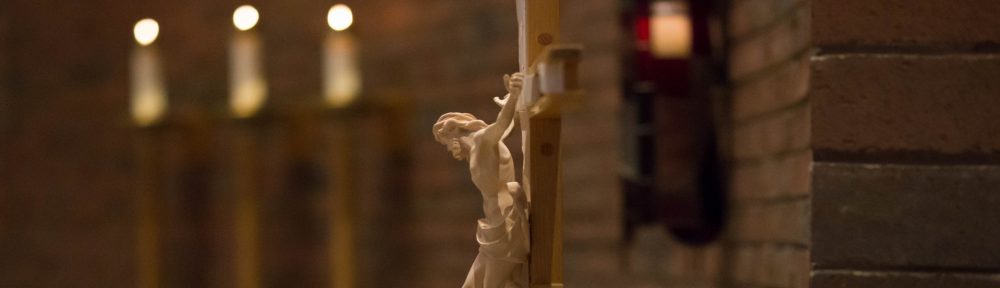







 Holy Week is upon us. God’s plan has been exacted.
 It’s very early, 5:30am to be precise. I’m writing this note from Cantrall, Illinois. Again, to be precise, I’m at Camp CILCA, which is just outside of Springfield.
 Cruciform Stuff