Faithful not Successful

Summer is nearly upon us. The weather is finally admitting as much. I give thanks to the Lord for this. Throughout the school year, the pace is much swifter around here, to be sure. Summertime allows more scheduling freedom, and as a result, things slow down a little. Of course, the calendar’s empty slots always fill up. There’s plenty to do. I can tell you that I’m already sufficiently booked into and through the first week of August. Still, as Michigan’s colder weather shrinks back into hiding for a few months, so also goes the guilt I might have for stopping to actually engage in something that has almost nothing to do with pastoring, something I might also enjoy—like figuring out how to lift my Jeep’s suspension an inch or two, or replacing the toilet in our downstairs bathroom, or putting a drop ceiling in our basement guest room.

One thing I do every summer is read. Of course, I read the scriptures. But I also pick away at classics. I’ve already decided on Jack London’s The Call of the Wild. That won’t take me long, so I’ll need something more. I decided to do something a little different. Those who know me best will know I’m keen on sci-fi/horror films. Although, I’ve never spent money on books from that genre. I decided to give the Rage War series by Tim Lebbon a try. It’s a three-volume series about the Yautja (the creatures from the Predator films) invading the earth, only to team up with the humans to fight against another unknown force unleashing xenomorphs (the creatures from the Alien films) across the galaxy. I likely wouldn’t have purchased these volumes if our school’s wonderful PTL hadn’t given me a gift card to Barnes and Noble. I blame them for this eagerly anticipated distraction.

I don’t expect these books to be anything but outlandishly fun, and I doubt I’ll discover anything worth quoting. Perhaps like me, you don’t like to mark up the pages of your books. I’ll usually bend the page’s corner if I find something worth revisiting. Plenty of books I own have these little bends. However, on occasion, I’ll underline something. Flipping through my edition of The Call of the Wild, on page 100, the following is underlined: “It was idle, he knew, to get between a fool and his folly….”

Thorton, a character well-versed in the Yukon’s ways, mulls this thought relative to Hal, an inexperienced and ignorantly vain character who has no idea how to care for, let alone drive, a dog sled team. Regardless of the context London has fashioned, the point is memorable, if not for its simplicity. Human beings are going to do what they want to do. Being the time of year for graduations, I’ve begun noticing this in the ever-increasing irreverence at commencement ceremonies. Ask the crowd to hold their applause, and they’ll clap anyway. Expect solemnity from the onlookers, and you’ll get airhorns and ear-piercing woot-woot screams. Moreover, people have the uncanny ability to be so prideful that they’ll do incredibly foolish things, even things that could ruin or destroy them. Perhaps more tragically, no matter how hard a person—a trusted friend, a sibling, a parent—might try to get between a person and self-destroying things, doing everything possible to coax them away from folly’s edge, unless they realize the nature of their self-centered predicament and accept the better direction, tragedy is all but guaranteed. They will fall. And it won’t be pretty.

I’ve noticed something else in my time as a professional church worker, this being my 29th year. The one trying to help often holds the most guilt, wishing more could have been done to prevent the disaster. A son, even after his mother’s tearful warnings, makes a life-altering mistake, and it’s Mom who cries herself to sleep, wondering where she went wrong. A daughter strays into an abusive relationship, and it’s Dad who grows visibly older with burdensome worry, wondering if he could’ve been a better, more affectionate example.

Erma Bombeck referred to this kind of grief-stricken guilt as the gift that keeps on giving.

Saint Paul said something a little different about it. He wrote, “For godly grief produces a repentance that leads to salvation without regret, whereas worldly grief produces death” (2 Corinthians 7:10). The word Paul uses twice for grief is λύπη. Essentially, it means mental turmoil. It’s a pain of the mind marked by agony and regret. As a father, I can assure you that parents are more than prone to this kind of grief. Close friends are, too.

Interestingly, in both instances, Paul takes care to modify the word. The first time, he couples it with “godly.” In the second instance, he attaches “worldly.” By doing this, he’s not saying that grief isn’t real or that it doesn’t hurt, but that there’s a distinct difference between the guilt-ridden heartache we endure by faith and the sorrow-laden regret borne according to human capacity. In short, godly grief has hope. It finds a footing in repentance and is met by God’s loving promises for a regretless future. The other has none of this. The other leads into the sinister depths of eternal sorrow and the end of all human hope, namely, Death.

If you were to visit the verse before verse 10, you’d see Paul commends godly grief, saying he’s glad for the harder moments that stir repentance. He’s not reveling in the pain, but he’s glad for what the pain produces.

There’s something going on here. If anything, a byproduct of godly grief is clarity. Saint Peter hinted at this in a way when he encouraged us to remember something. He wrote: “The Lord is not slow to fulfill his promise as some count slowness, but is patient toward you, not wishing that any should perish, but that all should reach repentance” (2 Peter 3:9).

When all human effort to help a loved one seems long spent and all hope appears lost, Peter brings us to something else. He reminds us that God’s timing rarely aligns with ours. God’s pace is His own. But no matter His stride, He’s dealing with us patiently. His desire for all human beings is to reach the uplands of repentance. What does this mean relative to what I’ve written so far? Well, let me think about that out loud for a second.

Firstly, I’d say we need to realize that we can’t live others’ lives for them. A mom cannot live her son’s life. Likewise, a dad cannot forever make his daughter’s choices for her. A friend does not control another friend’s will. The sooner we accept this, the better.

Secondly, Mother Teresa was right when she said, “We are not called to be successful, but faithful.” She didn’t come up with that on her own. The Bible taught her to say it (Luke 16:10-12; 2 Corinthians 5:7; Revelation 2:10; Matthew 10:22; and countless more). The point is that by the power of the Holy Spirit, we seek faithfulness to God in any given situation, even when we feel completely powerless to do or say anything of significance. Still, be faithful. Trust Him. Faith knows He’ll take even the most insignificant of one’s words, gestures, or whatever and put them to good use. He’s got you.

Thirdly, things might appear to go south no matter what we do. And when things don’t go as planned, there will be guilt. There will be grief. But let it be godly grief. Again, godly grief still hurts. This is only true because it’s honest. It’s self-examining. It wonders if it could’ve been more attentive, less critical, or whatever. That’s what desiring faithfulness often feels like. It wishes it could be more faithful. But amid its sadness, godly grief remembers something of God. It knows His forgiveness, the kind that covers regret. It also knows the game isn’t necessarily over. It knows that even though nothing we do seems to bring the results we want, we’re not in charge. God is, and He’s moving behind the scenes at His best, most perfect pace according to His steadfast love. Godly grief knows He’s listening to our prayers. It knows the kind of love driving Him aims at rescue—at working to instill repentance and faith.

That’s hope. That’s confidence in God’s love. God’s love dispels the gloom. There is no fear in that love (1 John 4:17-18). It knows that just as we don’t want to lose our loved ones to ungodliness leading to eternal separation in Death, neither does God.

And so, we continue praying while standing ready to act when necessary. This process may last a lifetime. We may never live to see anything change. Still, we know by faith that it could. Who knows for sure if it will? Only God. Either way, we can be at peace. We can continue to be faithful, not necessarily successful.

Be encouraged by this.

The World is Watching

What book are you reading right now? Maybe you’re not much of a reader. If so, which TV show currently has your attention? I don’t watch much TV. I read far more than I watch. When it comes to people, I do both. I watch, and I read.

I suppose, hypocritically, I don’t like being watched. Unfortunately for me, it happens a lot. I wear a clerical collar pretty much everywhere I go. Because far too many clergymen have ditched the traditional pastoral garb, trading it for whatever is more acceptable to the secular culture at the time, for many onlookers, a guy dressed in priestly duds is little more than a traveling relic. He’s weird and out of place. Spend five minutes in Walmart with me. You’ll see. Ask Jennifer. Ask my kids. They’ll tell you, too.

I hope she doesn’t mind me sharing it, but I think Jennifer has far too much fun with the staring. For example, we’ll be walking near to one another in a store, not necessarily close enough for people to assume we’re associated. She’ll see someone watching me, and immediately she’ll come over and take my hand. If she’s feeling somewhat rambunctious, she may even give me an affectionate kiss on the cheek as she leads me past the stunned spectator like a prized bull. I don’t use “prize” as though I’m exceptional. I mean “prize” in the sense that she’s exceptional. In other words, experience continually proves that anyone wearing clerical attire must be a Roman Catholic priest. When an onlooker sees Jennifer attending to me tenderly, I’m guessing they think that she must be exceptionally divine among all women, having managed to rope a man sworn to celibacy.

Once again proving the “Roman Catholic priest” theory, I took Evelyn to the dentist on Tuesday. Standing together at the receptionist’s desk before leaving, a high school girl watched us closely. As we departed, I heard her say to the gentleman beside her, whom I assumed was her father, “I didn’t think priests could marry and have kids.” Her dad replied, “The churches are way different now.”

He’s not wrong. Many churches are different now. I offered a subtle hint before as to how this is true. The hint: they’re becoming indistinguishable from the secular world. Regardless of your agreement, this is an important point. As people watch, they are also reading, or perhaps better said, interpreting. This interpretation reminds me of another recent incident. When I told my family about it at dinner, they were astonished.

Two weeks ago, I’d just left the self-checkout area at the Meijer in Hartland and was making my way to the exit doors. About fifty feet from full escape to the parking lot, a woman reached out and grabbed my arm as I walked by. Can you believe it? She actually took hold of my arm to stop me.

“What church are you from?” the bold woman asked, almost gruffly.

Stunned by her aggressive approach, I’m surprised I replied relatively peacefully, “I’m from a Lutheran church just down the street.” After that, she did all the talking. And her reason for stopping me, that is, what did her words directly imply? Assuming the conservative nature of my Christianity by looking at me, she needed me to know there was nothing special about my church compared to hers. In her words, all faiths worship the same God and lead to the same place. Taking a hint from both her demeanor and her “Love is Love” shirt, I interpreted her. The result: I assumed the nature of her church and the minimal likelihood that I’d convince her of its dreadful heresies. With that, I said absolutely nothing. I mean that. I did what one of my former seminary professors would do. He would meet illogically incoherent commentary with an uncomfortable smirking stare.

When the woman finished with her foolishness, the awkward nature of my grinning silence was enough for her to say, “Well, okay, thanks for chatting, and have a great day,” or something to that effect. I can’t recall for sure. The end of her final sentence met the back of my head.

Now, for all the seasoned people-watchers reading this note, had you watched this scenario unfold, you would have accurately interpreted the tenor of my response without me having to explain it. People-watchers are highly attuned to visual cues, making them adept conversationalists and skillful navigators of humanity. In other words, when a person learns to see what someone is likely thinking, the communication game changes. It elevates to another sphere.

Alfred Hitchcock once said something about how the dialogue in his films was just sound among sounds. For him, the real story was told through the characters’ movements, facial expressions, and the like. This is probably why he famously said, “If it’s a good movie, the sound could go off, and the audience would still have a perfectly clear idea of what was going on.”

How might this principle apply to so many churches embracing a seemingly secular trajectory? What is the “perfectly clear idea of what’s going on” the unchurched onlooker will likely have?

Perhaps from another perspective, I wonder if that’s part of what Jesus meant by His words, “You are the light of the world…. In the same way, let your light shine before others, so that they may see your good works and give glory to your Father who is in heaven” (Matthew 5:14, 16). He knew the world was watching. Saint Paul certainly knew the same. For example, in Colossians 4:5-6 he calls for behavioral distinctions before unbelievers. He urges the same in Philippians 1:27, insisting on observable behavior unique to the Gospel.

Don’t think for one second that I believe Jesus and His great apostle, Paul, are saying that words don’t matter. They do. The power for faith leading to salvation is given by way of the Word of the Gospel (Romans 1:16). However, feel free to accuse me of believing that the Word produces communicative behaviors that both carry and display it. These behaviors are distinct from the world. How do I know? The flesh gives birth to flesh while the Spirit gives birth to spirit (John 3:6). This is Christian faith. It produces visual cues, ones that, whether you’re speaking or not, transmit to others who you are in Christ and what you think is true and untrue about Him. If your church believes the LGBTQ, Inc.’s mantra that love is love—which is to say, homosexuality is perfectly acceptable before God, you’ll demonstrate it. That’s how it works.

By the way, silence is a demonstrative behavior, too. No matter the situation, it communicates. My cold silence that day in Meijer told the woman in unmistakable terms what I thought of her goofy theological impositions. On the other hand, how does the world interpret a Christian’s passive silence relative to abortion, gender confusion, and so many more gross atrocities happening in our world?

As a pastor, I know what God thinks of his pastors’ who prefer to keep a safe distance from their voices: “For with you is my contention, O priest…. My people are destroyed for lack of knowledge; because you have rejected knowledge, I reject you from being a priest to me” (Hosea 4:4,6).

The world is watching and learning what we believe. Our worship—the depth of its substance—demonstrates. Christian silence in the face of ungodliness does, too.

Do Not Disbelieve

I’ve said it before, and I’ll repeat it: when I get to heaven, after reconnecting with my brother, Michael, I want to meet the disciple, Thomas. The people here at Our Savior in Hartland know I think that of all the apostles, he seems to get a bad rap. That being true, there are some things I want to ask him.

Before actually asking any questions, I’d probably commend him first. After the Lord’s resurrection, he really was the only one demanding the evidence the Lord had already promised would be given (Matthew 16:21). In other words, he demanded to see a living Savior who’d recently been crucified. Once again, that’s what Jesus said on multiple occasions they’d see—a formerly dead Jesus now very much alive, wounds and all (Luke 9:22, 24:7; Matthew 17:9,23; 20:19, 26:32; John 10:17, 20:9). Even the angel at the tomb affirmed this, telling the women that Jesus had gone ahead of them into Galilee and that they’d see Him just as He said they would (Matthew 28:7).

Knowing this to be an essential part of the Lord’s regular teaching to His disciples, I suppose I’d ask Thomas what he was thinking when he refused to accept the other disciples’ message. Was he actually doubting, or was he simply unwilling to accept anything other than Jesus’ own words? Of course, Jesus somewhat answers the question when He eventually visits with Thomas in the upper room after the resurrection. It’s there He encourages him, “Put your finger here, and see my hands; and put out your hand, and place it in my side. Do not disbelieve, but believe” (John 20:27).

“Do not disbelieve….”

There’s something in that phrase. In Greek, the Lord’s words are, “μὴ γίνου ἄπιστος”—do not right now become unbelieving. This is to say, “You’re heading in that direction. Don’t go any further.” Personally, that’s all the wiggle room I need for saying Thomas was not underwater in doubt. Moreover, he certainly doesn’t deserve the unfortunate (and absolutist) title “Doubting Thomas.” He had faith. It was just wobbly.

A scene like this isn’t unfamiliar to any of us. Jesus spoke similarly to the terrified disciples during the storm on the sea in Matthew 8:26. He said, “Why are you afraid, O you of little faith?” Again, His words are precise. In Greek, He calls the disciples “ὀλιγόπιστοι”—little faiths. Each of the disciples had faith. But their faiths were just beginning to sprout. They were little. How much faith does one need to be saved? Jesus has already said multiple times that whoever believes will be saved. In these scenarios, perhaps one of the lessons we learn is that focusing on quantity has the potential to be distracting. Again, did they have it or not? Yes, they did. They likely wouldn’t have slipped and slid across the boat to wake the sleeping Jesus for rescue if they didn’t. But they did go to Him. They went to the One they somehow knew could save them. The same goes for Thomas. For whatever human reasons may have been involved, he was back among the disciples (even though it didn’t make much sense to be there), fiercely demanding what Jesus had already promised. These are clues. Jacob did a similar thing in Genesis 32:22-32. He wrestled with God, demanding a blessing before he’d let God go. The Canaanite woman in Matthew 15:21-28 did, too. She nagged and pestered until the seemingly cold Jesus finally relented in the test. These people had faith. Large or small, they were moved to hold God to His promises.

In a way, by demanding the signs, Thomas was doing the same. But still, it goes deeper.

I think faith was more than stirring in Thomas because, by his words and actions, he forced out into the open the Church’s confession that Jesus had risen in bodily form. In other words, for Thomas, it would be one or the other. Jesus was either fully dead in the body or fully alive in the body. As He couldn’t be both, He also couldn’t land in between. He couldn’t be a ghost. He couldn’t have risen only in a spiritual sense. That’s not what Jesus promised. The resurrection would be physical.

Having nowhere near the disciples’ specificity concerning the resurrection, even the Pharisees understood this. For the record, the Lord never once said in the Pharisees’ presence that He’d die and rise again in the flesh. But He did say, “Destroy this temple, and in three days I will raise it up” (John 2:19). This was to affirm that they’d kill Him, and yet, He would rise from death three days later. After the Lord’s burial, the Pharisees and Teachers of the Law revealed they knew what He meant. They demanded that Pontius Pilate place guards at the tomb, saying, “Sir, we remember how that impostor said, while he was still alive, ‘After three days I will rise.’ Therefore, order the tomb to be made secure until the third day, lest his disciples go and steal him away and tell the people, ‘He has risen from the dead,’ and the last fraud will be worse than the first” (Matthew 27:63-64). Why a guard? Again, to stop a bodily resurrection. Genuine or fraudulent, that would exist at the heart of the Christian Gospel.

Even the Lord’s enemies knew it could only be one or the other.

So, what’s the difference between Thomas and the Lord’s enemies? Faith. Jesus kept His promise and visited Thomas. The disciple declared, “My Lord and my God!” (John 20:28). Even after countless eyewitness accounts, the Lord’s enemies denied Him, doing all they could to kill the message and the messengers. That’s hardened unbelief. That’s real doubt.

Today the Church retells the Lord’s resurrection, and as it does, it includes Thomas’ important role. As you listen, go easy on him. Remember, he’s a believer like you and me. Times get tough. Things get confusing. We find ourselves calling out things like, “Why are you allowing this to happen?! How can you claim to love me?!” Still, we’re calling out, right? And to whom? The only One who can hear and save us. With that, follow Thomas’ lead. Look for the wounds of Christ. Look to the cross. See the Lord’s passionate display. Look there and, as the Lord said, do not right now become unbelieving. Be empowered to go no further in that direction. And then remember, He actually had you in mind when He said to Thomas, “Have you believed because you have seen me? Blessed are those who have not seen and yet have believed” (John 20:29).

That’s you He’s talking about. That’s me, too. We were on His mind. And He called us blessed. His blessed ones are His believers. Big or little faith, believers go to the One with the gifts that strengthen faith. That One is Jesus.

The Perfect Law, the Law of Liberty

As it happens on occasion, I crossed paths this morning with a social media post making the point that a person doesn’t need to go to church to be a Christian. For the record, this is not only a tired statement but also a theologically lazy one. The simple biblical fact is that Christians go to church. God mandates such fellowship. If you disagree, that is, if the Jesus you confess teaches it’s okay to be apart from Him and the gifts He gives in holy worship, then you’re following a false Christ.

I could go further with this, but I don’t want to. As I said, it’s a tired and lazy position. I’d rather steer into something Saint James wrote. It’s somewhat relevant to the way I started. Although, it reaches a lot further into the Christian life than worship attendance. Essentially, it establishes the premise that faith is one thing and faith adorned with deeds is another. Saying this, I mean what Saint James meant when he wrote:

“But be doers of the word, and not hearers only, deceiving yourselves. For if anyone is a hearer of the word and not a doer, he is like a man who looks intently at his natural face in a mirror. For he looks at himself and goes away and at once forgets what he was like. But the one who looks into the perfect law, the law of liberty, and perseveres, being no hearer who forgets but a doer who acts, he will be blessed in his doing” (1:22-25).

Do you know what the “perfect law, the law of liberty” is? Just know that whatever it is, James is not only insisting that we persevere in it but that such determination is somehow born from hearing it and then results in living according to it.

Maybe the best way to figure out what James means is to begin with the words he uses, namely, the word he employs for “perfect,” which is τέλειον. This word is equally translated as “complete.” In other words, the completed law—the totally accomplished law—establishes a standard for freedom. Variations of the same word are used in other places throughout God’s Word. But there is one crucial instance where it fully intersects with James’ understanding of the Law. It happens in John 19:30. It’s there the Lord announces from the cross the single word τετέλεσται, which is typically rendered as “It is finished.” Although, it’s just as accurately interpreted as “All is complete.”

By “perfect law, the law of liberty,” James has in mind Christ’s absolute fulfillment (completion) of the Law on our behalf. By His work, we have been set free, not only from Sin and Death but from the Law’s crushing burden as the only way of escaping eternal condemnation. In other words, instead of needing to keep the Law for salvation (which all of the Lord’s Apostles affirmed was impossible), we’re free to live in and according to it. It becomes a law of liberty, not one of bondage. James is saying that whoever keeps as one’s heading the Gospel of salvation through faith in Jesus Christ—whoever believes and perseveres in it—will become a “doer,” someone desiring to keep the Ten Commandments, not for salvation but out of love for Christ. These doers will do. And they will be blessed, not because they’re performing the Law, but because they’ve been set free in Jesus. This freedom moves them to desire faithfulness to Him. Faithfulness results in works. This is why James goes on the say:

“What good is it, my brothers, if someone says he has faith but does not have works? Can that faith save him? If a brother or sister is poorly clothed and lacking in daily food, and one of you says to them, “Go in peace, be warmed and filled,” without giving them the things needed for the body, what good is that? So also faith by itself, if it does not have works, is dead” (2:14-18).

Samuel Butler once said, “You can do very little with faith, but you can do nothing without it.” That was a sloppy way to say it, but I’m willing to give him the benefit of the doubt. He attempted to speak alongside James. His point is that a proclaimed faith is not the same as a faith that acts to save the unborn from abortion. Although, from the proper perspective, a proclaimed faith hints at a much bigger picture. The proclamation is itself a deed. And faith made it happen. Faith produces. And why? Martin Luther so famously answered the question relative to justification. He said, “God does not need your good works. Your neighbor does.”

Do you have to go to church to be a Christian? How about this instead: genuine faith moves a Christian to desire to be in worship with his Lord.

On second thought, I did want to go further with my initial concern for worship attendance.

By the way, the people here at Our Savior in Hartland, Michigan, are going to have plenty of opportunities for being in worship this week. Today is Palm Sunday. We’re entering Holy Week. There are services every day, sometimes more than one a day, all the way through to Easter. Should you attend all of them? I’ll simply say, give it your best effort to attend as many as possible. Each plays a role in leading us to the Triduum—Maundy Thursday, Good Friday, and the Vigil of Easter. Attending any or all certainly wouldn’t hurt you. It goes without saying that you’ll be blessed. Do you know what else goes without saying? The fact that your faith already knows this, and it’s craving to act on the knowledge.

Charming

This past week, someone I was chatting with used the word “charming” in a sentence. The word stood apart from the rest of the conversation. I think this is true for two reasons.

The first is that, like so many other words that have faded from regular employment, “charming” has fallen on hard times. Linguistically, this happens naturally, and for various reasons. In the vernacular economy, words replace other words. One reason I’ve heard for this has to do with proportionate use. In other words, a term maintains its viability when a larger portion of its users fit its description. I don’t know if that’s relevant to “charming.” Although, having recently witnessed a young boy in a waiting room at a doctor’s office tell his mom to shut up and give back his cell phone, and then to see her do exactly as he demanded, I sometimes wonder. Charming means polite and friendly leading to likability. Polite, friendly, and likable did not fit this kid, and unfortunately, such behaviors are more so becoming the rule than the exception. With that, I wonder if the word really is of much use to us, except in cases of sarcasm. This leads me to the other reason.

Another reason the word stood apart is that in this case it was used positively. We both knew the person being described as a friendly and likable person. Indeed, he is charming in every sense of the word. But again, it seems more often than not, the word is scarred by cynical nuance. Charm is seen as a tool for getting what one wants. I read this morning that psychologists have decided on a name for this kind of charm. It’s called “Eddie Haskell Syndrome,” appropriately named after the character from the show Leave it to Beaver. Eddie was known for gushingly good behavior when adults were around. But when they weren’t, he was up to no good. He used charm to gain trust, but only so that he could get away with his deviant schemes.

We all know people like Eddie Haskell, folks who portray themselves one way and yet are completely different behind the scenes.

A few years ago, I told my son Harrison that being charming was a lost art, and it’s one I wanted him to embrace—and I wanted him to do it in a genuine way. By the way, it’s not like he wasn’t demonstrating the characteristics already. He was (and does). In context, he was experiencing a moment of exhaustion from trying to be polite while so many of his peers seemed self-centered and impolite. In that tired moment, I just wanted to encourage him to stay the course, telling him that while it wouldn’t get any easier, it certainly was the best way to live. The Bible definitely says as much. The advice Saint Paul gives in texts such as 1 Corinthians 13:4-7, Galatians 5:22-23, and Colossians 3:12 isn’t bad. It’s good. By this, I meant for Harrison to understand that charm—polite and considerate friendliness—goes a long way with people. A man who does these things makes others glad to be with him. This is true not just because he’s pleasant to be around, but because he emanates honorability. He shows he’s worth trusting, and what he says and does is worth emulating. It’s likely I told Harrison what Albert Camus said about charm. Camus said something about how charming people are the only ones who own a person’s “yes” before ever asking a specific question.

Considering our world, Camus’ words (and mine) are likely to be twisted toward the negative. Politeness, kindness, respectfulness, clean language—all the various characteristics that make for charm—these are goodie-two-shoes behaviors for many modern onlookers, things people expect others to do because they’re either culturally awkward or because they’re attempting to manipulate others. In one sense, the cynics are right on both accounts. Genuinely charming people are out of step with the secular culture, which in my estimation, is a good thing. We need more people willing to speak up and say things like, “Hey, that’s wrong. You shouldn’t use foul language like that.” Secularism is rarely on the side of such goodness. But charming people seem to emit goodness. Goodness can and does influence others. Charming people tend to make others want to be better, not worse. Again, this is a good thing. We could use a lot more of what charming people bring to the societal table.

Of course, charm can be used for bad, too. Even Proverbs 31:30 notes that charm can be wielded deceitfully. More than familiar with this, I should mention I’ll have a close eye on any “charming” young men cozying up to my daughters. I’m not stupid. And so, to all the Eddie Haskells, I say, “Beware. My Jeep Wrangler is far roomier than it looks. It can also get to undiscoverable backwoods places that other vehicles cannot.” My point: I’ll be watching for charm’s real fruits—Godly fruits. In particular, I’ll watch for the boys who encourage my daughters to walk with Christ. However, only the ones who genuinely want to join them in that walk will ever come close to getting my blessing. In other words, if you cannot care for and walk with my girls as they walk beside Christ, you may be a nice person, but you’re not the kind of “charming” Christopher Thoma and the rest of his family are tracking.

In the end, the topic of charm’s fading usage is an interesting one. Does it really matter all that much? I don’t know. Plenty of words have disappeared over time. Although, it’s true we’ve lost some pretty interesting words like snollygoster and brabble. Look them up. You’ll see we absolutely need to reinvigorate both. Relative to charm, however, the word itself might not matter, but its meaning certainly does. I suppose when its synonyms (words like amiable, delightful, engaging, and others) begin disappearing, too, we should be concerned because, as a society, we likely no longer belong to their meanings.

Know the Labor Among Us is Not in Vain

I have a treat for you this morning. Truly.

For one, it’s proof that my congregation’s littlest children are listening—really listening—to what’s being preached and taught. This should be an assurance for anyone among us who’d question our Christian school or the rites and ceremonies of our liturgies. Our children, more than supported by faithful parents, are taking God’s Word into themselves in the richest ways—ways that equip them not only for steadfastness but for communicating the Gospel with substance. In other words, we’re raising our children to be far more than “Jesus loves you” Christians. They’re ones who can speak of God’s love and then go further into the person and work of Christ, the substance of that love.

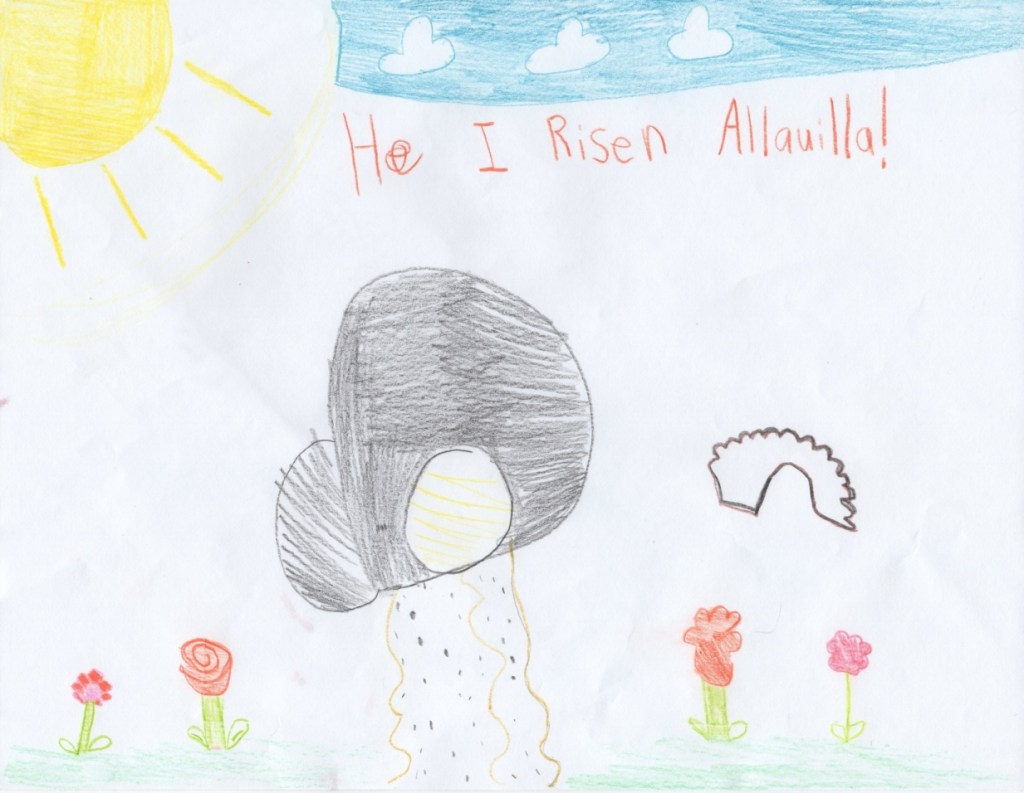
Proof of this can be seen in a series of pictures I received after worship last Sunday. The images, five in all, depict the events of Holy Week and the Triduum—from Palm Sunday to Easter. Giselle Graney made them for me. And oh, how wonderful they are!

For the record, Giselle is eight years old. But don’t let that distract you. It’s clear she knew what she was doing. By the way, I went down to the school to ask her about a few of the images’ details just to be sure. I learned she was at home feeling a little under the weather, so I called her mom, Kerry. I asked her to check with Giselle. Sure enough, Giselle was intentional, even with the seemingly inconsequential details. And by the way, what she put into the portraits proves a theological prowess that extends far beyond many adults—the kind of artistic demonstration of Christological depth that one usually only sees among the greats like Caravaggio and Rembrandt.

Give me a minute or two, and I’ll walk you through a few of Giselle’s images. I know you’ll be as blessed. But before I share, there’s one more thing to keep in mind: the rule of interpretation.

A line in The Picture of Dorian Gray comes to mind. This is likely because I recently spent some time in the book looking for another line that fit a paper I was writing. In the volume’s preface, Oscar Wilde writes, “All art is at once surface and symbol. Those who go beneath the surface do so at their peril.” In other words, when looking at art, you see the details that are actually there. That’s the surface. But there’s always more to it. There’s meaning. Art attempts to make meaning visible. That involves interpretation. That requires the viewer to dig deeper into what he sees. It also involves prerequisite knowledge. Together, there in the substratum, knowledge and meaning challenge the viewer, just as the artist would have it. Giselle has done this masterfully. What’s more, she’s been paying attention to everything she’s heard so far throughout Lent. These images prove her heart is already cemented for the events circling Golgotha’s terrifying hill. And yet, she’s making her way there (and now, she’s taking all of us along) with a firm grasp on everything Golgotha itself makes sure. Even at eight years old, Giselle is demonstrating the heart-shaping power of the Gospel.

She gave me five pictures. I’m only going to talk about four. And I’ll share each before I describe it.

The first one depicts Palm Sunday. What do I like about it? First of all, this is the only picture she drew with Jesus in it—which I’ll get to in a minute. Until then, know she gets Jesus right. It seems most Palm Sunday images are inclined to portray Jesus as jubilant and smiling. And yet, Luke’s Gospel tells us He was crying, saddened that people had no idea what was actually happening, that He was riding forth to die, and that their rejection of Him as the Savior could and would only end dreadfully (Luke 19:28-44). Giselle’s Palm Sunday roadway is festively bright with colorful cloaks and palm branches. But her Jesus is tearfully sad. (See the cropped image above.) Giselle has been paying attention to the intricate details being preached to her. She didn’t just roll along in the usual pace of a springtime smiling Jesus—which I imagine is preferable to many. She showed us the Lord’s concerned heart, even when the world around Him expected an entirely different kind of king. This matters more to the Palm Sunday story than most folks might know.

Another of her portraits that caught my eye was the one detailing Gethsemane. Strangely, as I mentioned before, Jesus is not in it. Then I realized why. Jesus has already been arrested and taken away by the guards. At the picture’s top, there’s a star-filled sky. But beneath this sky, the theme is clearly darkness, as it should be. This is the beginning of hell’s onslaught against Him. Jesus said as much when the troupe approached to take Him away. Giselle heard her Lord say this last Wednesday during midweek worship. “This is your hour,” He said, “and the power of darkness” (Luke 22:53).

Still looking for Jesus somewhere else in the Gethsemane picture, the viewer only sees where He’s been. On one side, a blood-pocked portion of grass is found beside a tree. That’s where He knelt and prayed, His sweat becoming blood (Luke 22:44). On the other side, a rooster (Matthew 26:34), a sword and a bloody ear (John 18:10), and thirty pieces of silver (Matthew 26:14-16). Beneath those images, the words: “Jesus shines butier than any star.”

Did you catch that?

Intentionally or unintentionally, Giselle did two things there. First, she combined beautiful and brighter into a single word. When writers do things like that, it’s for emphasis—to draw attention to something. Intentionally or unintentionally, Giselle highlighted a profound point: what Jesus has endured—the betrayal, the suffering, the road to a grisly death—these make for the brightest, most beautiful demonstration of God’s glory (John 12:23-29; Mark 10:35-40). Indeed, Jesus displays a glory that is butier by far than any spinning celestial in the endless sky.

Another image depicts Good Friday. Again, no Jesus. But a moment of reflection determines His location. It is finished (John 19:30). The cross at the center is empty. Jesus is in the sealed tomb to one side. The rest of the portrait reveals a blackened sky (Matthew 27:45), the Father’s hand extended as He gives Jesus over as payment for Sin (Romans 8:32), a torn temple curtain (Matthew 27:51), dice used for casting lots (Matthew 27:35), the centurion’s helmet reverently removed in the presence of God’s Son (Matthew 27:54), a wilting flower (Isaiah 40:8, Romans 8:22) beside other rich images relative to the Lord’s powerful sacrifice. Displayed most prominently are the words, “Father, forgive them” (Luke 23:34). These are the first of the seven last words Jesus spoke from the cross. I just preached on these particular words two weeks ago. Giselle was there. She heard the reason they’re first. Amid the gory details, the forgiveness of sins rests at the heart of the terrifying but butier event. That’s why Jesus is doing what He’s doing. He’s winning our forgiveness. It’s His goal. The “them” isn’t just the people attacking Him. It’s us, too. And He never loses sight of us throughout the ordeal. This sentence leads His final string of sentences, serving as the heart for each.

Giselle gets this.

The last image I’ll talk about is incredibly rich. It’s Giselle’s portrait of Easter. Again, no Jesus. But by now, I think I get Giselle’s broader theme, intentional or unintentional. First of all, while we can’t see Him, the risen and ascended Christ has promised, “Behold, I am with you always, to the end of the age” (Matthew 28:20. But more important to the Easter narrative’s cadence, Jesus is always a step ahead of His beloved. In other words, the Lord is always out in front, accomplishing what none of us could or would if left to ourselves. We can only follow and discover His wonderful work. Here, in particular, the tomb is open. The sun is shining. The flowers are blooming beneath a beautiful blue sky. Scribed across the skyline are the words announcing what He’s already done, “He I Risen Allauilla!”

Now, before you criticize Giselle’s spelling, give the eight-year-old artist her due. She’s already proven her masterful ways. Did she really misspell some words, or did she find a way to avoid using one in particular since we’re still in Lent? As many who celebrate Lent already know, tradition sets the word aside until Easter. We don’t sing, say, or write it. (Notice, I didn’t use it in this paragraph.) Also, notice it’s not “He is risen,” but “He I risen.”

Okay. She probably misspelled both words. Nevertheless, here’s a chance to apply interpretation born from what’s already been a faithful demonstration of the Gospel. The words she gave us, even if by accident, are asking to be mined more deeply.

Start with “He I risen.” That’s easy. Jesus and Giselle. That’s John 14:19. Because He lives, she will live also. As far as the other, when I saw “Allauilla,” I saw Latin. My Latin is more than rusty, but I think a case could be made for “Alla uilla!” to be translated as “Come on, to the village!” Thinking this way, remember, everything Giselle has presented so far was born from childlike faith listening to and receiving God’s Word. Staying the course, “Come on, to the village!” seems awfully familiar to Easter. If not, then you’ve forgotten Matthew 28:5-8. It’s there we read:

The angel said to the women, “Do not be afraid, for I know that you seek Jesus who was crucified. He is not here, for he has risen, as he said. Come, see the place where he lay. Then go quickly and tell his disciples that he has risen from the dead, and behold, he is going before you to Galilee; there you will see him. See, I have told you.”

Do you know what I’d say in a moment like that? “Alla uilla! Come on! Let’s go to wherever Jesus is going and find Him!” And sure enough, Jesus is found on the way to the village of Emmaus (Luke 24:13-35) and then again later that same day in the upper room in Jerusalem (Luke 24:36-49).

Giselle has given me so much through these images. I’ll cherish them until I meet face-to-face with the One who inspired them. That being said, I hope you realize how significant the investment for faith made in this little girl has been, not only by her faithful parents but by a congregation intent on preserving the pure preaching and teaching of God’s Word and the right administration of the Sacraments. A church holding to this is invaluable. A Christian school serving as an extension of such a congregation is priceless. I’m absolutely sure that’s Our Savior Evangelical Lutheran Church in Hartland, Michigan. Behold Giselle’s demonstration and know the labor among us is not in vain.

Humanity Is Not Free. Christians Are.

Lent is nearly upon us. The next three Sundays—Septuagesima, Sexagesima, and Quinquagesima—prepare us for its spiritual throttling.

In a way, worshipping communities that employ historic liturgies already have the upper hand on Lent’s penitential nature. They’ll easily recognize the following words’ shackling character used at the Divine Service’s beginning:

“Most merciful God, we confess that we are by nature sinful and unclean. We have sinned against You in thought, word, and deed, by what we have done and by what we have left undone. We have not loved you with our whole heart; we have not loved our neighbors as ourselves. We justly deserve Your present and eternal punishment.”

Or perhaps you know it another way:

“I, a poor, miserable sinner, confess unto you all my sins and iniquities with which I have ever offended You and justly deserved Your temporal and eternal punishment.”

Present and eternal punishment. Temporal and eternal punishment. Same thing. The spheres of this world and the next are both included.

Indeed, these words are incarcerating, leaving no room for escape.

Essentially, we first approach God’s altar admitting to something. Even as believers, the nature of faith has a sense of what that something is. Faith reminds the believer to think twice before approaching God according to our human virtues. We should never think He hasn’t the right to send us away in shame. We should never be so comfortable with ourselves that we begin to think His wrath is something we don’t merit. And so, before anything else occurs in the service, believers go to their collective knees in confession. We fold our hands. We keep our heads low. We establish a posture before the One who has every right to eradicate every swirling atom of this fallen creation. We do this agreeing to His description of humankind, not our own, a description rendered so eloquently—so searingly—in His holy Word.

I’m doing more reading these days than ever before, almost to the point of it being unenjoyable. I read somewhere along the way that Frank Lloyd Wright designed his unique structures in ways that communicated his heart’s greatest love for nature. What stirred in his heart caused him to say, “The space within becomes the reality of the building.” I get what he means. He was an architectural artist. And his words sound nice. However, I’ve seen some of Wright’s buildings. In my opinion, they’re as impractical as they are impressive. But what do I know? That being said, if you really want to see a genuine architectural rendering of a human heart, stop by any of the thirty-one prisons in Michigan. There you will see a more authentic representation of humanity’s viscera in an architectural form. You will observe an exterior adorned by multiple rows of massive fences decked in razor wire surrounding windowless cinderblock. What will you discover within? Through the facility’s massive metal doors, you’ll find wall after wall securing one human cage after the next.

A prison is the human heart’s best interpretation because, of itself, humanity is not free.

As I said, I’ve been reading quite a bit lately from lots of sources. Cyril Connolly is a writer I discovered by way of Rudyard Kipling. Connelly said something about how everyone is serving a life sentence in the dungeon of self. For as depressing as that might sound, he wasn’t that far from what Saint Paul meant by a number of phrases employed throughout his Epistle to the Romans. He writes things like “the law of sin and death,” “enslaved to sin,” and “the wages of sin is death.” Paul is trying to tell us something.

For one, he wants us to know we can’t keep God’s Law rightly. As humanity is enslaved to Sin, so is humanity dragged along by the innate desire to break God’s Law. Paul says as much, writing, “For the mind that is set on the flesh is hostile to God, for it does not submit to God’s law; indeed, it cannot. Those who are in the flesh cannot please God” (Romans 8:7-8). Naturally, when laws are broken, a judicial wage is earned: punishment. With this, we find ourselves closer to what Paul needs us to know by these phrases. Even apart from their proper context, we know something more about humanity. We not only begin to sense the handcuffs—the very real restraints that bind us to our treachery—but also the eternal punishment we’ve earned in destruction’s terrible cell.

And yet, God’s inclination has never been to punish, imprison, or destroy. He wants to show mercy (Luke 23:34, 6:36; 1 Peter 1:3; Lamentations 3:22-23). He wants to forgive. He wants to redeem—to buy back the criminals from their fate. He wants to set humanity free. Already knowing that the Gospel “is the power of God unto salvation” (Romans 1:16), the rest of the text surrounding Saint Paul’s select phrases brings this Gospel and instills the freedom God desires:

“We know that our old self was crucified with him in order that the body of sin might be brought to nothing, so that we would no longer be enslaved to sin” (Romans 6:6).

“For the wages of sin is death, but the free gift of God is eternal life in Christ Jesus our Lord” (Romans 6:23).

“For the law of the Spirit of life has set you free in Christ Jesus from the law of sin and death” (Romans 8:2).

The Good News is that Christ has won your freedom. He has paid the price. Faith in Christ binds the believer to Christ, thereby binding that same believer to the certainty that he cannot be condemned to Sin’s chains or held captive by Death’s cell.

The forthcoming Gesima Sundays are delivering us into this news in unique ways. Listen carefully. Lent will display its combat. Pay close attention. Good Friday will demonstrate the great exchange. Don’t miss it. All these things will culminate in a horrendously wonderful trial resulting in a hideously sweet verdict: Christ must take humanity’s place in judgment on the cross. The guilty ones are free to go.

And then Easter. Oh, Easter!—the joyful proof of the debt’s payment followed by the prison’s absolute demolition from the inside; a glorious work accomplished by the only Prisoner who could do it!

Theological Etiquette

I don’t know about you, but my early morning startup process is a mixture of ingredients. Coffee in hand, it typically involves a brief interaction with the Bible as prompted by a devotional resource. After that, as long as nothing is pressing, I spend a few minutes reading, whether that be an article or a casual scroll through social media. Last Sunday’s routine enjoyed a visit with John 1:14 followed by commentary from Luther, a portion of which encouraged believers to “further and increase [God’s] kingdom, which is in so many suppressed and hindered by the devil and the world.” Luther continued by saying this happens when we “open to Christ our treasures and present them to Him, as the wise men did. And how? Behold, His Word is written (Matthew 25:4): ‘Inasmuch as ye have done it unto one of the least of these my brethren, ye have done it unto me.’”

Not long after visiting with these things, I read a relatively intuitive quotation from Edmund Burke, a member of the British Parliament during the American Revolution and a critic of Britain’s treatment of the colonists. He said, “All men that are ruined, are ruined on the side of their natural propensities.” In other words, pay close attention to your natural inclinations in any particular situation. Doing so can spare you some of life’s biggest headaches, the kinds that will inevitably do you in.

This is incredibly insightful, so much so that it came to mind later that morning during the Adult Bible study. We’re currently studying Saint Paul’s letter to the Ephesians. Last week, we continued our walk through chapter 5, which began with revisiting:

“Therefore, be imitators of God, as beloved children. And walk in love, as Christ loved us and gave himself up for us, a fragrant offering and sacrifice to God. But sexual immorality and all impurity or covetousness must not even be named among you, as is proper among saints. Let there be no filthiness nor foolish talk nor crude joking, which are out of place, but instead let there be thanksgiving. For you may be sure of this, that everyone who is sexually immoral or impure, or who is covetous (that is, an idolater), has no inheritance in the kingdom of Christ and God. Let no one deceive you with empty words, for because of these things the wrath of God comes upon the sons of disobedience. Therefore, do not become partners with them; for at one time you were darkness, but now you are light in the Lord. Walk as children of light (for the fruit of light is found in all that is good and right and true), and try to discern what is pleasing to the Lord” (vv. 1-10).

Relative to this, Burke’s words seemed strangely appropriate. They understand that restraining the types of behavior Saint Paul forbids requires self-awareness, the kind born from genuine honesty.

I didn’t know it, but philosophically, Burke appears to have been a man after my own heart. He wrote a book entitled A Vindication of Natural Society. I managed to read about ten pages of it on Google Books before ordering a hard copy for myself. In the book, Burke chisels away satirically at deism’s popularity while also showing how proper manners help steer and uphold morality while fortifying the boundaries of natural law. He doesn’t necessarily use the following example, but it came to mind as I read those ten pages—and I shared the thought with the Bible study attendees.

Consider a man opening a door for a woman. When a man does this, he isn’t just being properly polite. He’s also acknowledging essential distinctions between men and women. There are things men can and should do that women cannot and should not. The same is true in the opposite direction. There are things women can and should do that men cannot and should not. And yet, while these things might be otherwise offensive to some, the distinction is acknowledged and upheld by an act of humility. Burke argues that the practice of manners—which are, for all intents and purposes, societal rites and ceremonies—restrain darker inclinations.

Now, think back to Burke’s original quotation insisting that one’s natural propensities, if unguarded, can be ruinous.

Everyone has improper tendencies. Let’s say a particular man has a propensity for lording over women, treating them as shameful lessers. By making a conscious effort to begin opening doors for women, this man takes a step toward restraining this unfortunate inclination. He’s submitting himself respectfully to the role of caretaker without unnaturally emasculating himself. The process acknowledges a man’s biblical role of headship, yet it does so in love. The practice of manners—the societal ceremony—helped maintain this framework. I’ll give you another, more personal, example.

I had a good circle of friends in my earliest high school years in Danville, Illinois. Believe it or not, even as testosterone-enriched athletes, we were never inclined to swear. The rest of our teammates were. Outnumbered in this regard, as a result, there came a time when swearing began infecting our circle. To stop it, the four of us pledged to punch one another anytime an inappropriate word crossed our lips. A few days and lots of bruises later, we brought what was becoming a natural propensity under control.

It’s too bad I cannot continue employing such tactics as a clergyman. But I digress.

In short, my friends and I knew ourselves. We were honest about what was becoming a dreadful propensity. We were Christians, and we sensed foul language’s incompatibility with our faith (and, as Burke might suggest, its erosive effect on a moral society). With that, we warred against the tendency with a ceremony capable of maintaining the boundaries (Ephesians 4:29-30, 5:1-13). We did this before the propensity ruined us. Interestingly, the ceremony was unpleasant when used. It hurt. But it was worth it. I should say, it’s likely even Saint Paul would have approved. In 1 Corinthians 9:27, the verb for “discipline” (ὑπωπιάζω) means to strike something physically. Paul appears willing to use extreme techniques to keep his own body under control. Getting punched, perhaps by Timothy, wasn’t off the table.

During last week’s Bible study, I wondered out loud if any of this was relevant to worship style. Of course, my wondering was rhetorical. How could it not be? That’s one of the benefits of traditional worship’s maintaining of historic rites and ceremonies. In a way, they’re theological manners.

Tradition understands man’s propensities. It knows we want things to be our way (anthropocentrism). To restrain this more-often-soiled-than-not tendency, rites and ceremonies—spiritual etiquette—carry the worshipper along in ways designed to exchange anthropocentrism with Christocentrism. In other words, their purpose is to force man out from the center of his own universe and put Christ firmly in the middle.

Understandably, rites and ceremonies are multifaceted, and like getting punched by three friends all at once, they can sometimes be uncomfortable. I get that. They’re strict means of exercise. But the most rigorous kinds of training often produce the best results. In this case, the singular goal of each word and motion is a heart fixed securely on Christ by faith and a new propensity—a Spirit-driven inclination—to imitate Him in the world around us (Ephesians 5:1).

Little by Little

I hope all is well with you so far this year. That might seem a strange thing to say, especially since we’re only a week into 2023. Still, we both know a lot can happen in a week. In truth, a lot can happen in mere seconds. Anything can change in an instant. An honest person—someone who knows by faith the inner workings of this fallen world—will not only admit to this but will embrace it as inevitable.

I’m guessing that for those looking in on faith from the outside, a Christian who rolls with change’s inevitability might appear to be living a disinterested life. Amid good or bad change, a Christian can speak alongside Job, saying, “The Lord gave, and the Lord has taken away; blessed be the name of the Lord” (Job 1:21). Such a person might appear to be drifting through life as though it were a mighty river sweeping him away feebly in its current.

On the other hand, perhaps the Christian can roll with life’s punches because he understands the intricacies of life and its changes in a way that onlookers cannot.

Admittedly, I’m somewhat of a mixed bag regarding change. Some people thrive on change. I don’t. I prefer most things to remain the same. There’s certainty in the steady things. Although, like most people, now and then, I get the urge to move things around in my personal spaces. I’ll be sitting at my desk, and then suddenly, I’ll rise and move an entire section of books from one shelf to another. I’ll be sitting at the bar in my basement, and then somewhat abruptly, I’ll rearrange the movie memorabilia sitting on cabinets and hanging on the walls. Those landscape alterations might not seem like a big deal to most. However, the urge that stirs them is genuine, and it acknowledges something deeply relevant to life. The seemingly innate need to change things is a reminder that something is seriously wrong with this world, and whatever it is, it needs to be made right.

But there’s something else proven by the exercise. The urge to rearrange things returns. It might be a week later. It might be two years later. Either way, it returns. This proves that no matter what I do to get things in the right places, the deeper disorder remains.

By faith, Christians can get along in such a world, no matter the changes. Good or bad, we’re the kind of people who endure.

I’m sure I’ve shared before that I appreciate Washington Irving. I read his infamous The Legend of Sleepy Hollow at least once a year. I do this not only because he spends his best energy delving into classical tales from early America but because, unlike modern writers, Irving handles the frightful things with a poetic style. Or perhaps a better way to say it is that he seems to take hold of scary things and presents them nonchalantly, almost as though they ought to be expected even while they are surprising. For a Christian, that kind of storytelling makes sense. As someone fitted by the Holy Spirit to endure, Irving makes sense to us when he writes, “There is a certain relief in change, even though it be from bad to worse…it is often a comfort to shift one’s position and be bruised in a new place.”

Perhaps that’s part of what the Lord meant when He instructed His followers to turn the other cheek (Matthew 5:39). He doesn’t intend for His Christians to be punching bags. He means for us to know we should never expect to be hit only once. More will come. And so, don’t be foolish. Situate yourself for endurance.

Thinking about these things, I should mention that Christians are by no means complacent about change. Christian endurance is far different than giving up and floating helplessly downstream. The knowledge of the deeper disorder keeps us vigilant. Because of this, we’re far more attuned to change than the rest of the world around us. It seems for most people in the world, change is of little consequence so long as it doesn’t bring personal inconvenience. In one sense, that’s how things got so bad in Nazi Germany. The United States Holocaust Memorial Museum attempted to memorialize that reality with a wall plaque of Rev. Martin Niemöller’s words, which were:

“First, they came for the socialists, and I did not speak out—because I was not a socialist. Then they came for the trade unionists, and I did not speak out—because I was not a trade unionist. Then they came for the Jews, and I did not speak out—because I was not a Jew. Then they came for me—and there was no one left to speak for me.”

Little by little, changes were made that targeted particular groups of people. Eventually, those changes crossed over into Niemöller’s sphere. But when they did, it was too late. Collectively, the little modifications had become unstoppable juggernauts. Truth be told, for as many people who lived relatively untouched lives during the 1930s and 40s, Christians were the first to see the dangers and sound the alarm, ultimately doing all they could to trip the Nazi jackboots. Many died trying. Rev. Dietrich Bonhoeffer was one. But he wasn’t the only one. There were plenty of others.

I suppose with the New Year comes both the awareness of and inclination for change. Mostly, I’m guessing a person’s New Year resolutions exist within the Niemöller-type frame. They’re personal, and it’s likely they’ll only allow inconvenience if a personal benefit is involved. People try to eat better, to exercise more, to be healthier. The intent in these things is good. And I’m certainly one to root for their success. I suppose what’s coming to mind this morning is not only the need to encourage continued endurance amid discomforting changes in our world but to encourage awareness of change beyond the safety of self. In other words, just because it doesn’t affect you doesn’t mean it isn’t worth your attention. It might be hurting someone else. That should matter to you. If it doesn’t, the time may come when you’ll have no choice but to be concerned.

For example, back in 2021, Scott Smith could have cared less about the demands of LGBTQ, Inc. in schools. But then his 15-year-old daughter was raped by a transgender student in the women’s bathroom at her high school. He responded angrily against the Loudoun County School Board (as any loving father should have), was arrested, and branded a domestic terrorist by the National School Boards Association, Merrick Garland, and President Biden. Interestingly, it took such a startling tragedy to stoke nationwide parental concerns for these and other issues. Now countless seats on School Boards across America have been seized by parents intent on jettisoning these radical—but already very entrenched—ideologies from our schools. They’re discovering and unbinding the dangerous grip of Critical Race Theory. They’re uncovering and dismantling the attempts by progressive ideologue teachers to read pornographic literature to 1st graders. They’re finding all these things and more, and they’re waging war against the disorder.

As the saying goes, Rome wasn’t built in a day. Little by little, changes were made. And now we’re cleaning up some pretty big messes. As Christians, we know the sources of these messes: Sin, Death, and Satan.

These are the powers at work in the deeper disorder.

Again, be encouraged to pay closer attention in the New Year. Perhaps a personal resolution for change might be to become more aware of what’s changing around you—whether the change is good or bad, who it affects, and what you can do to help. Doing this, I’m certain you’ll find ways to flex the already empowered muscle of faith in a world that desperately needs what you have to offer, not only for the sake of living peaceful and godly lives (1 Timothy 2:2) but for leading others to the only One who capable of bringing an all-surpassing order to the deeper disorder. Jesus accomplished this on the cross. He proved it by His resurrection. Now we live in this Gospel, owning the spoils of His victory, and employing them in the world around us.

We are not drifting through life. We are engaging in it with an altogether different kind—a divinely impenetrable kind—of endurance and discernment amid change.

The Epiphany of Our Lord, 2023

I’m writing this note to remind and invite you to the Epiphany Divine Service tonight at Our Savior in Hartland at 7:00 pm. Epiphany sees Christmas depart, and a new season begins. In a way, and considering the meaning of the word epiphany, it’s almost paradoxical.

Epiphany comes from the Greek word meaning “to make known.” When someone experiences an epiphany, something is revealed, and the person becomes aware of something previously unknown. In a sense, Christmas is itself a preeminent epiphany event. God gives His son to the world. By His birth, so much is made known. The angels break through fantastically from heaven to declare it. Shepherds so wonderfully announce it to everyone they meet. There’s Jesus, the Son of God, in the flesh. Emmanuel, God with us. But then January 6 arrives, and with it, the season of Epiphany begins. It begins with the account of the Magi being led by a star to the humble residence of the Christ-child. Traditionally, and suddenly, January 6 sees that all of the seasonal pomp of Christmas is put away—hidden out of sight, put back into the boxes under the stairs, in the closet, in the basement. If epiphany means to make known, then this seems counterintuitive to the season’s message.

But it isn’t. Throughout the season of Epiphany, Christ is being revealed in incredible ways that Christmas could not fully deliver. For one, the hiding of Christmas’ divine pomp hints at Christ’s veiled divinity. As the Christmas Gospel declared, He is God in the flesh dwelling among us. And yet, unlike all other human beings walking around, their souls similarly veiled, Jesus is both the creator and deliverer of souls. Epiphany sets the stage in unmistakable terms that Jesus is who He says He is. His identity is revealed throughout as He does things no one else can do. This man is no ordinary man.

I can’t remember who said it, but someone noted that the Lord’s miracles toll an epiphany bell. They point to Calvary. They ring for the human senses a divine awareness of what’s actually occurring when this man suffers and dies on the cross. Human senses cannot fathom such an event as being anything so wonderfully divine, yet it is. The One who accomplishes the work of mankind’s salvation has proven by His miracles the merit of His words and deeds. He can say to a dead girl, “Arise,” and she does (Mark 5:21-43). He can speak to a vicious sky, “Be quiet,” and it submits (Mark 4:35-41). Beholding these things, He can say to you, “I will go to Jerusalem. I will suffer for your sins. I will die in your place. I will rise from death and give to you the merits of my effort” (Matthew 20:18-19). When He says this, you can believe Him. Epiphany is the clarion call of His trustworthiness.

As a side, Epiphany has the potential for tolling other bells.

For one, Epiphany encourages Christians to pay attention to the revelations of faith itself. For example, and perhaps on a personal level, I suppose the strangest epiphany born from faith is the realization (and the otherworldly sensation) of love for a Savior so secure that I’d be willing to die for Him rather than forsake Him. He saved me from eternal Death. The world may do its worst. Like the Magi, I’m willing to risk life and limb to be with Him. What do I have to fear?

When that realization lands on you—when that genuine aspect of faith becomes known—life takes on an altogether different hue.

Consider joining us for worship tonight at 7:00 pm. Be strengthened in this alongside your brothers and sisters in Jesus. I’m preaching tonight, and I hope to look out and discover you in the pews.