Two of the little girls washed away in the floodwaters were sisters. Blair and Brooke Harber were their names. Blair was 13 years old. Brooke was 11. When they found their lifeless bodies fifteen miles downstream, they were still holding hands.
When Jennifer shared this with me last night, I thought this couldn’t possibly be true. Then I looked it up. It seems it is true. The New York Post reported it. So did the Houston Chronicle and the Associated Press.
But here’s the thing. I have two daughters. If there’s one thing I know for sure about them, had they been swept away in a similar tragedy, we’d have discovered them in a similar embrace.
Madeline and Evelyn are as different as night and day. One loves to fly. The other could spend the whole day fishing. One prefers all things scary. The other is most comfortable in cowboy boots. One slips into unfamiliar scenes with quiet grace. The other makes sure everyone in the room knows where she stands on pretty much everything. But for as different as they are, the love they have for Christ, their family, and each other has never needed them to be alike. It has only needed them to be near.
So, while Jen was reading to me about those two girls, I’ll admit I got a little choked up. Who wouldn’t? Although I didn’t let her see it. She was already struggling to read the article, and a husband needs to be sturdy at these times and in these ways. Still, it was hard to hear, not just for the sorrow of it, but for the unseen truth, something familiar to me, that stirred in the swirling muck of a dreadful situation. The kind of love those girls had, I see it in my own daughters. That kind of final grasp isn’t made in a moment. It’s made over the years through late-night whispers, shared stories, and tearful apologies. It’s born from a wordless understanding between two sisters who know each other sometimes better than they know themselves. It is a love that holds on.
I know Madeline and Evelyn would have held on, too. And I believe they still will, no matter how far the current of life carries them. Because love like that just doesn’t let go. Even better, they have a Savior who won’t let go of them. And together, as sisters, they know it. They know even if the world gives way beneath them, He is there. By faith, they know, just as the seemingly simple and yet incredibly profound song goes, “Little ones to Him belong. They are weak, but He is strong. Yes, Jesus loves me.”
The news out of Mystic, Texas, was shocking. The flash floods brought more than water. They brought terrible sadness. I just checked. As of only a few hours ago, forty-three people are dead. Fifteen of them are children. The Associated Press article I was reading reported that “27 girls from Camp Mystic, a riverside Christian camp for girls in Hunt, Texas, still were unaccounted for about 36 hours after the flood.”
There’s something especially jarring about the death of children. It’s a primal ache. The little ones among us are meant to be protected. I can only imagine how helpless the parents of those children are feeling right now. They sent them to camp, expecting them to return. But in the middle of the night, a cabin of eight-year-olds was swept away.
Tragedies like this awaken something deep in us. They are reminders that being an adult is, in part, about standing guard. Even when, as children, we resisted the watchfulness, something changed the moment we became parents ourselves. We began to understand. We realized that protecting children is one of the most fundamental callings written into the human frame.
At least, you’d think it was. It seems more and more that this essential truth has been blurred by design. It seems that deliberate choices are being made by adults that not only fail to protect children but actually drop them right into the rising ideological deluge, insisting it’s for their good, even as the current pulls them under.
A long-time friend of mine, Martha, stopped by my office this past Wednesday while in town on business. It was good to see her. We spent a little over an hour catching up.
When it comes to what’s going on in the world, she’s a lot like me. She wonders how things got so backward. At one point along the way, we touched briefly on the recent U.S. Supreme Court decision upholding the Tennessee law. Essentially, the law bans transgender hormone treatments and surgeries for minors. I was glad for the 6-3 decision. Martha was, too. At its core, the law is a step toward protecting children from irreversible harm.
I mentioned to her in passing that Michigan has similar legislative efforts in motion. For example, House Bill 4190 would prohibit doctors from prescribing hormones or puberty blockers to minors. It also bans gender reassignment surgery on kids. My friend, Jason Woolford, is the one behind this worthwhile piece. He is an example of someone willing to step into the gap and defend children where others hesitate. I don’t think I mentioned the like-minded Senate bills that would criminalize healthcare providers while giving parents the right to sue for damages. One is Senate Bill 291.
These are all noble efforts, for sure. Still, I told Martha that someone should at least consider drafting a bill identical to Tennessee’s law. Make it word for word. I realize that with Governor Gretchen Whitmer at the helm and the Democrats controlling the State Senate, it’s unlikely that anything will get through and become law. Nevertheless, a shift in power could be on the very near horizon. And so, push the identical bill. Tennessee’s law has already been stress-tested in the nation’s highest court.
I’m sure not everyone agrees with this approach. Some might argue that simply copying another state’s legislation overlooks the subtleties of Michigan’s political landscape. I wonder if that’s part of the problem. Perhaps we’ve become too concerned with tailoring bills to conciliate rather than to confront. In fact, the longer I stand at the intersection of Church and State, the more convinced I become that we’re overcomplicating things. Too often, bills are laced with endless nuances, providing this exception and that concession, all in hopes of pleasing as many as possible, and yet resulting in the legislation being neutered before it even reaches the Governor’s desk. The more I see this, the more I question whether the bill drafters truly grasp the dangers posed by the ideologies they’re supposedly trying to address.
Chiseling away at devilish ideologies is virtuous, but only insofar as truth continues to meet squarely against anti-truth. To do this requires both unwavering clarity and legislative precision. When it comes to radical gender ideologies in particular, anything else risks the grotesqueness embedding itself deeper into our schools, our medical systems, our laws, and our souls.
Now, I should probably steer preemptively into two critiques I expect to receive from what I’ve just written.
First, I have plenty of friends in government who’ll step from my seemingly simple-mindedness, calling me naïve—that I don’t know how things work in Lansing, or, bigger still, Washington, D.C. I expect that assessment. And to some extent, they’d be right. However, I would respond by saying that if political realism leads to bills that ban surgery but affirm the worldview behind it, even if only a little, then perhaps a little naïveté is exactly what’s needed.
That said, rest assured, I’m not ignorant of the legislative process. I am aware that the political world involves negotiation, committees, amendments, and such. Rest assured also that I’m not necessarily an absolutist. Like Jesus during His earthly ministry, I’m more of an incrementalist. Indeed, divine absolutism will eventually play out, and everyone everywhere will know when it does (Philippians 2:10–11). On that day, “He will judge the nations with justice and the peoples with equity” (Psalm 98:9). Meanwhile, the Lord didn’t reach into this world, taking upon Himself human flesh, and instantly demanding complete comprehension from those He encountered (John 1:9-14). He preached, He taught, and He walked with people (Luke 24:27; Matthew 4:23; John 3:2). He led them step by step into His identity and truth—patiently, deliberately, and with perfect clarity (Mark 4:33–34; John 16:12–13).
But take note: He did this, never compromising truth’s substance for the sake of palatability (John 6:60–66).
That’s the balance I prefer. I want to do everything I can to move the ball down the field, avoiding any plays that risk giving up ground. In other words, incrementalism must never become appeasement. I’ve seen how the slow erosion of truth so often hides behind the phrase “what’s politically possible.” Refusing to give ground is the only respectable posture.
But that means we must first understand and then acknowledge just how backward things are. Until we do, we’ll remain a society that embraces madness, the kind that creates bills that still allow exceptions in some instances for surgically mutilating its citizens under the banner of compassion.
The second thing I should probably steer into is likely to come from a now former friend (unfortunately) who I can hear saying something like, “Look, no one wants to see kids suffer. But we need to get the government out of this altogether. We need to let families and doctors make these deeply personal decisions without government interference.”
And that, right there, is a big part of the problem.
Even apart from Christianity’s boundaries, personal liberty has never equated to moral neutrality. Liberty understands that truth exists and that citizens must be free to seek, speak, and live according to that truth without fear of coercion or punishment. But liberty untethered from truth is no longer liberty—it’s radical individualism. When radical individualism invokes the Declaration of Independence’s “pursuit of happiness” phrase to justify the mutilation of children, then freedom has become a twisted version of itself. We end up using our nation’s founding documents, not in pursuit of truth, but as permission-granting sources for redefining it. And again, it’s the children who pay the highest price for such redefinitions. They are both the battlefield and the collateral.
“But that’s more or less a spiritual argument, Pastor Thoma.”
In a sense, yes. But so is the counterargument. Right now, the prevailing narrative in our world says that someone can be “born in the wrong body.” Having spent enough time around Dr. James Lindsay, I’ve realized this is a deeply Gnostic concept—one that severs the soul from the body and declares the physical form irrelevant or even hostile to the true self.
The Christian faith insists otherwise. Body and soul are not at war but in union, created by God in perfect harmony (Genesis 2:7). Our Lord took on flesh, not as a costume to be shed, but as the very substance of our redemption (John 1:14). Christ’s incarnation affirms the goodness of the human body—male and female—as God designed it (Genesis 1:27). To mutilate that body in the name of self-actualization is not compassionate liberation. It’s a spiritual act, and a desecrating one at that (1 Corinthians 6:19–20). To slice away organs or pump anyone, child or adult (because age does not sanctify the level of one’s error), with cross-sex hormones in pursuit of an impossible transformation is not compassion or the pursuit of happiness. It is bodily harm, sanctified by pseudo-Gnostic jargon cloaking a lie, one that is easily detected in Natural Law (Romans 1:25).
Ultimately, I hope that future generations will look back on this time in America as a dark age. I hope everything that’s happening relative to so-called “gender-affirming care” will be remembered with the same horror as lobotomies. Whether such somber reflection will ever occur, I don’t know. What I do know is that a generation of legislators did not defeat slavery with bills that allowed “grandfather” exceptions.
There’s one more critique I should probably address before wrapping up, mainly since much of this has focused on gender dysphoria.
Per usual, I will be accused of hatred for what I’ve written. I will be told that I just don’t understand and that I am invalidating someone’s identity. Someone may even wield dissenting Supreme Court Justice Sonia Sotomayor’s argument that my position is nothing short of advocacy for suffering.
To that, I suppose I might say, “Yes, I am advocating for suffering. Just not the kind you think.”
I’m advocating for what we Lutherans call the “Theology of the Cross,” a path marked by humility, struggle, and self-denial. It’s what Jesus meant by saying, “If anyone would come after me, let him deny himself and take up his cross and follow me” (Matthew 16:24). The one following Jesus is less interested in worldly accommodation, but instead, is inclined to suffer all things, even suffering against internal desires, rather than be separated from Him and His redemptive work on the cross. All this stands in stark contrast to the world’s “Theology of Glory,” which seeks affirmation and comfort at any cost.
Every human being is born with backward desires. That’s the reality of sin. Taking up the cross in life’s combat, some fight against lust. Others wage war against drinking. Others fight dysphoric tendencies. Right now, we live in a culture more inclined to affirm and celebrate these disorders rather than restrain them. Still, Christ bids us to follow Him, not the “self.” It is not dangerous or unloving to say this. It is, however, unloving to affirm a lie, and it’s risky to give it room.
In the end, I expect to be called hateful for my positions. However, in every aspect of life, the courage to suffer for the sake of truth is the only way forward. It’s the best levee for holding back the water. That’s because its strength lies in a divine kind of love that brings truth, even when it costs something. Look to Jesus on the cross and see for yourself. There, love and truth are not in conflict but are inseparably joined—and in the most wonderfully protective way.
I wasn’t going to write anything this morning relative to the Fourth of July celebration. I intended to wake up, get some coffee, and just relax.
However, just a few minutes ago, I read an online piece about what actually went into planning and executing particular liberty-securing special military operations in early American history. It was dangerous. It was the embodiment of diligence. It was the deliberate offering of one’s own life for the sake of others. It was early mornings without the certainty of evening rest. It was calculated suffering, guided by conviction, and sustained by the hope that a freer nation might actually be built—brick by brick, battle by battle, prayer by prayer.
In other words, for our Founding Fathers, it was anything but waking up, drinking coffee, and relaxing.
Maybe we should set aside our barbecues and eat turkey instead. It sure feels a little like the Fourth of July could be interchangeable with Thanksgiving Day. We could sing our anthems, light our fireworks, and gather around tables not because we have earned this freedom, but because God has so graciously granted it, and for that, we are incredibly thankful.
The Apostle Paul wrote, “For freedom Christ has set us free; stand firm therefore, and do not submit again to a yoke of slavery” (Galatians 5:1). He wasn’t talking about national liberty. He was talking about freedom in Jesus. This is freedom from sin, death, and Satan. Still, where Christian liberty exists, there is true liberty in every sense of the word. It makes sense, then, that we would give thanks for the national freedom to gather and to worship our Lord without fear.
This is, in fact, a place where Church and State meet—not by confusion of their roles, but by acknowledgment that God rules over both. By His rule, we have the greatest freedom secured by a Savior, and another freedom He has so graciously given, made sure by patriots.
That carries me to something else.
Liberty rightly understood is not license. It is a gift to be stewarded, not an idol to be polished. God’s Word reminds us: “Live as people who are free, not using your freedom as a cover-up for evil, but living as servants of God” (1 Peter 2:16). In other words, liberty is not measured by the expanse of its seemingly endless boundaries. A person is not truly free if freedom means indulging in that which destroys. You are not living in liberty if you believe a person is free to murder an unborn child or redefine human sexuality. Genuine liberty pursues what is good, right, and true.
So, I guess what I’m saying this morning is that I’m thankful for liberty and the price paid for it, both on the cross and the mortal trenches. And yet, looking up from the trenches, I’m thankful for the preservation of this nation only insofar as she continues to understand liberty rightly, that she repents where needed, and that she pursues righteousness where lacking.
Yesterday, I was on a national phone call with Dr. Ben Carson. He asked me to speak. Of course, I agreed. One thing I said was that, in a sense, any nation with Christians living in it is blessed. That’s because they know what to pray for. Not only that, but they can hold the line on truth (1 Corinthians 16:13), and they can speak that truth in love (Ephesians 4:15). Their love for Christ always supersedes their love of country, and in that sense, they serve as purifying elements, whether they realize it or not.
Now, I don’t mean these things in a dominionist way—as if to say only Christians should run the government. What I mean is that when Christians live in faithfulness to Christ and therefore live faithfully according to their vocations, loving their neighbor and fearing God, the nation is naturally enriched, even when it doesn’t know why. Christians truly are any nation’s salt and light (Matthew 5:13-16).
I suppose I’ll close with that.
Remember that as Christians, we are dual citizens. While we walk the soil of this great republic, we belong to a Kingdom not of this world (John 18:36). And yet, when considering America by comparison to so many other nations, we are bound to be thankful for both. In such thankfulness, keep the proper perspective. When you see the fireworks booming, remember the thunderous response of the dark sky and cracking rocks at the Lord’s crucifixion. He won your truest freedom there. When you see the fireworks flashing, remember that His divine light has shattered the darkness. When you see the flag waving, remember that the banner of Christ’s cross is forever raised over every nation, tribe, and tongue. And by the power of the Holy Spirit alive in you by the Gospel, you go forth in service to Him with a bit of extraordinary insight. You know, “Blessed is the nation whose God is the Lord” (Psalm 33:12).
It’s been several weeks since the “No Kings” protests. However, I just saw an online advertisement this morning for “No Kings 2.0” scheduled for the Fourth of July. I did some checking around, and it seems this is only a rumor.
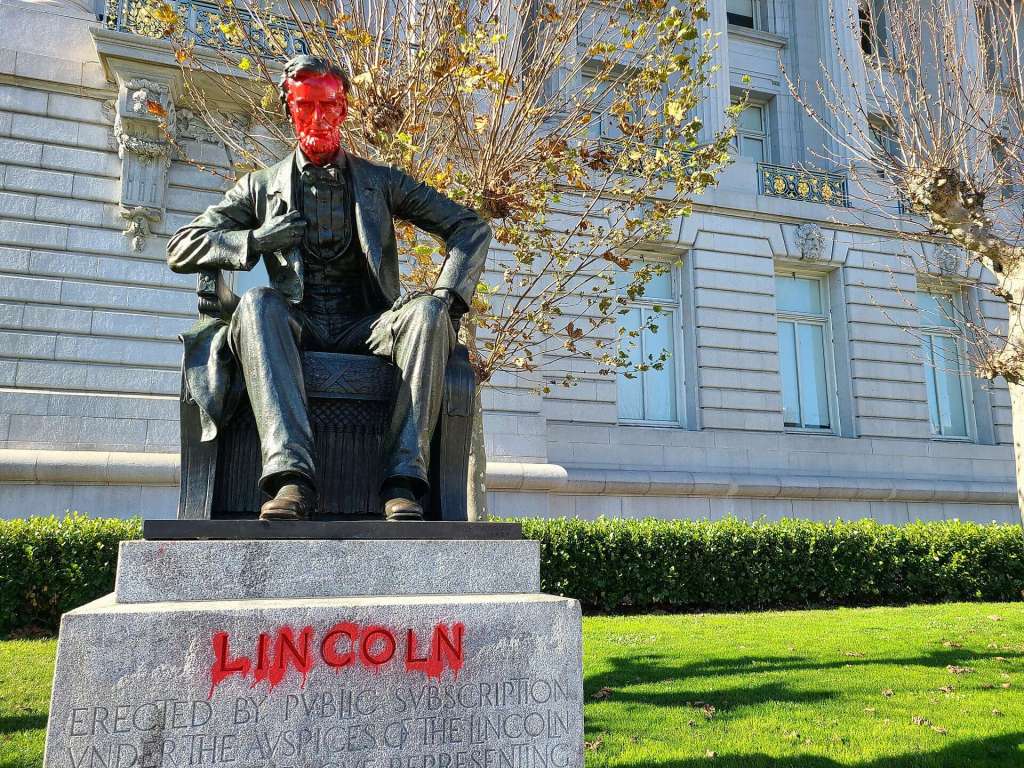
My daughter, Madeline, told me the group gathered in Fenton a few weeks ago for their first attempt. There were people there with signs and slogans. In Lansing, they gathered on the Capitol’s steps. I didn’t pay it much attention at the time, which is probably another reason why I’m only now offering commentary. I have plenty to keep me busy these days. And besides, the whole thing felt like just another performance of the usual twisted pageantry. I remember seeing an image of a sign from the Lansing event that displayed the slogan “86-47,” which is the not-so-subtle numerical code calling for the 47th president’s removal by any means necessary, including death. In other cities across America, people wearing all black and face coverings gathered in public places and spray-painted the “No Kings Here” mantra on historic monuments, essentially defacing memorials actually put into place as emblems against tyranny. That’s ironic, isn’t it? Still, the groups marched and chanted like voodoo shamans performing their dark rites and ceremonies.
If you’re not familiar with the relatively fizzled No Kings movement, as I already hinted, the essence is pretty predictable. Like most everything that bubbles up from the progressive left, it was just another resistance to President Trump. With this particular effort, they framed him as a self-coronated dictator. The organizers aimed to present the movement as a spontaneous, grassroots uprising, as though everyday Americans were uniting against what they claimed was an unprecedented crackdown on illegal immigration.
But in truth, it was and remains more of the same: a theater of outrage designed to imply that Americans are universally appalled by the dismantling of the so-called “woke” infrastructure—that we’re incensed President Trump refuses to pander during “Pride Month,” which LGBTQ, Inc. has claimed not merely as a season, but as a sovereign domain over the entirety of June itself.
In the end, it’s a familiar pattern. These are the same voices that rage not so much at what Trump does as that he remains entirely unmoved by their contempt. He doesn’t flinch. He simply continues forward undeterred and, perhaps most offensively to them, unbothered.
For the record, and as the saying goes, I voted for this.
Beyond these things, what I find most interesting is that while the protests wanted to appear organic, the entire operation was orchestrated and paid for by ideologically captured groups, nearly all of which are connected to George Soros.
Now, some will read that sentence I just typed out and say, “Uh-oh, Thoma is becoming a conspiracy theorist.” But I’m not. In fact, I don’t think I’ve ever mentioned Soros’ name in anything I’ve ever written. What’s the difference here? Well, the receipts are in. The documented funders of the “No Kings” protests included groups such as Indivisible, the ACLU, MoveOn.org, 50501, and various teacher unions and organized labor federations, all of which had received their funding for the effort from Soros’ Open Society Foundations. That’s not a conspiracy. That’s basic bookkeeping.
Setting the ledgers aside for a moment, while mindful of the effort’s truest geist, the irony of the No Kings protests—beyond the faux-revolutionary aesthetic and its TikTok theology—is that they presume to cast down the idea of kingship while fully prostrating before their own tyrants. They say they will not bow, and yet, they’re already on their knees in so many ways.
They slather praise on transgender activism as it tyrannically jackboots through female locker rooms and right into women’s sports. They still wear masks in their cars while declaring the unvaccinated to be “anti-science.” Their costumes are rainbow t-shirts that say, “Love is love,” while they do all they can to cancel anyone who would claim marriage is for one man and one woman. They converge on businesses, first emerging from vehicles with a “Coexist” bumper sticker ironically surrounded by other stickers with crass anti-conservative slogans. Then they march into the business offices wearing their government DEI badges, insisting that racism can only be quelled by applying more racism.
The authority they wield doesn’t come from thrones or castles but from 501(c)(3) and 501(c)(4) corporations. Their language isn’t regal, but it is rehearsed. Catchphrases have become decrees, and school boards have become their courts. And their reigns are no less absolute than the supposed tyrants they say they want to depose. Except, unlike the kings of old, they demand far more than taxes and loyalty. They want your mind. They require your memory and morals. They absolutely demand your children. And just try taking a public stand against their mandates. Try dissenting, even politely. You’ll discover how quickly the No Kings crowd finds its enforcement arm. In fact, I realized this firsthand in a place where I thought I’d be relatively safe from it.
This past Friday, during the convention of the English District of the LCMS, a lay delegate approached me during the morning break. His two-fold goal? To announce his pride in the Democrat Party and to accost me for my public opinions on abortion and LGBTQ issues. Think about that for a second. I was sitting alone at a triennial gathering for supposedly biblically minded clergy and laymen. This individual—a representative of a sister congregation sent to embody and, if possible, move the District according to its theological positions—sought me out of his own volition to assault biblical positions. Scary. Although the gathering onlookers (who did and said nothing, by the way) enjoyed quite the intermission at my expense.
Before I stray too far, I guess what I’m saying is that the No Kings folks are not really trying to rid the world of tyrants. Tyrannical ideologies already enslave them, and as such, they more or less prove they’re okay with kings, especially the ones who sanctify their sins. The ones willing to call their rebellion by name must be overthrown. In that sense, they don’t want freedom, at least, not like they’re saying. They’re after dominion. And I suppose in the most ironic twist of all, they cry “No kings!” while building a congregation of progressives, one formed by the gospel of “self” and served by priests in rainbow vestments intent on leading all of us in the new liturgy of control.
That’s not just cultural irony. It’s a theological tragedy. And that’s really the crux of it. As Christians, we know this isn’t just about politics or public policy. In the end, it’s not even about power. It’s about divine things.
God’s Word insists that every human heart has a throne, and every throne demands a king. If Christ is not seated there, someone else—or something else—will be. This isn’t conjecture. It’s reality. Saint Paul wrote, “You are slaves of the one whom you obey—either of sin, which leads to death, or of obedience, which leads to righteousness” (Romans 6:16). In other words, you will serve a master. Your heart will be devoted. You will bend the knee. This is because the heart is not some morally neutral chamber of vague intentions. It is, as the Bible says, the seat of human desire and its fruit. That’s why Solomon wrote, “Keep your heart with all vigilance, for from it flow the springs of life” (Proverbs 4:23). What fills the heart rules the life.
Interestingly, this principle doesn’t apply only to individuals. It seems to apply to entire societies. Indeed, every group has its creed. Every society bows before something. “They [entire generations of people] exchanged the truth about God for a lie,” Paul writes, “and worshiped and served the creature rather than the Creator” (Romans 1:25). But Paul doesn’t stop there. He later warns in 1 Corinthians 10:20–21 that our devotion never exists in a neutral zone. It is aimed either toward the divine or toward the demonic. There is no third option. There is no spiritual vacuum.
And so, to come back around to the No Kings crowd. They spray-paint their slogans in defiance, but they’re not really free. Sure, they declare autonomy, but it’s an illusion, if only because autonomy requires clarity of thought and freedom of conscience—neither of which survives long under the tyranny of hatred. Their obsession with Donald Trump—regardless of what he does—isn’t principled resistance. It’s programmed allegiance. And in that sense, they are not without a king. Their hatred has become their monarch and lord. It governs their emotions, their actions, and even their sense of righteousness. But hatred is a brutal master. It blesses confusion, punishes dissent, and demands unquestioning loyalty. So, no, their chants aren’t declarations of liberty. They’re the sound of spiritual captivity—liturgies offered to the ever-hungrier lords of the age.
As for me, I will not bow to these new kings making jumbled decrees from their cathedrals draped in “self.” Instead, I’ll bow to the One who wore a crown of thorns. I’ll do this while steering into our nation’s Fourth of July celebration with incredible thankfulness for the Founding Fathers and their extraordinary courage. Indeed, I am blessed to be an American. That said, I intend to love this nation, not as an idol, but as a gift worth serving and supporting, most especially as one forged in the understanding that true liberty means responsibility before God, not license to rebel against Him. I intend to be a citizen who remembers that even a constitutional republic can fall if its people forget that true freedom requires virtue, and virtue only endures when rooted in Christ.
So, to the No Kings folks, if you do decide to attempt a 2.0 effort, go ahead and do it if you must. March and chant and graffiti your slogans across the faces of the dead, doing so well-funded and furious as ever. But do not pretend you have no king. You do. The only question is who—or what—occupies your throne (Matthew 16:15).
If you haven’t already heard, the U.S. military used our country’s infamous bunker-buster bombs yesterday to take out Iran’s nuclear sites. Whether one agrees with the decision or not, it’s a sobering reminder: the world our children are navigating is growing more perilous by the hour. That said, when I woke up this morning, I had already intended to write about a significant role reversal I experienced last week. I’m going to stay the course, yet I can already sense how this morning’s news will impact it.
Essentially, my daughter, Madeline, recently earned her private pilot’s license. As a Father’s Day gift, she took me on an hour-long flight. We departed from Bishop International Airport in Flint, flew to a small airstrip in Linden, landed and launched twice, and then returned to Flint. On approach into Flint, she performed a maneuver called a “slip.” I looked it up and found the following definition to be exactly as I experienced:
“A slip is an aeronautical maneuver that involves banking the aircraft into the wind and using opposite rudder to maintain a desired flight path while increasing descent rate or correcting for wind drift.”
In plain terms, Madeline banked us left, and yet, we didn’t turn. We slid sideways while descending rapidly. Just above the runway, she finally straightened the plane, leveled us out, and touched down as if we were angels gently descending from heaven.
She was amazing.
Now, I started by saying I experienced a significant role reversal. To frame all of this in the proper perspective, it really wasn’t all that long ago that Madeline’s life was in my hands in every way imaginable. Indeed, it’s as if only recently, I was tucking her into a car seat and securing the five-point harness, even adjusting the straps to fit her comfortably while ensuring maximum safety. I was the one who checked twice—sometimes three times—that every latch was secure, every buckle snug, because that’s what a father does to keep his child safe. He does things like hold her hand in public. He hovers behind her on staircases that she is still too small to climb. He steadies the handlebars on her first bike ride, jogging alongside her down the sidewalk, ready to catch her when she tips. Everything about her very existence—the entirety of her well-being—is entrusted to him.
But last Sunday—Father’s Day, no less—somewhere just beneath the clouds, the roles reversed, and I found my life was entirely in my daughter’s hands. I climbed into the copilot’s seat and fastened the belt, which she then refastened because I hadn’t done it correctly. She proceeded to adjust it accordingly. And then she was the one now glancing over the vehicle’s every dial, confirming each setting, running her hand along the controls, reciting the pre-flight checklist items with unbroken concentration. I did nothing. She captained the headset, talked with the towers, and guided me through what to expect.
I guess what I’m saying is that the magnitude of that transfer wasn’t lost on me. It was exhilarating, yes, but also profoundly humbling.
Still beaming a couple of days after the flight, while Madeline and I were driving together, I told her again how proud I was of her. I mentioned a quote that had resurfaced in my mind as we flew—something from C.S. Lewis’ The Four Loves. He wrote so profoundly, “To love at all is to be vulnerable.” I explained how placing my life in her hands had revealed something. It wasn’t just that I trusted her. It was more about the depth of love I have for her, the kind that knows just how much she loves me, too.
I’ve known Lewis’ words for a long time. I’ve reflected on them in the context of marriage, friendship, pastoral ministry, and countless other situations where love demands a certain measure of risk. But I’d never thought to apply them to my kids until now. And yet, there they were, soaring right beside us at 2,000 feet on Father’s Day.
I’m usually pretty good with words. But this morning, I’m feeling somewhat limited. The English language doesn’t really have the capacity for genuinely communicating the moment your parental life shifts from giving care to receiving it—from being the one at the controls, both literally and metaphorically, and then, in an instant, letting go of the illusion that I would always be the one doing the work to keep my child safe. That kind of vulnerability doesn’t come easily, especially for a dad. But it is, I think, a place where, if we’re looking through the lens of the Gospel, God shows us just how complete love can be in a family.
I suppose something else comes to mind in all of this, too.
I would imagine that most Christians are familiar with the text of Proverbs 22:6, which reads, “Train up a child in the way he should go; even when he is old, he will not depart from it.” Most folks see that verse in terms of instruction in moral grounding and right living. That’s not wrong. But it misses the heart of the verse.
Its primary aim is that we would raise our children in the “way,” namely, faith so that when they do climb into the cockpit of life, so to speak, they do so not only with competence but with wings outstretched for trust in Christ. In that sense, Proverbs 22:6 reminds us that even as our children’s hands might reach to ours for learning character, skills, and such, it is far more critical that they know to reach for the Lord’s hand in all things. Only then can they truly navigate both the clear skies and the storms with spiritual wisdom and poise. Only in Christ will they know how to take off, how to “slip” when necessary, and how to land with grace.
Anyone considering these things honestly will recognize something more.
Without question, the world my children are navigating is by no means the same one I inherited. Long before the latest news about Iran, the skies they were flying in were already far more turbulent. The voices buzzing through the coms are more confusing, almost unintelligible. The instrument panel in front of them, while more advanced, is almost entirely calibrated by a secular age that denies God’s existence altogether, calling His Word foolishness and insisting that truth itself should be wholly despised.
My point is that the role of Christian parenting cannot be passive in any of this. It cannot be content merely with getting one’s kid into a good college so that they are materially successful. All of that ends when they breathe their last. As I’ve often said from the pulpit, this world and everything in it carries an expiration date. You may not see it, but it’s there. That said, we are not just raising children to exist and survive among temporal things. We are raising them, as Luther said, “to believe, to live, to pray, to suffer, and to die” (LW, Vol. 47, pp. 52-53), which, by default, means we’re raising them to exist in this world with eternal things in mind. We’re raising them to stand, to speak, and to boldly hold the line when others around them are folding. We’re raising them to do these things, not with arrogance, but with conviction formed by the eternal Word of God.
That’s why Proverbs 22:6 matters so deeply. Indeed, to “train up a child in the way he should go” means to help position them for good character and success. But the “way” it mentions is not abstract. It is the cruciform road that leads through repentance and faith in Jesus. When we train our children in this way, we’re grounding them in the very mind and heart of God.
And they need this grounding. They’re already being told that truth is subjective and that steadfast Christian conviction is cruelty. Worst of all, the surrounding world insists that biblical godliness is an artifact of a bygone era. They are surrounded by cultural winds that do not merely blow—they howl. If they are to fly straight—if they are to correct for this world’s drift—they will need spiritual discernment. They will need courage calibrated by sound doctrine and faithful practice. They will need to be taught to see everything in this world through the lens of who they are in Jesus.
In a sense, the time has already come for me to realize that my kids are now flying and I’m not. If you haven’t yet arrived at the same realization, then just know that you’ll be there soon enough. The time is coming when your little ones’ hands will be on the controls, and your hands will be folded in prayer.
That time comes sooner than we think. Parents, the preparation begins now.
When the choice is between faithfulness to Christ and the world’s distractions, choose faithfulness, even when the child doesn’t want to. Lead the way. Even as they might kick and scream to get free from the car seat, strap them in and set out. Do this not only because you’re teaching them how to fly but why to fly. Do this, remembering your children will one day be at the controls, and they’ll be faced with circumstances you never imagined.
Still, when this happens, you’ll be okay, even if things appear to be going south. You’ll be confident that you did everything possible to keep them connected to Christ. You’ll be able to hope that, when it matters most, they’ll know to lean not on the wisdom of this world but on the One who will never steer them wrong. Even better, you’ll know that even though you’re not in the cockpit, Christ is, and regardless of what anyone’s bumper sticker might say, He’s no copilot.
I’m sure you already know this, and yet, just in case you don’t, Israel launched preemptive strikes against Iran’s nuclear sites on Thursday. As expected, Iran responded. It was reported in the news that we knew those strikes were coming, even as America was attempting to broker a peace deal with Iran. However, Iran appeared to be doing what Iran always does, which is to make every excuse for not securing peace. Meanwhile, Israeli and American intelligence agencies reported that Iran was only days away from having enough enriched uranium to build a minimum of fifteen nuclear weapons, only one of which would be needed to turn Israel to glass. Used against the United States, millions here would die.
Is any of this news reporting accurate? Is the media telling us what’s true? It’s hard to tell these days.
On one hand, Iran’s supreme leader, Ali Hosseini Khamenei, has said they would pursue nuclear independence. He also said as recently as 2023 that “Death to America is not just a slogan. It is our policy.” And of course, Iran—the largest state sponsor of terrorism in the world—has made it a priority to rid the world of the Jews. That’s not breaking news. That’s an open and longstanding fact. What’s more, Iran’s desire for Israel’s destruction, some have said, is the only truly unifying principle that keeps the nation together. A largely tribal nation, Iran would likely come entirely undone if not for its leaders’ radical Islamic ideology.
On the other hand, nearly everything the news reported about COVID turned out to be false. Masks and social distancing absolutely did not accomplish anything, except to decelerate development in generations of children. It turns out that ventilators made the sick worse. Ivermectin, the Nobel Prize-winning medication prescribed to humans for decades, was negatively labeled a “horse dewormer” and called dangerous, ultimately getting doctors who knew better and prescribed it into heaps of trouble. And yet, it turned out to be wholly sufficient for treating the illness. If a person added vitamin D to his regimen, he would be good to go. Conversely, most news outlets insisted that the vaccine would protect from infection. They streamed Biden’s thank-you to the vaccinated while warning the unvaccinated to expect “a winter of severe illness and death.” And yet, the opposite was true. In fact, the rates of unexpected deaths have seen a sharp increase only among the vaccinated.
I read an article this morning from CBS News saying that the FDA is insisting Pfizer and Moderna “expand the warning labels on their COVID-19 vaccines about the risk of a possible heart injury side effect linked to the mRNA shots, primarily in teen boys and young men.” It goes on to talk about unusual spikes in myocarditis. A peripheral article warned of the same, but then added strange cancers and other diseases to the list of concerns, conditions that were never as prominent until after the COVID vaccines and boosters were so widely administered. One particular example shared was that sudden athlete deaths were off the charts by comparison to pre-COVID statistics.
By the way, I should say I’m not surprised by the vaccine results. Dr. Mary Talley Bowden was recently on Joe Rogan’s podcast, and she mentioned that we now have five years of data stacks confirming the vaccine’s dangers. She essentially noted that anyone who received the vaccine is now, in a sense, permanently rewired—because what the news called a vaccine isn’t a vaccine. It’s an mRNA injection. It’s gene therapy. Gene therapy rewrites DNA. Vaccines, in theory, are designed to prompt and arm the body’s immune system. Gene therapy is designed to manipulate the body’s very DNA. It works at a genetic level.
Still, the public’s response to COVID proved how quickly fear and misinformation can bend entire societies—even churches—toward error. I say this as so many churches, even after the lockdowns, continued to forbid worshippers through the door unless they were masked, vaccinated, and sat two rows apart. This is an absolute violation of God’s Word, regardless of the government’s mandates! The same patterns are playing out again, just under different headlines.
However, I didn’t start writing this morning with COVID-19 on my mind. I was more concerned about the possibility of war. More precisely, I was thinking about how easily things come undone—or how easily human beings can steer into falsehood—when our handling of source material is faulty.
Concerning everything I’ve described so far? I suppose the only answer I can give is to say, “Read, read, and read some more.” As Christians, I encourage you to do this, remembering three things in particular.
First, understand that skimming content is rarely helpful. Dig in and digest, reading from various sources in order to get a topic’s fullest spectrum of perspectives. Second, pitch everything you read against the Word of God. In other words, let everything you take in pass through the filter of Scripture. God’s Word shapes our opinions, not the other way around. Third, make sure your doctrine is sound. Doctrine doesn’t just articulate what we believe about salvation. It provides necessary boundaries, becoming a primary tool for discerning everything we see and experience. If you claim the Bible, and yet your theology depends on the modern nation of Israel going to war with Iran as a fulfillment of end-times prophecy before Christ can return, then it’s likely the first two recommendations weren’t heeded. In other words, first, you aren’t all that familiar with the Bible’s actual contents; and second, your opinion has become your strongest filter. As a result, your doctrinal compass is misaligned, and you’re destined only to distort the source material—the Bible.
Now, I say this as someone who’s spent a lot of time wrestling with how theology and the public square intersect, particularly through the lens of Church and State, or the doctrine of the Two Kingdoms. What we believe about God’s rule and our role in the world carries consequences, both for faithfulness and for clarity during incredibly confusing times.
Be aware that confusion has a way of hardening into error.
You may have already noticed from what I wrote earlier about Israel and end-times prophecy that one particular distortion in times like these is Christian Zionism. It’s a theological framework that merges biblical language with modern political expectations, often assigning messianic significance to the nation of Israel. This confusion leads many to misapply sacred titles and divine promises in ways that seem patriotic or spiritually inspiring, but ultimately are biblically reckless and incredibly dangerous.
For example, Israel’s current offensive has been dubbed “Operation Rising Lion.” An online friend posted on Saturday an image of a lion with an Israeli flag blended into its face. The tagline read, “The Lion of Judah has risen.” The image made me cringe. Yes, I support the nation of Israel’s right to protect itself from annihilation. Still, the nation of Israel is not the Lion of Judah. The phrase “Lion of Judah” belongs to Jesus Christ alone (Revelation 5:5). Furthermore, it was posted by someone who assumes the modern nation of Israel still carries an unbroken divine mandate, simply by virtue of its geography or ethnicity.
To believe and confess this is to upend the fuller testimony of Scripture. It replaces Christ-centered fulfillment with nationalistic nostalgia and, in doing so, distorts God’s promises and perpetuates grave theological error.
This kind of misreading reflects the same pattern I’ve addressed already. Whether it’s Iran’s deception or the media’s COVID narratives, when we abandon faithfulness to God’s Word, we can only lose our bearings in life’s fog. Reality becomes distorted, and we are just as vulnerable to being swept away by falsehood as anyone else.
Of course, whenever someone challenges the notion that modern Israel holds a unique divine status, the charge of antisemitism isn’t far behind. Even as someone who supports Israel’s right to defend itself, I’ve borne that charge. But the accusation misses the mark entirely. I’ve written before that it is by no means antisemitic to say (alongside Saint Paul, the inspired writer and chief apostolic interpreter of Christ and the Old Testament Scriptures) that Christians are the “Israel of God” (Galatians 6:16). The Israel of God is not ethnic or a localized nation. Saint Peter clarifies it is “a chosen people, a royal priesthood, a holy nation, God’s special possession…” (1 Peter 2:9–10). And again, Saint Paul writes, “If you belong to Christ, then you are Abraham’s seed, and heirs according to the promise” (Galatians 3:29); and “For not all who are descended from Israel are Israel. Nor because they are his descendants are they all Abraham’s children… it is the children of the promise who are regarded as Abraham’s offspring” (Romans 9:6–8).
Children of the promise—Christians—are regarded by God as Abraham’s true offspring. Like Abraham, they believe in the promise (Genesis 15:6; Romans 4:3; James 2:23). And what is the promise? The One who was promised—Christ (Galatians 3:16; Luke 1:54–55; Luke 1:31–33; Acts 2:29–31; Hebrews 8:6–13; Romans 15:8–9; 2 Corinthians 1:20; and countless other texts). All who look to Christ in faith will be saved (John 6:38–40) and brought into the new Jerusalem—eternal life (Revelation 21–22; Psalm 46:4–5; Isaiah 65:17–19; and others).
To say that only believers in Christ are saved and given eternal life is not antisemitic, but it is fundamental to Christian theology, and it does show Christian Zionism’s error. If it were antisemitic, then the apostles were antisemites for believing and declaring, “Salvation is found in no one else, for there is no other name under heaven given to mankind by which we must be saved” (Acts 4:12). What’s more, Christ Himself would be an antisemite for saying in absolutist terms, “I am the way, and the truth, and the life. No one comes to the Father except through me” (John 14:6); and, “Whoever believes in [God’s Son] is not condemned, but whoever does not believe stands condemned already because they have not believed in the name of God’s one and only Son” (John 3:16–18).
It is right and godly to defend and protect anyone and everyone from persecution or attack. Long before the events of this past week, Iran and its proxies had launched over 500 ballistic missiles into Israel. Christians should support restraining Iran. To do so is to love one’s neighbor as oneself. But that doesn’t change the fact that Christian Zionism is a dangerously confused theology—a dreadfully miscalibrated doctrine—that must be avoided, if only because it corrupts the Gospel that can save everyone in both Israel and Iran.
I suppose in the end, my main point is to say that if Christians are not vigilant—biblically, and therefore doctrinally—we will find ourselves swept along by narratives that feel righteous but stand in contradiction to God’s revealed truth. Whether it’s the media rewriting science or Christians assigning eternal significance to things that do not deserve it, the temptation to trade discernment for ideological capture is only ever a step away.
This is why being in God’s Word is so important. I encourage you: make it a part of your everyday routine. And as I said, don’t skim. Even better, don’t search the Scriptures just to find proof texts that reinforce your existing political views or cultural assumptions. Instead, go there to be corrected, shaped, and grounded. Go there for truth. Go there to find Christ. He is enough, and His Word is sufficient. And the Church—His true Israel—must live and speak as though both of those things are actually true.
If you have a moment, I have an early morning observation to share.
Sometime last week, a conversation erupted in an online forum for families associated with our local school district. Essentially, a collection drive was orchestrated, and for those elementary students who participated and ultimately reached a particular goal, a celebratory activity would be their reward. The original post was from a woman bothered that her child was excluded from the activity. Did she and her child participate in the collection drive? No. And yet, her problem was that while the kids who did participate had their fun, the students who didn’t were kept busy off to the side doing something else, but still within view of the other kids. This mother felt it was inappropriate to keep any of the children from enjoying the activity, especially when all the children could see it happening.
I don’t know how you feel about this, but I have at least two observations I’d like to offer. And I won’t lie to you. They feel somewhat contradictory. Still, give them a chance. I think you’ll see that the two thoughts, while seemingly in tension, actually point to the same underlying concern that many of us have, which, in the end, boils down to the formation of character. In other words, both revolve around the same question: What kind of people are we trying to raise?
I’ll start with the more contentious of the two, just to get it out of the way.
The first is that it’s troubling we feel the need to entice children with rewards in order to prompt benevolent behavior. It may seem harmless to offer a small celebration for those who participate. And yet, beneath this is the subtle and unfortunate lesson that doing good is only worth our time if there’s something in it for us. In other words, when generosity is trained to function as a transaction, it ceases to be true generosity. Children begin to associate helping others not with compassion or responsibility but with the personal perks that follow. That kind of moral formation may produce momentary results, but over time, it undermines the deeper virtues we hope to cultivate. True goodness, if it is to mean anything at all, should stand even when no one is looking—and especially when no one is offering a reward.
Personally, if I were to rule the world, I would not allow these types of activities in schools at all. Instead, I would build rhythms of service into the classroom life—moments where students are invited to help not for a prize but because someone needs help. I would normalize the idea that compassion is part of being a decent human being, not a means to an end. Rather than gamifying kindness, I would frame it as a basic responsibility, just as we expect students to clean up after themselves or treat their peers with respect. When we treat generosity as performative, kids internalize the notion that doing good is about being seen. But when we treat generosity as expected and ordinary, kids begin to understand it as part of who they’re meant to be.
Again, I won’t lie to you. On occasion, we organize activities in our Christian school, such as the one described above. And yet, for the most part, I think we lean far more into the former frame of mind than the latter. Interestingly, our incoming Kantor made such a comment this past week. While visiting among the students, he said he experienced a spirit of genuine care and concern for one another that he’d never experienced among students anywhere else. That, of course, made me smile.
The second point I wanted to make is much easier, and it steers directly into the woman’s concern, which was that everyone deserves the reward, regardless of whether or not they earned it.
I say, probably like many of you, not everyone deserves a trophy. I know that sentiment has become somewhat cliché in our cultural discourse, but in this case, it’s deeply relevant. If a student didn’t participate in the effort, regardless of the reason, then it stands to follow that he wouldn’t be included in the celebration meant to recognize those who did. Those were the parameters, and the school families were well aware of them in advance. To bend the rules or to insist otherwise is to flatten the meaning of both achievement and reward. It cheapens the accomplishment of the children who gave their time and energy while simultaneously reinforcing the idea that effort is optional and that outcomes should be distributed equally, regardless of the input.
This isn’t just about collection drives or school events. It’s about a broader cultural confusion between fairness and sameness. Fairness involves recognizing and rewarding effort, commitment, and virtue. Sameness, on the other hand, insists that everyone be treated identically, even when their choices and behaviors differ. When sameness becomes the goal, excellence is discouraged, and mediocrity becomes the norm. Worse still, it breeds resentment, resulting in anti-achievement. Children who do what’s right may begin to ask why they should bother if the rewards are the same for everyone.
In short, if we want to raise children with integrity, we can’t afford to teach them according to the first point, which is that virtue is transactional. But neither can we teach them according to the second point, which is that one’s effort is irrelevant.
I suppose in the end, as with all things, the Bible weighs in on this discussion, coming to rest in character’s domain, which is a land that prizes humility, integrity, charity, good order, and so many other godly traits. And by the way, they’re not negotiable characteristics, but rather, they are essential for society’s stability and flourishing.
Concerning the first point, I don’t have to go far to hear straight from the God-man’s mouth that when we give, we should not do so “as the hypocrites do… to be honored by others,” but instead secretly (Matthew 6:1-4). This behavior is a fruit of faith, one that already understands it isn’t meant to be paraded or purchased—it’s meant to be lived for its own sake. If it can be an open reflection of God’s goodness at work in us for the sake of encouraging faith in others, then so be it (Matthew 5:13-16; Ephesians 2:8-10). God will work that result. In the meantime, we understand the first concern regarding these things. When we train our children to do good only for what they can gain, we inadvertently lead them into works-righteousness and away from the heart of Christ, who gave freely and called us to the same.
God’s Word also affirms the principle of just reward. In Galatians 6:7, Paul writes, “Do not be deceived: God is not mocked, for whatever one sows, that will he also reap.” This isn’t about merit in the salvific sense—grace remains unearned—but it does speak clearly to how the world is meant to function when aligned with God’s order. Labor deserves its wage (1 Timothy 5:18). Diligence bears fruit (Proverbs 13:4; Proverbs 10:4; Galatians 6:9). Obedience and discipline are not to be dismissed as elitist virtues but as marks of maturity and wisdom (Hebrews 12:11; Proverbs 12:1; John 14:23). When we ignore those distinctions, when we give everyone the same outcome regardless of participation or effort, we cultivate confusion and ultimately injustice (Proverbs 17:15; Romans 2:6; Luke 19:17).
That’s why both points, while perhaps initially sounding as though they are at odds, are really part of the same conversation. We’re called to raise children who are generous without self-interest and responsible without entitlement. That’s no small task in today’s world. When I look around and see the popularity of celebrating self over sacrifice, and I see online celebrities being applauded, even though they’ve accomplished nothing, I worry that the next generation is learning to give little and expect much.
I know it seems like heavy lifting. Nevertheless, it’s worth the effort to push back on this, if only because the world our children have (in a sense) already inherited desperately needs help. But not the kind of help this culture is willing to provide. That kind of help is no help at all. Instead, it needs help from hearts aligned with Christ and anchored in genuine truth.
Welcome to June. It’s a little chilly. Nevertheless, it’s here.
Ever since I was a kid, summer always belonged to June. The poet, William Carlos Williams, scribbled, “In summer, the song sings itself.” Every kid knows he was right. When June came, that meant life’s doors were opening to easier days—summer days.
As a kid growing up in central Illinois, in the twilight hours, after we’d become bored with jumping ramps, climbing trees, playing hotbox, or anything else we felt like doing, we’d throw golf balls into the air to attract the bats. After an hour of watching them swoop and flitter and spin in this and that direction, and feeling like pitchers in our eighth inning, we’d head inside to watch whichever movie might be playing on whatever tunable station we could manage in our cableless house.
As an adult, the summer doesn’t necessarily promise me the same freedoms. Still, when June arrives, it seems the world starts loosening its collar. The daylight stretches further. Togetherness on the front porch or back deck lasts longer. Solitude’s silence hums with a kind of warmth that winter could never understand. Time itself seems to wander around barefoot.
Summer doesn’t ask for permission. It simply arrives and reminds us to live—that staying inside isn’t the only possibility. We can go outside, too.
A few weeks ago, I sat in a video conference with a publisher. I’ve been sitting on a handful of chapters for a children’s fantasy novel for more years than I can count. Only recently did a wind of inspiration hit me. In truth, it was my grandson’s birth. Inhaling the event’s freshness, I’ve been exhaling newness to the story. Contextually, I’d already been chatting with the publisher about crafting a religious liberty book, which I more or less completed last night. But this conversation was about the children’s book. Just for fun, I sent along the first six chapters, and with that, interest was sparked, and ultimately, encouragement to move forward followed.
Contextually, I began writing the story as a means to help my son, Joshua, navigate the challenging waters of my full-time seminary training. He was four years old when I began what would be three long years of commuting to and from Fort Wayne, Indiana. I would drive down on Sunday night and return to Michigan on Friday night. Meanwhile, even as a full-time student, I would also maintain my full-time Director of Christian Education (DCE) duties here at Our Savior, doing what I could to manage long-distance responsibilities, while also holding regular office hours and participating in activities on weekends.
To prevent the loss of Josh’s childhood along the way, we started writing a story together. The routine was fairly simple. Before I left on Sunday night, we’d sit together to talk about the story. In between classes and paper-writing that week, I’d add to the story based on what we talked about. When I returned the following Friday, not only was he happy to see me, but he also wasn’t dreading my Sunday departure because he knew I wouldn’t share the new material with him until just before leaving. And once again, after reading what I’d crafted, we’d talk about what should happen next, and then I’d go back to Fort Wayne and repeat the process.
In a sense, I share all of this, reminded of something I just read last night from George R.R. Martin. He wrote, “Summer will end soon enough, and childhood as well.” Again, that’s what I was guarding against when I began writing the story in the first place. It was a dreadfully taxing experience, one I’d never recommend anyone else try. Once it started, I didn’t want Joshua to get lost in the mess. With that, while the story endeavor was a relatively simple exchange, it became something sacred between us—a way to hold things in place; a way to let the summer of our togetherness linger just a little longer.
I managed quite a bit of text before the effort no longer seemed necessary. He adjusted, and we found other ways to manage the distance while growing closer, not apart.
Joshua is 25 years old now. His childhood has ended. All is well. Strangely, not long after Preston’s birth, I happened to glance at the story, and I remembered that its primary character, quite literally based on my son (even bearing his name) is the story’s narrator. He is recounting the tale for someone. The reader doesn’t yet know who it is. Something tells me it’s Joshua as a father visiting with his son. My gut tells me that son is Preston.
“Summer will end soon enough, and childhood as well.” True. Seasons come and go. But within those seasons, there are seeds of things that continue. The story I began for a little boy served its purpose. And yet, it appears to have waited patiently, like a half-built treehouse in the backyard. Now another little boy has arrived—new to the world, unaware of what stories await him—and suddenly, I hear the hammering again. Interestingly, I feel the warmth of June, and I know what I’ll be doing in my free time this summer. In fact, I created a writing schedule that carries me into July. If I stay on track, I’ll be done before the summer’s end. I really want to finish what began for Joshua, but now, too, for Preston.
Yes, time passes. But just like summer, stories have a way of returning, full of promise and life. King Solomon said it best: “To everything there is a season, and a time for every matter under heaven… He has made everything beautiful in its time. Also, He has put eternity into man’s heart” (Ecclesiastes 3:1,11).
Childhood, like summer, may come to an end. But the God who governs all seasons is unchanging. In the same way that He weaves beauty into the warmth of June, He plants joyful opportunity among times of potential heartache. We don’t always see it. However, we can know it. Indeed, He interlaces incredible beauty into each of these moments, whether summer-like or winter-like. He reminds us that the seasons are His to orchestrate, and we can trust Him. The faithful God who gives us June, who gives us childhood, who gives us time and story and memory, He cares year-round (Psalm 124:1). And besides, just as Solomon said, He’s already sown eternity in our hearts. That’s a wink at faith—a glance toward the Gospel fact that something happened (the death and resurrection of Jesus), has been sown in us, and remains in full bloom, no matter the season.
I could sit here and continue to unpack this wonder, but I need to wrap up. In the meantime, just know that for believers, the seemingly fleeting beauty of summer and the tender brevity of childhood aren’t really lost to time, not when you have Jesus. With Jesus, nothing truly good ever slips away. Instead, it is preserved, perfected, and restored in ways we can hardly imagine.
And so, welcome to June. Summer is just beginning. Yes, it will eventually end. But the better story of God’s faithfulness is forever being told.
I take vitamins. I have for years. Whether or not they’re helpful, I don’t know. I think they are. Either way, I take them because of habit, along with an unspoken hope to stave off decline. Hope and habit, I suppose, outweigh my skepticism.
Each morning, I rattle and shake the pills from my dispenser like dice in a gambler’s palm, casting my lot with D3, E, and others I hope will maintain my joints and back. There’s a strange comfort in the ritual—a brief moment every morning of feeling like I’ve done something to tip the scales in my favor. After all, I’m getting older, and nowadays, I’m less concerned about being what I once was as an athlete and more interested in picking up my grandson, Preston, when he reaches out to me.
Admittedly, I sometimes wonder if it’s all just a polite nod to the illusion of betterment. Maybe. But in a world that already feels incredibly out of balance, the smallest rituals can be the most stabilizing. And for me, that’s reason enough to continue.
A few weeks ago, Jennifer and I were remembering when we first met. After that brief conversation, I found myself drifting into earlier memories, years before Jennifer. Back then, I was a determined guy who didn’t like to lose. I’m still that way today, but nowhere near the level of my youth. Looking back at my late teens and early twenties, I see now that much of what I claimed to know was really just a thick confidence borrowed from youthfulness. Life seems to thin out over time—not just in muscle mass or bone density, but in what I actually know. There’s truth in the saying: the more you know, the more you realize just how much you don’t know. I was so sure about certain things that I ended up saying or doing things I probably wouldn’t say or do today. In truth, I didn’t fully understand the situation, but I acted anyway, believing I did.
Thankfully, most things worked out. God certainly used my youthful zeal for my betterment. That said, I lean less on determination these days and more on steadiness. Like my vitamin regimen, I’ve exchanged the need for proof with the simple desire to keep showing up every day.
Determination has given way to commitment.
You’d be surprised how much happier a person can be when he’s less interested in the next big accomplishment and more committed to the long game of where he is right now. When it comes to life in the Church—life as a pastor—that’s a better posture anyway. A pastor’s life isn’t defined by conquest beyond his congregation’s borders. Sometimes that’s necessary. But most of the time, it’s about continuity—holding to faithfulness and preserving a congregation’s Christian identity. Much of what we do is simply hanging in there and not giving up. It’s preaching and teaching today, trusting that it will take root and grow tomorrow.
At the heart of it, I suppose what I’m really thinking about and pointing toward this morning is faithfulness. Saint Paul wrote, “It is required of stewards that they be found faithful” (1 Corinthians 4:2). Paul already knows how a developed knowledge of God’s Word and sound doctrine is essential. But here, he implies that no small part of the task itself is faithful stewardship with what He’s given and where He’s situated you to use what He’s given.
No small part of the task is showing up.
Showing up has taught me some things. For one, I’ve learned that the truly sacred things in life are the ordinary, everyday things. I’ve also learned that when they’re gone, they’re missed more than any titles or trophies ever achieved along the way. The most meaningful moments in my life rarely arrive with fanfare. They come quietly—and they take many forms. The most recent was a child in our school who asked me a theological question that stopped me in my tracks. I hadn’t thought about the topic that way before, and with the child’s help, I could see the world a little differently. Truthfully, the same thing happens more often than not in most casual conversations with young and old here at Our Savior. But the point is that such moments don’t happen through force—they happen through repetition, patience, and the long, slow process of showing up.
So yes, I show up to take my vitamins. But I also show up each week with an eNews message. I show up in the pulpit with a sermon. I show up prepared for Bible study or religion class. I show up when I’m called to someone’s hospital room at two o’clock in the morning. I show up when my children need me. (They’ll tell you I show up even when they don’t.) I show up for meetings. I show up to hear confessions that break my heart. I show up when a couple’s marriage is struggling. I show up to pray every morning for the congregation God has called me to serve.
I show up for myself, too. For one, writing is my thing. It’s therapeutic. But I also show up in other ways: taking a minute to stretch on the closet floor in the morning, gulping down a handful of vitamins, doing a few pullups or planks when I get a chance, walking on the treadmill—not because I’m chasing youth, but because I’m caring for what remains.
That’s what life looks like for me now. It’s certainly not complacency. But it is less about accomplishment and more about steadiness. And just so you know, I think there’s a quiet kind of victory in staying steady and persistent—to be available to hold Preston when he wants to be held, to be present for those quietly arriving moments.
After I’m gone, for whoever chooses to remember me, I don’t want the strength of my life measured by accomplishment. I want it measured by faithfulness. That’s the standard I’m aiming for—not brilliance, not acclaim, not even success as the world defines it. Just faithfulness to my Lord and to the people among whom He’s placed me. Day in and day out, it was just as habitual to do what needed to be done among them as it was to take my vitamins. It’s really as simple—and as profound—as that.
It didn’t take long for me to discover what I wanted to write about this morning. The image I’ve shared here (with the strikethrough I added, affirming my disgust) was all the inspiration I needed.
Now, before I say what’s on my mind, just know that if you purchased the item advertised, I’m not condemning you. Advertising is designed to rope us into doing things we might not normally do. However, I suppose if you succumbed to this particular advertisement, then I am concerned. With very little wiggle room for alternate interpretation, the ad implies something deeply theological, and it isn’t good.
In short, the advertisement’s premise is “How to get closer to Christ.” Next, it gives the following three steps for accomplishing this:
Take a tiny slate. Etch the Holy Bible on it. Wear it on jewelry.
So, plainly, a way to draw nearer to the Savior of the world—to actually be closer to Him—is to miniaturize the entirety of His written Word to a nano-size document unreadable by any human being, and then hang the document around your neck as a trinket. Therefore, by wearing the necklace, you are closer to Christ, and He is closer to you.
What’s the implied theology here? Well, before I go any further, let me first deal with what I expect will be a knee-jerk concern from readers wondering how this might be different from wearing a cross or crucifix as jewelry.
For starters, the Christian Church has long employed visible symbols—crosses, crucifixes, stained glass, icons. Lots of critics like to take aim at these things, suggesting the Church employs them as magical objects. I suppose some do. That’s unfortunate. However, genuine confessional Christianity doesn’t do this—and never did.
A crucifix, for example, places before our eyes the very heart of our faith: Christ crucified for sinners. It certainly doesn’t suggest that Jesus is somehow trapped in its wood or metal, or that the closer you are to it physically, the closer you are to Him. Instead, it visually echoes what can only be sourced from God’s Word: “We preach Christ crucified” (1 Corinthians 1:23). Even better, it demonstrates a completely different trajectory of approach, which is that “while we were still sinners, Christ died for us” (Romans 5:8). This is say that while our sinful nature would have nothing to do with God, He reached to us, giving Himself in the most comprehensive way. With these things in mind, a crucifix is a devotional aid that directs the senses to faith’s genuine object, Christ, and all that His person and work entail.
The advertised pendant, however, claims to contain the Bible, yet it’s completely undecipherable. You can’t see a chapter, a verse, not even a letter. It has no visual function, no teaching capacity, no communicative power. At best, it gestures vaguely at the idea of God’s Word. But only the wearer knows that—sort of. Not even they can read it. A crucifix, by contrast, is visible. A child can look at it and ask, “Who is that?” The one wearing it now has an opportunity to share the message behind the theological cue, which is the powerful Gospel message that saves (Romans 1:16).
The trinket in question? It invites no such conversation. It says nothing and teaches nothing. More to the point, it falls flat because of why it’s being sold—which is not complicated. The company wants you to believe that by buying and wearing this necklace, you will be closer to Jesus. That’s not the same as stained glass in a church. That’s not the same as a portrait of Christ in your home. That’s not even close to the purpose of a cross or a crucifix.
The consequences of believing and acting on this advertisement aren’t small. At a minimum, the company is selling talismans—the idea that proximity to God’s Word, rather than receiving it, is sufficient for faith. That’s not Christianity. Genuine Christianity knows how closeness with God is achieved. Ultimately, He comes to us in Christ, who is the Word made flesh (John 1:14). Indeed, He comes, not micro-etched on a pendant in talismanic fashion, but through the verbal and visible means of His Word He established; where His Word is read, proclaimed, preached, and taught; in Baptism, where water and Word unite to bring forgiveness and new life; the Lord’s Supper, where bread and wine are His body and blood, given for you.
Conversely, this pendant nonsense is little more than a devotional gimmick being sold in the marketplace of false teaching. It’s the kind of shallow spirituality that resulted in Jesus turning over tables (Matthew 21:12-13) and rebuking church leaders (Matthew 23:25-27).
I sometimes wonder how things like this gain traction. I suppose it’s because the ad uses Christian-like language and images, which makes it sound harmless, maybe even holy. But the message is upside down. Unfortunately, that’s entirely possible in a culture and world brimming with churches plagued by Christian illiteracy. This ad didn’t appear in a vacuum. It thrives in places where spiritual depth is replaced by shallow sentimentality. That someone thought this ad would work (and probably has metrics saying it does) is a sad commentary on what people think Christianity is. It also testifies to a generation raised on inspirational memes instead of catechesis. It signals a Christian faith that’s been gutted—hollowed out by unchecked religiosity peddling subjective emotion over objective doctrine.
Again, if you bought the pendant because you thought that by doing so you’d be closer to Jesus, I’m sorry. I’m not sorry if my words have offended you. I’m sorry that you didn’t know any better. I’m sorry that somewhere along the line, someone convinced you—or failed to love you enough—to correct the faulty notion that closeness to Christ could be achieved through anything other than the means He Himself instituted. I feel terrible that marketing has become so indistinguishable from ministry in our culture that it’s hard to tell the difference between a product pitch and a proclamation of truth, resulting in people spending their money on something that will not get them where they want to go.
But even as I’m sad about these things, I’m also hopeful. Because now you know that Jesus is not found in a pendant, no matter how cleverly it’s designed. He’s found where He promised to locate Himself: His verbal and visible Word, the Means of Grace. These means aren’t slick. If anything, they’re so mundane they’re unmarketable. Still, they are eternally powerful. And they’re yours, not by purchasing power, but because the God you could never with all your mortal intellect and strength draw near to loved you enough to draw near to you.








 Cruciform Stuff