There are moments in my life when the world seems to divide itself into two kinds of time. There are times of noise. And by noise, I mean the ceaseless insistence that I give my attention to this or that thing. It feels like I live in that time most of my waking hours. But then there are times of silence. Those are moments for thinking. Well, maybe not just thinking. Maybe they’re more about paying attention to the right thing, and memory is one of attention-to-the-right-thing’s accessible wells.
Admittedly, these two kinds of time rarely coexist comfortably. One tends to drive out the other.
I didn’t watch the Super Bowl. I most certainly didn’t watch the halftime show. The great machinery of American sports moved on without me a very long time ago. And the thing is, I do not feel poorer for it. What may be a national ritual for pretty much everyone else has never really been a ritual for me. Call me a fuddy duddy. That’s fine. There was a time when I followed this stuff. And I’m not judging anyone who does. I’m just saying that I don’t have the time required for proper devotion.
“But the quarterback is the youngest to ever go to the Super Bowl,” someone might say. That’s completely lost on me. “But Bad Bunny is the halftime show, and he just won like fifty Grammys or something.” Yawn. All I know about him is that he doesn’t sing in English, which means I couldn’t sing along if I wanted to. And then there’s the plain weirdness of a guy known for performing in women’s clothing. Yeah. No thanks.
And then there’s Charlie.
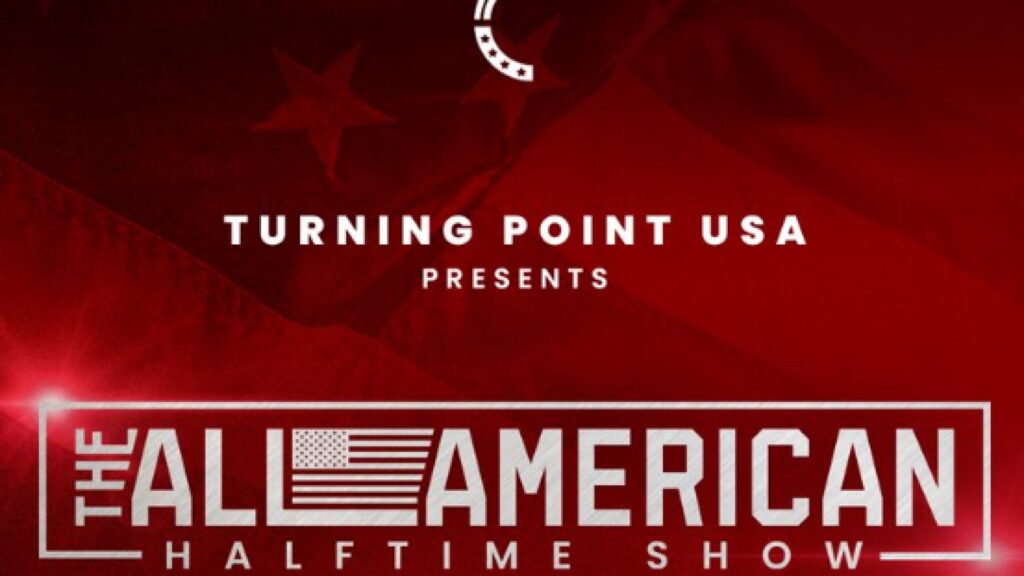
For Charlie, Jennifer and I watched the TPUSA halftime tribute. The performances were not what I would normally choose. Modern country is not my native tongue musically any more than the seemingly talentless, autotuned, largely digitally-created pop anthems of the stadium might be. But the songs were not the point. The point was where I began—the noise versus memory. I miss Charlie. I wanted to watch what TPUSA put together, if only for him.
When the videos and images of Charlie played at the end of the TPSUA halftime show, the weight of his absence landed pretty squarely on me again. I know I said audibly to Jennifer, “I can’t believe he’s gone.” Probably more than once. I haven’t watched any videos of Charlie since his death. I’ve avoided them. But then, suddenly, I was watching him in clips. In that moment, it was hard to just keep him safely in the category of someone I once knew but is now gone. There he was, moving and smiling and pointing. For me, that was a flashback to my times with him—laughing, talking, leaning forward in conversation about something he insisted that I know and remember. Again, as I always have to clarify, we were not besties. But he was legitimately a friend.
There was my friend. Ugh. Life is by no means an abstraction. It’s motion and voice and presence. And then, all of a sudden, it’s little more than memory.
I’ve never been a fan of Kid Rock. Not really. I struggle to see how he can sit in an interview, every other word from his mouth being the f-word, and then stand on stage and sing of Jesus. That doesn’t make sense to me. That said, fewer and fewer people actually do make sense to me. Most seem like they’re barely hanging on in faith, so I suppose Kid Rock needs some space, too. Still, the Gospel changes people. We’re not who we were before it found us. We want to be better. That said, it pays to keep in mind that the person bringing the message doesn’t empower the message. As Saint Paul made clear, the Gospel is the power of God unto salvation (Romans 1:16). We don’t save people. God does. And He does it by His Gospel.
I only mention Kid Rock because of the song he sang. “Til You Can’t,” hit pretty hard, not for its added theology, but for the deeply human reality it presented. Again, it’s all motion and voice and presence, until it’s only a memory. That’s how I was feeling about Charlie when I saw those videos and images.
Beyond these things, from what others are saying, the contrast between what I watched and what I didn’t watch was unquestionable. One performance, as usual, was built to be a worldly spectacle, teaching spectators how to worship pleasure. I believe the halftime show I watched was built, not just to compete with or protest this, but for remembrance. And not just to remember Charlie, even though that’s what I spent most of the time doing. It was an attempt to remember what makes America worthy of our concern—and perhaps even our active participation—enough to stir us to lift a finger to help.
Either way, whatever you took from whichever you watched, I’m pretty sure the world has probably moved on to other things already, as it always does. Still, I took something unforgettable from it. I was able to remember a life that had touched mine. And I was able to find thirty-five minutes of cultural rest as an American who just wants to “cut my grass, feed my dogs, wear my boots,” as Lee Brice sang, and not hear the world preach another sermon about how I’m irredeemable, backward, or somehow shame-worthy for thinking a man can’t be a woman, or for loving what America used to be. I suppose, unlike Super Bowls of the past, I walked away from this one feeling better, not worse—like maybe we still have a chance. The viewership numbers coming out certainly seem to suggest the possibility. It seems that as many as 22 million of us feel this way.
Maybe that’s the real story. Maybe Charlie’s legacy organization did what he’d have wanted it to do. Maybe millions of ordinary people experienced something more than a time of noisy spectacle. Maybe they experienced a time of memory. Maybe they were given a moment to ponder what’s good.
If that’s what happened, then perhaps the world hasn’t moved on quite as much as it thinks it has.
 Cruciform Stuff