
This past Thursday, while many of my dearest friends were gathering in Lansing for the March for Life—a trip I genuinely wanted to make—I found myself in places far less energizing: doctors’ office waiting rooms. I was in two different locations that day. One of the appointments I’d scheduled mid-summer. And it was one of those “you’d better not reschedule this” kind of appointments. The other was one I didn’t anticipate. Regardless, I’ll admit I felt a little restless sitting beneath the fluorescent lights and watching the time tick by, all the while thinking of the better effort in Lansing. Of course, I prayed that the march would be impactful.
At the “you’d better not reschedule” appointment—a cardiologist’s office—I ended up in a conversation with someone a few seats away. We somehow wandered into the topic of death. I think I know why. At one point, I mentioned a friend from High School who had died this past Tuesday, someone I still considered relatively young, barely fifty-one. The exchange set the tone for what’s on my mind this morning. You may or may not appreciate what I’m about to write. Although it’s my keyboard, so there’s that. But more importantly, what I’m going to tell you echoes some of what we talked about.
I’ll just state the premise plainly: When death visits, it has become all too common for sentiment to replace reality. Now, let me explain.
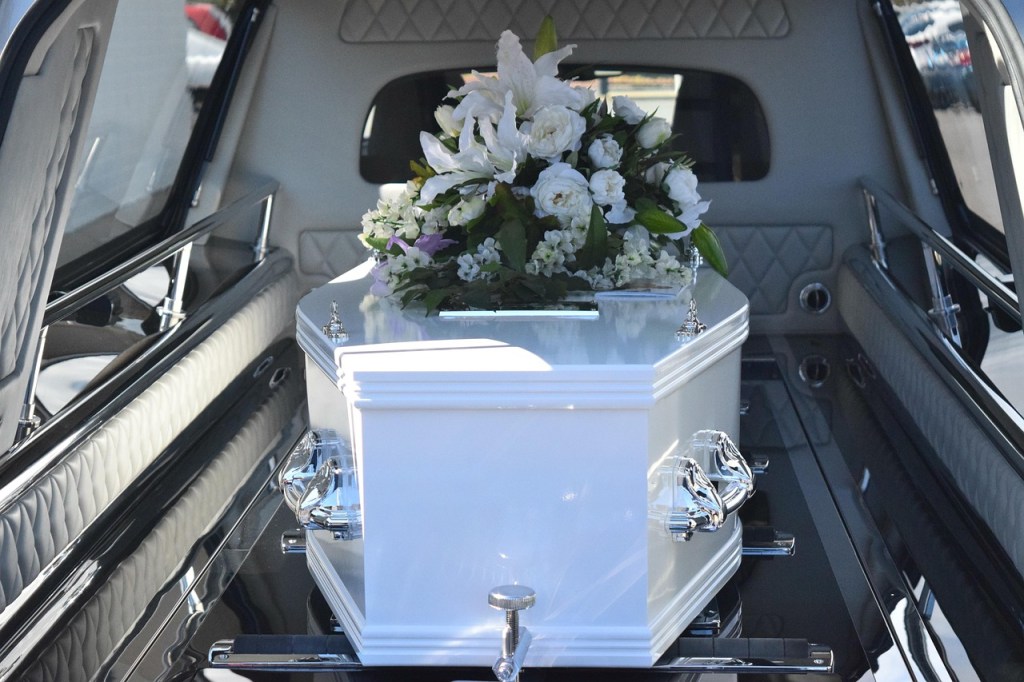
Imagine for a moment you’re at a funeral. There, before you in the casket, is the deceased. It’s someone who had no time or inclination for faith—or maybe even denied the faith outright. Nevertheless, in death, suddenly—almost magically—the deceased is a believer. Suddenly, everyone gathered around the casket is speaking and acting as though the person had a devout (but entirely undetectable) trust in Jesus. And so, “He’s in a better place,” someone says. Or “She’s with the angels now,” another whispers.
How does this happen?
I suppose one reason people speak this way (although not the genuine point of what I intend to say) is that so many want to believe death is good. We say things like, “Death was her friend at the end.” But the Scriptures never speak of death as a friend. Death is the enemy (1 Corinthians 15:26). It is sin’s wage (Romans 6:23). And it is final (Hebrews 9:27). It is the moment when the curtain falls between time and eternity, when what a person believed—or refused to believe—is laid bare before the living God. And when death comes, this enemy reports there are no do-overs. I imagine the people hovering around the casket are secretly hoping there will be. They’re hoping that death, in its supposed kindness, will go easy on them.
But no matter how we try to recraft the moment, no matter what we do to make the moment palatable, death remains what it has always been. It is the world’s final intruder. And to pass death off as some sort of friend who comes along to take a person’s hand, in the end, is to cheapen the Lord’s war against death on the cross.
Christ did not come to make death poetic. He came to destroy it. If this is true, then the moments when death confronts us deserve a clarity that matches its seriousness. In other words, it’s no time for pretending.
Regrettably, I think some pastors, caught in the strange nether space between compassion and conviction, are pulled into this gush. I’ve experienced the pull before. Not so much anymore. But I do remember in the earlier days of my ministry the urge to choose words, not necessarily for truth’s sake, but to avoid offending onlookers during a sensitive moment. And yet, when the Church and her pastors do this—ultimately confusing comforting sentiment with truth—we’re really just betraying both.
I guess what I’m saying is that when we do this, we pave the way for so many to go wandering off into vague spirituality. And forget for a moment syrupy sentiments like the deceased is “looking down from heaven.” I’m talking more about faith-identifying descriptors that would somehow imply that an unbeliever is “at peace” or “in heaven now.” In other words, too many speak as though heaven were a natural right granted to the well-meaning with relatively respectable qualities. But again, the Bible knows nothing of such generalities. Salvation is not the automatic destination of the nice, the kind, or the merely religious. It is the gift of God through faith in Jesus Christ alone (Ephesians 2:8-9). If you are not a believer, when you die, you are not at peace. You are in terrible suffering. And that place of suffering—hell—isn’t imaginary. It’s real, and it’s eternal.
I know that’s not easy to hear. I warned you at the beginning. But I suppose that’s also why I’m writing this. God’s standards are the ones that apply. Never our own. That means faith in Jesus is no small thing. That also means that funerals become unique opportunities for the living.
A few weeks ago, I happened to be sitting in a funeral director’s office near the facility’s front door when I heard an unfortunate conversation between a teenage girl and someone I’m guessing was her mother.
“Why are we here?” the young girl asked. “Funerals are stupid,” she continued, sounding half-annoyed, the way young people do when confronted with something they don’t understand. Her mother replied, “We’ll just stay for a little while and then go home.” I didn’t see the girl’s expression, but I’m guessing by her sigh that she rolled her eyes before adding, “I don’t want to be here. And who cares, anyway? He’s gone.”
Her words echo a world that no longer knows what to do with death. It doesn’t know what it means.
Of course, I don’t know the complexity of the girl’s relationship to the deceased. But let’s just assume the young girl meant exactly what she said. Had I been her parent, I would’ve shepherded her to a quiet corner and explained that of all places, a funeral is the time to know what’s true, not what’s comfortable. If there’s any moment when eternity should press in upon human hearts, it’s when we’re standing beside a casket. That’s when the thin veil between life and death is most real. It’s when our mortality is undeniable. Then I’d walk her to the casket. “Look in there,” I might say. “One day, that will be me. One day, that will be you. Then what?”
That’s the intrusive question no one wants to ask at a funeral, and yet it’s one of the only ones that matter. In one sense, funerals are mirrors held up to the living. They’re opportunities to strip away the noise of daily life and, if anything, to at least recall three very important things.
First, our time is unknown. Second, eternity is real. Third, what we believe—or refuse to believe—matters more than anything someone might say about us when we’re in the casket. A room full of mourners saying nice things and grasping at a hopeful but false future won’t make that future real. Not for the dead. Not for them.
I suppose that third detail brings me back around to where I started. When churches speak and act as if every soul is saved—as if everyone who dies is owed a Christian burial with Christian hymns, Christian prayers, and a Christian sermon, they teach the living that faith and its fruits don’t really matter, that repentance and trust in Christ are optional extras that can be conjured after the fact. This unclarity does not comfort the grieving. It anesthetizes them. It teaches them to believe in a sentimental fiction rather than in the Savior who conquered the cruelest enemy, death.
Plenty of folks have asked me what I like most about being a pastor. My first answer is always, “Baptizing babies!” I just love it. Next, I appreciate funerals. Funerals are where the rubber hits the road. If ever there was a time to proclaim the Law and Gospel clearly—the fact that we are sinners in need of a Savior, and that Savior is Jesus—it’s at a funeral.
At the same time, a funeral sermon is one of the heaviest burdens a pastor has to bear, especially when he somehow finds himself standing beside the casket of someone he knows was without faith. (And in case you think I’m “judging” someone’s heart, take a quick trip through the following texts: Matthew 7:16-20; Matthew 12:33-35; Luke 6:43-45; James 2:17-18; 1 John 1:6; 1 John 2:3-4; 1 John 3:9-10; Titus 1:16; Galatians 5:19-23.) Don’t get me wrong. Great care is needed when choosing one’s words in such situations. Still, there will be the temptation to believe that speaking truth in that moment is cruel and speaking falsehood is compassionate. But actually, the reverse will always be true.
To proclaim a false peace over the unbelieving dead is to rob the living of the Gospel’s urgency. It implies that Christ’s sacrifice was really no big deal—maybe even unnecessary—and that sin has no real consequences, and ultimately that heaven can be had without the narrow way of repentance and faith (Matthew 7:13-14). This kind of preaching might comfort for a moment in the funeral parlor, but in the end, it can only lead away from Christ and condemn for eternity.
A Christian pastor must lead the people to mourn honestly. He’s wasting oxygen when he points to the moral résumé of the deceased. His job is to point to the mercy of God in Christ—mercy which had been available to the one in the casket but is still available right now for the listeners. Doing this, the pastor is careful to communicate that God’s mercy is not cheap. It came at great cost to Christ. But He went into that combat supernal because He loves you, and He knew you could not defeat the last enemy, death.
That sits at the heart of the Gospel. When the Church loses this clarity, it loses its reason to exist. To be clear about these things is not cruel. It’s love. Real love.
Of course, Christians do not gloat over judgment. We grieve for the lost. But it’s a strange kind of grieving. It’s strange because we do it as ones who have hope (1 Thessalonians 4:13), but we know better than to hope in ourselves. Our hope is in Christ, who died for sinners. Holding to this hope, we are careful not to rewrite God’s Word to make the Gospel cheap, punching holes in it and then wiggling to fit every opinion through faith’s narrow gate.
The task of the Church is to proclaim what Christ has done, not to invent an easier gospel when death makes us uncomfortable. The world may prefer gentle lies. The Church must love her listeners enough to tell the truth.
 Right now, my office is a mess. Before I left it yesterday afternoon, as I turned to close the door, I scanned the room and could see the disaster to which I’d be returning. My desk is buried beneath papers. And that’s not the half of it. I have books all over the floor, countless sticky notes hanging from this or that shelf, and a number of other things strewn throughout the entirety of the space. It’s enough to give any visitor the impression I’m about as disheveled as they get.
 Cruciform Stuff