Two of the little girls washed away in the floodwaters were sisters. Blair and Brooke Harber were their names. Blair was 13 years old. Brooke was 11. When they found their lifeless bodies fifteen miles downstream, they were still holding hands.
When Jennifer shared this with me last night, I thought this couldn’t possibly be true. Then I looked it up. It seems it is true. The New York Post reported it. So did the Houston Chronicle and the Associated Press.
But here’s the thing. I have two daughters. If there’s one thing I know for sure about them, had they been swept away in a similar tragedy, we’d have discovered them in a similar embrace.
Madeline and Evelyn are as different as night and day. One loves to fly. The other could spend the whole day fishing. One prefers all things scary. The other is most comfortable in cowboy boots. One slips into unfamiliar scenes with quiet grace. The other makes sure everyone in the room knows where she stands on pretty much everything. But for as different as they are, the love they have for Christ, their family, and each other has never needed them to be alike. It has only needed them to be near.
So, while Jen was reading to me about those two girls, I’ll admit I got a little choked up. Who wouldn’t? Although I didn’t let her see it. She was already struggling to read the article, and a husband needs to be sturdy at these times and in these ways. Still, it was hard to hear, not just for the sorrow of it, but for the unseen truth, something familiar to me, that stirred in the swirling muck of a dreadful situation. The kind of love those girls had, I see it in my own daughters. That kind of final grasp isn’t made in a moment. It’s made over the years through late-night whispers, shared stories, and tearful apologies. It’s born from a wordless understanding between two sisters who know each other sometimes better than they know themselves. It is a love that holds on.
I know Madeline and Evelyn would have held on, too. And I believe they still will, no matter how far the current of life carries them. Because love like that just doesn’t let go. Even better, they have a Savior who won’t let go of them. And together, as sisters, they know it. They know even if the world gives way beneath them, He is there. By faith, they know, just as the seemingly simple and yet incredibly profound song goes, “Little ones to Him belong. They are weak, but He is strong. Yes, Jesus loves me.”
If you haven’t already heard, the U.S. military used our country’s infamous bunker-buster bombs yesterday to take out Iran’s nuclear sites. Whether one agrees with the decision or not, it’s a sobering reminder: the world our children are navigating is growing more perilous by the hour. That said, when I woke up this morning, I had already intended to write about a significant role reversal I experienced last week. I’m going to stay the course, yet I can already sense how this morning’s news will impact it.
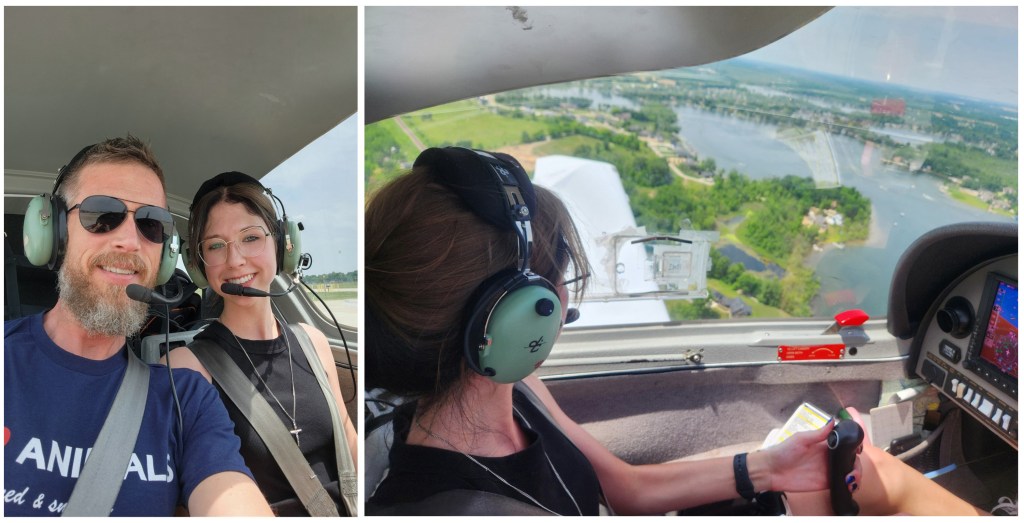
Essentially, my daughter, Madeline, recently earned her private pilot’s license. As a Father’s Day gift, she took me on an hour-long flight. We departed from Bishop International Airport in Flint, flew to a small airstrip in Linden, landed and launched twice, and then returned to Flint. On approach into Flint, she performed a maneuver called a “slip.” I looked it up and found the following definition to be exactly as I experienced:
“A slip is an aeronautical maneuver that involves banking the aircraft into the wind and using opposite rudder to maintain a desired flight path while increasing descent rate or correcting for wind drift.”
In plain terms, Madeline banked us left, and yet, we didn’t turn. We slid sideways while descending rapidly. Just above the runway, she finally straightened the plane, leveled us out, and touched down as if we were angels gently descending from heaven.
She was amazing.
Now, I started by saying I experienced a significant role reversal. To frame all of this in the proper perspective, it really wasn’t all that long ago that Madeline’s life was in my hands in every way imaginable. Indeed, it’s as if only recently, I was tucking her into a car seat and securing the five-point harness, even adjusting the straps to fit her comfortably while ensuring maximum safety. I was the one who checked twice—sometimes three times—that every latch was secure, every buckle snug, because that’s what a father does to keep his child safe. He does things like hold her hand in public. He hovers behind her on staircases that she is still too small to climb. He steadies the handlebars on her first bike ride, jogging alongside her down the sidewalk, ready to catch her when she tips. Everything about her very existence—the entirety of her well-being—is entrusted to him.
But last Sunday—Father’s Day, no less—somewhere just beneath the clouds, the roles reversed, and I found my life was entirely in my daughter’s hands. I climbed into the copilot’s seat and fastened the belt, which she then refastened because I hadn’t done it correctly. She proceeded to adjust it accordingly. And then she was the one now glancing over the vehicle’s every dial, confirming each setting, running her hand along the controls, reciting the pre-flight checklist items with unbroken concentration. I did nothing. She captained the headset, talked with the towers, and guided me through what to expect.
I guess what I’m saying is that the magnitude of that transfer wasn’t lost on me. It was exhilarating, yes, but also profoundly humbling.
Still beaming a couple of days after the flight, while Madeline and I were driving together, I told her again how proud I was of her. I mentioned a quote that had resurfaced in my mind as we flew—something from C.S. Lewis’ The Four Loves. He wrote so profoundly, “To love at all is to be vulnerable.” I explained how placing my life in her hands had revealed something. It wasn’t just that I trusted her. It was more about the depth of love I have for her, the kind that knows just how much she loves me, too.
I’ve known Lewis’ words for a long time. I’ve reflected on them in the context of marriage, friendship, pastoral ministry, and countless other situations where love demands a certain measure of risk. But I’d never thought to apply them to my kids until now. And yet, there they were, soaring right beside us at 2,000 feet on Father’s Day.
I’m usually pretty good with words. But this morning, I’m feeling somewhat limited. The English language doesn’t really have the capacity for genuinely communicating the moment your parental life shifts from giving care to receiving it—from being the one at the controls, both literally and metaphorically, and then, in an instant, letting go of the illusion that I would always be the one doing the work to keep my child safe. That kind of vulnerability doesn’t come easily, especially for a dad. But it is, I think, a place where, if we’re looking through the lens of the Gospel, God shows us just how complete love can be in a family.
I suppose something else comes to mind in all of this, too.
I would imagine that most Christians are familiar with the text of Proverbs 22:6, which reads, “Train up a child in the way he should go; even when he is old, he will not depart from it.” Most folks see that verse in terms of instruction in moral grounding and right living. That’s not wrong. But it misses the heart of the verse.
Its primary aim is that we would raise our children in the “way,” namely, faith so that when they do climb into the cockpit of life, so to speak, they do so not only with competence but with wings outstretched for trust in Christ. In that sense, Proverbs 22:6 reminds us that even as our children’s hands might reach to ours for learning character, skills, and such, it is far more critical that they know to reach for the Lord’s hand in all things. Only then can they truly navigate both the clear skies and the storms with spiritual wisdom and poise. Only in Christ will they know how to take off, how to “slip” when necessary, and how to land with grace.
Anyone considering these things honestly will recognize something more.
Without question, the world my children are navigating is by no means the same one I inherited. Long before the latest news about Iran, the skies they were flying in were already far more turbulent. The voices buzzing through the coms are more confusing, almost unintelligible. The instrument panel in front of them, while more advanced, is almost entirely calibrated by a secular age that denies God’s existence altogether, calling His Word foolishness and insisting that truth itself should be wholly despised.
My point is that the role of Christian parenting cannot be passive in any of this. It cannot be content merely with getting one’s kid into a good college so that they are materially successful. All of that ends when they breathe their last. As I’ve often said from the pulpit, this world and everything in it carries an expiration date. You may not see it, but it’s there. That said, we are not just raising children to exist and survive among temporal things. We are raising them, as Luther said, “to believe, to live, to pray, to suffer, and to die” (LW, Vol. 47, pp. 52-53), which, by default, means we’re raising them to exist in this world with eternal things in mind. We’re raising them to stand, to speak, and to boldly hold the line when others around them are folding. We’re raising them to do these things, not with arrogance, but with conviction formed by the eternal Word of God.
That’s why Proverbs 22:6 matters so deeply. Indeed, to “train up a child in the way he should go” means to help position them for good character and success. But the “way” it mentions is not abstract. It is the cruciform road that leads through repentance and faith in Jesus. When we train our children in this way, we’re grounding them in the very mind and heart of God.
And they need this grounding. They’re already being told that truth is subjective and that steadfast Christian conviction is cruelty. Worst of all, the surrounding world insists that biblical godliness is an artifact of a bygone era. They are surrounded by cultural winds that do not merely blow—they howl. If they are to fly straight—if they are to correct for this world’s drift—they will need spiritual discernment. They will need courage calibrated by sound doctrine and faithful practice. They will need to be taught to see everything in this world through the lens of who they are in Jesus.
In a sense, the time has already come for me to realize that my kids are now flying and I’m not. If you haven’t yet arrived at the same realization, then just know that you’ll be there soon enough. The time is coming when your little ones’ hands will be on the controls, and your hands will be folded in prayer.
That time comes sooner than we think. Parents, the preparation begins now.
When the choice is between faithfulness to Christ and the world’s distractions, choose faithfulness, even when the child doesn’t want to. Lead the way. Even as they might kick and scream to get free from the car seat, strap them in and set out. Do this not only because you’re teaching them how to fly but why to fly. Do this, remembering your children will one day be at the controls, and they’ll be faced with circumstances you never imagined.
Still, when this happens, you’ll be okay, even if things appear to be going south. You’ll be confident that you did everything possible to keep them connected to Christ. You’ll be able to hope that, when it matters most, they’ll know to lean not on the wisdom of this world but on the One who will never steer them wrong. Even better, you’ll know that even though you’re not in the cockpit, Christ is, and regardless of what anyone’s bumper sticker might say, He’s no copilot.
Here in Michigan, with the summer weather comes the bluer skies—the endlessly deeper sapphire skies. They’re beautiful, and they’re more than worth one’s staring. It’s supposed to rain today. That’s okay. We more than need it.
I installed a new stereo in my Jeep. The previous stereo had become somewhat rebellious. For example, it preferred to pause the music when I pressed the mute button. Also, it tended to begin its life anew at every stop. Five minutes at the gas station, and it would reset its clock, lose all the stations, and so much more. Sometimes, it wouldn’t even acknowledge me. I’d press a button, and it wouldn’t do anything. It’s now in a box in my basement.
The new stereo connects to my phone and its music applications, one of which is Spotify. On the way to school one day last week, Evelyn and I listened to whatever Spotify sent us. Elton John’s “Rocket Man” was one of its suggestions. Listening to that song beneath what was gradually becoming a clear blue sky stirred a particular memory for me. I described it to Evelyn. I told her that I heard that song while driving a week or so after my brother Michael died. It was in July 1995. The sky was a seamless blue. I remember leaning a little bit into the steering wheel of my truck to look upward through the windshield for a better view. I did this as Elton sang, “And I think it’s gonna be a long, long time….”
I was 22 years old at the time. My brother—my only brother—was 24 when he died. I remember looking into that infinitely vast sky and thinking it would be a very long time until I’d see him again.
After sharing that memory, I’m pretty sure I noticed Evelyn moving as inconspicuously as she could to wipe away some tears. She’s truly a lovely girl, empathetic in every way. Of course, I didn’t end the story without the Gospel truth, which I’d already shared in a simpler way. Yes, it would be a long time before I saw Michael again. It’s already been almost three decades since we were last together. Still, I will see him. That’s the promise. And I believe it.
My oldest daughter, Madeline, just graduated from high school. Her graduation party was yesterday. What a joy it was to spend time with so many friends. Naturally, as it is with many events in my life—my wedding, the births of my children, my ordination, and so many others—I’ve looked around each event’s scene and wished Michael could’ve been there. That happened at Madeline’s party. Certainly, I’ve always wished my children could’ve known him. And yet, I wasn’t thinking that way yesterday. Instead, more than once while visiting with so many people I cherish, I thought, I wish Michael could’ve been here to meet you. I know he’d have liked you as much as I do.
As the saying goes, each day, a day goes by. But when you love someone, the person’s absence hurts, and each day apart seems to have a thousand hours instead of only twenty-four.
I suppose for many of you, I’m not describing something unfamiliar. You know the sensation. You’ve experienced those moments when you’ve heard a song, taken in a scent, or seen a sight that swept you backward to a time with someone who right now is permanently out of reach.
Having just used the word “permanently,” I realize how strange that word is for Christians. Even with synonyms like “perpetually” and “forever,” for Christians, the truth is that these terms have an expiration date when paired with the out-of-reach nature Death seems to bring. For Christians, Death isn’t permanent. It isn’t forever.
There’s another saying that Death has a thousand doors, and we all find one. There’s truth in that statement. However, no matter its form, because Christ conquered Death, it becomes just another event in a believer’s mortal life—an entryway to a timeless unending with Christ so beautifully described as the shelter of His glorious presence, a place where believers “shall hunger no more, neither thirst anymore; the sun shall not strike them, nor any scorching heat. For the Lamb in the midst of the throne will be their shepherd, and he will guide them to springs of living water, and God will wipe away every tear from their eyes” (Revelation 7:16-17).
And by the way, this wonderful reality will occur among what Saint John called “a great multitude that no one could number” (v. 9). All believers in Christ will fill that multitude’s ranks. Michael is already there, along with all who’ve gone before us in the faith. I’ll be there one day. Someday my wife and children will be there. By faith in Christ, you’ll be there, too.
Until then, in a mortal sense, I think it’s gonna be a long, long time. But that’s okay. Time will end. But eternal life won’t. Knowing this, I can hear a song that prompts a glance toward the heavens and have a different longing as I do it, realizing that for every hour we’re apart from those who’ve died in the faith, there will be a limitless cadence of eternal hours together with them in our Savior’s presence. That same Savior, Jesus Christ, gives this to us because, in perhaps the simplest way, He knows the feeling. Believers are a part of His family. By His relationship to the Heavenly Father, He calls us His brothers and sisters (Mark 3:34-35, Romans 8:29, Philippians 2:8-11, Hebrews 2:11, 2 Corinthians 5:21). He loves us more than anything—enough to shed His blood—and He doesn’t want to be without us.
One last thing.
Don’t get me wrong. I don’t mean to make Death out to be no big deal. It is. That’s why, as I’ve said countless times before, I always give Death a capital “D.” Death is not our friend. It isn’t our helper. But also, it isn’t something we must fear because it isn’t our master. The real Master, Jesus, has declawed, defanged, and defeated it. That’s why Paul can recite rhetorically, “O death, where is your victory? O death, where is your sting?” (1 Corinthians 15:55).
Again, Christ loves us more than anything. Not even Death can keep Christ’s brothers and sisters from Him. Instead, Death must hand them over to the Lord every single time. That’s something worth pondering, no matter the sky’s demeanor.
My daughter, Madeline, mentioned being tasked by one of her teachers with reading A Tale of Two Cities by Charles Dickens. Having two editions in my office, I shared one with her so that she wouldn’t need to wrestle with acquiring it from the school library.
I adore Charles Dickens—his skill with characters, his dexterity with language, and his prowess for telling a good story. Few writers compare. Maybe I’ve shared with you before that I have a first edition set of his complete works in my office. My favorite of his volumes is The Cricket on the Hearth. If you haven’t read it, I’d encourage you to do so, especially if you’re a fan of his infamous A Christmas Carol.
In my humble opinion, pitched against the ever-growing list of worthless garbage our present-day public schools are calling literature, Dickens’ works are golden. I was glad when Madeline told me the assignment, and I knew if she could just get through the first few pages of the story, she’d be in for a real treat. Among all Dickens’ works, it’s one we might call a thriller. It’s very much a three-part story held together by perilous action, and it all ends at the guillotine.
I remember watching a film version of it when I was a kid, except I didn’t necessarily know what I’d seen until I read the book in high school several years later. As a bored eight or nine-year-old who was, as you’d expect, thoroughly unappreciative of the value of Sunday afternoon black-and-white matinees, I recall tuning in and sticking with the film only because, as a fan of scary movies, Christopher Lee was in it. As it would go, he played the cold-hearted Marquis St. Evremonde. To this very hour, I can imagine the possibility of a fanged Christopher Lee emerging from his horse-drawn carriage to bite someone’s neck. Of course, He didn’t. But I do remember a stake-through-the-heart moment his character experienced while sleeping. Either way, the film, like the book, had an aura of unpredictability.
I like unpredictable storytelling. Just ask Jennifer. The movies I find myself enjoying most are ones that keep me guessing. When it comes to all others, I’m as annoying as annoying can be. I think this is true because, as Hollywood continues to sew its recycled and under-considered plots into the sleeves of fast-food characters, there’s a good chance before a movie’s end that I’ll have already shouted out what’s going to happen. I’m not always right, but I certainly am more than the people sitting beside me would prefer. Annoying? Yes. So be sure to commend Jennifer for enduring my predictability.
Speaking of predictability, there’s an oft quoted opening line from the third chapter of the first part of the book. It reads:
“A wonderful fact to reflect upon, that every human creature is constituted to be that profound secret and mystery to every other.”
In a volume filled with twists, Dickens refers to something in humans that’s universally predictable. Strangely, he points to every person’s hidden, namely, unpredictable side. In other words, the only thing you can predict with humans is that they’re unpredictable. Or to dive a little deeper, for as well as you might know someone, there will always be the side you don’t know and couldn’t have expected—the secret self that would surprise you if it were suddenly revealed.
As this meets with the season of Lent—a time when we’re exceptionally attuned to our need for a Savior—my Christian mind wanders to what this means for me. As it roams, I discover how I’m more than capable of concealing my sinful tendencies. And yet, the writer to the Hebrews untangles all misconceptions of this in relation to God when he offers that “no creature is hidden from [God’s] sight, but all are naked and exposed to the eyes of him to whom we must give account” (4:13).
And therein is a path to something incredibly wonderful that we may not have predicted.
Yes, God knows the real you. He knows everything you’ve done. He knows all your horribleness. He knows all your dreadfulness. He knows your soiled intentions. He knows the worst of your thoughts, words, and deeds. And yet, even with all these horrendous things on display before His divine omniscience—things that He knows and sees and has every right to account as hell-worthy—still, He tells us by His Word that He looked on us in love and sent His Son to save us (John 3:16-17). He makes clear that “while we were still sinners, Christ died for us” (Romans 5:8). The predictability of God’s right to judge us accordingly is unpredictably turned on its head by His divine passion for our rescue. He does not give us what we deserve. Instead, He heaps our unfortunate dues upon Jesus, and by His wounds, we are healed (Isaiah 53:5).
I already told you just how much I love an unpredictable story. Well, it doesn’t get any better than the Gospel. And by this, I not only mean the death of God’s innocent Son for the dreadfully guilty, but also the unpredictable nature of the resurrection. That itself was a world-altering event. No one expected an empty tomb. No one expected to see Jesus alive. Not even the disciples. And yet, there He was, is, and remains. Sure, I like Dickens. But his stories are fiction. The Gospel is real, which makes the Bible that carries and communicates it, with every twist and turn of both the Old Testament and New Testament, the greatest volume in human history.



 Cruciform Stuff