
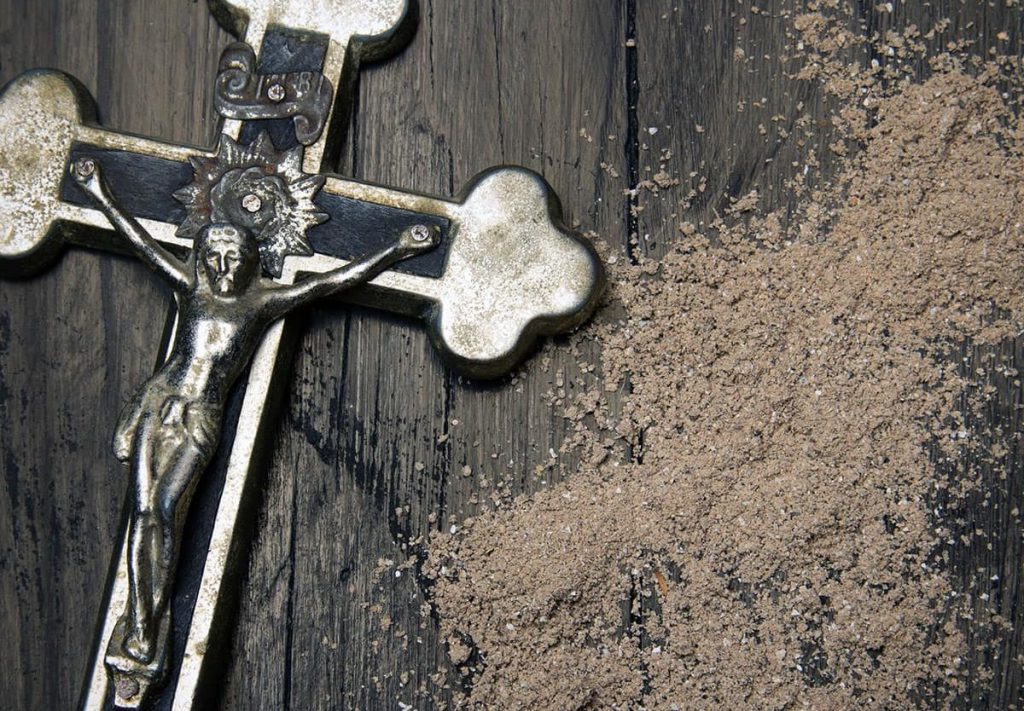
The Church now stands at the threshold of one of her most searching seasons. Lent is not just another stretch of the calendar. In fact, if ever there was a Church season that could see through the masks we wear all year long, it’s Lent. It’s a season that presses upon us who we really are. In that sense, it’s recalibrating. It calls us back to better clarity.
But first, Ash Wednesday, the gateway into Lent.
In Ash Wednesday’s solemn liturgy, cooled cinders are placed upon our foreheads—the remains of what fire has consumed, the residue of destruction. As they’re smeared, you are told, “Remember that you are dust, and to dust you shall return.” This is the biblical origin of the philosophers’ ancient phrase “Memento mori”—remember that you must die.
If, for some reason, you miss these words, rest assured, the ashes themselves will preach them. They are rough to the touch, pitch black, and stubborn to remove. They insist that death is no abstraction. It is the wage of sin, and it leaves its mark on every human life. There is nothing delicate about it. It is brutal consequence.
If you’ve ever stood in line to receive those ashes, then perhaps you already know the quiet gravity of it. One person steps forward, then another, and then another, until at last it’s your turn. You are dust. Memento mori. Each of us must face the same end. Each of us must reckon with the same truth. The Divine finger of God’s unalterable Law presses heavily against our hearts, corralling us into the fellowship of Adam, who heard God say through him to all of us, because of what we’ve done, “cursed is the ground because of you” (Genesis 3:17).
And yet, there is something else to know in these moments. Pay attention. If possible, watch the finger applying the ashes. If you can’t see it, look around you. See the same mark you bear being borne by everyone else around you. The mark is in the form of a cross. However uneven the lines may be, that shape is unmistakable.
See that mark and know you are a child of promise. Yes, memento mori. But also, memento Christus—remember Christ! You were claimed by the One who has entered death and overcome it. The cross traced in ashes declares that the end of Man is not the end of Christ, and therefore it is not the end of those who belong to Him.
Scripture teaches that we carry in our bodies not only the death of Jesus but also His life (2 Corinthians 4:10-11). His death was no defeat. On the contrary, it was the death of death itself. By His resurrection, the grave has lost its dominion, and its sting has been taken away (1 Corinthians 15:54-57). We are children of that promise!
Regardless of how other churches prefer to enter into Lent, this is how Our Savior Evangelical Lutheran Church and School in Hartland, Michigan, begins it. We keep Ash Wednesday. We need the reminder. Left to ourselves, we grow comfortable. We begin to imagine that life in this fallen world is stable, predictable, maybe even secure. Ash Wednesday strips away those illusions. It teaches us to see clearly what sin has wrought, and at the same time it directs us to the only refuge that endures—to Christ, who has entered the darkness and shattered it from within.
And then we go forth into the season. We meet the great struggle at the heart of our redemption. The contest between Christ and death will appear, for a time, to be no contest at all. Our Lord will be mocked, beaten, scourged, and crucified. He will yield Himself fully into the hands of His enemies. To every earthly calculation, it will look like utter ruin.
Yet that is precisely where the victory is won. And we will receive it as it truly is, even when it appears weak or foolish by the world’s measure. We know it’s a kingdom established by a crucified King.
The cross, in all its horror, stands at the center of the Gospel. It is harsh to behold, and yet it is good—profoundly good—because there the Son of God bore the sin of the world and reconciled us to the Father. And so, Saint Paul writes with fervor, “We preach Christ crucified” (1 Corinthians 1:23). Indeed, we do, and without shame. The Gospel is and remains the power of God unto salvation for all who believe (Romans 1:16-17).
For all of these reasons, I encourage you, if you’ve never attended the Ash Wednesday liturgy, make the effort to do so. Receive the ashes. Hear the Word. Begin the Lenten journey as the Church has long begun it—with repentance, with sobriety, and with hope fixed firmly on Christ.
Here at Our Savior, we’ll gather on Ash Wednesday for worship at 8:10 a.m. and then again at 6:30 p.m. You are welcome to come. Indeed, join with the faithful. Be reminded of life’s frailty, and—far more importantly—to hear again the promise of the One who said, “I am the resurrection and the life. Whoever believes in Me, though he die, yet shall he live” (John 11:25-26).






 Cruciform Stuff