
Here at Our Savior in Hartland, we spend Holy Monday, Holy Tuesday, and Holy Wednesday making our way through John 12:20-50. The context of the reading is Palm Sunday. It’s the Lord’s immediate beginnings in the temple after He entered the city to fast-fleeting fanfare. He’s there teaching.
We handle the reading in sections. Monday considers verses 20-36. Tuesday, we hear 37-43. On Wednesday, we digest 44-50. I’ve been doing it this way for a while. It works, if only because the Lord’s words here are wonderfully bottomless. And their point? His truest glory. His death on the cross for sinners.
Right now, I’m thinking about Tuesday’s reading. It ended with John telling us, almost in passing, that “many even of the authorities believed in Him, but for fear of the Pharisees they did not confess it, so that they would not be put out of the synagogue; for they loved the glory that comes from man more than the glory that comes from God” (vv. 42-43).
As a pastor, those words are familiar. I’m not trying to be negative. However, the plain truth is that there is a kind of belief that teeters dangerously at the edge of unbelief. John more or less describes it as the kind that never quite finds its voice, but instead, stays hidden. His words are a passing indictment of something that’s far more dangerous than we may realize.
Most often, we might assume things like open hostility to God’s Word or flat-out rebellion against this or that are the real dangers leading to unbelief. Maybe they’re the worst of the bunch. But they’re not the only pavers on the path to destruction. Some are much subtler. Here, John references the deadly nature of self-preserving hesitation. He describes the kind of faith that remains hidden because it’ll cost too much if it’s seen.
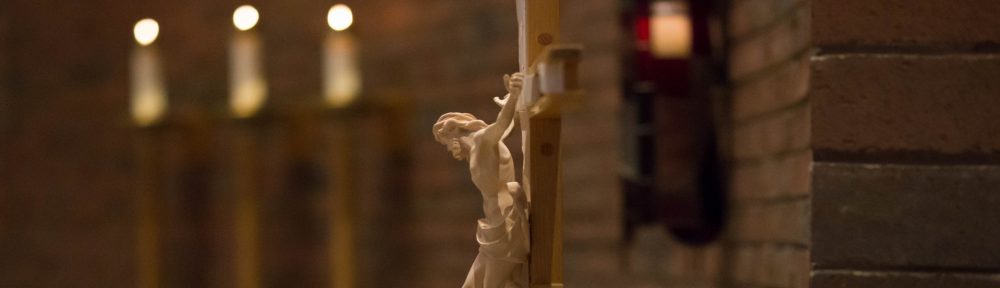
Today is Good Friday. Good Friday presses directly into that space. That’s because, regardless of those in the churches who’d prefer to keep the crucifixes hidden because they seem offensive, the fact is, the cross doesn’t allow for a private allegiance. It doesn’t leave room for a faith that exists only in the interior life, safely insulated from consequence. The crucifixion of Jesus was public. It was out in the open and very public.
That’s right where it belonged, making it, in every sense of the word, costly.
I think that’s the real reason some churches, even some here in my neighborhood, shrink from displaying crosses in their buildings—and why they jump from Palm Sunday straight to Easter, without even the slightest glance toward Good Friday. It’s not that they don’t believe. I won’t go that far. John was clear. They did believe. Something in them knew and recognized the Savior. Something in them was drawn to Him. But belief—the kind refusing to confess the glory Jesus had been describing all along—it began to bend. It began to accommodate. It learned how to survive without ever having to embrace Christ entirely. It might not be unbelief, but it’s really darn close.
“They loved the glory that comes from man more than the glory that comes from God.”
That’s the fault line right there. And it should sound familiar. It describes competing loves, and we all know that sensation. Jesus warned against this in the Sermon on the Mount. He preached, “No one can serve two masters, for either he will hate the one and love the other, or he will be devoted to the one and despise the other” (Matthew 6:24).
But what does this look like in a practical sense? I already mentioned the churches near me that have openly expressed disdain for displaying crosses, one in particular having been quoted in a local newspaper a few years back. For the rest of us, the reasons are not far removed. Christ takes a back seat to the desire to be thought well of. He’s pushed aside by the instinct to remain inside the popular circle. We do quiet calculations that weigh what faithfulness might cost against what acceptance provides. And when those scales tip—even just a little—keeping quiet about our faith in Jesus begins to feel reasonable, or in certain circumstances, maybe even necessary.
“If they know, I’ll never get the promotion.”
Good Friday weeps over this reasoning even as it refuses to let it stand. Because on this day, the One in whom they believed is no longer teaching in parables or confounding His critics in the temple courts. He’s lifted up in the open. He’s stripped of all dignity before the crowds. He’s nailed to wood while the masses mock Him. He’s cast entirely from everyone and everything. He’s openly and publicly rejected by every man-made structure this world uses to define belonging. Indeed, it is as Isaiah foretold: “He was despised and rejected by men, a man of sorrows and acquainted with grief; and as one from whom men hide their faces he was despised, and we esteemed him not” (Isaiah 53:3).
I know it couldn’t have been an easy scene. Of course some people hid their eyes from it. But that doesn’t change the fact that the crucifixion of Jesus was the “hour for the Son of Man to be glorified” (John 12:23), and that according to that hour, as Jesus continued, “And I, when I am lifted up from the earth, will draw all people to myself” (v. 32). John explains, “He said this to show by what kind of death He was going to die” (v. 33).
The Christian Church has no more important day than today. Yes, the Resurrection is crucial. But in a sense, it’s proof of today’s significance. The crucifixion of Jesus is the moment of moments for the Christian faith. It’s where the Son of God exacted what was necessary for your salvation. And in that moment, every believer, open or hidden, is forced to reckon with something the world will never embrace. Behold what the Christian faith finds so beautiful! The death of God’s Son for me!
The devil hates everything about the crucifixion, most importantly, what it earned for us. He’d love for it to become something we avoid, interpreting it as little more than jewelry-worthy while, at the same time, convincing us to prefer a version of faith that never disrupts our place in the world.
As is often the case, the Bible provides real-life examples so we know better. John 12 is just such an example. Some of the Jewish authorities believed, but they stopped short of faith’s confession. And in stopping short, they forfeited something essential. Because faith that never speaks or moves or risks anything—it almost always conforms to the very pressures it fears. It becomes quiet enough to coexist. It remains safe enough to go unnoticed and, as a result, steps away from Christ’s insistence that believers have been recreated by faith as salt of the earth and lights in the world. Christ would have us as recognizable conduits—a means for the unbelieving world to see and meet Him and, ultimately, give glory to the Father in heaven (Matthew 5:13-16).
Good Friday stands entirely against the kind of belief John described—the kind that’s weak enough to disappear in every crowd. Again, John doesn’t scold it in his account. He simply presents it as a dangerous reality that we shouldn’t ignore, if only because the One preaching in the temple at that moment didn’t remain hidden to preserve His standing. He didn’t adjust His mission to avoid trouble. He embraced the hour of true glory—His death for sinners. And lest you doubt what I’ve said about the hour of His glorification being His death, read our Lord’s passionate announcement in verse 27: “Now is my soul troubled. And what shall I say? ‘Father, save me from this hour’? But for this purpose I have come to this hour.”
I suppose part of my point this morning is to invite you to step a little closer to the Lord’s hour. Go to church today. Make time—not as a formality, or as an obligation squeezed into an already crowded day—but as a deliberate act of open alignment. Ask your boss. Invite a friend. Make time and go to the place where so many others in your church family are going, a place where the cross is not background noise, but the central reality of the faith we are to live before others each and every day.
Today—especially today—go! Refuse to remain at a distance from what stands at the center of history. The intense Gospel rendering of this day strips away the lesser things you’re prone to holding onto, even the ridiculously simple things like the need for approval, the fear of exclusion, or the quiet compromises you’ve made to keep everything around you safely intact.
Let Good Friday interrupt you and give you something better. Let it press on you. Let it ask more of you than is comfortable. Let it show you more than what you’re willing to see.
If you don’t have a church home, or your church does not offer Good Friday services, I’m sorry. Rest assured, you’re welcome to join us here at Our Savior in Hartland. Our first Good Friday service, Tre Ore, is at 1:00 PM. The next, Tenebrae, is at 6:30 PM. I’m preaching at the 1:00 service. Our headmaster, Pastor Scheer, so graciously offered to help by preaching at the 6:30 PM service. Attending either or both, I promise you’ll be blessed with all that’s necessary for a faith that can stretch its legs beyond the borders of anything this world might call belonging.
 Cruciform Stuff