Role Reversal

If you haven’t already heard, the U.S. military used our country’s infamous bunker-buster bombs yesterday to take out Iran’s nuclear sites. Whether one agrees with the decision or not, it’s a sobering reminder: the world our children are navigating is growing more perilous by the hour. That said, when I woke up this morning, I had already intended to write about a significant role reversal I experienced last week. I’m going to stay the course, yet I can already sense how this morning’s news will impact it.

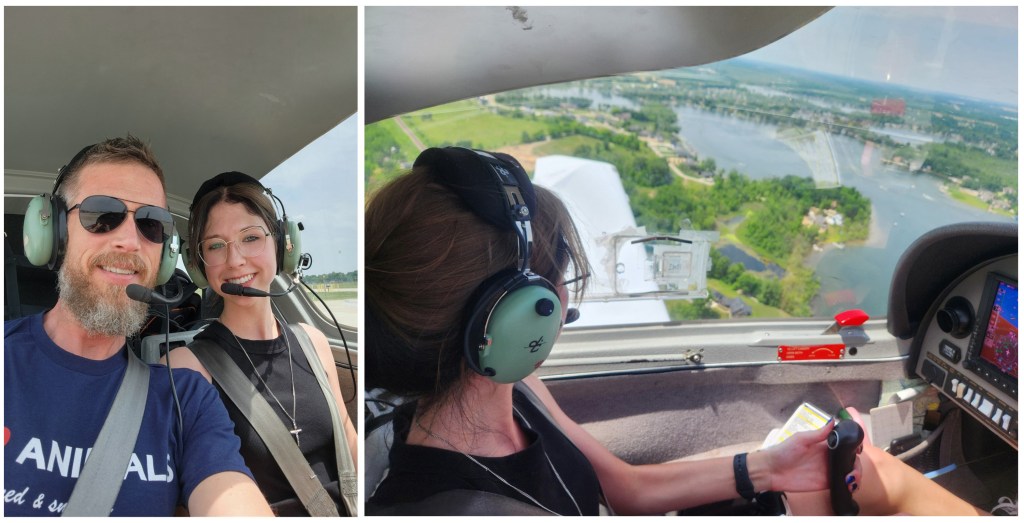
Essentially, my daughter, Madeline, recently earned her private pilot’s license. As a Father’s Day gift, she took me on an hour-long flight. We departed from Bishop International Airport in Flint, flew to a small airstrip in Linden, landed and launched twice, and then returned to Flint. On approach into Flint, she performed a maneuver called a “slip.” I looked it up and found the following definition to be exactly as I experienced:

“A slip is an aeronautical maneuver that involves banking the aircraft into the wind and using opposite rudder to maintain a desired flight path while increasing descent rate or correcting for wind drift.”

In plain terms, Madeline banked us left, and yet, we didn’t turn. We slid sideways while descending rapidly. Just above the runway, she finally straightened the plane, leveled us out, and touched down as if we were angels gently descending from heaven.

She was amazing.

Now, I started by saying I experienced a significant role reversal. To frame all of this in the proper perspective, it really wasn’t all that long ago that Madeline’s life was in my hands in every way imaginable. Indeed, it’s as if only recently, I was tucking her into a car seat and securing the five-point harness, even adjusting the straps to fit her comfortably while ensuring maximum safety. I was the one who checked twice—sometimes three times—that every latch was secure, every buckle snug, because that’s what a father does to keep his child safe. He does things like hold her hand in public. He hovers behind her on staircases that she is still too small to climb. He steadies the handlebars on her first bike ride, jogging alongside her down the sidewalk, ready to catch her when she tips. Everything about her very existence—the entirety of her well-being—is entrusted to him.

But last Sunday—Father’s Day, no less—somewhere just beneath the clouds, the roles reversed, and I found my life was entirely in my daughter’s hands. I climbed into the copilot’s seat and fastened the belt, which she then refastened because I hadn’t done it correctly. She proceeded to adjust it accordingly. And then she was the one now glancing over the vehicle’s every dial, confirming each setting, running her hand along the controls, reciting the pre-flight checklist items with unbroken concentration. I did nothing. She captained the headset, talked with the towers, and guided me through what to expect.

I guess what I’m saying is that the magnitude of that transfer wasn’t lost on me. It was exhilarating, yes, but also profoundly humbling.

Still beaming a couple of days after the flight, while Madeline and I were driving together, I told her again how proud I was of her. I mentioned a quote that had resurfaced in my mind as we flew—something from C.S. Lewis’ The Four Loves. He wrote so profoundly, “To love at all is to be vulnerable.” I explained how placing my life in her hands had revealed something. It wasn’t just that I trusted her. It was more about the depth of love I have for her, the kind that knows just how much she loves me, too.

I’ve known Lewis’ words for a long time. I’ve reflected on them in the context of marriage, friendship, pastoral ministry, and countless other situations where love demands a certain measure of risk. But I’d never thought to apply them to my kids until now. And yet, there they were, soaring right beside us at 2,000 feet on Father’s Day.

I’m usually pretty good with words. But this morning, I’m feeling somewhat limited. The English language doesn’t really have the capacity for genuinely communicating the moment your parental life shifts from giving care to receiving it—from being the one at the controls, both literally and metaphorically, and then, in an instant, letting go of the illusion that I would always be the one doing the work to keep my child safe. That kind of vulnerability doesn’t come easily, especially for a dad. But it is, I think, a place where, if we’re looking through the lens of the Gospel, God shows us just how complete love can be in a family.

I suppose something else comes to mind in all of this, too.

I would imagine that most Christians are familiar with the text of Proverbs 22:6, which reads, “Train up a child in the way he should go; even when he is old, he will not depart from it.” Most folks see that verse in terms of instruction in moral grounding and right living. That’s not wrong. But it misses the heart of the verse.

Its primary aim is that we would raise our children in the “way,” namely, faith so that when they do climb into the cockpit of life, so to speak, they do so not only with competence but with wings outstretched for trust in Christ. In that sense, Proverbs 22:6 reminds us that even as our children’s hands might reach to ours for learning character, skills, and such, it is far more critical that they know to reach for the Lord’s hand in all things. Only then can they truly navigate both the clear skies and the storms with spiritual wisdom and poise. Only in Christ will they know how to take off, how to “slip” when necessary, and how to land with grace.

Anyone considering these things honestly will recognize something more.

Without question, the world my children are navigating is by no means the same one I inherited. Long before the latest news about Iran, the skies they were flying in were already far more turbulent. The voices buzzing through the coms are more confusing, almost unintelligible. The instrument panel in front of them, while more advanced, is almost entirely calibrated by a secular age that denies God’s existence altogether, calling His Word foolishness and insisting that truth itself should be wholly despised.

My point is that the role of Christian parenting cannot be passive in any of this. It cannot be content merely with getting one’s kid into a good college so that they are materially successful. All of that ends when they breathe their last. As I’ve often said from the pulpit, this world and everything in it carries an expiration date. You may not see it, but it’s there. That said, we are not just raising children to exist and survive among temporal things. We are raising them, as Luther said, “to believe, to live, to pray, to suffer, and to die” (LW, Vol. 47, pp. 52-53), which, by default, means we’re raising them to exist in this world with eternal things in mind. We’re raising them to stand, to speak, and to boldly hold the line when others around them are folding. We’re raising them to do these things, not with arrogance, but with conviction formed by the eternal Word of God.

That’s why Proverbs 22:6 matters so deeply. Indeed, to “train up a child in the way he should go” means to help position them for good character and success. But the “way” it mentions is not abstract. It is the cruciform road that leads through repentance and faith in Jesus. When we train our children in this way, we’re grounding them in the very mind and heart of God.

And they need this grounding. They’re already being told that truth is subjective and that steadfast Christian conviction is cruelty. Worst of all, the surrounding world insists that biblical godliness is an artifact of a bygone era. They are surrounded by cultural winds that do not merely blow—they howl. If they are to fly straight—if they are to correct for this world’s drift—they will need spiritual discernment. They will need courage calibrated by sound doctrine and faithful practice. They will need to be taught to see everything in this world through the lens of who they are in Jesus.

In a sense, the time has already come for me to realize that my kids are now flying and I’m not. If you haven’t yet arrived at the same realization, then just know that you’ll be there soon enough. The time is coming when your little ones’ hands will be on the controls, and your hands will be folded in prayer.

That time comes sooner than we think. Parents, the preparation begins now.

When the choice is between faithfulness to Christ and the world’s distractions, choose faithfulness, even when the child doesn’t want to. Lead the way. Even as they might kick and scream to get free from the car seat, strap them in and set out. Do this not only because you’re teaching them how to fly but why to fly. Do this, remembering your children will one day be at the controls, and they’ll be faced with circumstances you never imagined.

Still, when this happens, you’ll be okay, even if things appear to be going south. You’ll be confident that you did everything possible to keep them connected to Christ. You’ll be able to hope that, when it matters most, they’ll know to lean not on the wisdom of this world but on the One who will never steer them wrong. Even better, you’ll know that even though you’re not in the cockpit, Christ is, and regardless of what anyone’s bumper sticker might say, He’s no copilot.
Slipping Into Error

I’m sure you already know this, and yet, just in case you don’t, Israel launched preemptive strikes against Iran’s nuclear sites on Thursday. As expected, Iran responded. It was reported in the news that we knew those strikes were coming, even as America was attempting to broker a peace deal with Iran. However, Iran appeared to be doing what Iran always does, which is to make every excuse for not securing peace. Meanwhile, Israeli and American intelligence agencies reported that Iran was only days away from having enough enriched uranium to build a minimum of fifteen nuclear weapons, only one of which would be needed to turn Israel to glass. Used against the United States, millions here would die.

Is any of this news reporting accurate? Is the media telling us what’s true? It’s hard to tell these days.

On one hand, Iran’s supreme leader, Ali Hosseini Khamenei, has said they would pursue nuclear independence. He also said as recently as 2023 that “Death to America is not just a slogan. It is our policy.” And of course, Iran—the largest state sponsor of terrorism in the world—has made it a priority to rid the world of the Jews. That’s not breaking news. That’s an open and longstanding fact. What’s more, Iran’s desire for Israel’s destruction, some have said, is the only truly unifying principle that keeps the nation together. A largely tribal nation, Iran would likely come entirely undone if not for its leaders’ radical Islamic ideology.

On the other hand, nearly everything the news reported about COVID turned out to be false. Masks and social distancing absolutely did not accomplish anything, except to decelerate development in generations of children. It turns out that ventilators made the sick worse. Ivermectin, the Nobel Prize-winning medication prescribed to humans for decades, was negatively labeled a “horse dewormer” and called dangerous, ultimately getting doctors who knew better and prescribed it into heaps of trouble. And yet, it turned out to be wholly sufficient for treating the illness. If a person added vitamin D to his regimen, he would be good to go. Conversely, most news outlets insisted that the vaccine would protect from infection. They streamed Biden’s thank-you to the vaccinated while warning the unvaccinated to expect “a winter of severe illness and death.” And yet, the opposite was true. In fact, the rates of unexpected deaths have seen a sharp increase only among the vaccinated.

I read an article this morning from CBS News saying that the FDA is insisting Pfizer and Moderna “expand the warning labels on their COVID-19 vaccines about the risk of a possible heart injury side effect linked to the mRNA shots, primarily in teen boys and young men.” It goes on to talk about unusual spikes in myocarditis. A peripheral article warned of the same, but then added strange cancers and other diseases to the list of concerns, conditions that were never as prominent until after the COVID vaccines and boosters were so widely administered. One particular example shared was that sudden athlete deaths were off the charts by comparison to pre-COVID statistics.

By the way, I should say I’m not surprised by the vaccine results. Dr. Mary Talley Bowden was recently on Joe Rogan’s podcast, and she mentioned that we now have five years of data stacks confirming the vaccine’s dangers. She essentially noted that anyone who received the vaccine is now, in a sense, permanently rewired—because what the news called a vaccine isn’t a vaccine. It’s an mRNA injection. It’s gene therapy. Gene therapy rewrites DNA. Vaccines, in theory, are designed to prompt and arm the body’s immune system. Gene therapy is designed to manipulate the body’s very DNA. It works at a genetic level.

Still, the public’s response to COVID proved how quickly fear and misinformation can bend entire societies—even churches—toward error. I say this as so many churches, even after the lockdowns, continued to forbid worshippers through the door unless they were masked, vaccinated, and sat two rows apart. This is an absolute violation of God’s Word, regardless of the government’s mandates! The same patterns are playing out again, just under different headlines.

However, I didn’t start writing this morning with COVID-19 on my mind. I was more concerned about the possibility of war. More precisely, I was thinking about how easily things come undone—or how easily human beings can steer into falsehood—when our handling of source material is faulty.

Concerning everything I’ve described so far? I suppose the only answer I can give is to say, “Read, read, and read some more.” As Christians, I encourage you to do this, remembering three things in particular.

First, understand that skimming content is rarely helpful. Dig in and digest, reading from various sources in order to get a topic’s fullest spectrum of perspectives. Second, pitch everything you read against the Word of God. In other words, let everything you take in pass through the filter of Scripture. God’s Word shapes our opinions, not the other way around. Third, make sure your doctrine is sound. Doctrine doesn’t just articulate what we believe about salvation. It provides necessary boundaries, becoming a primary tool for discerning everything we see and experience. If you claim the Bible, and yet your theology depends on the modern nation of Israel going to war with Iran as a fulfillment of end-times prophecy before Christ can return, then it’s likely the first two recommendations weren’t heeded. In other words, first, you aren’t all that familiar with the Bible’s actual contents; and second, your opinion has become your strongest filter. As a result, your doctrinal compass is misaligned, and you’re destined only to distort the source material—the Bible.

Now, I say this as someone who’s spent a lot of time wrestling with how theology and the public square intersect, particularly through the lens of Church and State, or the doctrine of the Two Kingdoms. What we believe about God’s rule and our role in the world carries consequences, both for faithfulness and for clarity during incredibly confusing times.

Be aware that confusion has a way of hardening into error.

You may have already noticed from what I wrote earlier about Israel and end-times prophecy that one particular distortion in times like these is Christian Zionism. It’s a theological framework that merges biblical language with modern political expectations, often assigning messianic significance to the nation of Israel. This confusion leads many to misapply sacred titles and divine promises in ways that seem patriotic or spiritually inspiring, but ultimately are biblically reckless and incredibly dangerous.

For example, Israel’s current offensive has been dubbed “Operation Rising Lion.” An online friend posted on Saturday an image of a lion with an Israeli flag blended into its face. The tagline read, “The Lion of Judah has risen.” The image made me cringe. Yes, I support the nation of Israel’s right to protect itself from annihilation. Still, the nation of Israel is not the Lion of Judah. The phrase “Lion of Judah” belongs to Jesus Christ alone (Revelation 5:5). Furthermore, it was posted by someone who assumes the modern nation of Israel still carries an unbroken divine mandate, simply by virtue of its geography or ethnicity.

To believe and confess this is to upend the fuller testimony of Scripture. It replaces Christ-centered fulfillment with nationalistic nostalgia and, in doing so, distorts God’s promises and perpetuates grave theological error.

This kind of misreading reflects the same pattern I’ve addressed already. Whether it’s Iran’s deception or the media’s COVID narratives, when we abandon faithfulness to God’s Word, we can only lose our bearings in life’s fog. Reality becomes distorted, and we are just as vulnerable to being swept away by falsehood as anyone else.

Of course, whenever someone challenges the notion that modern Israel holds a unique divine status, the charge of antisemitism isn’t far behind. Even as someone who supports Israel’s right to defend itself, I’ve borne that charge. But the accusation misses the mark entirely. I’ve written before that it is by no means antisemitic to say (alongside Saint Paul, the inspired writer and chief apostolic interpreter of Christ and the Old Testament Scriptures) that Christians are the “Israel of God” (Galatians 6:16). The Israel of God is not ethnic or a localized nation. Saint Peter clarifies it is “a chosen people, a royal priesthood, a holy nation, God’s special possession…” (1 Peter 2:9–10). And again, Saint Paul writes, “If you belong to Christ, then you are Abraham’s seed, and heirs according to the promise” (Galatians 3:29); and “For not all who are descended from Israel are Israel. Nor because they are his descendants are they all Abraham’s children… it is the children of the promise who are regarded as Abraham’s offspring” (Romans 9:6–8).

Children of the promise—Christians—are regarded by God as Abraham’s true offspring. Like Abraham, they believe in the promise (Genesis 15:6; Romans 4:3; James 2:23). And what is the promise? The One who was promised—Christ (Galatians 3:16; Luke 1:54–55; Luke 1:31–33; Acts 2:29–31; Hebrews 8:6–13; Romans 15:8–9; 2 Corinthians 1:20; and countless other texts). All who look to Christ in faith will be saved (John 6:38–40) and brought into the new Jerusalem—eternal life (Revelation 21–22; Psalm 46:4–5; Isaiah 65:17–19; and others).

To say that only believers in Christ are saved and given eternal life is not antisemitic, but it is fundamental to Christian theology, and it does show Christian Zionism’s error. If it were antisemitic, then the apostles were antisemites for believing and declaring, “Salvation is found in no one else, for there is no other name under heaven given to mankind by which we must be saved” (Acts 4:12). What’s more, Christ Himself would be an antisemite for saying in absolutist terms, “I am the way, and the truth, and the life. No one comes to the Father except through me” (John 14:6); and, “Whoever believes in [God’s Son] is not condemned, but whoever does not believe stands condemned already because they have not believed in the name of God’s one and only Son” (John 3:16–18).

It is right and godly to defend and protect anyone and everyone from persecution or attack. Long before the events of this past week, Iran and its proxies had launched over 500 ballistic missiles into Israel. Christians should support restraining Iran. To do so is to love one’s neighbor as oneself. But that doesn’t change the fact that Christian Zionism is a dangerously confused theology—a dreadfully miscalibrated doctrine—that must be avoided, if only because it corrupts the Gospel that can save everyone in both Israel and Iran.

I suppose in the end, my main point is to say that if Christians are not vigilant—biblically, and therefore doctrinally—we will find ourselves swept along by narratives that feel righteous but stand in contradiction to God’s revealed truth. Whether it’s the media rewriting science or Christians assigning eternal significance to things that do not deserve it, the temptation to trade discernment for ideological capture is only ever a step away.

This is why being in God’s Word is so important. I encourage you: make it a part of your everyday routine. And as I said, don’t skim. Even better, don’t search the Scriptures just to find proof texts that reinforce your existing political views or cultural assumptions. Instead, go there to be corrected, shaped, and grounded. Go there for truth. Go there to find Christ. He is enough, and His Word is sufficient. And the Church—His true Israel—must live and speak as though both of those things are actually true.