I don’t know about you, but the older I get, the more New Year’s Eve loses its luster. It feels less like a party and more like a bedtime challenge. Can I make it to midnight? Can I even make it past 9:30? I think William Vaughn said it best, “Youth is when you’re allowed to stay up late on New Year’s Eve. Middle age is when you’re forced to.”
For the record, I stopped trying for midnight years ago, especially with a worship service in the morning. Still, the moment has never been lost on me. New Year’s Eve—the day itself—has always been a moment to pause. It can be sort of a held breath between what was and what will be, if only we’ll take the opportunity to consider it. Right now, I’m sitting at my dining room table. Even with a quick glance around the room, I’m reminded of just how quickly things can change.
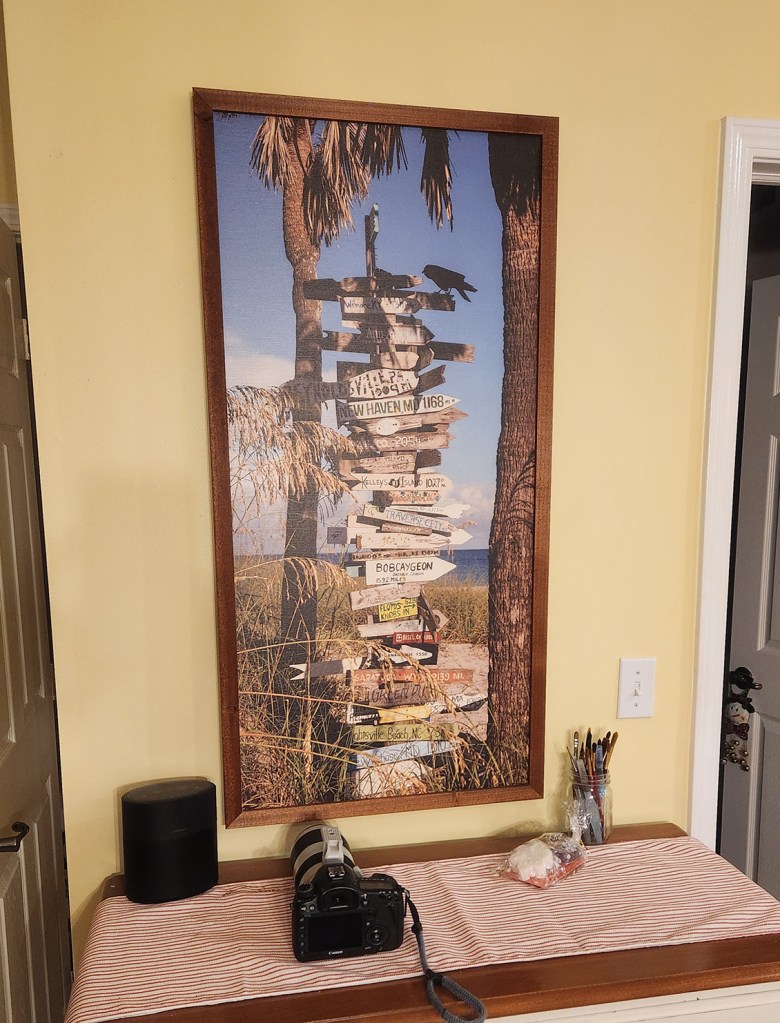
For example, right across from where I’m sitting, a poster-sized photo hangs on the wall. Jennifer snapped the picture. Essentially, she captured a moment we can never revisit.
The photo was taken on a beautiful, sun-washed day at a beachside restaurant near Lemon Bay, Florida—one we visited with some relatively newfound friends at the time who knew the place and loved it. In the image, there’s a wooden post planted in the sand with forty or so signs nailed to it, each pointing somewhere else—cities across the United States, and a few beyond its borders, all measured in miles from that very spot. A bird is perched on one of the top signs, palled by a nearby palm tree’s shadow. It’s as if the bird’s deciding which of the cities he’ll choose to visit next. The sky is bright blue, interrupted only by a handful of clouds. Everything about the picture feels calm, steady, and permanent.
But permanence is a lie we tell ourselves when the sun is shining and things are easy. Hurricane Ian erased everything in that photo back in 2022. The sign, the restaurant, the familiar stretch of beach, it was all pretty much gone overnight. It was reduced to ocean-soaked debris and memory.
That said, I can promise you, the Thoma family loves the image all the more, if only because everything in it is gone. In a way, it’s not just a photograph for us anymore. It’s a reminder that certain moments don’t ask our permission before they become history. We will never stand there again. We will never see that post in the sand exactly as it was. We’ll never be able to visit that restaurant and relive that moment.
New Year’s Eve has a way of turning our attention toward that same kind of truth. We look back at the year behind us and realize how much of it has vanished without much ceremony. I think of my dear Christian friend, Alex Bak, who died just before Christmas. We had recent conversations together that I never suspected would be our last. Like the signs near the beachfront restaurant, I lived as though Alex would always be there. I just assumed I’d always see Alex sitting in his same pew near the post on the pulpit side of the church’s nave. Indeed, plenty of other things have happened all around me that felt ordinary at the time but now feel sacred because they’re gone.
I suppose the point I’m trying to make is that time moves forward with or without my consent. The clock ticks with absolute indifference to my nostalgia.
But I have an upper hand on the clock’s cruelty. As a Christian, I know Christ is present in every moment. “Behold,” He said, “I am with you always, to the end of the age” (Matthew 28:20).
Everything we love in this world is fragile. I’ve been known to say from the pulpit from time to time that everything has an expiration date. Everything is subject to wind, water, decay, and time. But the thing is, Christ stands right in the middle of the storms. He’s a fixed anchor right in the middle of all our victories and losses. He’s unshaken and unchanging. He does not promise that the signposts will remain standing. He doesn’t promise that the forthcoming year and its moments will be gentle. But He does promise Himself. And with that promise comes the impenetrable truth of a kingdom that cannot be washed away, grasped by a hope-filled strength that does not weaken or erode.
So as 2025 becomes 2026, just as I won’t cling to the misapprehension that I can stay up until midnight, I won’t hold to the illusion that the coming year will somehow be free from struggle or loss. Time has cured me of that naiveté. There will be storms I didn’t see coming, moments I assumed would last that didn’t, and conversations I didn’t realize were final until they already were. But those potential realities are not hollow or hopeless when viewed through the lens of the Gospel. The calendar can change all it wants. Christ remains the same—yesterday, today, and forever (Hebrews 13:8).
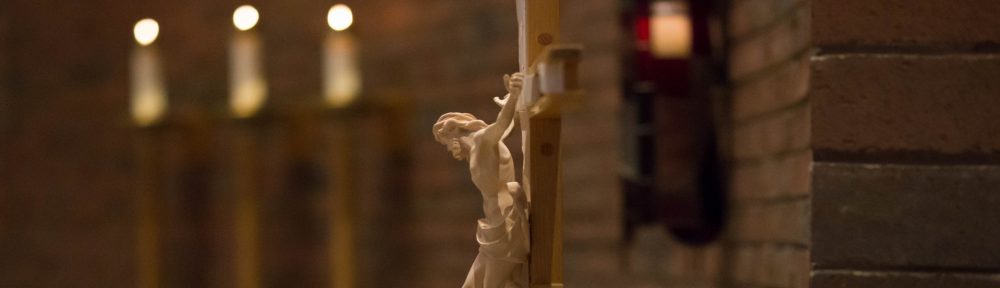
Indeed, the world may lose its landmarks. Favorite places and moments may disappear into the Gulf, maybe even becoming portraits on our dining room walls. But in the middle of all of it, the cross still stands, unmoved by this world’s winds and waves, untouched by time’s inevitable erosion. And that’s enough for me. I have everything I need in Jesus, which means I’ll have everything I need in 2026. My prayer is that He’ll be enough for you in the new year, too.
By the way, if your church doesn’t offer a New Year’s Eve service, stop by Our Savior Evangelical Lutheran Church in Hartland, Michigan. Ours is at 4:30 pm. For the record, I’ve never met anyone who was disappointed they went to church on New Year’s Eve.
 Cruciform Stuff