
New Year’s Eve 2025

I don’t know about you, but the older I get, the more New Year’s Eve loses its luster. It feels less like a party and more like a bedtime challenge. Can I make it to midnight? Can I even make it past 9:30? I think William Vaughn said it best, “Youth is when you’re allowed to stay up late on New Year’s Eve. Middle age is when you’re forced to.”

For the record, I stopped trying for midnight years ago, especially with a worship service in the morning. Still, the moment has never been lost on me. New Year’s Eve—the day itself—has always been a moment to pause. It can be sort of a held breath between what was and what will be, if only we’ll take the opportunity to consider it. Right now, I’m sitting at my dining room table. Even with a quick glance around the room, I’m reminded of just how quickly things can change.

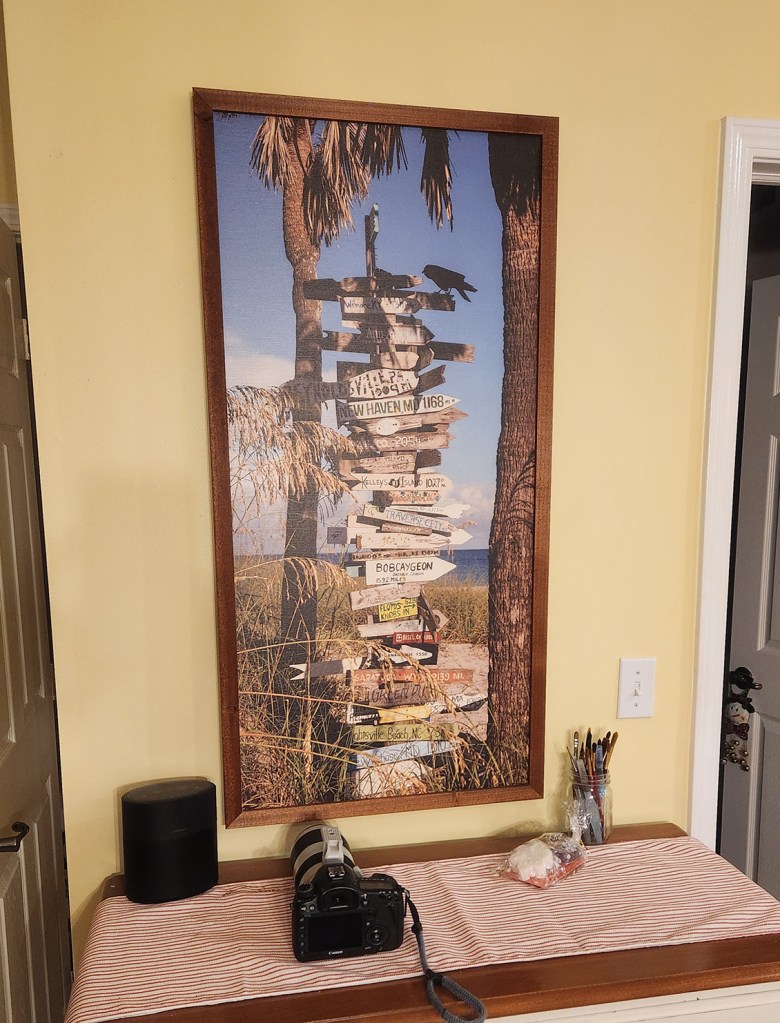
For example, right across from where I’m sitting, a poster-sized photo hangs on the wall. Jennifer snapped the picture. Essentially, she captured a moment we can never revisit.

The photo was taken on a beautiful, sun-washed day at a beachside restaurant near Lemon Bay, Florida—one we visited with some relatively newfound friends at the time who knew the place and loved it. In the image, there’s a wooden post planted in the sand with forty or so signs nailed to it, each pointing somewhere else—cities across the United States, and a few beyond its borders, all measured in miles from that very spot. A bird is perched on one of the top signs, palled by a nearby palm tree’s shadow. It’s as if the bird’s deciding which of the cities he’ll choose to visit next. The sky is bright blue, interrupted only by a handful of clouds. Everything about the picture feels calm, steady, and permanent.

But permanence is a lie we tell ourselves when the sun is shining and things are easy. Hurricane Ian erased everything in that photo back in 2022. The sign, the restaurant, the familiar stretch of beach, it was all pretty much gone overnight. It was reduced to ocean-soaked debris and memory.

That said, I can promise you, the Thoma family loves the image all the more, if only because everything in it is gone. In a way, it’s not just a photograph for us anymore. It’s a reminder that certain moments don’t ask our permission before they become history. We will never stand there again. We will never see that post in the sand exactly as it was. We’ll never be able to visit that restaurant and relive that moment.

New Year’s Eve has a way of turning our attention toward that same kind of truth. We look back at the year behind us and realize how much of it has vanished without much ceremony. I think of my dear Christian friend, Alex Bak, who died just before Christmas. We had recent conversations together that I never suspected would be our last. Like the signs near the beachfront restaurant, I lived as though Alex would always be there. I just assumed I’d always see Alex sitting in his same pew near the post on the pulpit side of the church’s nave. Indeed, plenty of other things have happened all around me that felt ordinary at the time but now feel sacred because they’re gone.

I suppose the point I’m trying to make is that time moves forward with or without my consent. The clock ticks with absolute indifference to my nostalgia.

But I have an upper hand on the clock’s cruelty. As a Christian, I know Christ is present in every moment. “Behold,” He said, “I am with you always, to the end of the age” (Matthew 28:20).

Everything we love in this world is fragile. I’ve been known to say from the pulpit from time to time that everything has an expiration date. Everything is subject to wind, water, decay, and time. But the thing is, Christ stands right in the middle of the storms. He’s a fixed anchor right in the middle of all our victories and losses. He’s unshaken and unchanging. He does not promise that the signposts will remain standing. He doesn’t promise that the forthcoming year and its moments will be gentle. But He does promise Himself. And with that promise comes the impenetrable truth of a kingdom that cannot be washed away, grasped by a hope-filled strength that does not weaken or erode.

So as 2025 becomes 2026, just as I won’t cling to the misapprehension that I can stay up until midnight, I won’t hold to the illusion that the coming year will somehow be free from struggle or loss. Time has cured me of that naiveté. There will be storms I didn’t see coming, moments I assumed would last that didn’t, and conversations I didn’t realize were final until they already were. But those potential realities are not hollow or hopeless when viewed through the lens of the Gospel. The calendar can change all it wants. Christ remains the same—yesterday, today, and forever (Hebrews 13:8).

Indeed, the world may lose its landmarks. Favorite places and moments may disappear into the Gulf, maybe even becoming portraits on our dining room walls. But in the middle of all of it, the cross still stands, unmoved by this world’s winds and waves, untouched by time’s inevitable erosion. And that’s enough for me. I have everything I need in Jesus, which means I’ll have everything I need in 2026. My prayer is that He’ll be enough for you in the new year, too.

By the way, if your church doesn’t offer a New Year’s Eve service, stop by Our Savior Evangelical Lutheran Church in Hartland, Michigan. Ours is at 4:30 pm. For the record, I’ve never met anyone who was disappointed they went to church on New Year’s Eve.
The Gentle Man

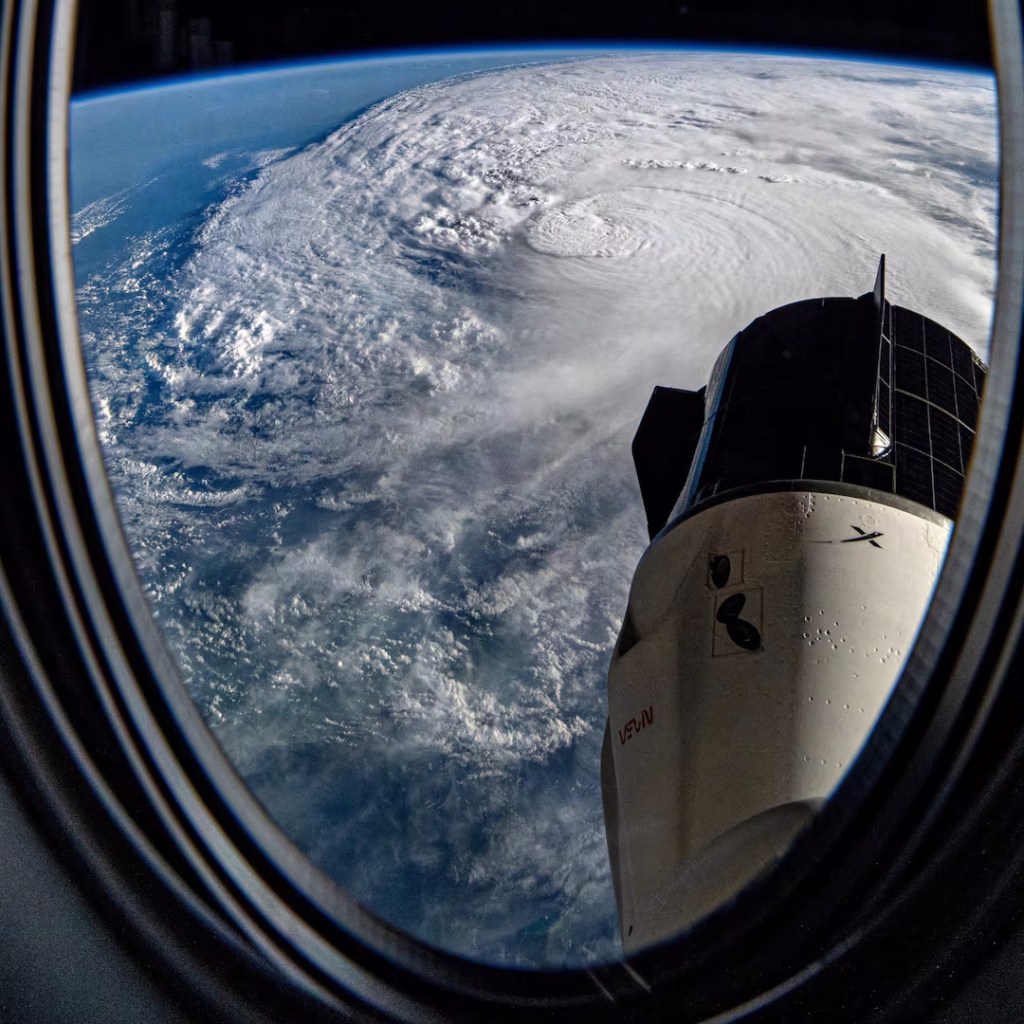
You likely need very little help from me to know the dreadfulness of Hurricanes Helene and Milton. From its center to its malicious extremities, Hurricane Helene was estimated to be 502,000 square miles in size. I did a little math. For perspective, that’s larger than France, Germany, and Italy combined. And then, with seemingly very little breathing room, Hurricane Milton—125,000 square miles of viciousness—tore through Florida in a little more than 24 hours. Thankfully, it weakened from a Category 5 to a Category 3 when it hit land. Nevertheless, it left more ruin in its obliterating wake.

I’m sure, like me, you were attuned to the events. I watched videos of the awful winds. I saw the overwhelming storm surges in Florida and swollen rivers sweeping away entire hillsides in North Carolina. I gave my fullest attention to the reporters visiting and describing the devastation. I listened to the tearful pleas from people who’ve lost everything in mere moments. And by everything, I mean family and friends. As of this morning, Helene claimed 260 lives. Milton took 17. It’s all very heartbreaking.

But there’s more to the story.

Even as the winds were still shaking walls and rattling glass, neighbors were helping neighbors. People were coming to one another’s aid. Everyday people cleared washed-out roads. Local business owners delivered generators. Strangers sheltered strangers from danger, giving them food, water, and a place to sleep.

All this happened long before FEMA arrived sharing online links to emergency loans to people with no internet access. All this continued even as Kamala Harris, the nation’s Vice President, went on Stephen Colbert’s show in full campaign mode for a “beer summit” and an opportunity to laugh about this and that, with no mention of the crisis. All this continued as President Biden, when asked by a reporter if the people in the storm zones were receiving the help they needed, fumbled to remember what the reporter meant by “storm zones.”

In all things political or civil, the ones who are so often piously “above it all” tend to lean on their favorite engagement escape hatch text, Psalm 146:3, which reads, “Put not your trust in princes….” In this case, they’re right to do so. The text refers to rescue. It refers to feeding the hungry and caring for the widows and the fatherless. Of course, the psalmist names God as the only trustworthy one when trouble strikes and needs are abundant. That said, Jesus told His listeners that when He returns in judgment on the Last Day, He will say to His believers, “Come, you who are blessed by my Father, inherit the kingdom prepared for you from the foundation of the world. For I was hungry and you gave me food, I was thirsty and you gave me drink, I was a stranger and you welcomed me, I was naked and you clothed me, I was sick and you visited me, I was in prison and you came to me” (Matthew 25:34-36). From there, Saint James offers rather straightforwardly concerning the Christian religion’s contours, “Religion that is pure and undefiled before God the Father is this: to visit orphans and widows in their affliction, and to keep oneself unstained from the world” (James 1:27).

To be clear, none of these things are teaching that salvation is dependent on our deeds. Good works are fruits of faith, and they are fully orchestrated by the Holy Spirit, who dwells in the believer (Ephesians 2:8-10). However, what we learn from these texts is that God regularly accomplishes the human care ascribed to Him in Psalm 146 through people. And so, I was by no means surprised to learn that neighbors were providing the initial and most crucial material and human resources, and in many cases, their help exceeded what the federal government was willing and able to provide. Where FEMA promised $750 to a hill-dwelling family to cover a catastrophic loss, churches both near and far, along with their denominational institutions, were already gathering funds to rebuild that same family’s home entirely.

Go figure. That’s what Christians do. We are the salt of the earth and the bright-beaming cities on this world’s hills. The deeds done are nothing more than the powerful glory of God at work through His people (Matthew 5:13-16).

I read very little modern fiction. However, someone who knows my appreciation for Lewis and Tolkien recommended I give Patrick Rothfuss a try. For the record, I probably won’t. Still, to investigate, I typed his name into Google. Along the way, I stumbled upon a potent quotation from his book The Name of the Wind. Rothfuss wrote, “There are three things all wise men fear: the sea in storm, a night with no moon, and the anger of a gentle man.”

That’s an intuitive sentence. The ferocity of nature, such as a stormy sea, is something a wise man fears because he knows its potential for danger. A moonless night of pitch-blackness provides cover for enemies and creatures we can’t see and yet would harm us. Therefore, a wise man avoids being out on such evenings. That same wise man also knows that when a person with an ordinarily gentle persona—someone from whom we’d only ever expect passivity and calm—when that person is moved to action, watch out. It’s likely an unstoppable conviction that’s driving him.

All of this prompts another thought. Well, actually, two.

First, I think we heard from the gentler man after the recent hurricanes. I think Helene and Milton juxtaposed the fire hose of billions of free-flowing cash to foreign countries with so many of our own citizens who couldn’t get the help they needed when they needed it. Because of this, I think the ordinarily quiet man is going to make himself heard in the forthcoming election. I think his voice will resonate long after. The hard truth is that people who just want to go to work, go to church, enjoy their lives and families, and all the things that a peaceful and dignified societal context provides are becoming frustrated. They don’t want to be forced to say a man is a woman when he isn’t. They’re tired of people like Gretchen Whitmer, Michigan’s governor, mocking sacred things like Holy Communion and then gaslighting them, saying what they saw is not what they saw. They’re tired of being forced to sit through DEI and CRT training at the office. They don’t want to feel as though they’re inherently and unforgivably racist because of the color of their skin. They don’t want their children’s teachers to indoctrinate them with confused sexual ideologies. They don’t want their parental rights stripped away. They don’t want their already exorbitant taxes to become monthly paychecks to illegal immigrants. They don’t want those taxes to pay for the same illegals to stay in posh New York hotels while their neighbors in North Carolina receive a few dollars during a disaster. They don’t want any of this.

Second, we heard another quiet man’s voice before, during, and after the hurricanes. We heard from those who live quiet lives of Christian conviction. Their faith proved capable of transforming fear into hope and ultimately showing a strength that could rival both the storms and the Federal government. Their Godly concern for genuine human suffering became a visible force that this sin-infected world and its princes just could not match.

I suppose Hurricanes Helene and Milton are reminders that while nature’s fury is something to be respected, there’s something else—or I should say someone else—far more awe-inspiring and worthy of our reverence: God. His rule has no limits, and His reign is forever, just as the Psalmist declared. More importantly, He cares. He is not distant. He’s close—closer than close can be. Faith knows that He’s so close that He’s often extending a helping hand through a friend or even a stranger. That moves us to thankfulness, first to Him and then to the agents of His manifested care.

Amid these current disasters, I’m not surprised the Christians have made an incredible showing. I bear Godly pride for my own Lutheran Church-Missouri Synod’s response. What a tremendous response from gathered Christians whose eyes are firmly fixed on Christ! But what else should I expect? That same Christ told us it would be this way. His servant, Saint James, did, too. God promised there would be people ready to step into the gaps—neighbors who would help when help was needed, who would ride out the storm while sheltering others through it, and then would remain in the aftermath to rebuild. We’re seeing this.

God be praised for His faithfulness!