
Musk, Depp, and the Final Court

There’s quite a lot happening in the news these days. Do you have some time this morning for thoughts on some of it? Go get some coffee, because I have a few.

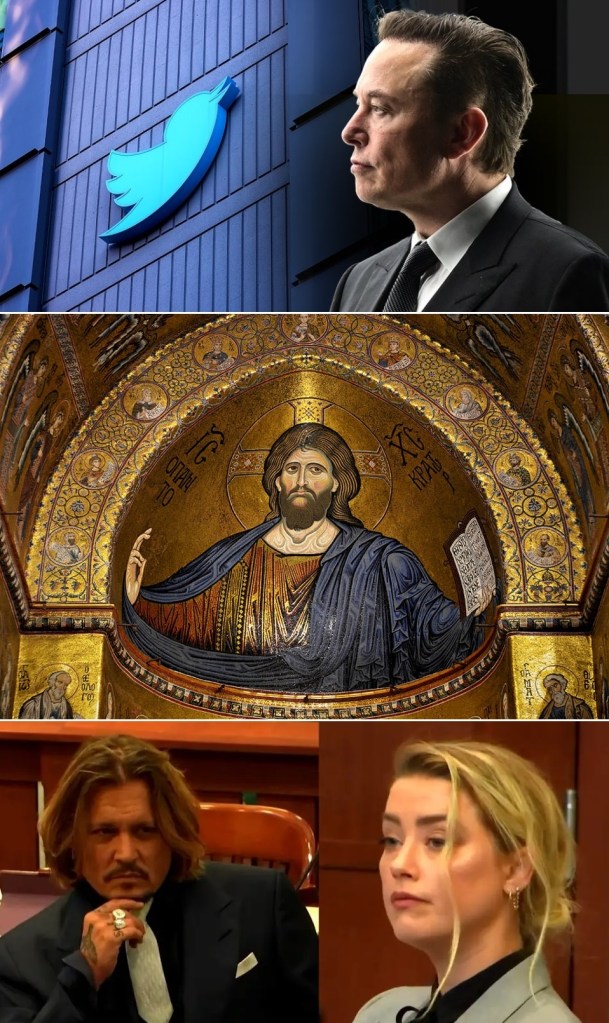
Elon Musk’s offer to buy Twitter was accepted. Admittedly, this was a bright-beaming ray of sunshine in my newsfeed. A few more beams poked through the dreariness of April’s war between chill and warmth when I saw the mainstream media folks throwing fits on live TV over Musk’s stated intentions, which were, essentially, that he wanted Twitter to be a true public forum for free speech. An important lesson here: the folks at MSNBC, CNN, and other such drivelous news agencies betrayed their ideological innards when they became enraged over Musk’s determination to halt the banning and shadow-banning of alternative points of view (namely, conservative viewpoints) so that genuine conversation can once again occur.

I mentioned online earlier this year—much to the repulsion of some—that I was starting to admire Elon Musk. This is one reason why. He may be eccentrically different from me in so many ways, and yet, he seems to have a good grasp of certain fundamentals that matter, one of which is the First Amendment. Yes, the Gospel will go forth with or without the freedom of speech. Still, the First Amendment is in alignment with Saint Paul’s concern in 1 Timothy 2:1-3, which includes engaging in the public square for the sake of maintaining a civil context that preserves the freedom to preach and teach Christ crucified. That being said, we should be on the side of anyone pulling for the First Amendment.

Interestingly, a few days after Musk’s purchase was announced, the Biden administration established the DGB or the “Disinformation Governance Board.” Hmm.

Political Commenter, Steven Crowder, pointed out another notable government in history that did the same thing: The Nazi Party. Crowder didn’t mention the Nazi board by name, but students of history will remember it as the Reich Ministry for Public Enlightenment and Propaganda (Public Relations). It was established in 1933, not long after Hitler came to power. Its stated goal was to “protect” Germans from disinformation. Joseph Goebbels was the ministry’s director. If you’ll recall, Goebbels was a principal architect of the “Final Solution,” that is, the extermination of the Jews. In other news, and perhaps strangely relevant, Holocaust Remembrance Day was this past Thursday in Israel. The whole country came to a literal standstill to remember the six million Jews murdered by the Nazi regime. I watched a video of the event. It was eerie; cars stopped on the freeways and their occupants standing outside the vehicles perfectly still. On the sidewalks, people stopped mid-stride, as if frozen. Maybe someone could do a quick PowerPoint presentation on this at the next DGB meeting.

Anyway, I could go deeper into this, but let’s just say for now that I hope Musk’s effort with Twitter is a success. What’s more, I may even rejoin the platform. I left Twitter a few years ago not only because I was being shadow-banned, but because Twitter was taking it upon themselves to delete my followers. I had several thousand, and then one day the number was cut by half. The very next day, the remaining followers were cut by half, again—and so on. On top of that, the “cancel” brigades were becoming exceptionally wily with my account. Believe it or not, the final straw for me was when Donald Trump’s account was permanently canceled, while Ali Khamenei, the supreme leader of Iran (and visceral sponsor of global terrorism and hatred toward America and Israel), his account was preserved. It remains to this day.

I’m also hoping that what Musk is doing with Twitter makes the folks at Facebook at least a little bit contemplative, if not nervous. Facebook owns Instagram. Right around the time I left Twitter, I was permanently banned from Instagram for posting a meme that stated men are men and women are women. Someone reported my post as hate speech. I was jettisoned from the platform. I tried opening another account a few weeks ago, but somehow, they knew it was me. I received messages reminding me I’d been banned permanently for violating platform policies.

I’m not so worried about this stuff, which I’ll get to the reason for in a moment.

So, what else is in the news?

Well, believe it or not, I’ve also been following the court case between Johnny Depp and Amber Heard. I don’t normally care all that much about celebrity trials, however, this one caught my attention. Why? Because while we hear so much about abusive (toxic) masculinity (i.e., the “Me Too” movement, and other default mantras), Johnny Depp was insisting on an alternate narrative. After a bit of reading, my gut began telling me we were finally seeing a man in Hollywood push back against abusive femininity. Having listened to several hours of the broadcasted trial (which is far less than the content of what I’ve read), I’m definitely rooting for Depp. He isn’t perfect by any means. He’s wrestled with drugs and alcohol. He’s been a neglectful father on far too many occasions. Admittedly, He’s been a lousy husband. But among these things, he’s never been one to abuse a woman. He appears to be the kind of man who, when verbally and physically abused, will never respond in kind—even if it means being belittled daily or having one’s fingertip sliced off.

Heard, on the other hand—someone who was known by her bodyguards to destroy Depp’s personal belongings, put feces into his bed, and whose friends testified that she hit them, too, for seemingly no reason—has been tested psychologically and deemed quite the opposite. I’m not surprised. Her documented behavior is hard to explain away, no matter how skilled the attorney may be. Perhaps worse, a recording played before the court proved her willingness to abuse Depp all the while hiding behind the current Hollywood (and dare I say, worldwide) mentality that men are, by default, toxically abusive and overlording. Heard’s recorded words were chilling. She implied that everyone would believe her before ever believing Depp simply because he’s a man and she’s a woman. In other words, he should just expect by default that her testimony would be considered true and his would not. She accentuated her arrogance by insisting that no judge or jury would ever side with a man in such a case, saying, “Tell the world, Johnny, tell them ‘I, Johnny Depp, a man, I’m a victim, too, of domestic violence… And see how many people believe or side with you.” When asked by his lawyer about his response to Heard’s taunting, Depp said rather simply, “I said, ‘Yes, I am.” What he meant was that he was, in fact, a man who was also a domestic abuse victim.”

Depp’s lawyer described Heard’s behavior as gross bullying—the kind that was only fed by Depp’s already burdensome sadness over his failings. It reminded me of Publius Syrus’ words: “Cruelty is fed, not weakened, by tears.” Indeed, Depp was already hurting. Heard used the tears of that hurt to increase her cruelty’s potency.

Shannon Curry, a clinical psychologist, testified against Heard using the term “code 36” to assert she has a personality disorder. Curry described this code, saying, “The 36 code type is very concerned with their image, very attention-seeking, very prone to externalizing blame to a point where it’s unclear whether they can even admit to themselves that they do have responsibility in certain areas.” She went on to say Heard is self-righteous, judgmental, and full of rage, with all these characteristics emerging from a deep, inner hostility. I think one place to see this is in the difference between Depp’s defamation suit and Heard’s countersuit. Depp is suing Heard for $50 million, which is what he believes he’s lost as a high-profile actor now considered toxically unemployable by most film studios. Sounds fair. Heard, however, is countersuing for $100 million, which is Depp’s total worth. In other words, Depp wants justice. Heard wants to completely decimate Depp. When someone can’t just walk away, but rather seethes with the desire to destroy another person’s life completely, that speaks volumes about what’s going on inside them.

As I said, I’m rooting for Depp. Equally, I’m hoping that the judge mandates for Heard to get treatment. Although, narcissistic personality disorders like hers are hard to cure, mostly because the one bearing them typically refuses to admit to needing help. Either way, and as I like to say on occasion, “The divine lights always come on in the end,” which means, do and say what you want now, but remember, the time will come for settling scores. That’s why I mentioned earlier that I’m not so worried about being slighted or maligned. God, namely, Christ Himself, will be the Pantocrator occupying the bench in the only courtroom that matters. It’ll be just as the Creed declares: “And He will come again with glory to judge both the living and the dead, whose kingdom will have no end.” He’ll settle things according to His standards, not ours. And no matter how right anyone thought they were, His “right” will be the final rule of measurement for all things and all people of all time.

That might sound scary to some. It probably should. That’s the benefit of God’s generous forewarnings. However, it doesn’t have to be menacing. Through trust in the person and work of Jesus Christ, believers can only ever be found guilty of one thing: saving faith. Jesus said as much in John 16:8-11 regarding the work of the Holy Spirit. He mentioned that when the Holy Spirit comes, He will bring three distinct counts of conviction. Jesus said the Spirit would convict the world “concerning sin and righteousness and judgment…” (v.8). The conviction in sin is an easy one. Jesus explained this will happen to those who “do not believe in me” (v. 9). In short, unbelievers remain trapped in sin. Skipping ahead to the last one mentioned—judgment—the Lord takes direct aim at the devil, saying that we can count on final judgment being leveled against Satan once and for all. It’s right in between verses 9 and 11 that the Lord says the Holy Spirit will convict “concerning righteousness, because I go to the Father, and you will see me no longer” (v. 10). In other words, we can’t see Jesus, and yet, we believe. These words Jesus is speaking on Maundy Thursday sound an awful lot like the ones He spoke to Thomas a few days later on Easter Sunday:

“Jesus said to him, ‘Have you believed because you have seen me? Blessed are those who have not seen and yet have believed’” (John 20:29).

The points here: Firstly, saving faith is only possible by the power of the Holy Spirit. Secondly, on the Last Day, all believers in Christ will be accused and found guilty of faith in Jesus before the highest court in heaven and earth. And so, if you’re going to be convicted of anything before God, let it be that.

Between you and me, knowing my many failings, I’m counting on God’s justifying promise found in the life, death, and resurrection of His Son, Jesus. Confessing my sins and clinging to His righteousness, even as things could be rough in this life, I know everything is going to be okay for the next when the divine lights come on and all is revealed.
Apologizing to Thomas

There is the rather elementary saying that one thing leads to another. It’s elementary because it’s true, and I have the perfect example to share.

You may or may not know this, but I’m a fan of 80s and early 90s sci-fi and horror films. I’ve seen them all, both the A and the B list—from Academy Award winners like “Silence of the Lambs” to straight-to-VHS gems like “Attack of the Killer Tomatoes.” Watching them now, I have to say that many are still very good. They’ve stood the test of time. Others were trash before they ever became a script, and they remain trash long afterward. The special effects were terrible, often intentionally. The dialogue was just as bad. It’s easy to tell that many were made just to be made. Trust me, “Friday the 13th” could have been put to rest after “Part IV, The Final Chapter.” Still, they gave us seven more and an attempted reboot. The same goes for the “A Nightmare on Elm Street” series. “Dream Warriors,” the third movie in the series, was the last of the franchise’s serious attempts. But the thing is, even the cringe-worthy sequels remained great fun. Their hokeyness only made the good films seem better.

Not long ago I was watching a documentary series called “The Movies that Made Us.” One episode focused on James Cameron’s masterpiece “Aliens.” Anyone who’s been in my basement will confirm the film as an absolute favorite of mine. I mean, it did win seven Academy Awards, one of which was for best visual effects.

Anyway, after watching the documentary, I did a little reading about James Cameron. In comparison to his accomplishments, I was fascinated with his beginnings. Interestingly, after seeing “Star Wars” on the big screen, he was inspired to leave his job as a truck driver and take aim at making movies in Hollywood. Personally, I’m glad he took the chance.

Reading about his life, I came across a TV interview he did with a California news station in what I believe was the early 2000s. During the interview, he said something along the lines of, “If your goals are set ridiculously high and then you fail, you’ll already be well past everyone else, having failed well above everyone else’s successes.”

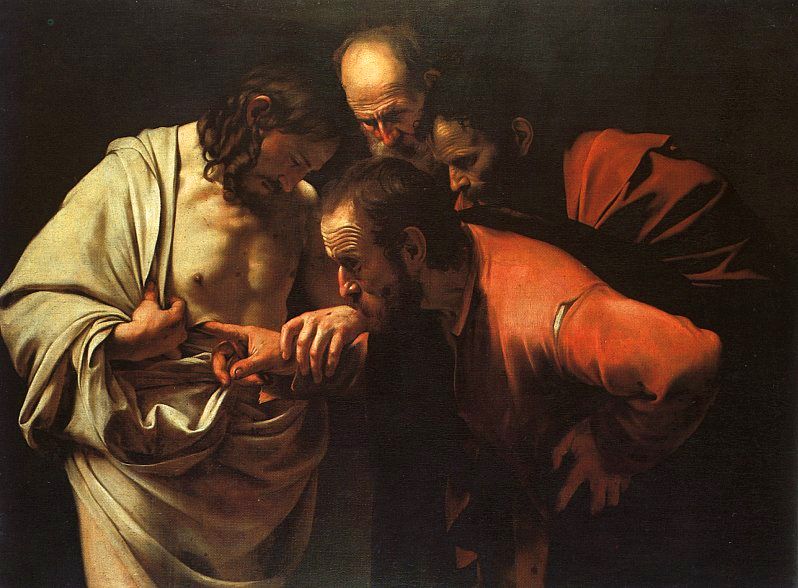
Remember how I said one thing leads to another? Well, here’s why I said it. That comment reminded me of the disciple Thomas. By the way, apart from Jesus, Thomas is the most important character in the resurrection narrative from John 20:19-31, which is also the appointed Gospel reading for the Second Sunday of Easter. Essentially, Thomas is the one who continues even now to get a bad rap for doubting the Lord’s resurrection. But the thing is, his seemingly greatest failure was far above the successes of everyone else in the bunch. Here’s what I mean.

All the disciples deserted Jesus. Peter denied the Lord. Still, it would appear that after the crucifixion and burial, all but Thomas were gathered together in the upper room. The narratives say this happened because the disciples were afraid of what the Jews would do to them, too. But where was Thomas? I’m willing to bet that the answer is assumed by the ease with which the disciples retrieved him after the Lord’s first resurrected appearance among them. They went to where they knew they’d find him—at home. Thomas went back to his life, apparently having already accepted his fate concerning a failed messiah.

But Jesus hadn’t failed. And so, the disciples went to Thomas to tell him the Lord had risen. What were Thomas’ words in reply?

“Unless I see in his hands the mark of the nails, and place my finger into the mark of the nails, and place my hand into his side, I will never believe” (John 20:25).

These words prove Thomas’ failure was well above everyone else’s successes. While everyone else was stowed away in fear and asking questions bent on self-preservation, Thomas had subscribed to his fate. But he did this bearing the embers of a faith that was asking for the only proof Jesus had ever promised to give. In other words, Thomas knew (whether consciously or subconsciously) that his faith could only be rekindled when he met a living Jesus with crucifixion wounds.

I was asked a few weeks ago who I’d like to meet first in heaven. Apart from the Lord Himself, and then my brother, I hope to meet Thomas. I intend to apologize to him on behalf of any human in history who ever used the title “Doubting Thomas” to describe him. Indeed, Thomas’ failure was well above the rest of our so-called successes. In the darkest hour of Good Friday and Holy Saturday’s deepest confusion, Thomas was asking the right questions. Everyone else was asking for personal safety. Thomas was asking to see the One who would eventually say by Revelation 1:18, “I died, and behold I am alive forevermore, and I have the keys of Death and Hades.” He believed as Saint Paul would eventually preach foundationally: faith in Christ crucified and raised (1 Corinthians 1:23, 15:1-26).

If only we could be as clear-sighted for receiving the risen Christ as Thomas, who is also the same one who gave what is perhaps one of the most moving confessions of joyful faith ever recorded in the scriptures. When Thomas took the strangest of chances at rejoining his fellow disciples in the upper room, the Lord gave Thomas what he asked for—the opportunity to touch His wounds. And again, what were Thomas’ words?

 “My Lord and my God!” (John 20:28).

I dare say that as we so often live our lives beneath a shroud of deeper doubt than even that of Thomas, not trusting that the Lord will care for us as He’s promised, there will come the day when the Lord shows us His wounds in the glories of heaven—wounds that will forever be the proof of His triumph in and over all things. I’m guessing there’s a good chance we’ll sound a lot like that one disciple with the millennia-long bad reputation.

They Saw Jesus

He is risen! He is risen, indeed! Alleluia!

There is a special sort of energy to this saying, isn’t there? When a believer says it, there is a sense of the world spinning in the opposite direction, as if what was once undone is now being turned back, as if our view of Eden has become a little less blurry.

Amen. The resurrection of Jesus changes everything.

“He is risen” is the cheering of the Church of all ages. She sings out to the world in praise of her Savior who died, and yet, did not fall short of His goal, no matter the apparent dreadfulness of the Good Friday wreckage. Jesus gave Himself over into Death. He did it willingly and without our asking. He turned His face toward the events with an unmatchable steadfastness, and like a juggernaut, He could not be stopped. He pressed through and into Death’s deepest hideousness, ultimately defeating it for all time from the inside.

Saint Paul makes clear for those who may still be wondering what the resurrection has to do with God’s plan of redemption, saying, “The last enemy to be destroyed is death” (1 Corinthians 15:26). He says this so his readers will know there’s nothing left to be accomplished between sinners and God. Christ has done it all.

How do we know? Indeed, Paul warns of the concern if Christ hasn’t been raised, having already announced, “And if Christ has not been raised, your faith is futile and you are still in your sins” (15:17).

But Christ has been raised. Paul is a witness. And not only Paul but hundreds of others were visited by the bodily-resurrected Jesus (15:3-8). Would Paul lie? Would he trade his life of promise and ease for prison and execution? Would they all lie? Would they all be able to maintain such deception, keeping the story straight among such a large number? Perhaps like Paul, when the lives of these firsthand witnesses, and the lives of their families, were found teetering at the edge of grisly death, with their only safety being found in recantation, would courage built on a lie be able to see them through the moment?

Of course not, because they saw Jesus.

So, rejoice. It’s all true. Christ is risen, and your Easter faith is secure. You have staked a claim in the Lord who faced off with Death and won. His labor removed your Sin, and His resurrection victory justified you before the Father (Romans 4:25), granting to you the first-fruit spoils of eternal life (1 Corinthians 15:20).

God bless and keep you in this peace, not only today but always.

Sure of His Courage

There is the saying that goes something like, “Until it matters, no man can be sure of his courage.” I appreciate those words. Indeed, one can hardly be considered courageous from ease’s protective tower. Knowing this, I suppose that’s why each year on Good Friday, the words by the Gospel-writer Mark to describe Joseph of Arimathea are piercing. Each year they find their way deeper into my contemplation of the Lord’s sacrificial death on the cross.

It’s not long after the Lord’s final breath that we read:

“And when evening had come, since it was the day of Preparation, that is, the day before the Sabbath, Joseph of Arimathea, a respected member of the council, who was also himself looking for the kingdom of God, took courage and went to Pilate and asked for the body of Jesus” (15:42-43).

Why are these words so resonant? Because they describe a man who, for the most part, has kept his faith in Jesus an unchallenged secret. And why would he do this? Because as a member of the Sanhedrin—the primary human force in opposition to Jesus—Joseph knew what would happen to him if it was ever discovered. He and his family would be utterly undone economically, socially, and religiously. But then suddenly, none of these things appear to matter anymore. Mark writes that Joseph “took courage,” having been moved to act beyond the boundaries of his fears and request custody of the Lord’s body from Pilate.

What caused this? He witnessed the death of His Savior, Jesus.

The actual deed—the very intersecting act of God’s redeeming plan in this world—that’s what sits at the heart of faith. Joseph saw it. Whether or not he fully understood what had happened, it would certainly appear that his faith knew the significance of the gory details. In that moment, his faith became a daring powerhouse more than ready to flex the divine muscles the Holy Spirit had granted it. It moved him to go before Pilate and do something that would very soon thereafter become public knowledge.

What does this mean for us?

If anything, it means none of us ought to take Good Friday for granted. It means there’s something to be said for a day that’s spends itself thinking on the epicentral event of our Lord’s work to win us back from Sin, Death, and the power of the devil. It means if ever there was a day for doing something that might unmask our oft-hidden commitment to Christ—such as missing an extra-curricular activity or asking for time off from work to attend worship—Good Friday is that day. In one sense, that’s what the Greek word for “took courage” (τολμήσας [tolmēsas]) insinuates. At its root, it means to take a chance, to dare, to be bold in a way that lowers one’s defenses, maybe even in a way that provokes evil to attack.

Joseph took courage. He did this knowing that to do so could result in trouble. But he did it, anyway. Maybe you can, too. You certainly have less to lose than Joseph, even if only to give up some time to attend one of the two services occurring here at Our Savior in Hartland, Michigan. The Tre Ore service occurs at 1:00pm, and the Tenebrae service is at 7:00pm. I’m preaching at both, and I can’t wait to do so.

God bless and keep you by His grace.

Credibility

I coined a phrase a few years back, one I’ve never heard anyone else say. Since its realization, I share it with regularity among the students in my theology and catechetical classes, both young and old. It almost always comes up while studying the 8th Commandment and its explanation in Luther’s Small Catechism.

Before sharing it with you, I think the best way to tee up the phrase’s instantaneous formation in my mind is to compare it with the process of information transference in the film “The Matrix.” If you’ve seen the film, then you’ll know what I mean. In one scene, Neo doesn’t know Kung Fu. In the very next, he’s a Kung Fu master. Everything necessary was instantaneously downloaded to his brain.

In my case, the phrase came to me in the middle of realizing a troubling situation had grown beyond my abilities to solve it. All along the way, my intentions were good, even Godly. I had followed the Word of God the best I knew how. I’d maintained confidences. I’d spoken to the right church leaders. I’d reached to both friend and foe alike through steady communication, all along the way doing what I could to navigate toward peaceful shores. But things didn’t work out as I’d hoped. The harder I tried, the worse things seemed to get, eventually coming undone altogether. As it would go, there was one moment when I knew I’d become infected by the undoneness.

It happened in a small meeting room in our school. It involved me and three other people. In short, what started as a calm conversation became heated, and at one point in the fray, a rather nasty word was used to describe my wife, Jennifer. Almost without hesitation, I rose from my seat, put my finger in the face of the person who’d spoken the word, and with a shout, I warned that if such a word used to describe my wife ever passed through the lips of that individual again, the results would be unforgettably severe.

In all my twenty-three years in ministry, that was the first and last time I ever lost my cool and shouted at anyone.

Unfortunately, the room and its uninsulated door are along a primary thoroughfare for church and school staff traffic, and it just so happened that a longtime staff member was passing by the room. Having no idea what I said or why I said it, but only that it was me who was shouting, the word spread quickly among my detractors, serving as evidence that I was a ruthless dictator more than capable of measuring the pastoral office against others in a threatening way. Less than a day later, when I realized what that single moment had produced among the people I was attempting to bring to repentance, a thought surged into and through me as if I’d touched an electrified wire. I was alone in my office when I heard my voice say as if in conversation, “Chris, your reputation is the only thing you own that everyone else keeps for you. Guard it.”

Since that moment, I fight for my reputation and the integrity that underpins it as if they were gold. Say something nasty to me. No problem. Post derogatory comments about me across the span of social media. I’ll brush it off and continue forward. But recast my credibility in a way that undermines my ability to serve, and things are going to get rough between us. Why? Well, not only because God’s Word describes pastors as ones who must be above reproach (1 Timothy 3:2), or because one of the lessons I’ve learned in ministry is that the people willing to exert energy in this way must be dealt with firmly, but primarily because, as I already said, if my credibility becomes questionable, who am I to bring God’s authoritative Word of correction to anyone? For example, who am I to say that shouting at someone in anger is sinful if I live my life doing the same thing? With that, I’m a firm believer that one’s credibility is tied to his or her own integrity; or as I was moved to write on social media this past week in response to Will Smith smacking Chris Rock, “An act’s integrity is relative to the moral soundness of the one performing it.” I wrote this because Will Smith hit a man who insulted his wife, Jada. And yet, Will Smith lives in an open marriage, meaning he and Jada allow one another to have sex with others. Because of this, I’d say Will Smith has very little credibility when it comes to defending his wife’s honor.

This is an incredibly important thing for all of us to consider as sometimes we, too, discover ourselves required to rebuke someone else’s behavior in defense of what’s right. What’s more, it has me thinking about something else.

Do you remember that commercial from the 80s in which a mother shouts at her son after discovering drug paraphernalia in his room? Essentially, she asks him in a rage where he got the stuff, but more importantly, how he learned about any of it. Frustrated by her hypocrisy, the boy shouts back, “I learned it from you!” The camera then pans and refocuses on her bedroom, revealing a bag of marijuana beside an ashtray full of ashes. For as hokey as the acting in the commercial was, the message was stingingly true. If you’re doing it, you have no credibility for dissuading a child from doing it, too. And this matters to more than just drug use. If you are willfully living together with someone outside of marriage, don’t be surprised or angry if your child does the same one day. And if you try to dissuade them from doing it, what can you say to them when they reply, “I learned it from you”? Not much, that’s for sure. The list goes on from here. If you swear a lot, don’t be surprised or angry when your children swear a lot, too. If you speak abusively to your spouse, don’t be shocked when your daughter-in-law reveals the man she married, your son, is verbally abusive to her.

By now, I’m guessing that some, if not all of you have already whispered to yourself something that sounds a little like, “But I’ve done these sorts of things, so what credibility do I have for steering anyone else toward what’s right?”

Well, the answer to this is relatively simple. When your sinful deeds are your only history, then you have no credibility. However, when through confession and absolution your sins are snatched away from you for all time, having been instantaneously consigned to the shoulders of Christ through faith in His sacrifice on the cross, you are no longer who you were before. Things begin again. You are remade. Or better yet, re-created as one whose credibility is not his or her own history, but Christ’s. Such newness has no baggage, at least nothing God could ever conjure up to use against you. Don’t believe me? Listen to the Psalmist speak of God’s forgiveness in a remarkable way, saying, “As far as the east is from the west, so far does he remove our transgressions from us” (103:12). Just as potently wonderful, God reminds us by His Word that when He forgives us, He also forgets the sins completely (Hebrews 8:12). Do you know what that means? It means that the only way for God to recall them will be for us to remind Him. And why? Because He looks upon us through the blood of His Son. He sees us adorned in the white baptismal garment of His love fashioned from the threads of the Law-fulfilling credibility of Christ’s perfect righteousness (2 Corinthians 5:21; Galatians 3:27; Revelation 7:14).

Knowing this, no matter what you’ve done, through humble contrition met by God’s mighty redemption, you can say to an onlooker accusing you of having no credibility due to the same sins, “I was wrong. I shouldn’t have done that. It was a sin against God and the ones involved. I know this. Thanks be to God that my Lord paid the price for this and all my failures by His death and resurrection. Now, by the power of His Holy Spirit, I want to be faithful to Him. This faithfulness moves me to want to warn you from falling into the same destructive traps I fell into. I don’t want that for you in the same way Jesus doesn’t want that for you.”

Believe it or not, such a confession can be disarming.

Of course, even such sincere communication might not win the heart of someone holding tightly to his or her transgressions. Trust me, I get it. And yet, that’s where the right handling of God’s Word, the divine courage promised to believers by that same Word, and the viscera for trusting that God will bless your efforts for faithfulness all come into play.

I need to remind myself of this regularly, especially as one who works to guard his own credibility with ferocity. The fact remains that no matter how hard I try, I won’t always succeed. I’m a sinner. But through genuine confession resulting in absolution, the script gets flipped and I can keep on keeping on. As I do, I know there will always be people out there laboring to defame me, doing all they can to bring me into the same state of despair and lostness in which they dwell. In the end, I don’t have to take it sitting down. But I also know that no matter what happens, ultimately, God’s forgiveness cements my credibility to Christ. With that knowledge, my work becomes less about trusting myself, and more about being confident in Christ, the One who’s always running point. From my perspective, that’s an impenetrable place from which to launch an offensive against this world and its terrible armies.

I’m Not Buying It

I probably shouldn’t admit to it, but I’ve been watching TV, mostly Netflix, far more than I should these days. Honestly, I should be working on homework, or perhaps, looking ahead to the sermon texts for Holy Week and Easter. I have a couple of papers coming due at that time, so it would be wise to get a jumpstart on sermon preparation. The problem is, by the time I roll into the garage most evenings, the level of my zeal only seems capable of a routine involving a two-finger pour of whisky, a seat beside Jennifer, and an hour-long visit before bedtime with TV shows of the past.

For the record, our current reminiscence is Knight Rider.

I loved Knight Rider as a kid. Watching it now, I can attest to the terrible acting, not to mention the very little effort that appears to have been placed on the scripts and special effects. Apart from the real reason Jen and I have gravitated toward such shows, we’re also watching them for amusement. The dialogue is hilariously hokey. The storylines are riotously worse. And as I hinted, the special effects are often laughable. Take for example a particular scene that sees K.I.T.T., the artificially intelligent car, driving itself into a parking lot. As K.I.T.T. comes to a stop beside Michael Knight (played by David Hasselhoff), it’s easy enough to see that the car isn’t driving itself, but instead, the driver’s seat has been removed, and a man dressed to look like the seat is in its place. The man’s hands can be seen on the steering wheel.

Jen and I rewatched and laughed at that scene a few times.

In another episode, Michael gets shot in his left shoulder. While pursuing the bad guys, he covers the wound with his right hand. The scene shifts to the dashboard as K.I.T.T.’s blinking voice indicator encourages him to go to the hospital. The scene turns back to Michael still nursing the wound, except now it’s on his right shoulder and he’s using his left hand.

We re-watched that scene a couple of times just for fun, too.

I suppose apart from the humor, nostalgia is the real reason we started watching the show. We long for the days when television scriptwriters, directors, and producers knew better than to allow certain words or behaviors to be portrayed as normal. We miss the time when shows had a clearer understanding of right and wrong, truth and untruth, good and evil. I say this thinking that perhaps like me, you were troubled by the news that a man won the women’s NCAA 500-yard freestyle championship. Yes, you read that sentence correctly. A man won the women’s title. And by the way, a man won the distinction of USA Today’s “Woman of the Year.” Yes, you read that sentence correctly, too. And so, how are these things possible? Well, Lia Thomas (formerly Will Thomas) and Rachel Levine (formerly Richard Levine) are both transgender females. Or is the term “transgender male”? I don’t know, anymore. It’s becoming rather difficult to keep pace with the latest wokisms being imposed upon us by this Sin-sick world.

But for all I don’t understand, what I do know is that Lia Thomas, someone who is dominating women’s competitive swimming, and Rachel Levine, Joe Biden’s first and favorite choice for Assistant Secretary for Health, are both biological males in every way. For starters, I can say this because when Thomas and Levine die, if their mortal remains were ever exhumed, two male skeletons would be discovered. How do I know this? Because, apart from the fact that these two men’s biologics are written into every bit of their DNA (the distinction being that male DNA contains one X chromosome and one Y chromosome, while female DNA contains two X chromosomes), but also that without some seriously inventive reconstructive surgery, a male’s bone structure is very different from a female’s. In other words, gender isn’t a system of belief. It is an objective, biological fact, no matter the clothes worn, or the hairstyle donned.

You may dress yourself to look like the seat of a car, but you aren’t a car’s seat. You need special effects and the world of fantasy to be a car’s seat.

Interestingly, Joe Biden’s Supreme Court nominee, Judge Ketanji Brown Jackson, was asked this past Tuesday by Senator Marsha Blackburn, “Can you provide a definition for the word ‘woman’?” Jackson’s answer: “No, I can’t. I’m not a biologist.”

Three quick observations in this regard. Firstly, Jackson is a woke progressive Democrat. There’s no hiding that fact. She’s on record for stating such things rather proudly. Secondly, if the term “woman” is undefinable to anyone other than biologists, then how do we know for sure she holds the honor of being the first black woman nominated to the Supreme Court? Even further, why is everyone everywhere using feminine identifiers like “she” and “her” when referring to her? Lastly, for as much as she wants to allow for truth to be anything to anyone, her answer affirmed gender is rooted in biology rather than an individual’s perception of “self.” If it weren’t this way, her answer would’ve been, “No, I can’t. I’m not a psychiatrist.”

Still, Thomas and Levine continue believing themselves to be women, which, as it meets with basic human autonomy, is tolerable to some extent. I suppose this is true in the same way that mental illnesses must be mildly accommodated during treatment. However, the problem is no longer that they’re convinced of something that isn’t true, but that they’re insisting the rest of us believe and live according to this untruth, too. Thomas has imposed his fantasy upon the entirety of women’s sports to the detriment of genuine female athletic achievement. Levine, on the other hand, has not only forced his fantasy on the entire nation, but as one of the first-face representatives of health science, he embodies the acceptance of pseudoscience. Perhaps worse still (albeit expected), the LGBTQ militia, along with its compliant voters and media, are jackbooting through America insisting that we allow ourselves to be assimilated into the mental constructs of these two very confused men. And if we refuse—if we speak up, if we push back, if we share opinions counter to the acceptable ones—we’re labeled as loveless bigots worthy only of cancellation. You should read some of the things that have been written about Senator Blackburn since Tuesday’s hearing. It’s telling if not also frightening.

For the record, I’m not buying into it. I discourage you from buying into it, too.

Last Sunday was a powerful day for understanding this here at Our Savior, especially considering the Epistle lesson from Ephesians 5:1-9, which is a text that doles out uncomplicated instructions to Christians for handling situations of sexual immorality. After six descriptive verses, in verse 7, Paul speaks prescriptively:

“Therefore do not associate with them.”

In the Greek text, the word translated as “associate” is συμμέτοχοι(symmetochoi). However, I’m not so sure “associate” is the best interpretation. συμμέτοχοι means “co-partaker.” “Associate” conveys a simple connection to someone or something, but συμμέτοχοι implies a link that includes willful engagement and active participation.

Verse 7 sounds like Saint Paul’s way of saying, “Don’t buy into it.” I’d say he gave us a hint to his seriousness in this regard when he back in verse 3 that sexual immorality “must not even be named among you.” The word for “named” is ὀνομαζέσθω (onomazesthō), which carries the sense of not even mentioning such things out loud. Paul wants Christians to stay as far from sexual immorality as is humanly possible, which means we shouldn’t even leave the slightest impression we might be okay with it. Instead, we are to give a clear enunciation of truth while also making an effort to bring the errant back into the boundaries of God’s moral and natural laws. Paul aims in this direction for a reason. Right after warning against being co-partakers, he reminds Christians in verses 8 and 9:

“For at one time you were darkness, but now you are light in the Lord. Walk as children of light, for the fruit of light is found in all that is good and right and true.”

Paul’s words echo the words of Jesus in Matthew 5:14-16. He teaches that because of who we are in Christ (Matthew 5:14-16), we can bring the light of goodness, rightness, and truth right into the middle of the darkness. Continuing to verse 11, we hear Paul add:

“Take no part in the unfruitful works of darkness, but instead expose them.”

It’s not a Christian’s role to be silent, but rather we are called to expose the darkness. How is darkness exposed? Light. When the lights are shining, darkness is dispelled. When the lights are hidden, darkness maintains its grip.

The photo I’ve shared here, especially the uppermost image, hints at everything said so far. In it, the three young ladies who competed against Thomas have elected not to be associated with Thomas’ meritless victory. I like that image a lot. I may even get it framed. Why? Because these girls have earned my respect. Risking their reputations, they’ve communicated the difference between right and wrong in a stunningly visual way. They’re not being cruel. They’re not being bigoted. They’re conveying truth adorned with smiles to a confused and erring media that’s applauding a confused and errant man.

I’m hoping these girls, their families, and all their friends will continue along in stride with Saint Paul’s words, eventually finding the courage to put their concerns into words.

I ask the Lord for this courage almost every day. I ask Him regularly to provide the same courage for you, too. I know so many of you are enduring challenging situations in your own families, friendships, and workplaces. As you stand in the middle of these things, I pray the Lord will strengthen you to be lights in the darkness, not seeking to disown anyone, but instead, to beam brightly for all the truth of God’s Law and Gospel—both His loving warning against Sin and His incredible promise of forgiveness and restoration through faith in Jesus Christ.

Sinner and Saint

I finished a book this past week by Andrew Murray entitled Humility: The Beauty of Holiness. It was an interesting read, although not necessarily one I’d likely recommend. My reason for dissuading you is not because the book had nothing to offer, but rather, I feel as though the author spent the energy of his zeal in some of the wrong places. It seemed that every time he got close enough to see Calvary—the truest image of God’s love and the demonstration of His humility—he jerked away from it to a synergistic interpretation, implying that Jesus was merely demonstrating something He wanted us to emulate in order to cooperate in our eternal rescue.

But that’s not what the events of Calvary were about. Jesus was accomplishing there what we could never accomplish. And to think that somehow we might be able to cooperate in any way that might compare with the salvific work of the Son of God on the cross is a gross miscalculation, a miscalculation that will have dire consequences, one of which is the dreadful pall of uncertainty regarding our eternal future.

How will we know if we’ve done enough? How will we know if we’ve held up our end of the agreement?

Admittedly, there are plenty of aspects to the Christian Faith that Jesus wants us to demonstrate. Humility is one of them. Love is one of them, too. In fact, He demonstrated both in a practical way as He washed the disciples’ feet the very same night that they would betray Him into death (John 13:1-17, 34-35). Still, He did this knowing His followers could never do it the way He could—perfectly. Even in a shallow sense, He washed their feet without ever experiencing the sensation of complaint or disgust. On our part, even the slightest hesitancy, even the minutest thought of revulsion, disqualifies us, betraying our inadequacies in comparison to Jesus’ perfect love. What’s more, the fact that we may actually follow through with such a filthy form of servitude as washing someone’s feet isn’t a testament to our goodness, but rather serves as proof of the Spirit’s influence within us as He produces the fruits of faith (Ephesians 2:8-10). We don’t want to wash someone else’s feet. But somehow, we muscle through it, anyway. Why? Because even as we’re more inclined toward “self,” Christ has promised us the Spirit to equip and enable us to serve in love.

It’s the sinner/saint on full display in everything we do.

All of this might sound somewhat critical of human ability. It’s meant to. That’s where genuine Godly humility begins—the recognition that of ourselves, none of us has anything to offer God, and even our greatest worldly achievements will always be as brittle as sun-dried autumn leaves by comparison. One touch and they break into nothing. Only Jesus has what it takes to apply an overabundance to our red-filled ledgers, canceling the debts and setting us free.

The events of Calvary demonstrate this.

On the other hand, the satirist Jean de La Bruyère said that criticizing goodness “robs us of the pleasure of being moved by some very fine things.” There’s a hint of truth to what he said. Who among us will slight an enemy for feeding a homeless person? On the contrary, observing such things through the lens of faith, such a demonstration might cause an unbeliever to see his enemy in an entirely new light, one that might even stir him to reach out for friendship.

Could that be a hint to what Jesus meant in Matthew 5 when He said that onlookers “will see your good deeds and give glory to the Father in heaven” (v. 16)? Could that be a clue to what He meant in John 13 when He said to the disciples after washing their feet that by serving in such ways “all people will know that you are my disciples” (v. 35)? Could that be a nod to what Saint Paul meant in 1 Timothy 4 when he encouraged young Timothy to keep a close eye on both his doctrine and life. “Persevere in them,” he said, “because if you do, you will save both yourself and your hearers” (v. 16).

The good deeds a Christian performs never precede salvation. We don’t partner with Jesus in our rescue. However, the good things we do follow along as products of His grace and are born from thanksgiving. Amazingly, they are more than capable of steering the doer into acts of joyful humility that God says bears the potential for leading onlookers to the only One who can save them. This Lententide, may God grant for you to consider these things.

Predictably Unpredictable

My daughter, Madeline, mentioned being tasked by one of her teachers with reading A Tale of Two Cities by Charles Dickens. Having two editions in my office, I shared one with her so that she wouldn’t need to wrestle with acquiring it from the school library.

I adore Charles Dickens—his skill with characters, his dexterity with language, and his prowess for telling a good story. Few writers compare. Maybe I’ve shared with you before that I have a first edition set of his complete works in my office. My favorite of his volumes is The Cricket on the Hearth. If you haven’t read it, I’d encourage you to do so, especially if you’re a fan of his infamous A Christmas Carol.

In my humble opinion, pitched against the ever-growing list of worthless garbage our present-day public schools are calling literature, Dickens’ works are golden. I was glad when Madeline told me the assignment, and I knew if she could just get through the first few pages of the story, she’d be in for a real treat. Among all Dickens’ works, it’s one we might call a thriller. It’s very much a three-part story held together by perilous action, and it all ends at the guillotine.

I remember watching a film version of it when I was a kid, except I didn’t necessarily know what I’d seen until I read the book in high school several years later. As a bored eight or nine-year-old who was, as you’d expect, thoroughly unappreciative of the value of Sunday afternoon black-and-white matinees, I recall tuning in and sticking with the film only because, as a fan of scary movies, Christopher Lee was in it. As it would go, he played the cold-hearted Marquis St. Evremonde. To this very hour, I can imagine the possibility of a fanged Christopher Lee emerging from his horse-drawn carriage to bite someone’s neck. Of course, He didn’t. But I do remember a stake-through-the-heart moment his character experienced while sleeping. Either way, the film, like the book, had an aura of unpredictability.

I like unpredictable storytelling. Just ask Jennifer. The movies I find myself enjoying most are ones that keep me guessing. When it comes to all others, I’m as annoying as annoying can be. I think this is true because, as Hollywood continues to sew its recycled and under-considered plots into the sleeves of fast-food characters, there’s a good chance before a movie’s end that I’ll have already shouted out what’s going to happen. I’m not always right, but I certainly am more than the people sitting beside me would prefer. Annoying? Yes. So be sure to commend Jennifer for enduring my predictability.

Speaking of predictability, there’s an oft quoted opening line from the third chapter of the first part of the book. It reads:

“A wonderful fact to reflect upon, that every human creature is constituted to be that profound secret and mystery to every other.”

In a volume filled with twists, Dickens refers to something in humans that’s universally predictable. Strangely, he points to every person’s hidden, namely, unpredictable side. In other words, the only thing you can predict with humans is that they’re unpredictable. Or to dive a little deeper, for as well as you might know someone, there will always be the side you don’t know and couldn’t have expected—the secret self that would surprise you if it were suddenly revealed.

As this meets with the season of Lent—a time when we’re exceptionally attuned to our need for a Savior—my Christian mind wanders to what this means for me. As it roams, I discover how I’m more than capable of concealing my sinful tendencies. And yet, the writer to the Hebrews untangles all misconceptions of this in relation to God when he offers that “no creature is hidden from [God’s] sight, but all are naked and exposed to the eyes of him to whom we must give account” (4:13).

And therein is a path to something incredibly wonderful that we may not have predicted.

Yes, God knows the real you. He knows everything you’ve done. He knows all your horribleness. He knows all your dreadfulness. He knows your soiled intentions. He knows the worst of your thoughts, words, and deeds. And yet, even with all these horrendous things on display before His divine omniscience—things that He knows and sees and has every right to account as hell-worthy—still, He tells us by His Word that He looked on us in love and sent His Son to save us (John 3:16-17). He makes clear that “while we were still sinners, Christ died for us” (Romans 5:8). The predictability of God’s right to judge us accordingly is unpredictably turned on its head by His divine passion for our rescue. He does not give us what we deserve. Instead, He heaps our unfortunate dues upon Jesus, and by His wounds, we are healed (Isaiah 53:5).

I already told you just how much I love an unpredictable story. Well, it doesn’t get any better than the Gospel. And by this, I not only mean the death of God’s innocent Son for the dreadfully guilty, but also the unpredictable nature of the resurrection. That itself was a world-altering event. No one expected an empty tomb. No one expected to see Jesus alive. Not even the disciples. And yet, there He was, is, and remains. Sure, I like Dickens. But his stories are fiction. The Gospel is real, which makes the Bible that carries and communicates it, with every twist and turn of both the Old Testament and New Testament, the greatest volume in human history.

Ash Wednesday, 2022

Lent begins tomorrow. We enter into it by way of Ash Wednesday’s gritty gate. The branches from last year’s Palm Sunday procession are reduced to cinders, cooled, and set aside to be daubed upon the foreheads of Christians. The smear is a cruciform one. It’s in the shape of a cross. It is this way as it marks an honest self-inventory that hopes in the Savior, Jesus. It signals a genuine repentance toward something deep, something that cannot be uprooted by human hands, but by God in Christ alone.

Mind you, Ash Wednesday leaves no room for the kind of repentance described by the poets inclined to mock it, men like Ybarra who so flippantly look at it as something we do on Sunday out of sorrow for something we did on Saturday, and yet, intend to do again on Monday.

Although, I should say, if this is your practice, then the shoe fits and you must wear it. I’d also suggest that perhaps you are more needful of the direction Ash Wednesday and Lent provide than you realize.

Still, such shallow religiosity does not beat in the heart of genuine Christian repentance just as it could never be the cadence for Ash Wednesday and Lent. In humility and faith, by the power of the Holy Spirit, we are found sorrowful for our Sin against God and neighbor. We know we are as guilty as guilty can be. And yet, by the sacrifice of Christ on the cross, we are forgiven, made new, and sent forth into the world as His own. As we go, we take the message of the cross with us.

When it comes to participation in the Imposition of Ashes, regardless of what those who poke fun at the practice might think, its partakers will carry the Gospel out into the world in a uniquely visible way. The cross will be seen on their faces, and by it, there will be opportunities for onlookers to know that Jesus still matters to some. Perhaps a passerby will, in kindness, let you know you have dirt on your face, and when you tell them it isn’t dirt, but an ashen cross, they’ll ask what it means. It’ll then be for its bearer to say with confidence to the inquisitive stranger, “I’m a sinner. I need a Savior. But, I know Jesus shed His precious blood on the cross for me, and by His sacrifice, I’ve been set free from Death and its end in the dust.”

Maybe you’ll be blessed with such an opportunity. Either way, I hope to see you tomorrow at one of the Ash Wednesday services here at Our Savior in Hartland, Michigan, whether it be at the brief service in the morning at 8:10am, or tomorrow night at the 7:00pm Divine Service.

Consequences

The church and school staff here at Our Savior in Hartland meet every Wednesday for study of the Lutheran Confessions. Currently, I’m leading them through Article IV of the Apology of the Augsburg Confession. Article IV deals with the doctrine of justification—the doctrine by which the Church stands or falls. During this past Wednesday’s study, we wandered into the area of consequences. As we did, a quotation from T.H. Huxley came to mind, which I shared. He said something about how logical consequences are a fool’s scarecrow, but for a wise man, they are a beacon.

Interestingly, each of the presentations during yesterday’s “Mental Health and Children” seminar here at Our Savior proved an awareness of consequences. Each presenter handled the term a little differently, but in the end, all affirmed consequence’s necessity.

In a psychological sense, I’m guessing that like all three of yesterday’s presenters, perhaps one of Huxley’s points is that foolish people meander about life less interested with consequence, and not necessarily because they’re completely oblivious, but because they’re mentally and spiritually unhealthy. These people are often disassociated from the effects of their words and actions. We see them treating people as it suits them. We see them expect respect without having done anything to earn it. I think they do these types of things because of an early-learned assumption that as long as they believe their intentions are noble, no matter how they treat someone, everything will be okay in the end. Things always work out. For them, that’s the only consequence.

This is scarecrow foolishness.

According to Huxley, wise people weigh consequences. Yesterday’s seminar presenters spoke in a similar stride, associating such awareness with normal mental health. Following Huxley’s lead, wise people observe consequences like pyres burning brightly on the horizon. They tend to maintain better control of the “self.” They keep their emotions in balance. They craft their words with care. I’m guessing they’re also likely to be people who are self-aware of their own unspoken tells—things like body language, tone, and catch-phrases. They care about even these things in conversation.

I made the point in the staff study on Wednesday that I believe a person who is mindful of consequence will naturally know his or her threshold for action. In other words, knowing the consequences of an action will uncover what a person is willing or unwilling to do in any given situation. I said this in relation to what we were reading at the time, and I didn’t want the staff to miss what the text was inferring, which was, through faith in Christ, no matter what happens in this life, the consequence of all consequences has been met by Jesus on the cross. By faith in this sacrifice, whether we live or die, we are His. This doesn’t mean we are now free from all consequences, but rather we have been made into people capable of walking into and withstanding challenges that others might normally avoid. Faith now serves as the point of origin for Christian discernment, translating all logical consequences in ways that help us break through to faithfulness when fear seems to be preventing us from doing what needs to be done.

A personal example from this past week comes to mind.

Having spent most of last Sunday evening in the Emergency Room, I ended up at our preferred pharmacy near our home on Tuesday afternoon (because Tuesday was the soonest I could get there) to pick up a subsequent prescription. On the way in, I noticed a car in the parking lot with two rather large bumper stickers, both prominently displayed and easily seen from a distance. One was the Antifa emblem, and the other read, “Capitalism is the virus.”

In case you didn’t know, Antifa is a far-left militant group. Their goal: to disrupt and destroy the American system and to replace it with their own. Do you remember those “Autonomous Zones” in Seattle and Washington D.C. back in 2020? Antifa were the thugs behind that stuff. They’re the ones you see on national news dressed in black, wearing ski masks and helmets and body armor, and leveling all sorts of violence and ruin using urban guerilla-warfare tactics. They’re hell bent on seeing socialism replace capitalism, and they believe the only way to do this is through intimidation and violent confrontation similar to their Marxist forefathers of the early 20th century. You can almost always count on them to serve as the muscle at “Black Lives Matter” rallies. Holding anarchy signs, they attack passersby, break windows, and burn buildings and cars. They’re famous for using improvised explosives, chemical irritants, and pretty much anything they can turn into a weapon—like metal pipes, axe handles, baseball bats, hammers, bricks, and the like. Not to mention, whether or not they’ve surrounded, sucker-punched, and kicked you to a bloody pulp, you know they’ve been in your neighborhood because they leave everything covered with trash and graffiti.

But sometimes you don’t know they’re in your neighborhood.

Another of their tactics aimed toward disruption is infiltration. Some experts believe this is how Antifa has known where and when to arrive in mass numbers when some relatively obscure conservative groups have organized an event. This happened to a Christian church’s outdoor service last year in Seattle.

In short, Antifa is responsible for hundreds of thousands of acts of violence, some resulting in death, as well as billions of dollars in damages across 140+ of America’s cities and towns. In May of 2020, President Trump announced he was labeling Antifa a domestic terrorist group. Of course, Joe Biden has since walked that back. Go figure.

Anyway, I went into the pharmacy. I looked around. I didn’t notice any black-clad militant Marxists. In fact, the only two patrons in the store were in line at the pharmacy. Both were elderly gentlemen who, as it turns out, knew each other. By their clothing, both appeared to be veterans. And both spent their time in line talking back and forth about what was happening at their respective churches.

I waited in line, got my prescription, stopped at home for a few minutes, and then went back to the church for a School Board meeting.

Later that night, I found myself back in the pharmacy parking lot. The car was still there. Once again, I went inside and scanned the store with the hope of identifying the person. But the place was empty. I grabbed a bottle of pop from one of the coolers in the furthest corner, and after a brief discussion with the manager at the checkout counter (one in which I shared much of what I just shared with you, while also drawing the manager’s attention through the store’s windows to the car in the parking lot), I discovered the vehicle’s owner works in the pharmacy. My concluding words in the conversation were fairly crisp.

“So, let me get this straight,” I said. “An Antifa sympathizer—someone driving around advertising a belief, not only in the disassembling of America through violence, but also in the benefit of subversive anonymity—has been hired by this company to fill prescriptions for the people of this town, at least two of whom are, as I discovered earlier this afternoon, elderly veterans, men who epitomize everything your employee hates?”

“Oh, goodness,” the manager said. “I’m probably going to have to talk to her.”

“I think that’s a really good idea,” I added, tucking my purchase into my coat pocket. “You might even want to talk to someone a little higher up before you do, because this is pretty serious. I doubt any company would want to generate unnecessary buzz due to association with a domestic terror group.” I said this insinuating I was willing to make that happen.

Notice I didn’t share with you the name of the store or town. Although, I’m sure some of you already know both. Nevertheless, I’m going to sit on that information for a few days to see what happens.

In the meantime, what does any of this have to do with knowing one’s threshold for action in relation to consequences? Well, quite a bit, actually.

There will be consequences for what I’ve done. Heck, I anticipate there will be consequences from some of you for just sharing this. Some will label me derogatorily as a “Karen.” Some will chalk me up as part of the cancel culture. Others will say my actions suppress free speech. Knowing Antifa’s history, others will say I put myself in harm’s way by seeking the person out. Perhaps worse, by confronting the ideology, and maybe even getting the person fired, others will accuse me of putting the store and its town in the crosshairs of this dreadful organization. All of these are but a few of the consequences. Believe me, the list is much longer than this. Yes, I was paying attention in the School Board meeting earlier that night, but I was also pondering the list’s possibilities.

Face it, folks. This nation is spiraling in so many ways. But this is largely true because too many have been unwilling to act for fear of the above list of consequences. The viscera for saying what needs to be said or doing what needs to be done in some of the hardest moments has, in many instances, been lost on the citizens of a somnolent nation braced by the fear of being cancelled. We’ve become those who meander around thinking that no matter what happens, everything will be okay. America will be fine. It’ll get sorted out.

No, it won’t. And we are experiencing the consequences of this scarecrow foolishness.

In the end, I did what I did because I know Christians are the ones best equipped for speaking. Why? In part, because we know the role consequences play in the equation of faith.

I know this has been a long read so far, but give me one last minute to explain.

Whoopi Goldberg (a celebrity on the daytime TV show “The View” that regularly ridicules Christians and conservatives) was recently put on leave for some truly ignorant comments about the Holocaust. In response, there were plenty of Christians calling for her suspension, but not necessarily calling for it permanently. While they despised what she said, they didn’t want to see her cancelled. They said she needed to be forgiven and then let loose back into the wilds of TV land.

Personally, I’m one of the Christians who wants her gone permanently. I’m also one of those guys who believes that any leader in the Church caught having an affair or other such ungodly behaviors, should be removed from his or her position of leadership permanently and with no exceptions. Why? Well, I have at least three reasons for starters.

The first is not because I’m unwilling to forgive anyone their sinful stupidity. We all fall short in big and small ways. The Bible is clear in this regard (Romans 3:10). But I say this because the person is in a place of influential strength, and their impact has a blast radius that God’s Word warns against (Titus 3:10-11; 1 Timothy 1:19-20). Besides, history itself proves how dangerous such situations involving public figures can be for communities. Their Sin has a way of trickling into and affecting countless others. With regard to Whoopi, the second reason is that she remains defiantly unrepentant in her Sin. The third reason is because, even if she does eventually repent, I believe in consequences in the same way our Lord describes them in Matthew 5:23-26:

So if you are offering your gift at the altar and there remember that your brother has something against you, leave your gift there before the altar and go. First be reconciled to your brother, and then come and offer your gift. Come to terms quickly with your accuser while you are going with him to court, lest your accuser hand you over to the judge, and the judge to the guard, and you be put in prison. Truly, I say to you, you will never get out until you have paid the last penny.”

Part of the Lord’s point is the urgency of penitent reconciliation. Get on it right away. He wants peace accomplished swiftly and thoroughly. If it isn’t, the logical consequences will eventually ensue. Relationships will come undone, even though forgiveness has been given. What once was good will become obscured, even though things have been set right. That’s just the way it works in a fallen world. Or perhaps from another angle, you may be a serial killer on the way to trial who has a genuine “come to Jesus” moment of repentance born from the Gospel that results in saving faith. Praise God. You are forgiven. No matter the outcome, eternal life is yours. But the consequences remain for the serious boundaries of natural and moral law you crossed. While you may be assured of heaven through faith in Christ and the forgiveness He bestows, here on earth you’re assured of prison, and maybe even execution. And rightfully so. These are the just consequences. But again, even as you face these consequences, by the Gospel you have the certainty that the consequence of all consequences has been defanged and defeated by the same Savior who has shown you eternal mercy. By this, whether you live or die, you know you’ll be okay.

I’m praying for a change of heart in the Antifa pharmacist. I’m praying for the wisdom of the manager at that store. I’m praying for a change of heart in Whoopi Goldberg. But as I lift these petitions before God, I do so also asking that He’d help me to be ready and willing to cross the thresholds of my fear in order to endure the consequences of any action I might be called to take in opposition to these devilries. I pray for these things because I know what they mean for my enemies just as much as what I know they mean for me.