Blind Leading the Blind

I was tidying up the sermon for this morning from John 3 when I ended up wandering through Matthew 15. This happened because I was wondering if perhaps Nicodemus was present during the event. Anyway, I’m curious what you think of the Lord’s words in verse 14, where He says, “Leave them; they are blind guides. If the blind lead the blind, both will fall into a pit.” Jesus said these words in response to the disciples’ warning that the Pharisees were offended by His teaching.

Of course, while the Lord was always very precise with His words, He rarely minced them, either. Jesus had just shown how human piety can exist in a way that looks really nice—seemingly worthy of admiration—but in all actuality, be found horribly misaligned and apart from God. In this particular instance, Jesus pointed out that the Pharisees were knowingly breaking the Ten Commandments in order to maintain their self-aggrandizing, and yet eye-pleasing, manmade traditions. And why were they doing this? To keep themselves—their security, health, wealth, and so many other things—squarely at the control panel of their religion. Jesus made sure they knew that by deliberately nullifying even one of God’s commands, they were nullifying the entirety of God’s Word, and as a result, they were well-deserving of the stinging description Jesus recited from Isaiah, which He said was written specifically for them:

“These people honor me with their lips, but their hearts are far from me. They worship me in vain; their teachings are merely human rules.” (Isaiah 29:13)

Thinking back to Jesus’ words to the disciples after this brief showdown, again, I’m curious, what do you think? Even better, if you could summarize his reply in one word, which would you use? On my part, I’d have a hard time choosing just one. Both ridiculous and foolish come to mind. A blind man leading another blind man is the embodiment of ridiculousness. A blind man willingly trusting another blind man to lead him is to dig past the topsoil of ridiculousness into the deeper layer of utter foolishness. It’s just not going to end well. In this case, there’s a reason Jesus chose the word “pit” as the terminus to such carelessness. It symbolized more than just an impairment relative to the eyes, but rather an all-consuming injury and gloom that would ultimately swallow the whole person. I’m guessing an attuned listener would know what Jesus meant by “pit.” He was referring to hell, and he was saying fools lead other fools right into it.

In short, it’s a really stupid idea to nullify God’s Word (even if only temporarily) for the sake of preserving and maintaining allegiance to the “self,” no matter what the reason may be. It’s one of the easier paths to hell. And if you knowingly follow someone headed along this path, Jesus can’t help but to call you ignorant. In contrast to this, and still traveling this embattled trajectory with the Pharisees well into chapter 16, we discover Jesus saying things like:

“Whoever wants to be my disciple must deny themselves and take up their cross and follow me. For whoever wants to save their life will lose it, but whoever loses their life for me will find it. What good will it be for someone to gain the whole world, yet forfeit their soul? Or what can anyone give in exchange for their soul?” (vv.24-26)

These aren’t easy words to hear. The truth at their epicenter is even harder to admit, which is why the Pharisees were so offended by them. Jesus was preaching that the shadiest culprit in the work to divide us from God is often our own ridiculous self and its ties to this world. We’ll disregard His Word because we prefer the comfort of our opinions. We’ll legitimize any excuse to ignore His explicit directions. We’ll jettison His mandates because we favor leisure. We’ll set aside trusting His promises because, very simply, we’ve made promises to ourselves, and of course, we consider ourselves far more reliable.

The Pharisees proved the depths of their fidelity to “self” when they plotted and then carried through with the unlawful trial and execution of Jesus. They used the angle that He was a false teacher, blasphemer, and lawbreaker, even though they themselves were astounded by His wise handling of God’s Word. Nevertheless, He was disrupting their earthly authority. Without authority, they had no earthly security. To protect their self-interests, they were willing (even if only once, and with just this one man) to disregard God’s Word to keep from losing what they held dear.

“I know it’s wrong, but God won’t mind just this once.” Unfortunately, the “once” often becomes a habitual blindness existing apart from God’s Word.

I can think of countless examples in the Church where this applies. Deliberately withholding tithes and offerings is a common one. Actively participating in slanderous gossip is another. Electing to do the things that married people do, except to do them outside of marriage.

There’s another angle that comes to mind, one that meets with the thought of actively following people who lead apart from God’s Word. One way we disregard God’s Word and make excuses in favor of “self” is to choose political candidates who embrace platforms apart from what we believe as Christians. The blind lead the blind when we choose to elect men and women who are actively pushing abortion, the confusion of Natural Law under the guise of equality, radical ideologies that maintain an economy of oppressor groups (Critical Race Theory, Black Lives Matter, and the like), and so many other horribly skewed ideologies deliberately designed to spit in God’s face.

“I know God would not have me follow such a person, but I’m going to do it anyway.” Yikes. So, your preferences matter more than God’s? Good luck with that blind-leading-the-blind strategy. And by the way, there’s no such thing as luck.

It was Martin Luther King, Jr. who said something about how there’s nothing in the world more dangerous than devoted ignorance and heartfelt stupidity. I’d say he was on to something there. To be led along unknowingly by falsehood is a tragedy. It’s a thousand times worse when, clinging to “self,” we do it deliberately while knowing the truth. The Bible speaks very clearly regarding the dangers of such heartfelt imprudence. Actually, God’s Word says such behavior actually negates a person’s salvation.

“For if we go on sinning deliberately after receiving the knowledge of the truth, there no longer remains a sacrifice for sins, but a fearful expectation of judgment, and a fury of fire that will consume the adversaries. Anyone who has set aside the law of Moses dies without mercy on the evidence of two or three witnesses. How much worse punishment, do you think, will be deserved by the one who has trampled underfoot the Son of God, and has profaned the blood of the covenant by which he was sanctified, and has outraged the Spirit of grace?” (Hebrews 10:26-30)

“For if we go on sinning deliberately after receiving the knowledge of the truth…” That means we know better, and yet we act contrary anyway. That’s a sign of unrepentance and a full rejection of the need to amend the sinful life.

“…there no longer remains a sacrifice for sins…” That’s telling us we know Jesus was sacrificed for our transgressions, but we’d prefer to embrace our sins, anyway. That’s a bad idea. An unwillingness to repent and amend, even if we claim faith, cancels out the Lord’s sacrifice for us and we find ourselves apart from redemption.

That’s some heavy duty stuff right there. That’s God’s Word warning us about the forthcoming pit. By the way, those verses meet with Sin in general even though they’re given in relation to skipping church, the place where God promises to dole out His faith-strengthening Means of Grace that deliver forgiveness and produce a wisdom that knows better—a faith that has open eyes to see and avoid the pit.

Speaking frankly—and to bring this mental meandering to a conclusion—to willingly embrace the ignorance of “self” is not only dangerously stupid, but it’s an affront to the Lord’s crucifixion and death, which He accomplished in order to eradicate every human being’s sinful “self” that He would make us a new creation in Him (2 Corinthians 5:17). It’s an insult to Jesus’ resurrection, too. Thinking on the fact that countless churches still remain closed to in-person worship, that so many Christians remain apart from their congregations, it’s as if they’re existing in unconquerable fear, preferring to believe and live as though the last enemy, Death, still maintains looming control over us (1 Corinthians 15:26). It’s as if they’re choosing the terror that believes and lives as though the “strong man,” the devil, was not ousted by the “stronger man,” Jesus Christ (Luke 11:21-22).

Living in the “knowledge of the truth,” I’m not going to exist as though Sin, Death, and the devil hold sway over me. They don’t. I hope you won’t exist that way, either.

One last thing, since I’m thinking about it.

Something is approaching on the very near horizon that for years continues to prove itself far more potent for excuse-making than Covid-19 ever could.

Summer.

Don’t stay away from worship this summer. Don’t make excuses to skip it. Commit right now to wrestling the urge to vacation from Christ and His gifts. You need to be in worship. Your children need to be in worship, too. Don’t be tempted to “trample underfoot the Son of God” or “profane the blood” or “outrage the Spirit of grace.” Those things lead straight into pits. Instead, behold your Savior—the God of all creation who is ready and waiting with arms wide open, the One whose foremost desire is to love and forgive you, and then to send you back out into the world secured by His mercies and unafraid of the specters that would steer us toward the uncertainty of “self.”
God Will Let It Slide, Right?

I’m reminded of something my daughter, Evelyn, said to me on our way to the school this past Thursday morning.

Folks in Michigan will recall that Thursday was quite the sunny day. Even at 6:45am, which is when Evelyn and I set out for the day, the sun was already well above the horizon. Turning east out of our subdivision, the sun’s beams poured through the windshield, filling the car with its glory. It felt good—the warmth on my face in crisp distinction from the chill just outside my window. Even as it was somewhat blinding, before feeling the need to adjust the sun visor, its first stirring was that of happiness.

Surprisingly, Evelyn grumbled.

“I don’t like the sun in my eyes,” she said, scooting up in her seat and reaching to adjust her visor.

“I love it,” I replied, my visor still tucked neatly above the windshield. “It feels good.”

“I don’t,” she countered. “It’s too bright.”

“Well,” I added, “we probably shouldn’t complain about it, especially since we’ve been longing for days like this all winter.”

Evelyn didn’t respond, but I could tell she was reconsidering her position.

Certainly, I understood her frustration in the moment, especially since I was piloting the vehicle. For as much as I enjoyed the sun’s resplendence, I needed to be able to see, and the sun was making that a little more difficult. Still, the last thing I ever want to do is lie to myself, expressing any dismay at all for something I’ve been waiting more than a half-year of mornings to enjoy. In my eyes, or wherever, the sunshine was a welcomed guest to a long-suffered winter.

Tapping away at the keyboard while recalling this circumstance, I suppose there are plenty of lessons within it to be learned by it. Although, I can’t think of one in particular.

Okay, how about this…

Looking back at what I just wrote, the lesson that seems most prominent is the foolishness found in lying to oneself.

One of the worst things that anyone can do is to lie to his or herself. And it’s not necessarily the lie itself that holds all the danger, but rather the potential for becoming so convinced by your own deception that you willingly exchange truth for untruth. This reminds me of a video of Joe Biden from 2015 I watched this past week. It was a quasi-interesting twenty minutes of Joe sitting before a fawning reporter and cameraman and doing what Joe does, which is to wear a triangular smile while rambling incoherently. And yet, during the purgatory-like segment of softball-question nonsense, there was something Joe spoke about with relative unequivocalness. I ended up posting something about it on Facebook. Here’s what I wrote:

“I just watched a portion of a video of Joe Biden from September of 2015 in which he attempted to describe the authenticity of his Catholic faith. Barely a few minutes into his plastic words I had a thought. To be a liar is one thing. To be a sincere liar is something altogether worse. Or as Shakespeare mused through the character of Hamlet, ‘One may smile and smile, and be a villain.’”

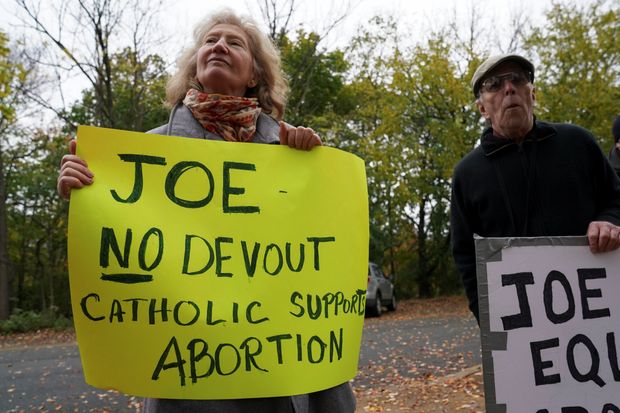
The point behind this comment relates to ongoing news of several Roman Catholic bishops around the country and overseas pushing for Joe Biden to be excommunicated. They’re doing this because Joe claims that one can be a Catholic and be pro-choice—and not just the “safe but rare” kind that the Democrats proffered back in the 80s, but rather the kind that goes right over the cliff into believing abortion (in all of its grisly forms) is a gift from God, and even worse, that full-term abortion is something upon which God dotes with an similarly triangular smile.

Do you know what full-term abortion is? If you guessed a full-term newborn child being killed immediately after delivery, then you guessed rightly. The President of the United States—your president—believes such a thing is holy.

Of course, I expect the nominal Christians to come out of the shadows to say I’m misconstruing his position, that he only supports it in this or that special circumstance. These folks will say this because, well, they voted for him, and like him, they aren’t necessarily using the lens of God’s Word for discerning these things. Well, whatever. Use whichever intellectual dance moves you prefer for avoiding the visceral fact that the President of the United States has given a thumbs-up to doctors delivering and then murdering newborn children if in such a moment a mother decides she doesn’t want her child.

But let me take a brief step backward to where this started.

As a Christian, the only way to arrive at an acceptance of the pro-choice position, no matter the justification, is to lie to yourself about a great many things. It is to lie about what life is and means. It is to lie about life’s Author. It is to lie about what that Author said with regard to human dignity and the truest definition of personhood. It is to wield the Word of God in deceptive ways, and ultimately by such handling, to summarily reject it, whether the one wielding it realizes it or not. Lastly, it is to be caught in the dilemma that to reject the Word of God, by default, is to reject the Word made flesh, Jesus Christ.

You cannot stake a claim in Christianity and reject the Savior who sits at its heart. It just doesn’t work. Thankfully, there remain plenty of Bishops in the Roman Catholic Church who are willing to enforce this basic doctrinal premise.

I wrote and posted something else this past week that comes to mind, too. It had to do with an article from The Federalist entitled “Lockdown Mongers Can Point Fingers, But The Science Is In: They’re To Blame.” By the way, one of the two senior editors at The Federalist is a biblically astute LCMS Lutheran, Mollie Hemingway, whose father is a Confessional Lutheran pastor. I should add that The Federalist has several LCMS writers on its roster of contributors, and in my opinion, that alone makes it one of the few political/cultural news sources out there to be trusted. Anyway, here’s what I wrote when I posted the article:

“The devil has plenty of instruments in his bag, but deception is the glove he wears for wielding each one.”

Again, the point here was to say that there are plenty of tools in the devil’s toolbox for drawing us into Sin, things he uses for convincing us to believe and do the wrong things. But before he goes about his darkly deeds, his grip on each instance begins with deceptively enticing half-truths.

“Sure, I know it’s against God’s Word for me and my girlfriend to live together before marriage,” the young man says, “but it makes good financial and logistical sense to do so. I figure that as long as we have the intention of getting married, God will let this one slide.”

Don’t lie to yourself. Repent.

“It makes perfect sense that the churches are closed,” the husband and wife contemplate over Sunday morning coffee. “The science says that mass gatherings for worship are sure to be super spreaders of the virus. The Church can ‘love thy neighbor’ a lot better by masking up and staying home.”

Don’t lie to yourself. Repent.

“Certainly I’m justified in speaking poorly about that person to others,” she muses. “How could I be wrong in doing so? My friend hurt me, and I need the emotional support from other friends who understand. The only way to get the support is to tell others about what happened.”

Don’t lie to yourself. Repent.

To knowingly persist in such behaviors unrepentantly, having exchanged the truth of God’s Word for lies, won’t end well. Still, the devil will work to convince you that it will. He may even do it in ways that sound pious, kind of like Adlai Stevenson’s infamous words given in jest: “A lie is an abomination to the Lord, and a very present help in trouble.”

Again, I don’t want to lie about the sunshine and say I don’t like it. I love it, even when it’s uncomfortably shining in my eyes. It’s the same here. Don’t be fooled. Stick to the truth of God’s Word, even when it’s uncomfortable to do so. No matter what happens, you’ll have the certainty of real truth. You’ll be traveling along the stepping stones of faith cut from God’s reliable quarry. Along the way, you’ll know and understand the gravity of your Sin—your very REAL Sin—and you’ll know the One who came to forgive you of that Sin, to recreate you by His wonderful love, and to send you out as someone capable of beaming the refreshing and face-warming sunlight of His love in a wintry world of Sin longing for the rescue of a divine summer.

Backroad Cemeteries

It’s very early, 5:30am to be precise. I’m writing this note from Cantrall, Illinois. Again, to be precise, I’m at Camp CILCA, which is just outside of Springfield.

A summer camp I attended in my youth, I know this place well. Even better, I eventually became CILCA’s head counselor in the early nineties, having held the position for four consecutive summers. I should add that during those same years I was also the head lifeguard, music leader, sports director, and weekend maintenance assistant to a wonderful man I’ll forever consider a friend, Derald Sasse, may his soul rest in peace.

I stayed here at CILCA this weekend, having spoken last night at the camp’s annual banquet at Our Savior Lutheran Church in Springfield. I received a kindly invitation last fall from the current Camp Director, Reverend Joshua Theilen, to be the banquet keynote speaker. I was certainly glad to accept. And of course, the topic being something along the lines of Christian engagement in the public square, I was certainly ready to drive down and prattle on about such things. I pray my words last night were of benefit to the people in attendance.

Interestingly, I’m staying in the Christian Growth Center here at the camp, which back in my day, was the only building on the camp property with air conditioning. The funny thing is, in all my years here at CILCA, I never once spent a night in this building. I maintained it. I helped clean the rooms for various groups that came through. I fixed broken windows and repaired faulty electrical outlets, but I never actually enjoyed the fruits of my labor. And yet, here I am twenty-five years later. Life is weird that way, I guess.

As soon as I finish typing this note, I’ll be hopping into the Jeep and heading back to Michigan. To get here to Illinois, I took the backroads. I’ll probably do the same thing going home. I like driving the backroads. While they’re pleasantly uneventful, there’s plenty to see. Driving along through the sleepy farmlands provides more than enough opportunities for thoughtful observation. Thinking back to these travels a few days ago, I can think of at least two things I remember pondering.

The first thing I spent some travel time thinking about was the Old Testament reading from Genesis 22 appointed for the Fifth Sunday in Lent, which tells the story of God commanding Abraham to take his son, Isaac, to a yet undisclosed place and sacrifice him. I’d call this event dreadful if I didn’t already know its substance and ultimate conclusion. As a father, could I follow through as Abraham did? And yet, if the listener is paying attention as Abraham speaks, the comfort of trust in the promises of God is woven into the narrative. Once Abraham and Isaac arrived at the place God commanded, Abraham told the servants who journeyed with them that he and his son were going to go and worship God and then return to them.

That moment is a clue as to what Abraham knew would happen. He would unreservedly follow God’s commands already knowing something of God.

God promised Abraham that Isaac would be the one through whom the Messiah would come. God assured Abraham of this. Abraham knew that God doesn’t break His promises, and so no matter what approached from the horizon, Isaac would be fine. Abraham trusted this. If you doubt this analysis, then take a look at Hebrews 11:17-19. The writer to the Hebrews acknowledges this as he digs a little deeper into Abraham’s faith, describing him as knowing full well that if he was indeed forced to follow through with the frightful deed, God would give Isaac back to him alive. He’d have to. God would reverse Death, and preserve Isaac’s life.

This is a very rich moment, both emotionally and theologically, especially as we prepare to wrap up Lent and rejoice in the Easter celebration of Christ’s resurrection. I suppose that thinking about these things probably influenced the second thing I remember pondering along the way.

While tooling along through the farmlands of Indiana and Illinois, I noticed something familiar to each of the little towns along the way. They all have conspicuous cemeteries.

Now, you might be thinking that just about every city or town in America has a cemetery. Believe it or not, they don’t. But these backroad towns do, and each is noticeably prominent, often pitched on a hill at the edge of the city, perhaps adorned with an elderly oak tree or two. And if the cemetery isn’t standing guard at the edge of town, it’s situated somewhere along the town’s main street, making it impossible for anyone to miss while passing through. In either, the collection of headstones is a community of both old and new, and from a reasonable distance, against a setting sun, their mutual silhouette looks almost city-like.

I remember when I was a kid in the seventies and eighties, my friends and I would hold our breaths when passing a cemetery. The lore was that by breathing, there was a chance we might make a wandering spirit jealous. Another version of the myth claimed that you might accidentally inhale a spirit and become possessed. Silly, I know. Good thing I know better, because now that I’m far from those youthful fooleries, I passed a particularly lengthy cemetery on Saturday evening near Lincoln, Illinois as I was making my way to Cantrall from Morton, Illinois, where my parents and sister live. Had I held my breath as I passed, I might have ended up unconscious and in a ditch. Or worse, in a cemetery.

And yet, having said this, the fact that every town has its cemetery is a reminder that at some point, my body will end up in one. There’s no avoiding it. Read the poets. Christian or not, they get the inevitability of Death. Percy Shelley called Death the veil that is finally lifted during the deepest sleep. John Donne described Death as mighty and dreadful, and yet without pride, portraying it as simply doing what it does almost boringly even as it is unstoppable. Robert Browning describes the knowledge of unavoidable Death as motivation for living life fully. Emily Dickinson, of course, is famous for portraying Death as unstoppable, being the carriage that will one day arrive for all. And when it knocks at your door, you will be unable to keep from opening it.

Since I’ve suddenly shifted to considering the poets this morning, I’ll admit to appreciating Lord Tennyson’s description of Death:

Sunset and evening star,
And one clear call for me!
And may there be no moaning of the bar,
When I put out to sea.

Tennyson doesn’t describe Death fearfully. Instead, he sets it before his reader as something of a story’s ending. It’s the sunset to an eventful day. It is an open sky with a view to the evening star. It is a clear call of his name, and a drawing to a vessel setting sail into the open sea, a place that he loved.

I don’t know what influenced Tennyson’s perspectives on things, but I’ll say his consideration of Death is comforting. It evokes the Lord’s even more so reassuring words throughout the Gospels.

Now, don’t misunderstand the Lord’s position on Death. Jesus knows full well it’s a big deal. He knows it isn’t pretty. He knows Death is an ugly ordeal, that it’s a terrorizing power. Following His lead, Saint Paul describes it as the worst of all enemies of Man. But pretty much all of the biblical writers go out of their way to make sure we know that through faith in Christ, we don’t need to be afraid of Death. We don’t need to be fearful because Christ has defeated it. Like Abraham, we can face off with its dreadfulness with the promises of God well in hand. And so the Lord can say to Lazarus’ sisters that whoever lives and believes in Him, will live even though he dies. Saint Paul can mock Death, courageously poking at it with the Word of God’s promises, asking, “Where is your sting?” Job can speak so joyfully that even in the midst of Death, at the last, he will stand and behold God with his own eyes of flesh.

I like Tennyson’s description because he has this similar verve. It’s almost as if he’s equipped with the knowledge of faith, which we as Christians know by the power of the Holy Spirit through the Gospel enables us to see Death for what it has now become for the believer: a turning from one page to the next.

And the next page holds an unending chapter that is far better than any that came before it.

I like that. And again, the season of Lent is certainly teaching this very point, making sure we’re ready to fully embrace the significance of the Lord’s resurrection—His conquering of Death—all for us!

To use Tennyson’s imagery, Easter is the clear call. Easter doesn’t allow for moaning of the bar. Easter sets sail for the unending horizons of eternal life through faith in the One who was crushed and killed for our iniquities, and yet was found alive on the third day, having wrestled Death and won.

Here in a few moments I’ll be packing up my car and making my way back to Michigan. I’ll be passing many of those same cemeteries I encountered on the way here. I won’t be holding my breath when I pass, just as I won’t be looking on them as fearful markers signifying hopelessness. I’ll observe them as Abraham looked upon Isaac. God is faithful to His promises. He is our hope in the midst of Death. Through that lens—the lens of faith—each of the tombstones whizzing past me will herald particular truths. The first is that unless the Lord returns first, I will die someday. There’s no way of getting around that fact. The second is that even as Death would come calling, it is not my master. Christ has won my eternal life. I am not consigned to the grave forever, but rather with my last breath, I will set sail into the joys of eternal life with my Lord at the helm.

Guilt

The season of Lent is a powerful time in the Church Year. Throughout its forty days, if there’s one thing in particular it draws out and defines with its penitential crispness, it’s the authenticity of human guilt.

Guilt is an incredibly palpable thing, isn’t it?

It’s thick. It’s strong. It’s voracious.

A terrible task-master, guilt binds its victims, keeping them in chains, all the while haunting every square inch of its chosen domain. As a pastor, I’ve learned to recognize guilt in people—and not because I exist in some sort of sphere of unimpeachable innocence, but because I know and have met my own dreadfulness of thoughts, words, and deeds. I am very familiar with guilt’s shape and stamina, and like you, I can be found wrestling with it, too.

As a pastor who is fully prepared to admit this, that means I’m a lot harder to fool when it comes to guilt.

It’s so often easy enough to see it peering back from its victim’s eyes like a shadowy knight in the watchtower of a guarded fortress. It can be sensed in a person’s physical presence. It disturbs human posture and is betrayed by facial expressions. On the phone or in person, its grip alters the human voice. By email or text message, it chooses certain words and repeats certain phrases that reveal its in-dwelling.

Guilt is by no means shy in these regards. It isn’t necessarily concerned by the possibility of its own notoriety. Admittedly, however, it would prefer to dwell in the peace of secrecy, hoping its host will deny its existence and thereby miss the telltale traces of its acidosis. This is true because it knows that to deny its presence is to preserve and protect the master that planted it—Sin. The denial of Sin’s guilt is the embracing of wickedness. It is to justify it, and to find the license for willfully employing it.

But again, for guilt’s host to be aware of its existence is just as acceptable, too. It quite enjoys its castle adorned in the paraments of hopelessness, fear, anxiety, and depression.

Whether it’s outright disavowal or fearful seclusion to avoid being found out, guilt is happy to live in the pitch black darkness of either. It will do anything to protect its domain, anything to smother the approaching lantern of Truth’s messenger, anything to prevent the invasion of a better, chain-shattering, Lord.

From purely a human perspective, Shakespeare’s Hamlet is a great place for seeing the examination of these two natures of guilt. For example, Queen Gertrude says so frankly of strong denial, “The Lady doth protest too much, methinks” (III, ii). This is hinting that to so boldly defend one’s absolute incorruptibility—to make excuses for or justify one’s bad behavior—is itself evidence of self-deception in relation to guilt. Further into the play, Shakespeare takes aim at the futility of concealing guilt for fear of being found out, saying that eventually it “spills itself in fearing to be spilt” (Act 4, Scene V). In other words, the continued filling of guilt’s ever-swelling balloon can only last for so long before it bursts, ultimately spattering its gore across the landscape of a person’s life. Things will get messy. Little episodes will become big. Plans will come undone.

So, what to do?

There’s a reason Jesus said on occasion, “He who has ears to hear, let him hear” (Matthew 11:15). He knows that the Word of God—namely, the proclamation of the Gospel—brings what’s needed for Sin. This cure is also, by God’s design, a medicine for the ousting of paralyzing guilt. The first pill in its prescribed regimen of truth is big and hard to swallow, and yet it delivers directly to our insides the very important knowledge-filled remedy that “all have sinned and fall short of the glory of God” (Romans 3:23).

The course continues along in a way that moves from concern to sweetness, first urging us not to deny or be fearful of our guilt (1 John 1:8). Both are self-deceptions leading to eternal harm. Instead, we are invited to confess our truest selves and our failings, knowing that God is faithful and just, and He will wash the guilt away (1 John 1:9). His faithfulness is embodied by Jesus, who did not come to condemn us, but to save us (John 3:17). Through faith in Him, we have full access to the throne of God’s grace in every time of need (Hebrews 4:16), being certain that God will receive us—that He will not shame us in our guilt, but rather will help us by taking it away (Isaiah 50:7; Psalm 103:12).

This wonderful routing of guilt from the fortress of Man is on full display in the person and work of Jesus Christ—His cross and empty tomb. It’s there that we see our guilt being heaped upon His shoulders. It’s there that we see our fear and shame infused with His divine body. It’s there that our hope is born, and by faith in His sacrifice and victory, the gates of fault’s domain are kicked open and guilt is dragged to its eternal demise.

You don’t have to be afraid to say you’ve done wrong. God forgives. And by the power of the Holy Spirit at work in His people, offended Christians are prepared to forgive in return.

Let this Gospel be of comfort to you. Better yet, be empowered by it to put away the need to hide your guilt. And whatever you do, don’t deny its existence. Besides, God already knows it’s there, and He desires for us to own this truth, too. Even better, He doesn’t want to leave us in it. He would have us look to and know the One He sent for our rescue—Jesus Christ—and in Him discover the mettle for coming clean, for real repentance, for the real receiving of the mercy won for us on Calvary’s cross. It is by confession of Sin and faith in Christ that guilt’s shame is turned back on itself and made into nothing.

Lent is teaching us these things. Lent is leading us to Good Friday and Easter—those eternal moments on the mortal timeline that seal the deal on this wonderful news.