Even on vacation, as always, I’m up and at it. Soon, the rest of the Thoma family will awaken, and then we’ll be off to Zion Lutheran Church in Winter Garden. The service is at 9:00 AM if you’re in the area and interested.
We never miss worship. Not even on vacation. Why would we? God doesn’t take vacations from us.
Until it’s time, I’m sitting in my usual early-morning writing space, a swimming pool just beyond the wall to my right. What to write about? Well, the first thing that comes to mind is that we’re already about halfway through the summer. Thankfully, that realization comes to mind at a relatively impenetrable moment. What I mean is that, first, I’m typing this from what is, more or less, my happy place: Florida. And second, we just arrived here last night, so we have almost two full weeks of rest and relaxation ahead of us. Together, these two facts form a perfect moment for perspective—a kind of balance that vacations alone seem to offer.
In the early days of time away, there is an abundance of freedom. You look ahead and think, “We have so many days for anything and nothing. The time is wide open, and we can fill it however we’d like.” But then, something subtle happens a little past the halfway mark. It’s a quiet shift. Without warning, instead of looking toward a seemingly endless expanse, a countdown of sorts begins: “Only five days left. Now four. Now three.”
Maybe it isn’t this way for you, but it can be for me. And if I’m not careful, it can become almost like a thief. It steals my mind away from the present and into a kind of preemptive grief over what hasn’t even ended yet. And so, I do my best to savor rather than tally. If anything, my family makes that easy to do. They’re so much fun to be around, and the blessing is that when the vacation ends, we end it together. When we go home, we go back home together to just be what we were before we left—and for me, that’s enough.
There’s a well-worn line in Henry Wadsworth Longfellow’s epic poem “Evangeline: A Tale of Acadie” that takes a straight aim at the tallying urge I described before. For me, it translates into pondering what’s left of anything and instead dwelling in the enchantment of right now. As only Longfellow could scribble, he sets before us, “Then followed that beautiful season… Summer… Filled was the air with a dreamy and magical light; and the landscape lay as if newly created in all the freshness of childhood.”
I’m 52 years old. Childhood seems so far away. And yet, I get what he means. He wraps his words around something that doesn’t seem to fade with age. He describes a kind of freshness that isn’t necessarily about being young, but about being present in something that has been given.
I don’t want to get too esoteric this morning. And yet, vacation time certainly does provide access to an entirely different and yet unrestricted level of thinking for me. I just feel good, more thoughtful. It’s the one time during the year when I can better see the things I already know. For example, as a Christian, I already know that life is far more than droning schedules. But on vacation, I can actually see it. It isn’t just symmetry on a calendar. It’s not something mathematical. Instead, life is a great big grace-filled opportunity that doesn’t need to spend any of its time worried about its end.
By faith, there is no end, and so, this is good, and it’s enough, whatever it is.
Maybe that makes sense to you, and you agree. Maybe it doesn’t, and you don’t. Well, whatever. For me, it’s enough. And either way, God’s Word agrees with me. Or better said, I agree with God’s Word.
If and when I find myself worrying about life’s fast-fleeting days, my Lord is there to remind me, “Therefore do not worry about tomorrow, for tomorrow will worry about itself. Each day has enough trouble of its own” (Matthew 6:34). These words are not intended as motivational poster material. They’re powerful. By the Holy Spirit’s power, they instill what they commend, which is a divine permission to stop counting what’s left of anything and simply receive what is. They’re words that stir believers to begin each day ready to hum along with the Psalmist, “This is the day that the Lord has made; let us rejoice and be glad in it” (Psalm 118:24). The Psalm-writer didn’t say “was made” or “will be made.” He said, “This is the day.” This one. For me, it’s the one that begins with this little eNews message, a cup of tolerable coffee, and eventually a trip with my still-sleeping family to church at Zion Lutheran Church in Winter Garden, Florida. I don’t know what comes after that. Although it’s more than possible it’ll involve laughter echoing from the pool after eating a meal that makes it far too hard for me to swim.
Whatever the family and I decide to do, Lamentations 3:22–23 will rise and shine over all of it, even more brightly than the Florida sun. We’ll soak up the time remembering that the “steadfast love of the Lord never ceases; his mercies never come to an end; they are new every morning; great is your faithfulness.”
I suppose I’ll end with that. Indeed, life is not dwindling by the day. Not with Jesus. By faith, I know that even if I only have a few more days of vacation or a few more days of mortal life, it’ll be perfectly enough.
Spring is upon us. Do you want to know how I know this? Migraines.
Every year at this time, the migraines set in. I never experienced them growing up in Illinois. Here in Michigan, surrounded by the Great Lakes, the temperature and barometric changes are more drastic, making their probability and frequency more prevalent.
Do you want to know one of the places with the least barometric fluctuation resulting in migraines? Florida.
Yes, Florida is a peninsula, which means it’s surrounded by water. Still, coastal regions aren’t as chaotic when it comes to barometric changes. They’re relatively ordered. I suppose that’s why I feel great while there. In fact, my chronic back pain typically disappears, too.
I read that tropical regions near the equator are the best places to avoid migraines. However, moving to an off-the-grid village somewhere outside of a place like Macapá, Brazil, probably wouldn’t work for me. I know that stress levels play a part in migraines, and I’m guessing my first trip to the bodega for supplies could result in a new kind of headache. While I’m generally disinterested in material things, I do appreciate creature comforts, such as air conditioning and pasteurized milk. My stress levels would almost certainly increase when these things are only occasionally (if at all) accessible. It’s also why I’d last maybe three days before packing up and moving to a place with more reliable electricity and steady internet access. I need to impose my ramblings upon the world around me, if not for you but for me. My constant need to type something—anything—helps maintain my brain’s order. I’ve written before that my need to write is almost disease-like. It’s an itchy affliction. If I don’t scratch it, I’ll unravel.
I wasn’t sure where this was leading just yet, but I think I figured it out. I’m a man who appreciates good order. My body is in complete agreement, and my seasonal migraines are a reminder.
Jennifer insists among our children that they keep themselves in order with calendars, planners, and the like. Our oldest son, Joshua, is married now, has a son, and works a full-time job. It’s funny how he’ll hug his mom and say, “You were right about keeping things organized.” He has come to realize, as many of his age eventually do, that disorder breeds unrest. The Bible certainly affirms this. In fact, it interprets disorder as sin’s regular product.
Saint Paul insists somewhat plainly that rejecting God and His natural law results in a “debased mind,” which is little more than a condition of mental and moral confusion (Romans 1:21-22, 28). Saint James writes, “For where jealousy and selfish ambition exist, there will be disorder and every vile practice” (James 3:16). Isaiah offers, “Woe to those who call evil good and good evil, who put darkness for light and light for darkness” (Isaiah 5:20). The implication is that sin distorts moral clarity, ultimately confusing right and wrong.
Again, disorder is sin’s fruit.
Relative to this, I should say that I appreciate simplicity. Sinful humanity tends to complicate things. Sure, the mechanics of almost any issue are vast. In a way, I attested to that last week when I wrote about the need to read more, not less. Still, the point of sifting through the swirling details of any particular issue is to find a way through the confusion to something better. When we do find that way through, we often discover that the fix was not as complicated as we thought. It may be difficult getting there, but when we do, it won’t be hard to understand the what, why, and how of it all.
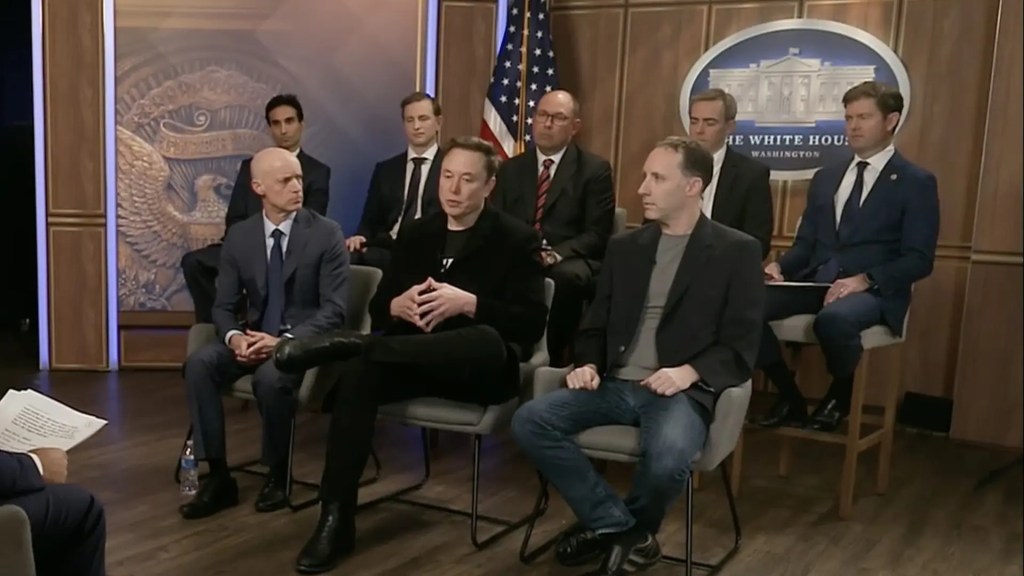
I wonder if this is why I’m oddly captivated by Elon Musk and his Department of Government Efficiency. While the United States government swirls with chaotic dysfunction, here’s a guy who has stepped into the middle of all of it and found a way to make its complicated mess into something crisp. His brainiacs have devised algorithms that can gather the chaos, sort it, identify the good and bad, and find a way through to an objective fix. When I observe this through a Gospel lens, there’s something strangely biblical about what Musk and his nerds are doing. No, not in the “mark of the beast” kind of way that the Revelation-twisting junkies and modern-day prophet-following weirdos try to suggest. First, I’m led to more of a David-and-Goliath image, where the unlikeliest champion throws a stone at the lumbering establishment, and the whole system wobbles. My second inclination goes far deeper.
Whether he realizes it or not, Musk has stumbled into sacred territory. A binding thread inherent to natural law is God’s desire for order. Saint Paul affirms this in 1 Corinthians 14:33 when he writes, “For God is not a God of confusion but of peace.” In Titus 1:5, he tells Titus to “set in order the things that are lacking” in the churches of Crete, making it clear that the Church itself requires structural clarity and good governance. Even in Acts 6, when the early Church faced the initial challenge of caring for widows, the Apostles responded with an administrative order. They appointed deacons to handle the task so that the administration of the Word remained central. It’s here (as it was with 1 Corinthians 14:33) that we see God’s deepest desire for order, which Saint Paul highlights in 1 Timothy 2:1-6 when he writes about the need for Christians to interface with earthly authorities. We do this to help maintain good order. And why? In verses 2 through 4, Paul says the goal is “that we may lead a peaceful and quiet life, godly and dignified in every way” (v. 2). He continues, “This is good, and it is pleasing in the sight of God our Savior, who desires all people to be saved and to come to the knowledge of the truth” (vv. 3-4).
The whole point of order is to provide a context in which the Gospel can be preached freely and without obstacle, all for the sake of saving souls.
With these things in mind, I realize it’s by no means coincidental that, right from the beginning, one of the first mandates God gave to Adam was to maintain order. In one of the most surprising acts of delegation ever recorded, God said, “Fill the earth and subdue it.” Next, He added, “and have dominion” (Genesis 1:28). This was a call to cultivate and maintain order in God’s creation. And so, we do. Certainly, this is an issue of faith relative to obedience. But as with all of God’s commands, there are practical fruits that come from holding to His divine commands. I already told you the most important one: the Gospel’s perpetuation. But there are others.
For example, order is inherent to a stable household. The Thoma family spent most of our dinnertime together on Friday talking about the blessings of a household that’s built in the way God designed it. A household established on God’s orderly design for marriage—a husband and wife—doesn’t just produce more humans. The sacred offices of husband and wife, becoming father and mother, create an ordered framework for children to understand love, responsibility, and many other aspects that make life truly enjoyable, just as God intended. If anything, a stable household becomes a training ground for carrying the kind of order that’s true to God’s heart into the broader world. It isn’t stifling. It nurtures growth while simultaneously instilling a crucial resilience to chaos, which is the space where confusion cooks up division, leading to broad-reaching and long-lasting harm.
As I said, observing through the Gospel’s lens, Musk and his team are in sacred space when they do what they’re doing, if only because they’re trying to bring order to chaos. They’re laboring to establish order’s honest clarity amid falsehood’s confusion.
To wrap this up, I mentioned at the beginning that migraines are a seasonal reminder. Keeping this ailment within the boundaries of God’s Word and beneath the shadow of the cross, my migraines are a natural protest against disorder—my body’s internal revolt against barometric chaos. In that sense, they’re a metaphor. They are proof that sin exists; it’s at work in my body (Romans 7:23). With it comes disorder. They also help me remember that God did not intend them by His design, and therefore, I’m not where I’m meant to be. In a mortal sense, even as I’m better suited for Florida’s climate, in the more extraordinary sense, I’m genuinely meant for the restored order of the new heaven and new earth (Revelation 21:1-5, Isaiah 65:17, 2 Peter 3:13) that Christ brings at the Last Day—the time when my whole self “will be set free from its bondage to corruption” (Romans 8:21).
Indeed, this world’s chaotic brokenness isn’t the final word. Genuine, actual, real restoration of order is coming. Christ has already seen to this by His life, death, and resurrection.
We arrived in Florida a little differently this year. Jennifer drove. She left a day early with Harry and Evelyn. I flew. Madeline went with me. It’s better that I flew to Florida and didn’t drive. My back is terrible. More than three hours in the car equals a few days of vacation ruined. That’s how long it takes me to recover, and I need every day I’m away to be as vacationy as possible. Indeed, I need two unscathed weeks of palm trees and a pool.
Unfortunately, when we landed, our phones exploded with the news that President Trump had been shot. Some of you texted me. Others left voicemail. Thanks be to God he’s okay. Now we pray for the families of the casualties and injured. Usually, I’d suggest praying for the perpetrator, except he’s already been neutralized. Now, he answers to eternity. Had his life been spared, we might know more. It’ll be a lot harder to get to the bottom of things now that he’s dead.
The White House noted that the FBI would be running the investigation. I wonder how Trump’s folks feel about that given the agency’s relative weaponization against him. By the way, I don’t say that lightly. I was nominated and accepted into an eight-week citizen’s training with the FBI this past spring. I learned firsthand just how partisan the agency has become. Passing jabs at conservatives was common. So were the excuses for “mostly peaceful” groups like Antifa, Black Lives Matter, LGBTQ, Inc., and Pro-choice extremists. I’m by no means inclined to believe the FBI has President Trump’s well-being in mind. They answer to ideologues who rile crowds, comparing Trump to Hitler and labeling him a “threat to democracy” and “the end of America.” Their boss, Joe Biden, rasped at a recent fundraiser, “It’s time to put Trump in a bullseye.”
It appears someone may have been listening.
I hope I’m wrong about the FBI. I hope I’m wrong about Biden and his administration. I hope they’ll get to the bottom of this. I also hope their gabbling is nothing more than campaign rhetoric. I hope the Democrats’ continued stoking of the so-called tolerant left and the subsequent assassination attempt are only coincidental. Either way, the images of Trump covered in Secret Service agents—a man who’s been through so much, the American flag now billowing above his blood-smeared face, his breaking through the agents’ shielding to fist-pump the word “Fight!”—this image was seared into the hearts and minds of billions worldwide. It will unify many.
This has me thinking of something else.
I began by saying there aren’t too many things I like more than palm trees and a pool. That said, there’s almost nothing more entertaining than an hour in an airport terminal watching passersby. You never know what you’ll see. A woman dragging her angry child by a leash a short distance across the airport floor, his shoes squeaking like well-worn brakes as he tries to hinder her momentum—an oblivious tween wearing headphones two paces behind the struggling mother. A heftier man with bleach blonde hair and fishnet over a bright t-shirt doing all he can to be a woman but without an ounce of success. Two clerics in flowing cassocks pulling bags, and one has a cane that he doesn’t appear to need for walking. A beeping trolley with an elderly woman in its passenger seat. An eager crowd of Florida-bound travelers waiting and watching a bedraggled ensemble disembark an arriving plane, their vacation has come to an end. Atop all of it, a bird that somehow found its way inside and is now flittering from steel beam to steel beam above the unsuspecting bustle.
Like the bird, an inconspicuously observing man with his own past, present, and future sitting beside his oldest daughter and thinking, “I wonder what else there is to these people.”
For as weird as the theater of humanity might be, I appreciate individuality. Each person is gifted and uniquely valuable, no matter who they are or what they believe. If this were not true, Christ would not have told Nicodemus about God’s love extending itself to the extremities of death for the whole world (John 3:16). He would not have told His disciples, “Look, I tell you, lift up your eyes, and see that the fields are white for harvest” (John 4:35), which was to say that every person in this world is worth laboring to retrieve.
Still, the importance of uniqueness has become misapplied, reaching a fever pitch in society. We currently exist in a culture hellbent on amplifying individualism above everything else, the result being extreme division. The attempt on Trump’s life is proof. Perhaps just as worse, society has learned to praise and protect abnormality while shaming normalcy. A person who wants to get married, have children, go to church, and live a relatively normal life is considered the epitome of mindless conformity. But a man who disrupts the community of “family” and “friends” by quitting his job, divorcing his wife, and leaving his children to embrace his most authentic self as a six-year-old girl is heralded as courageous. Get in his way, and you’ll be sorry. Try to help his family, and you’re a bigot to be canceled.
I’m reminded of something Rev. Henry Melville wrote. Unfortunately, his words are often misattributed to Herman Melville, the author of Moby Dick. Nevertheless, Rev. Melville insisted in a sermon he delivered in 1855, “Ye live not for yourselves; ye cannot live for yourselves; a thousand fibers connect you with your fellow men, and along those fibers, as along sympathetic threads, run your actions as causes, and return to you as effects.” This is sermonically reminiscent of Saint Paul’s warning, “The eye cannot say to the hand, ‘I don’t need you!’ And the head cannot say to the feet, ‘I don’t need you’” (1 Corinthians 12:21). And yet, society has grown to despise such a message, and now we have a mess of self-concerned, handless, and footless bodies. We have a mess of separate and nearly unnavigable identities, with more and more people inventing new ones every day, each highlighting its own supposed uniqueness. In short, it has become commendable to cut the fibers that bind us to community. It has become laudable to stand entirely apart.
Yes, we’re all unique, and our individuality is essential. But our sameness is, too. In fact, it’s individuality’s point. We have roles to play in something bigger. This is true in microscopic ways, such as individual talents and skillsets used to support an organization, but also in much grander ways. A man or woman is only one-half of the single most important society-perpetuating and stabilizing equation. Relative to the Church, it’s why Saint Paul wrote, “For as in one body we have many members, and the members do not all have the same function, so we, though many, are one body in Christ, and individually members one of another. Having gifts that differ according to the grace given to us, let us use them” (Romans 12:4-6).
Use them for what? For the benefit of the community. This is a divine nod to something significant.
The more radically individualized and disconnected from community and its normalcy we become, the more our society seals its doom. We’re already seeing airplane crashes because a more qualified engineer was overlooked for another with lesser skill but with 7% more Cherokee DNA. Even now, people are losing the will and ability to communicate in fundamental ways, having become utterly incapable of engaging in honest conversation for fear of using incorrect pronouns and offending someone’s made-up uniqueness.
While I’m people-watching, I certainly do wonder about individual backstories. However, in the end, I’ve realized I can only really do this through the lens of sameness. I suppose therein lies one of life’s greatest ironies, which I’ve heard phrased, “Each of us is different, just like everybody else.” The adults before me were all children once. I wonder about the uniqueness of their upbringing. They all eat food. I imagine their favorite meal. I also wonder about their struggles. Everyone has sins that they wrestle to keep hidden from others and themselves. White or black, tall or short, we’re all members of the fellowship of sinful human dreadfulness. Rich or poor, well-known or societally invisible, God does not show partiality and cannot be bribed (Deuteronomy 10:17), and, therefore, none among us is above or below the other relative to the need for a savior.
But here’s the thing: even as God formed each of us as unique individuals, His greatest gift took aim at our sameness. He sent a Savior for all. By the person and work of Christ—His life, death, and resurrection—the whole world’s redemption was accomplished. He didn’t do it one way for Americans and another way for Somalis. We’re all the same in this. No one stands beyond the blast radius of the cross. Only according to this perspective does a genuine uniqueness come to light.
Those who believe this Gospel of redemption become the truly exceptional ones. They’re made holy. To be holy means to be set apart. Believers are set apart from a world intent on self-promoting shouts of uniqueness from the mountaintops. This world is set on having things its way—on doing, saying, and being anything it wants without consequence, all the while expecting commendation for the insanity. The Gospel for faith changes this. It’s the only thing that really sets a person apart, while at the same time drawing the one it inhabits to a better frame of reference. Suddenly, a person’s uniqueness becomes consequential to more than just the self. It becomes less about the spotlight and more about community. It’s moved to enact selfless love for the neighbor. And still, it knows more. Concerning the Church, suddenly, the community’s boundaries and preservation become paramount. That’s one reason why I appreciate tradition so much. It’s why the historic liturgy and the creeds are so valuable. They help bind and fortify the eternal community across time and location.
To wrap this up, I suppose I’ll close by acknowledging my appreciation to God for your uniqueness. I also give thanks for the more spectacular sameness of God’s love in Christ that binds us together in community. This sameness testifies to our value as individuals in the only way that truly matters.
This summer has been and continues to be a challenging one. I don’t intend to bemoan my circumstances. Neither am I pleading for a reprieve from the arrayed struggles. I’m simply relaying that I do not expect to look back on the summer of 2023 with any measure of fondness. It has been busier than busy, sometimes crueler than cruel, and occasionally sprinkled with some enjoyably restful moments. Our time together in Florida was one. Taking Evelyn to see a NASCAR race was another. In between, far too many negatives filled the gaps.
As I said, I don’t mean to complain. Complaining accomplishes nothing. Muscle through and do; that’s more my way. Complaining invites excuses and accepts defeat. Ask Jennifer. I don’t accept defeat too well, but mostly because there almost always seems to be a way to succeed. You just need to find it. The adage rings true that you can either be a part of the problem or a part of the solution.
Part of acknowledging any challenging situation means admitting to what’s really going on behind the scenes in this world. Sin is a very real thing, and it has infected everything. I should not be surprised when the season I look forward to more than any other becomes something to endure rather than enjoy. Sin will do that. God certainly doesn’t promise immunity from tragedy to His Christians—at least not in the way the name-it-and-claim-it charlatans of this world suggest.
On the contrary, He assures us we’ll experience trouble. Jesus said as much to His disciples, saying, “In the world you will have tribulation” (John 16:23). But He didn’t end His words there. He continued, “But take heart; I have overcome the world.” Here the Lord promises His care. He promises to give us what we need to endure. Saint Paul echoed the same, writing, “God is faithful…he will provide the way of escape, that you may be able to endure it” (1 Corinthians 10:13).
While He gives what’s necessary to each believer as He knows best, as you can see, there’s something He sets before the whole world: the Gospel—absolute hope through faith in Christ and the promise of eternal rest apart from sin’s terrifying grip. That hope is endurance’s fuel. Interestingly, Christian endurance produces some pretty neat behaviors. For example, in times of trouble, when I discover myself stretched to my emotional extremities, I become attuned to the humor in seemingly humorless things. Just this morning, my backpack on my shoulder, my rolling bag in one hand, and a cup of coffee and my keys in the other, I attempted to use my foot to open my office door only to lose my balance and stumble forehead-first into its solid oaken barrier.
It hurt. How I managed to fumble like that, I don’t know. Still, I laughed because it was ridiculously funny.
Over the years, I’ve come to realize that the man who can laugh at whatever befalls him demonstrates a type of lordship over this world. From the Christian perspective, he proves a Job-like verve capable of saying, “The Lord gave, and the Lord has taken away; blessed be the name of the Lord” (Job 1:21). He can speak along with King David who wrote so daringly, “The Lord is my light and my salvation; whom shall I fear? The Lord is the stronghold of my life; of whom shall I be afraid? (Psalm 27:1). He can be at peace because he “is not afraid of bad news; his heart is firm, trusting in the Lord (Psalm 112:7). He’s already asked and answered himself, “What can flesh do to me?” (Psalm 56:4).
Nothing. Everything sin has corroded is passing away. “Behold,” the Lord said, “I am making all things new” (Revelation 21:5).
With this trustworthy Word from our gracious Savior, bad news is a toothless beastie, tragedy is a pinprick, catastrophe is a mouse’s shadow, and heartbreak is a wound needing little more than a Band-aid. All this is true because, as Saint Paul wrote so plainly, we are justified before God by faith in Jesus Christ (Romans 5:1). The endgame has already played out on Calvary’s cross. Now, everything is endurable by the power of the Holy Spirit at work within us. I’d say, maybe even laughable. Paul explains:
“Therefore, since we have been justified by faith, we have peace with God through our Lord Jesus Christ. Through him we have also obtained access by faith into this grace in which we stand, and we rejoice in hope of the glory of God. Not only that, but we rejoice in our sufferings, knowing that suffering produces endurance, and endurance produces character, and character produces hope, and hope does not put us to shame, because God’s love has been poured into our hearts through the Holy Spirit who has been given to us” (Romans 5:1-5).
In conclusion, please don’t think I’m making light of anything you might be enduring right now. I’m not. And neither is our Lord. I’m merely setting a point of origin for steering into all of it. You have hope. God said so.
While I can’t quite see the Florida sun from where I’m sitting, I know it’s there. Its morning beams have already gone out to paint the sky like flower girls scattering petals before the bride in a wedding procession. Sunrise is coming. It’s at the day’s gate.
Every year I say I will not write any eNews messages while on vacation, that I will leave everything behind and simply simmer in the joy of minimal obligation. But then I end up doing it anyway. I told Jennifer yesterday at the airport that perhaps I’d fight the urge this year. Truth be told, I had another factor prompting today’s early morning rise. In the house where we’re staying, the same place we visit every summer, the owners got a different mattress for the master bedroom—a horribly cheap mattress. I don’t know why. What I do know is that I have a terrible back, and the new mattress has got to be the worst, most pain-inducing one I’ve ever slept on in my entire life. I’ll try one of the other beds tonight. I’ll sleep on the dining room table if they’re all the same. Or a lounge chair near the pool. Or the bathtub.
Since today is Father’s Day, I certainly have the gem-filled occasion in mind this morning as I sip my coffee and down some ibuprofen. I’ve learned a few things as a dad, many of which have only come to fuller bloom in recent years. For example, as the father of two daughters, I’ve learned that, in a way, I’ll always be my girls’ first love. I mean that they’ve likely learned the type of man they want to marry from observing the man I’ve been. I can promise you the day either of them stands beside a husband-to-be at the Lord’s altar will be a conflicted moment of joy and sadness. I’ll be happy, trusting the Lord’s promise to bless them. But I’ll also be sad, foolishly convinced that no one will ever love my daughters like me.
As the father of two sons, I’ve learned a similar lesson. I’ve learned that any words of advice I’ve given them through the years are of fractional value compared to the things they’ve seen me do. Again, the day my sons become husbands—and by God’s grace, fathers—will be a day of mixed emotions. I’ll be blissful, trusting in the same blessings of God. And yet, I’ll be torn. I’ll know I’ve reached a certain point of irrelevancy in their lives. In other words, they’ll have set sail. Once at sea, a ship’s builder is no longer needed.
I suppose these concerns are ridiculous. Of course, someone can love my daughters like me. Maybe even better. And certainly, I won’t be irrelevant to my sons. They’ll meet with situations that, even as husbands and fathers themselves, will prompt them to ask their own dad’s perspective. I know these things. And I know they’re all a part of one generation carrying on to the next.
“…one generation carrying on to the next.”
Now and then, when I write something, I must examine my own words. Plenty in God’s Word describes how that carrying on is to happen. There is plenty more revealing what a parent’s truest goal in the process must be, namely, to raise their children in the faith. Still, one text resonates more with me this morning than the others. Psalm 103:13 reads, “As a father shows compassion to his children, so the Lord shows compassion to those who fear him.”
Firstly, an underpinning of this text has to do with demonstration, of learning behaviors from someone else. Secondly, the text isn’t teaching a single step in a broader course but instead is looking at every stage and showing what’s necessary to each—what’s actually binding each of life’s efforts to the next. Interestingly, it does this by way of three assumptions. The first assumes that fathers will show compassion. The second considers the Lord’s compassion as the standard to replicate. The third believes the Lord’s compassion will be given to those who put their faith in Him. That’s His promise, and it can be trusted.
At the root of the denominative verb used for “shows compassion” is the noun “racham.” Chasing this word around the Old Testament for a few minutes this morning, I discovered other interesting uses relative to sympathy, nurturing, brotherly fellowship, and the like. One of the more unique connections has to do with a mother’s womb and the reality of birth. This connection matters most to me this morning, especially as a parent with a mind for Father’s Day. Although, it might not be for the reason you’re thinking.
I think it matters most because, even though I’m the one God put in place to shepherd my children, I’m no different from them regarding human birth. We’re all born into the sinful predicament of human dreadfulness (Romans 5:12-18). As a dad, when I observe their failings, I must be aware of my own. I must recall my place beside my children in this rumpled and grimy world, where I own just as much Sin-stained guilt as the next person. In other words, I must parent them, realizing we’re in this together. We’re standing before God on the same footing and need something.
Admitting this, I’m drawn to remember what that “something” is. Nicodemus’ conversation with Jesus in John 3:1-21 frames it. It was there Jesus told Nicodemus—a man who’d soon experience faith’s stirring to defend Jesus in John 7:50-52 and then assist in His burial after the crucifixion in John 19:38-42—that even as one is born of the flesh, God is compassionate, and a rebirth is possible. Most people today use the phrase “born again,” but it’s really better translated as “born from above” (γεννηθῇ ἄνωθεν). In other words, just as a child can’t choose to be born, the rebirth of faith is God’s laboring. He births us into His family. It’s no wonder the same disciple who recorded this interaction with Nicodemus also wrote in 1 John 4:7 that a believer who truly demonstrates Godly love—a person who shows compassionate care—proves “out of God he has been born” (ἐκ τοῦ θεοῦ γεγέννηται).
I was born in the flesh, but I was also reborn in faith. From this vantage, I can clearly see the Lord’s fatherly demonstration of compassion, and I can carry that demonstration to my children. God did not give me what was owed for my crimes. He loved me. He had mercy, and He birthed me for something better. Child or adult, did I suffer the natural consequences of certain behaviors? Yes. But am I eternally condemned by them? Have I crossed beyond the border of God’s compassion? No. That’s the most reliable assumption woven into Psalm 103:13. For those who, by repentance and faith, know their Sin, they’ve been reborn to know a God who stands ready to receive them, One who promises never to leave nor forsake them (Hebrews 13:5). He is compassionate. He demonstrated it fully through the person and work of His Son, Jesus Christ. He moves Godly fathers to emulate the same compassionate care, principally as they introduce their children to Christ for the sake of salvation but also as they demonstrate the humility of repentance and trust in Him. It’s God’s will for this powerful Gospel display to surge forth from one generation of fathers to the next.
I want to instill these reliable assumptions in my children, both in their relationship with Christ and in their relationship with me. The time is coming—very soon, in fact—when they’ll work to instill the same unfailing assumptions in their own families. God willing, I’ll be here to help when they ask and for as long as the Lord allows.
Happy Father’s Day. I pray it’s an enjoyable one for all.
Like many of you, I have vacationing on the brain.
Memorial Day is meant to remember those who gave their lives in service to the country. Still, judging by the weekend’s typical worship attendance, it’ll be akin to a test run of the forthcoming summer’s getaway potential. In other words, it’s a practice vacation. It doesn’t offer much time to rest, but it gives a sense of what rest could be. And if not rest, then at least the liberty to spend a long weekend with friends and family—some we like and some we don’t—doing something…or nothing.
I just used the word liberty.
I’m not above reminding anyone why the rest they enjoy in America is possible. People died to provide it. Considering that Thomas Jefferson once called religious liberty “the most inalienable and sacred of all human rights,” I’m not above reminding folks to consider churchgoing as one of liberty’s best exercises. A far more critical death sits at its center—the death of God’s Son. His death won far more than freedom from earthly tyranny or foreign threats. His death stole you away from eternal condemnation and the power of Death. That’s certainly worth a day or two of any vacation.
At our Church Council meeting last week, our new Youth Board chairman, Jason, spoke about future opportunities for our youth to enjoy fellowship together and serve in the community. As he explained, I drifted back to my days as the youth leader, a time when we were heavily invested in international mission efforts, going to places like Russia and Lithuania. I share this because later that night, on the treadmill, I visited a travel website to check on airfare prices to Lithuania, figuring it might once again be a possibility. Of course, Russia seems like a stretch right now. Anyway, while ticket shopping, one of the side advertisements was scrolling quotations about vacationing. I don’t usually pay much attention to advertisements. The sayings caught my eye in this case, probably because the Thoma family is precisely 20 days away from our annual two-week getaway to Florida.
The first quotation I jotted down was from Robert Orben. He said, “A vacation is having nothing to do and all day to do it in.” Another from Hal Chadwicke offered, “A vacation is a sunburn at premium prices.” I also saw one by Susan Sontag. She wrote, “I haven’t been everywhere, but it’s on my list.” Finally, there was the following from Gustave Flaubert: “Travel makes one modest. You see what a tiny place you occupy in the world.”
I know who Robert Orben was. In fact, he died just this year. He was a comedy writer who later became a presidential speech writer. I only know this because he managed to do something I’d appreciate doing, which is speech writing for political candidates. Other than that, I’ve never been a fan. I don’t know who Hal Chadwicke is. I’ve never heard of him. I’ll probably look him up after typing this. Known or unknown, he said something insightful that was worth sharing. Susan Sontag was a leftist crazy. She did all she could to depict America as a villain. For example, she was the kind of person who could visit an orphanage in Africa built by Americans and figure out how to blame America for the local warlord’s murdering the children’s parents. I’m not a fan of Susan Sontag. Still, she wrote at least one thing worth sharing.
Gustave Flaubert’s observation resonated with me the most. He was a nineteenth-century French novelist. He wrote Madame Bovary. I’ve never read it. It’s a classic, so I probably should. I guess I’ve never been that interested, mainly because of its reputation for having a class-envy theme. Still, Flaubert’s words about travel are pinpointedly accurate. Stepping beyond the front door of our lives has a way of revealing the uniqueness of one’s place in the world.
Vacations are inherently good for this.
Relative to this ramble’s start, I think I’ve sorted out a few things. One lesson learned concerns my being completely disinterested in spending a Memorial Day weekend with any of the authors I mentioned. However, even though I might not be fond of particular people, situations, or tasks, I can garner something of value from almost anyone or anything if I’m paying attention. Even Saint Paul found value in the pagan poets. With that, no matter where you are or what you’re doing, pay attention to what’s happening around you, even when you’re doing absolutely nothing. You’re bound to discover something worthwhile. This leads me to something else.
I suppose vacations are designed to provide rest. But they’re also supposed to be rejuvenating. Rejuvenation isn’t necessarily a do-nothing event. It’s restorative. It’s a creative act. It’s also self-contemplative. It takes in information and applies it to the self. It has a heightened awareness, one that’s undistracted from the usual day-to-day bustle and capable of looking around at life for new ways of making one’s regular days healthier and, perhaps, more productive. I can promise you that’s one of the only reasons I try new things while on vacation. I rarely do nothing. But I rarely do something to say I’ve done it. I eat food I’ve never eaten or try activities I’ve never tried so that I can decide if I want to add them (if possible) to my life back home. I discover things about myself and my everyday routines as I do this. As Flaubert hinted, I’m reminded how small my corner of the world is compared to the rest of God’s beautiful creation. The older I get, the more aware of this process I become. And it really is a splendid process.
Now, I didn’t set out at the beginning to sound like some new-age therapist bent on meditative self-help techniques. Instead, I’m thinking about my upcoming vacation, realizing I’m going away to a place that’s not my home. I will return to the real world and its seemingly endless tasks.
I’m also thinking about what I read in Ecclesiastes 3 this morning. Chapter 3 is that memorable portion from King Solomon that talks about how there’s a time for everything under heaven. I noticed vacationing fits into what Solomon wrote.
Interestingly, after Solomon lists various seasons in life, some good and some bad, he appears to connect all of them to man’s general toiling—his day-to-day vocation. In verse 13, he summarizes that God wants man to take pleasure in his work. His phraseology implies that the toil and its fruits are God’s gifts to us, not simply a package of things we endure until retirement. They’re proof of God’s love.
In verse 22, the final sentence of the chapter, Solomon adds one more thing. He once again restates that man should rejoice in his work, but then he ends by asking the rhetorical question, “Who can bring him to see what will be after him?” I won’t dig too deeply into this question because I’ve already been long-winded. In light of everything Solomon has written, it sounds like he’s assuming a life of labor in gratefulness to God produces a job well done. A job well done benefits those who come after us.
Finally, reading Solomon’s concern for times of laughter and healing—and knowing they’re relative to our daily labors—I think one of the “vacation” takeaways is that we shouldn’t necessarily be thinking about our time off as an escape from work. Instead, we vacation for the sake of our vocation. In other words, we take time to rejuvenate—we grow and learn and take in new mental and physical resources—so that we can return to our daily labors better equipped for faithful laboring to the glory of God and the good of the neighbor.
Returning to the real world after vacation can be depressing for some. I get it. Still, I think Solomon is telling us there’s a way to take a little bit of it with you. My advice: pay attention. Ask yourself while away, “What can I bring back to my corner of the world that’ll make my vocation more of a joy in thankfulness to God and a blessing to my neighbor?”
Now, if I can only figure out how to fit Florida’s sunshine, a few palm trees, and a swimming pool into my suitcase. I’ll bet that would make everyone in Michigan happy. Florida can keep its sharks.
As I type this, a bag sits on the chair across from my office desk. The bag has puzzles inside. I don’t know who placed it there, but I’m assuming it to be a kindly gesture by someone who knows my family likes such things. Somewhat of a betrayal of my observational skills, I think the bag was delivered to my office this past Wednesday. I can’t say for sure, mainly because last week was a bit of a blur. A lot happened in a very short period. Some of it was easy. Other parts were more challenging. All of it is in the Lord’s hands. It’s His church. We can all sleep easier knowing that.
I should say that as grateful as I am for the gifted puzzles, unfortunately, I do have one concern about the bag. It is adorned with a wintry scene bearing a smiling snowman. Above the frosty gent are the words, “Let it snow!” Again, thank you to whoever gave us the puzzles. What a treat! Nevertheless, I need you to know I’m going to burn this bag once my family removes the thoughtful gifts in its keep. I dread the snow and everything that comes with it. I say, keep the snow upstairs in heaven’s attic, and instead, let the warm sunshine continue to gild the grassy summertime landscapes down here.
Summer is better. Summer is my thing.
Of course, this isn’t to be. Anything I might call “my thing” is never really mine to control. Nothing is. Even the things I might consider autonomic—something like breathing—will one day cease. I won’t be in control at that moment. And so, for as much as I want summer to remain, winter is coming. Beyond that, there’s no use in complaining about it—even though I’m pretty sure I will continue to do so.
Technically, I have no right to complain. I live in Michigan, a tundra-like state. I do so by choice. Well, maybe not by choice. I blame my wife, Jennifer. She’s from Michigan. I met her, fell in love, and I stayed here because I wanted to be where she was. Thankfully, God saw fit to put me into a congregation I dearly love. Or perhaps better stated, I’d die for the people of Our Savior in Hartland, Michigan. Considering Joe Biden’s recent speech, it seems that’s becoming less a rhetorical statement and more a possibility.
Still, if I had the magical ability to lift Our Savior Lutheran Church and all its people from the earth and set them down on a gulf-kissed shore in Florida, I would. The place would look nice with some pineapple trees in our gardens and a few palm trees by our bell tower. I know I’m a stickler for stewardship, but if anyone suggested during a congregation meeting that we install a pool, I’d probably go for it. I mean, why not? Hey, trustees, what do you think?
But as I said, I have no right to complain. Come to think of it, at a base level, none of us has a right to complain about discomforting things we experience in this world. These things exist because of Sin. Sin is our fault, and complaining about it is a bit like turning on the stove, putting our hand in the flame, and then whining that we were burned. Besides, in the grand scheme of things, the One to whom we’re most likely directing our complaints—God—isn’t responsible for Sin. The fact that He handled it anyway says something about Him.
He loves us.
That brings something else to mind this morning: the Complaint Psalms—Psalms such as 3, 31, 44, 64, 142, and others. The Psalms of Complaint certainly are good examples of divinely inspired writers whining to God. That being said, such Psalms assume a few things.
Firstly, they assume a distinction between good and bad complaining. Bad complaining is often described in the scriptures as grumbling. Grumbling is the negative bemoaning that happens when our attention is more set on self than Christ. We want what we want. When we don’t get it, we complain. Perhaps worse, we end up blaming God for our woes rather than trusting in His divine care. I think good complaining—biblical concern—is different. God expects His people to complain to Him. He expects us, like Him, to be bothered by Sin’s darkly products. If we’re not expressing our concern in some measure for Sin’s grip on humanity and its dreadful horribleness unfolding in the lives of every man, woman, and child across the planet, then we’re far denser than we might give ourselves credit. This same assumption understands faith. It understands, firstly, that God is ready to hear the cries of His people; and secondly, we go to Him because He’s the only One capable of doing anything about Sin. Yes, we can complain about the ungodliness of abortion. We can even get involved, doing everything we can to stop it. Still, God is the only One who will see to its permanent demise. This leads to another assumption about good complaining: the anticipation and expectation of God’s love. We know God will always be ready to exchange our concern with His comforting Gospel—the wonderful proclamation of our deliverance from Sin through the person and work of Christ and the promise to strengthen us for meeting the challenges that stirred our concern in the first place.
He loves us. He hears us. He’s with us. He enlightens and empowers us, using the momentum of our Godly concerns to work through us in His world.
Still, as with the rest of God’s Word, the Complaint Psalms are in place to herald Christ. They meet with the Sin problem, being sure to dole out the only hope that can soothe our visceral concerns. Take a look at some of the Psalms I mentioned above. They never leave the complainer without hope.
I’m not so sure my complaining about snow fits into the category of good griping. While I’m burning the snowman bag, I’ll reflect on what I do know—which is that if it’s the Lord’s will, He’ll see me through another season that more than taxes me holistically. This world—His world—will continue to spin. Winter will become spring. Summer will return after that. All along the way, He’ll take both my bad and good complaints and put His faithful Word before me—both His Law and Gospel. He’ll give His Law to reveal my sinful selfishness and His Gospel to forgive and strengthen me for being His trusting child who engages in the surrounding world.
In all, I’d say that will forever be a pretty good gig for whiners like me.
Having just returned to Michigan from Florida yesterday, I suppose I’ll begin this morning’s note with a simple observation. In short, one of the most enchanting qualities of “home” is that while it sometimes feels so incredibly good to be away from it, there’s very little that compares to returning. The ghostly warmth hovering throughout—the familiar smells and the favorite spaces; one’s bed or best-loved chair—all of it together is a resonant foretaste of the purest welcome to be found only in the chambers of heaven.
Indeed, as Cicero once said, “There is no place more delightful than one’s own fireside.”
I was thinking on the plane yesterday afternoon about how difficult it can be to make one’s way back into the busyness of life. After two weeks in which the hardest thing I had to do was adore the palm trees while swimming from one end of the pool to the other, just about anything else can seem daunting. Even unpacking the suitcase last night felt like a chore, especially compared to the exertion that today will require. Today, I’ll drift from yesterday’s lazy river into the swifter current of this and that and then this and that. I’ll finish tapping out this message, and then I’ll write the prayers for the Divine Service. From there, I’ll make my way toward plenty of other preparatory things before the 9:30 AM start time. At that point, I’ll preside over the liturgy, baptizing a little one at the beginning and seeing that you get the Lord’s Supper at the end. After the Bible study hour that follows, I have a couple of meetings, and then it’s off to officiate a wedding followed by another baptism.
Today will be nothing like yesterday’s palm trees. I expect I won’t find my way home until mid-evening. I’m grateful to Rev. Christian Preus for joining us this morning as a guest preacher and for taking time during the Bible study hour to talk about the up-and-coming Luther Classical College. Not only will this help, but if you’re at all concerned about sending your child off to any of today’s modern colleges or universities, his time with us will be worthwhile.
Having said all these things with an unmistakable tenor, you must know that none of them changes the point I made in the beginning. No matter what’s going on, L. Frank Baum was correct to make his character Dorothy repeat, “There’s no place like home.” Surrounded by her family and friends at the end (who echoed through the characters she discovered in Oz), Dorothy realized, as so many often do, that it’s not necessary to travel the world to find what we need. Home is where you’ll often find it. In that sense, home is more than things. It’s people. It’s routines. It’s a sense of belonging. It often requires from you just as much as it gives, and that’s okay. It’s a two-way investment that creates unique relationships resulting in lives actually lived rather than only being observed from afar. You’re not just passing through. Instead, you belong—with and for the others who are there, too. God so graciously works these things into our lives, settling the solitary in a home (Psalm 68:6) and blessing them with a wonderful synergy of both needing and being needed.
These thoughts on home bring something else to mind.
Last week I learned a new word from Rev. Dr. Scott Murray. He used the term “theologism.” If I recall correctly, he defined it as a religious statement that many people regularly say, having accepted as totally self-evident. But when the saying is rigorously tested, it’s proven to be far less than all-encompassing. In particular, he identified as an example the saying, “God hates sin but loves the sinner.” I think he’s right. Psalm 5:5 is an easy example of God’s dislike for sinners. The first chapter of the Prophet Malachi combined with Saint Paul’s handling of the same material in Romans 9:10-13 is another example. Personally, I think many Christians gravitate toward the saying because they feel God needs a little help in the Public Relations department. In other words, rather than simply accepting that God hates Sin and everything it produces—which includes sinners—we attempt to soften the blow of such things. When we do, we confuse the theology and allow wiggle room for missing the seriousness of the predicament and our need for actual rescue. When that happens, we begin redefining Sin in ways that enable us to remain comfortable with it in certain forms. I think it’s better to say that hate is an alien thing for God. His natural inclination is one of love, which is why the Gospel is far more prominent in the Bible than God’s hatred. If anything, we are to know that what’s innate to God’s very being has overpowered what He knows we’re due and what He has every right to exact. In other words, His love moved Him to do what was necessary for rescuing even the things He hates. In our case, by the power of the Holy Spirit through faith in Christ, He makes us into friends.
Perhaps another theologism is the saying, “We’re only just passing through this life. Heaven is our home.”
For the most part, the saying is true, especially when you consider Saint Paul’s words in Philippians 3:20. He refers to Christians as citizens of heaven awaiting the Lord’s return. Hebrews 13:14 speaks similarly, describing God’s people as awaiting the arrival of “the city that is to come.” The Apostle Peter calls us “sojourners and exiles” in 1 Peter 2:11.
I suppose I start to steer away from this saying as all-encompassing or all-interpreting when I realize how it licenses far too many for disengagement in this world’s affairs, as though they don’t belong. This bothers me, especially when I read the Lord’s words in John 17:14-16, which is a moment where He prays to the Father on our behalf, saying, “I have given them your word, and the world has hated them because they are not of the world, just as I am not of the world. I do not ask that you take them out of the world, but that you keep them from the evil one. They are not of the world, just as I am not of the world.”
Two things come to mind in this.
Firstly, and indeed, we are foreigners in this world. The world hates us, but mostly because we do not rely on it as the source of our lives. We look to something else, that is, someone else—namely, Jesus. John 15:19 confirms this. Here in John 17, the genitive preposition “ἐκ” (which is often translated into English as “of”) implies the same thing. The word means “out of, out from, by means of, or as a result of”—which is to say the source of our lives and existence does not come from this world. It comes from God.
Secondly, the Lord digs deeper into this when He prays that we not be extracted from the world but protected while living in it. In other words, we belong here, and until the Lord returns on the Last Day bringing the new heaven and earth, this world, as a location, is just as much our home as is heaven—even as exiles, even as sojourners, even as prisoners. What’s more, God’s Word (which is also Jesus Himself [John 1:1-3, 14]) is referenced as the source of this protection right at the beginning of the Lord’s plea in verse 14 above. From this perspective, we understand our home as far more than the house in which we live or the community in which we dwell, whether in the past, present, or future. Instead, the definition of home becomes akin to Solomon’s inspired words in Proverbs 24:3-4: “By wisdom a house is built, and by understanding it is established; by knowledge the rooms are filled with all precious and pleasant riches.”
Your truest and final dwelling is coming. But your home—both in this life as a foretaste and the next as fulfilled—is in the Word. I’m guessing this isn’t far from what the Lord meant when He said in John 14:23, “If anyone loves me, he will keep my word, and my Father will love him, and we will come to him and make our home with him.”
I suppose I should probably end this morning’s note right here, primarily because I need to get started on some other things. In the end, know that even as eternal life is yours in Christ, you’re not just passing through this mortal life. By faith in Him, eternal life is happening to you right now, too. Holding fast to Him and His Word, no matter where you are, you’re already home. He’s with you, and wherever He promises to dwell, there, too, is the Christian’s own fireside.
A lot has happened in the past few days, hasn’t it? For one, Roe V. Wade was overturned. Praise God for this. Now, America actually has a good reason for expressing pride during the month of June—Godly pride, that is. Personally, I’d say the timing couldn’t have been better.
First of all, and liturgically speaking, the day the ruling was handed down—June 24—is traditionally celebrated by the Church as the Nativity of Saint John the Baptist. I know lots of folks are jumping up and down about the ruling happening on the Sacred Heart of Jesus, which is a distinctly Roman Catholic devotional celebration more or less born from private revelations the Jesuits claimed Saint Gertrude experienced in the 1600s. The point of the celebration has become Christ’s love for humanity. I suppose that’s a fine theme, too. Except to say that the Sacred Heart celebration was never really a fixed feast date. It moved around throughout history based on various papal decrees. I can’t say for sure, but I think it still does. If that’s the case, then remembering June 24 becomes more difficult.
But the Nativity of Saint John the Baptist is cemented to June 24. Even better, its origin isn’t speculative. It remembers events and characters actually recorded in God’s inspired Word, having been fixed on the calendar by Christians since the fifth century. This is no insignificant thing when we consider the SCOTUS ruling in relation to the date. Yes, it celebrates John’s birth, but it also digs deeper. It’s seasoned with the memory of John who, as an unborn child in Elizabeth’s womb, leaped for joy when Elizabeth’s cousin, Mary, the mother of our Lord, stepped into her presence. And why did the unborn forerunner of Christ begin stirring with joy at that moment? The scriptures tell us it was because Mary was pregnant with Jesus (Luke 1:41-45). Even superficially, the Bible considers John and Jesus to be far more than clumps of cells as the vile pro-choice ideologues would claim.
Second of all, and a little closer to home, the 6 to 3 ruling by the highest court in the land was well timed in the sense that it arrived on the heels of 14 pastoral and lay delegates who, at our recent English District convention, voted anonymously against a resolution affirming life and the important resources made available for preserving it pre and post-birth. I know that’s not very many votes, especially since there were a few hundred in attendance over the three days. Still, I struggled to stomach the fact that 14 people representing a handful of LCMS congregations in my own district had just proved themselves to be at odds not only with the church body in which they hold membership but with God’s Word. If that weren’t enough, a handful of pastors and delegates voted against a resolution affirming human sexuality as God designed it—namely, that men cannot be women and women cannot be men. A small number opposed this biblical truth, and yet, it was still quite bothersome. Another resolution decrying Critical Race Theory and its ideological promulgators, such as the openly Marxist organization “Black Lives Matter,” had a much larger contingent of dissenters. There were 44 among us who voted against that particular resolution.
For the record, I intend to do a little investigating. If I can know the voting record of my elected representatives in congress, I should be able to know the votes (and the reasons) of those who voted on doctrinal issues. I mean, if any electoral process requires the integrity of letting one’s yes be yes and no be no (Matthew 5:37), it’s in forums that discern and determine the future of the Church’s doctrine and practice.
Of course, this same thing happened in many of the other district conventions bearing similar resolutions. Thankfully, the English District passed all of the resolutions I mentioned with overwhelming support. This is proof that we still have an overwhelming number of faithful pastors and lay leaders throughout the 22 states we call home. I thank Bishop Jamison Hardy for leading the way in this regard.
Anyway, enough with this stuff. I’m writing from a bright little spot about an hour and thirty minutes south of Tampa, Florida. The sun has just arisen. There’s a palm tree just outside the nearest window. I can see the anoles are already skittering up and down the tree’s trunk as though it were a miniature highway. I don’t know what they’re doing, but whatever it is, it seems far more important than what I’m doing at the moment.
I don’t have to do anything right now. Not even this tapping at the keyboard is required. I’m on vacation.
I won’t tell you where the Thoma family is presently holed up only because I value your friendship and I’d miss you if you were gone. You know the saying: I could tell you but then I’d have to… well… you know. It’s likely those of you closest to me also know that of all the routine things the Thoma family might do in a year, the two weeks of vacation we attempt each summer are the most sacrosanct. There is no other moment amid the earth’s regular orbiting of the sun when we get to be together, just us, for such a significant stretch of time. Not even the days post-Christmas and Easter offer the kind of rest we get in these moments. In that sense, this time is untouchably holy.
It hasn’t always been this way.
It wasn’t until 2016 that we took our first real family vacation. I’ve been serving in the church since 1994, and yet, before 2016, I’d never gone away for any significant amount of personal time. The only time I can remember being out of the saddle for more than a week with family doing something that wasn’t necessarily church-related occurred in the summer of 1995 when my brother Michael died. Other than that, I had only ever scooted away for two or three days in the middle of the week a handful of times. Not much changed after Jennifer and I got married in 1997. We took two or three midweek days to visit family, but we were always sure to return home no later than Saturday night so that I could climb back onto Sunday morning’s horse.
But then, Jennifer took a chance. Without really even including me in the plans, she scheduled a ten-day vacation in Florida. She paid the airfare, reserved a house with a pool, and rented a van that seated six people. The phone conversation was incredibly brief. If I remember correctly, it happened sometime in January, and it went something like this:
“Chris, whatever you have scheduled from June 25 to July 7,” she said, plainly, “get someone else to do it.”
“Um,” I likely mumbled.
“We’re going to Florida for two weeks.”
“We are?”
“Yes,” she replied, just as simply as she began. “All six of us.”
“Okay.”
“I’ll tell you more tonight when you get home. Love you.”
That was about it. Needless to say, I first checked to make sure I wasn’t presiding at any weddings, and then I noted in my calendar accordingly.
Admittedly, it was challenging at first to step away from my duties. It felt alien to be so far out of reach. The life of a pastor is a 24/7 thing, and it’s not kept cleanly compartmentalized in public and personal boxes—at least, not like so many other jobs. It’s just the plain truth that the public’s gravity is almost always stronger than the personal. No matter where I am or what I’m doing, I’m always within reach of anyone who needs me. This is good. But it can also be incredibly draining, not only for me but for my family. Ask them. Plenty of family moments have been abruptly altered by a phone call and my sudden departure. That’s not a complaint. It’s what I signed up for. Still, and I suppose humanly speaking, rest is needed, and if the 24/7 access to anyone and everyone isn’t kept in check, the pastor and his family can be irrevocably harmed. In a way, I’ve been forcibly taught that a vacation is one of the necessary barriers that help to preserve my family’s wellbeing.
Sometimes we need to be forcibly taught what’s good for us.
The English novelist Lisa St. Aubin de Terán said something about how taking a vacation is like flirting with actual life. I don’t know the context of her words. I only know that she wrote them. I’m guessing she meant that for many, vacationing is a brief interlude with a way of life they cannot have. In a sense, that’s true. I’d love to wake up each morning and do what I’m doing right now with a palm tree outside my window. And after a brief bit of early morning writing, I’d awaken my lovely family with the crisp aromas and crackling sounds of breakfast, all before inviting them to join me for a leisurely dip in the pool, the rest of the day being an open horizon leading toward whatever we’d prefer.
This is the life I’m flirting with right now. That being said, one day, I intend to make it a reality. Strangely, I had to be forcibly introduced to it. And now that I know it, I never want to surrender its pursuit. In fact, I’ve learned I need it. Without the rest these two weeks in a year provide, the potential weariness of the year’s remaining days would almost certainly overtake me.
I suppose this word-rambling is leading me to something else.
Take a vacation from the day-to-day and go to church. Don’t be fooled into thinking you have no time for it. You do. And you need it. Join your holy Savior in worship. To do so is to enjoy a divine romance with life—eternal life. Although, this is a flirtation that extends far beyond what I’ve already described. To be with your loving Savior each week in worship is by no means to experience something you’ll never have. Instead, it is a rest-filled foretaste and proclamation of the divine promises of God’s forgiveness that are already yours by faith, something you will fully retire into when you breathe your last breath. Unfortunately, this is something that far too many Christians appear to resist, especially during the summer months. And so, for a person’s wellbeing, Christ and His pastors must sometimes forcibly say, “Go to church. And take your kids.” They do this because they know the routine rest that worship provides is necessary. It’s fundamental to Christian health, both as individuals and as a community.
We’ll be going to church this morning. Just like a vacation itself, worship is a relationship with life—the One who is the way, the truth, and the life—we never want to surrender. We need what Christ gives. We need the rest God imputes by the power of the Holy Spirit through the Gospel preached and administered. And so, we go. No matter where we are, we go. This year we’ll be attending Redeemer Lutheran Church in Englewood, Florida, which is a confessional congregation helmed by one of the Lord’s faithful servants, Reverend James T. Kress. Although I suppose now that I told you this, you can figure out the general vicinity of our retreat. Still, I suppose if you want to use this information to crash our time of respite, you’ll need to move quickly. Worship begins at 9:15 A.M. Also, I should say you wouldn’t be crashing anything. It would be a pleasure to sit beside you and your family in the pews, partaking together of God’s gracious gifts of Word and Sacrament with the rest of His people at Redeemer.
I’m okay with that. But I’ll draw the line there. Don’t plan on following us to our rental home after the Benediction. I love you in the Lord and all that, but rest assured I’ll be driving like a criminal on the show “Cops” to lose you along the way.
As it is every year at this time, I never anticipate sending these notes while on vacation. I know, I know. I’m supposed to take full advantage of my time away and leave these types of things behind. It’s just that the temptation to be a pastor—to reach to you on the Lord’s Day with something even the least bit edifying—is just too great even while I’m away. Besides, the rest of my family is still sleeping and won’t be up to get ready for church for another half hour or so. With that, I have some time for coffee, a pre-sunrise view, and a visit with you.
Just so you know, as I type this here in Florida, I’m sitting in my usual chair near the window that allows an unobstructed view of the swimming pool and my favorite summertime flora. Trust me when I say I’m relaxing. With that, don’t expect whatever comes next to be too… well… profound.
Our plan this morning is to attend Zion Lutheran Church in Winter Garden. Pastor Rojas is the shepherd there. I know him. Not well, but enough to know we’ll be well fed by the faithful preaching of Law and Gospel and the right administration of the Sacrament of Christ’s holy body and blood for our forgiveness.
How about you? Will you be well fed in worship this morning, too?
If with honesty your first inclination was to say “no,” then I suppose my question may have unexpectedly jarred your conscience to attention. That’s good. You need your conscience to be aware of its surroundings. This is true not only for knowing and understanding the looming threat of Sin and humanity’s deepest necessity for rescue, but because of the challenging days in which we live. A somnolently weak conscience, one that isn’t assisting your navigation or pestering you to stay connected to Jesus and the truth of His Word, is of little use to you. It certainly can’t match the volume of the world’s voice.
For example, having arrived in Florida just yesterday through the Orlando International Airport, I can affirm that had this been my very first visit to earth from another planet, I’d probably be somewhat puzzled by the flourishing population. I say this because the LGBTQ voice appeared to be quite dominant throughout the terminals and their various shops. It could lead one to assume that most of the world’s population is homosexual. And if that’s true, a logical question might be: “Where did all these earthlings come from?”
Homosexuality cannot produce people.
In short, from our gate to the tram, from the tram to the bus, from the bus to the car, my conscience contested loudly within me against the overwhelming voice around me. As it did, I understood the tragic miscommunication and I was able to tune it out. Admittedly, a sense of sorrow was stirred for the bustling people already so overwhelmed by the voice.
This got me thinking…
I appreciate the text of Hebrews 9. Take a look when you have a chance. The epistle’s author talks about lots of very important things throughout, but in that particular portion, he notes the sacrifice of Christ on the cross as being all-sufficient for Sin. And then at one point along the way, right around verse 14, he makes sure we understand how the blood of Christ purifies the human conscience, enlivening it within the believer for faithfulness to God. In other words, the voice of the Christian conscience is born from the Gospel and readied for real life discernment leading to Godly action.
This, of course, walks in stride with what the Apostle James wrote in James 4:17—which alludes to the fact that if our Christian conscience is doing its job, having been fed by the Word of God, we’ll know what’s right. But if we muzzle it when it speaks, knowing what’s right but refusing to listen and then do it, we fall prey to Sin and its consequences.
Finally, I suppose all this brushes into Matthew 5:13-16, too. It’s there we learn that the voice of the Christian conscience is in place not only for the self, but for others, too. Its grammar sounds a lot like God’s Word. Its tone communicates both immovable commitment and loving care. And its goal: not only to be heard, but to be seen. It operates with the desire that others would behold and be led to give glory to the Father.
Circling back around to Hebrews 9, remember what was written there about the blood of Christ purifying the conscience for faithfulness to God—which means having the ability to discern the countless external voices. While you are recalling that text, don’t forget when and where the purifying interaction happens most powerfully.
Worship. Now, if you aren’t already, go get dressed and ready for church—just as your Christian conscience already urged you to do.