Role Reversal

If you haven’t already heard, the U.S. military used our country’s infamous bunker-buster bombs yesterday to take out Iran’s nuclear sites. Whether one agrees with the decision or not, it’s a sobering reminder: the world our children are navigating is growing more perilous by the hour. That said, when I woke up this morning, I had already intended to write about a significant role reversal I experienced last week. I’m going to stay the course, yet I can already sense how this morning’s news will impact it.

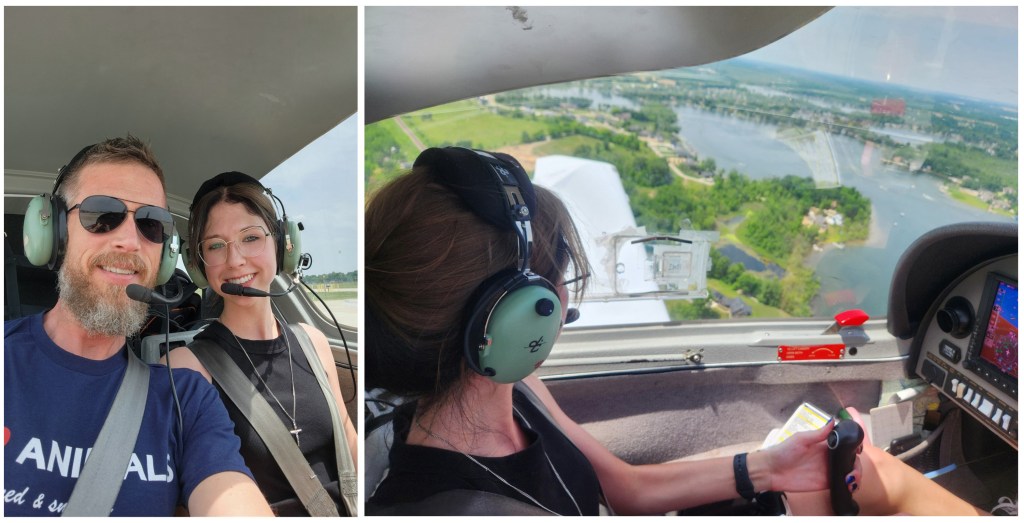
Essentially, my daughter, Madeline, recently earned her private pilot’s license. As a Father’s Day gift, she took me on an hour-long flight. We departed from Bishop International Airport in Flint, flew to a small airstrip in Linden, landed and launched twice, and then returned to Flint. On approach into Flint, she performed a maneuver called a “slip.” I looked it up and found the following definition to be exactly as I experienced:

“A slip is an aeronautical maneuver that involves banking the aircraft into the wind and using opposite rudder to maintain a desired flight path while increasing descent rate or correcting for wind drift.”

In plain terms, Madeline banked us left, and yet, we didn’t turn. We slid sideways while descending rapidly. Just above the runway, she finally straightened the plane, leveled us out, and touched down as if we were angels gently descending from heaven.

She was amazing.

Now, I started by saying I experienced a significant role reversal. To frame all of this in the proper perspective, it really wasn’t all that long ago that Madeline’s life was in my hands in every way imaginable. Indeed, it’s as if only recently, I was tucking her into a car seat and securing the five-point harness, even adjusting the straps to fit her comfortably while ensuring maximum safety. I was the one who checked twice—sometimes three times—that every latch was secure, every buckle snug, because that’s what a father does to keep his child safe. He does things like hold her hand in public. He hovers behind her on staircases that she is still too small to climb. He steadies the handlebars on her first bike ride, jogging alongside her down the sidewalk, ready to catch her when she tips. Everything about her very existence—the entirety of her well-being—is entrusted to him.

But last Sunday—Father’s Day, no less—somewhere just beneath the clouds, the roles reversed, and I found my life was entirely in my daughter’s hands. I climbed into the copilot’s seat and fastened the belt, which she then refastened because I hadn’t done it correctly. She proceeded to adjust it accordingly. And then she was the one now glancing over the vehicle’s every dial, confirming each setting, running her hand along the controls, reciting the pre-flight checklist items with unbroken concentration. I did nothing. She captained the headset, talked with the towers, and guided me through what to expect.

I guess what I’m saying is that the magnitude of that transfer wasn’t lost on me. It was exhilarating, yes, but also profoundly humbling.

Still beaming a couple of days after the flight, while Madeline and I were driving together, I told her again how proud I was of her. I mentioned a quote that had resurfaced in my mind as we flew—something from C.S. Lewis’ The Four Loves. He wrote so profoundly, “To love at all is to be vulnerable.” I explained how placing my life in her hands had revealed something. It wasn’t just that I trusted her. It was more about the depth of love I have for her, the kind that knows just how much she loves me, too.

I’ve known Lewis’ words for a long time. I’ve reflected on them in the context of marriage, friendship, pastoral ministry, and countless other situations where love demands a certain measure of risk. But I’d never thought to apply them to my kids until now. And yet, there they were, soaring right beside us at 2,000 feet on Father’s Day.

I’m usually pretty good with words. But this morning, I’m feeling somewhat limited. The English language doesn’t really have the capacity for genuinely communicating the moment your parental life shifts from giving care to receiving it—from being the one at the controls, both literally and metaphorically, and then, in an instant, letting go of the illusion that I would always be the one doing the work to keep my child safe. That kind of vulnerability doesn’t come easily, especially for a dad. But it is, I think, a place where, if we’re looking through the lens of the Gospel, God shows us just how complete love can be in a family.

I suppose something else comes to mind in all of this, too.

I would imagine that most Christians are familiar with the text of Proverbs 22:6, which reads, “Train up a child in the way he should go; even when he is old, he will not depart from it.” Most folks see that verse in terms of instruction in moral grounding and right living. That’s not wrong. But it misses the heart of the verse.

Its primary aim is that we would raise our children in the “way,” namely, faith so that when they do climb into the cockpit of life, so to speak, they do so not only with competence but with wings outstretched for trust in Christ. In that sense, Proverbs 22:6 reminds us that even as our children’s hands might reach to ours for learning character, skills, and such, it is far more critical that they know to reach for the Lord’s hand in all things. Only then can they truly navigate both the clear skies and the storms with spiritual wisdom and poise. Only in Christ will they know how to take off, how to “slip” when necessary, and how to land with grace.

Anyone considering these things honestly will recognize something more.

Without question, the world my children are navigating is by no means the same one I inherited. Long before the latest news about Iran, the skies they were flying in were already far more turbulent. The voices buzzing through the coms are more confusing, almost unintelligible. The instrument panel in front of them, while more advanced, is almost entirely calibrated by a secular age that denies God’s existence altogether, calling His Word foolishness and insisting that truth itself should be wholly despised.

My point is that the role of Christian parenting cannot be passive in any of this. It cannot be content merely with getting one’s kid into a good college so that they are materially successful. All of that ends when they breathe their last. As I’ve often said from the pulpit, this world and everything in it carries an expiration date. You may not see it, but it’s there. That said, we are not just raising children to exist and survive among temporal things. We are raising them, as Luther said, “to believe, to live, to pray, to suffer, and to die” (LW, Vol. 47, pp. 52-53), which, by default, means we’re raising them to exist in this world with eternal things in mind. We’re raising them to stand, to speak, and to boldly hold the line when others around them are folding. We’re raising them to do these things, not with arrogance, but with conviction formed by the eternal Word of God.

That’s why Proverbs 22:6 matters so deeply. Indeed, to “train up a child in the way he should go” means to help position them for good character and success. But the “way” it mentions is not abstract. It is the cruciform road that leads through repentance and faith in Jesus. When we train our children in this way, we’re grounding them in the very mind and heart of God.

And they need this grounding. They’re already being told that truth is subjective and that steadfast Christian conviction is cruelty. Worst of all, the surrounding world insists that biblical godliness is an artifact of a bygone era. They are surrounded by cultural winds that do not merely blow—they howl. If they are to fly straight—if they are to correct for this world’s drift—they will need spiritual discernment. They will need courage calibrated by sound doctrine and faithful practice. They will need to be taught to see everything in this world through the lens of who they are in Jesus.

In a sense, the time has already come for me to realize that my kids are now flying and I’m not. If you haven’t yet arrived at the same realization, then just know that you’ll be there soon enough. The time is coming when your little ones’ hands will be on the controls, and your hands will be folded in prayer.

That time comes sooner than we think. Parents, the preparation begins now.

When the choice is between faithfulness to Christ and the world’s distractions, choose faithfulness, even when the child doesn’t want to. Lead the way. Even as they might kick and scream to get free from the car seat, strap them in and set out. Do this not only because you’re teaching them how to fly but why to fly. Do this, remembering your children will one day be at the controls, and they’ll be faced with circumstances you never imagined.

Still, when this happens, you’ll be okay, even if things appear to be going south. You’ll be confident that you did everything possible to keep them connected to Christ. You’ll be able to hope that, when it matters most, they’ll know to lean not on the wisdom of this world but on the One who will never steer them wrong. Even better, you’ll know that even though you’re not in the cockpit, Christ is, and regardless of what anyone’s bumper sticker might say, He’s no copilot.

Be a Man

The Thoma family doesn’t go out to dinner very often. It isn’t just that dining out has become quite expensive. Instead, it’s that we’ve always been more interested in family dinners at home. Any time we’re required to share a dining space with others, it seems the genuine Thoma frivolity becomes unfortunately inhibited. At home, we can be us, laughing as loudly as we’d like at whatever we like. We play games. We rib each other. Sometimes, we even throw stuff. We don’t make a mess. We’re not messy people. But we do things at home we surely wouldn’t do in a restaurant.

I should admit that in restaurants, Jennifer is the governess. She maintains the boundaries. I certainly know where the boundaries are. However, my threshold for public tomfoolery is a little higher. I can easily become a part of whatever hilarious thing Harrison or Madeline might be doing that requires a little more volume or risk. Thankfully, Jennifer anticipates this and brings us back into orbit. She doesn’t quell the fun. She maintains its appropriateness.

When things are no longer in tomfoolery mode but instead require actual discipline, it’s often the other way around. Jennifer is much gentler. I stand at the borderlands’ edges, allowing nothing illegal to cross. Ultimately, my sons are expected to be Godly men, and my daughters are expected to be Godly women.

Looking back at what I’ve written, two things come to mind.

The first is that fathers and mothers—men and women—are very different. I probably don’t need to tell you this. Or maybe I do because it sure seems these roles are more than confused these days. Men are portrayed as inept and effeminate ninnies in movies, TV shows, and commercials. Women are depicted as hardnosed boss-girls who shepherd the men around like children, but that’s only when they have need of them. The genuine give-and-take of naturally complimentary roles has been lost to artificial ideologies meant only to disrupt. Perhaps worst of all, the ability to define the actual roles has already been sacrificed at confusion’s altar. What is a woman? What is a man? Fewer and fewer can answer these questions, lest they give a truthful answer and be canceled. In fact, the answer is becoming more elusive, not only relative to gender but to species. For example, a 22-year-old man who thinks he’s a female cat is running for a seat on the Board of Commissioners here in Livingston County. I have a quick story about this.

I was picking up my daughter, Evelyn, from volleyball practice at the Hartland Community Education building when I drove past this candidate and his friends having a picnic-style demonstration on the facility’s front lawn. There were only a handful of people with him. It was by no means a grand event. Nevertheless, he placed signs near the facility’s driveway, one of which read, “Protect trans students like you protect your guns.” If I hadn’t been in a hurry to get Evelyn home to Linden and then back again to Hartland for a church meeting, I may likely have stopped to ask for clarification. This tendency does get me into trouble sometimes. Just ask Jennifer. She shifted into governess mode a couple of times yesterday at a conference in Detroit to keep my tomfoolery at bay. However, one particular gent in a breakout session who insulted me for being Lutheran rather than Catholic did receive a word or two. Actually, he received four.

Still, I believe in conversation, especially for the sake of invalidating untruths. I certainly had more than my fair share of questions before I rounded the first turn in the parking lot to fetch Evelyn that day. In particular, I would have asked the 22-year-old cat woman with male genitalia if “Protect trans students like you protect your guns” meant registering trans students with the government. Next, I would have asked if that meant red flag laws, too. In other words, if a trans student behaves in ways that make me nervous—like, say, demanding drag queen story hours at the local library—I could call the cops and have him, or her, or whatever taken away and locked up, letting the situation get sorted out in court before allowing him (or her, or whatever) to go home. Along those same lines, I’d have asked if he thinks we should keep all trans students locked away in safes to help keep children safe.

This is only one thread in gender confusion’s fabric. But this fabric is so easily unwound when the hard truth pulls on it. Speaking in an elementary sense, the fact that two men cannot create a child excludes such madness from any real claim on Father’s Day. Inherently, the word “father” assumes and requires “mother,” so whether a man and woman procreate or adopt, fatherhood remains innately a man and woman thing, not a man and man thing. The same goes for Mother’s Day.

I told you two things came to mind. The second is the blessing of home.

Everything I described begins in the home. If a child’s home is unsteady or confused, then everything beyond it will be, too. Beyond this, I once heard someone say that home is a pre-heaven of sorts. Indeed, home is a place where your seat at the table is certain. The rule of forgiveness secures it, and everyone there is family. Oliver Wendell Holmes said something about how our feet may leave home, but our hearts never will. This is to say that we’re forever rooted in a lifeblood sort of way with our home. Who we are, what we’ve learned, who taught us, and why—all these things go with us. And yet, even as they’re carried away on two legs, they are forever bound to the source, no matter where we might be. In my opinion, this is just another way of highlighting the significance of fathers and mothers and that no matter where a child goes, he can never really shake loose from the home his parents made. Good or bad, it’s forever a part of him.

Wrapping this up, I say, since it’s Father’s Day, grab hold of confusion’s fabric and pull. Do what you can to dispel gender confusion. Treat your dad like the manly man he is and ought to be. Rejoice and publicly share those things that show dads to be the God-given heads and protectors a family needs and requires. Maybe even take a chance at grabbing this world’s absurdity by the jugular. June certainly would be the month to do it. Women, demand alongside Saint Paul that the men in your life “act like men and be strong” (1 Corinthians 16:13). Husbands and fathers—the gents crafting the next generation of men—insist beside King David, who instructed his son, Solomon, “Be strong, and show yourself a man” (1 Kings 2:2). Even better, demonstrate manliness for them. Demonstrate it for your daughters, too. Be tough when toughness is required. Be courageous. Most of all, shepherd them toward Jesus, and along the way, do everything you can to hold the line on truth while invalidating untruth. My guess is that when they eventually leave home, and they will, no matter where they go, their hearts will be permanently sourced by something far stronger and more certain than this world’s sin-draped irrationality.

Father’s Day 2023

While I can’t quite see the Florida sun from where I’m sitting, I know it’s there. Its morning beams have already gone out to paint the sky like flower girls scattering petals before the bride in a wedding procession. Sunrise is coming. It’s at the day’s gate.

Every year I say I will not write any eNews messages while on vacation, that I will leave everything behind and simply simmer in the joy of minimal obligation. But then I end up doing it anyway. I told Jennifer yesterday at the airport that perhaps I’d fight the urge this year. Truth be told, I had another factor prompting today’s early morning rise. In the house where we’re staying, the same place we visit every summer, the owners got a different mattress for the master bedroom—a horribly cheap mattress. I don’t know why. What I do know is that I have a terrible back, and the new mattress has got to be the worst, most pain-inducing one I’ve ever slept on in my entire life. I’ll try one of the other beds tonight. I’ll sleep on the dining room table if they’re all the same. Or a lounge chair near the pool. Or the bathtub.

Since today is Father’s Day, I certainly have the gem-filled occasion in mind this morning as I sip my coffee and down some ibuprofen. I’ve learned a few things as a dad, many of which have only come to fuller bloom in recent years. For example, as the father of two daughters, I’ve learned that, in a way, I’ll always be my girls’ first love. I mean that they’ve likely learned the type of man they want to marry from observing the man I’ve been. I can promise you the day either of them stands beside a husband-to-be at the Lord’s altar will be a conflicted moment of joy and sadness. I’ll be happy, trusting the Lord’s promise to bless them. But I’ll also be sad, foolishly convinced that no one will ever love my daughters like me.

As the father of two sons, I’ve learned a similar lesson. I’ve learned that any words of advice I’ve given them through the years are of fractional value compared to the things they’ve seen me do. Again, the day my sons become husbands—and by God’s grace, fathers—will be a day of mixed emotions. I’ll be blissful, trusting in the same blessings of God. And yet, I’ll be torn. I’ll know I’ve reached a certain point of irrelevancy in their lives. In other words, they’ll have set sail. Once at sea, a ship’s builder is no longer needed.

I suppose these concerns are ridiculous. Of course, someone can love my daughters like me. Maybe even better. And certainly, I won’t be irrelevant to my sons. They’ll meet with situations that, even as husbands and fathers themselves, will prompt them to ask their own dad’s perspective. I know these things. And I know they’re all a part of one generation carrying on to the next.

“…one generation carrying on to the next.”

Now and then, when I write something, I must examine my own words. Plenty in God’s Word describes how that carrying on is to happen. There is plenty more revealing what a parent’s truest goal in the process must be, namely, to raise their children in the faith. Still, one text resonates more with me this morning than the others. Psalm 103:13 reads, “As a father shows compassion to his children, so the Lord shows compassion to those who fear him.”

Firstly, an underpinning of this text has to do with demonstration, of learning behaviors from someone else. Secondly, the text isn’t teaching a single step in a broader course but instead is looking at every stage and showing what’s necessary to each—what’s actually binding each of life’s efforts to the next. Interestingly, it does this by way of three assumptions. The first assumes that fathers will show compassion. The second considers the Lord’s compassion as the standard to replicate. The third believes the Lord’s compassion will be given to those who put their faith in Him. That’s His promise, and it can be trusted.

At the root of the denominative verb used for “shows compassion” is the noun “racham.” Chasing this word around the Old Testament for a few minutes this morning, I discovered other interesting uses relative to sympathy, nurturing, brotherly fellowship, and the like. One of the more unique connections has to do with a mother’s womb and the reality of birth. This connection matters most to me this morning, especially as a parent with a mind for Father’s Day. Although, it might not be for the reason you’re thinking.

I think it matters most because, even though I’m the one God put in place to shepherd my children, I’m no different from them regarding human birth. We’re all born into the sinful predicament of human dreadfulness (Romans 5:12-18). As a dad, when I observe their failings, I must be aware of my own. I must recall my place beside my children in this rumpled and grimy world, where I own just as much Sin-stained guilt as the next person. In other words, I must parent them, realizing we’re in this together. We’re standing before God on the same footing and need something.

Admitting this, I’m drawn to remember what that “something” is. Nicodemus’ conversation with Jesus in John 3:1-21 frames it. It was there Jesus told Nicodemus—a man who’d soon experience faith’s stirring to defend Jesus in John 7:50-52 and then assist in His burial after the crucifixion in John 19:38-42—that even as one is born of the flesh, God is compassionate, and a rebirth is possible. Most people today use the phrase “born again,” but it’s really better translated as “born from above” (γεννηθῇ ἄνωθεν). In other words, just as a child can’t choose to be born, the rebirth of faith is God’s laboring. He births us into His family. It’s no wonder the same disciple who recorded this interaction with Nicodemus also wrote in 1 John 4:7 that a believer who truly demonstrates Godly love—a person who shows compassionate care—proves “out of God he has been born” (ἐκ τοῦ θεοῦ γεγέννηται).

I was born in the flesh, but I was also reborn in faith. From this vantage, I can clearly see the Lord’s fatherly demonstration of compassion, and I can carry that demonstration to my children. God did not give me what was owed for my crimes. He loved me. He had mercy, and He birthed me for something better. Child or adult, did I suffer the natural consequences of certain behaviors? Yes. But am I eternally condemned by them? Have I crossed beyond the border of God’s compassion? No. That’s the most reliable assumption woven into Psalm 103:13. For those who, by repentance and faith, know their Sin, they’ve been reborn to know a God who stands ready to receive them, One who promises never to leave nor forsake them (Hebrews 13:5). He is compassionate. He demonstrated it fully through the person and work of His Son, Jesus Christ. He moves Godly fathers to emulate the same compassionate care, principally as they introduce their children to Christ for the sake of salvation but also as they demonstrate the humility of repentance and trust in Him. It’s God’s will for this powerful Gospel display to surge forth from one generation of fathers to the next.

I want to instill these reliable assumptions in my children, both in their relationship with Christ and in their relationship with me. The time is coming—very soon, in fact—when they’ll work to instill the same unfailing assumptions in their own families. God willing, I’ll be here to help when they ask and for as long as the Lord allows.

Happy Father’s Day. I pray it’s an enjoyable one for all.