Two of the little girls washed away in the floodwaters were sisters. Blair and Brooke Harber were their names. Blair was 13 years old. Brooke was 11. When they found their lifeless bodies fifteen miles downstream, they were still holding hands.
When Jennifer shared this with me last night, I thought this couldn’t possibly be true. Then I looked it up. It seems it is true. The New York Post reported it. So did the Houston Chronicle and the Associated Press.
But here’s the thing. I have two daughters. If there’s one thing I know for sure about them, had they been swept away in a similar tragedy, we’d have discovered them in a similar embrace.
Madeline and Evelyn are as different as night and day. One loves to fly. The other could spend the whole day fishing. One prefers all things scary. The other is most comfortable in cowboy boots. One slips into unfamiliar scenes with quiet grace. The other makes sure everyone in the room knows where she stands on pretty much everything. But for as different as they are, the love they have for Christ, their family, and each other has never needed them to be alike. It has only needed them to be near.
So, while Jen was reading to me about those two girls, I’ll admit I got a little choked up. Who wouldn’t? Although I didn’t let her see it. She was already struggling to read the article, and a husband needs to be sturdy at these times and in these ways. Still, it was hard to hear, not just for the sorrow of it, but for the unseen truth, something familiar to me, that stirred in the swirling muck of a dreadful situation. The kind of love those girls had, I see it in my own daughters. That kind of final grasp isn’t made in a moment. It’s made over the years through late-night whispers, shared stories, and tearful apologies. It’s born from a wordless understanding between two sisters who know each other sometimes better than they know themselves. It is a love that holds on.
I know Madeline and Evelyn would have held on, too. And I believe they still will, no matter how far the current of life carries them. Because love like that just doesn’t let go. Even better, they have a Savior who won’t let go of them. And together, as sisters, they know it. They know even if the world gives way beneath them, He is there. By faith, they know, just as the seemingly simple and yet incredibly profound song goes, “Little ones to Him belong. They are weak, but He is strong. Yes, Jesus loves me.”
Spring is upon us. Do you want to know how I know this? Migraines.
Every year at this time, the migraines set in. I never experienced them growing up in Illinois. Here in Michigan, surrounded by the Great Lakes, the temperature and barometric changes are more drastic, making their probability and frequency more prevalent.
Do you want to know one of the places with the least barometric fluctuation resulting in migraines? Florida.
Yes, Florida is a peninsula, which means it’s surrounded by water. Still, coastal regions aren’t as chaotic when it comes to barometric changes. They’re relatively ordered. I suppose that’s why I feel great while there. In fact, my chronic back pain typically disappears, too.
I read that tropical regions near the equator are the best places to avoid migraines. However, moving to an off-the-grid village somewhere outside of a place like Macapá, Brazil, probably wouldn’t work for me. I know that stress levels play a part in migraines, and I’m guessing my first trip to the bodega for supplies could result in a new kind of headache. While I’m generally disinterested in material things, I do appreciate creature comforts, such as air conditioning and pasteurized milk. My stress levels would almost certainly increase when these things are only occasionally (if at all) accessible. It’s also why I’d last maybe three days before packing up and moving to a place with more reliable electricity and steady internet access. I need to impose my ramblings upon the world around me, if not for you but for me. My constant need to type something—anything—helps maintain my brain’s order. I’ve written before that my need to write is almost disease-like. It’s an itchy affliction. If I don’t scratch it, I’ll unravel.
I wasn’t sure where this was leading just yet, but I think I figured it out. I’m a man who appreciates good order. My body is in complete agreement, and my seasonal migraines are a reminder.
Jennifer insists among our children that they keep themselves in order with calendars, planners, and the like. Our oldest son, Joshua, is married now, has a son, and works a full-time job. It’s funny how he’ll hug his mom and say, “You were right about keeping things organized.” He has come to realize, as many of his age eventually do, that disorder breeds unrest. The Bible certainly affirms this. In fact, it interprets disorder as sin’s regular product.
Saint Paul insists somewhat plainly that rejecting God and His natural law results in a “debased mind,” which is little more than a condition of mental and moral confusion (Romans 1:21-22, 28). Saint James writes, “For where jealousy and selfish ambition exist, there will be disorder and every vile practice” (James 3:16). Isaiah offers, “Woe to those who call evil good and good evil, who put darkness for light and light for darkness” (Isaiah 5:20). The implication is that sin distorts moral clarity, ultimately confusing right and wrong.
Again, disorder is sin’s fruit.
Relative to this, I should say that I appreciate simplicity. Sinful humanity tends to complicate things. Sure, the mechanics of almost any issue are vast. In a way, I attested to that last week when I wrote about the need to read more, not less. Still, the point of sifting through the swirling details of any particular issue is to find a way through the confusion to something better. When we do find that way through, we often discover that the fix was not as complicated as we thought. It may be difficult getting there, but when we do, it won’t be hard to understand the what, why, and how of it all.
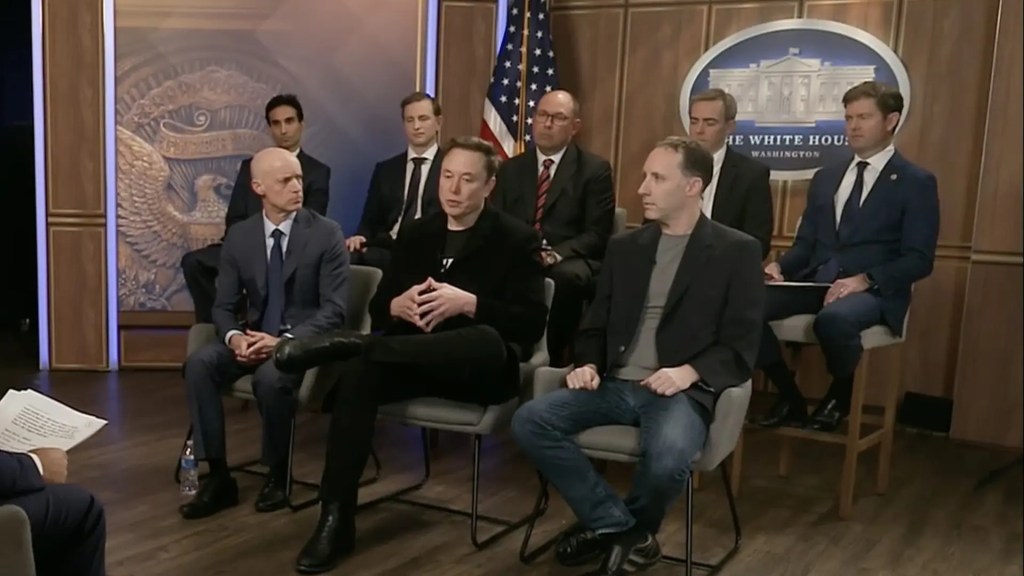
I wonder if this is why I’m oddly captivated by Elon Musk and his Department of Government Efficiency. While the United States government swirls with chaotic dysfunction, here’s a guy who has stepped into the middle of all of it and found a way to make its complicated mess into something crisp. His brainiacs have devised algorithms that can gather the chaos, sort it, identify the good and bad, and find a way through to an objective fix. When I observe this through a Gospel lens, there’s something strangely biblical about what Musk and his nerds are doing. No, not in the “mark of the beast” kind of way that the Revelation-twisting junkies and modern-day prophet-following weirdos try to suggest. First, I’m led to more of a David-and-Goliath image, where the unlikeliest champion throws a stone at the lumbering establishment, and the whole system wobbles. My second inclination goes far deeper.
Whether he realizes it or not, Musk has stumbled into sacred territory. A binding thread inherent to natural law is God’s desire for order. Saint Paul affirms this in 1 Corinthians 14:33 when he writes, “For God is not a God of confusion but of peace.” In Titus 1:5, he tells Titus to “set in order the things that are lacking” in the churches of Crete, making it clear that the Church itself requires structural clarity and good governance. Even in Acts 6, when the early Church faced the initial challenge of caring for widows, the Apostles responded with an administrative order. They appointed deacons to handle the task so that the administration of the Word remained central. It’s here (as it was with 1 Corinthians 14:33) that we see God’s deepest desire for order, which Saint Paul highlights in 1 Timothy 2:1-6 when he writes about the need for Christians to interface with earthly authorities. We do this to help maintain good order. And why? In verses 2 through 4, Paul says the goal is “that we may lead a peaceful and quiet life, godly and dignified in every way” (v. 2). He continues, “This is good, and it is pleasing in the sight of God our Savior, who desires all people to be saved and to come to the knowledge of the truth” (vv. 3-4).
The whole point of order is to provide a context in which the Gospel can be preached freely and without obstacle, all for the sake of saving souls.
With these things in mind, I realize it’s by no means coincidental that, right from the beginning, one of the first mandates God gave to Adam was to maintain order. In one of the most surprising acts of delegation ever recorded, God said, “Fill the earth and subdue it.” Next, He added, “and have dominion” (Genesis 1:28). This was a call to cultivate and maintain order in God’s creation. And so, we do. Certainly, this is an issue of faith relative to obedience. But as with all of God’s commands, there are practical fruits that come from holding to His divine commands. I already told you the most important one: the Gospel’s perpetuation. But there are others.
For example, order is inherent to a stable household. The Thoma family spent most of our dinnertime together on Friday talking about the blessings of a household that’s built in the way God designed it. A household established on God’s orderly design for marriage—a husband and wife—doesn’t just produce more humans. The sacred offices of husband and wife, becoming father and mother, create an ordered framework for children to understand love, responsibility, and many other aspects that make life truly enjoyable, just as God intended. If anything, a stable household becomes a training ground for carrying the kind of order that’s true to God’s heart into the broader world. It isn’t stifling. It nurtures growth while simultaneously instilling a crucial resilience to chaos, which is the space where confusion cooks up division, leading to broad-reaching and long-lasting harm.
As I said, observing through the Gospel’s lens, Musk and his team are in sacred space when they do what they’re doing, if only because they’re trying to bring order to chaos. They’re laboring to establish order’s honest clarity amid falsehood’s confusion.
To wrap this up, I mentioned at the beginning that migraines are a seasonal reminder. Keeping this ailment within the boundaries of God’s Word and beneath the shadow of the cross, my migraines are a natural protest against disorder—my body’s internal revolt against barometric chaos. In that sense, they’re a metaphor. They are proof that sin exists; it’s at work in my body (Romans 7:23). With it comes disorder. They also help me remember that God did not intend them by His design, and therefore, I’m not where I’m meant to be. In a mortal sense, even as I’m better suited for Florida’s climate, in the more extraordinary sense, I’m genuinely meant for the restored order of the new heaven and new earth (Revelation 21:1-5, Isaiah 65:17, 2 Peter 3:13) that Christ brings at the Last Day—the time when my whole self “will be set free from its bondage to corruption” (Romans 8:21).
Indeed, this world’s chaotic brokenness isn’t the final word. Genuine, actual, real restoration of order is coming. Christ has already seen to this by His life, death, and resurrection.
Every family is a symphony. Every member is a skilled musician with a unique instrument in hand. Every moment is a song, and every word is a note carrying its melody. Early last week, the Thoma family’s ensemble just grew by one performer. Preston Michael took his seat among us, and as you might imagine, for this grandpa, his promise is most rapturous.
I got to meet him the day after he was born. His dad—my son, Joshua—introduced us. I didn’t get to greet Preston properly, though. He’s currently in the NICU, and he’ll likely be there for a few more days. Nevertheless, at the time, his wriggling fingers, crinkly nose, and peeking glances were silent greetings that sang straight into my heart—a kind of resonance that only children and the angels who guard them can produce (Matthew 18:10). I finally got to hold him yesterday, and what a joy it was.
I can promise you that I intend to be the kind of grampa whose hug is felt long after I’ve let go.
With Preston’s birth came an in-rushing of familiar sensations. The day after he was born, Joshua and I talked about it while Jennifer and Lexi went down the hall for a turn with him. We spoke as only fathers can. I wondered aloud something like, “When you were born, I remember experiencing a particular sensation. It was a sudden awareness—almost a presence—something I felt like I could reach out and touch if I wanted to.” I told Joshua that when I first saw him, I knew everything in my life would be different, that nothing would ever be the same again, and that whatever happened from here on out, I was all in for him. I loved him. He was family.
Joshua confirmed the sensation. I’m not surprised. I imagine that, for most parents, the moment their child arrives—finally intersecting with the world in a touchable way—it is an event like none other. In a sense, even though the Earth still revolves around the sun, there’s a shift in gravity’s center. The child becomes the middle, a luminescent joy around which all other planets must spin. Indeed, as it was when I first became a father, it was the same for Joshua. Everything was different now, and no matter what the future held, trusting Christ, Josh knew it was going to be incredible.
We both admitted it wouldn’t be easy. In that moment, roles reverted. I was the dad again, and he was the son, with both of us recalling the challenges as we knew them. We acknowledged times when Josh made life more complicated and times when I wasn’t the best parent I could’ve been. Still, we returned to where we started. There we were, acknowledging that the lack of ease doesn’t negate the joy of parenting. If anything, it serves to remind us even more of family’s wonderfulness.
I’ve always believed that while God has fashioned some indescribably splendid things, of them all, family is one of His best. He brings two very different people together, a man and a woman, and from their union, life! However, not just human life (which, of course, is the wonder above all others), but instead the actual experience of living—the lived reality of vocation and recreation and relationships and all the things that a human experiences. The thing about family, however, is that while we’re out and about in the world living, even as that same world will so often be vicious and unforgiving, there will always be a group of people—a place—where living assumes love and where the cardinal rule of governance is forgiveness. In other words, God has designed the human family to be reminiscent of Himself. When everything around you is coming undone, or when you’ve been as unlovable as you can be, there will be someone willing to take you in, forgive you, and continue to love you.
The writer George Bernard Shaw, while he was a philosophical and spiritual mess, managed to get something right when he wrote that “family is but an earlier heaven.” In a way, Christians know at least two deeper truths in this.
First, we know that marriage, the institution that establishes families, is a glorious image of the Gospel itself. Saint Paul described marriage as a mysterious representation of something much grander: the relationship between Christ and His bride, the Church (Ephesians 2:32). Go anywhere else in Paul’s writings, and you’ll see this relationship is what it is because of the forgiveness won and exacted by the Groom, Jesus.
Second, we know family can at least be an atom-sized glimpse of heaven because, as I mentioned before, love and forgiveness are a family’s glorious essentialities. This is to say, the Gospel of Christ’s life, death, and resurrection show us a family established by grace born from devoted love. Born into this by baptism into faith, heaven becomes our rightful home. As believers, we’re those whose robes have been washed and made white in the blood of the Lamb (Revelation 7:14). By this, we belong, not because of anything we’ve done, but because of what God has done for and to us.
In short, God adopted us as His children (Galatians 3:26, Romans 8:14-15). He made us family. And now, no matter where His believers are from or what scars their pasts inflicted, God always takes in His family.
I don’t know what Preston’s future holds. But I do know he’s been born into a family that loves him, one that knows its frailties, and because of those insufficiencies, things won’t always be easy. And yet, God stands at the podium. With baton in hand, He’s conducting with grace-filled movements, coaxing from His white-robed orchestra such lovely sounds. It’s a divine composition of His care, ringing out melodies that sound like “I love you,” and “I’m sorry,” and “I forgive you,” and “It’s good to see you,” and “I’m glad you’re home,” and so many more. Preston now has a seat on this stage, and like everybody else in the orchestra and audience, I can’t wait to hear him play.
I tell myself every year I’m not going to write and send an eNews message while on vacation. Every year, I fail to keep this pledge. I know why. There are two reasons.
First, it’s because I’m a writer at heart. For me, writing is far more than a byproduct of my task as a pastor. It’s in my DNA. Somewhere along the twirling genetic strand responsible for my development as a human being is a switch. In the off position, writing is a chore. But mine’s been flipped to the “on” position. I do it because it’s who I am, and as such, it’s harder to avoid writing than it is just to sit and do it.
My wife, Jennifer, more or less highlighted the second reason I continue to fail at keeping the “no eNews” pledge. It happened during a relatively recent conversation between us concerning death. She asked where I’d like to be buried. Assuming the conversation wasn’t hinting at a secret desire to off me in the pool while away, I floated along in its stream, implying I didn’t really care where the family returned me to the ground. My only two requirements have been that I not be cremated and that the mortician embalms me with my remaining whisky, fully aware that, even as I’m friends with many of the funeral directors in the area, the former is more probable than the latter. Beyond that, the family can sink me in the pond in the backyard for all I care.
From there, Jennifer asked if our church had ever considered using some of its property for a cemetery. I told her it had been discussed at one time years ago, but nothing ever came of it. It was then she betrayed a profound love for the people in our congregation and how she didn’t want to be buried in a random cemetery somewhere. When it came time for her burial, she wanted a place where she, and perhaps the generations of Thoma kin to follow, could be laid to rest together with their realest family—their church family. When she said that, not only did I know she was describing something I somehow knew I also wanted but never realized, but I understood why I would continue writing a message like this on vacation when I really don’t have to.
It’s because I love my family. The hundreds of people who receive this eNews every week at Our Savior Evangelical Lutheran Church in Hartland, Michigan, where I serve as pastor, are a part of that family—my realest family. Along with my immediate family, these are the people who, when the final trumpet sounds and our corrupted bodies are raised incorruptible to stand before the throne of Christ (1 Corinthians 15:51-57), I will count it all joy to experience this beside them. I’d count it a privilege to be alongside the Christians among whom I lived and breathed and served and worshipped in this life.
Maybe it’s time to revisit the idea of a church cemetery. With twenty-six acres, we certainly have the space. I’ll leave that to the church leaders at Our Savior, who may be reading this right now. To everyone else, I’ll simply encourage you to give thanks to God for your church family. In this life and the next, they’re the realest family you’ll ever know.
By the way, for the editors out there, I know “realest” isn’t a word. I just like how it sounds.
The Thoma family doesn’t go out to dinner very often. It isn’t just that dining out has become quite expensive. Instead, it’s that we’ve always been more interested in family dinners at home. Any time we’re required to share a dining space with others, it seems the genuine Thoma frivolity becomes unfortunately inhibited. At home, we can be us, laughing as loudly as we’d like at whatever we like. We play games. We rib each other. Sometimes, we even throw stuff. We don’t make a mess. We’re not messy people. But we do things at home we surely wouldn’t do in a restaurant.
I should admit that in restaurants, Jennifer is the governess. She maintains the boundaries. I certainly know where the boundaries are. However, my threshold for public tomfoolery is a little higher. I can easily become a part of whatever hilarious thing Harrison or Madeline might be doing that requires a little more volume or risk. Thankfully, Jennifer anticipates this and brings us back into orbit. She doesn’t quell the fun. She maintains its appropriateness.
When things are no longer in tomfoolery mode but instead require actual discipline, it’s often the other way around. Jennifer is much gentler. I stand at the borderlands’ edges, allowing nothing illegal to cross. Ultimately, my sons are expected to be Godly men, and my daughters are expected to be Godly women.
Looking back at what I’ve written, two things come to mind.
The first is that fathers and mothers—men and women—are very different. I probably don’t need to tell you this. Or maybe I do because it sure seems these roles are more than confused these days. Men are portrayed as inept and effeminate ninnies in movies, TV shows, and commercials. Women are depicted as hardnosed boss-girls who shepherd the men around like children, but that’s only when they have need of them. The genuine give-and-take of naturally complimentary roles has been lost to artificial ideologies meant only to disrupt. Perhaps worst of all, the ability to define the actual roles has already been sacrificed at confusion’s altar. What is a woman? What is a man? Fewer and fewer can answer these questions, lest they give a truthful answer and be canceled. In fact, the answer is becoming more elusive, not only relative to gender but to species. For example, a 22-year-old man who thinks he’s a female cat is running for a seat on the Board of Commissioners here in Livingston County. I have a quick story about this.
I was picking up my daughter, Evelyn, from volleyball practice at the Hartland Community Education building when I drove past this candidate and his friends having a picnic-style demonstration on the facility’s front lawn. There were only a handful of people with him. It was by no means a grand event. Nevertheless, he placed signs near the facility’s driveway, one of which read, “Protect trans students like you protect your guns.” If I hadn’t been in a hurry to get Evelyn home to Linden and then back again to Hartland for a church meeting, I may likely have stopped to ask for clarification. This tendency does get me into trouble sometimes. Just ask Jennifer. She shifted into governess mode a couple of times yesterday at a conference in Detroit to keep my tomfoolery at bay. However, one particular gent in a breakout session who insulted me for being Lutheran rather than Catholic did receive a word or two. Actually, he received four.
Still, I believe in conversation, especially for the sake of invalidating untruths. I certainly had more than my fair share of questions before I rounded the first turn in the parking lot to fetch Evelyn that day. In particular, I would have asked the 22-year-old cat woman with male genitalia if “Protect trans students like you protect your guns” meant registering trans students with the government. Next, I would have asked if that meant red flag laws, too. In other words, if a trans student behaves in ways that make me nervous—like, say, demanding drag queen story hours at the local library—I could call the cops and have him, or her, or whatever taken away and locked up, letting the situation get sorted out in court before allowing him (or her, or whatever) to go home. Along those same lines, I’d have asked if he thinks we should keep all trans students locked away in safes to help keep children safe.
This is only one thread in gender confusion’s fabric. But this fabric is so easily unwound when the hard truth pulls on it. Speaking in an elementary sense, the fact that two men cannot create a child excludes such madness from any real claim on Father’s Day. Inherently, the word “father” assumes and requires “mother,” so whether a man and woman procreate or adopt, fatherhood remains innately a man and woman thing, not a man and man thing. The same goes for Mother’s Day.
I told you two things came to mind. The second is the blessing of home.
Everything I described begins in the home. If a child’s home is unsteady or confused, then everything beyond it will be, too. Beyond this, I once heard someone say that home is a pre-heaven of sorts. Indeed, home is a place where your seat at the table is certain. The rule of forgiveness secures it, and everyone there is family. Oliver Wendell Holmes said something about how our feet may leave home, but our hearts never will. This is to say that we’re forever rooted in a lifeblood sort of way with our home. Who we are, what we’ve learned, who taught us, and why—all these things go with us. And yet, even as they’re carried away on two legs, they are forever bound to the source, no matter where we might be. In my opinion, this is just another way of highlighting the significance of fathers and mothers and that no matter where a child goes, he can never really shake loose from the home his parents made. Good or bad, it’s forever a part of him.
Wrapping this up, I say, since it’s Father’s Day, grab hold of confusion’s fabric and pull. Do what you can to dispel gender confusion. Treat your dad like the manly man he is and ought to be. Rejoice and publicly share those things that show dads to be the God-given heads and protectors a family needs and requires. Maybe even take a chance at grabbing this world’s absurdity by the jugular. June certainly would be the month to do it. Women, demand alongside Saint Paul that the men in your life “act like men and be strong” (1 Corinthians 16:13). Husbands and fathers—the gents crafting the next generation of men—insist beside King David, who instructed his son, Solomon, “Be strong, and show yourself a man” (1 Kings 2:2). Even better, demonstrate manliness for them. Demonstrate it for your daughters, too. Be tough when toughness is required. Be courageous. Most of all, shepherd them toward Jesus, and along the way, do everything you can to hold the line on truth while invalidating untruth. My guess is that when they eventually leave home, and they will, no matter where they go, their hearts will be permanently sourced by something far stronger and more certain than this world’s sin-draped irrationality.
Did you know there’s an aspect of human development called childhood amnesia? I didn’t. At least, not until I went looking for information on childhood memory formation. Essentially, childhood amnesia is as it sounds. So many things happened to us when we were little that we just cannot remember. As we grow, a pool of various experiences becomes more and more accessible to memory recall. Scientists used to think that this happened around the ages of seven or eight. Now they believe it happens much earlier, closer to two or three years old.
And so, here’s what prompted my memory-formation search.
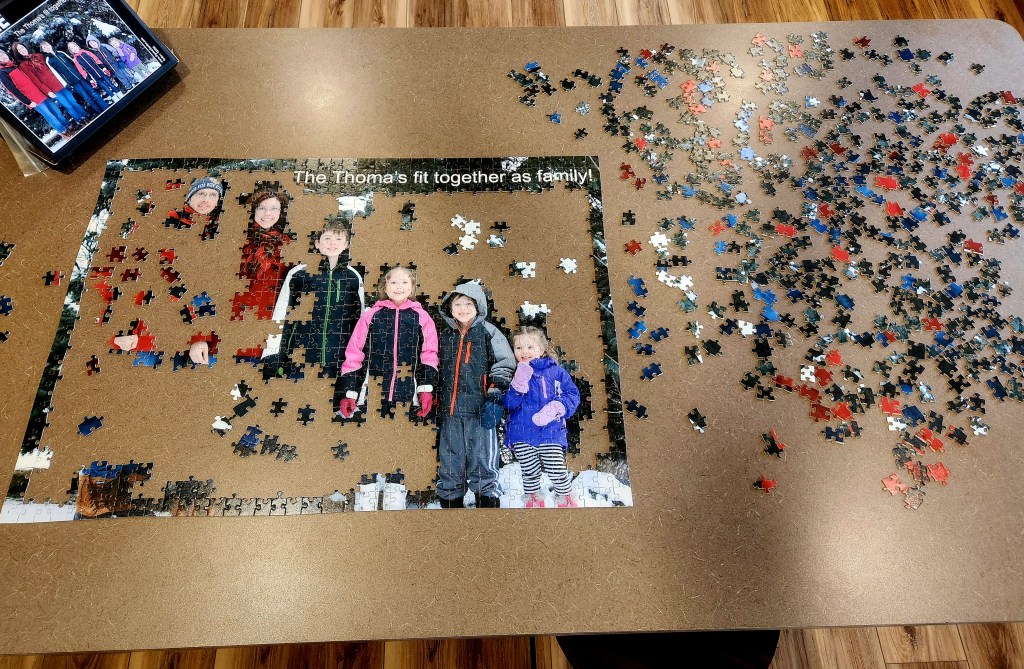
The Thoma family enjoys assembling puzzles. On occasion, Jennifer will fetch one from our shelved collection and dump it on the island in the kitchen. Within minutes, one, two, three, and then all of us are digging through the fragments, looking for the most important startup pieces—the edge pieces. The 1,000-piece puzzle currently occupying our countertop is one I had custom-made as a Christmas gift for the family a few years ago. It’s a wintertime family image taken in front of some pine trees at our former home. The kids were still very young at the time. For perspective, Evelyn is now fourteen. She was a toddler, barely three years old, when the photo was taken.
While assembling herself in the puzzle, Evelyn mentioned that she remembered the image’s moment well. To prove her recollection, she described the event in detail. She remembered Jennifer using one of our old wooden barstools as a camera stand. She remembered her mother taking test shots to sort out the camera’s timer. She remembered snuggling into Harrison beside her. Her ability to recount the details was impressive.
Standing beside her at the puzzle, I attempted silently to conjure my earliest memories. The first that came to mind was sitting in worship at Trinity Lutheran Church in Danville, Illinois. I remember sitting next to my brother, Michael, near the front. I remember flipping through the pages of a book with a red cover. I remember wondering why the people around me said they were “hardly sorry” for their sins. As it would go, that was the 1941 edition of The Lutheran Hymnal, and the word wasn’t “hardly” but “heartily.”
Another that came to mind was being in the bed of a truck at a drive-in. I don’t remember the movie that was showing. Although, I remember explorers, an island, and dinosaurs. It wasn’t King Kong. Kong is hard to forget. If I had to guess, it was The Land that Time Forgot, a film that was instinctively familiar when I discovered it on TV as a Sunday matinee. Concerning the drive-in, I remember a magnificent screen, an expanse of cars, and the tinny sound from a tiny speaker.
There are more memories I could share. I’m sure you have your own, too. What struck me about mine and Evelyn’s is that our earliest memories felt like primitive echoes of who we are today. For example, when it comes to family, Evelyn is all in. She loves her family. If we plan to do anything, the discussion is irrelevant if the whole family cannot participate. This rule remains even now that Josh is married. Interestingly, one of Evelyn’s first memories is a family event captured in a photo. Relative to my first conjurable memories, I’m a Lutheran pastor, and I absolutely love movies, especially the kinds meant to scare.
It’s no secret that a person’s childhood experiences are foundational. Like the puzzle Evelyn and I were putting together, they’re crucial pieces to what will become a more complete picture. I suppose I’m speculating that a child’s first memories mark childhood experiences that had incredibly formative power.
This past week, I had these things in mind while rehearsing with our school children for the children’s Christmas service. The kindergarten and first-grade students, the children who are likely emerging from the amnesia stage right now, sat closest to me. I watched them. As I did, I wondered which among them might have as a first memory what they were currently experiencing. Would any among them remember the twinkling décor adorning every corner of their church’s massive worship space? Would they recall the church’s mighty pipe organ lifting their joyful voices to the very threshold of heaven? Would they one day reminisce about how they were so excited to sing “Joy to the World” that they kept singing too soon? Would they remember their teachers whispering at times, “Just wait, not yet,” gently quieting them for the appropriate moment to start singing? Would little Isabella, a first-grader sitting where she could spy Pastor Thoma behind the Christmas tree, remember how he smiled and winked at her every chance he could and how she smiled so brightly back?
I hope so.
One thing is certain, though. Children kept from such things won’t have these memories. Ever. And this doesn’t just apply to the more fanciful time of Christmas. It’s true all year long. If parents don’t bring their children to church, it should be expected that a desire for Christ and His gifts will be foreign to their future selves. In other words, it’s more likely the puzzle pieces at the edge of their identities will border a future image that doesn’t include Jesus.
Unfortunately, it’s during these crucial developmental stages that parents are most tempted to stay away from worship. Apart from the dreadful poison of outright unbelief, what would keep a Christian parent from bringing their children to the Lord’s house? Well, that’s an easy one. It’s the struggle. Every parent who has (or had) toddlers knows it. Indeed, the toddling stage is simultaneously the most demanding, and yet, the most fertile.
I wrote a piece in 2020 after seeing something occur during Sunday morning worship here at Our Savior in Hartland. It was the all-too-familiar scene of a young mother wrestling with her toddlers. In short, she got more of a cardio workout in worship that day than she could have at the gym. Still, for as wild as the scene may have been, she was an inspiration to many. I told her as much, being sure to give her glowing encouragement. The very next day, I wrote and posted the note to parents I’ve included below. If you’d like to read (and share) the original, you may do so by clicking here. I ask one thing of you, though. As you read it, keep the “first memories” thought in mind. Remember that every minute of the day for our little ones has first-memory potential. Make it so that times with Jesus in worship will be more than one of them. Make sure they start with these pieces of the puzzle.
___________
Dearest Christian Parents struggling with little children during worship,
I know you feel like a mess on Sunday mornings.
I know you feel like every resonating sound in the church nave is coming from your pew. I know you feel like every eye is aimed at you in disgust. I know you feel like everything you are doing is useless and that the little ones in your care just can’t seem to settle in. I know you feel like you’re not getting anything from worship because you’re just too busy doing everything you can to ensure your children and, perhaps, the people in your immediate blast radius are getting the barest scraps between fidgety whines.
I know you feel overwhelmed—like the struggle is never-ending. I know you’re often teetering at the edge of calling it quits before you even roll out of bed.
But don’t.
Know that your children belong right where they are. Sure, take the kids out when it’s clear they need recalibrating, but get them back into the service as soon as you can. Do this knowing that you’re being faithful. Know that the struggle will end one day, and as you venture toward that day, your kids need you to do what you’re doing right now. Know that your gracious God promises to bless your every effort all the way there.
Know that you are being fed in worship. It may not feel like it but know that you are. Know that all of us—an assembly of people with countless distractions unavailable to human senses—are gathered by faith into the presence of our gracious Savior, assured that His reaching into us with His loving kindness hardly depends on our acumen. Again, rest assured, He’s at work there for you just as much as He is for everyone else in the room.
Finally, you need to know that your pastor is rooting for you. I’ve got your six. I’m watching the folks watching you, and if I ever get the sense they have forgotten what it was like to be in your shoes, I’ll be there in a heartbeat to remind them of the Lord’s words to “Let the little children come to me and do not forbid them,” and to steer them to the familiar relief they experienced when others gave encouragement rather than scowls.
Again, don’t give up. Your laboring—worked by the Holy Spirit for faithfulness to Christ and in love for your children—is by no means in vain.
With gladness, appreciation, and admiration, Your Pastor
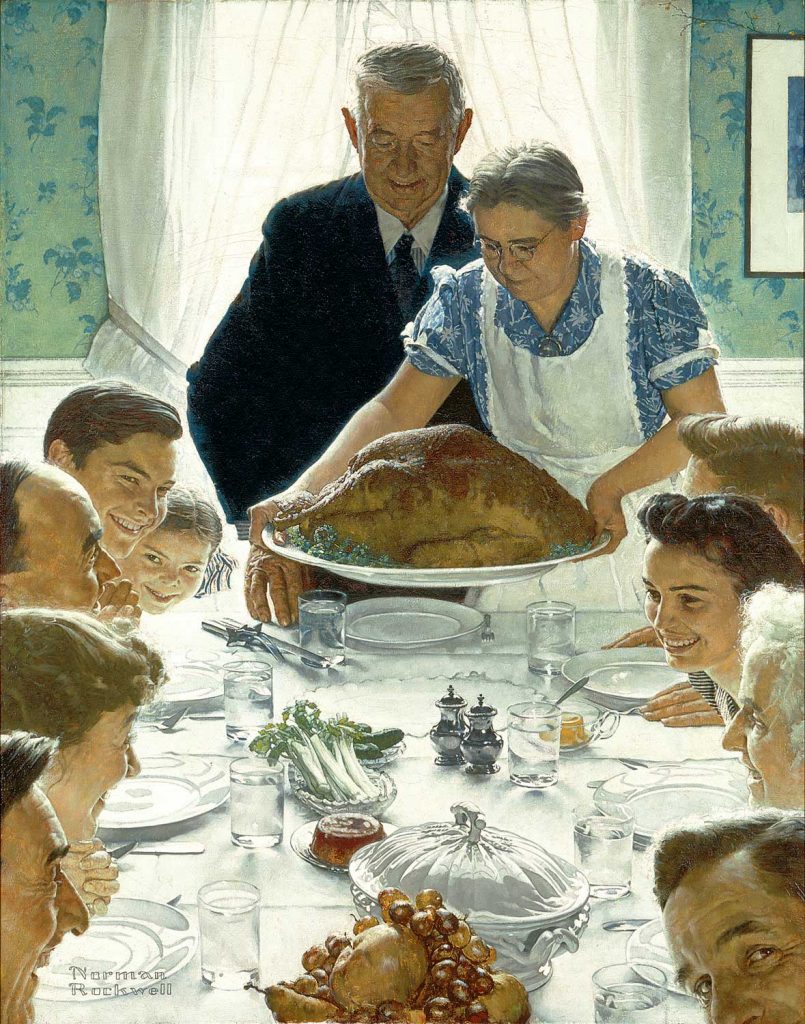
I’m guessing you know what I mean when I say the Thanksgiving holiday has a unique sense about it. Regardless of autumn’s shrouded frigidity, Thanksgiving remains bright and warm, as if the sun leaned closer to the earth for just this one day.
I say this knowing full well that family gatherings at Thanksgiving can be a mishmash of dynamics. I also know from casual reading that division in families from this or that issue is at an all-time high. For some, family get-togethers are more taxing than enjoyable. Still, I meant what I said. Thanksgiving has a unique sense about it. And it’s good.
It’s good, not because the Thanksgiving feast is the meal all other meals only wish they could be. For the pessimists among us, it’s not good because it only happens once a year. Thanksgiving is as it is because of its point: no matter where we’ve come from, where we’re going, where we are right now, what we’re experiencing, or who we’re with, we can be thankful. Thanksgiving’s point is gratitude.
Relative to families, someone once said genuine gratitude is only possible when the memories stored in the heart conquer those in the mind. I don’t know who said it. And yes, I suppose the saying is somewhat Hallmark card-like. Still, I’m fond of the thought, even if only for how I prefer to interpret it, which, as you might expect, is through the Christian lens.
Admittedly, the human heart and mind are both sin-stained in every way. And yet, Christians know something beyond this fact, especially when it comes to the Holy Spirit’s work in us through the Gospel for faith. We understand what Ezekiel meant when he spoke for God, saying, “I will give you a new heart and put a new spirit within you” (Ezekiel 36:26). We know what Jeremiah meant when he shared the similar promise, “I will give them a heart to know Me, for I am the Lord; and they will be My people, and I will be their God, for they will return to Me with their whole heart” (Jeremiah 24:7). We know what Saint Paul meant when he insisted, “Therefore, if anyone is in Christ, he is a new creature; the old things passed away; behold, new things have come” (2 Corinthians 5:17). Paul’s words in Romans 5:5 are not lost on us, either. We know what he meant when he wrote, “And hope does not put us to shame, because God’s love has been poured into our hearts through the Holy Spirit who has been given to us.”
Filtering the adage through these biblical truths, I suppose I like it because it implies that genuine gratitude is out of reach to mental calculation. In other words, as humans, we remember things. Those things shape and reshape us. Remembering how people have treated us—what they’ve done to help or hurt us, whether they’ve behaved as friends or foes—these become the variables we ponder in the calculations of relationship mathematics. And like any equation, sometimes the resulting product is positive. Sometimes, it’s in the negative.
Through the lens created by the Bible texts I shared, the phrase “memories stored in the heart” seems to hint at a different sort of math, an involuntary, grace-filled action uninhibited by human sensibility. It sees things through the Gospel. It understands annoying family members more so as family than annoying, and it’s thankful for them. It knows the time required to prepare a massive meal is exhausting, and yet it’s grateful for the opportunity to serve the ones it loves who’ll be gathering at the table to eat it. Some of those people haven’t been all that nice in the past. Still, it knows that kindness will always be sweeter than malice. It stands on its tiptoes, ready to reconcile. It’s hopeful for it to happen and gives thanks when it discovers itself stumbling into uncomfortable moments that are all but begging for it to be enacted.
In short, the memories of a Christian heart are the memories of Christ. The Holy Spirit puts them there. They are the remembrances that Christ, even when we were utterly unlovable, loved us to the end (John 13:1). They remember that even while we were still sinners, He gave Himself over entirely into Death’s perpetual night (Romans 5:8). They retain the incredibly crucial sense that we are just as needful of Christ’s merciful love as the screwed-up people sitting beside us at the Thanksgiving Day table, and with that, we belong together.
These Christian heart memories stir genuine gratitude, even when gratitude seems nonsensical and maybe even a bit foolish.
My prayer for you this Thanksgiving is two-fold. First, I hope you’ll begin your Thanksgiving Day by going to worship. There’s no better way to be equipped with Godly gratitude than by receiving Christ’s gift of forgiveness through the administration of His Word, both in its verbal and visible forms. Here at Our Savior, the service begins at 10:00 a.m. I hope to see you.
Second, I hope the memories stored in your Christian heart will conquer those in your mortal mind, and as a result, your Thanksgiving Day celebration with family will indeed be brighter and warmer, as if the sun leaned closer to wherever you are standing even if only for this one day.
Those of you who read these meanderings regularly will know that I struggle at summer’s end every year. It’s not so much that the longed-for season of effortless schedules is leaving (although this summer has been anything other than easy), but instead, it’s that the sun begins making less time for us. Moving into autumn, the sun makes drastic changes to its schedule. For one, it gets up late and goes to bed far earlier. Some of us will go days without experiencing its presence, traveling to and from the office in the pitched blackness of its absence. On an occasionally cloudless day, you’ll see it pass by the window—but only if you have a window. If not, it’ll be as if the sun used to exist but does so no longer.
My stomach turns just thinking about it.
Jen posted something on social media last week. It was a snippet from our family’s after-dinner cleanup. Essentially, Evelyn asked, “Momma, did you know there is something called S.A.D.? It’s when people get very sad when summer ends.” She was referring to Seasonal Affective Disorder. And before she even finished her testimony, I was already answering, “Yes. And would you like me to explain it to you?” I wasn’t being snarky. The moment was a jesting one. However, looking back on the moment, I wonder if she planted the question. She knows how disjointed I become in the perpetual darkness of the sun’s absence. I get the feeling she asked Jennifer the question to spare me a momentary cloud while also showing me she is paying attention and understands. She’s like that. She’s mindfully caring.
It usually takes me a few weeks to get into autumn’s rhythm. In fact, by the time I discover myself finally beginning to appreciate fall’s colorful detonation, the snow arrives and covers it. Gripping summer’s absence tightly, I put myself at a disadvantage, resulting in being a step behind other opportunities for joy. Admittedly, I am forever learning a lesson from these things.
Honestly, absence is a tricky thing. John Dryden said that when you love someone or something so much, an hour of absence is like a month, and a day is like a year. Jennifer and I were talking about this one night last week before bed. She mentioned that family dinners will soon be very different. She’s right. Like a curious organism, absence will grow. Right now, dinners together as a family are quintessential to our lives. We do everything we can to ensure all six of us attend. But life’s seasons are changing. Soon six will be five, five will be four, and then four will be three. And then it’ll just be Chris and Jen. For the Thoma family, that’s a big deal. We’re knitted very closely together. When one is absent, it’s as if the world has suddenly become strangely uninhabited.
I get it. At least, I’d better get it. The day is surely drawing near when Chris and Jen will be Chris or Jen. Some of you already know what I’m talking about. Absence—the experience of being apart and missing that person so incredibly much—can be devastatingly palpable. I miss the sunshine during winter. Still, that’ll be nothing compared to an empty nest—or Jen’s empty chair. Personally, and in a selfish way, I hope my chair is found vacant first.
Having said these things, there’s something else to the topic of absence. Christians know what it is.
For some, absence means loss. Not just any kind of loss, but permanent loss, as if the person they miss is forever out of reach. One of my favorite texts from God’s Word is “The last enemy to be destroyed is death” (1 Corinthians 15:26). I like it because it serves as a capstone statement to Paul’s previous preaching in the chapter that Christ has conquered all things, and by His resurrection, the seemingly impossible obstacle that brings ultimate separation—Death—has itself been massacred and tossed aside in the cosmic contest for our eternal future. As a result, no other enemy stands between us and our God. Christ saw to it. His resurrection proved it handily. From this vantage, one of Death’s offspring—permanent human separation from God and each other—is included in the list of enemies defeated by Christ’s work. In other words, because of Christ’s victory against Death, Christians can’t really even speak of a loved one who died in the faith as absent in the sense of being lost or gone for good. Those who are no longer with us, while absent from us, are not absent from the Church’s eternal fellowship. This means we’ll be with them again in person. Right now, they’re with Christ, and according to His plan, their time of physical separation from us is already on a trajectory of reversal. Their mortal absence might indeed stir sadness. Still, we really can’t justify the kind of sadness relative to permanent absence or being lost. The absence is not permanent. Believers are with Christ in His nearest presence. And if you know right where a person is, how can he or she be lost?
Indeed, in natural time, the sun goes away during autumn and winter. Likewise, the day is coming when either I’ll be without Jen or she’ll be without me. But only for a time. The spring and summer sun will return. Believers won’t be apart from our loved ones who’ve died in the faith for long. Soon enough, there will be an eternal sunrise in an unending time of togetherness outside of time. That’s Christ’s promise to His faithful. Until then, the faithful have another powerful guarantee. The same risen Christ vowed He would never leave or forsake us (Hebrews 13:5). He promised He is with us always, even to the end of all things (Matthew 28:20). That promise meets with right now. While ten thousand sermons could be preached on either of these two texts, all with unique renditions of Christ’s beautiful assurances, each would bear a common thread of consequence: You’ve been won by the person and work of Christ, and now, by faith, no matter what, you are never alone. Interestingly, you can be confident of this because of something Christ cannot do. He cannot break His promises, and therefore, He cannot be absent from those who are His own.
To close, remember these two things during autumn’s darker days, whether that autumn is seasonal or human: Human absence is not our forever, and in Christ, you are never alone.
I pray all is well with you this morning. I, for one, am performing my usual early Sunday morning routine, even in Florida. Again, I continue to tell myself I won’t write and send anything on Sunday mornings. But then, I do. I already know the disease’s name. It’s called hypergraphia. It’s a neurological condition marked by an intense desire to write or draw.
I’m just kidding. I don’t have hypergraphia. People suffering from hypergraphia will do something like spend an afternoon writing the lyrics to a favorite song fifty times. I wouldn’t do that. I’d be more inclined to spend a free afternoon writing fifty new songs. I see writing—especially free writing—as a means of creative probing designed to discover what I think about something. The particular prompt is never an issue. I look around at things. I sip my coffee. In a moment or two, I see something, then I’m off and following. In the early morning Florida sun, there are plenty of mental meadows for such wandering. Michigan has its share, too. Every place has an abundance. You need only to pay attention.
In a little while, the rest of the Thoma family will awaken. Soon thereafter, we’ll make our way to Zion Evangelical Lutheran Church in Winter Garden. We visited there last week. The guest pastor, a kindly gent, preached a fine sermon. At one point along the homiletical way, he spoke of being part of a group. Specifically, he described seeing a family gathered in a park for a reunion. He mentioned the picnic tables, the food, the laughter, the sunshine, and all the things that make for a friendly gathering of loved ones. From there, he described a lonely onlooker’s desire to be a part of such things—to have a place of belonging. The point of the illustration was to describe the Church, and he did so in an interesting way.
Admittedly, I drifted a little while the pastor described. Seeing the familial picnic in my mind, I imagined the conversations. In particular, I thought of how families often retell the worst about themselves, ultimately adorning their conversations in laughter rather than tears. They tell the story about so-and-so’s new carpeting and how their son, now a grown man, once ran diaperless through the room, ultimately doing his business and leaving a stain that remains to this day. Or they reminisce about the time Uncle so-and-so pushed Grandma on the park swing, and when she came back on the upswing, he grabbed her wig and ran away, leaving her helplessly embarrassed and angry.
Everyone listens and laughs at the former foolishness. The carpet stain is still there, forever remembering something good now soiled. Grandma is still there, too. She still wears her wig. And yet, she’s not embarrassed, and she’s no longer angry. Why?
Family.
I firmly believe that the only type of human love that will ever come close to demonstrating the love God shows us is the familial kind. When I look at my wife, when I look at my children, I see Jesus there. They know pretty much everything there is to know about me. More importantly, they know my worst, most detestable self. Still, they love me. And I love them—enough to give my life in their place. This love changes me. Self-love is pushed aside, making room for being the best husband and father I can be.
Even if only in a minimal way, all these things give a sense of Christ’s divine view. What’s more, all these things demonstrate just how wonderful things can be in a community desiring to live in the shelter of repentance, forgiveness, and amending the sinful life. It’s in gatherings like that where former sins become memories worthy of little more than a laugh.
Strangely, this sounds a lot like God’s blueprint for the Church. That being said, I hope you’re making plans right now for this morning’s family reunion. We are. We won’t see you, but we will be with you.
Here in Michigan, with the summer weather comes the bluer skies—the endlessly deeper sapphire skies. They’re beautiful, and they’re more than worth one’s staring. It’s supposed to rain today. That’s okay. We more than need it.
I installed a new stereo in my Jeep. The previous stereo had become somewhat rebellious. For example, it preferred to pause the music when I pressed the mute button. Also, it tended to begin its life anew at every stop. Five minutes at the gas station, and it would reset its clock, lose all the stations, and so much more. Sometimes, it wouldn’t even acknowledge me. I’d press a button, and it wouldn’t do anything. It’s now in a box in my basement.
The new stereo connects to my phone and its music applications, one of which is Spotify. On the way to school one day last week, Evelyn and I listened to whatever Spotify sent us. Elton John’s “Rocket Man” was one of its suggestions. Listening to that song beneath what was gradually becoming a clear blue sky stirred a particular memory for me. I described it to Evelyn. I told her that I heard that song while driving a week or so after my brother Michael died. It was in July 1995. The sky was a seamless blue. I remember leaning a little bit into the steering wheel of my truck to look upward through the windshield for a better view. I did this as Elton sang, “And I think it’s gonna be a long, long time….”
I was 22 years old at the time. My brother—my only brother—was 24 when he died. I remember looking into that infinitely vast sky and thinking it would be a very long time until I’d see him again.
After sharing that memory, I’m pretty sure I noticed Evelyn moving as inconspicuously as she could to wipe away some tears. She’s truly a lovely girl, empathetic in every way. Of course, I didn’t end the story without the Gospel truth, which I’d already shared in a simpler way. Yes, it would be a long time before I saw Michael again. It’s already been almost three decades since we were last together. Still, I will see him. That’s the promise. And I believe it.
My oldest daughter, Madeline, just graduated from high school. Her graduation party was yesterday. What a joy it was to spend time with so many friends. Naturally, as it is with many events in my life—my wedding, the births of my children, my ordination, and so many others—I’ve looked around each event’s scene and wished Michael could’ve been there. That happened at Madeline’s party. Certainly, I’ve always wished my children could’ve known him. And yet, I wasn’t thinking that way yesterday. Instead, more than once while visiting with so many people I cherish, I thought, I wish Michael could’ve been here to meet you. I know he’d have liked you as much as I do.
As the saying goes, each day, a day goes by. But when you love someone, the person’s absence hurts, and each day apart seems to have a thousand hours instead of only twenty-four.
I suppose for many of you, I’m not describing something unfamiliar. You know the sensation. You’ve experienced those moments when you’ve heard a song, taken in a scent, or seen a sight that swept you backward to a time with someone who right now is permanently out of reach.
Having just used the word “permanently,” I realize how strange that word is for Christians. Even with synonyms like “perpetually” and “forever,” for Christians, the truth is that these terms have an expiration date when paired with the out-of-reach nature Death seems to bring. For Christians, Death isn’t permanent. It isn’t forever.
There’s another saying that Death has a thousand doors, and we all find one. There’s truth in that statement. However, no matter its form, because Christ conquered Death, it becomes just another event in a believer’s mortal life—an entryway to a timeless unending with Christ so beautifully described as the shelter of His glorious presence, a place where believers “shall hunger no more, neither thirst anymore; the sun shall not strike them, nor any scorching heat. For the Lamb in the midst of the throne will be their shepherd, and he will guide them to springs of living water, and God will wipe away every tear from their eyes” (Revelation 7:16-17).
And by the way, this wonderful reality will occur among what Saint John called “a great multitude that no one could number” (v. 9). All believers in Christ will fill that multitude’s ranks. Michael is already there, along with all who’ve gone before us in the faith. I’ll be there one day. Someday my wife and children will be there. By faith in Christ, you’ll be there, too.
Until then, in a mortal sense, I think it’s gonna be a long, long time. But that’s okay. Time will end. But eternal life won’t. Knowing this, I can hear a song that prompts a glance toward the heavens and have a different longing as I do it, realizing that for every hour we’re apart from those who’ve died in the faith, there will be a limitless cadence of eternal hours together with them in our Savior’s presence. That same Savior, Jesus Christ, gives this to us because, in perhaps the simplest way, He knows the feeling. Believers are a part of His family. By His relationship to the Heavenly Father, He calls us His brothers and sisters (Mark 3:34-35, Romans 8:29, Philippians 2:8-11, Hebrews 2:11, 2 Corinthians 5:21). He loves us more than anything—enough to shed His blood—and He doesn’t want to be without us.
One last thing.
Don’t get me wrong. I don’t mean to make Death out to be no big deal. It is. That’s why, as I’ve said countless times before, I always give Death a capital “D.” Death is not our friend. It isn’t our helper. But also, it isn’t something we must fear because it isn’t our master. The real Master, Jesus, has declawed, defanged, and defeated it. That’s why Paul can recite rhetorically, “O death, where is your victory? O death, where is your sting?” (1 Corinthians 15:55).
Again, Christ loves us more than anything. Not even Death can keep Christ’s brothers and sisters from Him. Instead, Death must hand them over to the Lord every single time. That’s something worth pondering, no matter the sky’s demeanor.





 Cruciform Stuff