Liberty is No Enemy of Holiness

As many of you know, I prefer to post and ghost. In other words, I share something, and then I rarely return to read the comments, if only because I believe humans weren’t designed to receive 24/7 input from an endless crowd of digital judges. It’s not healthy to live beneath the constant gaze of the commentariat. Admittedly, 24/7 commentary goes with the territory for anyone who writes for public consumption, which I do. Still, I’m wise enough to know that the soul can wither when every thought must be defended and every sentence explained. It’s better, I think, to set one’s observations before readers, entrust it to the Lord, and then move on with the quiet confidence that truth doesn’t require

That said, sometimes I break my own rule.

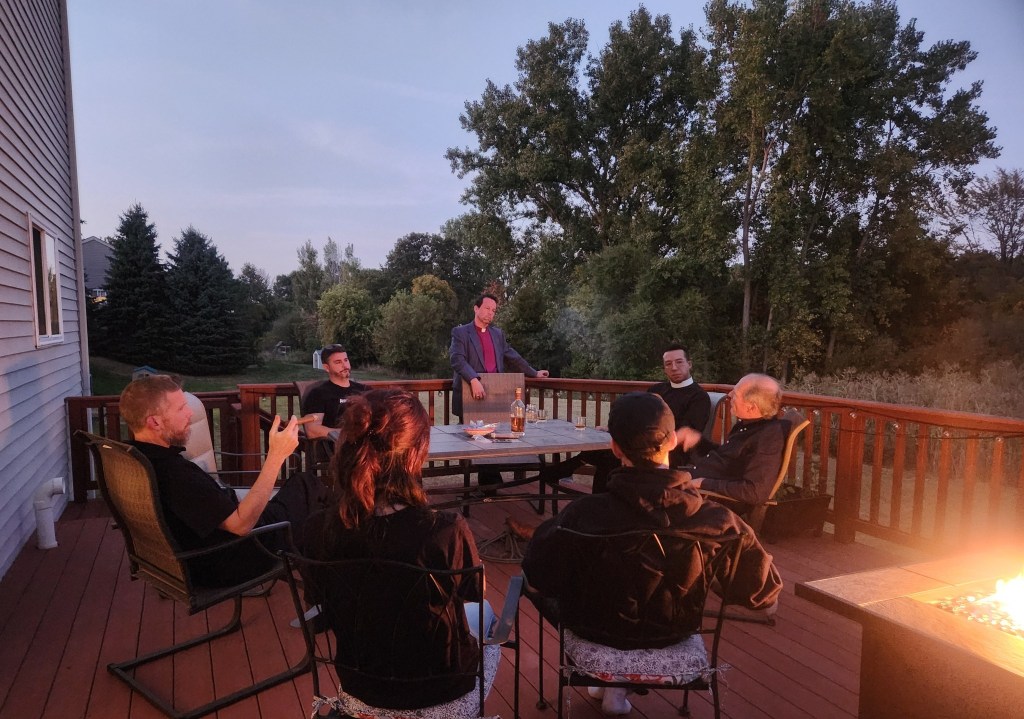
Essentially, I shared an image of myself, Dr. James Lindsay, Father Calvin Robinson, Bishop Mel Williams, and William Federer enjoying pre-conference whiskies and cigars on my deck. It wasn’t long before Facebook reply notifications began arriving. Usually, I scroll past those notifications. But this time I didn’t. I clicked on one.

A passerby had expressed concern: “That doesn’t seem like the best example to set for young parishioners.”

Now, his words are a common enough sentiment. The supposition is that anything capable of misuse must be avoided altogether by Christians, lest someone follow the example and sin. This is Pietism in its most socially acceptable form: the attempt to preserve holiness by limiting someone else’s Christian liberty.

Attempting to be funny (but not really), I replied, “It was a heretical-pietist-free evening. Praise God for that!” Maybe I shouldn’t have. But I did. With that, the conversation grew, and with textbook precision. My counterpart immediately invoked the dangers of addiction and disease. I responded that not all enjoyments lead to sin and then offered the ancient liturgical phrase, “Τὰ ἅγια τοῖς ἁγίοις” (The holy things for the holy ones). In other words, God’s gifts are for those sanctified by Christ, not denied by fear.

The back-and-forth continued. He warned against “promoting potentially harmful behaviors.” Identifying this as classic Pietism, I took another quick moment to lay out the contrast between moral restraint and moralism:

“You are conflating personal abstinence with holiness and assuming that visible restraint equals moral superiority… you make ordinary Christian liberty (whisky and cigars) sin-adjacent, implying that the ‘holy’ choice is abstention.”

Of course, what I just shared with you was not my entire reply. In my much longer response, I invoked God’s Word and fundamental human reason, adding that the dangers of sugar, gluttony, and social media are by far statistically worse for health than cigars or whisky. My point was not complicated: true wisdom is not found in prohibition, but in discernment.

Still, he kept on. Clearly wounded by personal loss, he shared his father’s tragic battle with lung cancer. Yet even his heartfelt appeal that others should keep their “unhealthful affectations” private revealed Pietism’s blind spot. Pietism mistakes personal experience for universal moral law. In fact, is that not one of the great dreadfulnesses of our age—the confusion of subjective perception with objective reality? People no longer ask what is true, but rather what feels true to them. Truth has become elastic, molded to suit one’s emotion or experience. But someone’s subjective conviction, however sincere, cannot alter objective reality. Reality fragments when truth is privatized, its authority giving way to the tyranny of preference.

That’s the soul of Pietism. The objective Gospel is recast as personal sentiment rather than divine fact.

I know some might argue it, but I think my final (and rather lengthy) reply was both pastoral and theological, weaving together compassion, Scripture, and principle. I wrote, “Your experiences are tragic, and you have my sympathy… But in my home, I will not make your weakness my law. Christian liberty is not sin. Compulsion is.”

Then, as before, I anchored the argument in God’s Word—Titus 1:15, 1 Timothy 4:4, Psalm 104:15, Luke 7:34, Galatians 5:1. Each text underscores that the Christian life is not defined by what we abstain from, but by what we receive rightly. Certainly, one could say that Pietism was born of good intentions. Indeed, it was a 17th-century reaction to cold orthodoxy and a response to the particular woes of the day, alcoholism being one of them. But good intentions can be deadly when they elevate personal zeal above divine grace. In its essence, Pietism teaches that visible piety proves a person’s inner holiness. When it does this, it replaces the Gospel’s declaration, “You are free,” with the conscience’s suspicious questioning, “Are you holy enough?”

That’s not good. That’s flat-out dangerous to the soul.

Still, the Pietist goes further, imposing on others, “Do not drink, smoke, dance, or play cards, because these things might harm your witness.” But the Gospel says, “All things are lawful—not all are beneficial, but you are free” (1 Corinthians 10:23).

I suppose part of the irony in all of this is that Pietism sees danger everywhere except in itself. It replaces real sin with symbols of sin, preferring the optics of sanctity to the substance of faith. It is less concerned with the heart that trusts Christ than with the appearance that pleases observers.

Maybe even the more profound irony is that Pietism claims to protect morality but ends up birthing hypocrisy. It trains Christians to hide, to present a sanitized version of life, and to confuse the suppression of appetite with the cultivation of virtue. As it does this, it unwittingly revives the very Pharisaical spirit Christ so often condemned—the one that tithed mint and cumin but neglected mercy, freedom, and joy.

Against this, Saint Paul, and ultimately Confessional Lutheranism, have a proper understanding of these things, one that stands firm. And it’s simply that God’s creation is good, and when received with thanksgiving, it sanctifies rather than defiles. When Scripture warns against drunkenness, it condemns excess, not alcohol’s existence. When Paul tells Timothy to “use a little wine,” he affirms alcohol’s benefit, not vice. When Jesus turns water into wine at Cana, He not only dignifies holy marriage, but also Godly fellowship and festivity. You know one thing Jesus doesn’t do in Cana? Magnify abstinence.

Make no mistake, the theology of Christian liberty does not promote recklessness. It insists that the conscience be ruled by grace, not by fear. It says that a Christian’s freedom is not to be licentiousness, but rather faithfulness. In this context, a Christian can receive a cigar or a dram of whisky as a gift, not as a threatening vice or idol. A Christian can also choose to refrain, not because of superstition concerning one’s holiness, but according to Godly discernment.

I quoted Saint Paul’s words in my final response, saying, “If food makes my brother stumble, I will never eat meat” (1 Corinthians 8:13). For the record, that’s not self-contradictory, not in context. Paul is writing about charity, not control. He’s teaching about sensitivity, not censorship. Saint Paul would never forbid meat. To do so would make his other writings on the subject instantaneously hypocritical. In this instance, he forbids the sin of despising the weaker conscience. Still, Paul’s compassion never becomes compliance with false laws. And so, I also shared Saint Paul’s words that “to the pure, all things are pure” (Titus 1:15), and that “everything created by God is good, and nothing is to be rejected if it is received with thanksgiving” (1 Timothy 4:4). I noted that God Himself gives “wine to gladden the heart of man” (Psalm 104:15). I even reminded that Christ was accused of being “a glutton and a drunkard, a friend of tax collectors and sinners” (Luke 7:34), not because He was those things, but because He partook freely of God’s gifts within holy boundaries with others.

My opponent’s final plea—that such moments be kept private to avoid tempting the “impressionable”—revealed one of Pietism’s most corrosive features. Pietism’s instinct is to hide the very goodness of God’s creation. It imagines that holiness grows in secrecy, that joy must be concealed lest someone misunderstand. But remember, Christ’s first miracle at Cana was very public. His critics were the ones who scowled that He did the things He did so openly and so freely.

I should also add that to hide God’s gifts is not humility. It’s ingratitude. To pretend that the Christian life is tidy, risk-free, and maybe even unembodied is so far away from spiritual maturity. Perhaps worse, it’s a denial of the Incarnation itself. Indeed, God did not hover above creation as though holiness required distance from it. He dwelt bodily in it in ways that Pietism insists we distrust. To recoil from the tangible—food, drink, fellowship, and the bodily joys of this life—is to behave as though God erred in becoming man. It is to imply that holiness exists only in the abstract, not in the enfleshed grace of Christ who came as one of us—eating and drinking—for our salvation. The Word became flesh, not vapor.

In the end, I suppose the entire debate comes down to who sets the boundaries of holiness. Is it human fear or divine grace? I think Pietists fear liberty because they cannot control it. Pietists are closet tyrants. But Christians are free from such tyranny in every way. They are enabled by the Holy Spirit through faith to discern and embrace Christian liberty, ultimately trusting in Christ, the One who governs it.

“For freedom Christ has set us free,” Paul wrote, “do not submit again to a yoke of slavery” (Galatians 5:1). The Pietist, though well-meaning, forges a new yoke from his own fears and insists that it’s righteousness. But freedom—true Gospel freedom—is not the enemy of holiness. It is its foundation.

So, pour the whisky if you want. If it will lead to your demise, don’t. Light the cigar if you prefer. If it will harm your physical condition, discern the foolishness of your action and don’t. But whichever you choose, laugh with friends who love Christ. And do so not to provoke the weak, but to proclaim the strength of Christian liberty and its discernment. Proclaim that God’s gifts are good. His creation is not the problem, and holiness is found not in rejecting or hiding His generosity but in receiving it in faith with all joy.

Role Reversal

If you haven’t already heard, the U.S. military used our country’s infamous bunker-buster bombs yesterday to take out Iran’s nuclear sites. Whether one agrees with the decision or not, it’s a sobering reminder: the world our children are navigating is growing more perilous by the hour. That said, when I woke up this morning, I had already intended to write about a significant role reversal I experienced last week. I’m going to stay the course, yet I can already sense how this morning’s news will impact it.

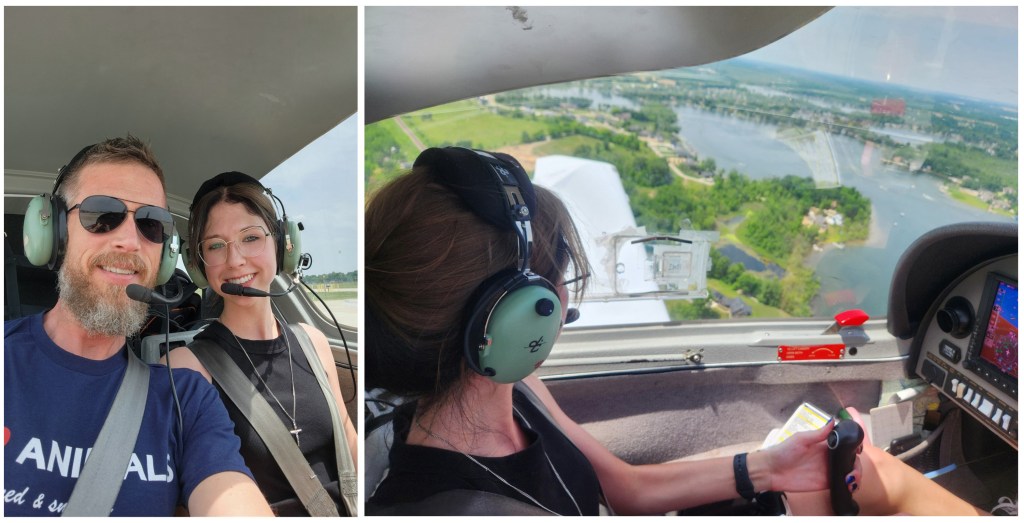
Essentially, my daughter, Madeline, recently earned her private pilot’s license. As a Father’s Day gift, she took me on an hour-long flight. We departed from Bishop International Airport in Flint, flew to a small airstrip in Linden, landed and launched twice, and then returned to Flint. On approach into Flint, she performed a maneuver called a “slip.” I looked it up and found the following definition to be exactly as I experienced:

“A slip is an aeronautical maneuver that involves banking the aircraft into the wind and using opposite rudder to maintain a desired flight path while increasing descent rate or correcting for wind drift.”

In plain terms, Madeline banked us left, and yet, we didn’t turn. We slid sideways while descending rapidly. Just above the runway, she finally straightened the plane, leveled us out, and touched down as if we were angels gently descending from heaven.

She was amazing.

Now, I started by saying I experienced a significant role reversal. To frame all of this in the proper perspective, it really wasn’t all that long ago that Madeline’s life was in my hands in every way imaginable. Indeed, it’s as if only recently, I was tucking her into a car seat and securing the five-point harness, even adjusting the straps to fit her comfortably while ensuring maximum safety. I was the one who checked twice—sometimes three times—that every latch was secure, every buckle snug, because that’s what a father does to keep his child safe. He does things like hold her hand in public. He hovers behind her on staircases that she is still too small to climb. He steadies the handlebars on her first bike ride, jogging alongside her down the sidewalk, ready to catch her when she tips. Everything about her very existence—the entirety of her well-being—is entrusted to him.

But last Sunday—Father’s Day, no less—somewhere just beneath the clouds, the roles reversed, and I found my life was entirely in my daughter’s hands. I climbed into the copilot’s seat and fastened the belt, which she then refastened because I hadn’t done it correctly. She proceeded to adjust it accordingly. And then she was the one now glancing over the vehicle’s every dial, confirming each setting, running her hand along the controls, reciting the pre-flight checklist items with unbroken concentration. I did nothing. She captained the headset, talked with the towers, and guided me through what to expect.

I guess what I’m saying is that the magnitude of that transfer wasn’t lost on me. It was exhilarating, yes, but also profoundly humbling.

Still beaming a couple of days after the flight, while Madeline and I were driving together, I told her again how proud I was of her. I mentioned a quote that had resurfaced in my mind as we flew—something from C.S. Lewis’ The Four Loves. He wrote so profoundly, “To love at all is to be vulnerable.” I explained how placing my life in her hands had revealed something. It wasn’t just that I trusted her. It was more about the depth of love I have for her, the kind that knows just how much she loves me, too.

I’ve known Lewis’ words for a long time. I’ve reflected on them in the context of marriage, friendship, pastoral ministry, and countless other situations where love demands a certain measure of risk. But I’d never thought to apply them to my kids until now. And yet, there they were, soaring right beside us at 2,000 feet on Father’s Day.

I’m usually pretty good with words. But this morning, I’m feeling somewhat limited. The English language doesn’t really have the capacity for genuinely communicating the moment your parental life shifts from giving care to receiving it—from being the one at the controls, both literally and metaphorically, and then, in an instant, letting go of the illusion that I would always be the one doing the work to keep my child safe. That kind of vulnerability doesn’t come easily, especially for a dad. But it is, I think, a place where, if we’re looking through the lens of the Gospel, God shows us just how complete love can be in a family.

I suppose something else comes to mind in all of this, too.

I would imagine that most Christians are familiar with the text of Proverbs 22:6, which reads, “Train up a child in the way he should go; even when he is old, he will not depart from it.” Most folks see that verse in terms of instruction in moral grounding and right living. That’s not wrong. But it misses the heart of the verse.

Its primary aim is that we would raise our children in the “way,” namely, faith so that when they do climb into the cockpit of life, so to speak, they do so not only with competence but with wings outstretched for trust in Christ. In that sense, Proverbs 22:6 reminds us that even as our children’s hands might reach to ours for learning character, skills, and such, it is far more critical that they know to reach for the Lord’s hand in all things. Only then can they truly navigate both the clear skies and the storms with spiritual wisdom and poise. Only in Christ will they know how to take off, how to “slip” when necessary, and how to land with grace.

Anyone considering these things honestly will recognize something more.

Without question, the world my children are navigating is by no means the same one I inherited. Long before the latest news about Iran, the skies they were flying in were already far more turbulent. The voices buzzing through the coms are more confusing, almost unintelligible. The instrument panel in front of them, while more advanced, is almost entirely calibrated by a secular age that denies God’s existence altogether, calling His Word foolishness and insisting that truth itself should be wholly despised.

My point is that the role of Christian parenting cannot be passive in any of this. It cannot be content merely with getting one’s kid into a good college so that they are materially successful. All of that ends when they breathe their last. As I’ve often said from the pulpit, this world and everything in it carries an expiration date. You may not see it, but it’s there. That said, we are not just raising children to exist and survive among temporal things. We are raising them, as Luther said, “to believe, to live, to pray, to suffer, and to die” (LW, Vol. 47, pp. 52-53), which, by default, means we’re raising them to exist in this world with eternal things in mind. We’re raising them to stand, to speak, and to boldly hold the line when others around them are folding. We’re raising them to do these things, not with arrogance, but with conviction formed by the eternal Word of God.

That’s why Proverbs 22:6 matters so deeply. Indeed, to “train up a child in the way he should go” means to help position them for good character and success. But the “way” it mentions is not abstract. It is the cruciform road that leads through repentance and faith in Jesus. When we train our children in this way, we’re grounding them in the very mind and heart of God.

And they need this grounding. They’re already being told that truth is subjective and that steadfast Christian conviction is cruelty. Worst of all, the surrounding world insists that biblical godliness is an artifact of a bygone era. They are surrounded by cultural winds that do not merely blow—they howl. If they are to fly straight—if they are to correct for this world’s drift—they will need spiritual discernment. They will need courage calibrated by sound doctrine and faithful practice. They will need to be taught to see everything in this world through the lens of who they are in Jesus.

In a sense, the time has already come for me to realize that my kids are now flying and I’m not. If you haven’t yet arrived at the same realization, then just know that you’ll be there soon enough. The time is coming when your little ones’ hands will be on the controls, and your hands will be folded in prayer.

That time comes sooner than we think. Parents, the preparation begins now.

When the choice is between faithfulness to Christ and the world’s distractions, choose faithfulness, even when the child doesn’t want to. Lead the way. Even as they might kick and scream to get free from the car seat, strap them in and set out. Do this not only because you’re teaching them how to fly but why to fly. Do this, remembering your children will one day be at the controls, and they’ll be faced with circumstances you never imagined.

Still, when this happens, you’ll be okay, even if things appear to be going south. You’ll be confident that you did everything possible to keep them connected to Christ. You’ll be able to hope that, when it matters most, they’ll know to lean not on the wisdom of this world but on the One who will never steer them wrong. Even better, you’ll know that even though you’re not in the cockpit, Christ is, and regardless of what anyone’s bumper sticker might say, He’s no copilot.

Showing Up

I take vitamins. I have for years. Whether or not they’re helpful, I don’t know. I think they are. Either way, I take them because of habit, along with an unspoken hope to stave off decline. Hope and habit, I suppose, outweigh my skepticism.

Each morning, I rattle and shake the pills from my dispenser like dice in a gambler’s palm, casting my lot with D3, E, and others I hope will maintain my joints and back. There’s a strange comfort in the ritual—a brief moment every morning of feeling like I’ve done something to tip the scales in my favor. After all, I’m getting older, and nowadays, I’m less concerned about being what I once was as an athlete and more interested in picking up my grandson, Preston, when he reaches out to me.

Admittedly, I sometimes wonder if it’s all just a polite nod to the illusion of betterment. Maybe. But in a world that already feels incredibly out of balance, the smallest rituals can be the most stabilizing. And for me, that’s reason enough to continue.

A few weeks ago, Jennifer and I were remembering when we first met. After that brief conversation, I found myself drifting into earlier memories, years before Jennifer. Back then, I was a determined guy who didn’t like to lose. I’m still that way today, but nowhere near the level of my youth. Looking back at my late teens and early twenties, I see now that much of what I claimed to know was really just a thick confidence borrowed from youthfulness. Life seems to thin out over time—not just in muscle mass or bone density, but in what I actually know. There’s truth in the saying: the more you know, the more you realize just how much you don’t know. I was so sure about certain things that I ended up saying or doing things I probably wouldn’t say or do today. In truth, I didn’t fully understand the situation, but I acted anyway, believing I did.

Thankfully, most things worked out. God certainly used my youthful zeal for my betterment. That said, I lean less on determination these days and more on steadiness. Like my vitamin regimen, I’ve exchanged the need for proof with the simple desire to keep showing up every day.

Determination has given way to commitment.

You’d be surprised how much happier a person can be when he’s less interested in the next big accomplishment and more committed to the long game of where he is right now. When it comes to life in the Church—life as a pastor—that’s a better posture anyway. A pastor’s life isn’t defined by conquest beyond his congregation’s borders. Sometimes that’s necessary. But most of the time, it’s about continuity—holding to faithfulness and preserving a congregation’s Christian identity. Much of what we do is simply hanging in there and not giving up. It’s preaching and teaching today, trusting that it will take root and grow tomorrow.

At the heart of it, I suppose what I’m really thinking about and pointing toward this morning is faithfulness. Saint Paul wrote, “It is required of stewards that they be found faithful” (1 Corinthians 4:2). Paul already knows how a developed knowledge of God’s Word and sound doctrine is essential. But here, he implies that no small part of the task itself is faithful stewardship with what He’s given and where He’s situated you to use what He’s given.

No small part of the task is showing up.

Showing up has taught me some things. For one, I’ve learned that the truly sacred things in life are the ordinary, everyday things. I’ve also learned that when they’re gone, they’re missed more than any titles or trophies ever achieved along the way. The most meaningful moments in my life rarely arrive with fanfare. They come quietly—and they take many forms. The most recent was a child in our school who asked me a theological question that stopped me in my tracks. I hadn’t thought about the topic that way before, and with the child’s help, I could see the world a little differently. Truthfully, the same thing happens more often than not in most casual conversations with young and old here at Our Savior. But the point is that such moments don’t happen through force—they happen through repetition, patience, and the long, slow process of showing up.

So yes, I show up to take my vitamins. But I also show up each week with an eNews message. I show up in the pulpit with a sermon. I show up prepared for Bible study or religion class. I show up when I’m called to someone’s hospital room at two o’clock in the morning. I show up when my children need me. (They’ll tell you I show up even when they don’t.) I show up for meetings. I show up to hear confessions that break my heart. I show up when a couple’s marriage is struggling. I show up to pray every morning for the congregation God has called me to serve.

I show up for myself, too. For one, writing is my thing. It’s therapeutic. But I also show up in other ways: taking a minute to stretch on the closet floor in the morning, gulping down a handful of vitamins, doing a few pullups or planks when I get a chance, walking on the treadmill—not because I’m chasing youth, but because I’m caring for what remains.

That’s what life looks like for me now. It’s certainly not complacency. But it is less about accomplishment and more about steadiness. And just so you know, I think there’s a quiet kind of victory in staying steady and persistent—to be available to hold Preston when he wants to be held, to be present for those quietly arriving moments.

After I’m gone, for whoever chooses to remember me, I don’t want the strength of my life measured by accomplishment. I want it measured by faithfulness. That’s the standard I’m aiming for—not brilliance, not acclaim, not even success as the world defines it. Just faithfulness to my Lord and to the people among whom He’s placed me. Day in and day out, it was just as habitual to do what needed to be done among them as it was to take my vitamins. It’s really as simple—and as profound—as that.

Don’t Lose Hope

I had an interesting conversation with my soon-to-be 20-year-old daughter, Madeline, a few weeks ago before leaving for the office. Wondering what she had planned, I asked her about her day. She’s in school. She’s also nearing the end of her efforts toward a well-earned private pilot’s license. That particular day, she had a lesson at Bishop Airport, followed by an evening shift at work. Knowing she was close to finishing, I asked her if there was a final test of some sort. She said she’d already aced the knowledge tests but that she’d soon go up with an instructor who, apart from testing and observing her skills, would put her through a barrage of questioning. In her words, she said, “It’ll be like the Great Confession, except it’ll be a lot harder because I didn’t grow up in it.”

First, by Great Confession, she means what I put our young catechumens through prior to Confirmation. In other words, to be confirmed, you must present yourself for interrogation before the congregation, and I’m the chief inquisitor. It happens the Saturday before Palm Sunday, with the Rite of Confirmation occurring the very next day. Essentially, I ask the catechumens questions—a lot of theological questions—and then, if they answer them sufficiently, they must each recite Article IV of the Augsburg Confession. Article IV iterates the doctrine of Justification. It’s crucial that they do this. Justification has been long understood as the doctrine by which the Church stands or falls. If the Church gets the doctrine of Justification wrong, it ceases to be the Church.

This is the Great Confession, and to be confirmed at Our Savior Evangelical Lutheran Church in Hartland, Michigan, you must endure it successfully. Some haven’t, and they weren’t confirmed; not many, but some.

Understandably, the kids preparing for the Great Confession get a little worked up over it. Of course, I’m not questioning them in a way that seeks their failure. I want them to succeed. But I also want them to dig deeply, think through, and confess what they believe before taking their place at the Lord’s altar to confirm that same baptismal faith. Too many kids are confirmed just because that’s what mom and dad want or because that’s just what happens in their church at this age. Not here. There will be kids of various ages, some much younger than you’d expect. There will be kids who’ve been at it longer than others. This year, there are five students. Next year, there could be as many as sixteen. But no matter how many present themselves for examination, none will be confirmed apart from this process. It has proven itself reliable, and I have no plans ever to change it.

To understand why I’m sharing this requires returning to what Madeline said about it that morning a few weeks ago. She is five years past her Great Confession. Still, she remembers it. It was challenging. Still, she claimed that compared to her experience enduring the Great Confession, her final flight exams would be much harder. Again, her words: “It’ll be harder because I didn’t grow up in it.” Her point was that the Christian Faith has occupied her since she was born. This is true not only because she never misses worship and Bible study or because she attended her church’s Christian day school, but because she remains immersed in it all the other moments of her life—having conversations with her family at dinner, in the pool on vacation, out shopping with her mom, riding in the car with dad, and so many others of life’s usual moments. For her, whether it’s the Great Confession with her dad or a stranger’s casual interest, she can confess Christian truths as readily as tying her shoes.

But what about others her age who’ve fallen away? What happened? Perhaps their faith was never truly integrated into their daily lives. Maybe church and doctrine were compartmentalized—reserved for Sunday mornings or the occasional youth event—rather than woven into the fabric of their everyday experiences. Of course, suppose faith is treated as just one activity among many, or worse, a burdensome obligation rather than a life-giving necessity. In that case, it becomes all too easy to set it aside for what seems more important. The world is already relentless in offering distractions and alternatives that seem more appealing or more immediately rewarding. It’s certainly hard to argue the culture’s influence, with its constant noise and competing narratives.

Here’s something else to consider.

A 2020 study in “Education Week” reported that around 27% of public school teachers considered themselves ideologically conservative. Compared with another survey from Pew Research, about half of that same group considered themselves conservative Christians. A conservative Christian is defined as someone who attends worship regularly and believes the Bible is God’s inspired and inerrant Word. The assumption is that anywhere from 10% to 15% of all public school teachers are Bible-believing educators. When you figure that the average student with a bachelor’s degree had as many as 115 different teachers throughout their public school life, it’s likely that only 17 of those teachers were being steered by Christian faithfulness. However, studies also show that most Christian teachers prefer to remain thoroughly neutral, neither teaching to the left nor the right, while ideologically liberal teachers are twice as likely to insert their beliefs into their lessons. When these are the contours of our children’s learning environment, and we figure that a third of their waking life is spent in it, no wonder so many of our children end up in rainbow-colored ditches.

Looking back at what I just wrote, I’m suddenly sensing the strange urge to plan a fundraiser for our own tuition-free Christian school here at Our Savior in Hartland, Michigan. As I said in our recent promotional video, the world needs what we bring to the table. By the way, if you haven’t seen the video, you can view it here: https://www.oursaviorhartland.org/wp-content/uploads/2025/02/our_savior_evangelical_lutheran_school_promo-1440p.mp4.   

Continuing, someone asked me not all that long ago what they should do to help steer their adult child back toward the faith. With a few insights relative to the context, essentially, I gave this person the same answer I give to others who’ve asked the same question.

First, don’t lose heart. The Word of the Lord does not return void (Isaiah 55:11). The seeds of faith, once planted, remain, even if buried beneath the weeds of worldly temptations.

Second, are we talking about a baptized child of God? If so, then instead of despair, parents should almost certainly remain steadfast in prayer, trusting in the Holy Spirit’s work. One of the great things about baptism is the promise associated with God’s name. A child baptized in the name of the Father, the Son, and the Holy Spirit, just as Jesus mandated, is a child upon whom the Triune God’s name has been placed. For starters, in the Old Testament, God explicitly ties His name to the temple, saying that where He puts His name, He promises to dwell (2 Samuel 7:13, 1 Kings 8:29, 1 Kings 9:3, 2 Chronicles 7:16). In Numbers 6:24-27, God’s personal name (YaHWeH) is invoked three times in the Priestly Blessing (unsurprisingly in a trinitarian way), and in so doing, He promises that His name is thereby placed on His people resulting in blessing.

All of this more than carries over into the New Testament theology of baptism. I don’t have time for all of it, but we certainly get the sense in Matthew 28:19-20, Galatians 3:27, and Acts 2:38-39. Even further, just as God placed His name upon the temple in the Old Testament, Saint Paul tells us that God places His name on His people, the baptized Church. We learn this explicitly in 1 Corinthians 3:16-17, 2 Corinthians 6:16, and Ephesians 2:19-22. Even better, this naming extends into the heavenly realms. God’s name is on people there, too, marking them as His own. Revelation 3:12 presents this. Revelation 22:4 does, too. Even better, I think it’s equally interesting that Revelation 7:14 describes these marked believers before the throne as those who “have washed their robes and made them white in the blood of the Lamb.” That’s an interesting way to describe the people upon whom God’s name has been placed. I wonder what it could mean. Perhaps the answer to this rhetorical wondering is given elsewhere, in places like Acts 22:16, for example.

My point: a baptized child bears the Triune God’s name, and God isn’t so easily separated from His name. There’s hope in this divine reality.

Third, I recommend keeping the doors open. Engage them in meaningful conversations about life and faith, and most importantly, model unwavering devotion to Christ. If you go to visit for a weekend, start simply. For example, pray before meals. Make plans to attend worship on Sunday. Invite them to join you in both. Be a fixed point of faithful devotion to Christ no matter where you are or what you’re doing. They’ll see this. And then, keep in mind that the prodigal son returned because he knew where home was fixed, and he knew his merciful father was there waiting (Luke 15:11-32). Likewise, those who have been immersed in the faith, even when they stray, can recall the way home, especially when they see the way home through you.

A Tiny but Divine Juggernaut

The feeling is always the same. The day after the conference here at Our Savior, there’s a lingering sense of exhilaration and anticipation. For most in attendance, I’d say the exhilaration erupts not only from the opportunity to meet people they usually only see on TV but also from a newfound passion to engage in the world for the sake of preserving our nation’s founding ideals, which is nothing less than the societal context Saint Paul insists that Christians pray for and intercede to maintain (1 Timothy 2:1-6). He said we do this so that “we may lead a peaceful and quiet life, godly and dignified in every way” (v. 2). But to what end? Again, Paul helps us, writing that such a context “is good, and it is pleasing in the sight of God our Savior” (v. 3) because He “desires all people to be saved and to come to the knowledge of the truth” (v. 4).

All of this is to say that when religious liberty is secure, the freedom to preach and teach the most important message the world has ever known is more widely available. And what is that message? Paul tells us: “For there is one God, and there is one mediator between God and men, the man Christ Jesus, who gave himself as a ransom for all, which is the testimony given at the proper time” (vv. 5-6).

There’s an excitement that comes with playing a role in this preservative action, especially when it so often seems at every turn that Christians have their backs up against the wall. Of course, we’re not inserting ourselves because we somehow think God needs our help to maintain His world. We engage because He invites us to. Interestingly, the same Gospel we’re supporting has already moved us to love Him in ways that embrace His invitations, no matter where they may lead. Luther referred to this Spirit-driven compliance as a believer’s duty. In his explanation of the First Article of the Apostles Creed in the Small Catechism, he wrote that in response to God’s “divine goodness and mercy, without any merit or worthiness in me… it is my duty to thank and praise, serve and obey Him.”

Indeed, this is most certainly true. And so, we do.

I talk with a lot of people at our conference every year, and each conversation is an enlightening one. I learn something from every person I meet. One particular takeaway from this year’s conversations happened after everything had concluded and we were cleaning up. I spoke with a woman who expressed feeling helpless to change things for the better in America. But no sooner than she said this did she thank God for what she received from our conference, describing it as superbly educational and, thereby, motivational. And then, as if wrestling with her own premise while speaking, she found herself insisting that even the slightest, most insignificant effort to engage has a way of eclipsing that helpless feeling.

I grew happier as she spoke. Why? Because without even referencing it, she essentially reiterated the conclusion to the speech I’d given only a few hours prior. She was even now digesting what was said and talking herself toward the realization that faithful engagement comes in different shapes and sizes. The size and shape are determined by God and the gifts He gives.

Stepping from this point of origin into the public square, worry’s inevitable hopelessness is overshadowed by hope’s possibilities born from God’s gracious care.

That’s what I meant at the beginning of this note when I mentioned the lingering sense of exhilaration and anticipation. Again, the exhilaration comes from getting into the game and playing hard. The anticipation is the perpetual hopefulness that, while I might not be the best player by any worldly league’s standards, God still put me on His team. His squad is not made from this world’s muscle. If you doubt this, consider Saint Paul’s perspective in 1 Corinthians 1:26-30:

“For consider your calling, brothers: not many of you were wise according to worldly standards, not many were powerful, not many were of noble birth. But God chose what is foolish in the world to shame the wise; God chose what is weak in the world to shame the strong; God chose what is low and despised in the world, even things that are not, to bring to nothing things that are, so that no human being might boast in the presence of God. And because of him, you are in Christ Jesus, who became to us wisdom from God, righteousness and sanctification and redemption, so that, as it is written, ‘Let the one who boasts, boast in the Lord.’”

Paul isn’t just implying that each and every Christian is on God’s team by faith, lest any of us think that our salvation is based on deeds. He’s also making sure we understand that to look in the mirror and determine one’s value or potential for service to His kingdom according to worldly standards is to make a grave error. God doesn’t work that way. If He did, then the innocent Son of God would not have been given over to death for the sins of the guilty. He’d have left us behind right after the events in Eden, inevitably allowing us to get what we deserve. Instead, Jesus, the epitomizing demonstration of God’s backward way—God’s Son pinned to a cross in what appears to be pathetic weakness—is the mightiest of death blows to Sin, Death, and Satan.

This Gospel is itself the muscle and skillset that outmaneuvers our wisest and strongest opponents. It strengthens its team to suffer the heaviest tackles while still getting up and getting back into formation. It is, by all means, the best play in God’s playbook—the one that, since the beginning of time, Satan and his knuckleheads just can’t seem to figure out how to stop.

We are on God’s team. We didn’t get there by trying out. He baptized us into our respective positions. He has endowed us with what’s necessary for making a difference. And so, we play as hard as we can. We use the gifts God has seen fit to grant us, putting them to work to move the ball down the field toward the goal.

The after-conference conversation I mentioned began with a sense of individual irrelevance and ended with courageous invigoration. For as challenging as it is to assemble and administer a conference like ours, I’ll be forever glad that we do it if only to be reminded that, as the saying goes, where there’s one, there are another five. In other words, my momentary conversation partner—a relatively small woman by human measurements—was by no means the only one refreshed for gameplay. And the thing is, if God continues maneuvering as He does (which I know He will), the world is never going to see this tiny but divine juggernaut coming.

A Commendation

A Commendation to God’s People at Our Savior in Hartland

————–

I must confess that our “The Body of Christ and the Public Square” conference (which we just enjoyed yesterday) is both a highlight and a burden for our lives each year. It’s a burden because much work is necessary for its success. We plan all year for a single day’s labor. Precious time and resources are given. Sweat is spent. In short, it does not happen unless we fully put our backs into it. For me, its burdens include occasional verbal beatings from friends and foes alike. To be clear, I’m not complaining. This is one of the price tags attached to the chances I take. Thomas Jefferson said something about how anyone who assumes a public role must inevitably consider himself public property. I get it. Anyone putting himself out for public consumption should expect to be chewed on from time to time. I certainly get my fair share.

Pondering the highlights, I assure you that our conference efforts always prove themselves well worth the exertion. Over the last ten years, spanning twenty educational events, big and small, this congregation’s determination to communicate a right understanding of Church and State engagement has been unquestionably fruitful across countless denominational boundaries. Without being too bold, I dare say the handful of Christians who call Our Savior in Hartland, Michigan, their church home has influenced local and national landscapes in ways few other churches of a much larger size can claim. This isn’t boasting. It is a fact. God has used these efforts to effect significant change while holding the line on what’s good.

Along those same lines, I suppose it isn’t far from some who volunteer at the event to thank God for the unique opportunities to work alongside guest speakers most folks only know from a distance. For example, my son and future daughter-in-law shepherded Riley Gaines through her time with us, ensuring she made it to and from the event. I can understand the excitement of being near one of history’s boldest. Even better, something must be said for building genuine relationships with national policy architects and influential newsmakers. After the conference, I spent a few hours at my basement bar with Dr. James Lindsay. We chatted about anything and everything—politics, philosophy, theology, you name it. It was indeed an exceptional time, feeling more like minutes than hours. We parted company as new and better friends, intent on reconnecting whenever we might find ourselves within one another’s vicinity.

Of course, as starstruck as anyone might be with these folks, we don’t idolize them. If there’s anything I’ve learned from these relationships, they are people like the rest of us. Nevertheless, I also know that to live according to the tenets of faith (1 Timothy 2:2-6), ultimately protecting the Church’s freedom to preach and teach the Gospel apart from the shadows, these people are part of the calculus in twenty-first-century America. They’re included in Saint Paul’s phrase “πάντων τῶν ἐν ὑπεροχῇ”—all who are in high positions (1 Timothy 2:2). To influence them is to influence the public square and, as a result, to have a role in steering the outcome of the game. To what end? Again, to the preservation of what Saint Paul continues to describe in verses 2 through 4: “that we may lead a peaceful and quiet life, godly and dignified in every way. This is good, and it is pleasing in the sight of God our Savior, who desires all people to be saved and to come to the knowledge of the truth.”

We’ve been blessed with those relationships as an organization, so we form, maintain, and enjoy them accordingly.

As the pastor at Our Savior, I’m glad for God’s people here. Seeing your vigor in all of this certainly makes me smile. Moreover, your joy in the task is one of the reasons I’ll likely continue to take the punches. Your joy brings me joy. Truly. You’re forever proving their commitment to Christ. For one, you’re miles beyond mere words. You’re not willing to simply rah-rah from the bench, saying to those who need help, “Be warm and well fed” (James 2:16-17). You’re in the game, and you’re playing hard. With or without accolades, you’re moving the ball down the field in ways that serve even your detractors and will resonate for generations.

Unfortunately, as I’ve already hinted, we often do this to our peril. I’ll give you an example.

I had a conversation yesterday with someone who, no matter how gently she explains religious liberty’s benefits to her liberal family members, is viciously attacked as a mean-spirited and bigoted conservative who wants to force her opinions on others. I did what I could to encourage her. Apart from sharing God’s Word relative to the matter, at one point, I shared a thought Ralph Waldo Emerson once penned. He wrote about how there will always be a certain meanness to conservatism. Unfortunately for conservatism’s opponents, the meanness always comes bearing superior logic and facts. In other words, it brings truth. Relative to her conversations with family members, confining someone with anything will always seem restrictive, inhibiting, and mean. Still, as mean as truth’s confinement might seem, it’s good.

What’s more, the only people we should trust are the ones calling to us from within truth’s boundaries. Those people are not trying to keep us from living; they’re beckoning us to a life endowed with the greatest access to truth’s arsenal of facts—to what makes truth true. As biblically conservative Christians, we have this in spades.

Quite simply, truth—whether it be moral or natural law—is unphased by opinion; or, as I heard first-hand from Ben Shapiro long before it ever became a bumper sticker, facts don’t care about your feelings.

This congregation gets it. You know it isn’t an easy road. Still, it’s a road you want to travel because you know the One who is Truth in the flesh—Jesus Christ. He is the way of eternal life. Those who cling to Him have been set free from Sin’s foolish desires to trust anyone or anything beyond truth’s borders. You want others to know this, so you do what you can to preserve the Church’s freedom to preach and teach it. Our conference is one way you do this.

By the way, we’re already taking aim at next year’s effort. As was mentioned yesterday at the conference’s end, it looks as though Tucker Carlson will be with us in October of 2024. And Jim Caviezel is in tow for an after-Easter event of some sort. I haven’t sorted the details yet, but rest assured that I will.

Faithful not Successful

Summer is nearly upon us. The weather is finally admitting as much. I give thanks to the Lord for this. Throughout the school year, the pace is much swifter around here, to be sure. Summertime allows more scheduling freedom, and as a result, things slow down a little. Of course, the calendar’s empty slots always fill up. There’s plenty to do. I can tell you that I’m already sufficiently booked into and through the first week of August. Still, as Michigan’s colder weather shrinks back into hiding for a few months, so also goes the guilt I might have for stopping to actually engage in something that has almost nothing to do with pastoring, something I might also enjoy—like figuring out how to lift my Jeep’s suspension an inch or two, or replacing the toilet in our downstairs bathroom, or putting a drop ceiling in our basement guest room.

One thing I do every summer is read. Of course, I read the scriptures. But I also pick away at classics. I’ve already decided on Jack London’s The Call of the Wild. That won’t take me long, so I’ll need something more. I decided to do something a little different. Those who know me best will know I’m keen on sci-fi/horror films. Although, I’ve never spent money on books from that genre. I decided to give the Rage War series by Tim Lebbon a try. It’s a three-volume series about the Yautja (the creatures from the Predator films) invading the earth, only to team up with the humans to fight against another unknown force unleashing xenomorphs (the creatures from the Alien films) across the galaxy. I likely wouldn’t have purchased these volumes if our school’s wonderful PTL hadn’t given me a gift card to Barnes and Noble. I blame them for this eagerly anticipated distraction.

I don’t expect these books to be anything but outlandishly fun, and I doubt I’ll discover anything worth quoting. Perhaps like me, you don’t like to mark up the pages of your books. I’ll usually bend the page’s corner if I find something worth revisiting. Plenty of books I own have these little bends. However, on occasion, I’ll underline something. Flipping through my edition of The Call of the Wild, on page 100, the following is underlined: “It was idle, he knew, to get between a fool and his folly….”

Thorton, a character well-versed in the Yukon’s ways, mulls this thought relative to Hal, an inexperienced and ignorantly vain character who has no idea how to care for, let alone drive, a dog sled team. Regardless of the context London has fashioned, the point is memorable, if not for its simplicity. Human beings are going to do what they want to do. Being the time of year for graduations, I’ve begun noticing this in the ever-increasing irreverence at commencement ceremonies. Ask the crowd to hold their applause, and they’ll clap anyway. Expect solemnity from the onlookers, and you’ll get airhorns and ear-piercing woot-woot screams. Moreover, people have the uncanny ability to be so prideful that they’ll do incredibly foolish things, even things that could ruin or destroy them. Perhaps more tragically, no matter how hard a person—a trusted friend, a sibling, a parent—might try to get between a person and self-destroying things, doing everything possible to coax them away from folly’s edge, unless they realize the nature of their self-centered predicament and accept the better direction, tragedy is all but guaranteed. They will fall. And it won’t be pretty.

I’ve noticed something else in my time as a professional church worker, this being my 29th year. The one trying to help often holds the most guilt, wishing more could have been done to prevent the disaster. A son, even after his mother’s tearful warnings, makes a life-altering mistake, and it’s Mom who cries herself to sleep, wondering where she went wrong. A daughter strays into an abusive relationship, and it’s Dad who grows visibly older with burdensome worry, wondering if he could’ve been a better, more affectionate example.

Erma Bombeck referred to this kind of grief-stricken guilt as the gift that keeps on giving.

Saint Paul said something a little different about it. He wrote, “For godly grief produces a repentance that leads to salvation without regret, whereas worldly grief produces death” (2 Corinthians 7:10). The word Paul uses twice for grief is λύπη. Essentially, it means mental turmoil. It’s a pain of the mind marked by agony and regret. As a father, I can assure you that parents are more than prone to this kind of grief. Close friends are, too.

Interestingly, in both instances, Paul takes care to modify the word. The first time, he couples it with “godly.” In the second instance, he attaches “worldly.” By doing this, he’s not saying that grief isn’t real or that it doesn’t hurt, but that there’s a distinct difference between the guilt-ridden heartache we endure by faith and the sorrow-laden regret borne according to human capacity. In short, godly grief has hope. It finds a footing in repentance and is met by God’s loving promises for a regretless future. The other has none of this. The other leads into the sinister depths of eternal sorrow and the end of all human hope, namely, Death.

If you were to visit the verse before verse 10, you’d see Paul commends godly grief, saying he’s glad for the harder moments that stir repentance. He’s not reveling in the pain, but he’s glad for what the pain produces.

There’s something going on here. If anything, a byproduct of godly grief is clarity. Saint Peter hinted at this in a way when he encouraged us to remember something. He wrote: “The Lord is not slow to fulfill his promise as some count slowness, but is patient toward you, not wishing that any should perish, but that all should reach repentance” (2 Peter 3:9).

When all human effort to help a loved one seems long spent and all hope appears lost, Peter brings us to something else. He reminds us that God’s timing rarely aligns with ours. God’s pace is His own. But no matter His stride, He’s dealing with us patiently. His desire for all human beings is to reach the uplands of repentance. What does this mean relative to what I’ve written so far? Well, let me think about that out loud for a second.

Firstly, I’d say we need to realize that we can’t live others’ lives for them. A mom cannot live her son’s life. Likewise, a dad cannot forever make his daughter’s choices for her. A friend does not control another friend’s will. The sooner we accept this, the better.

Secondly, Mother Teresa was right when she said, “We are not called to be successful, but faithful.” She didn’t come up with that on her own. The Bible taught her to say it (Luke 16:10-12; 2 Corinthians 5:7; Revelation 2:10; Matthew 10:22; and countless more). The point is that by the power of the Holy Spirit, we seek faithfulness to God in any given situation, even when we feel completely powerless to do or say anything of significance. Still, be faithful. Trust Him. Faith knows He’ll take even the most insignificant of one’s words, gestures, or whatever and put them to good use. He’s got you.

Thirdly, things might appear to go south no matter what we do. And when things don’t go as planned, there will be guilt. There will be grief. But let it be godly grief. Again, godly grief still hurts. This is only true because it’s honest. It’s self-examining. It wonders if it could’ve been more attentive, less critical, or whatever. That’s what desiring faithfulness often feels like. It wishes it could be more faithful. But amid its sadness, godly grief remembers something of God. It knows His forgiveness, the kind that covers regret. It also knows the game isn’t necessarily over. It knows that even though nothing we do seems to bring the results we want, we’re not in charge. God is, and He’s moving behind the scenes at His best, most perfect pace according to His steadfast love. Godly grief knows He’s listening to our prayers. It knows the kind of love driving Him aims at rescue—at working to instill repentance and faith.

That’s hope. That’s confidence in God’s love. God’s love dispels the gloom. There is no fear in that love (1 John 4:17-18). It knows that just as we don’t want to lose our loved ones to ungodliness leading to eternal separation in Death, neither does God.

And so, we continue praying while standing ready to act when necessary. This process may last a lifetime. We may never live to see anything change. Still, we know by faith that it could. Who knows for sure if it will? Only God. Either way, we can be at peace. We can continue to be faithful, not necessarily successful.

Be encouraged by this.

Soli Deo Gloria

I wanted to take a quick moment to say thank you. It’s certainly appropriate to do so, not only because we’re still in the Thanksgiving mood, but because, like the man who wrote the chief hymn we’ll be singing today (“Savior of the Nations Come”), Saint Ambrose once said, “No duty is more urgent than that of returning thanks.”

I’ve shared that quotation with you before. Sitting here at the church early on Thanksgiving Day morning, I took a quick stroll through previous Thanksgiving Day messages to the people of God at Our Savior in Hartland. In the note I sent last year, I shared the familiar quotation from Ambrose. Curious about its origin, I tracked it down. But before I get to that, let me continue the thread of sentiment I already started.

To the faithful here at Our Savior in Hartland—and in all the churches—you’re owed a debt of gratitude. Speaking as the pastor here, I should say that this congregation—how she operates, what she accomplishes, where she’s going—happens because of the faithful.

Now, don’t for one second think that I’m straying from our wonderful Lutheran legacy which knows to call out “Soli Deo Gloria” (to God alone be the glory)! I’m not. I’m simply doing what Saint Paul does with regularity throughout his epistles (Romans 1:8, Ephesians 1:16, 1 Corinthians 1:4, Philippians 1:3, Colossians 1:3, Philemon 1:4, 1 Thessalonians 1:2, 2 Thessalonians 2:13, and countless others). My thanksgiving to you is an acknowledgment that God has used (and continues to use) you for some pretty incredible things, all of which join to form a singular, bright beaming light of constancy streaming from this place. It pierces a shadowy world in desperate need of the Gospel. As your pastor, I thank you for your diligence in this. I owe this gratitude to you.

There’s another reason this is your due, and again, we consider Saint Ambrose. That same great Bishop of Milan wrote the words I quoted not long after the unexpected passing of his brother, Satyrus. Interestingly, if you read my Thanksgiving Day note sent out last Tuesday, you’ll see my words emerged from thoughts of my brother’s death, too. Reading most of Ambrose’s eulogy this morning, I can see he experienced the same nagging sense as me. Standing at the grave of his brother, he encounters a particular awareness. Ambrose understands that none among us knows the hour of our final moments together (Ecclesiastes 9:12). No one knows what his or her last words given or received in this mortal life will be. Will they be loving? Will they be cruel? Will they be inconsequential? Will they be thankful? Whatever they are, Ambrose acknowledges the finality of Death, and as a result, he writes something familiar to those of us who’ve lost someone close:

“To die is gain to me, who, in the very treatise in which I comfort others, am incited as it were by an intense impulse to the longing for my lost brother, since it suffers me not to forget him. Now I love him more, and long for him more intensely. I long for him when I speak, I long for him when I read again what I have written, and I think that I am more impelled to write this, that I may not ever be without the recollection of him.”

Now that Satyrus is gone, Ambrose feels the deepest sting of Death’s separating power. It makes sense, then, that he would urge the rest of us toward genuine thanksgiving in the here and now—that we would be glad to God for each other and that we would share this same tiding with the people in our lives. He calls it our duty. And we can agree, especially as we’re prompted by another sense hovering among Ambrose’s words. He knew something about his brother, something that stirred him to cry out, “You have caused me, my brother, not to fear death, and only would that my life might die with yours!”

Ambrose thanked his brother for being an example of faithfulness, even in Death. For a second time, this brings me back around to where I started. I’m grateful for your enduring devotion, just as Ambrose wrote that his brother “saw [Christ’s] triumph, he saw His death, but saw also in Him the everlasting resurrection of men, and therefore feared not to die as he was to rise again.”

Thank you for being a congregation filled with Christians who emit this Gospel truth in so many ways. Some of you do it through financial support of the mission’s efforts. Others do it through hands-on service. So many do it through regular prayer. Countless do it in simple conversation. All of you do it by the power of the Holy Spirit in faith. Truly, you know the value of what we have in this place—historic liturgy, binding creeds, rites and ceremonies that reach far beyond the here and now, a sturdy backbone for enduring an ever-encroaching world—things that so many churches are dismissing as unfriendly, socially stiff, or culturally irrelevant. But you know better. You’ve learned from those who’ve gone before you. Even Plato knew that “learning is a process of remembering.” And so, like Satyrus for Ambrose, you remember. You’ve learned from the examples of others to live by faith in Jesus Christ, trusting just as Ambrose did that “Death is not, then, an object of dread, nor bitter to those in need, nor too bitter to the rich, nor unkind to the old, nor a mark of cowardice to the brave, nor everlasting to the faithful nor unexpected to the wise.”

If the world had the capacity for genuine gratitude, it would owe its gratefulness to God and His Christians throughout history. Established in shiftless ways as this world’s salt and light—God’s gifts to the world in human form—the sour darkness of this life is made flavorful and bright (Matthew 5:13-15). Acknowledging this does not negate a heritage of “Soli Deo Gloria!” Why not? Well, let Jesus answer. He’s the One who said that through the faithfulness of Christians—the ones reflecting His light—the needful world around us will “see your good works and give glory to your Father who is in heaven” (v. 16).

To God alone be the glory for all you are and do and say in service to His Gospel.

Again, thank you for your faithfulness. Know you are loved and admired by your pastor. But not only me. By others, too. Come to think of it, may I suggest something? When you arrive for worship, take a chance at putting your arms around a fellow Christian or two you’ve not visited with in a while. Tell them just how thankful you are that they’re in your life. Remind them how their example of faithfulness is not only a delightful blessing of comfort amid so many life-terrorizing things, but it is also a simple and ongoing demonstration of Saint Paul’s words to “encourage one another and build one another up” (1 Thessalonians 5:11).

Being together in the Lord to receive His gifts, and taking the opportunity while we still can to commend one another for that togetherness, is a blessing once again remembered not only at Thanksgiving, but every time we gather together in the Lord’s house to receive His wonderful gifts of forgiveness. I’m glad for that. And I’m glad to celebrate it with all of you.

Wisdom and Greatness

What makes a person wise?

The default answer for many Christians (and it’s a good answer) is to recite Proverbs 9:10: “The fear of the Lord is the beginning of wisdom…” Although, take care to notice King Solomon refers to faith (the fear of the Lord) as wisdom’s beginning. A beginning, by nature, leads to other things. And so, what comes in the second half of the verse makes sense: “and the knowledge of the Holy One is insight.”

Insight is born from faith. Insight discerns and then acts along life’s way.

Just so you know, my question was prompted by the text of Job 32:9. I crossed paths with it this morning during my short devotion. The text reads:

“It is not the great that are wise, nor the aged that understand judgment.”

I explored the context of the words, and as it would go, Elihu is the one who spoke them. It seems to me that from among Job’s so-called friends, Elihu was the only one who really tried to help Job as God would desire, which explains why neither Job nor God rebuked him in the final analysis. It’s from that angle we can learn from Elihu’s words. They resonate with Godly authenticity. Essentially, he speaks them to dispel some of the foolishness of Job’s critics. The first point he makes for Job is that just because someone is considered great does not mean wisdom inhabits his or her innards. And Elihu’s right. You and I both know people who’ve attained the title of greatness in this world, and yet have done so in ways that were not all that wise or virtuous. Look at Hollywood and pick a celebrity. Consider Washington DC and choose a politician.

Taking that point a little further, Elihu adds that age isn’t necessarily relevant to one’s ability to wield wise discernment. This is definitely true. While I know plenty of older folks I’d consider wise, I know plenty more undeserving of the descriptor. The man in the White House is an example. I’d trust a salamander to better understand the difference between right and wrong before trusting Joe Biden. On the flip side, I also know people well beneath my age who have firm grips on insight’s steering wheel and understanding’s chrome gear-shifter. Charlie Kirk is one of those people. He’s hard to outthink, and when it comes to discernment, he’s pretty solid. When he hits the gas pedal, my first inclination is to get in the backseat and simply enjoy the ride.

Still, I suppose the question remains: What makes a person wise?

Or perhaps thinking from another angle—since Elihu brought it up—maybe I should also be asking, “What makes a person great?”

Interestingly, and perhaps paradoxically, the people in my life I’d label as great are usually the ones who don’t see themselves as being all that spectacular to begin with. What’s more, no matter what they do, their labors always seem to be aimed at faithfulness to Christ. Again, paradoxically, this most often results in them being counted as lesser to their friends, family, and co-workers in an onlooking world. The world may appreciate them as people, but they don’t necessarily consider them among the greats.

The first example that comes to mind in this regard are the parents who do what they can to protect their children from cultural influences—namely monitoring their video game and internet access, having absolutely no tolerance for foul language, forbidding clothing that promotes inappropriate sexuality, and so many other things—these folks are great people in my book, even though they’re often interpreted by others around them as backwater itinerants with unrealistic expectations. Another example is a person who prefers anonymity when giving a sizable gift to the Church. In most cases, the world considers this a wasted opportunity among peers for recognition. Other examples of greatness are the Christian business owners who stand their ground while the cancel-culture attacks; or the pastors who hold to the Word of God rather than bending a little here and there to fill the pews. It might seem foolish not to embrace woke ideologies that all but guarantee a business’ success, or as a small church struggling financially to bend one’s theology a little in order to see more money received through the collection plate.

In summary, I think maintaining a steady course of faithfulness to Christ and His Word when everyone and everything around you is moving in the opposite direction indicates greatness.

Of course, these are just random examples that come to mind, and I could go on describing similar people and contexts. Still, I imagine what I’ve shared already sounds somewhat familiar to another group of people I consider great: the ones who observe, interpret, and respond to the world around them through biblical lenses. Those are the folks who read the descriptions above and made mental comparisons to our Lord’s interactions in the Gospels. For example, when a woman cries out regarding the greatness of Jesus’ mother, He is quick to reply that those who hear the Word of God and keep it are even greater—nay, blessed (Luke 11:28). When the disciples want to know who’s the greatest in the Kingdom of heaven, the Lord sets before them a toddler—someone of simple faith, a little one who trusts Him no matter what (Matthew 18:1-5). When the disciples are again found wrestling with the issue of greatness, the Lord so crisply reminds them that whoever is to be counted as great among them must be a servant (Matthew 20:26).

Again, I could share so much more in this regard. The Scriptures are full of this stuff. Suffice it to say that to be great in a way that actually matters doesn’t mean being powerful or popular. It certainly doesn’t mean being the oldest and most experienced. It almost certainly doesn’t mean being the most eloquent, smartest, wealthiest, or best looking. Instead, it starts from faith, and then it moves forward with a desire for steady and ongoing alignment with the will of Christ. And this is only possible by the power of the Holy Spirit through the Gospel. Apart from this, there’s no beginning.

By the way, it sure seems like this could be what’s behind Elihu’s less-than-direct communication to Job in the verse right before the one I originally shared. It certainly seems like he’s insinuating that the real measures of both wisdom and greatness have more to do with God’s gracious in-reaching than it does the nature of man.

“It is the spirit in man, the breath of the Almighty, that makes him understand” (v. 8).

If this is true, whether or not Elihu could articulate it precisely, it means that parents can continue to fight the arduous fight of faith for their children confident they bear wisdom and greatness that are not their own, but rather, were established in them by God. They can be sure these things have replaced their flimsy desires for worldly prominence with a sturdy determination aimed at faithfulness. Likewise, a person can give generously in support of the Church’s efforts without needing to be recognized. A Christian business owner can stand his or her ground, and a pastor can hold fast to the Word, come what may, because of this wonderful truth, too.

It was Ralph Waldo Emerson who said, “To be great is to be misunderstood.” Thinking on what happened to Scott Smith recently in Loudon County, Virginia, or what’s happening to Jack Philips, or the struggles of Barronelle Stutzman, or my new friend Artur Pawlowski in Canada, I can’t help but think just how right Emerson was. The world doesn’t get it. It just doesn’t understand real wisdom. It just can’t identify true greatness. This is true because the world’s definitions are completely out of step with the Lord’s definitions (1 Corinthians 1:20-25). On the other hand, believers know there’s only one kind of wisdom born from a singular form of greatness that can and will carry a human being from this life to the next, and this wisdom and greatness has nothing to do with anything this world might try to set on a pedestal.

A Beeline to Faithfulness

That was quite the wind and rain we experienced last week, wouldn’t you say? I think it’s safe to say that autumn has arrived.

Being unable to move very quickly because of my injury, the normally simple inconvenience rain causes became a bit more concerning. At one point on Tuesday, my daughter, Evelyn, and I were standing beneath the canopy near the church’s main entrance trying to decide how we would go about making our way to the car in what had suddenly become a torrential downpour. Thankfully, I had already moved the car into the circle drive near the entrance, so it was only about fifty feet away from us. Still, she was concerned that at my pace, I would be drenched by the time I made it, and so she offered to run to the car to fetch my umbrella and then come right back, and then together we’d make our way over.

What a sweetie.

In the end, we decided just to make a run for it. Well, she ran. I hobbled with fierce determination. Although, we only did this after first calculating another option and its possible outcomes. Essentially, we measured a simple dash to the car against Evelyn running to the vehicle, opening the hatch to retrieve the umbrella, and then running back to me, only for the two of us to then return to the car holding the sail-like device amid the blustering rainstorm, stopping at one door to allow one of us to climb inside as the other then circled around to the other to get in, being sure to first close and shake the umbrella. In the end, a beeline to the car seemed the better plan. Taking a hint from Longfellow, sometimes the best thing any of us can do when it’s raining is to let it rain. In other words, sometimes things are what they are and there’s nothing we can do to change them.

I suppose another lesson to be learned by this artless scenario is that our over-contemplated attempts at avoiding the discomforting things in life often result in making things worse rather than better. Digging even deeper into the moment, I’d say we sorted through the distinction between simply talking about doing and actually doing. As Evelyn and I negotiated, the rain only seemed to get worse. Had we made straight for the car when we first came out, we’d have been a lot less wet. But we didn’t. We stood there trying to decide what we were going to do, which involved a second option involving excessive details that, the more we talked about them, the more cumbersome and toll-exacting they seemed to become. I don’t know if it relates completely, but as I type this, I’m remembering the way Saint Paul often spends time in his epistles dealing with the contours of the Christian life.

I’m guessing there are plenty of folks who, when they visit with those portions of Paul’s writings in which he speaks about genuine Godliness, figure he’s being prescriptive, that is, he’s telling his readers how to live their lives in the world. That may be true some of the time, but not always. Occasionally he’s being descriptive, which means he’s simply describing what Christians have become by the power of the Holy Spirit through the Gospel for faith in Christ. When he does this, there’s an accompanying sense that enough time has already been spent talking about what it all means and now it’s time to just go and be it. I suppose in a practical sense, the more time we spend being unnecessarily cerebral about all of it, the more allowance for devastation our inaction seems to prove.

Think about it in a localized sense. There’s a reason why Saint Paul urges Christians not to let the sun go down on their anger (Ephesians 4:26). He knows the tendencies of Man. He knows that the longer we wait to reconcile, the more likely it is that the rainstorm of hatred will intensify. Of course, as the hatred grows fiercer, the worse things become and the less likely it will be that the two people will ever truly dry off in peace. On a larger scale, the more sedentary Christians remain, prattling away on social media about our troubled world without ever lifting a finger to change anything, the worse things are likely to become. One only needs to look around to see the necessity of Christian action. A glance will reveal the spin-rate of this world’s undoneness is continually picking up speed. School Boards across the country are often unopposed when they introduce sexually explicit materials and Critical Race Theory curriculums in their districts, often beginning as early as preschool. Christian business owners are taken to court and oftentimes fined out of existence simply for holding to the tenets of their faith and the basic science of Natural Law. What was once the quieter, but nonetheless satanic, mantra of “safe but rare” has become the full-throated cry of “Shout your abortion!” and the call for legalized slaughter of full term infants.

The rain is falling, folks. Sure, you can take some time to examine the best way through it, but one way or the other, you’re going to have to get wet. So, stop talking about it and get going. Make a beeline for faithfulness. Of course, the best place to start is by going to church. There’s not much use in trying to weather the storms if you haven’t been equipped accordingly to do so. You need what Christ gives by His Word and Sacrament gifts. Strengthened by these, may I suggest your next few steps for steering into the downpour be ones of faithfulness in your vocation as parent, child, friend, or worker? A lot can be accomplished simply by teaching your little ones while standing true to Christian conviction before family, friends, and co-workers. As you pick up speed in this, think about getting involved with your local Pro-life organization. Or perhaps you might help register Christian voters before the next election. Heck, I say if the Spirit is carrying you along with a brisk enough stride, take a chance at running for office. I already hinted at how holding a seat on your local School Board could make all the difference in the world to the next generation of citizens.

Whatever you’re thinking about doing, don’t think too long. Get out there and be who God has already made you to be. Yes, you’re going to get wet. That comes with the territory. But no matter the outcomes, the calculations for a beeline to your eternal life were already made by Christ through His life, death, and resurrection. By His victory, the courage you need for the first few steps has already been delivered. The words “It is finished!” (John 19:30) are the clarion call.