
A Shelter, Fortress, and Resting Place

Near the end of the Lutheran marriage liturgy, a prayer is prayed. Technically, three prayers are prayed. The first is for the groom and bride. The second is for all marriages and the homes they produce. The third is the Lord’s Prayer. The prayer I’m thinking about right now is the second prayer. It reads:

“O God, our dwelling place in all generations, look with favor upon the homes of our land. Embrace husbands and wives, parents and children, in the arms of Your love, and grant that each, in reverence for Christ, fulfill the duties You have given. Bless our homes that they may ever be a shelter for the defenseless, a fortress for the tempted, a resting place for the weary, and a foretaste of our eternal home with You; through Jesus Christ, Your Son, our Lord, who lives and reigns with You and the Holy Spirit, one God, now and forever. Amen.”

I suppose the prayer comes to mind for a few reasons. First, my son, Joshua, and his fiancé, Lexi, will start their premarital counseling classes with me soon. Anyone who wants to be married in this congregation must take these classes. Being related to the pastor provides no exception. Of course, I did offer to step aside and let someone else do it. Nevertheless, they insisted that I be the one, and I’m happy to help.

Perhaps the second reason is that very soon, two longtime and beloved members of this congregation will celebrate their 65th wedding anniversary.

Wow. Sixty-five years.

We can all admit that such marital spans are almost unheard of today. Not necessarily because it’s sixty-five years, but because marriage has more or less become disposable. Before I continue, I should say right away that I appreciate the folks who work hard to preserve marriage, especially those whose marriages may have been undone by divorce. It’s a sensitive subject, I know. Still, I commend the ones who did as their Lord required. They endured a proverbial meatgrinder, pursuing every avenue to preserve the sacred bond. Emotionally thrashed, they didn’t give up, even when they had the biblical license to do so. They kept their eyes fixed on what God said was better. They’ve more than demonstrated their verve as spouses. They’ve more than proven their desire for a home described by the above prayer, one that is “a shelter for the defenseless, a fortress for the tempted, a resting place for the weary….”

I suppose these things relate to another reason this prayer came to mind. Each time I’ve prayed it during the marriage liturgy, I’ve been moved by the words. In a sense, it isn’t necessarily describing a perfect home, but instead, the kind of home produced by marriage to a perfect friend. Or maybe a better way to say it would be the home God makes possible when He pairs a person with a genuine best friend.

For as uncertain and cruel as so many circumstances and relationships in this world can be, in marriage, God provides that one unfailing friend with whom to endure all of it. “It is not good that the man should be alone” (Genesis 2:18). God was right. Speaking from experience, my wife has been a reliable shelter whenever I’ve needed refuge from the pelting world. Through times of seemingly endless attacks, Jennifer has been a fortress. Through one exhausting event after another, going home to my bride has been the fulfillment of promised rest.

I’ll bet if I asked the folks who’ll be celebrating their sixty-fifth year of marriage about these things, they’d likely agree.

Now, don’t get me wrong. Even the best marriages aren’t perfect. Whether one day or sixty-five years into the marriage, trouble is likely to appear. There’s a saying that few men or women are so perfect that their spouses do not regret marrying them at least once daily. Maybe that saying bears a little bit of truth. Humans are born sinful. I can promise that I give Jennifer plenty of reasons for strapping me to a golf tee, pulling out her driver, and thwacking me into the woods. Of course, I’d never say the same thing about her—at least, not in print. (I’d likely need a sand wedge with her.) Still, with the Lord’s promised grace enveloping a marriage, the kind born from the person and work of Jesus Christ—a divine grace that immerses both the husband and wife in a tidal wash of daily forgiveness—not even the worst of marital catastrophes can parch such a relationship, let alone the annoyances that plague one day to the next.

This is what the above prayer means when it talks about being embraced in the arms of God’s love. It’s a good prayer. Of course, it stands in the shadow of the greatest prayer: the Lord’s Prayer. The Lord’s Prayer says all this and more, especially when you consider that everything it asks passes through the hope-filled words “Thy kingdom come, Thy will be done….” If you’re familiar with Luther’s explanation in the Small Catechism, then you know that to ask for God’s kingdom to come is to pray that “our heavenly Father gives us His Holy Spirit, so that by His grace we believe His holy Word and lead godly lives….” To ask, “How is God’s will done?” is to hear Luther reply:

“God’s will is done when He breaks and hinders every evil plan and purpose of the devil, the world, and our sinful nature, which do not want us to hallow God’s name or let His kingdom come; and when He strengthens and keeps us firm in His Word and faith until we die. This is His good and gracious will.”

A marriage rooted in God’s mercy delivered by His Gospel Word for faith rests in the Savior’s wonderful embrace. His protective care is a sturdy bastion capable of withstanding the devil’s terrible assaults. This is true not because the spouse He gives in marriage is perfect but because the Lord is. With Him, a marriage has everything it needs. With Him, sixty-five years with the same person becomes an immeasurable life-long joy shared with a best friend.


A Twisty Thing

Christ said rather plainly, “Let what you say be simply ‘Yes’ or ‘No’; anything more than this comes from evil” (Matthew 5:37). His point was relatively uncomplicated. When communicating, do so before the divine stage lights standing upon the planks of honesty and integrity. Observing the Lord’s words, perhaps R. C. H. Lenski said it best:

“The man whose heart is true to God utters every statement he makes as though it were made in the presence of God before whom even his heart with its inmost thought lies bare. With a heart thus pledged to truth, his lips will find no need to add anything to his ‘yea’ and ‘nay.’

Unfortunately, some folks use language more so to conceal than communicate. They use it to move away from the truth rather than draw closer. To do this, they bury their actual purposes beneath rhetorical devices. But these devices are far different from others. As someone who uses rhetorical devices regularly, I assure you that most writers employ language devices to help readers, not confuse them. They want what they’re writing to be clear, memorable, and above all else, profitable. But there are other devices—sinister ones—meant to confuse communication. They’re more so meant to distract and evade rather than confront and clarify. Chances are you’ve participated in conversations demonstrating these devices. They’re the kind of exchanges that make simple discussions frustratingly unbearable, making a plain question with an easy answer confusingly distorted.

Thankfully, these devices are relatively easy to detect. They’re typically abrasive and often little more than ad hominem in nature. Unfortunately, however, they almost always prove powerfully gravitational. In other words, they draw a person into unnecessary defensive positions, ultimately shifting the burden for answers from the evader to the questioner. I’ve experienced this before—relatively recently, in fact. Following a series of social media postings maligning my efforts in the public square, I reached out to one of the more influential culprits after I’d noticed a particular post had been deleted. I think I know why it was scrapped. Still, I wanted to know for sure. I began the private message by asking from curiosity why the post had disappeared. Before offering an explanation, he replied, “You’re curious? We’ll see if it is just curiosity.”

His tenor was readily detectable, but the evasive distraction was trickier. The blurring occurred when he met my question with a question, one that focused on my intention rather than my words.

You’ll end up on your heels if you’re not paying attention in such conversations. You’ll miss that by reversing the flow in this way, the objective nature of the original inquiry is made subjective and ultimately framed as suspiciously disingenuous and justifiably unanswerable. With this one rhetorical play, the one being approached for answers has established many potential escape routes, each capable of leading away from what he would prefer not to acknowledge.

Indeed, it is as Homer described: “The tongue of a man is a twisty thing.”

Sadly, not much can come from such dialogue. The mind is already made up, and the conversation’s end is already established. The best advice would be to keep it short, bowing out graciously and trying again at a different time. That’s certainly within the boundaries of God’s will. Indeed, even as our Lord insists that we work things out as soon as possible (Matthew 5:25-26, 18:15)—and Saint Paul insists similarly, warning that we ought not to let the sun set on our anger (Ephesians 4:26)—still, we are instructed to labor patiently (2 Timothy 4:2). And so, we do.

Inevitably, I’ll be back. I struggle to let things like this go, especially when I’m dealing with someone I once held in such high regard. Until then, I suppose there’s one final lesson to be learned from all this. It begins with a confession.

Some people can’t have a conversation with others—not a real conversation, that is. Why? Because they’re very nearly immobilized by self-absorption. It’s hard to hear others when you’re only willing to listen to yourself. When I’m around people like this, I feel like fighting—not with fists, but with words. Unfortunately, I rarely experience this urge because I genuinely want to help reform the person’s behavior. I realized this last week after a friend gifted me a quotation by George Santayana. He sent the words as reassurance, encouraging me not to worry and reminding me that people always get what’s coming to them in the end. I know what he was trying to do, and it was a noble gesture. But the words didn’t help. They accused me instead. Santayana wrote, “To knock a thing down, especially if it is cocked at an arrogant angle, is a deep delight to the blood.” In other words, it makes a person feel good to collapse a prideful person’s self-importance.

I agree. It does. And to feel that way is the worst kind of arrogance. It’s to believe that mercy belongs only to me.

Is that what Christians are to be about? Is someone else’s doom supposed to be an option noted in our reconciliatory schematic?

No.

Sure, there are times and places for teaching arrogant people a much-needed lesson. Interestingly, even as Christians are not to be pushovers, the lesson often gets taught with or without our help. God has His way of sorting these things out. In the meantime, the Christian’s immediate goal is not an opponent’s doom. Instead, “so far as it depends on you, live peaceably with all” (Romans 12:18). Vengeance is not our job. Therefore, Saint Paul continues, “Beloved, never avenge yourselves, but leave it to the wrath of God, for it is written, ‘Vengeance is mine, I will repay, says the Lord’” (v. 19).

But again, delivering a shattering blow to an arrogant opponent brings intoxicating delight to the blood. This means we’ll need help overcoming this powerful form of self-righteousness. Divine help is the only kind that can do it. I recommend two things. Firstly, confess your own failings and be absolved by God’s wonderful Gospel. By this, you’ll remember your needs are just as great as everyone else’s, and you’ll be ready to meet an opponent with grace-filled words. Secondly, before reaching out to the opponent, go to your knees in prayer. Ask God to crush your haughty spirit. Even further, plead with Him to give you the courage to reach out with the right words at the right time. You want to be brave. You want to approach when the time is best. You want to restore, not destroy.

One final thought: Remember Saint Paul’s introductory phrase, “So far as it depends on you….” Don’t forget those words. Indeed, the other person plays a vital role in the effort. Still, so far as it depends on you, be faithful. Do your part. Don’t worry about the rest. God already has all of it well in hand, and He’ll work the results for the good of those who love Him. That’s His promise.

Light or Dark, Day or Night

Apart from our basement living space, which is a visual explosion of movie memorabilia, the rest of the Thoma home betrays our minimalist nature. We store nothing on the kitchen counters. The available shelves are not cluttered. The walls are mindfully decorated. As it is for most people, the wall adornments vary.

The stairwell is where the family photos hang. The only other place we display family pictures is in the master bedroom. There are four images of the children on its north wall. A uniquely designed horizontal frame with wedding photos is on the south wall above our bed. Excluding the furniture (which includes a fireplace mantle Jennifer and I restored and put on the longest wall), the rest of the bedroom’s walls are relatively bare.

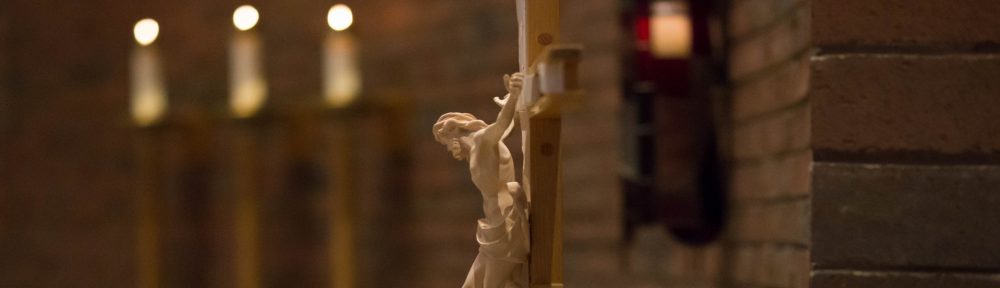
Almost every morning, I awaken on my right side. The first thing I see is a five-foot by eight-foot sky-blue wall with nothing on it. At least it used to have nothing on it. I bought and hung a 5-inch by 10-inch crucifix last week. Relative to the space, the crucifix is somewhat small. At first glance, it may even look swallowed up by the area around it. Still, I’m keeping it where it is. It’s crisply distinct, hovering as the space’s only focal point.

Interestingly, I can see the crucifix day or night. In the daytime, it casts a notable shadow. At night, after my eyes adjust, its contours are not lost in the blackness. It’s harder to see, but it is not invisible. There’s a unique comfort to be had by this, which means the crucifix is doing its job. But before I explain what I mean, I should clarify something else.

Some people despise the usage of crucifixes, icons, and other religious items. In their ignorantly hasty opinions, they blanketly consider them idolatrous, being little more than talisman-type objects that can only nudge God from center stage. Admittedly, some people do treat religious objects this way. I knew someone who once told me he put a Bible on his bedside table, not to read but to help him sleep more soundly. He believed its presence helped ward off evil spirits. That, of course, is ridiculous. Still, my guess is that most Christians don’t keep religious items around for such reasons. Instead, they have something else in mind.

Take, for example, the crucifix on the wall beside my bed. It’s where it is for a reason. I didn’t put it there for pseudo-spiritual reasons or because the wall needed décor. I’m not afraid of the devil, and Jennifer has more than decorated our bedroom, making it a cozy place of refuge and rest. I hung it there because it’s likely the first thing I’ll see when I wake up and the last thing I’ll see when I go to bed. I’ll see it when the lights are on or off, in the sunbeams of daylight or the pitched darkness of night.

A crucifix—a cross with a body on it—is the Gospel depicted. It’s a visual proclamation of Saint Paul’s words, “We preach Christ crucified” (1 Corinthians 1:23). It is a silent sermon wholly concerned with the person and work of Jesus Christ, the world’s Savior. That’s its job—to preach. You don’t worship a crucifix just as you don’t worship a pastor. Neither replaces Christ. Both preach Christ’s visceral efforts to defeat Sin, Death, and Satan. The preacher speaks it. A crucifix shows it. The one on my wall is no different. I awaken to its quiet preaching. I also close my eyes to it, finding rest in the Gospel promise of God’s forgiveness and care for me, a sinner needing daily rescue.

Relative to optics, there’s certainly more it teaches. I mentioned I can see it in both the daytime and at night. Things are simpler with the sunlight’s ease. You know what’s going on. You can see where you’re going. Your steps are freer and more leisurely. Life’s darker moments are harder. Terrors creep there. Perceptions are skewed. It’s far more difficult to see. Nevertheless, Christ’s payment stands. In the ease of daytime or the terrors of night, Christ’s sacrifice for our eternal future remains the solitary point of reference to everything this life presents. Faith sees it. It knows it. And it is at peace.

Goodbye, Summer

This summer has been and continues to be a challenging one. I don’t intend to bemoan my circumstances. Neither am I pleading for a reprieve from the arrayed struggles. I’m simply relaying that I do not expect to look back on the summer of 2023 with any measure of fondness. It has been busier than busy, sometimes crueler than cruel, and occasionally sprinkled with some enjoyably restful moments. Our time together in Florida was one. Taking Evelyn to see a NASCAR race was another. In between, far too many negatives filled the gaps.

As I said, I don’t mean to complain. Complaining accomplishes nothing. Muscle through and do; that’s more my way. Complaining invites excuses and accepts defeat. Ask Jennifer. I don’t accept defeat too well, but mostly because there almost always seems to be a way to succeed. You just need to find it. The adage rings true that you can either be a part of the problem or a part of the solution.

Part of acknowledging any challenging situation means admitting to what’s really going on behind the scenes in this world. Sin is a very real thing, and it has infected everything. I should not be surprised when the season I look forward to more than any other becomes something to endure rather than enjoy. Sin will do that. God certainly doesn’t promise immunity from tragedy to His Christians—at least not in the way the name-it-and-claim-it charlatans of this world suggest.

On the contrary, He assures us we’ll experience trouble. Jesus said as much to His disciples, saying, “In the world you will have tribulation” (John 16:23). But He didn’t end His words there. He continued, “But take heart; I have overcome the world.” Here the Lord promises His care. He promises to give us what we need to endure. Saint Paul echoed the same, writing, “God is faithful…he will provide the way of escape, that you may be able to endure it” (1 Corinthians 10:13).

While He gives what’s necessary to each believer as He knows best, as you can see, there’s something He sets before the whole world: the Gospel—absolute hope through faith in Christ and the promise of eternal rest apart from sin’s terrifying grip. That hope is endurance’s fuel. Interestingly, Christian endurance produces some pretty neat behaviors. For example, in times of trouble, when I discover myself stretched to my emotional extremities, I become attuned to the humor in seemingly humorless things. Just this morning, my backpack on my shoulder, my rolling bag in one hand, and a cup of coffee and my keys in the other, I attempted to use my foot to open my office door only to lose my balance and stumble forehead-first into its solid oaken barrier.

It hurt. How I managed to fumble like that, I don’t know. Still, I laughed because it was ridiculously funny.

Over the years, I’ve come to realize that the man who can laugh at whatever befalls him demonstrates a type of lordship over this world. From the Christian perspective, he proves a Job-like verve capable of saying, “The Lord gave, and the Lord has taken away; blessed be the name of the Lord” (Job 1:21). He can speak along with King David who wrote so daringly, “The Lord is my light and my salvation; whom shall I fear? The Lord is the stronghold of my life; of whom shall I be afraid? (Psalm 27:1). He can be at peace because he “is not afraid of bad news; his heart is firm, trusting in the Lord (Psalm 112:7). He’s already asked and answered himself, “What can flesh do to me?” (Psalm 56:4).

Nothing. Everything sin has corroded is passing away. “Behold,” the Lord said, “I am making all things new” (Revelation 21:5).

With this trustworthy Word from our gracious Savior, bad news is a toothless beastie, tragedy is a pinprick, catastrophe is a mouse’s shadow, and heartbreak is a wound needing little more than a Band-aid. All this is true because, as Saint Paul wrote so plainly, we are justified before God by faith in Jesus Christ (Romans 5:1). The endgame has already played out on Calvary’s cross. Now, everything is endurable by the power of the Holy Spirit at work within us. I’d say, maybe even laughable. Paul explains:

“Therefore, since we have been justified by faith, we have peace with God through our Lord Jesus Christ. Through him we have also obtained access by faith into this grace in which we stand, and we rejoice in hope of the glory of God. Not only that, but we rejoice in our sufferings, knowing that suffering produces endurance, and endurance produces character, and character produces hope, and hope does not put us to shame, because God’s love has been poured into our hearts through the Holy Spirit who has been given to us” (Romans 5:1-5).

In conclusion, please don’t think I’m making light of anything you might be enduring right now. I’m not. And neither is our Lord. I’m merely setting a point of origin for steering into all of it. You have hope. God said so.

Absence

It’s happening. The days are getting shorter.

Those of you who read these meanderings regularly will know that I struggle at summer’s end every year. It’s not so much that the longed-for season of effortless schedules is leaving (although this summer has been anything other than easy), but instead, it’s that the sun begins making less time for us. Moving into autumn, the sun makes drastic changes to its schedule. For one, it gets up late and goes to bed far earlier. Some of us will go days without experiencing its presence, traveling to and from the office in the pitched blackness of its absence. On an occasionally cloudless day, you’ll see it pass by the window—but only if you have a window. If not, it’ll be as if the sun used to exist but does so no longer.

My stomach turns just thinking about it.

Jen posted something on social media last week. It was a snippet from our family’s after-dinner cleanup. Essentially, Evelyn asked, “Momma, did you know there is something called S.A.D.? It’s when people get very sad when summer ends.” She was referring to Seasonal Affective Disorder. And before she even finished her testimony, I was already answering, “Yes. And would you like me to explain it to you?” I wasn’t being snarky. The moment was a jesting one. However, looking back on the moment, I wonder if she planted the question. She knows how disjointed I become in the perpetual darkness of the sun’s absence. I get the feeling she asked Jennifer the question to spare me a momentary cloud while also showing me she is paying attention and understands. She’s like that. She’s mindfully caring.

It usually takes me a few weeks to get into autumn’s rhythm. In fact, by the time I discover myself finally beginning to appreciate fall’s colorful detonation, the snow arrives and covers it. Gripping summer’s absence tightly, I put myself at a disadvantage, resulting in being a step behind other opportunities for joy. Admittedly, I am forever learning a lesson from these things.

Honestly, absence is a tricky thing. John Dryden said that when you love someone or something so much, an hour of absence is like a month, and a day is like a year. Jennifer and I were talking about this one night last week before bed. She mentioned that family dinners will soon be very different. She’s right. Like a curious organism, absence will grow. Right now, dinners together as a family are quintessential to our lives. We do everything we can to ensure all six of us attend. But life’s seasons are changing. Soon six will be five, five will be four, and then four will be three. And then it’ll just be Chris and Jen. For the Thoma family, that’s a big deal. We’re knitted very closely together. When one is absent, it’s as if the world has suddenly become strangely uninhabited.

I get it. At least, I’d better get it. The day is surely drawing near when Chris and Jen will be Chris or Jen. Some of you already know what I’m talking about. Absence—the experience of being apart and missing that person so incredibly much—can be devastatingly palpable. I miss the sunshine during winter. Still, that’ll be nothing compared to an empty nest—or Jen’s empty chair. Personally, and in a selfish way, I hope my chair is found vacant first.

Having said these things, there’s something else to the topic of absence. Christians know what it is.

For some, absence means loss. Not just any kind of loss, but permanent loss, as if the person they miss is forever out of reach. One of my favorite texts from God’s Word is “The last enemy to be destroyed is death” (1 Corinthians 15:26). I like it because it serves as a capstone statement to Paul’s previous preaching in the chapter that Christ has conquered all things, and by His resurrection, the seemingly impossible obstacle that brings ultimate separation—Death—has itself been massacred and tossed aside in the cosmic contest for our eternal future. As a result, no other enemy stands between us and our God. Christ saw to it. His resurrection proved it handily. From this vantage, one of Death’s offspring—permanent human separation from God and each other—is included in the list of enemies defeated by Christ’s work. In other words, because of Christ’s victory against Death, Christians can’t really even speak of a loved one who died in the faith as absent in the sense of being lost or gone for good. Those who are no longer with us, while absent from us, are not absent from the Church’s eternal fellowship. This means we’ll be with them again in person. Right now, they’re with Christ, and according to His plan, their time of physical separation from us is already on a trajectory of reversal. Their mortal absence might indeed stir sadness. Still, we really can’t justify the kind of sadness relative to permanent absence or being lost. The absence is not permanent. Believers are with Christ in His nearest presence. And if you know right where a person is, how can he or she be lost?

Indeed, in natural time, the sun goes away during autumn and winter. Likewise, the day is coming when either I’ll be without Jen or she’ll be without me. But only for a time. The spring and summer sun will return. Believers won’t be apart from our loved ones who’ve died in the faith for long. Soon enough, there will be an eternal sunrise in an unending time of togetherness outside of time. That’s Christ’s promise to His faithful. Until then, the faithful have another powerful guarantee. The same risen Christ vowed He would never leave or forsake us (Hebrews 13:5). He promised He is with us always, even to the end of all things (Matthew 28:20). That promise meets with right now. While ten thousand sermons could be preached on either of these two texts, all with unique renditions of Christ’s beautiful assurances, each would bear a common thread of consequence: You’ve been won by the person and work of Christ, and now, by faith, no matter what, you are never alone. Interestingly, you can be confident of this because of something Christ cannot do. He cannot break His promises, and therefore, He cannot be absent from those who are His own.

To close, remember these two things during autumn’s darker days, whether that autumn is seasonal or human: Human absence is not our forever, and in Christ, you are never alone.

Staring

Did your mother ever tell you it’s rude to stare? I’m pretty sure mine did. Granted, it was typically an instruction given relative only to people. Parents experience an entirely different form of concern when their children sit and stare at nothing. Good thing I’m the only parent in the entire building right now. Here I sit, staring out my office window. Although, I am not entranced by a strange-looking person, nor am I being drawn into a void of nothingness. Instead, a reasonably hefty groundhog is wandering around outside my window doing whatever groundhogs do. He appears to be busy scurrying and popping up and scurrying again. At one point, he popped up to look in my window. We saw each other. I said hello and told him he looked well-fed. He dropped back down to scurry away, only to pop up again as if to say, “Same to you, buddy.”

There are plenty of other things I should be doing right now. For one, I should be tidying up my sermon for this morning. It’s written, but it isn’t ready. And yet, I’m watching a groundhog. It’s not as if I haven’t seen one before. Or that groundhogs are all that interesting. It’s something else. It’s more that feeling one gets on occasion. I’m guessing you know the one. You begin looking at something, and after a time, you realize you’re locked on it in a lazy stare. You’re not necessarily interested in whatever you’re observing. You’re just looking. And as you do, you leave yourself for a moment.

Have you ever been doing this when someone suddenly asked you a question? One way to know it’s happening is that it takes several seconds to realize you’ve been asked a question and then a few more seconds to answer. And when you give a somewhat disjointed reply (because you began speaking while climbing back into yourself mentally), the person doesn’t thank you but inquires, “Are you okay?” I suppose it wouldn’t be out of order to respond, “Everything’s fine. I just stepped away from the control panel for a moment.”

Returning to the fact that I’m staring at the local wildlife when I should be working on my sermon, I get the sense that staring at someone can’t be all that bad. The Gospel reading for today is Mark 8:1-9. As Jesus directed the hungry multitude to sit, I imagine His disciples were staring at Him. Aware of the dire situation, they’d already asked Him, “How can one feed these people with bread here in this desolate place?” (v. 4). Rather than initiating a food search, the Lord instructed them to stay right where they were. That was weird. It invited astonishment, the kind that could easily become staring because it didn’t want to miss what might happen next.

My wife, Jennifer, is a gifted photographer. She’ll never admit it, but she has a visual sense about her that few others do. It’s a sense that employs staring—not the lazy kind I admitted to this morning, but the intently honed kind. Jennifer can spot things among casual scenery that most others will miss. Genuine photographers have this skill. Painters and poets do, too. They see things that others miss and then lock onto them. They look without flinching, observing the microscopic details. They learn by staring. They know a glimpse isn’t enough. They know you must look intently to truly see. By looking this way, they know they’ll be led to better, more substantial things.

When it comes to Jesus, this should be everyone’s rule. He’s worth far more than a superficial glance. Everything He says, everything He does, you don’t want to miss. There’s a purpose in all of it, and it’s entirely for His onlookers. That’s one reason any seasoned preacher will admit that even the most uncomplicated Gospel narrative can provide a lifetime of sermons. Every little detail relative to Jesus’ person and work—every single motion and word in every single context or conversation—aims for the miracle of humanity’s salvation. That salvation, and all its accessory minutia, must be examined and preached. To do so is to connect with the instance being studied and be prepared to understand other instances.

For example, observing Jesus here in Mark 8:1-9, I imagine that later on in the upper room on Maundy Thursday, when the Lord took the bread, gave thanks, and then broke and gave it to His disciples (just as He did with the multitudes in the wilderness), there were words and actions used that the disciples had seen before. It was an entirely different context, yet it was reminiscently similar. At a minimum, having paid close attention in the wilderness with the starving crowds, they’d know the Lord’s ability to take a single piece of bread in hand and, prior to giving it to anyone else, make it so much more than before He touched it. In the wilderness, one piece in the palm of His hand became five, and then ten, and then thousands upon thousands, enough that the uneaten leftovers filled seven baskets. Surely, a single morsel in the Lord’s Supper, surely a tiny sip from the Lord’s chalice, could be more than well-wishing symbolism. Certainly, Jesus can take hold of mundane things and extend their potential beyond human faculties for reason or comprehension.

Either way, these things are lost on those who are only willing to give Jesus a superficial glance, one that assumes it can sufficiently sort Him out in a drive-by interaction, ultimately considering Him to be just one spiritual guru among many. You can’t just pop up for an occasional peek, fitting him into your scurrying, and expect to be called a Christian. It’s better to stop and stare. You should watch Him closely. You should listen to Him carefully. You should mind what He’s doing, and as He does it, hang onto His every word (Luke 19:48).

Knowing that Christ is the Word made flesh, the same rule naturally applies to the Holy Scriptures. God’s Word is more than worth an irregular glance. Luther is the one who said, “If you picture the Bible to be a mighty tree and every word a little branch, I have shaken every one of these branches because I wanted to know what it was and what it meant.” In a mere practical sense, for Luther, a tree is a tree—until you examine it. When you stare into its branches with investigative eyes, you’ll see far more than a forgettable object with a trunk and green stuff growing out of it. You’ll discover details. You’ll see one branch leading to another—flowering adornments reaching out from countless stems covered in intricately contoured surfaces. You’ll find things living among the tree’s branches, lively creatures that call the tree home.

By the way, I think most pew-sitters can tell the difference between a pastor preaching from a drive-by glance at Jesus and one who has stopped to stare at Him. It’s not only revealed by the preacher’s care with words, but by the details his words are in place to carry. Telling the listeners about a tree is nothing compared to using words that lift them from the earth to set them into its branches. A tree remains an inconsequential construct until the preacher examines and then introduces you to it. That’s a reality relative to language.

Having said that, I should get back to the sermon-writing effort. In the meantime, consider your own willingness to stop and stare at Jesus. Is He of more interest to you than an occasional visit to church? Driving by, is He more than just another object decorating your intellect’s limited landscape? Is His value for life in this world and the next far more substantial than your rarely-opened Bible would betray? I hope so.

How about this? Pick a narrative from any of the four gospels. Long or short, read the same narrative every day for a week. After each textual visit, take some time to savor it. Think about what you read. Let yourself stare into it for a while. Do this with the same text each day for a week, taking a moment to jot down something you notice with each visit. My guess is that each interaction will provide a unique “something.” You might not understand the something right away. Still, you will have taken it in. And you’ll likely recall it right in the middle of another narrative somewhere else that may lead you toward understanding it. You may even begin to notice particular trajectories, ones that lead you from simple uses for water, food and drink, and so on, to other, more substantial truths—ones suggesting that there may be more to faith’s origin than you knew; or there may be more to baptism than you first thought; or there may be more to the Lord’s Supper than the one-size-fits-all church or the meme-assembled theologies have taught you.

Making Plans

It feels like the summer is flying right by. Thankfully, I do have things to show for it. I’m certainly not wasting time.

As a parent, I keep on my kids about things relative to time. For example, I occasionally remind them in my own way that someday will eventually become today, and unless you’ve planned accordingly, what today requires will be entirely inaccessible. A person simply cannot live without thinking of the future.

In some discussions with my kids, I try to steer them toward calculating one’s self-sufficiency relative to backup plans. In other words, you cannot always rely on other people. They will let you down. In the same way, you cannot always count on the things you think you can count on. Things wear out and break. Apart from syncing to a cloud-based drive, it’s why I have two external hard drives, each backing up from my computer’s working drive every four hours. It’s why I always bring my laptop to my church office every Sunday morning. If my office computer has problems, I can use my laptop to write and send the eNews and, if necessary, finish my sermon and the service prayers. It’s also why I’ve learned how to use my cell phone as a hotspot. If the internet is down on Sunday morning, I can still get this eNews message sent. It’s also why I have a second printer in my office. If the office printer is down, I can still print anything I might need in a pinch.

I didn’t always live my life this way. But I do now. A few unfortunate circumstances over the years taught me just how right Ben Franklin was when he said that failing to prepare is to prepare to fail. As a result, I do what I can to have a backup plan. Most often, I have two, and sometimes, even three.

I don’t mean to say that the future is controllable. It isn’t. Only the Lord knows what will or will not be, and plenty of people have prepared for the future in every imaginable way, only to suffer future-shattering tragedies beyond their control. For all my planning, I once showed up to the office on a Sunday morning and, attempting to print my sermon manuscript, discovered the office printer was down, the ink in my second printer had dried up, and I had zero replacement cartridges. I had to write it by hand. Twenty-eight years ago last week, my twenty-four-year-old brother Michael was killed in a car accident. Here I sit today, still astounded that he’s not around. His absence was something my family and I never expected.

Simple or grand, even when you prepare, tomorrow is never for sure.

I read a portion from Luther this morning in which he wrote, “Christ has not freed us from human duties but from eternal wrath.” He goes on to say that even as we strive and prepare, the only certainty we’ll ever truly have is situated in Christ. Faith receives that certainty. It can receive it because it understands what laboring in this fallen world as a responsible human being means, even when we know everything we’re doing could be for naught and could all come crashing down. Before it even begins a task, faith admits to human brittleness and life’s uncertainty. From there, it plods along diligently, knowing that you win some and you lose some. Faithfulness, not success, is key. It can live this way because its mortal future isn’t its final future. It is secure in Christ for a future beyond all futures. Destruction is not the last word for believers, not because we worked hard or devised a plan to avoid Sin’s inevitable wage, but because God had a plan for carrying us through it. He enacted that plan in Jesus, the God-man in whom faith is placed.

Relative to this, Christians do work hard. And they plan. Leaning on Luther, he mentions God’s gifts of reason and sense in his explanation of the First Article of the Creed in the Small Catechism. Our reason and our senses make these things possible. But remember, as Christians prepare, they measure their futures by looking through Gospel lenses. Faith doesn’t make plans apart from looking to Christ. Faith does not plan a vacation without planning a way to be present in worship while away. Faith does not invest financially without mindfulness for Christ and His bride, the Church. Faith considers the Gospel’s perpetuation for future generations when voting today. Faith plans, all in faithfulness to Christ and the benefit of the neighbor.

Again, do the plans always succeed as we intend? No. Remember: faithfulness to Christ, not success. Faithfulness to Christ is blessed. Saint Paul assured us that “all the promises of God find their yes in Him” (2 Corinthians 1:20). Of course, that truth is a theme throughout God’s Word (Proverbs 28:20, 1 Thessalonians 5:23-24, 2 Thessalonians 3:3-5, and others).

By the way, by blessing, God is not promising health, wealth, and other sorts of earthly things. Again, He promises the future beyond all futures—the eternal reward that’s inedible to moths, out of reach to thieves, and impervious to Death itself (Matthew 6: 19-20, 25-33). When a person has this divine schematic (God’s greater plan for an eternal future) in one’s pocket, what terrors can threaten with any real significance?

There aren’t any. And the ones that try are toothless. Read Romans 8:31-39, and you’ll see.

Indeed, Luther was right to measure all our future concerns and their subsequent plans against God’s promises in Christ, referring to all of it collectively as “true freedom” and then continuing that “no man can value it high enough. For who can express what a great thing it is that a man is certain that God is no longer angry with him and will never be angry again, but for the sake of Christ is now, and ever will be, a gracious and merciful Father?”

I Think It’s Gonna Be a Long, Long Time

Here in Michigan, with the summer weather comes the bluer skies—the endlessly deeper sapphire skies. They’re beautiful, and they’re more than worth one’s staring. It’s supposed to rain today. That’s okay. We more than need it.

I installed a new stereo in my Jeep. The previous stereo had become somewhat rebellious. For example, it preferred to pause the music when I pressed the mute button. Also, it tended to begin its life anew at every stop. Five minutes at the gas station, and it would reset its clock, lose all the stations, and so much more. Sometimes, it wouldn’t even acknowledge me. I’d press a button, and it wouldn’t do anything. It’s now in a box in my basement.

The new stereo connects to my phone and its music applications, one of which is Spotify. On the way to school one day last week, Evelyn and I listened to whatever Spotify sent us. Elton John’s “Rocket Man” was one of its suggestions. Listening to that song beneath what was gradually becoming a clear blue sky stirred a particular memory for me. I described it to Evelyn. I told her that I heard that song while driving a week or so after my brother Michael died. It was in July 1995. The sky was a seamless blue. I remember leaning a little bit into the steering wheel of my truck to look upward through the windshield for a better view. I did this as Elton sang, “And I think it’s gonna be a long, long time….”

I was 22 years old at the time. My brother—my only brother—was 24 when he died. I remember looking into that infinitely vast sky and thinking it would be a very long time until I’d see him again.

After sharing that memory, I’m pretty sure I noticed Evelyn moving as inconspicuously as she could to wipe away some tears. She’s truly a lovely girl, empathetic in every way. Of course, I didn’t end the story without the Gospel truth, which I’d already shared in a simpler way. Yes, it would be a long time before I saw Michael again. It’s already been almost three decades since we were last together. Still, I will see him. That’s the promise. And I believe it.

My oldest daughter, Madeline, just graduated from high school. Her graduation party was yesterday. What a joy it was to spend time with so many friends. Naturally, as it is with many events in my life—my wedding, the births of my children, my ordination, and so many others—I’ve looked around each event’s scene and wished Michael could’ve been there. That happened at Madeline’s party. Certainly, I’ve always wished my children could’ve known him. And yet, I wasn’t thinking that way yesterday. Instead, more than once while visiting with so many people I cherish, I thought, I wish Michael could’ve been here to meet you. I know he’d have liked you as much as I do.

As the saying goes, each day, a day goes by. But when you love someone, the person’s absence hurts, and each day apart seems to have a thousand hours instead of only twenty-four.

I suppose for many of you, I’m not describing something unfamiliar. You know the sensation. You’ve experienced those moments when you’ve heard a song, taken in a scent, or seen a sight that swept you backward to a time with someone who right now is permanently out of reach.

Having just used the word “permanently,” I realize how strange that word is for Christians. Even with synonyms like “perpetually” and “forever,” for Christians, the truth is that these terms have an expiration date when paired with the out-of-reach nature Death seems to bring. For Christians, Death isn’t permanent. It isn’t forever.

There’s another saying that Death has a thousand doors, and we all find one. There’s truth in that statement. However, no matter its form, because Christ conquered Death, it becomes just another event in a believer’s mortal life—an entryway to a timeless unending with Christ so beautifully described as the shelter of His glorious presence, a place where believers “shall hunger no more, neither thirst anymore; the sun shall not strike them, nor any scorching heat. For the Lamb in the midst of the throne will be their shepherd, and he will guide them to springs of living water, and God will wipe away every tear from their eyes” (Revelation 7:16-17).

And by the way, this wonderful reality will occur among what Saint John called “a great multitude that no one could number” (v. 9). All believers in Christ will fill that multitude’s ranks. Michael is already there, along with all who’ve gone before us in the faith. I’ll be there one day. Someday my wife and children will be there. By faith in Christ, you’ll be there, too.

Until then, in a mortal sense, I think it’s gonna be a long, long time. But that’s okay. Time will end. But eternal life won’t. Knowing this, I can hear a song that prompts a glance toward the heavens and have a different longing as I do it, realizing that for every hour we’re apart from those who’ve died in the faith, there will be a limitless cadence of eternal hours together with them in our Savior’s presence. That same Savior, Jesus Christ, gives this to us because, in perhaps the simplest way, He knows the feeling. Believers are a part of His family. By His relationship to the Heavenly Father, He calls us His brothers and sisters (Mark 3:34-35, Romans 8:29, Philippians 2:8-11, Hebrews 2:11, 2 Corinthians 5:21). He loves us more than anything—enough to shed His blood—and He doesn’t want to be without us.

One last thing.

Don’t get me wrong. I don’t mean to make Death out to be no big deal. It is. That’s why, as I’ve said countless times before, I always give Death a capital “D.” Death is not our friend. It isn’t our helper. But also, it isn’t something we must fear because it isn’t our master. The real Master, Jesus, has declawed, defanged, and defeated it. That’s why Paul can recite rhetorically, “O death, where is your victory? O death, where is your sting?” (1 Corinthians 15:55).

Again, Christ loves us more than anything. Not even Death can keep Christ’s brothers and sisters from Him. Instead, Death must hand them over to the Lord every single time. That’s something worth pondering, no matter the sky’s demeanor.

Faithful not Successful

Summer is nearly upon us. The weather is finally admitting as much. I give thanks to the Lord for this. Throughout the school year, the pace is much swifter around here, to be sure. Summertime allows more scheduling freedom, and as a result, things slow down a little. Of course, the calendar’s empty slots always fill up. There’s plenty to do. I can tell you that I’m already sufficiently booked into and through the first week of August. Still, as Michigan’s colder weather shrinks back into hiding for a few months, so also goes the guilt I might have for stopping to actually engage in something that has almost nothing to do with pastoring, something I might also enjoy—like figuring out how to lift my Jeep’s suspension an inch or two, or replacing the toilet in our downstairs bathroom, or putting a drop ceiling in our basement guest room.

One thing I do every summer is read. Of course, I read the scriptures. But I also pick away at classics. I’ve already decided on Jack London’s The Call of the Wild. That won’t take me long, so I’ll need something more. I decided to do something a little different. Those who know me best will know I’m keen on sci-fi/horror films. Although, I’ve never spent money on books from that genre. I decided to give the Rage War series by Tim Lebbon a try. It’s a three-volume series about the Yautja (the creatures from the Predator films) invading the earth, only to team up with the humans to fight against another unknown force unleashing xenomorphs (the creatures from the Alien films) across the galaxy. I likely wouldn’t have purchased these volumes if our school’s wonderful PTL hadn’t given me a gift card to Barnes and Noble. I blame them for this eagerly anticipated distraction.

I don’t expect these books to be anything but outlandishly fun, and I doubt I’ll discover anything worth quoting. Perhaps like me, you don’t like to mark up the pages of your books. I’ll usually bend the page’s corner if I find something worth revisiting. Plenty of books I own have these little bends. However, on occasion, I’ll underline something. Flipping through my edition of The Call of the Wild, on page 100, the following is underlined: “It was idle, he knew, to get between a fool and his folly….”

Thorton, a character well-versed in the Yukon’s ways, mulls this thought relative to Hal, an inexperienced and ignorantly vain character who has no idea how to care for, let alone drive, a dog sled team. Regardless of the context London has fashioned, the point is memorable, if not for its simplicity. Human beings are going to do what they want to do. Being the time of year for graduations, I’ve begun noticing this in the ever-increasing irreverence at commencement ceremonies. Ask the crowd to hold their applause, and they’ll clap anyway. Expect solemnity from the onlookers, and you’ll get airhorns and ear-piercing woot-woot screams. Moreover, people have the uncanny ability to be so prideful that they’ll do incredibly foolish things, even things that could ruin or destroy them. Perhaps more tragically, no matter how hard a person—a trusted friend, a sibling, a parent—might try to get between a person and self-destroying things, doing everything possible to coax them away from folly’s edge, unless they realize the nature of their self-centered predicament and accept the better direction, tragedy is all but guaranteed. They will fall. And it won’t be pretty.

I’ve noticed something else in my time as a professional church worker, this being my 29th year. The one trying to help often holds the most guilt, wishing more could have been done to prevent the disaster. A son, even after his mother’s tearful warnings, makes a life-altering mistake, and it’s Mom who cries herself to sleep, wondering where she went wrong. A daughter strays into an abusive relationship, and it’s Dad who grows visibly older with burdensome worry, wondering if he could’ve been a better, more affectionate example.

Erma Bombeck referred to this kind of grief-stricken guilt as the gift that keeps on giving.

Saint Paul said something a little different about it. He wrote, “For godly grief produces a repentance that leads to salvation without regret, whereas worldly grief produces death” (2 Corinthians 7:10). The word Paul uses twice for grief is λύπη. Essentially, it means mental turmoil. It’s a pain of the mind marked by agony and regret. As a father, I can assure you that parents are more than prone to this kind of grief. Close friends are, too.

Interestingly, in both instances, Paul takes care to modify the word. The first time, he couples it with “godly.” In the second instance, he attaches “worldly.” By doing this, he’s not saying that grief isn’t real or that it doesn’t hurt, but that there’s a distinct difference between the guilt-ridden heartache we endure by faith and the sorrow-laden regret borne according to human capacity. In short, godly grief has hope. It finds a footing in repentance and is met by God’s loving promises for a regretless future. The other has none of this. The other leads into the sinister depths of eternal sorrow and the end of all human hope, namely, Death.

If you were to visit the verse before verse 10, you’d see Paul commends godly grief, saying he’s glad for the harder moments that stir repentance. He’s not reveling in the pain, but he’s glad for what the pain produces.

There’s something going on here. If anything, a byproduct of godly grief is clarity. Saint Peter hinted at this in a way when he encouraged us to remember something. He wrote: “The Lord is not slow to fulfill his promise as some count slowness, but is patient toward you, not wishing that any should perish, but that all should reach repentance” (2 Peter 3:9).

When all human effort to help a loved one seems long spent and all hope appears lost, Peter brings us to something else. He reminds us that God’s timing rarely aligns with ours. God’s pace is His own. But no matter His stride, He’s dealing with us patiently. His desire for all human beings is to reach the uplands of repentance. What does this mean relative to what I’ve written so far? Well, let me think about that out loud for a second.

Firstly, I’d say we need to realize that we can’t live others’ lives for them. A mom cannot live her son’s life. Likewise, a dad cannot forever make his daughter’s choices for her. A friend does not control another friend’s will. The sooner we accept this, the better.

Secondly, Mother Teresa was right when she said, “We are not called to be successful, but faithful.” She didn’t come up with that on her own. The Bible taught her to say it (Luke 16:10-12; 2 Corinthians 5:7; Revelation 2:10; Matthew 10:22; and countless more). The point is that by the power of the Holy Spirit, we seek faithfulness to God in any given situation, even when we feel completely powerless to do or say anything of significance. Still, be faithful. Trust Him. Faith knows He’ll take even the most insignificant of one’s words, gestures, or whatever and put them to good use. He’s got you.

Thirdly, things might appear to go south no matter what we do. And when things don’t go as planned, there will be guilt. There will be grief. But let it be godly grief. Again, godly grief still hurts. This is only true because it’s honest. It’s self-examining. It wonders if it could’ve been more attentive, less critical, or whatever. That’s what desiring faithfulness often feels like. It wishes it could be more faithful. But amid its sadness, godly grief remembers something of God. It knows His forgiveness, the kind that covers regret. It also knows the game isn’t necessarily over. It knows that even though nothing we do seems to bring the results we want, we’re not in charge. God is, and He’s moving behind the scenes at His best, most perfect pace according to His steadfast love. Godly grief knows He’s listening to our prayers. It knows the kind of love driving Him aims at rescue—at working to instill repentance and faith.

That’s hope. That’s confidence in God’s love. God’s love dispels the gloom. There is no fear in that love (1 John 4:17-18). It knows that just as we don’t want to lose our loved ones to ungodliness leading to eternal separation in Death, neither does God.

And so, we continue praying while standing ready to act when necessary. This process may last a lifetime. We may never live to see anything change. Still, we know by faith that it could. Who knows for sure if it will? Only God. Either way, we can be at peace. We can continue to be faithful, not necessarily successful.

Be encouraged by this.

The Possibilities

It has begun. Multiple times a day, the Thoma children announce how many days remain until the last day of school. I bet they’d be ready with the hours, minutes, and seconds if I asked any of them. I’m certainly not annoyed when they do this. I know why they do it. For youth, summer and freedom are synonyms. Besides, I did it, too. As a kid, I counted the days until my only schedule-consuming responsibilities would be jumping ramps on my bike, hunting crawdads in muddy creeks, playing army in the forest behind my best friend’s house, participating in socially recalibrating neighborhood scuffles, watching late-night scary movies, and just about anything else summer could conjure.

Thinking back to those days, even though I stayed up pretty late almost every night, I don’t really remember sleeping in the following day. I remember wanting to get as much from my summer as possible. And so, I’d hop out of bed no later than 8:00 or 9:00 a.m., throw on the cleanest clothes from my floor, have a bowl of cereal, and then fly out the back door to the rusty shed where I kept my bike. I’d throw up a dust trail speeding down our gravel driveway or go off-roading through our bumpy backyard, my bike clanking and rattling all the way. But whichever direction I went, the horizon’s possibilities were limitless.

Some of the summer’s possibilities were great. Others, not so much. I remember one summer hearing that my friend, Todd Smart, fell from the tree in his front yard and died. It was July of 1983. I was ten years old at the time. My dad told me the news. I certainly knew the tree. I’d climbed it, too. If I had to guess, I’d say it was at least twenty feet tall. Although, things seemed so much bigger when you were a kid. As the story goes, Todd had just about reached its peak when the branch he was standing on broke, and he fell to the ground, hitting branch after branch all the way down. A couple of days later, my friend, John, told me he’d heard Todd looked like a pinball bouncing off the bumpers as he fell. Oddly, John and I had that conversation about ten feet from the ground in a tree near my grandmother’s apartment.

It’s strange the things one remembers from childhood. Before telling me the news about Todd, I remember the look on my dad’s face. It was uniquely unordinary. I knew I was going to hear something I didn’t expect. I remember the tree near my grandmother’s apartment. I remember which branches a kid needed to grapple with to climb it. I remember my friend John’s home phone number. I just typed it into Google. A woman with an extraordinary name—Drewcylla—appears to own it now.

Whether winter, spring, summer, or fall, each season holds more across its horizon’s boundary than what’s right in front of us at any given moment. What we experience in those lands will be with us well into the future—well into forthcoming seasons. Some things we’ll remember in detail. Other parts we’ll forget. Some we’ll observe from this side of life and realize how we didn’t fully comprehend the event’s particulars because of our immaturity at the time. Remember, my friend died climbing a tree, and a few days later, another friend and I discussed the tragedy while climbing a tree. I’m well past ten years old, and I only recognized the irony just now as I typed this. Still, the Christopher Thoma tapping on this keyboard this morning is the same one who dangled from that tree near Valleyview Heights Apartments in Danville, Illinois, forty years ago. And yet, I’m not the same person. I’m entirely different after meeting each season’s moments. That’s life. That’s development. That’s growth. And it’s normal.

Seasonally speaking, I’m absolutely certain that growing up in the 1970s and 80s barely compares to childhood today. For one, I don’t remember any of my classmates identifying as cats. (Honestly, the neighborhood scuffles I mentioned before would’ve fixed that weirdness in a hurry.) I don’t remember any of my teachers encouraging me to explore my gender identity or encouraging anyone I knew to consider gender reassignment surgery. The 70s and 80s could get crazy, but not this kind of crazy. I certainly don’t recall any of my teachers attempting one of the worst kinds of crazy: to undermine my Christian faith or divide me from my parents. For example, my son, Harrison, came to me this past week to tell me that his AP US History teacher at Linden High School overheard him talking to a friend about a scene from the Monty Python film “The Life of Brian.” Harrison hasn’t seen the movie, but I have shown him a few of its more hilarious scenes. The conversation unfolded something like this:

“Isn’t your dad a priest or something?”

“He’s a Lutheran pastor,” Harrison answered.

“He actually let you watch that movie?” the teacher pressed.

“No, I haven’t seen it. I’ve only seen a few scenes. They don’t really want me watching it.”

“Of course not,” the instructor replied. “He probably doesn’t want you watching it because it’ll challenge what he’s taught you to believe and teach you another way to look at the Christian religion.”

Nice try. But most certainly a hit and a miss. Jennifer and I haven’t kept the movie from Harrison because we’re his cruel overlords. Thankfully, he knows this. And thankfully, he talks to us openly about things like this. For the record, Mr. History Teacher, his mother and I don’t want him to watch the movie because it employs a few choice words we’d prefer for him to avoid and has full frontal male and female nudity. Other than that, it’s hilarious. And if anything, the “I want to be called Loretta” scene makes you and your dreadfully woke automaton colleagues look imbecilic by comparison.

Right now, even as Harrison is sixteen, he’s developing. It’s our job to help him along. We do this by ensuring he knows we love him more than anything, second only to Christ. When Harrison’s beyond this season of our responsibility, we’ll be happy to let him take the helm. That’s how it works. He’s already proving his ability to make his way without us. He’s already showing that he’s seeing and enjoying the world in ways far different than what the world would prefer. I’ll come back to this in a second.

In the meantime, as sure as I am of the vast differences between the 1970s/80s and today, I’m just as confident that the nature of humanity hasn’t changed all that much. Kids are developing—spiritually, socially, physically, and psychologically. What happens right now—how we talk to them, what we allow to happen to them, whom we allow in their circles, whom we allow to teach or influence them—all these things might seem irrelevant in the moment. And yet, like it or not, every one of the atom-sized occurrences relevant to each situation is affecting them. Twenty years, thirty years, forty years from now, each situation’s truest impact will be remembered and likely demonstrated. As I already said, that’s life. That’s development. That’s growth. And it’s normal.

But know this: The Lord’s normal differs from the world’s normal. And so, with Christ as one’s north star, “normal life” itself is affected. Both the good and bad seasons meet first with the One who promises to go before us, pledging to never leave nor forsake those who are His own (Deuteronomy 31:8). With that, all things meet the child quite differently. In any given moment, recognizable or not, this Gospel will be doing what our faithful God says it’ll do: cultivating joy, resilience, and a necessary endurance that will only strengthen as one matures toward a final breath and then enters eternal life (Proverbs 22:6; Deuteronomy 6:7; Isaiah 54:13; Jeremiah 29:11; Matthew 19:4; 2 Timothy 3:14-17; and the like). As parents, we bear no insignificant role in this exchange. God included us in His baptismal mandate, insisting that we teach our little ones the Christian faith and support them in it (Matthew 28:19-20).

I suppose one reason I’m probably thinking about these things leads back to where I began. We’re coming to the end of the school year. My kids are counting down. As I look around at the children in this congregation’s school, I’ll bet they are, too. Even so, I’m hopeful for their forthcoming summers. I can be. For any of our good or bad seasons (which every community experiences), each child and his or her family has enjoyed the opportunity to meet first with the Gospel of our faithful Savior. Myriads of parents and children in countless schools worldwide don’t enjoy that. In our little corner, on this fractional portion of each of our students’ developing timelines, they do—and in abundance. Forty years from now, when I’m ninety—if I’m still alive—I expect to hear retellings of the memories associated with these things. I’m sure it’ll make me smile then, just as it does right now.