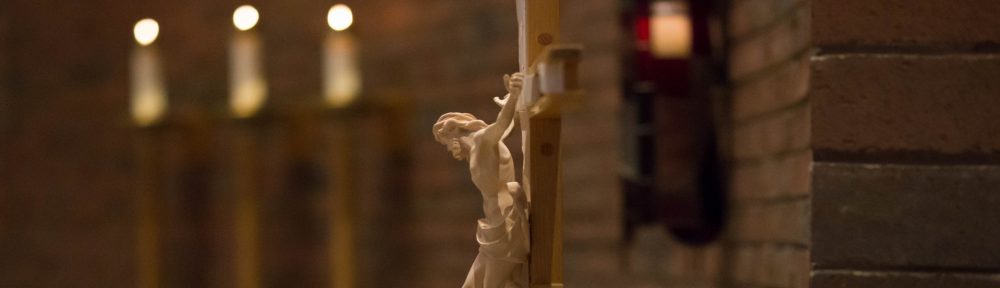

Worship is Incarnational

Before I begin, a clarification is in order, if only because people asked for a recording of the hymn I described in last week’s eNews message.

For starters, yes, we do record our worship services. The audio recordings are kept and given to those who genuinely need them, which I’ll come back to in a moment. In the meantime, know that the device we use to capture the service is fed straight from our thousand-year-old microphones directly to a flash drive. In other words, the recordings are, by no means, a spectral capture in crisp Dolby stereo. Above and beneath and around the liturgy’s voice, there are a multitude of ambient sounds you’d expect in a room bearing several hundred people. Thankfully, the spoken word survives the ordeal reasonably well. You can hear the lector reading and the pastor preaching clearly enough, and without much annoyance. But what does not fare so well is the music. It sounds like it’s being performed and sung from inside a gigantic oil drum.

In short, the recordings do what they are meant to do, which is to preserve the Word of God preached and read. However, they do not showcase the liturgical experience—and I’m perfectly okay with that, for a couple of reasons.

One of the reasons we do not share our services with anyone other than shut-ins or other folks in genuine need became especially clear during COVID. Not long after so many in society became terrified, even as we gathered in person, I warned the Board of Elders that providing a virtual alternative would inevitably give people an excuse to stay away—not out of necessity, but out of convenience. And as it turns out, I was right. While it didn’t necessarily happen to us, plenty of studies have discovered it did, in fact, happen to countless others. Indeed, American Christendom experienced a significant shift. Duke Divinity School’s Faith & Leadership initiative found that most congregations that normalized virtual worship during COVID never fully regained their in-person attendance, ultimately returning to in-person worship with 10% fewer people than before. The COVID Religion Research Project found that as many as 25% of regular churchgoers in America now regularly rely on online worship as a viable substitute for in-person gatherings.

Gathering these things into a singular thought, my sense is that what began as an emergency measure became, for many churches, a long-term standard for deliberate displacement. People settled into watching rather than attending, observing rather than gathering.

And yet, the Bible does not treat worship in this way. That’s because it does not consider the actual assembly as optional (Hebrews 10:24-25). Christian worship is, by design, incarnational. We do it together, in person. It is God’s people gathered in one place to hear, confess, receive, and sing. We do this in one another’s presence. We’re the Body of Christ, and that’s how a body works, together with its other parts (1 Corinthians 12:12-27).

So, what about service recordings? Well, we record and share our services as a care for those who truly cannot be there—the shut-in, the homebound, those whose bodies no longer allow them to gather without real difficulty. These are exceptional cases of care. I’ve always considered the service recordings as functioning sort of like an artificial heart. It’s not ideal. It more or less sustains when what should be there cannot be. In the meantime, for the healthy among us, we resist broadcasting beyond this threshold because we do not want to train anyone to believe that artificial substitutes are equivalent to the real thing. Again, an artificial heart does not replace a healthy, living one. In the same way, virtual presence can serve in cases of genuine need, but it is not the same as real presence.

But there’s still more to this.

Returning to where I started, after last week’s note, more than a few people asked if I had a recording of the service. I was going to disregard everything I just said and share a short clip of “What Child Is This” from our Children’s Christmas service. I really was. But then I listened to the recording. As I did, I ran squarely into what I mentioned before.

Our service recordings are not very good—and I like that they’re not. Yes, the hymn as it was sung that night—the children’s voices, the organ, the words—all these parts were technically present in the recording. But at the same time, they weren’t. The recording did not capture the moment. To understand what I described last week, you had to be there. If you weren’t there, then, well, you missed it.

Along the same lines as what I’ve already written here, there’s something about being in the room. It’s something no microphone can seize, and no speaker can reproduce. I can only tell you about it—the way the sound moved, the way the congregation was pulled into carrying the lyrics, the way time seemed to slow during the second stanza of “What Child Is This,” as though its words really were pressing down on all of us with a theological weight you could actually feel. Sure, I could play the recording for you. You’d hear the music and singing. But you cannot experience the surge of a moment when truth lands heavily, and everyone in the room is caught in its blast radius.

That only happens incarnationally. It only happens when you are there.

This is not a critique of recordings. They serve a purpose. Again, we consider it a kindness to shut-ins, travelers, and those whose bodies or circumstances truly prevent them from gathering with their Christian family. Thanks be to God for such tools. But they were never meant to replace presence. They cannot. They do not.

Christian worship is far more than content delivery. It’s not something you consume efficiently while cleaning the kitchen or working in the garage. It is not background noise for Sunday morning coffee or something you “catch up on” later in the week. Christian Worship is a holy and deliberate interruption to everything else in your life. It is God gathering His people to Himself at a time and in a place to feed and sustain them with His gifts of forgiveness.

Even better, Christian worship is where the Word is not merely read but actually addressed to you personally—where the Sacrament of Christ’s body and blood is not something thought about but actually received. You open your mouth, and you eat and drink. It’s a place where forgiven hearts sing praises to God, and what they sing isn’t just sound, but it’s borne by the space itself—by breath and wood and pipe and stone and people standing shoulder to shoulder confessing and resonating the same truths together (Colossians 3:16).

The night we sang “What Child Is This,” the hymn was not so moving or impressive because it was technically flawless. It was powerful because, in a sense, it was inhabited. Indeed, Kantor Newman painted the text gloriously. And yet, the text was painted not only by him, but by the space, by the gathered Church, by the shared attentiveness of people who had come expecting God to do what He has promised to do. And He did (Isaiah 55:10-11). That’s something you cannot download and listen to during the car ride to work.

Now, may I say something plainly and pastorally?

As we stand on the doorstep of a new year, if you have been away from church, come back. If attendance has slipped into something occasional, make it deliberate again. I’m all about New Year’s resolutions. I’m already planning mine. Perhaps you could embrace and use the tradition to recommit to attending church.

Now, be careful. Don’t do it because you feel attendance somehow checks a box and proves your devotion. Don’t do it for any reason other than you know you need what God gives you there. You need to be where the hymnody—God’s Word put to music—is not just captured, but encountered. You need to be where your sins are forgiven out loud (John 20:22-23), where death is named from the pulpit and defied from the pews, where joy is shared by the rest of the Christian body who believe and confess the body’s head, Jesus Christ, together (Ephesians 1:22-23).

Quite simply, nothing compares to being present.

You know as well as I do that this coming year will bring its share of noise, distance, and disembodied substitutes for real life. Resist the lie that these are enough. The Christian faith has always insisted on incarnational truths. So go. Stand. Sing. Listen. Receive. Let the gathering of God’s people in holy worship do what it was always meant to do—which is not merely to pass through your ears, but rather, to take hold of you completely (Psalm 95:1-7).

I assure you, nothing compares.

Slipping Into Error

I’m sure you already know this, and yet, just in case you don’t, Israel launched preemptive strikes against Iran’s nuclear sites on Thursday. As expected, Iran responded. It was reported in the news that we knew those strikes were coming, even as America was attempting to broker a peace deal with Iran. However, Iran appeared to be doing what Iran always does, which is to make every excuse for not securing peace. Meanwhile, Israeli and American intelligence agencies reported that Iran was only days away from having enough enriched uranium to build a minimum of fifteen nuclear weapons, only one of which would be needed to turn Israel to glass. Used against the United States, millions here would die.

Is any of this news reporting accurate? Is the media telling us what’s true? It’s hard to tell these days.

On one hand, Iran’s supreme leader, Ali Hosseini Khamenei, has said they would pursue nuclear independence. He also said as recently as 2023 that “Death to America is not just a slogan. It is our policy.” And of course, Iran—the largest state sponsor of terrorism in the world—has made it a priority to rid the world of the Jews. That’s not breaking news. That’s an open and longstanding fact. What’s more, Iran’s desire for Israel’s destruction, some have said, is the only truly unifying principle that keeps the nation together. A largely tribal nation, Iran would likely come entirely undone if not for its leaders’ radical Islamic ideology.

On the other hand, nearly everything the news reported about COVID turned out to be false. Masks and social distancing absolutely did not accomplish anything, except to decelerate development in generations of children. It turns out that ventilators made the sick worse. Ivermectin, the Nobel Prize-winning medication prescribed to humans for decades, was negatively labeled a “horse dewormer” and called dangerous, ultimately getting doctors who knew better and prescribed it into heaps of trouble. And yet, it turned out to be wholly sufficient for treating the illness. If a person added vitamin D to his regimen, he would be good to go. Conversely, most news outlets insisted that the vaccine would protect from infection. They streamed Biden’s thank-you to the vaccinated while warning the unvaccinated to expect “a winter of severe illness and death.” And yet, the opposite was true. In fact, the rates of unexpected deaths have seen a sharp increase only among the vaccinated.

I read an article this morning from CBS News saying that the FDA is insisting Pfizer and Moderna “expand the warning labels on their COVID-19 vaccines about the risk of a possible heart injury side effect linked to the mRNA shots, primarily in teen boys and young men.” It goes on to talk about unusual spikes in myocarditis. A peripheral article warned of the same, but then added strange cancers and other diseases to the list of concerns, conditions that were never as prominent until after the COVID vaccines and boosters were so widely administered. One particular example shared was that sudden athlete deaths were off the charts by comparison to pre-COVID statistics.

By the way, I should say I’m not surprised by the vaccine results. Dr. Mary Talley Bowden was recently on Joe Rogan’s podcast, and she mentioned that we now have five years of data stacks confirming the vaccine’s dangers. She essentially noted that anyone who received the vaccine is now, in a sense, permanently rewired—because what the news called a vaccine isn’t a vaccine. It’s an mRNA injection. It’s gene therapy. Gene therapy rewrites DNA. Vaccines, in theory, are designed to prompt and arm the body’s immune system. Gene therapy is designed to manipulate the body’s very DNA. It works at a genetic level.

Still, the public’s response to COVID proved how quickly fear and misinformation can bend entire societies—even churches—toward error. I say this as so many churches, even after the lockdowns, continued to forbid worshippers through the door unless they were masked, vaccinated, and sat two rows apart. This is an absolute violation of God’s Word, regardless of the government’s mandates! The same patterns are playing out again, just under different headlines.

However, I didn’t start writing this morning with COVID-19 on my mind. I was more concerned about the possibility of war. More precisely, I was thinking about how easily things come undone—or how easily human beings can steer into falsehood—when our handling of source material is faulty.

Concerning everything I’ve described so far? I suppose the only answer I can give is to say, “Read, read, and read some more.” As Christians, I encourage you to do this, remembering three things in particular.

First, understand that skimming content is rarely helpful. Dig in and digest, reading from various sources in order to get a topic’s fullest spectrum of perspectives. Second, pitch everything you read against the Word of God. In other words, let everything you take in pass through the filter of Scripture. God’s Word shapes our opinions, not the other way around. Third, make sure your doctrine is sound. Doctrine doesn’t just articulate what we believe about salvation. It provides necessary boundaries, becoming a primary tool for discerning everything we see and experience. If you claim the Bible, and yet your theology depends on the modern nation of Israel going to war with Iran as a fulfillment of end-times prophecy before Christ can return, then it’s likely the first two recommendations weren’t heeded. In other words, first, you aren’t all that familiar with the Bible’s actual contents; and second, your opinion has become your strongest filter. As a result, your doctrinal compass is misaligned, and you’re destined only to distort the source material—the Bible.

Now, I say this as someone who’s spent a lot of time wrestling with how theology and the public square intersect, particularly through the lens of Church and State, or the doctrine of the Two Kingdoms. What we believe about God’s rule and our role in the world carries consequences, both for faithfulness and for clarity during incredibly confusing times.

Be aware that confusion has a way of hardening into error.

You may have already noticed from what I wrote earlier about Israel and end-times prophecy that one particular distortion in times like these is Christian Zionism. It’s a theological framework that merges biblical language with modern political expectations, often assigning messianic significance to the nation of Israel. This confusion leads many to misapply sacred titles and divine promises in ways that seem patriotic or spiritually inspiring, but ultimately are biblically reckless and incredibly dangerous.

For example, Israel’s current offensive has been dubbed “Operation Rising Lion.” An online friend posted on Saturday an image of a lion with an Israeli flag blended into its face. The tagline read, “The Lion of Judah has risen.” The image made me cringe. Yes, I support the nation of Israel’s right to protect itself from annihilation. Still, the nation of Israel is not the Lion of Judah. The phrase “Lion of Judah” belongs to Jesus Christ alone (Revelation 5:5). Furthermore, it was posted by someone who assumes the modern nation of Israel still carries an unbroken divine mandate, simply by virtue of its geography or ethnicity.

To believe and confess this is to upend the fuller testimony of Scripture. It replaces Christ-centered fulfillment with nationalistic nostalgia and, in doing so, distorts God’s promises and perpetuates grave theological error.

This kind of misreading reflects the same pattern I’ve addressed already. Whether it’s Iran’s deception or the media’s COVID narratives, when we abandon faithfulness to God’s Word, we can only lose our bearings in life’s fog. Reality becomes distorted, and we are just as vulnerable to being swept away by falsehood as anyone else.

Of course, whenever someone challenges the notion that modern Israel holds a unique divine status, the charge of antisemitism isn’t far behind. Even as someone who supports Israel’s right to defend itself, I’ve borne that charge. But the accusation misses the mark entirely. I’ve written before that it is by no means antisemitic to say (alongside Saint Paul, the inspired writer and chief apostolic interpreter of Christ and the Old Testament Scriptures) that Christians are the “Israel of God” (Galatians 6:16). The Israel of God is not ethnic or a localized nation. Saint Peter clarifies it is “a chosen people, a royal priesthood, a holy nation, God’s special possession…” (1 Peter 2:9–10). And again, Saint Paul writes, “If you belong to Christ, then you are Abraham’s seed, and heirs according to the promise” (Galatians 3:29); and “For not all who are descended from Israel are Israel. Nor because they are his descendants are they all Abraham’s children… it is the children of the promise who are regarded as Abraham’s offspring” (Romans 9:6–8).

Children of the promise—Christians—are regarded by God as Abraham’s true offspring. Like Abraham, they believe in the promise (Genesis 15:6; Romans 4:3; James 2:23). And what is the promise? The One who was promised—Christ (Galatians 3:16; Luke 1:54–55; Luke 1:31–33; Acts 2:29–31; Hebrews 8:6–13; Romans 15:8–9; 2 Corinthians 1:20; and countless other texts). All who look to Christ in faith will be saved (John 6:38–40) and brought into the new Jerusalem—eternal life (Revelation 21–22; Psalm 46:4–5; Isaiah 65:17–19; and others).

To say that only believers in Christ are saved and given eternal life is not antisemitic, but it is fundamental to Christian theology, and it does show Christian Zionism’s error. If it were antisemitic, then the apostles were antisemites for believing and declaring, “Salvation is found in no one else, for there is no other name under heaven given to mankind by which we must be saved” (Acts 4:12). What’s more, Christ Himself would be an antisemite for saying in absolutist terms, “I am the way, and the truth, and the life. No one comes to the Father except through me” (John 14:6); and, “Whoever believes in [God’s Son] is not condemned, but whoever does not believe stands condemned already because they have not believed in the name of God’s one and only Son” (John 3:16–18).

It is right and godly to defend and protect anyone and everyone from persecution or attack. Long before the events of this past week, Iran and its proxies had launched over 500 ballistic missiles into Israel. Christians should support restraining Iran. To do so is to love one’s neighbor as oneself. But that doesn’t change the fact that Christian Zionism is a dangerously confused theology—a dreadfully miscalibrated doctrine—that must be avoided, if only because it corrupts the Gospel that can save everyone in both Israel and Iran.

I suppose in the end, my main point is to say that if Christians are not vigilant—biblically, and therefore doctrinally—we will find ourselves swept along by narratives that feel righteous but stand in contradiction to God’s revealed truth. Whether it’s the media rewriting science or Christians assigning eternal significance to things that do not deserve it, the temptation to trade discernment for ideological capture is only ever a step away.

This is why being in God’s Word is so important. I encourage you: make it a part of your everyday routine. And as I said, don’t skim. Even better, don’t search the Scriptures just to find proof texts that reinforce your existing political views or cultural assumptions. Instead, go there to be corrected, shaped, and grounded. Go there for truth. Go there to find Christ. He is enough, and His Word is sufficient. And the Church—His true Israel—must live and speak as though both of those things are actually true.

Do Not Skim. Read.

I do not own a single eBook. At least, I don’t think I do. I like books I can hold in my hands. I realize this makes me somewhat of a weirdo in the 21st-century world. Still, it is what it is. I’d rather turn a page than scroll. I’d rather dogear some of those pages, gripping a pencil and underlining beloved portions, than add virtual bookmarks or whatever people do in eBooks to preserve and revisit certain words.

I sometimes wonder if the world will one day be absent of physical books. I hope not. I don’t say this because I’m concerned about what people will use to balance a wobbly table or what they’ll reach for to swat an annoying fly. I’ve written before that I think a world without physical books will foster less reading—actual substantive reading and content digestion. I also say this because I think there’s something to the proverbial phrase “out of sight, out of mind.” In other words, just because a digital device offers unrestricted access to literature’s vast kingdom doesn’t mean its user is naturally inclined toward using it that way. I think this premise is relatively provable. No matter one’s age, in a room filled with books, it’s harder to resist the urge to snatch a volume and peruse it. In a room void of books, the device in one’s hand offers countless other preference-stroking arenas—video games, social media, audio and video streaming; you name it.

I know that many education experts prattle on about the lack of real differences in literacy rates among children exposed to either on-screen or in-print reading. This exceptionally convenient research deduction was reached and endlessly proffered during COVID. While I’m no expert, I’d argue that literacy research focused more so on the ability to read than reading comprehension. Mark Twain once said something about how a man who can read but doesn’t will have no advantage over a man who can’t read. I’d add that a man who can read but cannot understand what he’s reading is advantageless, too. The whole purpose of reading is comprehension.

I suppose I’m sharing this in part because I wonder how so many in our world can accept, or perhaps worse, stand idly by as some genuinely idiotic things sprout and blossom into full bloom. We just hosted an event here at Our Savior last Wednesday in which Irene Miller, a holocaust survivor, described the events of her life. Much of what she said seemed familiar, especially the parts about fascism finding room to grow as only particular bits of information were allowed to the population while all others were suppressed. I suppose I’ll come back to that point in a moment. In the meantime, let me stay with my initial heading. Some studies show how in-print reading outpaces on-screen in two essential ways: attention span formation and content processing. This makes complete sense to me.

A person’s attention span is the framework for comprehension. Content processing is the comprehension process. When I think about typical on-screen reading, it seems to involve a lot of skimming and scrolling, selective reading, and keyword spotting. I can’t prove it, but I’m guessing this ever-increasing type of information intake is playing no insignificant part in our devolving world. Shorter attention spans are barriers to in-depth reading, ultimately teeing readers up to take from a text what they want or have time for it to say rather than what it actually says. It’s selective. It’s also incredibly self-centered. It isn’t discovering. It’s looking for what it already thinks it wants. It’s the kind of reading that’s incapable of grasping an issue’s truths and untruths. It’s the kind of learning that produces what we’re seeing on our college campuses right now—students and faculty who, when asked about Hamas’ actions on October 7, 2023, defend the terrorist group using some of the most irrational talking points and little more. These protestors appear incapable of a depth that understands no matter what a person’s reason for fighting, massacring unarmed concert-goers, and putting Israeli babies into ovens and cooking them is wrong. The protesters, many likely raised in hardworking families and known by friends and neighbors from their home communities, are now found wearing keffiyehs and blocking roadways, all the while having no idea what a keffiyeh represents. Pink-haired, with their bodies pierced in about every conceivable location, they lock arms and shout, “From the river to the sea, Palestine will be free,” but are entirely unaware of what the Islamic extremist chant means relative to Israel’s (let alone any non-Muslim’s) existence or that the Quran instructs that any form of bodily piercings other than the ears is satanic and worthy of severe punishment. In other words, for Hamas and the Palestinians, freedom does not mean what you think it means.

Because we’ve already seen how the universities wrestling with these protests aren’t all that interested in doing much about them, one way to stop the nonsense—or at least inhibit it—would be for the parents and grandparents doling out tuition dollars to these adolescents to turn off the financial spigot and bring them home. They’re obviously not quite ready to engage with the world yet. They’re certainly not prepared for higher education. What they need is a spanking, a lengthy grounding from video games and cellphone usage, a remedial reading course followed by a civics class or two, and an early bedtime. If that doesn’t work, a philosophy internship in Iran probably would. Be sure to send along their rainbow-colored hijab and “Allah loves equality” t-shirts. You might also want to pack a parachute. It’s standard practice to throw folks with differing opinions off of rooftops.

That said, who can argue that we don’t have the same problematic reading problems in Christianity in general, and it’s producing some seriously misinformed people? Folks skim an internet article with a few scripture verses here and there and are suddenly biblical experts capable of divinely authorized world-altering diatribes. Who needs the seminaries? We have Wikipedia and Google. And while this shallow form of study may result in some Christians stepping up and pushing back against culture, the pushback is often far weaker than the emboldened warriors may have imagined. This is because the pushback is half-baked, being more so agenda-driven than accurate, ultimately leaving immense loopholes in the logic. I’ll give you an elementary example I’ve shared with others in the past.

I’m pro-gun. I have two, a Glock 19 and a Sig Sauer P226. To argue my right to own and carry them, I would never lean on the Cain and Abel account from Genesis 4. Why not? Because, even as so many conservatives like to share memes saying things like, “Guns are not the problem” right after noting that when “Cain killed Abel with a rock, God didn’t get rid of all the rocks,” the fact is that Genesis 4:8 simply reads: “Now Cain said to his brother Abel, ‘Let’s go out to the field.’ While they were in the field, Cain attacked his brother Abel and killed him.” There’s no mention of how Cain killed Abel. Uninspired apocryphal writings mention things like jawbones and plowheads. But the Bible doesn’t say Cain used anything to kill Abel. Verse twelve talks about Abel’s blood crying out from the ground, giving the sense there might have been quite a bit spilled. My guess is that it was Abel’s own knife used to sacrifice animals. Still, it’s a guess—purely speculative. For all anyone knows, Cain choked Abel to death, and when he fell to the ground, he hit his head and bled out. Either way, it’s the content found in the deeper strata that can make an argument sturdy or wobbly. All a non-skimming opponent needs is to go to and read Genesis 4. See, no rock, thus no direct relevance to handheld weapons.

With this in mind, the type of reading habits I’ve described are the exact same ones employed by doofuses trying to smother pure Christian doctrine who, when they discover texts like Matthew 7:1, say something like, “See, Jesus said, ‘Do not judge,’” completely missing the text’s insistence that Christians must judge, but only as they understand their own sinfulness and the ever-present need for forgiveness. In other words, a person who believes he’s perfect has lost all credibility for judging anything rightly. I suppose, worst of all, these reading habits eventually produce pro-choice Christians. They produce pro-LGBTQ believers. They result in Christian churches and schools brimming with pro-DEI and pro-CRT advocates. They inspire folks who claim faithfulness to Christ while simultaneously embracing so many ridiculously heretical Christian authors, speakers, so-called prophets, and countless internet-assembled sayings that sound good but simply aren’t.

So, how do we combat this?

That’s a good question. How about this, for starters?

First of all, read. And I mean, really read. Don’t skim. On-screen or in-print, dig deeply. Take in the information, even if you don’t like what it’s saying. My guess is that by doing so, more loopholes in your knowledge investigation will be closed than left open.

Second, while you should choose your sources carefully, you shouldn’t limit your intake to the side of the argument you prefer most. Read both. Truth has a way of outing lies, especially when the two are set side by side. In my experience, when suddenly confronted by truth, liars deflect. They redirect. They gaslight, making you think what is true might not be true. They tweak a narrative’s corners, ultimately creating alternate renditions. When queried, they cannot answer the actual questions you are asking, especially when the questions do not fit the newly constructed narrative. However, here’s the thing. If truth weren’t in the room, they might be all-convincing to the onlooker or reader. But with truth standing right beside them, their wriggling and writhing becomes apparent, and for an honest investigator, the foolishness is almost always outed.

In the final measurement, even in the barest sense, truth stands tall, and as it does, it proves itself capable of maintaining the field.

Inheritors of the World to Come

Perhaps you’re still trying to keep up with the latest safety recommendations for COVID? I’m not. I stopped trying to “be in the know” about these things long ago. To be clear, when it became apparent that entire fields of science were being manipulated to satisfy political agendas—many of which conveniently hindered the efforts of the Church, parental authority in schools, and so many other things that are fundamental to a moral society—my belief in the current government’s legitimate ordination became less than sturdy, and with it, my desire to cooperate in its externals. As a result, I’ve found myself accepting the possibility that God’s smiling countenance upon America, if ever ours to claim, is very near its end.

But that’s a topic for another day.

In the meantime, it seems if you can steer clear of most mainstream media sources, choosing instead to visit with some of the unprocessed and unfiltered numbers, a majority of what I think you’ll find appears to vindicate the ones who spoke out against forced vaccinations, mask-wearing, and school closings. Many studies show an astronomical surge in suicides, which is something never before seen in history. Others are proving cognitive deficiencies in children at unprecedented levels. Plenty of others imply drastic worldwide increases in cancers, strokes, cardiopulmonary diseases, respiratory illnesses, and even untimely deaths among youth within populations with the highest percentages of adherence to masking, social distancing, and vaccination acceptance.

These disastrous upturns appear to begin in the late spring of 2020. Why? What took place in 2020? I wonder.

Interestingly, the people who imposed these things upon us continue to claim that what they did was beneficial, and they’re even insisting we vote to keep them in their stations. Gretchen Whitmer, the Governor of Michigan, wants four more years. The one who, by executive order, required my local Ace Hardware to rope off its gardening and paint sections; the one who mandated that all Michigan hospitals forego countless life-saving treatments and surgical procedures; the one who sent state employees to tape off public play structures; the one who ticketed un-masked dog-walkers; the one who sent Michigan State Police to fine barbers and give citations to clergy holding worship services; the one who fortified a context in which newborns, who are now two years old, have only recently been allowed to see the unmasked faces of their caregivers, extended family, and closest childhood friends; the one who orchestrated unvaccinated employee terminations—this diabolical Governor wants to keep her job. She militantly choreographed these things and more while keeping the abortion clinics wide open and ensuring Michiganders had unhindered access to lottery tickets and liquor. This fiendish woman is insisting we give her another shot in Lansing.

Is there any doubt that I will do everything I can to see that she is not re-elected? Tudor Dixon, what can I do to help?

Of course, that’s a topic for another day, as well.

Still, no matter the ever-increasing pile of irrefutable data proving the destruction that has occurred (and continues to occur) over the last two years, some continue to show a strange tenacity for rejecting what the data shows. Why? Well, one reason might be because it’s tough to break free from the habit-forming rites and ceremonies of what has become the COVID religion. For the most part, I’ve been able to tune it out. Still, every time I stop for gas and, like you, find myself signing away years of my life for a few gallons, most of the commercials on the pump’s tiny screen involve COVID clergy repeating this new religion’s liturgies. The presiding minister says, “Mask up! Get vaccinated! This promise is for you and your children; vaccination now saves you!” The congregation resounds its amens and alleluias with, “It’s safe and effective! Love your neighbor!”

Speaking as a tradition-and-liturgy-loving Lutheran, when it comes to retaining true religion (which is what Saint James calls Christianity in the first chapter of his epistle [1:26-27], referring specifically to Christianity’s visible distinction from the world’s persona), that’s a big part of what liturgy, rites, and ceremonies are for. They deliver a clear, structured, and authoritative word from the word’s source. They repetitively do this. Repetition weaves subject matter into a person’s heart and mind, not only stirring trustworthiness but making it so that wherever the person might be, the content of his or her faith is accessible in an involuntary way. Immersing in such things creates credal boundaries designed to help a believer remain within the true faith while avoiding heterodox teachings. Again, all of these are reasons why I’m a full subscriber to liturgical Christianity. An added benefit (and again, speaking only for myself): the confines of credal Christianity have assisted many believers in identifying and defending against the inching impositions of the new credal COVID religion. Churches that are essentially “anything goes” in nature and practice don’t have the protective borders that historic liturgical churches have. In an “anything goes” world, an “anything goes” church is already a perfect match for the world’s ways. It’s just how humanity works.

But that, too, is a topic for another day.

Another thought: I think the willful cancellation of in-person worship says a lot about modern Christianity. Across the span of 2,000 years, closing the Church’s doors at Easter for fear of sickness and death seemed to communicate something viscerally wrong with 21st-century Christianity. The pastors who led the charge—or the people of God who pressured or threatened their pastors toward blind compliance—this side of the situation, I think the decision will haunt all. “At the time, we didn’t know what we didn’t know.” True. But the resurrection of Jesus is the cemented victory over death and all its creeping tendrils, the most creeping of all being fear. It should be the last celebration ever to be canceled. In Christ, for a believer, to die is not death but life. Do we tempt death with foolish practices? No. In uncertain situations, we take reasonable precautions, never imposing on God’s Word in the process. Still, do we do these things because we’re afraid of death? By no means. Why would we be? There’s a reason the Lutheran funeral liturgy includes (or at least should include) the Lord’s words to Martha at Lazarus’ tomb. Jesus spoke plainly of death to the saddened and fearful sister, “I am the resurrection and the life. He who believes in Me will live, even though he dies; and whoever lives and believes in Me will never die” (John 11:25-26). If one keeps reading the text, you’ll see the Lord didn’t end His sentence there. He asked Martha directly, “Do you believe this?” Martha’s answer will be heard and then seen.

21st-century Christians were asked, “Do you believe this?” Our communal words and deeds were incredibly disappointing.

As I said, the decision to close churches will forever haunt many Christians and clergy. But apparently, not everyone. Believe it or not, some churches are happy to remain closed to this day, and the members of those churches appear unbothered by it, too. Beyond those fellowships, many congregations have been seduced into online worship as a viable option, not just for shut-ins, be for able-bodied church-goers. Pastors and church leaders have steered God’s people into a church-certified justification for never stepping foot in the Lord’s house again. Pajamas, coffee, and church when it’s convenient—a complete disconnection from the worshipping community—have become pious. Worse than that, virtual communion is now a thing.

Terrible.

I have one thing to say about these things, especially as I think back to where I began: If you think the skyrocketing rates of suicide, illnesses, and premature deaths are alarming, these are nothing compared to the spiritual havoc that all this has created. It’s a mess of spiritual illnesses and deaths that reach into the world after this world. You name the tragedy—disease, lightning strike, shark attack, an automobile accident. All these things and more kill in this life. But Christians are not inheritors of this life. We are heirs of the life to come. A disconnected and starved faith kills the life to come—the unending life.

I should probably wrap up this morning’s rambling with some sort of point. I guess I’m saying that if you’ve been away from your church since 2020, having somehow become convinced that staying at home will keep you safe from all things leading to death, I beg you to reconsider your position. In truth, all the so-called reasonable excuses have dried up. Now you’re willfully committing spiritual suicide. Unfortunately, the COVID religion continues to bolster the virtue in doing so, convincing so many that they’re somehow showing genuine Christian love to their neighbors by abiding in its provably destructive dogmas.

Again, terrible—the devil’s scheme, for sure. Beware.

Remember, you can’t even begin to love your neighbor if you don’t love God more. You don’t get to the second table of the Ten Commandments (commandments four through ten) before passing through the first table (commandments one through three). God’s Word is not cloudy in this regard. Right there in the first table, trust in God above all things is chief, His name is above all others, and time with Him in worship is above all other opportunities. If these things are negligible or arbitrary to you, you’ve already wandered beyond the boundaries of the one true faith before your first hello to a neighbor. That said, there’s a good chance you’re apart from all the other salvation-crucial details inherent to the Gospel you claim to confess. Go to church. Be in study. Hear the preaching. Receive Word and Sacrament ministry for the benefit of a sturdy faith and a right trust in the Conqueror of death and its reverberating fears. Get back inside the safe keeping of this Conqueror’s sheep pen. Hear His voice and follow Him.

Unlike the inept and ever-varying science-shifters the prophets of COVID have proven to be, Jesus Christ is steady and can be trusted. He is the same yesterday, today, and forever (Hebrews 13:8). He has promised never to leave or forsake you (Deuteronomy 31:6; Hebrews 13:5). In my book, that settles it. What’s more, He gives these promises to Christians and then, with devout concern, asks rhetorically, “For what will it profit a man if he gains the whole world and forfeits his soul?” (Matthew 16:26). The answer: passing appeasement and pleasure in this temporary life but everything dreadful in the unending next.

The Barometer of Shame

I’m very capable of “stupid.” We all are. It’s in our nature to be Sin’s fool. And then, lest we think we can hide it, our thoughts, words, and deeds prove to others just how deep the roots of Sin’s foolishness go.

I could share plenty of personal examples of my stupidity. But I really don’t want to. And why not? Because, as I’m sure it is with you, I’m ashamed of my foolishness—my failings, my flaws, my deficiencies. Although, for the sake of piloting toward something worthwhile this morning, this discussion brings to mind a generality that likely applies to us both—but only if as Christians we are willing to deal in honesty.

It seems to me that for an honest person, a telltale sign in most circumstances that you’re being Sin’s fool is to make excuses for something you feel shameful for doing. In other words, you know it’s wrong, and you get a sense of indecency from it, but you commit to doing it, anyway. And then from there, hoping to feel better about it, you do what you can to convince yourself (and others) it was virtuous.

Now, let’s be clear. I’m not talking about the sadness we sometimes experience in certain situations. Sometimes sadness happens when we’re doing something right. I often experience sadness when punishing my children. I don’t enjoy it, and yet, I know that correcting them is the right thing to do. But if while disciplining them, I do something I shamefully regret—let’s say I’m so angry that the punishment I inflict clearly exceeds the crime—then I know by shame’s pestering that I should repent and amend my behavior, even though I’m pretty sure I could, like most parents trying to save face, conjure countless rationalizations for staying the course.

In short, when you’re doing something that stirs your inner shame, but still you find yourself making excuses for the behavior—projecting it as dutiful, or describing it as your only option, or perhaps worse, scrambling to defend it by lifting portions of God’s Word from their appropriate contexts—it could be in those moments you’ve been duped into embracing Sin; or as I said before, you’re being Sin’s fool.

“Well, I know you said you didn’t want to,” you might interject, “but can you provide an example, something that comes to mind that you can share to shed light on this?”

Sure. The first example that comes to mind as the pastor of a school is the idea of making our students wear masks. Now, having let you into my feeble mind, give me some room to explain.

For starters, if you were to look backward across the expanse of everything I’ve ever written or said publicly over the last eighteen months, you’d discover that I rarely, if ever, used my energy to argue for or against masks. Those closest to me know I’m against wearing them. They also know my reasons, which I prefer not to cram down anyone else’s throat. Instead, my steady goal has simply been to do what I can to help keep people connected to Christ during a time when the government seems to be doing everything it can to divide Christians from Him. Of course, I’ve experienced circumstances requiring me to face off with the mask issue as it relates to the State’s impositions on churches. When that happened, I made it clear that requiring masks in public worship or study, no matter how people tried to twist the “love thy neighbor” premise, was not something I would impose because it would mean straying beyond the boundaries of God’s Word. I knew the issue to be one of Christian liberty. If you wanted to wear a mask in church, you were free to do so. If you didn’t, that was okay, too. But whichever you preferred, no matter your reasoning, I could not establish your preference as a law that could potentially prevent others from being in the presence of God to receive His Word and Sacrament gifts.

Getting closer to the point, I’d say some of the same theological principles spill over and into the practice of mandating the masking of children in schools.

Aside from the serious physical, psychological, and pedagogical damages masking causes among children—all of which form a mountain of absolute wrongness I’d feel shameful while climbing—I’m far more concerned about the shame found in trespassing God’s will. I say this knowing that the authority of God vested in the Fourth Commandment and given to parents to raise and care for their children is not something I’m allowed to usurp. It is the sole duty of parents to decide if their children should or should not be masked, and for me to impose such a rule without leaving room for parental exemption or recourse would be to stray beyond the borders of God’s Word and wield a sovereignty He did not grant to me. Even worse, if I did decide to participate in it—if I try to justify it by saying I’m obligated to comply with the Health Department, or it’s my duty as a Christian according to Romans 13 to abide, or that there’s no reasonable doctrinal stance that can be taken against it—I’d be defending something I know is wrong and I’d experience shame. I’d be Sin’s fool.

That’s the example that comes to mind.

But since I brought up Romans 13 (v. 1), I might as well go a little further, because it’s likely someone has already started pulling the pin from the “Let everyone be subject to the governing authorities” hand grenade and is thinking of throwing it. Preemptively, I should say that I doubt in this circumstance it will detonate as expected. And why? Because as it meets with the discussion, there are plenty of other similarly minded Bible passages that help define and then test the legitimacy of governing authorities to be obeyed. Simultaneously, I’d say the Lutheran Church—Missouri Synod and its centuries-old confessional documents have a pretty good handle on such texts, ultimately realizing their depth in the “Two Kingdoms” doctrine, which is the biblical teaching that not only understands the authority of the Church and the authority of the State, but also when, where, and how these two kingdoms meet. By this doctrine, Christians can know and understand what it means to be subject to a legitimate government established by God. And by legitimate, we mean that it maintains its divine ordination and does not transgress God’s moral law. Likewise, we can know by the Two Kingdoms doctrine the possibility of a ruling authority’s delegitimization, thereby knowing when we, as Christians, may find ourselves in an unfortunate situation requiring us to disobey men in order to remain faithful to God (Acts 5:29).

Digging a little deeper, especially since we’ve now gone down the rabbit hole of governments maintaining their ordination, we need to remember that the United States government, as well as the state and local governments, are not sovereign entities. In the U.S., all people, Christian or otherwise, live within the contours of a constitutional republic established on the premise that the citizenry is the sovereign authority. In other words, all federal, state, and local governments are, by design, holders of limited authority over and against the citizenry’s personal liberties and their right to act and defend according to concern of conscience.

That’s our form of government in a nutshell. It was thoughtfully constructed in a way that its executive, legislative, judicial, and all leadership bodies by extension would not be found suppressing its citizens’ lives, liberties, and pursuit of happiness.

This means, then, that when a body of unelected appointees, such as a Health Department, begins governing with seemingly inescapable sovereignty, the kind that leaves no room by exemption for citizens to self-determine in these ways, it becomes delegitimized, and I dare say a Christian is no longer bound to obey.

Now, I know this was a lengthy answer, but you asked for an example, and this is the one that came to mind. This is true, most likely, because I’ve had so many conversations about it lately. It certainly is a relevant topic right now.

In the end, as the pastor of a school, I pray we don’t have to face off with these things again. My hope is that the Livingston County Health Department will simply leave things alone, allowing the individual schools to determine their own fate. If that’s the case, then things will be a lot easier for leadership around here at Our Savior. But if they don’t, well then, we already know that doing the right thing can sometimes bring a measure of sadness. For the record, I’m willing to accept the reward of sadness dished out by the world for doing what’s right rather than to experience shame before God for doing what I know is wrong.