There are very important moments when leadership is not measured by how loudly we speak, but by how carefully we choose our words. Rob Reiner was verbally cruel to President Trump. He had been for many years. No one argues this. But his and his wife’s rather gruesome deaths required words of reverent sobriety, not mockery.
This really could have been a time for President Trump to shine. Simplicity, or maybe even silence, would have been the wiser course. Of course, silence would’ve prompted backlash, so what’s the harm in a brief acknowledgment of loss? A recognition of grief, even for an outspoken enemy? That’s it. I mean, there is a time to argue, and there is a time to mourn.
I should say that I’ve stood before my congregation on countless occasions and in various contexts and shared the characteristics I appreciate most in people. Two in particular stand out right now. I think the best way to relay the first is to say that leadership isn’t always about how quickly a person responds in the middle of a crisis. It’s about whether the person actually understands the moment requiring a response. That said, the ability to exercise restraint when restraint is hardest—when emotion, and even a long history of provocation, seem to beg for a sharp response. Leadership we can call “good” knows when to tone down and hold back. Even better, I think it takes more guts to lower your voice than to shout one’s apparent vindication. That’s by no means a sign of weakness. It demonstrates strength under control.
Trump made a huge mistake. The moment called for restraint, and he blew it. That leads to another characteristic I admire in people. Those with the ability to admit to a mistake and seek to amend that mistake are the truly courageous among us. They are also the wisest, and I trust them above all others.
If I were advising Trump, I’d tell him an apology here would not weaken him. It would show that even a man accustomed to fighting understands when the fight needs to stop. It would communicate that there are moments when compassion must take precedence over score-settling. That kind of humility is already too rare in public life, which is precisely why it matters right now, and why it would strengthen President Trump, not weaken him.
Again, the strongest people I know can admit to being wrong and say, “I’m sorry.” They own their errors. And they correct course. When they do, they earn my trust rather than lose it. In this particular moment, a sincere apology would not erase what President Trump wrote, but it would demonstrate that he does, in fact, understand the gravity of the moment he first failed to recognize. I’ll pray that someone in his immediate circle encourages him to do this.
A quick thought before I go about my Wednesday, which is my busiest day of the week.
I’ve long said that writing for public consumption is not for the faint of heart. The moment you set your words before the world, you expose yourself. Your thoughts, your convictions, your attempts at clarity or humor—all of it sits out in the open where anyone can take a swing. And they do. It doesn’t matter whether what you said was good, measured, or even kind. There will always be someone waiting in the tall grass, eager to pounce.
That’s the risk of writing publicly, especially in the 21st century. You’re stepping into an incredibly reactionary arena where opinions and skimmed half-knowledge are razor blades—light enough to be waved around carelessly and sharp enough to leave marks. And yet, in that same noisy world, there are other readers. They’re not holding razors. They’re holding gratitude. And their responses remind you that for every pounce-ready critic in the weeds, there’s someone quietly thankful you dared to say something at all.
I suppose this is why I commend all who take the time to think, to write, and to share. It truly takes guts to wander out into such a landscape. Anyone can whisper ideas toward their computer screen. Venting where no one can push back is easy. But to take the time to craft one’s words, share those ideas, and then stand back while the world reacts—that’s something else entirely.
It’s the strange courage of any writer throughout history, talented or not-so-talented, to put one’s mind to work with language, all the while knowing the critique will come, knowing the ambush is inevitable. And still, they write and share anyway.
It might be old news, but one of my all-time favorite films, Jaws, celebrated its 50th anniversary this past June—the 20th, to be precise. Of course, the Thoma family observed the special day by ordering a pizza and watching it.
What brings this to mind right now is that I just learned that a documentary about the making of the film was released on July 11. I haven’t watched it yet, but I plan to. I’m sure it’ll bring back memories.
I remember the first time I saw the film. I wasn’t very old, maybe seven or eight. My brother and I watched it on a Betamax player my dad borrowed from a friend at work. At least, I think that was the context. I can’t say for sure. Either way, I loved the movie, and I dare say it played a huge part in my fascination with horror films. Although Jaws wasn’t really a horror film. It was more of an adventure-like thriller with horror elements. It was slow-building and suspenseful. But its charm was that it was grounded in something that could happen.
Ask my family, and they’ll tell you there isn’t much that I fear. Scary movies never bothered me. I’m rarely startled when surprised. I was never afraid of the dark as a kid. I never felt the urge to rush up the basement steps after turning out the light. But I can admit, I’m no fan of sharks. I have my reasons. And as such, I can admit, even when I was a 20-something lifeguard working at a freshwater lake in the summer, I thought about what might be lurking beneath the surface every time I went for a dip.
Harrison and I were listening to movie soundtracks on Spotify several weeks back. Jennifer and the girls walked in just as I played the soundtrack from Jaws. Right away, they all knew the iconic two-note motif, even without me telling them. Go swimming in a pool, and at some point along the way, it’s the resident father’s job to dip lower, his mouth just above the rippling surface, and begin, “Dun-dunt… dun-dunt… dun-dunt-dun-dunt-dun-dunt…” When that happens, no matter how old the children are, there’s a crazed splashing as they dash for the pool’s edge.
I finished the fantasy-fiction book I was writing and sent it off to the publisher. I’m glad to say it has been accepted for publication. Two more are expected. Now I’m five chapters into something completely different—a thriller. For the record, I’m loving every minute of its creation. Stepping beyond myself for a moment to observe the writing process, I think movies like Jaws did more than just spark my interest in all things scary. I believe it played a role in introducing me to the power of storytelling, particularly in terms of tension and pacing. It taught me that what you don’t see is often more frightening than what you do. Spielberg’s restraint—the decision to show the shark sparingly—was brilliant. It left space for the mind to fill in the fear.
It’s hard to believe it’s been fifty years. But then again, some stories never truly grow old. They just circle beneath the surface, waiting to rise again.
I read a reply to one of my Facebook posts this morning. It more or less supported the point in a cultural sense. Ultimately, I deleted the reply, if only because it was crass and attacking. Essentially, the person believed that LGBTQ issues should be seen as entirely normal and, therefore, acceptable. His premise was that LGBTQ relationships have existed as long as heterosexual relationships. So, in other words, longevity equals legitimacy.
For the record, that’s just silly.
Age alone doesn’t validate something. Throughout history, plenty of things have been long accepted, yet we now easily recognize them as absurd. The Spartan culture, for many centuries, considered it honorable to dispose of newborns with birth defects by throwing them from cliffs. Although I wouldn’t put it past Michigan’s current leadership to write the practice into the state’s constitution. We already have an amendment that allows abortion up to birth, and in some instances, afterward.
But before I stray from my original thought, my point is that the age of a thing, or even its level of acceptability in cultures throughout history, says nothing about its morality or truth. Ultimately, sin has been around since Eden. Pride, murder, greed, envy, idolatry—all of these things have endured. Not one of them is new. And all along the way, God’s Word has spoken clearly against them. Just because something has endured doesn’t mean it’s good or right.
Indeed, the enemy of God’s truth has always worked subtly, patiently, and yes, sometimes through the slow-building suspense of cultural conditioning—until finally, it’s time once again for the fin to break the surface and for the attack to come.
By the way, that Facebook reply itself was a tired example of the premise. The desire to justify one’s sin is an ever-lurking predator. It waits patiently just below the surface of the conscience, always ready to offer an excuse, always prepared to snap with, “This is who you are,” rather than, “This is what Christ came to redeem.”
It’s no coincidence that the Bible often describes devilish things in predatory terms. Sin crouches at the door (Genesis 4:7). The devil prowls like a lion (1 Peter 5:8). These things are purposely framed as ensnaring and deceiving. The cultural arguments we hear today try to steer away from these descriptions. But in the end, they’re little more than recycled lies with polished packaging—that is, for the lifeguard who’s paying attention. They see the appeal to emotion or history. They recognize the labeling of objectively true things as “fascism” and “bigoted,” and they see the same old fin circling the swimmers.
I suppose my concern these days is that the Church, the appointed lifeguard, is too often lulled by the quiet of the water. Too many in our ranks are too often asleep in the chair, thinking all is well. Perhaps worse, among those who know the dangers, many are afraid to swim out into the crimsoned waters to help. We know we, too, could be attacked, and that the effort to help might have an irreversible cost to our reputation, our comfort, our families, and so much more. In other words, not unlike the tension that Jaws portrayed so well, there’s a fear of what you don’t see but know could happen.
But here’s the thing. Christians are not called to fear, but to faithfulness. Our calling is not to retreat. We’re not to remain on the beach. We are sent into the waters knowing full well what stirs beneath. I’d say this is true because we’ve already been carried into and through the better waters of Holy Baptism, which is a washing that doesn’t remove fear, but transforms it. Our LCMS President, Rev. Dr. Matthew Harrison, once described this kind of Christian courage in a way that I’ve never forgotten. He said something about how Christian courage is nothing less than fear that’s been baptized.
He was right in so many ways.
Grafted into Christ, fear becomes something altogether different (John 15:4-5; Romans 11:17). It doesn’t necessarily vanish. Instead, it bows. It gets reordered by the Gospel, and as a result, it no longer rules the heart (Philippians 4:7; Colossians 3:15). That’s because it has been fixed to Jesus. Indeed, “we were buried therefore with him by baptism into death, in order that, just as Christ was raised from the dead by the glory of the Father, we too might walk in newness of life” (Romans 6:4-5). This is to say, we are joined to the One who has already gone into and through the depths of darkness and emerged alive again (Revelation 1:17-18).
That said, we’re not here to tread water or stay dry on the shore. We’re here to swim, and sometimes that means swimming right into the blood-stained mess. We do this not because we’re immune to fear. We’re no fools. We know so many unseen and fearful things are gliding quietly beneath us (Ephesians 6:12). This is especially true in the waters of culture. But the point is that for Christians, fear is not preventative. We know that the worst that could ever happen in any situation—death—has no dominion (Romans 6:9; 1 Corinthians 15:54-57).
There is the saying that goes something like, “Until it matters, no man can be sure of his courage.” I appreciate those words. Indeed, one can hardly be considered courageous from ease’s protective tower. Knowing this, I suppose that’s why each year on Good Friday, the words by the Gospel-writer Mark to describe Joseph of Arimathea are piercing. Each year they find their way deeper into my contemplation of the Lord’s sacrificial death on the cross.
It’s not long after the Lord’s final breath that we read:
“And when evening had come, since it was the day of Preparation, that is, the day before the Sabbath, Joseph of Arimathea, a respected member of the council, who was also himself looking for the kingdom of God, took courage and went to Pilate and asked for the body of Jesus” (15:42-43).
Why are these words so resonant? Because they describe a man who, for the most part, has kept his faith in Jesus an unchallenged secret. And why would he do this? Because as a member of the Sanhedrin—the primary human force in opposition to Jesus—Joseph knew what would happen to him if it was ever discovered. He and his family would be utterly undone economically, socially, and religiously. But then suddenly, none of these things appear to matter anymore. Mark writes that Joseph “took courage,” having been moved to act beyond the boundaries of his fears and request custody of the Lord’s body from Pilate.
What caused this? He witnessed the death of His Savior, Jesus.
The actual deed—the very intersecting act of God’s redeeming plan in this world—that’s what sits at the heart of faith. Joseph saw it. Whether or not he fully understood what had happened, it would certainly appear that his faith knew the significance of the gory details. In that moment, his faith became a daring powerhouse more than ready to flex the divine muscles the Holy Spirit had granted it. It moved him to go before Pilate and do something that would very soon thereafter become public knowledge.
What does this mean for us?
If anything, it means none of us ought to take Good Friday for granted. It means there’s something to be said for a day that’s spends itself thinking on the epicentral event of our Lord’s work to win us back from Sin, Death, and the power of the devil. It means if ever there was a day for doing something that might unmask our oft-hidden commitment to Christ—such as missing an extra-curricular activity or asking for time off from work to attend worship—Good Friday is that day. In one sense, that’s what the Greek word for “took courage” (τολμήσας [tolmēsas]) insinuates. At its root, it means to take a chance, to dare, to be bold in a way that lowers one’s defenses, maybe even in a way that provokes evil to attack.
Joseph took courage. He did this knowing that to do so could result in trouble. But he did it, anyway. Maybe you can, too. You certainly have less to lose than Joseph, even if only to give up some time to attend one of the two services occurring here at Our Savior in Hartland, Michigan. The Tre Ore service occurs at 1:00pm, and the Tenebrae service is at 7:00pm. I’m preaching at both, and I can’t wait to do so.
The church and school staff here at Our Savior in Hartland meet every Wednesday for study of the Lutheran Confessions. Currently, I’m leading them through Article IV of the Apology of the Augsburg Confession. Article IV deals with the doctrine of justification—the doctrine by which the Church stands or falls. During this past Wednesday’s study, we wandered into the area of consequences. As we did, a quotation from T.H. Huxley came to mind, which I shared. He said something about how logical consequences are a fool’s scarecrow, but for a wise man, they are a beacon.
Interestingly, each of the presentations during yesterday’s “Mental Health and Children” seminar here at Our Savior proved an awareness of consequences. Each presenter handled the term a little differently, but in the end, all affirmed consequence’s necessity.
In a psychological sense, I’m guessing that like all three of yesterday’s presenters, perhaps one of Huxley’s points is that foolish people meander about life less interested with consequence, and not necessarily because they’re completely oblivious, but because they’re mentally and spiritually unhealthy. These people are often disassociated from the effects of their words and actions. We see them treating people as it suits them. We see them expect respect without having done anything to earn it. I think they do these types of things because of an early-learned assumption that as long as they believe their intentions are noble, no matter how they treat someone, everything will be okay in the end. Things always work out. For them, that’s the only consequence.
This is scarecrow foolishness.
According to Huxley, wise people weigh consequences. Yesterday’s seminar presenters spoke in a similar stride, associating such awareness with normal mental health. Following Huxley’s lead, wise people observe consequences like pyres burning brightly on the horizon. They tend to maintain better control of the “self.” They keep their emotions in balance. They craft their words with care. I’m guessing they’re also likely to be people who are self-aware of their own unspoken tells—things like body language, tone, and catch-phrases. They care about even these things in conversation.
I made the point in the staff study on Wednesday that I believe a person who is mindful of consequence will naturally know his or her threshold for action. In other words, knowing the consequences of an action will uncover what a person is willing or unwilling to do in any given situation. I said this in relation to what we were reading at the time, and I didn’t want the staff to miss what the text was inferring, which was, through faith in Christ, no matter what happens in this life, the consequence of all consequences has been met by Jesus on the cross. By faith in this sacrifice, whether we live or die, we are His. This doesn’t mean we are now free from all consequences, but rather we have been made into people capable of walking into and withstanding challenges that others might normally avoid. Faith now serves as the point of origin for Christian discernment, translating all logical consequences in ways that help us break through to faithfulness when fear seems to be preventing us from doing what needs to be done.
A personal example from this past week comes to mind.
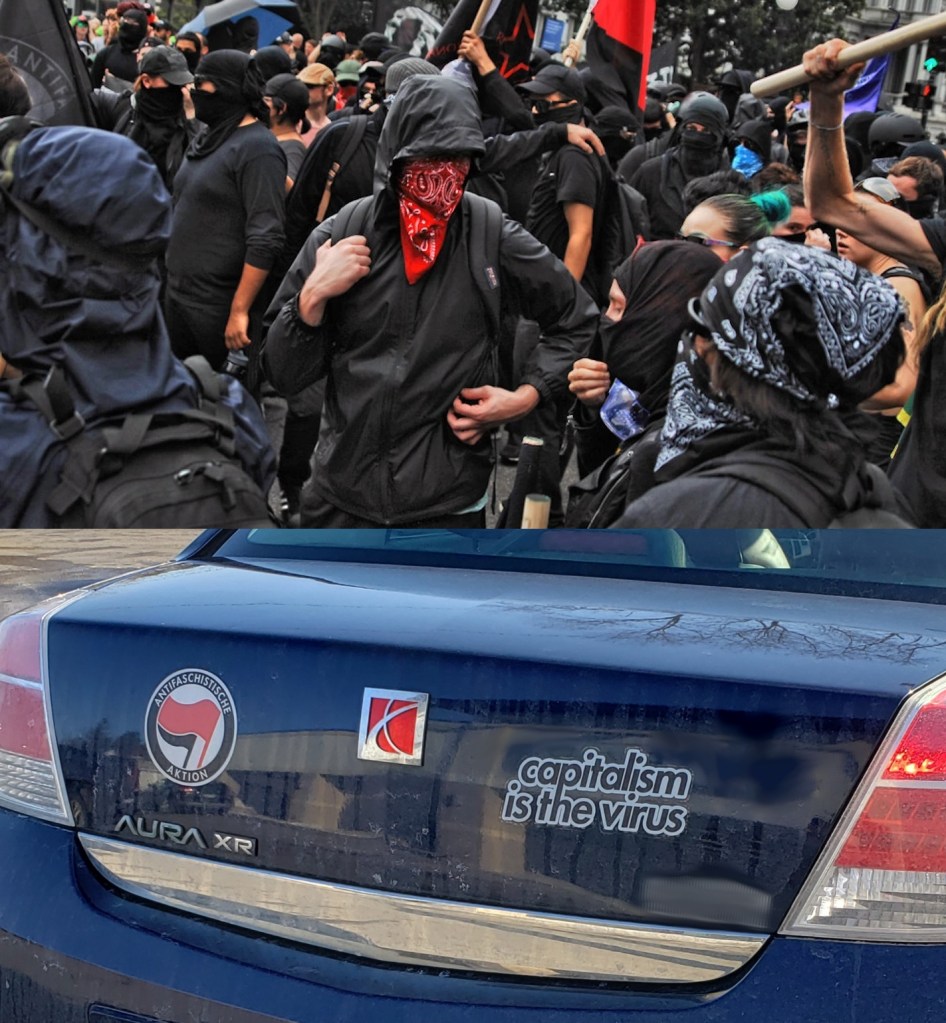
Having spent most of last Sunday evening in the Emergency Room, I ended up at our preferred pharmacy near our home on Tuesday afternoon (because Tuesday was the soonest I could get there) to pick up a subsequent prescription. On the way in, I noticed a car in the parking lot with two rather large bumper stickers, both prominently displayed and easily seen from a distance. One was the Antifa emblem, and the other read, “Capitalism is the virus.”
In case you didn’t know, Antifa is a far-left militant group. Their goal: to disrupt and destroy the American system and to replace it with their own. Do you remember those “Autonomous Zones” in Seattle and Washington D.C. back in 2020? Antifa were the thugs behind that stuff. They’re the ones you see on national news dressed in black, wearing ski masks and helmets and body armor, and leveling all sorts of violence and ruin using urban guerilla-warfare tactics. They’re hell bent on seeing socialism replace capitalism, and they believe the only way to do this is through intimidation and violent confrontation similar to their Marxist forefathers of the early 20th century. You can almost always count on them to serve as the muscle at “Black Lives Matter” rallies. Holding anarchy signs, they attack passersby, break windows, and burn buildings and cars. They’re famous for using improvised explosives, chemical irritants, and pretty much anything they can turn into a weapon—like metal pipes, axe handles, baseball bats, hammers, bricks, and the like. Not to mention, whether or not they’ve surrounded, sucker-punched, and kicked you to a bloody pulp, you know they’ve been in your neighborhood because they leave everything covered with trash and graffiti.
But sometimes you don’t know they’re in your neighborhood.
Another of their tactics aimed toward disruption is infiltration. Some experts believe this is how Antifa has known where and when to arrive in mass numbers when some relatively obscure conservative groups have organized an event. This happened to a Christian church’s outdoor service last year in Seattle.
In short, Antifa is responsible for hundreds of thousands of acts of violence, some resulting in death, as well as billions of dollars in damages across 140+ of America’s cities and towns. In May of 2020, President Trump announced he was labeling Antifa a domestic terrorist group. Of course, Joe Biden has since walked that back. Go figure.
Anyway, I went into the pharmacy. I looked around. I didn’t notice any black-clad militant Marxists. In fact, the only two patrons in the store were in line at the pharmacy. Both were elderly gentlemen who, as it turns out, knew each other. By their clothing, both appeared to be veterans. And both spent their time in line talking back and forth about what was happening at their respective churches.
I waited in line, got my prescription, stopped at home for a few minutes, and then went back to the church for a School Board meeting.
Later that night, I found myself back in the pharmacy parking lot. The car was still there. Once again, I went inside and scanned the store with the hope of identifying the person. But the place was empty. I grabbed a bottle of pop from one of the coolers in the furthest corner, and after a brief discussion with the manager at the checkout counter (one in which I shared much of what I just shared with you, while also drawing the manager’s attention through the store’s windows to the car in the parking lot), I discovered the vehicle’s owner works in the pharmacy. My concluding words in the conversation were fairly crisp.
“So, let me get this straight,” I said. “An Antifa sympathizer—someone driving around advertising a belief, not only in the disassembling of America through violence, but also in the benefit of subversive anonymity—has been hired by this company to fill prescriptions for the people of this town, at least two of whom are, as I discovered earlier this afternoon, elderly veterans, men who epitomize everything your employee hates?”
“Oh, goodness,” the manager said. “I’m probably going to have to talk to her.”
“I think that’s a really good idea,” I added, tucking my purchase into my coat pocket. “You might even want to talk to someone a little higher up before you do, because this is pretty serious. I doubt any company would want to generate unnecessary buzz due to association with a domestic terror group.” I said this insinuating I was willing to make that happen.
Notice I didn’t share with you the name of the store or town. Although, I’m sure some of you already know both. Nevertheless, I’m going to sit on that information for a few days to see what happens.
In the meantime, what does any of this have to do with knowing one’s threshold for action in relation to consequences? Well, quite a bit, actually.
There will be consequences for what I’ve done. Heck, I anticipate there will be consequences from some of you for just sharing this. Some will label me derogatorily as a “Karen.” Some will chalk me up as part of the cancel culture. Others will say my actions suppress free speech. Knowing Antifa’s history, others will say I put myself in harm’s way by seeking the person out. Perhaps worse, by confronting the ideology, and maybe even getting the person fired, others will accuse me of putting the store and its town in the crosshairs of this dreadful organization. All of these are but a few of the consequences. Believe me, the list is much longer than this. Yes, I was paying attention in the School Board meeting earlier that night, but I was also pondering the list’s possibilities.
Face it, folks. This nation is spiraling in so many ways. But this is largely true because too many have been unwilling to act for fear of the above list of consequences. The viscera for saying what needs to be said or doing what needs to be done in some of the hardest moments has, in many instances, been lost on the citizens of a somnolent nation braced by the fear of being cancelled. We’ve become those who meander around thinking that no matter what happens, everything will be okay. America will be fine. It’ll get sorted out.
No, it won’t. And we are experiencing the consequences of this scarecrow foolishness.
In the end, I did what I did because I know Christians are the ones best equipped for speaking. Why? In part, because we know the role consequences play in the equation of faith.
I know this has been a long read so far, but give me one last minute to explain.
Whoopi Goldberg (a celebrity on the daytime TV show “The View” that regularly ridicules Christians and conservatives) was recently put on leave for some truly ignorant comments about the Holocaust. In response, there were plenty of Christians calling for her suspension, but not necessarily calling for it permanently. While they despised what she said, they didn’t want to see her cancelled. They said she needed to be forgiven and then let loose back into the wilds of TV land.
Personally, I’m one of the Christians who wants her gone permanently. I’m also one of those guys who believes that any leader in the Church caught having an affair or other such ungodly behaviors, should be removed from his or her position of leadership permanently and with no exceptions. Why? Well, I have at least three reasons for starters.
The first is not because I’m unwilling to forgive anyone their sinful stupidity. We all fall short in big and small ways. The Bible is clear in this regard (Romans 3:10). But I say this because the person is in a place of influential strength, and their impact has a blast radius that God’s Word warns against (Titus 3:10-11; 1 Timothy 1:19-20). Besides, history itself proves how dangerous such situations involving public figures can be for communities. Their Sin has a way of trickling into and affecting countless others. With regard to Whoopi, the second reason is that she remains defiantly unrepentant in her Sin. The third reason is because, even if she does eventually repent, I believe in consequences in the same way our Lord describes them in Matthew 5:23-26:
“So if you are offering your gift at the altar and there remember that your brother has something against you, leave your gift there before the altar and go. First be reconciled to your brother, and then come and offer your gift. Come to terms quickly with your accuser while you are going with him to court, lest your accuser hand you over to the judge, and the judge to the guard, and you be put in prison. Truly, I say to you, you will never get out until you have paid the last penny.”
Part of the Lord’s point is the urgency of penitent reconciliation. Get on it right away. He wants peace accomplished swiftly and thoroughly. If it isn’t, the logical consequences will eventually ensue. Relationships will come undone, even though forgiveness has been given. What once was good will become obscured, even though things have been set right. That’s just the way it works in a fallen world. Or perhaps from another angle, you may be a serial killer on the way to trial who has a genuine “come to Jesus” moment of repentance born from the Gospel that results in saving faith. Praise God. You are forgiven. No matter the outcome, eternal life is yours. But the consequences remain for the serious boundaries of natural and moral law you crossed. While you may be assured of heaven through faith in Christ and the forgiveness He bestows, here on earth you’re assured of prison, and maybe even execution. And rightfully so. These are the just consequences. But again, even as you face these consequences, by the Gospel you have the certainty that the consequence of all consequences has been defanged and defeated by the same Savior who has shown you eternal mercy. By this, whether you live or die, you know you’ll be okay.
I’m praying for a change of heart in the Antifa pharmacist. I’m praying for the wisdom of the manager at that store. I’m praying for a change of heart in Whoopi Goldberg. But as I lift these petitions before God, I do so also asking that He’d help me to be ready and willing to cross the thresholds of my fear in order to endure the consequences of any action I might be called to take in opposition to these devilries. I pray for these things because I know what they mean for my enemies just as much as what I know they mean for me.
I’m guessing you heard the news about Jussie Smollett. He’s an actor who claimed he was attacked by two white men in Chicago because he’s both black and gay. He said they hit him, used bigoted slurs, put a noose around his neck, poured an unknown substance on him, and shouted, “This is MAGA country!”
Almost as soon as his story made the news, he was the golden child of the Democrats and the progressive Left who, together with their partners in the mainstream media, were doing all they could (and still are) to frame conservative America as deeply intolerant and unforgivably racist. Suddenly, Smollett’s relatively less-than-profound career had found powerful traction. He became a prominent guest at events, went on talk shows, and was even granted a primetime interview with ABC News’ Robin Roberts.
I watched the interview. Smollett cranked up the emotion and Roberts fawned, almost grotesquely. It was hard to watch, and not because I sympathized with him, or because I felt shame for being a conservative, but because something wasn’t right with Smollett’s story. Like so many others who watched it, I didn’t believe what he was saying. The thing is, much of the law enforcement community involved with the situation disbelieved him, too. Still, a few higher ranking officials in Cook County managed to pull enough strings to shield their celebrity friend from any attempts to reveal what was, even in their minds, looking to be a hoax.
Eventually, the tables turned. A fair-minded prosecutor was presented with the evidence, namely, that the men involved in the supposed attack were not even white, but black, and Smollett actually hired them. As it would go, Smollett was charged with six counts of orchestrating a hate crime against himself. Last week, the case and its facts unfolded before twelve jurors, and on Thursday, Smollett was found guilty of five of the six counts. Truth defeated untruth.
But it almost didn’t, which I’ll get to in a moment. First, I’ll let you in on a little secret—and I’ll bet it’s one to which others who do what I do for a living would likely nod in agreement.
It’s likely the reason I choked on the believability of Smollett’s interview with Robin Roberts is because pastors are pretty good at spotting liars.
If the job is being done right, no small portion of a pastor’s time involves interfacing with the underbelly of Sin’s grossest offenses. Lies rule in this realm. In one sense, this is true because the devil, the father of lies (John 8:44), labors tirelessly to maintain this dimly lit kingdom. Pastors know this. They know he uses lies like a model maker uses glue, connecting this and that misshaped part to create a seemingly insurmountable monstrosity that’s eventually found capable of hiding truth in its shadow. Still, I won’t place all of the blame on him. Even without his crafty influence, sinful humanity is more than capable of maintaining a kingdom of deceit. The Sin-nature is a powerful wellspring that feeds every human being’s ability to lie to others, and perhaps most disturbingly, to lie to oneself. What’s most troubling about this tendency is not only that it so often demonstrates itself with a twisted joyfulness—as if to suggest that without the ability to lie, humanity would be overcome by boredom—but that lying seems to be the first thing people will do to acquire what he or she wants, or to defend what he or she already believes.
Again, if pastors are doing their jobs, it’s likely they know the telltale signs of deception. They know the signs because they’ve heard and seen the same forms of dishonesty in countless situations. For example, all too often the man who confesses to having fallen out of love with his wife eventually proves he’s had eyes for another woman all along. He didn’t fall out of love. He lied to justify his desires and get what he wanted. Pastors see this all the time. Another example that repeats itself: It’s not uncommon for disgruntled church members to blame their unhappiness (or non-existence) on the pastor or a fellow member of the church community, landing on just about anything they’ve done or said as cold, unloving, or offensive. In my experience, the disconnect usually has to do with the wayward person’s desire to embrace an ideology or behavior contrary to God’s will and Word. It’s only after the pastor and church community have spoken truthfully to the errant Christian about the dangers of his or her living that the trouble begins. It’s then that the ones reaching with the truth are no longer counted as friends, but rather as unloving accusers. And yet, they’re not unloving. That’s a lie. They’re being faithful to both God and neighbor. They’re seeing a fellow Christian in need, and rather than closing their hearts to the opportunity for expressing God’s loving concern, they act. As Saint John points out, they epitomize love “in deed and truth” (1 John 3:17-18). On the contrary, the one who stubbornly refuses the truth is living in a perpetual darkness ruled by lies (1 John 1:6-9).
I could go on and on sharing similar examples, but I promised an explanation to my previous comment about truth nearly losing to untruth in the Jussie Smollett situation. What I meant is that if those who knew the facts had decided not to go the extra mile for truth, had those who were bothered by the lie being guarded by the people in power chosen to remain silent, an already monstrous narrative of untruth would have gained a deeper footing in America. But honest people took a chance at confronting dishonesty. They took a chance at offending the false narrative. They pursued truth, and truth won.
We can learn from these nameless advocates.
By their diligence, a deception was uprooted, and justice was served. What’s more, the blast radius of truth’s detonation revealed the scoundrels intent on weaponizing the lie. Thankfully, those frauds were silenced. Whether or not those same people are dealing honestly with themselves when it comes to public opinion, I don’t know. I will say that until they come clean, they’ll continue to simmer in their own foolishness in a glaring way. In other words, if I were Robin Roberts, or any of the other liberally progressive automatons who condemned anyone who questioned the verity of Smollett’s story—and this includes Joe Biden, Kamala Harris, and countless other ever-droning agendizers in government, Hollywood, and mainstream news and entertainment outlets—I’d apologize to America soon, all with the hope that my gushing foolishness would be soon forgotten. I’m sure the social media giants at Twitter, Facebook, and YouTube are certainly doing whatever they can to help scrub the crime scenes.
In the end, my real hope is that the shame these people are experiencing will not only shepherd them toward honesty, but will encourage them to measure their responses in the future. Admittedly, my hopes are not high in these regards.
So, why bring any of this up? Well…
A man is a man. A woman is a woman. Stand up to the lies that claim otherwise. Maybe take a chance and write a letter to the NCAA. Push back against their woke policies allowing transgenders to hijack women’s sports, ultimately stealing away so many well-deserving female athletes’ aspirations. The Smollett case has shown us that truth can win.
A person is not inherently evil because of the color of his or her skin. Fight in your communities and school districts against the deceptive race theories that claim otherwise. Go to the school board meetings. Call your local representatives. Do these things knowing truth can win.
An unborn child is a unique person, both dignified and worthy of life. Muster as much muscle as you can against the pro-choice devilry that would call this untrue. Get involved with your local Right to Life chapter. Give of your time and treasure to the cause. Be present at the gates of a Planned Parenthood to pray. Do this. As we’ve seen, truth can win.
Again, I could go on and on with this. The list of topics that would benefit from truth’s pushback is long. And yes, it also includes much of the pseudo-science that’s driving so much of what Americans are being required to endure these days. Against these looming deceptions, know that truth is forced into the shadows when those who are to be its hands, feet, and voice remain quietly indolent. Perhaps worse, truth teeters at the edge of burial when we wait for someone else to act.
I suppose in conclusion, whether any of us chooses to engage on behalf of truth, we can all rest assured that truth won’t settle for our disregard indefinitely. It certainly won’t forever tolerate those in the Christian community who, having been offended by it, take their marbles and go somewhere else. As I’ve said on countless occasions from the pulpit here at Our Savior, eventually the Last Day will come and the divine light switch will get flipped. In the bright-beaming streams of Christ’s return, even as every human being alive and dead will be found on their knees paying homage to the approaching King of Kings, all will see and know what is true and what isn’t. Joy or regret will be the two available emotions as all deceptions are stripped away and the final standards of judgment are laid unquestionably bare. By God’s grace at work through His revealing Word right now, Christians are equipped for that day. Through faith in Christ—the One who is truth in the flesh (John 14:6)—we are not only rescued from the perils of Sin and the regret it brings, but we are given hope for that moment of moments. Just as wonderfully, we are changed to know and desire truth in the here and now (John 8:32; James 1:18), and we are equipped by the Holy Spirit to protect and defend what is true (1 John 4:6).
By that same Gospel of deliverance in Christ alone, be strengthened to stand for truth. I say this knowing that if anyone is truly destined for the job, indeed, it’s Christians.
That was quite the wind and rain we experienced last week, wouldn’t you say? I think it’s safe to say that autumn has arrived.
Being unable to move very quickly because of my injury, the normally simple inconvenience rain causes became a bit more concerning. At one point on Tuesday, my daughter, Evelyn, and I were standing beneath the canopy near the church’s main entrance trying to decide how we would go about making our way to the car in what had suddenly become a torrential downpour. Thankfully, I had already moved the car into the circle drive near the entrance, so it was only about fifty feet away from us. Still, she was concerned that at my pace, I would be drenched by the time I made it, and so she offered to run to the car to fetch my umbrella and then come right back, and then together we’d make our way over.
What a sweetie.
In the end, we decided just to make a run for it. Well, she ran. I hobbled with fierce determination. Although, we only did this after first calculating another option and its possible outcomes. Essentially, we measured a simple dash to the car against Evelyn running to the vehicle, opening the hatch to retrieve the umbrella, and then running back to me, only for the two of us to then return to the car holding the sail-like device amid the blustering rainstorm, stopping at one door to allow one of us to climb inside as the other then circled around to the other to get in, being sure to first close and shake the umbrella. In the end, a beeline to the car seemed the better plan. Taking a hint from Longfellow, sometimes the best thing any of us can do when it’s raining is to let it rain. In other words, sometimes things are what they are and there’s nothing we can do to change them.
I suppose another lesson to be learned by this artless scenario is that our over-contemplated attempts at avoiding the discomforting things in life often result in making things worse rather than better. Digging even deeper into the moment, I’d say we sorted through the distinction between simply talking about doing and actually doing. As Evelyn and I negotiated, the rain only seemed to get worse. Had we made straight for the car when we first came out, we’d have been a lot less wet. But we didn’t. We stood there trying to decide what we were going to do, which involved a second option involving excessive details that, the more we talked about them, the more cumbersome and toll-exacting they seemed to become. I don’t know if it relates completely, but as I type this, I’m remembering the way Saint Paul often spends time in his epistles dealing with the contours of the Christian life.
I’m guessing there are plenty of folks who, when they visit with those portions of Paul’s writings in which he speaks about genuine Godliness, figure he’s being prescriptive, that is, he’s telling his readers how to live their lives in the world. That may be true some of the time, but not always. Occasionally he’s being descriptive, which means he’s simply describing what Christians have become by the power of the Holy Spirit through the Gospel for faith in Christ. When he does this, there’s an accompanying sense that enough time has already been spent talking about what it all means and now it’s time to just go and be it. I suppose in a practical sense, the more time we spend being unnecessarily cerebral about all of it, the more allowance for devastation our inaction seems to prove.
Think about it in a localized sense. There’s a reason why Saint Paul urges Christians not to let the sun go down on their anger (Ephesians 4:26). He knows the tendencies of Man. He knows that the longer we wait to reconcile, the more likely it is that the rainstorm of hatred will intensify. Of course, as the hatred grows fiercer, the worse things become and the less likely it will be that the two people will ever truly dry off in peace. On a larger scale, the more sedentary Christians remain, prattling away on social media about our troubled world without ever lifting a finger to change anything, the worse things are likely to become. One only needs to look around to see the necessity of Christian action. A glance will reveal the spin-rate of this world’s undoneness is continually picking up speed. School Boards across the country are often unopposed when they introduce sexually explicit materials and Critical Race Theory curriculums in their districts, often beginning as early as preschool. Christian business owners are taken to court and oftentimes fined out of existence simply for holding to the tenets of their faith and the basic science of Natural Law. What was once the quieter, but nonetheless satanic, mantra of “safe but rare” has become the full-throated cry of “Shout your abortion!” and the call for legalized slaughter of full term infants.
The rain is falling, folks. Sure, you can take some time to examine the best way through it, but one way or the other, you’re going to have to get wet. So, stop talking about it and get going. Make a beeline for faithfulness. Of course, the best place to start is by going to church. There’s not much use in trying to weather the storms if you haven’t been equipped accordingly to do so. You need what Christ gives by His Word and Sacrament gifts. Strengthened by these, may I suggest your next few steps for steering into the downpour be ones of faithfulness in your vocation as parent, child, friend, or worker? A lot can be accomplished simply by teaching your little ones while standing true to Christian conviction before family, friends, and co-workers. As you pick up speed in this, think about getting involved with your local Pro-life organization. Or perhaps you might help register Christian voters before the next election. Heck, I say if the Spirit is carrying you along with a brisk enough stride, take a chance at running for office. I already hinted at how holding a seat on your local School Board could make all the difference in the world to the next generation of citizens.
Whatever you’re thinking about doing, don’t think too long. Get out there and be who God has already made you to be. Yes, you’re going to get wet. That comes with the territory. But no matter the outcomes, the calculations for a beeline to your eternal life were already made by Christ through His life, death, and resurrection. By His victory, the courage you need for the first few steps has already been delivered. The words “It is finished!” (John 19:30) are the clarion call.
The world appears to be burning, doesn’t it? I read a statement this morning in which NATO officials called Biden’s abrupt and chaotic withdrawal of the United States presence in Afghanistan the biggest, most tragic debacle by a U.S. president since the organization’s founding in 1949. German Chancellor Merkel’s administration released a statement clarifying that the U.S., and the U.S. alone, owns the horrors of the situation. A nearly unanimous British Parliament made clear that the United States has lost significant credibility in the international community. I could go on, but I think you get the idea.
The situation in Afghanistan is bad.
Despite the news media’s reluctance to share the information, it looks as though the first real reports of Afghani Christians being brutalized and killed by the Taliban after the withdrawal are making their way to us here in America. I read that Glenn Beck’s organization raised more than $22 million in two days to help fund evacuation efforts. I read that David Barton and the WallBuilders organization is raising significant funding, too. Praise God for their efforts.
Curiously, the reports I’ve read, mostly by way of texts and emails from pastors and missionaries to partner churches in the United States, have not necessarily portrayed the concerns of Afghani Christians as fearful cries to foreign agencies to do whatever they can to rescue them from the gory dreadfulness. Rather, their petitions have been of a far different character, and noticeably two-fold in nature.
First, their hope is that their partner churches around the world would join them in praying that all Afghani Christians would remain faithful to Christ as they face imminent torture and death; and second, that God would use the Gospel witness of their martyrdom as a means for softening the hearts of their bloodthirsty persecutors, so that they, too, would turn to and believe in Christ for salvation.
Read that again.
The Christians in Afghanistan are facing the all-consuming storm clouds of a merciless evil. Not only do the forthcoming gales promise unthinkable forms of mortal suffering, but they also pledge by their waves a vicious temptation to renounce Christ in exchange for safety, which in the end, can only result in a believer’s eternal doom. I find it astounding, then, that these Christians are not asking for deliverance from these terrors. They’re asking for us to pray that God would continue to give them the will to steer into and endure them until the end. Even more strangely, while we might expect to hear them ask us to pray for a way of escape for themselves, instead, they’re asking us to pray that by the Gospel witness of their own deaths, their persecutors would discover Christ as the way of escape from unbelief leading to eternal Death.
Go ahead and read that again, too.
Having re-read my own words, I wonder if these are foolish prayer requests being made of the churches in America by the Afghani Christians. I mean, does American Christianity really even have what it takes to comprehend the substance of their pleas? The Afghani Christians are enduring apocalyptic-like onslaughts of misery. And yet, knowing full well that Taliban squads are going door to door sniffing for the slightest hints of Christianity—looking for bibles, devotional apps on phones, Christian symbols, and the like—still, and perhaps most astoundingly, the Afghani Christians refuse to abandon the most visible (and now most dangerous) sign of Christianity: gathering together for worship.
They refuse to forsake Christ’s mandate for gathering in fellowship to receive the preaching of the Gospel for forgiveness and the administration of the Sacraments for the same.
Is it really possible for any of their requests to make sense to American Christians who were so quick to close churches for fear of a virus that had a casualty rate of less than 1% at its peak? Considering only Michigan, the last I heard, around 15% of Michigan churches are still completely closed even as the state currently tracks at 21,344 deaths among 1.03 million cases. Doing the math, that’s around a 2% casualty rate. Will the Afghani Christians’ requests be intelligible for those who, even post-vaccine rollout, still refuse to attend worship for fear of this minuscule threat to personal safety? Will the phrase “faithful to the end” resonate among churches that have forsaken God’s Word and succumbed to cultural pressures just to avoid the woke attack squads? Will anything the Afghani Christians have asked for be translatable to a generation of families who’ve become so accustomed to prioritizing sports and leisure over faithfulness in worship with Christ?
Sadly, I don’t think so.
I suppose some church communities will get it. I’m guessing that for the most part, the Lutheran Church—Missouri Synod has a grip on it, although I haven’t seen much written in this regard, just yet. I’m confident that most here at Our Savior in Hartland are equipped to translate the Afghani’s requests. I know various individuals beyond our borders who are more than capable of interpreting them rightly. My friend, Jack Philips, will know what they mean. Barronelle Stutzman will get it. My Canadian friend, Pastor Artur Pawlowski, will understand. Reverend Dr. Juhana Pohjola, Bishop of the Evangelical Lutheran Mission Diocese of Finland, will get it, too.
Nevertheless, beyond the ever-increasing ranks of persecuted folks like these, I’m concerned that the mainstream Christian churches in America just don’t have the spiritual wherewithal for understanding anything the Afghani Christians are asking. And while I certainly agree we should be praying for them, I’m hoping in secret that they’re praying for us. I get the feeling we need their prayers far more than they need ours.
With all of this in mind, I suppose I’ll conclude as the Afghani Christians began, which is by offering a two-fold request.
Firstly, I’d urge all Christians to take heed of Christ’s clarion call not to choose the comforts of safety and security in this life over faithfulness to Him. Then I’d urge you to continue past the Lord’s gracious warning to His sweeter encouragement to trust Him—to take heart in His victory over Sin, Death, and the grave, knowing by this Gospel the peace that only He can provide.
“And calling the crowd to him with his disciples, he said to them, ‘If anyone would come after me, let him deny himself and take up his cross and follow me. For whoever would save his life will lose it, but whoever loses his life for my sake and the gospel’s will save it. For what does it profit a man to gain the whole world and forfeit his soul? For what can a man give in return for his soul? For whoever is ashamed of me and of my words in this adulterous and sinful generation, of him will the Son of Man also be ashamed when he comes in the glory of his Father with the holy angels’” (Mark 8:34-38).
“I have said these things to you, that in me you may have peace. In the world you will have tribulation. But take heart; I have overcome the world” (John 16:33).
Secondly, there is the saying that goes something like, “A ship in harbor is safe, but that’s not what ships are built for.” Pray for the Christians in Afghanistan. Do this remembering that the Church on earth—or the Church Militant as it’s commonly referred to throughout history—was not built to remain safely in harbor, but rather to set sail, no matter the temperament of the seas. She does this knowing Christ as the steady Captain at her helm. She goes into the winds and waves knowing that He’s steering the vessel toward the final shore of eternal life. As He does, it’s all hands on deck. We come up and out of the vessel’s innards to gather. We swab the decks and repair the masts. We hoist sails and mend tackle. We batten hatches and secure riggings. In other words, we come together to pray for one another and our world, to labor faithfully, to endure, to love as Christ first loved us, all the while being strengthened by the bountiful provisions of forgiveness—Word and Sacrament—being doled out in worship from our trustworthy Captain’s very own galley.
Know that I’m praying for the Afghani Christians and their persecutors. I hope you are, too. But know I’m also praying for the Church here on American soil just as fervently. Again, I hope you are, too.
It’s very early, 5:30am to be precise. I’m writing this note from Cantrall, Illinois. Again, to be precise, I’m at Camp CILCA, which is just outside of Springfield.
A summer camp I attended in my youth, I know this place well. Even better, I eventually became CILCA’s head counselor in the early nineties, having held the position for four consecutive summers. I should add that during those same years I was also the head lifeguard, music leader, sports director, and weekend maintenance assistant to a wonderful man I’ll forever consider a friend, Derald Sasse, may his soul rest in peace.
I stayed here at CILCA this weekend, having spoken last night at the camp’s annual banquet at Our Savior Lutheran Church in Springfield. I received a kindly invitation last fall from the current Camp Director, Reverend Joshua Theilen, to be the banquet keynote speaker. I was certainly glad to accept. And of course, the topic being something along the lines of Christian engagement in the public square, I was certainly ready to drive down and prattle on about such things. I pray my words last night were of benefit to the people in attendance.
Interestingly, I’m staying in the Christian Growth Center here at the camp, which back in my day, was the only building on the camp property with air conditioning. The funny thing is, in all my years here at CILCA, I never once spent a night in this building. I maintained it. I helped clean the rooms for various groups that came through. I fixed broken windows and repaired faulty electrical outlets, but I never actually enjoyed the fruits of my labor. And yet, here I am twenty-five years later. Life is weird that way, I guess.
As soon as I finish typing this note, I’ll be hopping into the Jeep and heading back to Michigan. To get here to Illinois, I took the backroads. I’ll probably do the same thing going home. I like driving the backroads. While they’re pleasantly uneventful, there’s plenty to see. Driving along through the sleepy farmlands provides more than enough opportunities for thoughtful observation. Thinking back to these travels a few days ago, I can think of at least two things I remember pondering.
The first thing I spent some travel time thinking about was the Old Testament reading from Genesis 22 appointed for the Fifth Sunday in Lent, which tells the story of God commanding Abraham to take his son, Isaac, to a yet undisclosed place and sacrifice him. I’d call this event dreadful if I didn’t already know its substance and ultimate conclusion. As a father, could I follow through as Abraham did? And yet, if the listener is paying attention as Abraham speaks, the comfort of trust in the promises of God is woven into the narrative. Once Abraham and Isaac arrived at the place God commanded, Abraham told the servants who journeyed with them that he and his son were going to go and worship God and then return to them.
That moment is a clue as to what Abraham knew would happen. He would unreservedly follow God’s commands already knowing something of God.
God promised Abraham that Isaac would be the one through whom the Messiah would come. God assured Abraham of this. Abraham knew that God doesn’t break His promises, and so no matter what approached from the horizon, Isaac would be fine. Abraham trusted this. If you doubt this analysis, then take a look at Hebrews 11:17-19. The writer to the Hebrews acknowledges this as he digs a little deeper into Abraham’s faith, describing him as knowing full well that if he was indeed forced to follow through with the frightful deed, God would give Isaac back to him alive. He’d have to. God would reverse Death, and preserve Isaac’s life.
This is a very rich moment, both emotionally and theologically, especially as we prepare to wrap up Lent and rejoice in the Easter celebration of Christ’s resurrection. I suppose that thinking about these things probably influenced the second thing I remember pondering along the way.
While tooling along through the farmlands of Indiana and Illinois, I noticed something familiar to each of the little towns along the way. They all have conspicuous cemeteries.
Now, you might be thinking that just about every city or town in America has a cemetery. Believe it or not, they don’t. But these backroad towns do, and each is noticeably prominent, often pitched on a hill at the edge of the city, perhaps adorned with an elderly oak tree or two. And if the cemetery isn’t standing guard at the edge of town, it’s situated somewhere along the town’s main street, making it impossible for anyone to miss while passing through. In either, the collection of headstones is a community of both old and new, and from a reasonable distance, against a setting sun, their mutual silhouette looks almost city-like.
I remember when I was a kid in the seventies and eighties, my friends and I would hold our breaths when passing a cemetery. The lore was that by breathing, there was a chance we might make a wandering spirit jealous. Another version of the myth claimed that you might accidentally inhale a spirit and become possessed. Silly, I know. Good thing I know better, because now that I’m far from those youthful fooleries, I passed a particularly lengthy cemetery on Saturday evening near Lincoln, Illinois as I was making my way to Cantrall from Morton, Illinois, where my parents and sister live. Had I held my breath as I passed, I might have ended up unconscious and in a ditch. Or worse, in a cemetery.
And yet, having said this, the fact that every town has its cemetery is a reminder that at some point, my body will end up in one. There’s no avoiding it. Read the poets. Christian or not, they get the inevitability of Death. Percy Shelley called Death the veil that is finally lifted during the deepest sleep. John Donne described Death as mighty and dreadful, and yet without pride, portraying it as simply doing what it does almost boringly even as it is unstoppable. Robert Browning describes the knowledge of unavoidable Death as motivation for living life fully. Emily Dickinson, of course, is famous for portraying Death as unstoppable, being the carriage that will one day arrive for all. And when it knocks at your door, you will be unable to keep from opening it.
Since I’ve suddenly shifted to considering the poets this morning, I’ll admit to appreciating Lord Tennyson’s description of Death:
Sunset and evening star,
And one clear call for me!
And may there be no moaning of the bar,
When I put out to sea.
Tennyson doesn’t describe Death fearfully. Instead, he sets it before his reader as something of a story’s ending. It’s the sunset to an eventful day. It is an open sky with a view to the evening star. It is a clear call of his name, and a drawing to a vessel setting sail into the open sea, a place that he loved.
I don’t know what influenced Tennyson’s perspectives on things, but I’ll say his consideration of Death is comforting. It evokes the Lord’s even more so reassuring words throughout the Gospels.
Now, don’t misunderstand the Lord’s position on Death. Jesus knows full well it’s a big deal. He knows it isn’t pretty. He knows Death is an ugly ordeal, that it’s a terrorizing power. Following His lead, Saint Paul describes it as the worst of all enemies of Man. But pretty much all of the biblical writers go out of their way to make sure we know that through faith in Christ, we don’t need to be afraid of Death. We don’t need to be fearful because Christ has defeated it. Like Abraham, we can face off with its dreadfulness with the promises of God well in hand. And so the Lord can say to Lazarus’ sisters that whoever lives and believes in Him, will live even though he dies. Saint Paul can mock Death, courageously poking at it with the Word of God’s promises, asking, “Where is your sting?” Job can speak so joyfully that even in the midst of Death, at the last, he will stand and behold God with his own eyes of flesh.
I like Tennyson’s description because he has this similar verve. It’s almost as if he’s equipped with the knowledge of faith, which we as Christians know by the power of the Holy Spirit through the Gospel enables us to see Death for what it has now become for the believer: a turning from one page to the next.
And the next page holds an unending chapter that is far better than any that came before it.
I like that. And again, the season of Lent is certainly teaching this very point, making sure we’re ready to fully embrace the significance of the Lord’s resurrection—His conquering of Death—all for us!
To use Tennyson’s imagery, Easter is the clear call. Easter doesn’t allow for moaning of the bar. Easter sets sail for the unending horizons of eternal life through faith in the One who was crushed and killed for our iniquities, and yet was found alive on the third day, having wrestled Death and won.
Here in a few moments I’ll be packing up my car and making my way back to Michigan. I’ll be passing many of those same cemeteries I encountered on the way here. I won’t be holding my breath when I pass, just as I won’t be looking on them as fearful markers signifying hopelessness. I’ll observe them as Abraham looked upon Isaac. God is faithful to His promises. He is our hope in the midst of Death. Through that lens—the lens of faith—each of the tombstones whizzing past me will herald particular truths. The first is that unless the Lord returns first, I will die someday. There’s no way of getting around that fact. The second is that even as Death would come calling, it is not my master. Christ has won my eternal life. I am not consigned to the grave forever, but rather with my last breath, I will set sail into the joys of eternal life with my Lord at the helm.
Right now, my office is a mess. Before I left it yesterday afternoon, as I turned to close the door, I scanned the room and could see the disaster to which I’d be returning. My desk is buried beneath papers. And that’s not the half of it. I have books all over the floor, countless sticky notes hanging from this or that shelf, and a number of other things strewn throughout the entirety of the space. It’s enough to give any visitor the impression I’m about as disheveled as they get.
But the thing is, I’m just not a messy person.
Of course I’m not perfectly tidy by any means. The scene I just described is proof. Still, I’m convinced I’m really not a messy person. Keeping things clean is unquestionably a part of my personality and general routine. Even at home, with anything that pertains to me personally, you’ll seldom find a trail. Of the few things I can actually call my own, I’ll rarely leave them lying around. It’s the same for my office. I prefer to work in an orderly space. And I do my best to keep it organized. It might sound somewhat neurotic, but I don’t even like my computer desktop adorned with working files or shortcuts. I keep the desktop relatively bare, with most files—working or completed—in a folder somewhere on an external hard drive that’s being automatically backed up to two other hard drives right next to it.
Having said all this, there is a particular bit of disorder in my office—at first glance, a clutter of sorts—that I don’t mind at all. It’s the vast scattering of handwritten notes and greeting cards lining my bookshelves. Each is a message I’ve received in the last twelve months from someone either within or without of Our Savior Lutheran Church and School. Right about this time each year, I begin the process of clearing these personal messages from the shelves, being sure to tuck them into a bin for safe keeping. I do this to make room for what I expect will be a new year’s stream of scribbled kindnesses.
Over the course of my twenty-five years of serving in the Church, this has been my routine, and let me tell you, it sure is something to go back and read from some of the older notes I’ve kept.
Why do I keep the old ones? Because they mean the world to me. They are dispatches from the trenches of life, communiques portraying various aspects of what it means to be God’s people existing together in the divine love established by His gracious hand at different moments on the timeline. That’s one reason. But there’s another reason, too.
Each message is a tangible reminder to me of what it means for Godly sentiment to become action. Here’s what I mean.
I teach my children never to miss the opportunity to offer a compliment. For example, I’ll tell my kids that if they think a woman’s dress is pretty, go ahead and tell her. What good is to be had by the dress being pretty if no one is willing to acknowledge it? I’ll tell my kids that if they think a friend did something well, let the friend know. How does it benefit the friendship by keeping your appreciation silent?
Sentiments that result in action can make things better, stronger. Go ahead and test me on this. A single thought that results in a spoken word or gesture of kindness has more gravity than an entire galaxy filled with unspoken sentiments. One notecard, one kind word, one genuine compliment will always raise the scale’s opposing plate stacked with unspoken sentiments.
I awoke this morning thinking the same goes for the Christian faith as it meets with the world around us.
It’s one thing to know and believe that Christ is the Savior. It’s another thing to live this faith before the world—to engage when others remain idle, to lean in when others lean back, to speak when everyone else is silent.
Action is by far the best eloquence. Shakespeare said something like that. And I agree. Still, Jesus said something even better.
“You are the light of the world. A city set on a hill cannot be hidden. Nor do people light a lamp and put it under a basket, but on a stand, and it gives light to all in the house. In the same way, let your light shine before others, so that they may see your good works and give glory to your Father who is in heaven” (Matthew 5:14-16).
Since I preached on the text from Romans 12:9-21 yesterday, naturally Saint Paul’s words come to mind.
“Let love be genuine. Abhor what is evil; hold fast to what is good. Love one another with brotherly affection. Outdo one another in showing honor. Do not be slothful in zeal, be fervent in spirit, serve the Lord. Rejoice in hope, be patient in tribulation, be constant in prayer. Contribute to the needs of the saints and seek to show hospitality. Bless those who persecute you; bless and do not curse them. Rejoice with those who rejoice, weep with those who weep. Live in harmony with one another. Do not be haughty, but associate with the lowly. Never be wise in your own sight. Repay no one evil for evil, but give thought to do what is honorable in the sight of all. If possible, so far as it depends on you, live peaceably with all. Beloved, never avenge yourselves, but leave it to the wrath of God, for it is written, ‘Vengeance is mine, I will repay, says the Lord.’ To the contrary, ‘if your enemy is hungry, feed him; if he is thirsty, give him something to drink; for by so doing you will heap burning coals on his head.’ Do not be overcome by evil, but overcome evil with good.”
That’s one particular place where the Apostle takes time to describe what Christian sentiment—the Christian light of faith—actually looks like when it becomes something tangible. It sounds like a list of “do this but not this” kind of stuff, but it really isn’t. Because of the re-creating work of the Gospel for faith that Paul described in the preceding chapters, this is now more of a commending of Christians to actually be who God has already made them to be. It might not have been the best analogy, but in the sermon I compared it to the caretaker of an apple orchard going out into its rows and telling the trees to produce apples.
There are plenty of other texts like this in the Bible. Another great one comes to mind. It’s James 2:14-18.
“What good is it, my brothers, if someone says he has faith but does not have works? Can that faith save him? If a brother or sister is poorly clothed and lacking in daily food, and one of you says to them, ‘Go in peace, be warmed and filled,’ without giving them the things needed for the body, what good is that? So also faith by itself, if it does not have works, is dead. But someone will say, ‘You have faith and I have works.’ Show me your faith apart from your works, and I will show you my faith by my works.”
With even a sliver of honesty, James’ argument is convincing. It’s hard to argue against faith being a skeletal creature if not for the musculature of Christian deeds. With what’s going on in our world, it’s even harder to argue against your role as a light-beaming Christian being incredibly important.
The days before us are very dark. Joe Biden, the President-elect (or whatever) said those particular words. He meant them with regard to COVID-19, but I can assure you from what he has pledged to do in his first 100 days, for the Church, his words mean something else. Unrelenting persecution is about to be let off the leash. Basic Christian teaching is about to be labeled as bigotry at the federal level. I’ve not been one to get too worked up about 501c3 restrictions, but I do realize how helpful they are to some. Just know tax-exempt status will likely disappear under a Biden presidency, and many of the churches already hovering at the cliff of financial disaster will almost certainly be nudged over its edge by their property taxes alone. Churches are going to close. The people they serve will suffer. The curriculums of Christian schools will draw even more spiteful ire. Their hiring and firing practices will come under vicious assault. We can expect countless new lawsuits to be leveled against anyone seeking to do business under the title “Christian.” I’m certain our own Governor Whitmer and Attorney General Dana Nessel will be the first ones to hound these organizations, being eager to press the button of prosecution.
More and more, Christianity will find itself existing in the shadows.
But keeping our Christian sentiment to ourselves—believing quietly—will be about the worst thing we can do. Christian action will be required, both as a formal organization and as individuals. The plain truth is that we’re going to need more people who not only know and understand just what James meant when he wrote that faith without works is dead, but we’ll need those same people to be courageous enough to believe and act on these words, people who take Jesus seriously when He calls for His believers to let their lights shine before men.
I suppose my innermost sentiment this morning is that you will be one of those people. And this message, like the messages currently adorning my bookshelves, is a materialized dispatch from the trenches by a friend who loves and appreciates you in the Lord and wants to encourage you in your faithfulness. Let this message be a virtual notecard resting on the bookshelf of your mind, one commending you as God’s child, and heartening you to continue to be who God made you to be—a person who knows what it means to be a city on a hill that cannot be hidden.







 It’s very early, 5:30am to be precise. I’m writing this note from Cantrall, Illinois. Again, to be precise, I’m at Camp CILCA, which is just outside of Springfield.
 Right now, my office is a mess. Before I left it yesterday afternoon, as I turned to close the door, I scanned the room and could see the disaster to which I’d be returning. My desk is buried beneath papers. And that’s not the half of it. I have books all over the floor, countless sticky notes hanging from this or that shelf, and a number of other things strewn throughout the entirety of the space. It’s enough to give any visitor the impression I’m about as disheveled as they get.
 Cruciform Stuff