I was gifted a slender volume years ago by a dear member of my congregation. Jeanette is her name. She’s now with the Lord. The book was hers as a child. Its title: “Literary Shrines.” The author, Dr. Theodore Wolfe, scribbled its 217 pages in 1895, but only after traveling to each of the locations he explains.
The book rests on the corner of my bar. Every now and then, I’d pour a two-fingered dram and turn a few pages. As I’ve done so, the book has served its purpose, which was to carry its reader into and through the communities and homes of the better-known among us—Hawthorne, Thoreau, and others.
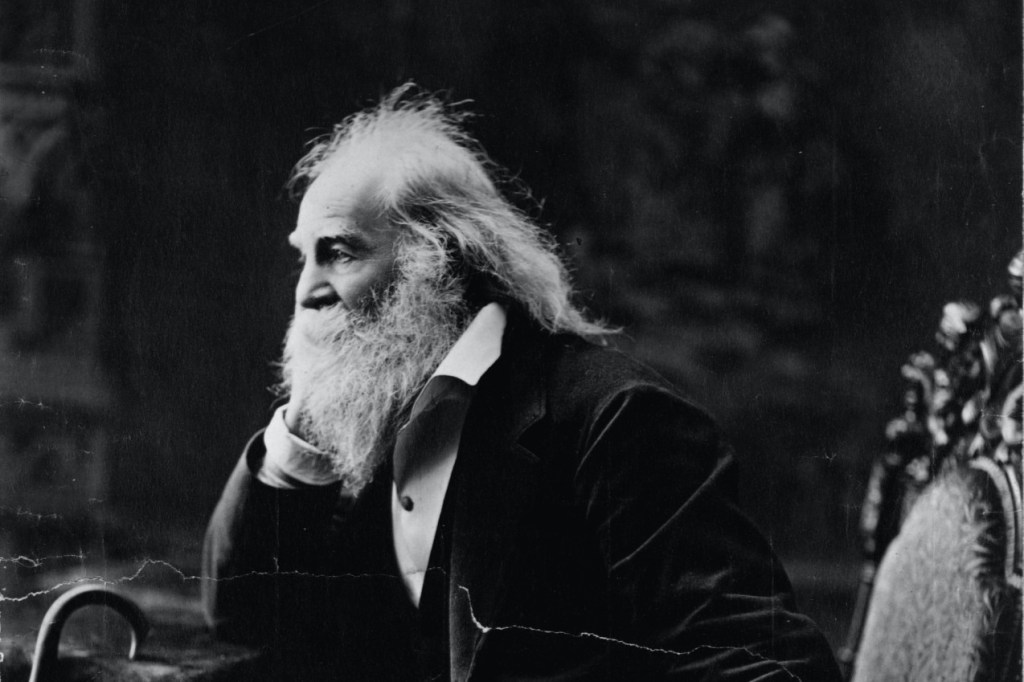
Having tipped one of the gentler bourbons in my cabinet, I finished the volume tonight. It ended at Walt Whitman’s house in Camden, New Jersey. Dr. Wolfe described the poet’s home at 328 Mickle Street, a “disappointingly unpretentious two-storied domicile…weather-worn and shabby,” he called it, with “W. Whitman” etched plainly on the doorplate.
But something else struck me about this concluding narrative.
Dr. Wolfe was taken to and left at Whitman’s home by a man who knew Whitman. Apparently, everyone in 19th-century Camden knew him. But this conductor, in particular, spoke rather peculiarly. Before leaving Dr. Wolfe to investigate, he said, “You have only to cross the ferry and apply to the first man or woman you meet, for there is no one in Camden who does not know Walt Whitman or who would not go out of his way to bring you to him.” He continued, “I never read a word Whitman wrote. I don’t know why they call him Socrates, but I do know he never passes me without a friendly nod and a word of greeting that warms me all through.”
I liked that.
Firstly, he spoke of Whitman as though he were still alive. I’m not surprised. Such people live well beyond their mortal departure. Secondly, Whitman—a favorite of mine—is described as everything I’d want him to be: kindly, gentle, aware of so much more than himself. Here was a man who more than dwelt among eloquence’s immortal collegium. Still, when you were near, he saw you, and he was interested.
If Walt Whitman, the most influential poet in American history, can have such a legacy, what about any of us?
It feels like the summer is flying right by. Thankfully, I do have things to show for it. I’m certainly not wasting time.
As a parent, I keep on my kids about things relative to time. For example, I occasionally remind them in my own way that someday will eventually become today, and unless you’ve planned accordingly, what today requires will be entirely inaccessible. A person simply cannot live without thinking of the future.
In some discussions with my kids, I try to steer them toward calculating one’s self-sufficiency relative to backup plans. In other words, you cannot always rely on other people. They will let you down. In the same way, you cannot always count on the things you think you can count on. Things wear out and break. Apart from syncing to a cloud-based drive, it’s why I have two external hard drives, each backing up from my computer’s working drive every four hours. It’s why I always bring my laptop to my church office every Sunday morning. If my office computer has problems, I can use my laptop to write and send the eNews and, if necessary, finish my sermon and the service prayers. It’s also why I’ve learned how to use my cell phone as a hotspot. If the internet is down on Sunday morning, I can still get this eNews message sent. It’s also why I have a second printer in my office. If the office printer is down, I can still print anything I might need in a pinch.
I didn’t always live my life this way. But I do now. A few unfortunate circumstances over the years taught me just how right Ben Franklin was when he said that failing to prepare is to prepare to fail. As a result, I do what I can to have a backup plan. Most often, I have two, and sometimes, even three.
I don’t mean to say that the future is controllable. It isn’t. Only the Lord knows what will or will not be, and plenty of people have prepared for the future in every imaginable way, only to suffer future-shattering tragedies beyond their control. For all my planning, I once showed up to the office on a Sunday morning and, attempting to print my sermon manuscript, discovered the office printer was down, the ink in my second printer had dried up, and I had zero replacement cartridges. I had to write it by hand. Twenty-eight years ago last week, my twenty-four-year-old brother Michael was killed in a car accident. Here I sit today, still astounded that he’s not around. His absence was something my family and I never expected.
Simple or grand, even when you prepare, tomorrow is never for sure.
I read a portion from Luther this morning in which he wrote, “Christ has not freed us from human duties but from eternal wrath.” He goes on to say that even as we strive and prepare, the only certainty we’ll ever truly have is situated in Christ. Faith receives that certainty. It can receive it because it understands what laboring in this fallen world as a responsible human being means, even when we know everything we’re doing could be for naught and could all come crashing down. Before it even begins a task, faith admits to human brittleness and life’s uncertainty. From there, it plods along diligently, knowing that you win some and you lose some. Faithfulness, not success, is key. It can live this way because its mortal future isn’t its final future. It is secure in Christ for a future beyond all futures. Destruction is not the last word for believers, not because we worked hard or devised a plan to avoid Sin’s inevitable wage, but because God had a plan for carrying us through it. He enacted that plan in Jesus, the God-man in whom faith is placed.
Relative to this, Christians do work hard. And they plan. Leaning on Luther, he mentions God’s gifts of reason and sense in his explanation of the First Article of the Creed in the Small Catechism. Our reason and our senses make these things possible. But remember, as Christians prepare, they measure their futures by looking through Gospel lenses. Faith doesn’t make plans apart from looking to Christ. Faith does not plan a vacation without planning a way to be present in worship while away. Faith does not invest financially without mindfulness for Christ and His bride, the Church. Faith considers the Gospel’s perpetuation for future generations when voting today. Faith plans, all in faithfulness to Christ and the benefit of the neighbor.
Again, do the plans always succeed as we intend? No. Remember: faithfulness to Christ, not success. Faithfulness to Christ is blessed. Saint Paul assured us that “all the promises of God find their yes in Him” (2 Corinthians 1:20). Of course, that truth is a theme throughout God’s Word (Proverbs 28:20, 1 Thessalonians 5:23-24, 2 Thessalonians 3:3-5, and others).
By the way, by blessing, God is not promising health, wealth, and other sorts of earthly things. Again, He promises the future beyond all futures—the eternal reward that’s inedible to moths, out of reach to thieves, and impervious to Death itself (Matthew 6: 19-20, 25-33). When a person has this divine schematic (God’s greater plan for an eternal future) in one’s pocket, what terrors can threaten with any real significance?
There aren’t any. And the ones that try are toothless. Read Romans 8:31-39, and you’ll see.
Indeed, Luther was right to measure all our future concerns and their subsequent plans against God’s promises in Christ, referring to all of it collectively as “true freedom” and then continuing that “no man can value it high enough. For who can express what a great thing it is that a man is certain that God is no longer angry with him and will never be angry again, but for the sake of Christ is now, and ever will be, a gracious and merciful Father?”
I hope you don’t mind, but I have marriage on the brain this morning. Jennifer and I will celebrate our 26th wedding anniversary this week.
I don’t know about you, but the further we travel into marriage’s future, the more content it seems we are to let the occasion be the occasion amid life being life. In other words, we’ll likely go out for dinner to celebrate, but we’ll also just as likely stop at Walmart on the way home for milk, cereal, toilet paper, or anything else a family of six might need. It sounds inconsequential, I know. Some people celebrate by going on trips. Others spend lavish amounts on gifts. That’s not really our way. Last year, we hoped to get away for a few days (since it was our 25th anniversary), but too many other things prevented us from doing so. Several weddings were scheduled, the English District Convention occurred, Vacation Bible School unfolded, and a whole host of other obligations landed on us. We barely managed to sneak away for dinner on a day close to our actual anniversary.
In the end, I think Jen and I have realized that no matter what we might do to celebrate, one exceptional day, while nice, can never really outmatch the everyday blessings we enjoy. Theodor Seuss Geisel—better known as Dr. Suess—was close to describing what I mean when he said, “You know you are in love when you don’t want to fall asleep because reality is finally better than your dreams.” I get his point. There’s very little that exceeds love’s discovery. In its moments, life and its possibilities exceed imagination.
One problem with Geisel’s words is that they don’t completely emerge from emotion’s shifting realm. I’d be on board if he defined reality as a willingness to completely spend oneself for the other in both good and bad times. That would better describe the profound mystery of marital love. It’s one reason why the traditional marriage vows include phrases like “for better, for worse, for richer, for poorer, in sickness and in health….” By the way, in my experience, people who choose to write their own marriage vows, typically turn them into syrupy emotional goo, ultimately missing the mark on what the vows are designed to communicate. For the record, don’t even think about writing your own vows if you want me to preside over your wedding. The longstanding traditional ones are more than sufficient, mainly because they do a fine job of communicating a commitment to something other than self. Two phrases, in particular, cement this commitment: “till death us do part” and “according to God’s holy will.” The previous phrases of the vow set reality’s tempo, acknowledging that there will be good times and bad times. These two insist that emotional love—purely human love—is not equipped to navigate real life to its very end. But love aligned with God’s will is. Love aligned with God’s will can stare death in the face.
Jesus told us straightforwardly what God’s will is. He said, “For this is the will of my Father, that everyone who looks on the Son and believes in him should have eternal life, and I will raise him up on the last day” (John 6:38-40). These words are not far from Jesus’ gentle description to Nicodemus of why God would send His Son in the first place: “For God so loved the world, that he gave his only Son, that whoever believes in him should not perish but have eternal life. For God did not send his Son into the world to condemn the world, but in order that the world might be saved through him” (John 3:16-17).
God knew that human love would be forever insufficient. Loving God and neighbor rightly—the Law’s strict demand—would never be met. But God’s love can do it. And so, that same love moved Him to send His Son. Christ fulfills the demand by His perfect life according to the Law and His sacrificial death on the cross. Jesus demonstrates that God’s love is a perfectly committed, selfless love. It insists that no matter what’s required, the self will never mean more than one’s beloved, even if it means completely emptying itself of all divine prerogatives and going down with the ship in death. Christ did this. And why? Because He loves you. This love is epicentral to His will. Taking a spouse “according to God’s holy will” is to pledge that God’s redeeming love—His forgiveness—will be the marriage’s template. When this is true, a marriage can steer through and around obstacles that might otherwise terrify human love.
But still, there’s more.
Regardless of what the culture believes, God established marriage. He owns it. As such, and whether anyone realizes it, His will naturally permeates its design. First and foremost, marriage is to be a divine snapshot of the Gospel. Saint Paul says as much, describing marriage as a mysterious image of Christ, the Groom, and the Church, the bride—an otherworldly relationship established and maintained by impenetrable commitment. It begins with the One who submits Himself to the death of deaths for the bride. Empowered by that Gospel love, it results in the bride submitting herself in all things, not as one cruelly shackled to an overlord, but as one who loves the Groom for all that He is and has done to make her His own (Ephesians 5:1-2, 22-33).
In a natural law sense, God’s inherent will remains. Marriage is the essential building block of every society throughout human history. The union of one man and one woman—inseparably committed and typically producing children—provides worldwide stability. Everything necessary for an ordered perpetuating society can be found within marriage’s boundaries. Saint Paul hints at how important societal order is when he instructs Timothy to pray for and intercede with the authorities put in place to manage it. He insists Christians do these things so that “we may lead a peaceful and quiet life, godly and dignified in every way. This is good, and it is pleasing in the sight of God our Savior, who desires all people to be saved and to come to the knowledge of the truth” (1 Timothy 2:2-3).
Paul’s point: God wants societal order so that the Gospel will spread.
Marriage not only stabilizes societies, but it is a fundamental conduit in each for communicating the Gospel from one generation to the next. When a society’s marriages begin steering away from God’s holy will—when devotion to self overtakes commitment to spouse and children, when marriage’s biological components become confused, when its sanctity becomes negotiable or irrelevant—the blocks begin to crumble, and the conduits fracture. When that happens, the Gospel—the message of the only kind of love that lasts into and through death—begins slipping into obscurity, eventually securing societal doom.
As I said, Jennifer and I will celebrate 26 years next week. We’ll likely celebrate by doing something special together. Still, even if we don’t—even if life suddenly gets in the way—the marriage won’t be any lesser than before. This is only true because the marriage is “according to God’s holy will.” With His love ordering each of our days, the inevitable road through a reality of good and bad, fading physicality, and unpredictable emotional seasons will continue to prove far better than dreams. It’s the kind of love that finds itself just as refreshed and content holding hands in the breakfast cereal section at Walmart as it does in a classy restaurant.
First, having just returned to Michigan from Florida, I’ll say it’s good to be home. Well, sort of. Indeed, there’s no place like home. Resting a travel-wearied body in one’s own bed is hard to match. Still, coming home from vacation can be hard.
For one, the very first on-the-clock item I tackled when I got to the office this morning was taking ibuprofen. My body feels different in Michigan. I noticed that when I moved here from Illinois back in 1994. Secondly, time means very little on vacation—excluding, of course, the vacation’s final day. That particular day seems to exist somewhere beyond time’s regular pace. It moves too quickly. And it’s rather tortuous for children. But apart from that, all the other days of vacation move leisurely along, requiring little to no concern of any sort. In other words, unlike a typical day, if my family and I want to go to a movie in the middle of the afternoon, we can. If we want to swim from sunrise to sunset, we can. We’re on vacation. We are not obligated to do anything other than what the moment requires for rest. Anything added to the schedule is the vacationer’s fault.
I did my very best to put my phone away while in Florida. Admittedly, I needed it at times. But for the most part, it stayed in my pocket or on a nearby shelf. After a while, I didn’t even notice it buzzing anymore, which is pretty astonishing. I get pinged all day with this text message and that email and those phone calls. I mentioned to some friends that after a few days, when these ever-prodding communiqués finally reach the delta of my absolute disinterest—that is, when each of the phone’s chirps meets with an audible, “Whatever it is, it can wait”—I know I’m finally unwinding. It truly is a moment of self-awareness.
If you’re paying attention, returning from a vacation can also be a moment for self-awareness. I know for a fact that I change a little while on vacation. I’m not who I was when I left. When I return home to my life’s unchanging things—my home, my office, my routines—I can see what’s different about myself by comparison.
Wondering about this, I just looked it up. A study was performed in 2013 suggesting that among people returning from vacation, more than half experienced measurable personality changes while away on holiday. In other words, they were noticeably different to themselves and others while performing their usual routines. Most often, their behaviors changed for the better, even as they passed through feelings of dread before returning to the grind. That is rather intriguing.
Researchers might read the data and conclude that rest is beneficial. Although, that seems like a “duh” deduction. Reading about rest’s merits, I hear Saint Augustine praying, “Our hearts were made for You, O Lord, and they are restless until they rest in You.” The benefits of rest are not lost on Christians. We already know God insisted on rest’s importance when, so long ago, He commanded, “Remember the Sabbath day by keeping it holy.” Luther framed the Christian’s understanding of this kindly mandate rather well in his Large Catechism:
“Our word ‘holy day’ or ‘holiday’ is so called from the Hebrew word ‘Sabbath,’ which properly means to rest, that is, to cease from labor; hence our common expression for ‘stopping work’ literally means ‘observing a holy day or holiday.’ In the Old Testament, God set apart the seventh day and appointed it for rest, and He commanded it to be kept holy above all other days. … [W]e keep holy days… first, for the sake of bodily need. Nature teaches and demands that the common people—manservants and maidservants who have attended to their work and trades the whole week long—should retire for a day to rest and be refreshed. Secondly and most especially, we keep holy days so that people may have time and opportunity, which otherwise would not be available, to participate in public worship, that is, that they may assemble to hear and discuss God’s Word and then praise God with song and prayer.”
Luther understood that God wants us to rest. And why? Well, for one, He knows we need it. Moreover, God knows that any form of physical rest, just as Saint Augustine poeticized, will always be a shadow of what can only be found in Him. He is the only One who can give respite from what truly makes us weary: Sin, Death, and Satan. And so, God mandates our presence in holy worship. He doesn’t make it optional. Just as He knows we need it, He also knows that if He doesn’t mandate it, our sinful nature will convince us that we can get by just fine without it. That sounds awfully familiar to me. I often struggle to admit I need a vacation. If I didn’t have caring folks around me saying, “Hey, Pastor, you need to get away,” I’d likely work myself to death. And in moments like this—the first day back, ibuprofen well in hand—I realize just how wonderful it can be to get away mentally and physically.
I’m glad I listened. My life and family have been better for it.
In the meantime, this year’s vacation is done. Physical rest has been had. It was exceptional, as always. Nevertheless, there’s another kind of rest I need far more than I get only once a year. Like my annual vacation, it includes family—my church family in Hartland. As a household of believers, we enjoy a better kind of rest. It’s an unmatchable kind—a divine kind—one in which God Himself attends to us with His brimming love. He beckons us into this rest, a respite only found in the arms of His compassionate care through Word and Sacrament ministry.
What could be more rejuvenating than that? Absolutely nothing. The Gospel given through Word and Sacrament has everything any of us could need for life in this world. And to think, these gifts of God’s grace are available to us every time we gather for holy worship.
I’m sad for those who think they can somehow endure without ever being together with their Christian family in worship to receive these heavenly gifts. It just doesn’t make sense to me. It is counterintuitive to genuine human need and spits in the face of the One who loves to provide for the need in abundance. Even more, it’s just plain foolish to believe that we can be apart from God in this way and still consider ourselves His children. God’s Word certainly warns against believing and practicing such nonsense. But even as it warns, it also promises. It promises that just as we’re inclined to take vacations from God, He’ll never take vacations away from us. Let that sink in. God is always on deck to give you rest. He’ll keep after you with the invitation.
Listen to Him. Understand that God’s Sabbath command is nothing short of the same kindly offer His Son offered when He said, “Come to me, all who labor and are heavy laden, and I will give you rest. Take my yoke upon you, and learn from me, for I am gentle and lowly in heart, and you will find rest for your souls” (Matthew 11:28-29).
I pray all is well with you this morning. I, for one, am performing my usual early Sunday morning routine, even in Florida. Again, I continue to tell myself I won’t write and send anything on Sunday mornings. But then, I do. I already know the disease’s name. It’s called hypergraphia. It’s a neurological condition marked by an intense desire to write or draw.
I’m just kidding. I don’t have hypergraphia. People suffering from hypergraphia will do something like spend an afternoon writing the lyrics to a favorite song fifty times. I wouldn’t do that. I’d be more inclined to spend a free afternoon writing fifty new songs. I see writing—especially free writing—as a means of creative probing designed to discover what I think about something. The particular prompt is never an issue. I look around at things. I sip my coffee. In a moment or two, I see something, then I’m off and following. In the early morning Florida sun, there are plenty of mental meadows for such wandering. Michigan has its share, too. Every place has an abundance. You need only to pay attention.
In a little while, the rest of the Thoma family will awaken. Soon thereafter, we’ll make our way to Zion Evangelical Lutheran Church in Winter Garden. We visited there last week. The guest pastor, a kindly gent, preached a fine sermon. At one point along the homiletical way, he spoke of being part of a group. Specifically, he described seeing a family gathered in a park for a reunion. He mentioned the picnic tables, the food, the laughter, the sunshine, and all the things that make for a friendly gathering of loved ones. From there, he described a lonely onlooker’s desire to be a part of such things—to have a place of belonging. The point of the illustration was to describe the Church, and he did so in an interesting way.
Admittedly, I drifted a little while the pastor described. Seeing the familial picnic in my mind, I imagined the conversations. In particular, I thought of how families often retell the worst about themselves, ultimately adorning their conversations in laughter rather than tears. They tell the story about so-and-so’s new carpeting and how their son, now a grown man, once ran diaperless through the room, ultimately doing his business and leaving a stain that remains to this day. Or they reminisce about the time Uncle so-and-so pushed Grandma on the park swing, and when she came back on the upswing, he grabbed her wig and ran away, leaving her helplessly embarrassed and angry.
Everyone listens and laughs at the former foolishness. The carpet stain is still there, forever remembering something good now soiled. Grandma is still there, too. She still wears her wig. And yet, she’s not embarrassed, and she’s no longer angry. Why?
Family.
I firmly believe that the only type of human love that will ever come close to demonstrating the love God shows us is the familial kind. When I look at my wife, when I look at my children, I see Jesus there. They know pretty much everything there is to know about me. More importantly, they know my worst, most detestable self. Still, they love me. And I love them—enough to give my life in their place. This love changes me. Self-love is pushed aside, making room for being the best husband and father I can be.
Even if only in a minimal way, all these things give a sense of Christ’s divine view. What’s more, all these things demonstrate just how wonderful things can be in a community desiring to live in the shelter of repentance, forgiveness, and amending the sinful life. It’s in gatherings like that where former sins become memories worthy of little more than a laugh.
Strangely, this sounds a lot like God’s blueprint for the Church. That being said, I hope you’re making plans right now for this morning’s family reunion. We are. We won’t see you, but we will be with you.
While I can’t quite see the Florida sun from where I’m sitting, I know it’s there. Its morning beams have already gone out to paint the sky like flower girls scattering petals before the bride in a wedding procession. Sunrise is coming. It’s at the day’s gate.
Every year I say I will not write any eNews messages while on vacation, that I will leave everything behind and simply simmer in the joy of minimal obligation. But then I end up doing it anyway. I told Jennifer yesterday at the airport that perhaps I’d fight the urge this year. Truth be told, I had another factor prompting today’s early morning rise. In the house where we’re staying, the same place we visit every summer, the owners got a different mattress for the master bedroom—a horribly cheap mattress. I don’t know why. What I do know is that I have a terrible back, and the new mattress has got to be the worst, most pain-inducing one I’ve ever slept on in my entire life. I’ll try one of the other beds tonight. I’ll sleep on the dining room table if they’re all the same. Or a lounge chair near the pool. Or the bathtub.
Since today is Father’s Day, I certainly have the gem-filled occasion in mind this morning as I sip my coffee and down some ibuprofen. I’ve learned a few things as a dad, many of which have only come to fuller bloom in recent years. For example, as the father of two daughters, I’ve learned that, in a way, I’ll always be my girls’ first love. I mean that they’ve likely learned the type of man they want to marry from observing the man I’ve been. I can promise you the day either of them stands beside a husband-to-be at the Lord’s altar will be a conflicted moment of joy and sadness. I’ll be happy, trusting the Lord’s promise to bless them. But I’ll also be sad, foolishly convinced that no one will ever love my daughters like me.
As the father of two sons, I’ve learned a similar lesson. I’ve learned that any words of advice I’ve given them through the years are of fractional value compared to the things they’ve seen me do. Again, the day my sons become husbands—and by God’s grace, fathers—will be a day of mixed emotions. I’ll be blissful, trusting in the same blessings of God. And yet, I’ll be torn. I’ll know I’ve reached a certain point of irrelevancy in their lives. In other words, they’ll have set sail. Once at sea, a ship’s builder is no longer needed.
I suppose these concerns are ridiculous. Of course, someone can love my daughters like me. Maybe even better. And certainly, I won’t be irrelevant to my sons. They’ll meet with situations that, even as husbands and fathers themselves, will prompt them to ask their own dad’s perspective. I know these things. And I know they’re all a part of one generation carrying on to the next.
“…one generation carrying on to the next.”
Now and then, when I write something, I must examine my own words. Plenty in God’s Word describes how that carrying on is to happen. There is plenty more revealing what a parent’s truest goal in the process must be, namely, to raise their children in the faith. Still, one text resonates more with me this morning than the others. Psalm 103:13 reads, “As a father shows compassion to his children, so the Lord shows compassion to those who fear him.”
Firstly, an underpinning of this text has to do with demonstration, of learning behaviors from someone else. Secondly, the text isn’t teaching a single step in a broader course but instead is looking at every stage and showing what’s necessary to each—what’s actually binding each of life’s efforts to the next. Interestingly, it does this by way of three assumptions. The first assumes that fathers will show compassion. The second considers the Lord’s compassion as the standard to replicate. The third believes the Lord’s compassion will be given to those who put their faith in Him. That’s His promise, and it can be trusted.
At the root of the denominative verb used for “shows compassion” is the noun “racham.” Chasing this word around the Old Testament for a few minutes this morning, I discovered other interesting uses relative to sympathy, nurturing, brotherly fellowship, and the like. One of the more unique connections has to do with a mother’s womb and the reality of birth. This connection matters most to me this morning, especially as a parent with a mind for Father’s Day. Although, it might not be for the reason you’re thinking.
I think it matters most because, even though I’m the one God put in place to shepherd my children, I’m no different from them regarding human birth. We’re all born into the sinful predicament of human dreadfulness (Romans 5:12-18). As a dad, when I observe their failings, I must be aware of my own. I must recall my place beside my children in this rumpled and grimy world, where I own just as much Sin-stained guilt as the next person. In other words, I must parent them, realizing we’re in this together. We’re standing before God on the same footing and need something.
Admitting this, I’m drawn to remember what that “something” is. Nicodemus’ conversation with Jesus in John 3:1-21 frames it. It was there Jesus told Nicodemus—a man who’d soon experience faith’s stirring to defend Jesus in John 7:50-52 and then assist in His burial after the crucifixion in John 19:38-42—that even as one is born of the flesh, God is compassionate, and a rebirth is possible. Most people today use the phrase “born again,” but it’s really better translated as “born from above” (γεννηθῇ ἄνωθεν). In other words, just as a child can’t choose to be born, the rebirth of faith is God’s laboring. He births us into His family. It’s no wonder the same disciple who recorded this interaction with Nicodemus also wrote in 1 John 4:7 that a believer who truly demonstrates Godly love—a person who shows compassionate care—proves “out of God he has been born” (ἐκ τοῦ θεοῦ γεγέννηται).
I was born in the flesh, but I was also reborn in faith. From this vantage, I can clearly see the Lord’s fatherly demonstration of compassion, and I can carry that demonstration to my children. God did not give me what was owed for my crimes. He loved me. He had mercy, and He birthed me for something better. Child or adult, did I suffer the natural consequences of certain behaviors? Yes. But am I eternally condemned by them? Have I crossed beyond the border of God’s compassion? No. That’s the most reliable assumption woven into Psalm 103:13. For those who, by repentance and faith, know their Sin, they’ve been reborn to know a God who stands ready to receive them, One who promises never to leave nor forsake them (Hebrews 13:5). He is compassionate. He demonstrated it fully through the person and work of His Son, Jesus Christ. He moves Godly fathers to emulate the same compassionate care, principally as they introduce their children to Christ for the sake of salvation but also as they demonstrate the humility of repentance and trust in Him. It’s God’s will for this powerful Gospel display to surge forth from one generation of fathers to the next.
I want to instill these reliable assumptions in my children, both in their relationship with Christ and in their relationship with me. The time is coming—very soon, in fact—when they’ll work to instill the same unfailing assumptions in their own families. God willing, I’ll be here to help when they ask and for as long as the Lord allows.
Happy Father’s Day. I pray it’s an enjoyable one for all.
Here in Michigan, with the summer weather comes the bluer skies—the endlessly deeper sapphire skies. They’re beautiful, and they’re more than worth one’s staring. It’s supposed to rain today. That’s okay. We more than need it.
I installed a new stereo in my Jeep. The previous stereo had become somewhat rebellious. For example, it preferred to pause the music when I pressed the mute button. Also, it tended to begin its life anew at every stop. Five minutes at the gas station, and it would reset its clock, lose all the stations, and so much more. Sometimes, it wouldn’t even acknowledge me. I’d press a button, and it wouldn’t do anything. It’s now in a box in my basement.
The new stereo connects to my phone and its music applications, one of which is Spotify. On the way to school one day last week, Evelyn and I listened to whatever Spotify sent us. Elton John’s “Rocket Man” was one of its suggestions. Listening to that song beneath what was gradually becoming a clear blue sky stirred a particular memory for me. I described it to Evelyn. I told her that I heard that song while driving a week or so after my brother Michael died. It was in July 1995. The sky was a seamless blue. I remember leaning a little bit into the steering wheel of my truck to look upward through the windshield for a better view. I did this as Elton sang, “And I think it’s gonna be a long, long time….”
I was 22 years old at the time. My brother—my only brother—was 24 when he died. I remember looking into that infinitely vast sky and thinking it would be a very long time until I’d see him again.
After sharing that memory, I’m pretty sure I noticed Evelyn moving as inconspicuously as she could to wipe away some tears. She’s truly a lovely girl, empathetic in every way. Of course, I didn’t end the story without the Gospel truth, which I’d already shared in a simpler way. Yes, it would be a long time before I saw Michael again. It’s already been almost three decades since we were last together. Still, I will see him. That’s the promise. And I believe it.
My oldest daughter, Madeline, just graduated from high school. Her graduation party was yesterday. What a joy it was to spend time with so many friends. Naturally, as it is with many events in my life—my wedding, the births of my children, my ordination, and so many others—I’ve looked around each event’s scene and wished Michael could’ve been there. That happened at Madeline’s party. Certainly, I’ve always wished my children could’ve known him. And yet, I wasn’t thinking that way yesterday. Instead, more than once while visiting with so many people I cherish, I thought, I wish Michael could’ve been here to meet you. I know he’d have liked you as much as I do.
As the saying goes, each day, a day goes by. But when you love someone, the person’s absence hurts, and each day apart seems to have a thousand hours instead of only twenty-four.
I suppose for many of you, I’m not describing something unfamiliar. You know the sensation. You’ve experienced those moments when you’ve heard a song, taken in a scent, or seen a sight that swept you backward to a time with someone who right now is permanently out of reach.
Having just used the word “permanently,” I realize how strange that word is for Christians. Even with synonyms like “perpetually” and “forever,” for Christians, the truth is that these terms have an expiration date when paired with the out-of-reach nature Death seems to bring. For Christians, Death isn’t permanent. It isn’t forever.
There’s another saying that Death has a thousand doors, and we all find one. There’s truth in that statement. However, no matter its form, because Christ conquered Death, it becomes just another event in a believer’s mortal life—an entryway to a timeless unending with Christ so beautifully described as the shelter of His glorious presence, a place where believers “shall hunger no more, neither thirst anymore; the sun shall not strike them, nor any scorching heat. For the Lamb in the midst of the throne will be their shepherd, and he will guide them to springs of living water, and God will wipe away every tear from their eyes” (Revelation 7:16-17).
And by the way, this wonderful reality will occur among what Saint John called “a great multitude that no one could number” (v. 9). All believers in Christ will fill that multitude’s ranks. Michael is already there, along with all who’ve gone before us in the faith. I’ll be there one day. Someday my wife and children will be there. By faith in Christ, you’ll be there, too.
Until then, in a mortal sense, I think it’s gonna be a long, long time. But that’s okay. Time will end. But eternal life won’t. Knowing this, I can hear a song that prompts a glance toward the heavens and have a different longing as I do it, realizing that for every hour we’re apart from those who’ve died in the faith, there will be a limitless cadence of eternal hours together with them in our Savior’s presence. That same Savior, Jesus Christ, gives this to us because, in perhaps the simplest way, He knows the feeling. Believers are a part of His family. By His relationship to the Heavenly Father, He calls us His brothers and sisters (Mark 3:34-35, Romans 8:29, Philippians 2:8-11, Hebrews 2:11, 2 Corinthians 5:21). He loves us more than anything—enough to shed His blood—and He doesn’t want to be without us.
One last thing.
Don’t get me wrong. I don’t mean to make Death out to be no big deal. It is. That’s why, as I’ve said countless times before, I always give Death a capital “D.” Death is not our friend. It isn’t our helper. But also, it isn’t something we must fear because it isn’t our master. The real Master, Jesus, has declawed, defanged, and defeated it. That’s why Paul can recite rhetorically, “O death, where is your victory? O death, where is your sting?” (1 Corinthians 15:55).
Again, Christ loves us more than anything. Not even Death can keep Christ’s brothers and sisters from Him. Instead, Death must hand them over to the Lord every single time. That’s something worth pondering, no matter the sky’s demeanor.
Summer is nearly upon us. The weather is finally admitting as much. I give thanks to the Lord for this. Throughout the school year, the pace is much swifter around here, to be sure. Summertime allows more scheduling freedom, and as a result, things slow down a little. Of course, the calendar’s empty slots always fill up. There’s plenty to do. I can tell you that I’m already sufficiently booked into and through the first week of August. Still, as Michigan’s colder weather shrinks back into hiding for a few months, so also goes the guilt I might have for stopping to actually engage in something that has almost nothing to do with pastoring, something I might also enjoy—like figuring out how to lift my Jeep’s suspension an inch or two, or replacing the toilet in our downstairs bathroom, or putting a drop ceiling in our basement guest room.
One thing I do every summer is read. Of course, I read the scriptures. But I also pick away at classics. I’ve already decided on Jack London’s The Call of the Wild. That won’t take me long, so I’ll need something more. I decided to do something a little different. Those who know me best will know I’m keen on sci-fi/horror films. Although, I’ve never spent money on books from that genre. I decided to give the Rage War series by Tim Lebbon a try. It’s a three-volume series about the Yautja (the creatures from the Predator films) invading the earth, only to team up with the humans to fight against another unknown force unleashing xenomorphs (the creatures from the Alien films) across the galaxy. I likely wouldn’t have purchased these volumes if our school’s wonderful PTL hadn’t given me a gift card to Barnes and Noble. I blame them for this eagerly anticipated distraction.
I don’t expect these books to be anything but outlandishly fun, and I doubt I’ll discover anything worth quoting. Perhaps like me, you don’t like to mark up the pages of your books. I’ll usually bend the page’s corner if I find something worth revisiting. Plenty of books I own have these little bends. However, on occasion, I’ll underline something. Flipping through my edition of The Call of the Wild, on page 100, the following is underlined: “It was idle, he knew, to get between a fool and his folly….”
Thorton, a character well-versed in the Yukon’s ways, mulls this thought relative to Hal, an inexperienced and ignorantly vain character who has no idea how to care for, let alone drive, a dog sled team. Regardless of the context London has fashioned, the point is memorable, if not for its simplicity. Human beings are going to do what they want to do. Being the time of year for graduations, I’ve begun noticing this in the ever-increasing irreverence at commencement ceremonies. Ask the crowd to hold their applause, and they’ll clap anyway. Expect solemnity from the onlookers, and you’ll get airhorns and ear-piercing woot-woot screams. Moreover, people have the uncanny ability to be so prideful that they’ll do incredibly foolish things, even things that could ruin or destroy them. Perhaps more tragically, no matter how hard a person—a trusted friend, a sibling, a parent—might try to get between a person and self-destroying things, doing everything possible to coax them away from folly’s edge, unless they realize the nature of their self-centered predicament and accept the better direction, tragedy is all but guaranteed. They will fall. And it won’t be pretty.
I’ve noticed something else in my time as a professional church worker, this being my 29th year. The one trying to help often holds the most guilt, wishing more could have been done to prevent the disaster. A son, even after his mother’s tearful warnings, makes a life-altering mistake, and it’s Mom who cries herself to sleep, wondering where she went wrong. A daughter strays into an abusive relationship, and it’s Dad who grows visibly older with burdensome worry, wondering if he could’ve been a better, more affectionate example.
Erma Bombeck referred to this kind of grief-stricken guilt as the gift that keeps on giving.
Saint Paul said something a little different about it. He wrote, “For godly grief produces a repentance that leads to salvation without regret, whereas worldly grief produces death” (2 Corinthians 7:10). The word Paul uses twice for grief is λύπη. Essentially, it means mental turmoil. It’s a pain of the mind marked by agony and regret. As a father, I can assure you that parents are more than prone to this kind of grief. Close friends are, too.
Interestingly, in both instances, Paul takes care to modify the word. The first time, he couples it with “godly.” In the second instance, he attaches “worldly.” By doing this, he’s not saying that grief isn’t real or that it doesn’t hurt, but that there’s a distinct difference between the guilt-ridden heartache we endure by faith and the sorrow-laden regret borne according to human capacity. In short, godly grief has hope. It finds a footing in repentance and is met by God’s loving promises for a regretless future. The other has none of this. The other leads into the sinister depths of eternal sorrow and the end of all human hope, namely, Death.
If you were to visit the verse before verse 10, you’d see Paul commends godly grief, saying he’s glad for the harder moments that stir repentance. He’s not reveling in the pain, but he’s glad for what the pain produces.
There’s something going on here. If anything, a byproduct of godly grief is clarity. Saint Peter hinted at this in a way when he encouraged us to remember something. He wrote: “The Lord is not slow to fulfill his promise as some count slowness, but is patient toward you, not wishing that any should perish, but that all should reach repentance” (2 Peter 3:9).
When all human effort to help a loved one seems long spent and all hope appears lost, Peter brings us to something else. He reminds us that God’s timing rarely aligns with ours. God’s pace is His own. But no matter His stride, He’s dealing with us patiently. His desire for all human beings is to reach the uplands of repentance. What does this mean relative to what I’ve written so far? Well, let me think about that out loud for a second.
Firstly, I’d say we need to realize that we can’t live others’ lives for them. A mom cannot live her son’s life. Likewise, a dad cannot forever make his daughter’s choices for her. A friend does not control another friend’s will. The sooner we accept this, the better.
Secondly, Mother Teresa was right when she said, “We are not called to be successful, but faithful.” She didn’t come up with that on her own. The Bible taught her to say it (Luke 16:10-12; 2 Corinthians 5:7; Revelation 2:10; Matthew 10:22; and countless more). The point is that by the power of the Holy Spirit, we seek faithfulness to God in any given situation, even when we feel completely powerless to do or say anything of significance. Still, be faithful. Trust Him. Faith knows He’ll take even the most insignificant of one’s words, gestures, or whatever and put them to good use. He’s got you.
Thirdly, things might appear to go south no matter what we do. And when things don’t go as planned, there will be guilt. There will be grief. But let it be godly grief. Again, godly grief still hurts. This is only true because it’s honest. It’s self-examining. It wonders if it could’ve been more attentive, less critical, or whatever. That’s what desiring faithfulness often feels like. It wishes it could be more faithful. But amid its sadness, godly grief remembers something of God. It knows His forgiveness, the kind that covers regret. It also knows the game isn’t necessarily over. It knows that even though nothing we do seems to bring the results we want, we’re not in charge. God is, and He’s moving behind the scenes at His best, most perfect pace according to His steadfast love. Godly grief knows He’s listening to our prayers. It knows the kind of love driving Him aims at rescue—at working to instill repentance and faith.
That’s hope. That’s confidence in God’s love. God’s love dispels the gloom. There is no fear in that love (1 John 4:17-18). It knows that just as we don’t want to lose our loved ones to ungodliness leading to eternal separation in Death, neither does God.
And so, we continue praying while standing ready to act when necessary. This process may last a lifetime. We may never live to see anything change. Still, we know by faith that it could. Who knows for sure if it will? Only God. Either way, we can be at peace. We can continue to be faithful, not necessarily successful.
Like many of you, I have vacationing on the brain.
Memorial Day is meant to remember those who gave their lives in service to the country. Still, judging by the weekend’s typical worship attendance, it’ll be akin to a test run of the forthcoming summer’s getaway potential. In other words, it’s a practice vacation. It doesn’t offer much time to rest, but it gives a sense of what rest could be. And if not rest, then at least the liberty to spend a long weekend with friends and family—some we like and some we don’t—doing something…or nothing.
I just used the word liberty.
I’m not above reminding anyone why the rest they enjoy in America is possible. People died to provide it. Considering that Thomas Jefferson once called religious liberty “the most inalienable and sacred of all human rights,” I’m not above reminding folks to consider churchgoing as one of liberty’s best exercises. A far more critical death sits at its center—the death of God’s Son. His death won far more than freedom from earthly tyranny or foreign threats. His death stole you away from eternal condemnation and the power of Death. That’s certainly worth a day or two of any vacation.
At our Church Council meeting last week, our new Youth Board chairman, Jason, spoke about future opportunities for our youth to enjoy fellowship together and serve in the community. As he explained, I drifted back to my days as the youth leader, a time when we were heavily invested in international mission efforts, going to places like Russia and Lithuania. I share this because later that night, on the treadmill, I visited a travel website to check on airfare prices to Lithuania, figuring it might once again be a possibility. Of course, Russia seems like a stretch right now. Anyway, while ticket shopping, one of the side advertisements was scrolling quotations about vacationing. I don’t usually pay much attention to advertisements. The sayings caught my eye in this case, probably because the Thoma family is precisely 20 days away from our annual two-week getaway to Florida.
The first quotation I jotted down was from Robert Orben. He said, “A vacation is having nothing to do and all day to do it in.” Another from Hal Chadwicke offered, “A vacation is a sunburn at premium prices.” I also saw one by Susan Sontag. She wrote, “I haven’t been everywhere, but it’s on my list.” Finally, there was the following from Gustave Flaubert: “Travel makes one modest. You see what a tiny place you occupy in the world.”
I know who Robert Orben was. In fact, he died just this year. He was a comedy writer who later became a presidential speech writer. I only know this because he managed to do something I’d appreciate doing, which is speech writing for political candidates. Other than that, I’ve never been a fan. I don’t know who Hal Chadwicke is. I’ve never heard of him. I’ll probably look him up after typing this. Known or unknown, he said something insightful that was worth sharing. Susan Sontag was a leftist crazy. She did all she could to depict America as a villain. For example, she was the kind of person who could visit an orphanage in Africa built by Americans and figure out how to blame America for the local warlord’s murdering the children’s parents. I’m not a fan of Susan Sontag. Still, she wrote at least one thing worth sharing.
Gustave Flaubert’s observation resonated with me the most. He was a nineteenth-century French novelist. He wrote Madame Bovary. I’ve never read it. It’s a classic, so I probably should. I guess I’ve never been that interested, mainly because of its reputation for having a class-envy theme. Still, Flaubert’s words about travel are pinpointedly accurate. Stepping beyond the front door of our lives has a way of revealing the uniqueness of one’s place in the world.
Vacations are inherently good for this.
Relative to this ramble’s start, I think I’ve sorted out a few things. One lesson learned concerns my being completely disinterested in spending a Memorial Day weekend with any of the authors I mentioned. However, even though I might not be fond of particular people, situations, or tasks, I can garner something of value from almost anyone or anything if I’m paying attention. Even Saint Paul found value in the pagan poets. With that, no matter where you are or what you’re doing, pay attention to what’s happening around you, even when you’re doing absolutely nothing. You’re bound to discover something worthwhile. This leads me to something else.
I suppose vacations are designed to provide rest. But they’re also supposed to be rejuvenating. Rejuvenation isn’t necessarily a do-nothing event. It’s restorative. It’s a creative act. It’s also self-contemplative. It takes in information and applies it to the self. It has a heightened awareness, one that’s undistracted from the usual day-to-day bustle and capable of looking around at life for new ways of making one’s regular days healthier and, perhaps, more productive. I can promise you that’s one of the only reasons I try new things while on vacation. I rarely do nothing. But I rarely do something to say I’ve done it. I eat food I’ve never eaten or try activities I’ve never tried so that I can decide if I want to add them (if possible) to my life back home. I discover things about myself and my everyday routines as I do this. As Flaubert hinted, I’m reminded how small my corner of the world is compared to the rest of God’s beautiful creation. The older I get, the more aware of this process I become. And it really is a splendid process.
Now, I didn’t set out at the beginning to sound like some new-age therapist bent on meditative self-help techniques. Instead, I’m thinking about my upcoming vacation, realizing I’m going away to a place that’s not my home. I will return to the real world and its seemingly endless tasks.
I’m also thinking about what I read in Ecclesiastes 3 this morning. Chapter 3 is that memorable portion from King Solomon that talks about how there’s a time for everything under heaven. I noticed vacationing fits into what Solomon wrote.
Interestingly, after Solomon lists various seasons in life, some good and some bad, he appears to connect all of them to man’s general toiling—his day-to-day vocation. In verse 13, he summarizes that God wants man to take pleasure in his work. His phraseology implies that the toil and its fruits are God’s gifts to us, not simply a package of things we endure until retirement. They’re proof of God’s love.
In verse 22, the final sentence of the chapter, Solomon adds one more thing. He once again restates that man should rejoice in his work, but then he ends by asking the rhetorical question, “Who can bring him to see what will be after him?” I won’t dig too deeply into this question because I’ve already been long-winded. In light of everything Solomon has written, it sounds like he’s assuming a life of labor in gratefulness to God produces a job well done. A job well done benefits those who come after us.
Finally, reading Solomon’s concern for times of laughter and healing—and knowing they’re relative to our daily labors—I think one of the “vacation” takeaways is that we shouldn’t necessarily be thinking about our time off as an escape from work. Instead, we vacation for the sake of our vocation. In other words, we take time to rejuvenate—we grow and learn and take in new mental and physical resources—so that we can return to our daily labors better equipped for faithful laboring to the glory of God and the good of the neighbor.
Returning to the real world after vacation can be depressing for some. I get it. Still, I think Solomon is telling us there’s a way to take a little bit of it with you. My advice: pay attention. Ask yourself while away, “What can I bring back to my corner of the world that’ll make my vocation more of a joy in thankfulness to God and a blessing to my neighbor?”
Now, if I can only figure out how to fit Florida’s sunshine, a few palm trees, and a swimming pool into my suitcase. I’ll bet that would make everyone in Michigan happy. Florida can keep its sharks.
It has begun. Multiple times a day, the Thoma children announce how many days remain until the last day of school. I bet they’d be ready with the hours, minutes, and seconds if I asked any of them. I’m certainly not annoyed when they do this. I know why they do it. For youth, summer and freedom are synonyms. Besides, I did it, too. As a kid, I counted the days until my only schedule-consuming responsibilities would be jumping ramps on my bike, hunting crawdads in muddy creeks, playing army in the forest behind my best friend’s house, participating in socially recalibrating neighborhood scuffles, watching late-night scary movies, and just about anything else summer could conjure.
Thinking back to those days, even though I stayed up pretty late almost every night, I don’t really remember sleeping in the following day. I remember wanting to get as much from my summer as possible. And so, I’d hop out of bed no later than 8:00 or 9:00 a.m., throw on the cleanest clothes from my floor, have a bowl of cereal, and then fly out the back door to the rusty shed where I kept my bike. I’d throw up a dust trail speeding down our gravel driveway or go off-roading through our bumpy backyard, my bike clanking and rattling all the way. But whichever direction I went, the horizon’s possibilities were limitless.
Some of the summer’s possibilities were great. Others, not so much. I remember one summer hearing that my friend, Todd Smart, fell from the tree in his front yard and died. It was July of 1983. I was ten years old at the time. My dad told me the news. I certainly knew the tree. I’d climbed it, too. If I had to guess, I’d say it was at least twenty feet tall. Although, things seemed so much bigger when you were a kid. As the story goes, Todd had just about reached its peak when the branch he was standing on broke, and he fell to the ground, hitting branch after branch all the way down. A couple of days later, my friend, John, told me he’d heard Todd looked like a pinball bouncing off the bumpers as he fell. Oddly, John and I had that conversation about ten feet from the ground in a tree near my grandmother’s apartment.
It’s strange the things one remembers from childhood. Before telling me the news about Todd, I remember the look on my dad’s face. It was uniquely unordinary. I knew I was going to hear something I didn’t expect. I remember the tree near my grandmother’s apartment. I remember which branches a kid needed to grapple with to climb it. I remember my friend John’s home phone number. I just typed it into Google. A woman with an extraordinary name—Drewcylla—appears to own it now.
Whether winter, spring, summer, or fall, each season holds more across its horizon’s boundary than what’s right in front of us at any given moment. What we experience in those lands will be with us well into the future—well into forthcoming seasons. Some things we’ll remember in detail. Other parts we’ll forget. Some we’ll observe from this side of life and realize how we didn’t fully comprehend the event’s particulars because of our immaturity at the time. Remember, my friend died climbing a tree, and a few days later, another friend and I discussed the tragedy while climbing a tree. I’m well past ten years old, and I only recognized the irony just now as I typed this. Still, the Christopher Thoma tapping on this keyboard this morning is the same one who dangled from that tree near Valleyview Heights Apartments in Danville, Illinois, forty years ago. And yet, I’m not the same person. I’m entirely different after meeting each season’s moments. That’s life. That’s development. That’s growth. And it’s normal.
Seasonally speaking, I’m absolutely certain that growing up in the 1970s and 80s barely compares to childhood today. For one, I don’t remember any of my classmates identifying as cats. (Honestly, the neighborhood scuffles I mentioned before would’ve fixed that weirdness in a hurry.) I don’t remember any of my teachers encouraging me to explore my gender identity or encouraging anyone I knew to consider gender reassignment surgery. The 70s and 80s could get crazy, but not this kind of crazy. I certainly don’t recall any of my teachers attempting one of the worst kinds of crazy: to undermine my Christian faith or divide me from my parents. For example, my son, Harrison, came to me this past week to tell me that his AP US History teacher at Linden High School overheard him talking to a friend about a scene from the Monty Python film “The Life of Brian.” Harrison hasn’t seen the movie, but I have shown him a few of its more hilarious scenes. The conversation unfolded something like this:
“Isn’t your dad a priest or something?”
“He’s a Lutheran pastor,” Harrison answered.
“He actually let you watch that movie?” the teacher pressed.
“No, I haven’t seen it. I’ve only seen a few scenes. They don’t really want me watching it.”
“Of course not,” the instructor replied. “He probably doesn’t want you watching it because it’ll challenge what he’s taught you to believe and teach you another way to look at the Christian religion.”
Nice try. But most certainly a hit and a miss. Jennifer and I haven’t kept the movie from Harrison because we’re his cruel overlords. Thankfully, he knows this. And thankfully, he talks to us openly about things like this. For the record, Mr. History Teacher, his mother and I don’t want him to watch the movie because it employs a few choice words we’d prefer for him to avoid and has full frontal male and female nudity. Other than that, it’s hilarious. And if anything, the “I want to be called Loretta” scene makes you and your dreadfully woke automaton colleagues look imbecilic by comparison.
Right now, even as Harrison is sixteen, he’s developing. It’s our job to help him along. We do this by ensuring he knows we love him more than anything, second only to Christ. When Harrison’s beyond this season of our responsibility, we’ll be happy to let him take the helm. That’s how it works. He’s already proving his ability to make his way without us. He’s already showing that he’s seeing and enjoying the world in ways far different than what the world would prefer. I’ll come back to this in a second.
In the meantime, as sure as I am of the vast differences between the 1970s/80s and today, I’m just as confident that the nature of humanity hasn’t changed all that much. Kids are developing—spiritually, socially, physically, and psychologically. What happens right now—how we talk to them, what we allow to happen to them, whom we allow in their circles, whom we allow to teach or influence them—all these things might seem irrelevant in the moment. And yet, like it or not, every one of the atom-sized occurrences relevant to each situation is affecting them. Twenty years, thirty years, forty years from now, each situation’s truest impact will be remembered and likely demonstrated. As I already said, that’s life. That’s development. That’s growth. And it’s normal.
But know this: The Lord’s normal differs from the world’s normal. And so, with Christ as one’s north star, “normal life” itself is affected. Both the good and bad seasons meet first with the One who promises to go before us, pledging to never leave nor forsake those who are His own (Deuteronomy 31:8). With that, all things meet the child quite differently. In any given moment, recognizable or not, this Gospel will be doing what our faithful God says it’ll do: cultivating joy, resilience, and a necessary endurance that will only strengthen as one matures toward a final breath and then enters eternal life (Proverbs 22:6; Deuteronomy 6:7; Isaiah 54:13; Jeremiah 29:11; Matthew 19:4; 2 Timothy 3:14-17; and the like). As parents, we bear no insignificant role in this exchange. God included us in His baptismal mandate, insisting that we teach our little ones the Christian faith and support them in it (Matthew 28:19-20).
I suppose one reason I’m probably thinking about these things leads back to where I began. We’re coming to the end of the school year. My kids are counting down. As I look around at the children in this congregation’s school, I’ll bet they are, too. Even so, I’m hopeful for their forthcoming summers. I can be. For any of our good or bad seasons (which every community experiences), each child and his or her family has enjoyed the opportunity to meet first with the Gospel of our faithful Savior. Myriads of parents and children in countless schools worldwide don’t enjoy that. In our little corner, on this fractional portion of each of our students’ developing timelines, they do—and in abundance. Forty years from now, when I’m ninety—if I’m still alive—I expect to hear retellings of the memories associated with these things. I’m sure it’ll make me smile then, just as it does right now.





 Cruciform Stuff