It’s Jesus’ Story to Tell

I was thinking about a social media exchange regarding the theological abilities of our nation’s new President that I participated in this past Saturday after our congregation’s annual “Getting Organized” meeting. But before I share its importance with you, I should probably start with a different conversation that occurred earlier in the week. I hope you’ll bear with me. I think it fits.

I had an interesting conversation with a group of students in my 7th and 8th grade religion class last Wednesday. Knowing that far too many folks these days appear to interpret the Bible according to some pretty messed up criteria, my goal this semester has been to walk the students through the process of completing an exegetical study.

Essentially, I’ve divided the class into two groups. One group is wrestling with Mark 10:46-52 (the healing of Bartimaeus, the blind beggar), and the other is handling Luke 10:25-37 (the Parable of the Good Samaritan). Both groups are tasked with studying from at least four different English translations of their assigned text (I’m helping with the Greek if they discover the need to dig deeper). They are to be concerned with discerning keywords, studying context (genre, writer, major and immediate sections, and the like), exploring parallel texts (which includes non-canonical resources), and so much more, all with the hope of exposing the primary purpose and meaning of the portion of God’s Word they are to be handling.

Pedagogically speaking, I’m not a big fan of small groups in an academic setting. I’m not convinced it’s the best way to learn. Still, I went against my own rule and gathered the students into groups according to their respective texts in order for them to discuss with one another the particular keywords they’d each discovered and were considering for his or her exposition. I hovered closely among the two groups.

For the most part, and interestingly, the students gravitated toward many of the same words. On occasion, however, one or two students would suggest the importance of a word that none of the others had considered. I was glad for that. I could go into greater detail as to why, but rest assured from their discussion, it was proof to me that they were really digging in and taking the assignment seriously.

At one point along the way, I suggested to both groups that they try to imagine themselves as onlookers to the situation, paying close attention with the mind’s eye to the visual flow of events. When they took time to do this, other aspects became visible.

With respect to keywords, an example of an obvious one from the Luke 10 text was the NIV’s term “expert in the Law” in comparison to the ESV’s rather simple descriptor “lawyer.” That’s an easy one. Does the difference matter? Maybe, maybe not. Either way, the students are going to figure that out. But when they placed themselves as observers of the conversation unfolding between Jesus and the expert in the Law, a few of the students noticed almost immediately a very strange shift. On the surface, Jesus seemingly commended the lawyer in verse 28 for giving the right answer to his question. “You have answered correctly,” Jesus said. “Do this and you will live.”

That’s great, right? Who wouldn’t want to be commended by the Lord? But in the very next verse, the lawyer appears to cop an attitude, feeling the need to justify himself, as if he’d somehow been insulted.

So, what happened?

One student in the bunch took the lead in the hunt for an answer. Eventually, he circled back around to the Lord’s reply to the lawyer, guessing that it was either the way the Lord said what He did (which we can’t necessarily determine His tone), or something wasn’t quite getting through in the English translation. Ultimately, he focused on the Lord’s words, “Do this and you will live,” because that seemed to be the critical moment of engagement in the Lord’s commendation. After a little more discussion, “Do this” became the student’s sole focus.

And that was it. In the Greek, the verb reveals the Lord’s insinuation that the lawyer, a man who thought he was keeping the Law of God perfectly, hadn’t been performing in the way he believed himself to be. “Do this” meant that if perhaps he actually got started right then and there, he might discover eternal life. Of course, that was a short, but loaded, reply to the lawyer’s self-righteous answer. To gain eternal life by way of keeping the Law is impossible. No one will pave their way to heaven with deeds. Jesus knows this. That’s why He came. But the lawyer was under the impression that he, an expert in the Law, was doing a pretty good job at actually accomplishing it. Jesus pointed out in front of the massive crowd that the show-off’s expertise in this regard was clearly lacking.

In short, here was a man whose trust for eternal life was located in himself, and the Rabbi he was challenging in that moment believed he was failing desperately at it. Like everyone else in the crowd, the lawyer needed a Savior.

This offended him. It embarrassed him, too. That meant he needed to do something to justify himself in order to regain his previous standing before the onlookers.

Knowing this particular detail in the exchange completely changes the trajectory for the Parable of the Good Samaritan. My guess is that most interpret the parable apart from this introductory text, and when they do, it becomes little more than a Sunday School story about how Jesus wants us to be good to others. But if we’re going to handle it honestly, that’s not why Jesus told the parable. The purpose of the parable is to point out how we fail, and by doing this, He’s putting before us the opportunity to admit we actually need a Savior. The astonishing part to this is that when we actually know the Lord’s real reason for teaching the parable, and then we dig into the parable itself, we may actually see the Gospel woven into its fabric. In other words, Jesus laid some gut-wrenching Law on us, but He didn’t leave us without hope. For the expert in the Law, Jesus foreshadowed the work of the Messiah—Jesus’ approaching work to accomplish our rescue—which is to say that He told the story of us and Himself.

He described someone who’d been pummeled and left for dead, and unless the wretch received help, his permanent end would be inevitable. That’s us. Sin has more than seen to this. Fascinatingly, the well-known animosity between the Jews and Samaritans is a hint to the vastness of the chasm that separates Man from God. And yet, the fact that the dying man’s chief enemy, a Samaritan, is the one who helped him is a glimpse of our Lord’s crossing over that divide in order to save us. As the story unfolded further, the scene became even clearer. The One who would be our enemy, rather than leaving us in our predicament, came down into the valley of our sorrow to be with us, to reach to us in love. He bandaged up our wounds, took us to a place where He arranged for our care, and then He promised to return to settle all accounts.

Sounds familiar, doesn’t it? It’s an image of the Lord’s incarnation all the way through to His return at the Last Day, with the in-between time being His wonderful work to rescue, forgive, and sustain us as His people.

I expect that the students assigned to this text, with a little more recalibrating of their exegetical lenses, are going to discover these gems in the text for themselves. But as I mentioned at the beginning of this note, I suppose the reason I was moved to share this particular moment from my 7th and 8th grade religion class with you is because of a conversation I had on Saturday with a Christian who felt the need to defend Joe Biden’s supposed “devout” Catholicism. One tritely employed phrase that was used during the conversation (and I say “tritely” because far too many Christians believe this): “Well, you interpret the Bible one way, and Biden interprets it another way. Maybe he doesn’t accept parts that you do. That doesn’t necessarily make him wrong.”

Puke.

God didn’t give us His Word so we could do whatever the heck we want with it, picking and choosing this or that portion, ultimately making it say whatever we feel like making it say. It is divinely inspired, inerrant, and immutable—and with that, there are intentions behind every single Word. If you don’t believe this, not only will you never be able to secure a faithful interpretation, but in the end, you’ll see it as having very little value to begin with. When this happens, you’ll have become no different than the self-righteous lawyer in Luke 10 who felt he had no need for Jesus, because after all, Jesus is the very Word made flesh (John 1:14). If you reject the Lord’s Word, by default you reject Him. That leads to big trouble. Eternal trouble.

I doubt our new President will ever allow a faithful pastor thirty or forty minutes of his time to exegize alongside him some of the Biblical texts he believes give license for murdering babies in (and out of) the womb, for allowing men who think they’re women to compete in women’s sports, or so many other ungodly ideologies. In fact, I know he won’t do this. He’s already verbally condemned the catholic bishops who’ve said he should be excommunicated for his radical handling of God’s Word in these particular arenas.

In the end, I guess I’m just going to continue to work with what I have—which means doing what I can to teach the students in the 7th and 8th grade at Our Savior Evangelical Lutheran School in Hartland, Michigan, the powerful contents of God’s Word. And as I do this, I’m going to do what I can to help carry them into a love for Biblical study, one that continues into adulthood. God willing, it’ll be a love that sees the value in taking time to wrestle with what God’s Word actually teaches, rather than relegating it to a thin scan and the shallow realm of “What does this mean to me?” as so many Christians are in the unfortunate habit of doing.

Strumming the Chords of Memory

I’m once again taking the opportunity to get a jumpstart on the eNews for this week.

You know how it goes for me. The sermon is done, and so now whatever comes to mind this morning is going to be quarried for gems.

I suppose with today being the 66th anniversary of our congregation, and since anniversaries are something of meaning, how about this?

It might sound somewhat absurd, but last week I spent about $12 to buy specialized batteries for a ramshackle calculator I’ve had since high school. But that’s only the half of it. I spent another $10 to buy three weirdly-sized batteries for a miniature, and equally bedraggled, R2D2 toy I’ve had for nearly as long.

For reference, the calculator’s screen is being held together with tape. The device’s black metal face is more than well-worn, with plenty of age-betraying scratches and dents. Honestly, it isn’t much to look at. And technologically speaking, it’s not even that advanced, especially in comparison to the calculators of today. For the twelve dollars I spent to revive it, I could’ve bought a brand new one with far greater capabilities.

The same goes for my R2D2, which by the way, sits on my desk just below my computer monitor. His white plastic case has yellowed with time, not to mention at some point along the way, the foot from one of his robotic legs came loose. It took superglue and surgeon-like skill to repair and reattach it in a way that it could still function. Like my calculator, he’s pretty beat up, which means he’s not going to be winning any astrodroid beauty pageants in this galaxy anytime soon. And yet, with the new batteries, at least he continues to be as I remember and expect. When you press his button, he whirs, boops, and beeps with glee. Even better, the tiny light on his dome still twinkles magnificently.

To look at these items, you’d think I was crazy for keeping them around, let alone spending as much as I did on batteries to keep them functioning. The thing is, for as immaterial as they might seem, they’re mine. They mean something to me.

I remember the store in my hometown of Danville, Illinois, where I bought the calculator. The last time I visited, I discovered the store no longer exists. Nevertheless, the calculator I got from one of its shelves is still helping me with math problems. I remember loaning the calculator to an old girlfriend—Estella—who, by the way, is the reason behind the tape holding it together.

As far as R2D2 goes, sure, I could buy another miniature figure just like him to adorn my workspace, and it would probably have more articulating parts and cooler sounds. But this is my R2D2. Again, he might not be much to look at, but he’s mine. And truth be told, even if he somehow loses all functions, or I discover him in a completely unrepairable state, I’ll never throw him away. He means something to me. I have memories stored away in my brain that only he can stir. Rest assured that even if he becomes nothing more than a pile of parts to be scooped up and put into a ziplock bag, I’ll keep R2 for as long as my mind will recognize him.

I suppose in a broad sense, when I consider all of this as a Christian, I can’t help but be reminded of how our God thinks on all of us in love. The human race is coming undone, and for the most part, it isn’t much to speak of. We lie. We cheat. We steal. Heck, we even have it in us to grind up babies in the womb. Overall, if there’s a line marking the borderland of horribleness, at some point along the way we’ll cross it. Still, God thinks on us in love. Even Saint Paul, at one time a devilish persecutor of Christians, couldn’t help but share how astounded he was with God’s mercy.

“For I am the least of the apostles, unworthy to be called an apostle, because I persecuted the church of God. But by the grace of God I am what I am, and his grace toward me was not in vain” (1 Corinthians 15:9-10).

Of course Paul didn’t just aim that honesty at himself. He turned it toward the entire human race, making sure we’re all fully aware of the predicament we’re in, while at the same time showing the divergence of God’s actions.

“God shows his love for us in that while we were still sinners, Christ died for us” (Romans 5:8).

The contrast is astounding. Paul didn’t use the term “sinners” lightly. He knew the core of the word. He knew he was referring to all of mankind, himself included, as rebelliously hateful enemies of God and completely dead to righteousness with every fiber of our being. And yet, it’s in this condition that God reached to us. Our yellowing nature, our lives barely being held together by the flimsy tape of human frailty, our broken efforts and our pummeled pasts—God sees all of this. And yet He doesn’t throw us away. We mean something to Him, and so He was willing to do the work and to pay the seemingly craziest price to restore what would otherwise be considered as junk.

That has me thinking from another perspective.

As I noted already, when I plink away at my old calculator or I admire my old R2D2 toy, some pretty substantial memories are stirred. I did quite a bit of reading last fall from Abraham Lincoln’s various writings, and at one point along the way I remember him saying something about how memories are like mystic chords that swell a chorus when strummed. This pathetic old calculator, this silly little R2D2, as trivial as they both may be, are tools for strumming. When I see them, I remember former days. When I reach out to touch them, I reconnect with a vastness of people, places, times and the like, all of which—through the lens of faith—leave me marveling at what, how, and to where God has carried me along the timeline of my own life.

Everything along the way has value. Unfortunately, and as the French novelist Georges Duhamel once said, it’s often true that we don’t know the true value of our life’s moments until they have undergone the test of memory. In other words, what’s happening right now matters, and it will either be remembered with fondness, or it will haunt us like the chains strung around the neck of Jacob Marley’s ghost.

As we navigate life, this can be a petrifying thought, even for Christians.

But be comforted. One thing is for sure, God thinks on and reaches to us in love. The death of Jesus Christ for sinners is the all-surpassing Gospel announcement of this. The One who was given over for our redemption, He is the Alpha and the Omega, the first and the last, the beginning and the end (Revelation 22:13). I don’t know how it is for you, but knowing He was and is always with me, I can look back at the things in my life that I regret and be reminded that I meant something to Him then and I mean something to Him now, that the steadfast love of the Lord never ceases, that His mercies never come to an end, that each day is a new day in His loving kindness, that His grace is fresh and bountiful every morning (Lamentations 3:22-24). I can ponder the fact that even my worst day filled with my most grievous Sins has been long forgotten by the One who, by virtue of His atoning sacrifice, looks me in the eye through the words of Isaiah 43:25 and says with a certain and thundering voice, “I, even I, am he who blots out your transgressions, for my own sake, and remembers your sins no more.”

With this Gospel at the ready each and every day, when my course in this life finally comes to an end and I draw my final breath, both the joys and regrets of life will all be found resting in the promise of a tearless future in the nearest presence of Jesus Christ, my Savior—the One who promised never to leave or forsake me (Deuteronomy 31:6; Hebrews 13:5). Through this lens of faith, even my calculator can be a reminder—a weird reminder, but a reminder nonetheless. It whispers that the same Savior who was with me as I tapped away in 10th grade math class in Danville, Illinois, is the same one who is with me now as I prepare to do a little computing with the average attendance numbers for a church and school four hundred miles away in Hartland, Michigan.

And a small, motionless R2D2 with a similar story looks on in twinkling affirmation.

Dying to Meet You

Do you have time for a quick story? Since you’re here, I’ll go ahead and share it.

We took a phone call here at Our Savior this past Friday. I didn’t answer it. Nikki, our Parish Administrator, did. It was someone calling to chat with me. Even though I wasn’t necessarily steeped in anything crucial, Nikki took a message for me. She does this because she knows that while technically Friday is my day off—and I probably shouldn’t tell you this—but I’m always in the office on Fridays. I have a few regularly scheduled appointments in the morning, and then after that, I use the rest of the day to catch up on things I didn’t have time for during the week. She runs block for me to let me do my thing.

Anyway, a woman called to let me know she didn’t appreciate the comparison I’d made in a recent radio bit equating Christians who justify skipping worship on a regular basis to so-called believers who justify voting for a candidate who favors abortion.

To be fair, the woman wasn’t rude with her critique—which was a welcomed difference in comparison to so many other calls or email messages I’ve received from metro-Detroit listeners. Instead, Nikki described her as someone who, with a conversational tone, was troubled “by likening someone absent from church to a Christian who’d support abortion,” and her hope was that I’d reconsider broadcasting the particular segment in its current form.

I’ll admit the association is a brutal one. And I’m more than willing to reconsider my words. The problem is, I didn’t write the script on this particular radio bit. My daughter did. Evelyn’s the one who made the observation and ultimately formed the comparative conclusion. I was so inspired by her insight, I wrote down what was spoken between us and together we recorded the 60-second radio spot right then and there. Again, I put into the microphone what I said. Evelyn put into it what she said. The brief conversation fit perfectly between the 15-second intro and the 15-second outro of my one-minute-and-thirty-seconds of airtime.

The context was simple. While waiting in my office before school, Evelyn was scanning the images from one of our previous church pictorial directories. Turning the pages, she stumbled upon the picture of someone she didn’t recognize. Second only to her dad, Evelyn practically lives here at Our Savior. She knows everyone’s name. And if she doesn’t know a member’s name, she certainly knows all the faces. Looking at a pictorial directory of people officially labeled as “members,” one holding the kindly faces of countless people she considers as members of her Christian family, it was natural for her to ask about someone she didn’t recognize. I didn’t say much at first, but I was careful not to be deceptive. Had I dodged her question, she would’ve known. Remember, like me, she’s here every Sunday. If she doesn’t recognize you, it’s probably because you don’t attend. That being the case in this particular instance, when she asked for the identity of the person, I said very nonchalantly, “She’s a member of the congregation, but she just doesn’t come to church very often.”

“Well, I’ve never seen her before in my life,” she replied, sounding somewhat concerned—just as I’d expect from this little girl with such a huge heart for her church family. “Does she work on Sundays?”

“No,” I answered, again trying not to give her any more information than she required.

“So, she could be here on Sundays?”

“I suppose.”

Evelyn thought for a moment, and then she laid the situation out unembellished. “How can she consider herself a member of a church she doesn’t even want to attend?”

My answer: “That’s a really good question, honey.”

Her next uninhibited reply, being the ardent pro-life girl that she is: “That’s kind of like people who call themselves Christian but support abortion. It just doesn’t make any sense.”

First of all, can you tell Evelyn is in tune with what’s going on around her, both in her church and her world? Second, there you have it. Even a child understands the inconsistency. How can we claim to be a devoted follower of someone we want nothing to do with? Using the same logic, how can we claim faith in Christ who is the Word made flesh (John 1:14), and yet be in opposition to the Word of God when it comes to topics like abortion?

It just doesn’t make any sense, and my little girl knew it.

Of course as adults, there will always be plenty of unknown angles to Evelyn’s observation that we’ll discover. COVID-19 has made things a little crazier these days. However, rest assured that the person in the picture was MIA long before COVID-19. That being said, be careful not to square the angles for escape from her scrutiny’s sting with whatever illegitimate excuses at whatever moment work best for you. And be sure to take even greater care not to overcomplicate or find offense in what’s been laid bare. If you do, you’re sure to miss a simple truth revealed by way of a simple faith, the same kind of child-like faith described by the Lord in Matthew 18:3 and now being demonstrated by a little girl who sees time with her Savior, concern for the members of her church family, and doing everything humanly possible to protect the lives of unborn children as essential and non-negotiable to the Christian life.

Her evaluation was simple, but it was a good one. I suppose in essence, it reminds us that even as our God cannot be in contradiction with Himself, He does not grant us space for being in contradiction with Him, either. This is built into the Lord’s announcement, “Whoever is not with me is against me, and whoever does not gather with me scatters” (Matthew 12:30).

Now, to begin wrapping all of this up, right after Nikki told me about the call on Friday, I posted on Facebook the very first thing that came to mind:

“I’m beginning to think that for some Christians, worship and Bible study are so precious they feel they need to ration them. Go to church.”

Yes, it was a sarcastic play on words.

“Well, I don’t support abortion, so don’t put my skipping church into the same category.”

But they are in the same category. Don’t have other gods. Don’t misuse God’s name. Don’t skip church. Don’t kill. Don’t lie. Don’t steal. These are all a part of the same list of things we do to thumb our noses at God, and ultimately, they’re things that keep us separated from Him. And yet, our Lord reaches to us by His Gospel. He empowers us there by His Holy Spirit for acknowledging our dreadful disobedience. Only by the power of the Gospel can we know to repent of these Sins and be changed to desire faithfulness (Romans 1:16).

I don’t necessarily know what many of the other churches around us are doing, but opportunities for holy worship are plentiful here at Our Savior. We have two Divine Services on Sunday. We enjoy the Office of Matins on Monday, another Divine Service on Wednesday, and an abbreviated Responsive Prayer (liturgics) service on Thursday.

And God is continually blessing all of our time together during these occasions for worship.

Dear Christians, there’s no need to ration your time with Christ. There’s an abundance! Indeed, the Lord is here, and His merciful gifts are overflowing all week long. Surely you can make it to one of those services to receive from the bounty that belongs to those who are His own? Wear your mask if you want to. Or don’t. No one is judging anyone in this regard. And why would we? The goal is simply to gather with the Lord and receive His care just as He desires to give it.

Quite honestly, I say all of this with a rather sizable concern in mind. For me personally, it’s one thing to be unrecognizable to Evelyn. Truthfully, if you are yet to meet her, you are missing out. But it’s a thing of far greater terror—the greatest terror there is—to be unrecognizable to Christ; to be one to hear Him say at one’s last hour, “I never knew you. Away from me…” (Matthew 7:23).

Go to church. You belong there. And even if you don’t feel like you belong just yet, go anyway. Christ is dying to meet you. Well, “died” to be more precise. And I know a church full of people who are eager to make the introduction.

Your Light is Important

Right now, my office is a mess. Before I left it yesterday afternoon, as I turned to close the door, I scanned the room and could see the disaster to which I’d be returning. My desk is buried beneath papers. And that’s not the half of it. I have books all over the floor, countless sticky notes hanging from this or that shelf, and a number of other things strewn throughout the entirety of the space. It’s enough to give any visitor the impression I’m about as disheveled as they get.

But the thing is, I’m just not a messy person.

Of course I’m not perfectly tidy by any means. The scene I just described is proof. Still, I’m convinced I’m really not a messy person. Keeping things clean is unquestionably a part of my personality and general routine. Even at home, with anything that pertains to me personally, you’ll seldom find a trail. Of the few things I can actually call my own, I’ll rarely leave them lying around. It’s the same for my office. I prefer to work in an orderly space. And I do my best to keep it organized. It might sound somewhat neurotic, but I don’t even like my computer desktop adorned with working files or shortcuts. I keep the desktop relatively bare, with most files—working or completed—in a folder somewhere on an external hard drive that’s being automatically backed up to two other hard drives right next to it.

Having said all this, there is a particular bit of disorder in my office—at first glance, a clutter of sorts—that I don’t mind at all. It’s the vast scattering of handwritten notes and greeting cards lining my bookshelves. Each is a message I’ve received in the last twelve months from someone either within or without of Our Savior Lutheran Church and School. Right about this time each year, I begin the process of clearing these personal messages from the shelves, being sure to tuck them into a bin for safe keeping. I do this to make room for what I expect will be a new year’s stream of scribbled kindnesses.

Over the course of my twenty-five years of serving in the Church, this has been my routine, and let me tell you, it sure is something to go back and read from some of the older notes I’ve kept.

Why do I keep the old ones? Because they mean the world to me. They are dispatches from the trenches of life, communiques portraying various aspects of what it means to be God’s people existing together in the divine love established by His gracious hand at different moments on the timeline. That’s one reason. But there’s another reason, too.

Each message is a tangible reminder to me of what it means for Godly sentiment to become action. Here’s what I mean.

I teach my children never to miss the opportunity to offer a compliment. For example, I’ll tell my kids that if they think a woman’s dress is pretty, go ahead and tell her. What good is to be had by the dress being pretty if no one is willing to acknowledge it? I’ll tell my kids that if they think a friend did something well, let the friend know. How does it benefit the friendship by keeping your appreciation silent?

Sentiments that result in action can make things better, stronger. Go ahead and test me on this. A single thought that results in a spoken word or gesture of kindness has more gravity than an entire galaxy filled with unspoken sentiments. One notecard, one kind word, one genuine compliment will always raise the scale’s opposing plate stacked with unspoken sentiments.

I awoke this morning thinking the same goes for the Christian faith as it meets with the world around us.

It’s one thing to know and believe that Christ is the Savior. It’s another thing to live this faith before the world—to engage when others remain idle, to lean in when others lean back, to speak when everyone else is silent.

Action is by far the best eloquence. Shakespeare said something like that. And I agree. Still, Jesus said something even better.

“You are the light of the world. A city set on a hill cannot be hidden. Nor do people light a lamp and put it under a basket, but on a stand, and it gives light to all in the house. In the same way, let your light shine before others, so that they may see your good works and give glory to your Father who is in heaven” (Matthew 5:14-16).

Since I preached on the text from Romans 12:9-21 yesterday, naturally Saint Paul’s words come to mind.

“Let love be genuine. Abhor what is evil; hold fast to what is good. Love one another with brotherly affection. Outdo one another in showing honor. Do not be slothful in zeal, be fervent in spirit, serve the Lord. Rejoice in hope, be patient in tribulation, be constant in prayer. Contribute to the needs of the saints and seek to show hospitality. Bless those who persecute you; bless and do not curse them. Rejoice with those who rejoice, weep with those who weep. Live in harmony with one another. Do not be haughty, but associate with the lowly. Never be wise in your own sight. Repay no one evil for evil, but give thought to do what is honorable in the sight of all. If possible, so far as it depends on you, live peaceably with all. Beloved, never avenge yourselves, but leave it to the wrath of God, for it is written, ‘Vengeance is mine, I will repay, says the Lord.’ To the contrary, ‘if your enemy is hungry, feed him; if he is thirsty, give him something to drink; for by so doing you will heap burning coals on his head.’ Do not be overcome by evil, but overcome evil with good.”

That’s one particular place where the Apostle takes time to describe what Christian sentiment—the Christian light of faith—actually looks like when it becomes something tangible. It sounds like a list of “do this but not this” kind of stuff, but it really isn’t. Because of the re-creating work of the Gospel for faith that Paul described in the preceding chapters, this is now more of a commending of Christians to actually be who God has already made them to be. It might not have been the best analogy, but in the sermon I compared it to the caretaker of an apple orchard going out into its rows and telling the trees to produce apples.

There are plenty of other texts like this in the Bible. Another great one comes to mind. It’s James 2:14-18.

“What good is it, my brothers, if someone says he has faith but does not have works? Can that faith save him? If a brother or sister is poorly clothed and lacking in daily food, and one of you says to them, ‘Go in peace, be warmed and filled,’ without giving them the things needed for the body, what good is that? So also faith by itself, if it does not have works, is dead. But someone will say, ‘You have faith and I have works.’ Show me your faith apart from your works, and I will show you my faith by my works.”

With even a sliver of honesty, James’ argument is convincing. It’s hard to argue against faith being a skeletal creature if not for the musculature of Christian deeds. With what’s going on in our world, it’s even harder to argue against your role as a light-beaming Christian being incredibly important.

The days before us are very dark. Joe Biden, the President-elect (or whatever) said those particular words. He meant them with regard to COVID-19, but I can assure you from what he has pledged to do in his first 100 days, for the Church, his words mean something else. Unrelenting persecution is about to be let off the leash. Basic Christian teaching is about to be labeled as bigotry at the federal level. I’ve not been one to get too worked up about 501c3 restrictions, but I do realize how helpful they are to some. Just know tax-exempt status will likely disappear under a Biden presidency, and many of the churches already hovering at the cliff of financial disaster will almost certainly be nudged over its edge by their property taxes alone. Churches are going to close. The people they serve will suffer. The curriculums of Christian schools will draw even more spiteful ire. Their hiring and firing practices will come under vicious assault. We can expect countless new lawsuits to be leveled against anyone seeking to do business under the title “Christian.” I’m certain our own Governor Whitmer and Attorney General Dana Nessel will be the first ones to hound these organizations, being eager to press the button of prosecution.

More and more, Christianity will find itself existing in the shadows.

But keeping our Christian sentiment to ourselves—believing quietly—will be about the worst thing we can do. Christian action will be required, both as a formal organization and as individuals. The plain truth is that we’re going to need more people who not only know and understand just what James meant when he wrote that faith without works is dead, but we’ll need those same people to be courageous enough to believe and act on these words, people who take Jesus seriously when He calls for His believers to let their lights shine before men.

I suppose my innermost sentiment this morning is that you will be one of those people. And this message, like the messages currently adorning my bookshelves, is a materialized dispatch from the trenches by a friend who loves and appreciates you in the Lord and wants to encourage you in your faithfulness. Let this message be a virtual notecard resting on the bookshelf of your mind, one commending you as God’s child, and heartening you to continue to be who God made you to be—a person who knows what it means to be a city on a hill that cannot be hidden.

Virtual Overlords and a Few Lessons Learned

So, what is there to talk about these days? Yeah, I know, right?

I don’t know about you, but the events of the past week have been concerning. And without sounding completely tone deaf, I should at least acknowledge that while I know what’s going on, I just don’t feel like visiting with it in the detail some may expect.

To be honest, with all of the conservatives on the news and social media platforms being rounded up and digitally executed, I think my time on certain networks is coming to an end. I’m not as active on Twitter as most, but I do have a few thousand followers, and so on Saturday night, just to see if I’d been affected by the mass cleansings, I discovered that about half of them were gone. I checked again later before the 12:30pm Divine Service on Sunday and saw that the number had risen to about two-thirds having gone MIA. Whether they’re leaving the platform or being punted, I think that’s a foretaste of what’s coming for guys like me who do what they can to bring the concerns of the Gospel to bear in the public square and culture.

Either way, no worries in this regard. I’m already in the process of closing my Twitter account as soon as I can get all of my data downloaded. Although I noticed that the Twitter overlords intend to craft the contours of that decision for me, too. Their archive downloading instructions read: “You can request a ZIP file with an archive of the data we think is most important to you.”

“…the data we think is most important to you.”

I can’t have all of my content. I can have what they decide I can have.

For the record, I’ve been trying to leave Facebook for a few years. Just ask my wife, Jennifer. She’ll tell you the only reason I’ve stayed as long as I have is because it’s been incredibly useful for introducing Our Savior Lutheran Church and School to the surrounding community—who we are, what we do, and why. Beyond that, everything else I write could just as easily be housed at one of my blogs: AngelsPortion.com or CruciformStuff.com.

But give it some time. Those might end up on the virtual book pyre in the next few weeks, too. I mean, I do scribe and share things on both sites that say horribly divisive things—like abortion is a no-no, and marriage is God’s property.

It should scare Americans that it’s only the conservative, pro-life, and Christian thinkers who are being booted, even as groups like “PornHub” (which, by the way, was successfully convicted of dealing in child pornography), most chapters of Antifa, and countless other liberal echo chambers are being allowed to stay and spread their doctrines. Interestingly, I read through Joe Biden’s presidential campaign donor report, and can you guess who some of the biggest donors were to his campaign? Yep. Big tech. He received lots of help from the likes of Jack Dorsey (Twitter), Jeff Bezos (Amazon), Mark Zuckerberg (Facebook), and Bill Gates (Microsoft).

Perhaps even more terrifying is that Amazon.com gave notice to Parler, which is a conservative competitor to Twitter, saying that unless Parler begins employing the same kind of draconian content policing policies that Twitter employs—which is code for cancelling conservatives and Christians—it’ll be dropped from their servers. I think the threat actually became reality last night. And both Apple and Google have already dropped the Parler mobile application from their stores so that no one else can join. They just don’t want conservatives to be able to communicate with mass momentum. I’ve read that MeWe, which is the conservative competitor to Facebook, is on the chopping block, too.

“That’ll never happen,” so many among us have said. “Just stay in your lane and leave it to God to handle.” Well, it’s happening. And oh, by the way, God handles these kinds of things through His people. There are countless portions of God’s Word urging us to be engaged in our communities and world. If the reader of these texts is being honest, then he’ll realize they’re nothing short of mandates for Christians to be who they are in the unavoidable areas of life. Stripping away rights, mass censoring of the conservative Christian voice, unjust fines and jail sentences, the murdering of the unborn, politics in general, and so much more—these topics are all born from the unavoidable areas.

Get in the game.

Now, I’ve already talked about this more than I wanted to when I sat down at the computer screen. But as I said, I didn’t want to sound tone deaf to the fact that we’re making our way into some serious times calling for solemn reflection and serious courage. Still, I’d rather steer in a different direction… that is, if you still have time this morning, because I have far more intriguing things that I’d still like to share.

Perhaps like me, at the beginning of every year you find yourself thinking on what you learned over the course of the preceding 365 days. If you don’t, I recommend making it a deliberate practice. I recommend grabbing a pen, a sheet of paper, and spending some time writing a list of the significant occurrences in your life from last year and what you garnered from them.

It’s not hard to do. I usually try to think of at least five, even though I know I could rake into a pile far more from the annals of my brain. I list these five events, giving each a title, and then beneath each one I write a short sentence—a summary statement of what I learned in that particular instance.

Sometimes it hurts to see what I’ve written. Sometimes it’s a joy. Either way, the result is that I can put a finger on and work to remember something I know now that I didn’t know before, and it continues to be a way to reach higher when it comes to being a better pastor, teacher, husband, father, friend, thinker, and all around human being.

One of the five things in this year’s list isn’t necessarily something I learned, but rather more of a recap. I was reminded that I am more than capable of lying to myself. I’ll give you an example.

There’s someone I know who, no matter what I say or do, just doesn’t seem to like me very much. Whether passively or with deliberate hostility, this person has proven a readiness to take anything I’ve said or done as a reason to lunge at almost any moment. Of course, it’s easy to see why this would bother me. No one wants to be treated this way. I certainly can’t think of too many people who enjoy being disliked. It’s painful. For me, it hurts even more because one of my New Year resolutions in 2020 was to make a genuine effort at bridging the gap of disdain between the two of us. And I did. But it seems each attempt only seemed to ricochet. In the end, however, the self-deception occurred, not in the sense that I was wrong in thinking I could better the relationship, but rather in thinking that it matters if the person genuinely likes me or not. The deception went deeper as I began believing that the person must actually be deranged for not liking me, because, I mean, how could anyone not like me? I’m so easy to get along with, and really quite wonderful in almost every single way.

Sure.

We all think this way sometimes, and with that, the poison of the lie begins seeping into our veins and arming us for retaliation—for giving us a false justification that gives us permission to despise them right back, and even worse, to act on that disposition.

Something else on the list of things I learned: Faithfulness means honesty, and honesty means responsibility, which is precisely why so many go out of their way to redefine faithfulness.

What I mean is that so many people appear to be able to keep their consciences clean while doing just about anything, just so long as they believe what they’re doing is okay with God. But the only way to do something like that is to set honesty aside in order to redefine faithfulness. For example, skipping church becomes acceptable as long as the core of our definition for faithfulness means that our actions are in some way divinely approved, or perhaps that true worship can happen in any form and anywhere. Or maybe we deliberately choose candidates in an election who support the murdering of babies in the womb because, in our thinking, the social welfare programs offered by those same candidates intend to lift far more from poverty, ultimately bettering far more lives than the ones they’d allow to be snuffed out. In other words, in the economy of good deeds, certainly God would be okay with that calculation because it helps more than it harms. Or how about shaming a person in a store for not wearing a mask. If one believes wearing a mask to be an unarguably virtuous cause, a moment spent showing some tough love to a maskless perpetrator in a grocery store can be internally translated as a brave display of righteousness that has as its goal the saving of lives.

I’m taking better care to be aware of these darkly maneuverings, especially among Christians. And as the days of 2021 unfold, I intend to continue probing such foolishness and being ready to respond.

I’ll share one more of my five-item list. Like the first one I shared, it isn’t anything new, but rather a re-learning of sorts.

Other than God, everything has a beginning and end, and if you can just give the stormy situation you’re in a little bit of time, some prayerful consideration, and if required, some careful conversation, eventually the situation will dissipate like a raincloud that has wept all its tears.

Even some of the worst situations I’ve ever experienced as a pastor have all quieted down at one point or another. “This, too, shall pass” is a well-worn phrase for a reason. Although, the phrase will never outmatch the value of Saint Paul’s words in 2 Corinthians 4: 17-18, where he reminds us that the troubles of this life are momentary, and in comparison to the eternal glory that is ours in Christ, they just can’t hold a candle.

To conclude, maybe give this exercise a try. Look back at 2020 and see what’s there. You may be surprised by what you discover. The Lord only knows what some of your lists might look like after the year’s remarkably unremarkable collection of insanity. Heck, even the last ten days of 2021 have been enough to generate those “Here, hold my beer” memes we all expected, and as a result, it’s likely you already have some items for next year’s list.

Still, whatever you discover (some of which I’m hoping will be Christian honesty, responsibility, and courage for faithfulness), as the knowledge of these discoveries flow from your heart and mind to the pen at the surface of the paper, as God’s child, be sure to keep in mind what He intends to teach you each and every new day: We needn’t be afraid of those who can harm us in this life but have no jurisdiction in the next (Matthew 10:28). God will never leave us nor forsake us (Deuteronomy 31:6). He is with us to the very end of all things (Matthew 28:20). His steadfast love never ceases; His mercies never come to an end; they are new every morning. Great is His faithfulness (Lamentations 3:22-23).

Jacob’s Ladder

We’re only a few days into 2021. Still, I pray all is well with you so far.
Interestingly, because of my daughter Madeline’s fondness for all things 80s, I crossed into the New Year having reconnected with some favorite music from my youth. While I’m more of a hard rock kind of guy—AC/DC being the typical go-to playlist at any given moment—I found myself emptying the dishwasher to some familiars by Huey Lewis and the News.

“I Want a New Drug.” “The Heart of Rock and Roll.” “Heart and Soul.” “Back in Time.” Let me tell you, I forgot how much I appreciated these songs. They had a memorable style.

For me, I think I found the combination of catchy rhythm guitar riffs and the rasp of Huey Lewis’ voice to be a welcome change to the poppy synthesizers that were saturating the airwaves and making the 80s music scene little more than canned cheese. When it came to skill, it felt lazy, and it was almost unendurable at times. Yes, Huey Lewis and the News used keyboards. But they used them the right way—in a bluesy rock way.

Of course, I don’t mean to insult any of my friends who remain huge fans of shoulder pads and “Bonnie Tyler” hairstyles. I most definitely don’t hold anything against those of you who tap down the road listening to the Pet Shop Boys, Culture Club, or Cyndi Lauper. But truthfully, there were only so many times I could be riding along with someone listening to A-Ha’s “Take On Me” before I actually felt like climbing into whichever comic book I might have been reading, even if it meant being accosted by a couple of brutes wielding chains and a monkey wrench. Seriously. If it weren’t for bands led by the likes of Angus Young, Eddie Van Halen, Joe Elliot, and yes, Huey Lewis, the radio would’ve, for the most part, been dead to me.

Of course I hear these songs through different filters, now. As a kid, it’s the music I remember most. But now I’m listening to the lyrics more intently, and oftentimes, I’m discovering things I missed.

Again, speaking of Huey Lewis and the News, I was listening to the song “Jacob’s Ladder.” There’s no arguing it’s sort of a “works righteousness” song. Lewis sings about being put off by the TV preachers and the aggressive Law-wielding Bible-thumpers. Good for him. They are off-putting to me, too. But because this is now his interpretation of Christianity, he turns to the even less certain spirituality of trying to figure it out on his own. He sings about striving to be a good person, and day by day, doing his best to climb his way to heaven. The insinuation is that ultimately God will smile on him when he finally arrives.

“Step by step, one by one. Higher and higher. Step by step, rung by rung. Climbing Jacob’s ladder.”

It’s a sad premise. The Word of God is pretty clear that no one will gain entrance to heaven by their works. In fact, Saint Paul couldn’t have said it any more straightforwardly than when he scribed:

“For by works of the law no human being will be justified in his sight, since through the law comes knowledge of sin” (Romans 3:20).

On the contrary, God’s Word makes clear that mankind is saved by grace through faith in Jesus Christ alone. Good works are a fruit of saving faith, and even as we do them, it is God at work through His believers. In other words, we can’t even take credit for our good deeds (Ephesians 2:8-10). It’s one reason why you’ll hear so many Christians, namely Lutherans, say the phrase, “Soli Deo gloria,” that is, to God alone be the glory.

I must confess, however, right in the middle of Huey’s messy (but also very popular) theology, he says something of value. By value, I mean it’s genuine, and I’m guessing it resonates with most normal people:

“All I want from tomorrow is to get it better than today.”

As a person, he honestly wants to improve. He just wants tomorrow to be better than the day before it.

I get that. As I said, I think most folks do, especially at this time each year. When the month of December has changed to January, and the old year has become a new one, many are hoping for better days—better relationships, better habits, better character, better selves.

There’s nothing wrong with working to be a better person. I say, if you can make those New Year’s resolutions and actually keep them, great. I made my own, and I intend to charge forth. Just keep in mind that as so many are striving to be what the world would consider better—wealthier, the most popular, the most intelligent and most talented in every way—to be any of these or none of these is as nothing if your innermost hope isn’t built on Christ. Without Him, you will be poor no matter the size of your holdings. Without Him, you are to be pitied no matter how many fawn in your presence. Without Him, you are the most foolish, no matter how many degrees you have on your wall; the most bumbling no matter the trophies.

Whatever comes your way in 2021, let your aim in every circumstance be fixed on Christ and His work to rescue you from Sin. He’s the only One with the divine strength for climbing the rungs of perfection, and He did it in your place. He’s the only One who took every step with perfect precision, and He did it all for your sake. He’s the only One who could take a righteous stand before the Father, and He did so as both your mediator and substitute. The Christmas season we just enjoyed is the foretelling of these things. Christmas preaches the Good News that after the fall into Sin, God didn’t turn away from His rebelliously imperfect world in disgust even as He knew we’d never be able to fix what we’d broken. Instead, He sent Jesus—the Son of God having become Man—who submitted Himself to all that we are and must endure. By His perfect work, He fixed what was broken. Now there is peace between God and man. Now, by faith, we are counted as righteous.

Because of Christ, your eternal tomorrow is guaranteed to be better than today.

The Wind Just Keeps On Blowing

Isn’t it strange how we do what we do as humans, and still the earth just continues to spin, doing what nature does?

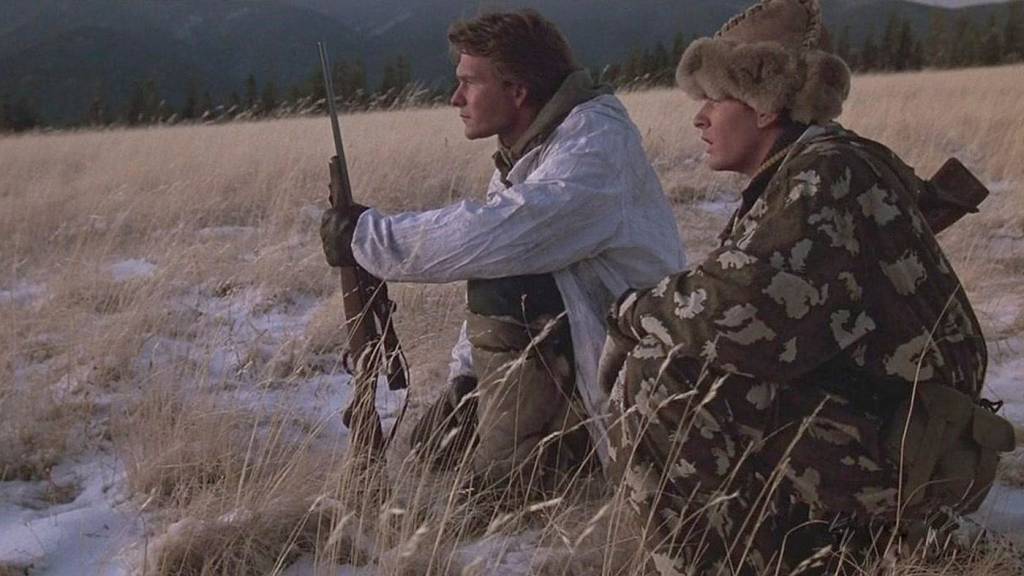
I live in Michigan where it can get pretty cold in the winter. But just a few days ago, the wind chill was registering at -35 degrees, and because so many were forced to run their furnaces non-stop, the entire state was facing a natural gas crisis of catastrophic proportion. The whole scene reminded me of a line in one of my favorite movies as a kid, Red Dawn. During a brief moment of quiet from what has already been a long and exhausting war to take back their home soil from invading forces, the character Matt says to his older brother Jed:

“It’s kind of strange, isn’t it, how the mountains pay us no attention at all? You laugh or you cry, and the wind just keeps on blowing.”

The wind just keeps on blowing.

During those very cold days, while I managed to make it out and around to visit a few folks, I found it necessary to be home with my family to help tend to their needs. During the quiet times, I took the opportunity to do something I’ve been meaning to do for a very long time.

I tackled the ever-piling messages in my email inbox.

I spent an entire afternoon reading through countless email notes, many new and just as many old. I saved some. I deleted most. To be honest, across three accounts, I deleted no less than six hundred or so.

There was one older message I discovered that I decided not to delete—and I don’t think I ever will.

The message I saved was from a dear friend, Lorraine Haas. She sent it on January 26 of 2017, and it was in response to the eNews she’d received the day before. Little did I know that a few weeks later I’d be preaching and presiding at her funeral.

The thing is, Lorraine responded to almost every single eNews message she ever received from me. Had I kept all of her messages throughout the years, I’d have hundreds. And what was common to them all (at least the ones related to what I would initially send to her) is that, firstly, she commented on this or that news item, making sure that I knew that she’d read the entire email; and secondly, by her words, she was sure to have a brightness of commendation for all the great things the Lord was allowing her home congregation to do. She was a perpetual encourager of the Gospel. She knew all of the volunteers and staff were working as hard as they could to accomplish the mission, and with that, she never spoke a negatively critical word.

Well, I should probably rephrase that. She never spoke a negatively critical word by way of an email. In private, face to face, and with a little bit of whisky in our glasses, she more than shared her mind on things. I always knew what mattered to Lorraine. But still, the written word remains for far longer than the spoken word. I’m pretty sure Lorraine knew that, and so whatever she put into print, you could be assured that it would always be an uplifting bit of phraseology meant to make your day better and not worse.

This particular (and unfortunately only remaining) email I kept from Lorraine was very short. I share it with you exactly as I received it. Visiting with it, I know why I’ve kept it sitting in my inbox for so long. It’s only a few sentences long, but it’s a tome of God’s grace.

And the Lord be with You also dear Pastor. May God Bless and Keep You, with Courage and Strength in the coming Day. He loves You, and Me and our Church. His Church! Blessings dear Pastor, and to your dear Family! Lorraine

It’s kind of strange, isn’t it, how the mountains pay us no attention at all? You laugh or you cry, and the wind just keeps on blowing.

Actually, no. The mountains, as sturdy as they are, will pass away. The winds of this world will eventually cease. The laughing and crying of this life will one day be left to the archives of what once was. But the Word of the Lord stands forever. Even now, by way of an email sent by a friend who died years ago, that Word of the Gospel alive in her continues to breathe life into a guy like me—and now into you, too.

It’s as if it reaches to us from the sphere of the divine. In a sense, it does.

Analyzing her sentences, I sometimes wonder if she capitalized words for the same reason I capitalize certain words. I do it in sermons all the time. I tend to capitalize words that are either incredibly important or are in some way an extension of God’s divine work. For example, in a sermon, I always capitalize the letters “d” and “s” in the words “death” and “sin.” I capitalize them because they’re no small thing to us. They’re dreadful powers in this world. If they weren’t, then Jesus’ work on the cross would be less needful to any of us. Equally, I’ll sometimes capitalize words like “redeem” or “love” or “salvation,” especially when they are connected to the person or work of Jesus.

I could be overanalyzing Lorraine’s note, but I wonder if she did the same thing for similar reasons. For example, she capitalized words like “bless” and “keep.” She also emphasized the first letters of “courage” and “strength.” Most interestingly, she capitalized the words “day,” “you,” “me,” and “church.” Why? Well, as peculiar as it may seem, I’d say that each of those words is an offshoot of the vine of Christ. He blesses and keeps us. The courage and strength we need from day to day come from Him alone. And with that, each one of those days belongs to Him. Each one holds the promise of His great love that is carrying you, me, and the whole Church to the Last Day.

With this perspective, go back and read Lorraine’s message one more time. Take it in carefully. I’m sure you’ll get a sense of the ever-living faith that surpasses all understanding, a faith built upon and strengthened for eternal resonation by the powerful Word of God that keeps hearts and minds in Christ Jesus; a Word so powerful that, in fact, not even death can silence it.

Yes, the wind just keeps on blowing. But the war will eventually end. And when it does, when the wind rustles its last leaf, we’ll be gathered into the nearer presence of Christ. In that place, we’ll see all those who’ve died in the faith—all those for whom we’ve shed a tear while the mountains looked on with disinterest and the breezes continued to blow.

I’ll see Lorraine again.

Most importantly, we’ll all see our Lord, the Giver of Life, and it’ll be a face-to-face encounter. Until then, as long as I can help it, I’m never going to delete that email from Lorraine. I’m going to store it away with a few others that are like it that I’ve received from another dearly departed friend, Reverend Dr. Jakob Heckert. As Gospel-driven notes, these messages are far too valuable as divine sources of encouragement to end up in the virtual trash bin.