REVEREND CHRISTOPHER I. THOMA is a husband, father, and Lutheran pastor in Michigan. He is allergic to sharks, has a 4th-degree black belt in Monopoly, is bored by scary movies, and drives a Jeep Wrangler he pretends is the Millennium Falcon.
Unfortunately, I haven’t been holding to my usual practice of posting and ghosting. Usually, I share what I’m thinking and move on, rarely returning to the original post. I did turn off notifications for my last post right after I wrote it, so there’s that. I feel somewhat refreshed. But for others, I’d been reading comments, and in so doing, sensing a black hole form in the galaxy of my willingness to share anything at all. I don’t like that sensation. I’d rather keep sharing, not because I have anything valuable to say, but because for me, writing is a mental illness. Seriously. I have to do it. As I’ve told others, if I don’t, I sometimes feel like my head will split open and spray words on the wall.
I’ve also noted on occasion that there’s a reason for the black hole’s formation and the value of posting and ghosting. No one is truly capable of enduring the scale or flow that the social media firehose can produce. No one is meant to say something and then be instantaneously admired or hated by so many all at once. I suppose the inspiration for what I’m writing right now is an article I just read about the rigors of life in the entertainment business. It certainly seemed interesting, so I scrolled through it. Essentially, the author, a psychiatrist, noted that celebrities—people in the public eye—are more prone to anxiety, depression, bipolar disorders, suicide, and substance abuse. And why? The never-ending media and public scrutiny. They are loved and hated on a mass scale. It seems the ones who survive this are those who can step out on stage, speak, and then leave the stage, ultimately retreating to a well-insulated distance.
In a way, social media gives everyday Joes like us a sense of this. Apart from the fact that it’s a forum where so many rules of normal communication already seem to dissipate into ethereal nothingness, social media gives a sense of broad-reaching importance to anything anyone writes. Social media lets all of us announce our thoughts to the world, as if history itself had been waiting for our exact opinions, typed right there on our phones in a grocery store checkout line. Add to that social media’s instinctual rules. For the most part, nuance is frowned upon. Tribal allegiance matters most. Thoughtful consideration followed by kindly conversation has become heresy. Reactionism is rewarded. And the highest virtue is not being right but being certain that I could never be wrong—preferably in all caps, and while correcting someone who never asked. Or perhaps worse, having direct access to someone through private messaging, demanding an answer to an angry question, neither the response nor the person’s time being something you are owed.
And so, the practice of posting and ghosting is a way of sharing one’s thoughts without being slow-boiled toward defeat by potential vitriol. It also prevents the temptation to knee-jerk in response to the vitriol. In other words—and I speak only for myself when I say it—it’s an act of both self-control and self-preservation in a system primarily designed to fan instantaneous and mass-scale reactionary flames. I believe people can have their moment on stage, speak, and then leave the stage, leaving the crowd to discuss without being harmed in the process. It might not be what readers want from the one posting, but it helps him avoid the black hole, ultimately keeping him around a little bit longer.
Why am I sticking my nose in this? Why do I care about it? Not only because folks are taking time out of their apparently not-so-busy work day to come after me by email now, but because it matters.
What doesn’t matter is what Rob Reiner bemoaningly said about Donald Trump in the past. His name-calling does not matter. It also does not matter what he said about Rush Limbaugh’s death, no matter how cruel. None of those words supply anyone with moral permission to cheer someone’s murder.
But do me a favor and keep reading. Don’t skim. Read, because some are already sensing the urge to object to what I just wrote.
Yes, Reiner’s rhetoric probably helped fuel the kind of violence that got Charlie killed. Yes, words can inflame unstable people, and I have criticized that recklessness for, well, forever. But inherent to my point is that causal responsibility is not moral permission. Cruel or deceitful speech may be blameworthy, but it is never a license for murder. It’s certainly never grounds for celebrating it. And if you cannot discern these things, you are not dealing in moral clarity. You are trapped in an emotional tribalism, and you are a part of the Woke Right.
The Woke Right, just like the Woke Left, can decide that a man’s death is funny, or deserved, or useful, or whatever. But once you cross into that borderland, every protest that follows rings ridiculously hollow—because you’ve already proven that your moral claims only apply when it is your tribe member lying dead on the ground.
Interestingly, someone decided to email me and say something like, “Well, what about being glad about Hitler’s death? What if someone could’ve killed him to stop him? Can we cheer for that?” I’ll respond right here.
Yes, there are such things as stupid questions, and you just asked one. Why is it stupid? Because in this context, your question is an evasive attempt to justify your cheering for Reiner’s murder. How so? Because none of this is even remotely comparable to stopping (or being glad someone stopped) a man like Hitler while he was actively murdering millions. There is a categorical difference between restraining or killing someone in order to halt ongoing mass slaughter and cheering the death of a movie director because you despised what he said about the leader of your tribe. The former is tragic necessity in the face of evil. The latter is moral rot. And conflating the two is either careless and accidental, because you didn’t think it through, or you didn’t know any better, or it’s deliberately dishonest. Whatever the case may be, if you cannot tell the difference between preventing slaughter and celebrating murder, then the problem is not the complexity of the situation. It is your collapsed moral framework.
In the end, it’s pretty simple for me. If my commitment to human dignity evaporates the moment it costs my side something, then it was never a conviction at all. I’m not going to live that way. And that’s how I’m different than the folks coming after me. I don’t care what you’ve said about me. Your life still matters to me, and I’m going to do everything I can to protect it. Not because I like you, but because Christ considered you worthy of every single drop of blood in His holy veins, and I’m on His side.
There are very important moments when leadership is not measured by how loudly we speak, but by how carefully we choose our words. Rob Reiner was verbally cruel to President Trump. He had been for many years. No one argues this. But his and his wife’s rather gruesome deaths required words of reverent sobriety, not mockery.
This really could have been a time for President Trump to shine. Simplicity, or maybe even silence, would have been the wiser course. Of course, silence would’ve prompted backlash, so what’s the harm in a brief acknowledgment of loss? A recognition of grief, even for an outspoken enemy? That’s it. I mean, there is a time to argue, and there is a time to mourn.
I should say that I’ve stood before my congregation on countless occasions and in various contexts and shared the characteristics I appreciate most in people. Two in particular stand out right now. I think the best way to relay the first is to say that leadership isn’t always about how quickly a person responds in the middle of a crisis. It’s about whether the person actually understands the moment requiring a response. That said, the ability to exercise restraint when restraint is hardest—when emotion, and even a long history of provocation, seem to beg for a sharp response. Leadership we can call “good” knows when to tone down and hold back. Even better, I think it takes more guts to lower your voice than to shout one’s apparent vindication. That’s by no means a sign of weakness. It demonstrates strength under control.
Trump made a huge mistake. The moment called for restraint, and he blew it. That leads to another characteristic I admire in people. Those with the ability to admit to a mistake and seek to amend that mistake are the truly courageous among us. They are also the wisest, and I trust them above all others.
If I were advising Trump, I’d tell him an apology here would not weaken him. It would show that even a man accustomed to fighting understands when the fight needs to stop. It would communicate that there are moments when compassion must take precedence over score-settling. That kind of humility is already too rare in public life, which is precisely why it matters right now, and why it would strengthen President Trump, not weaken him.
Again, the strongest people I know can admit to being wrong and say, “I’m sorry.” They own their errors. And they correct course. When they do, they earn my trust rather than lose it. In this particular moment, a sincere apology would not erase what President Trump wrote, but it would demonstrate that he does, in fact, understand the gravity of the moment he first failed to recognize. I’ll pray that someone in his immediate circle encourages him to do this.
I received my fair share of hate mail for what I shared last week about the church in Evanston, Illinois. Even a few business owners from the town reached out to give me a verbal slap. And yet, it is as I’ve said countless times before. Writing for public consumption is risky. And so, be ready to endure what goes with it. Of course, knowing what to expect helps. Most of the messages bore a tired spirit, the kind that only knows accusations like, “You’re a heartless human being,” or “You’re a hypocritical Christian.”
However, I found one email rather interesting. I’ve copied and pasted it here for you.
“With all due respect Mr. Thoma (I will not call you doctor or reverend because you are not) you are just one more fantic [sic] who does what you tell others not to do. You make the bible say things it does not. It does not talk about genders the way you do. It does not say anything at all about abortion. That church can make there [sic] manager [sic] scene say whatever they want. There is no rule to understand it the way you do. And didn’t Jesus say to judge not?”
There’s a lot in that message. It has a lot of the same trite prattling I’ve endured a thousand times before. That said, I’ll admit I have very little interest in responding to most of it, especially the first, third, and fourth concerns in the message. Those are easy. Yes, the Bible does speak rather precisely about gender. No, you cannot make the Gospel and its narratives into whatever you want. Lastly, you just judged me and then said Jesus insisted we not do such things.
But the second concern—that the Bible does not say anything specifically about abortion—is worthy of some attention.
This particular comment exposes a genuine hermeneutical problem—a way of interpreting God’s Word. It holds that if something is not loudly foregrounded in a familiar verse, then the Bible must intend for us to do whatever we want with it. To be fair, many within the prolife camp inadvertently reinforce this misunderstanding. This is where the prolife movement could use some help. What I’m saying is that when confronted by these same arguments, most in the prolife camp go for the low-hanging fruit. We quote Psalm 139, Jeremiah 1, Luke 1—verses about God forming life in the womb, about knowing us before birth, about children leaping for joy beneath a mother’s ribs. To be sure, these are beautiful passages. But they do not yet fully address the challenge posed in the message, which is the claim that the Bible doesn’t say anything specifically about abortion, like, at all.
And yet, the Bible does. Saint Paul himself is the crucial proof here.
A few years back, I spoke at a Right to Life banquet, and I spent most of my presentation dealing with this point. In particular, I focused on a word Saint Paul uses in 1 Corinthians 15. Before I share that word, we need to know the capabilities of the man who used it, not merely as an Apostle, but as a writer who knew the innate power of language and its ability to carry theological freight. In other words, Paul understood how one well-chosen term could do what a thousand explanations could not. And so, when he does this, we are wise to pay attention, being sure not to soften his intent, or to do what we can to explain it away.
First, Paul was fully aware he was writing Scripture (see Galatians 2:1–9). That matters. It means he knew what he wrote was not only inspired but also immutably authoritative. It wasn’t just for his time. It was aimed directly at the saints of every generation, including our own.
Second (and as a writer, I just love Paul for this), he was no dull penman. In fact, whenever I want to show the students in my religion class just how much fun the Scriptures can be, I take them into Saint Paul’s writings. The Holy Spirit’s allowance for a biblical writer’s mind, wit, personality, experiences, and education really shine through with Paul. His epistles breathe with imagery and rhetorical devices. Sometimes he thunders. Sometimes he sings. Sometimes he jokes. Sometimes he pokes with stinging sarcasm. Sometimes he rambles, as if wrestling with himself out loud. He laughs at himself on occasion. Sometimes the Holy Spirit leads him to write some really hard news, leaving him feeling slimy. When that happens, you can almost guarantee you’ll discover a strange doxological sentence afterward, as if he felt the need to take a verbal shower.
Aware of these things, Saint Paul is great fun to read.
But it also enables the reader to see those places where Saint Paul drops plainspoken word-bombs. There is one such place where the word he chooses, one that the prochoice world hopes no one will notice, is meant to rattle the teeth in a reader’s skull.
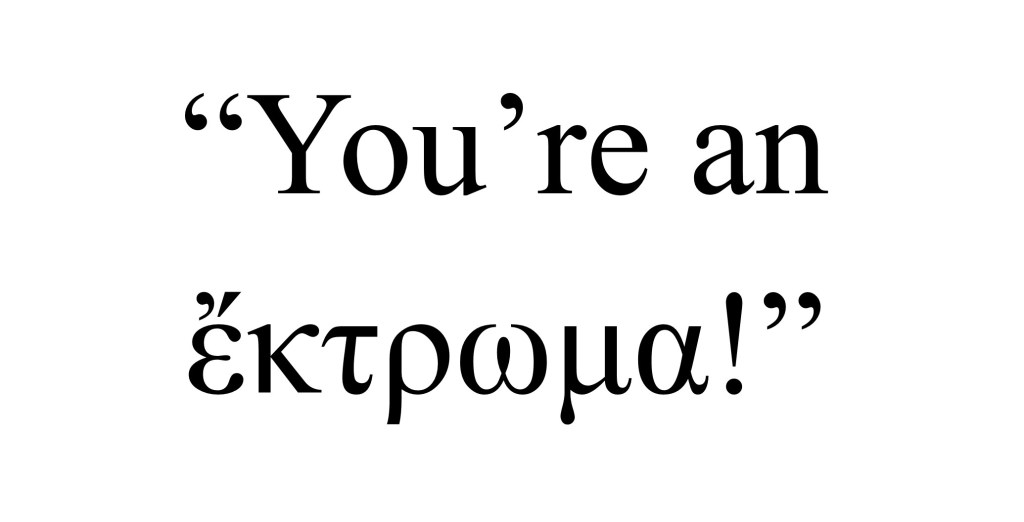
In 1 Corinthians 15:8, Paul describes himself as τῷ ἐκτρώματι. This is typically softened to “one abnormally born” or “untimely born.” Unfortunately, most assume Paul just meant he arrived late to the apostolic party, as if he were the last hired or least deserving. But that’s not at all what the word means.
Admittedly, ἔκτρωμα (ektroma) is a rare word in the New Testament. In fact, this is the only place it appears. But outside of Scripture, it is common enough in Hippocrates, Dioscorides, and other early medical writers. And there it rarely means “one abnormally born” or “untimely born.” It’s the word used for an aborted child—a baby expelled dead, and often deliberately. In other words, this is not just miscarriage or tragic happenstance language. The word includes the idea of killing a baby in the womb.
Now, let your stomach turn a little. I get the sense that’s the response Paul wanted. It’s an ugly comparison. Contextually, Paul is not mildly saying, “I was late to the apostles.” He is calling himself an abortion by comparison—a repulsive example of something terrible, the only thing he could be in his time apart from Christ, before his appointment as an apostle. Now, here’s why I think this matters to the discussion.
Years ago, I read an article in The Telegraph recounting a sermon by Rev. Katherine Ragsdale, then-Dean of the Episcopal Divinity School in Cambridge, Massachusetts. In front of an abortion clinic, Ragsdale said everything in public that the email I shared above implies. She called out from a microphone that the Bible was silent on abortion, and by its silence, a person’s freedom to have or not have one is implied. Stepping from that twisted assumption, she declared that abortion is actually a blessing given by God, and then she invited everyone in the crowd to chant, “Abortion is a blessing and our work is not done!”
Wow.
Of course, Ragsdale is not some persona plucked from modern Christendom’s fringe. Her ideas have actually taken root like invasive weeds throughout the denominational spectrum. I know this, not only because of the email that came my way, but because of the stereotypical points that “prochoice Christians” lean on to support their ungodly position. It’s a common defense to say that the Bible doesn’t even mention abortion, and since that’s true, it belongs in the category of adiaphora—something neither commanded nor forbidden by God’s Word. Furthermore, if something is neither commanded nor forbidden, we are free to do with it as we’d prefer—maybe even consider it a blessing.
Well, unfortunately for them, the Bible does mention abortion explicitly and by name—ἔκτρωμα. And by the way, I should add that it’s the theology of toddlers and thieves to shove genuine ungodliness into adiaphora’s category. I don’t care what the topic is. Besides, it is irrational to think that if any source, let alone the Bible, uses a word as an insult, the concept attached to that word could ever be considered good. Paul did not call himself a hug or a sunrise. He called himself an abortion—a grotesque image meant to reveal what sin makes of us, and what God has every right to do to us as children. In our sin, we deserve death before we even take our first breath. Grammatically, if abortion is used in this way to portray humanity’s depravity, then for Christians to call it a blessing or declare it holy is to declare altar fellowship with Molech.
The Church must know and understand this. And she must be ready to say it without stuttering. No, abortion is not a blessing. It is an abomination. It always has been, and it always will be. The Bible specifically refers to abortion as something dreadful. If your Bible translation calls it holy, go bury it somewhere. If your pastor calls it a blessing, well, don’t bury him, tempting as the thought may be. Instead, confront him and demand repentance. If he refuses, leave. Find a church that still believes the Word means what it says
Did you happen to see the article from Breitbart last week describing how a Christian (and I use the term loosely) congregation in Evanston, Illinois, put out a rather provocative nativity scene? My friend, Bob, sent it to me. I’m glad he did. Essentially, the church is displaying an infant Jesus bound with zip ties. Mary and Joseph are wearing gas masks. Roman soldiers are depicted as modern-day ICE agents, wearing insignia vests and all.
The first thing I’ll say is that it sure seems tempting for some to turn sacred things into public spectacles, especially in a culture that not only enjoys but rewards sensationalism. For those who know where I stand on worship styles, that’s really what sits at the heart of my beef with contemporary worship. I just can’t get past the anthropocentric exhibitionist nature of it all. Why would any of us need Hollywood theatrics to “encounter” the Lord? Why strain so hard to manufacture emotion when we know, by faith, that Christ Himself is truly present by His visible and verbal Word to deliver forgiveness, life, and salvation? But even as contemporary worship teeters on the edge of spectacle, I’m willing to admit that most who prefer it still at least want to tell the Lord’s story. They’re reaching, even if thinly, for Christ.
The church in Evanston, not so much. Their goal isn’t proclamation. It’s provocation. It is to deliberately exchange the holy mystery of Christ’s birth with a political message that the Christmas narrative was never meant to carry. And not just a little exchange. But a complete conversion into the ridiculous. The entire goal is to fashion Jesus’s birth into a statement about immigration. That’s it, and nothing more.
Ultimately, the heart of the Christmas narrative is that God became Man, thus the longstanding practice of reading John 1:1-14 as the appointed Gospel text for Christmas Day. The birth of Jesus Christ is not an allegory. It’s not a political metaphor. It’s not a social-justice image. It’s an all-encompassing historical and spiritual reality. Not one single inch of it is a backdrop for the progressive silliness we’re seeing in Evanston, Illinois. It’s the humble cradle of the One who became as us, that He might take our place in judgment (Isaiah 53:4-6; 2 Corinthians 5:21), and win for us eternal life (John 3:16). All of its themes and sub-themes circle this truth.
By the way, I think the response to this nonsense by some in the Church has been too kind. I saw a note on a Facebook post calling it an “unfortunate demonstration done in poor taste.” It is not poor taste. It is unbridled sacrilege.
But here’s the real catch. The display’s orchestrators claim we ought not miss the parallels between the Holy Family’s escape to Egypt and the plight of modern immigrants. However, any objective person, even one who spends only a minute or two on the Christmas narrative, will see this as a gross oversimplification and, ultimately, a distortion. The flight into Egypt was not a matter of contemporary geopolitics or border enforcement. It had nothing to do with social justice policy. It was divine choreography. It was the unfolding of God’s redemptive plan. To equate that salvific narrative with today’s immigration debates is to cram sacred things into the mold of secular activism, ultimately betraying progressive Christianity’s real geist.
Progressive Christianity is not interested in who Jesus is and what He’s done, except to convert Him into a mascot when convenient—or a moral illustration helpful only insofar as He endorses the activist agenda. Progressivism does not proclaim Christ crucified for sinners (1 Corinthians 1:23). It can’t. The theologies of sin and grace would undermine the Marxist premise that some are inherently unforgivable and some are inherently oppressed by those same unforgivables. Straying too far from that premise risks a finger pointing back in the direction of progressivism’s false “righteousness.” Jesus is a much safer Christ when He can be conscripted for slogans. And so, they do. And they do it for everything.
So keep digging. Read, don’t skim. The Breitbart article’s author was right. Their public “covenant” omits the Trinity, the divinity of Christ, His atoning death, and salvation by grace through faith.
Aware of these things, this ungodly nativity scene makes a little more sense. Not to mention, the omissions can be understood rightly. They aren’t incidental. They are foundational. Once the person and work of Jesus Christ cease to be central, the Gospel becomes malleable. And if the Gospel is malleable, it can be reshaped into any form that suits the latest progressive cause. You name it, and Jesus is a social warrior for it. Immigration, BLM, gender fluidity, and the list goes on.
But now, before I say anything else, I should circle back around to something I said already.
You can pretty much count on the progressive churches this time of year to roll out the ol’ “Jesus was a refugee” campaign. Unfortunately, many folks fall for it. That’s because it sounds compassionate on the surface. It’s also because people are biblically illiterate. It trades on half-remembered Sunday School summaries rather than what the Scriptures actually say. But once you step past the slogan and back into the sacred text, the whole construct collapses. A person can see that biblically, historically, and most importantly, theologically, the refugee narrative simply does not fit into the Christmas story. And the only way to bring them into stride is to do some serious rewriting.
First of all, the Holy Family’s escape was not an immigration crisis. It was, as I already said, divine choreography. Mary, Joseph, and the infant Jesus fled to Egypt because God commanded it through an angel (Matthew 2:13). They also returned because God commanded it through an angel (Matthew 2:19-20). Their escape was not a search for asylum. It wasn’t a reaction to immigration laws. It wasn’t a political protest. It was God preserving the Messiah so that He could accomplish His appointed work (Galatians 4:4-5). What we’re watching in the Christmas narrative is redemptive history, not social justice rhetoric.
Second, Egypt was not a foreign nation in the modern political sense. The first-century world wasn’t divided into modern nation-states. Egypt and Judea were both under Roman rule. There were no checkpoints or passports. There were no visas or asylum protocols. The Holy Family’s movement was absolutely nothing like border migration. It was, quite simply, movement within a unified structure, and about the only noticeable differences were the regional variations. In fact, it would be more honest to compare it to moving from one state in the U.S to another.
Third, the Holy Family was not homeless or destitute. Progressives love to depict them this way. But God’s Word doesn’t do that. After the Magi arrived bearing their gifts of gold, frankincense, and myrrh (Matthew 2:11), Joseph and Mary went into Egypt with some significant financial means. And don’t forget that Joseph is described as a τέκτονος (Matthew 13:55), which is a word that’s often translated as “carpenter,” but can also indicate a craftsman who works as a builder with various materials. In other words, Jesus’s adoptive father was a skilled tradesman. Those were in demand everywhere in the first century. Joseph was more than able to provide for his little family, which is to say our beloved Savior and His family were not impoverished migrants trying to survive. They were a well-cared-for, God-guided family under divine protection.
And it was all in place for one purpose: to preserve the Messiah.
Christ was spared from Herod so that He could die for the sins of the world at the appointed hour (John 10:17-18). This is the epicenter of the escape narrative, and to recast it as commentary on modern immigration is to betray no small ignorance of salvation history’s details and eventual arc.
But again, what should we expect from these goofy activist churches?
That said, I should warn you against the churches on the other side of the political aisle in this regard, too. Indeed, ours is a nation undeniably shaped by Christian principles, and for that we should give thanks. Patriotism, rightly ordered, is a gift—an expression of gratitude for rights we don’t deserve and didn’t earn, and yet God gave. With that, we rejoice in this nation because it’s free. Ironically, even as progressive ideologues are forever trying to silence conservative bible-believing churches, these same Bible-believing churches rejoice in religious liberty—the same principle that guarantees the sleazy progressive churches the freedom to hang LGBTQ, Inc. flags and put up activist nativity scenes.
Still, we have to be clear and consistent. The faithful churches must guard against any and all tendencies to allow anything to eclipse the Gospel (1 Corinthians 2:2). We must maintain that the Church’s calling is higher, older, and holier than any one nation’s story, even when we’re considering America’s uniquely Christological heritage. We’re glad for it. We rejoice in it. We do everything we can to prevent it from slipping into forgotten history. But it’s not the primary message of our lives in Christ. It’s a piece of who we are, not the thrust of our Christian identity (Philippians 3:20).
Now, again, don’t misunderstand me. (Of course, those who know me best won’t do such a thing.) We can and should talk about political things from the pulpit. In fact, I wrote a book that Fidelis Publishing is set to release in February, entitled Christ Before Caesar: Faithful Public Witness in an Age of Retreat. I more than mention throughout the importance of pastors concerning themselves with these things, if only because, just as Abraham Kuyper, the late nineteenth-century pastor and Prime Minister of the Netherlands, so rightly said: “There is not one square inch in the whole domain of our human existence over which Christ, who is Lord, does not cry ‘Mine!’” But I do this mindful that I am to preach the Word of God, and nothing is to get more airtime or airspace in the pulpit than the Gospel. In the churches that give more to politics than Christ, even the conservative ones, I dare say Christ is just as absent in the preaching there as He is in the Evanston church’s nativity scene.
The Church must preach a Christ unshadowed by any agenda—One whose kingdom is not of this world (John 18:36), yet who rules this world all the same for the good of His people (Ephesians 1:22-23).
In the end, that’s a key indicator of what separates the real Church from every cheap imitation of it. The world can dress Jesus in zip ties or put Him on an eagle’s back with a flag in His hand. It can drag Him into its activism, shrink Him into a mascot, or draft Him into its political crusades. But the real Christ didn’t take on flesh to validate movements. He came to save sinners (1 Timothy 1:15).
Full stop. The Church’s task is also not to improve the Lord’s image or update His mission. It is to be faithful to His Word. It is to proclaim the Gospel—what He’s done, is doing, and will continue to do for sinners relative to their dreadful predicament in judgment (Hebrews 13:8). Knowing this, we can strip away the theatrics. When we do, we’ll see Jesus there—the Holy Child in the manger, the Man on the cross, the Lord at the empty tomb. That Jesus—unrevised and unshadowed—is the only One who gives life (John 11:25). And if a church cannot preach that Christ purely and without alteration, it is not a church at all (Revelation 2:4-5).
If you’re about to crack open my new book Ashes To Ashes, but you’re doing so with Angel Studios or The Hallmark Channel in your head, do yourself a favor—close the book and walk away. There’s no soft lighting here, no mushy spirituality. This is humanity after dark.
It’s the story of a man—a Lutheran pastor—who’s tired of watching the world’s worst slip by untouched. And so, he’s done waiting for anything, including permission… from anyone. What follows is brutal consequence in literary form.
Again, this is no cocoa-by-the-fire Christian fiction. It doesn’t hold hands with anyone. Not at all. It grabs you by the throat and drags you across the line alongside an unexpected anti-hero, a man unlike any you’ve known. And along the way, you’ll find yourself praying that both of you find a way back.
A quick thought before I go about my Wednesday, which is my busiest day of the week.
I’ve long said that writing for public consumption is not for the faint of heart. The moment you set your words before the world, you expose yourself. Your thoughts, your convictions, your attempts at clarity or humor—all of it sits out in the open where anyone can take a swing. And they do. It doesn’t matter whether what you said was good, measured, or even kind. There will always be someone waiting in the tall grass, eager to pounce.
That’s the risk of writing publicly, especially in the 21st century. You’re stepping into an incredibly reactionary arena where opinions and skimmed half-knowledge are razor blades—light enough to be waved around carelessly and sharp enough to leave marks. And yet, in that same noisy world, there are other readers. They’re not holding razors. They’re holding gratitude. And their responses remind you that for every pounce-ready critic in the weeds, there’s someone quietly thankful you dared to say something at all.
I suppose this is why I commend all who take the time to think, to write, and to share. It truly takes guts to wander out into such a landscape. Anyone can whisper ideas toward their computer screen. Venting where no one can push back is easy. But to take the time to craft one’s words, share those ideas, and then stand back while the world reacts—that’s something else entirely.
It’s the strange courage of any writer throughout history, talented or not-so-talented, to put one’s mind to work with language, all the while knowing the critique will come, knowing the ambush is inevitable. And still, they write and share anyway.
We conservatives love to grumble about the indoctrination of children. I know I do. And why wouldn’t I? Every other week, there’s another headline about this dreadful thing and that horrible thing happening in a classroom somewhere, followed by another outraged post or podcast about how schools these days are poisoning our children.
Trust me, I get it. I’m frustrated, too. It’s why I do everything in my power to serve and maintain our tuition-free Christian school here at Our Savior in Hartland. I figure that apart from caring for my own family, the best way that I can help is to provide an alternative for the community—and not just a substitute, but something truly exceptional that puts Christ and His Word front and center as the chief interpreter to all that we are and will ever be.
That said, there remains an uncomfortable truth that everyone else out there is afraid to say out loud. Public schools are shaping our children because parents stopped doing it first.
We wring our hands over what the public schools are teaching about sexuality, identity, history, morality, or whatever. But the average Christian home spends more time watching Netflix in one evening than it does talking or teaching about Christ in a year. We shout at the school board about why our children are disrespectful, but the school didn’t raise them. We did, along with that glowing rectangle that’s been in their hands since they were two years old.
There’s a vacuum. The world is only doing what the world does to fill it. That’s not hard to see. Still, we take some strange comfort in blaming a system that’s true to its nature rather than taking a long, hard look at the parent in the mirror. We let the world form our children. And why? I think it’s because we’ve forgotten how. Or perhaps worse, we’ve decided we shouldn’t have to. Moral formation has become a subcontracted task—outsourced first to the church (if we have time to attend one). But for the most part, we leave it to whoever stands in front of the classroom—or the most popular TikTok influencer. And when the results disappoint us, we demand reform.
How about parental repentance first?
I just read a study saying that American parents, on average, will spend ten hours a week driving their kids to sports, at least four hours scrolling social media, and maybe—just maybe—a minute or two discussing what they learned at church—again, if they even go, because only around 22% of Americans attend church weekly. Only 33% attend at least monthly.
I think the truth in all of this is really pretty simple. You cannot demand values you yourself have never been willing to establish and maintain. You cannot expect anyone or anything to build character on a foundation you never laid.
I began this rant talking about public education. If you haven’t figured it out, that was just the lead-in to my frustration. Although, don’t get me wrong. I’m not excusing the failures of public education. It’s a hellscape of dreadfulness in many paces, filled with ideologies that are sending our children into moral and conceptual death spirals that many simply cannot escape. But that’s mostly because they cannot navigate it. Ultimately, that translates into any parental outrage without serious self-examination being nothing more than self-deception.
So, how about this… Before you get an itch in your craw to do all you can to tear down a Marxist curriculum, how about you also work on rebuilding the family dinner table? Before you demand traditional moral character formation in the classroom, how about you monitor the morality of your own mouth and behavior in the living room? Using the F-word in front of the kids, if ever at all, is not good parenting. Sorry to have to break this to you.
And so, before you go off to fight for your kids’ souls in a public forum, how about shepherding those souls at home? If we want a different outcome, we need different parents. Period. It’s not just that the schools stopped teaching our values. It’s that we stopped teaching them first.
I would usually sleep on the cot in my office at the church on a snow-laden day like today. But not this time. I slept in my own bed at home last night.
For one, I prefer to make sure everything remains in good working order throughout the night, namely, that the heat and power continue uninterrupted. I also prefer not to be the only one out on the unplowed roads at 4:00 in the morning. And that’s precisely what they were on the way in. As the years go by, it seems less thought is given to the churches—to the fact that God’s people are still gathering, still trying to make their way to worship. I get the sense that Sunday morning simply isn’t factored into anyone’s plans anymore, certainly not the folks deciding what gets plowed first.
Still, in all of Our Savior Evangelical Lutheran Church in Hartland, Michigan’s 70 years, we’ve never canceled a service. Not once. And it certainly isn’t going to happen on my watch. So, rest assured, the lights are bright. The heat is on. The Lord’s gifts of Word and Sacrament will be given, no matter how many gather to receive them.
The holy season of Advent begins today. That means Christmas is coming. And yet, last weekend at an event anticipating Christmas—a Christmas tree-lighting ceremony in downtown Chicago—shots rang out, resulting in one dead and eight seriously wounded. That same night, in Concord, North Carolina, another tree-lighting ended in gunfire. Four were shot. Three of the victims are still in critical condition.
Violence in Chicago is a pretty standard thing. It’s one of the most dangerous cities in America. Concord, North Carolina, not so much. In fact, it ranks among the safest cities in America. Safe or not-so-safe, what makes all of this stand out is the setting. Although Christmas trees no longer mean to most what they’re supposed to mean. The whole point of a Christmas tree is Jesus—or at least it used to be, way back when Christian communities looked to the evergreen as a reminder of life in Christ during winter’s deathly season. But now, it’s little more than a seasonal prop stripped entirely of its sacred center. Still, public tree-lighting ceremonies continue to be celebratory opportunities, and if anything, a warm assumption of community. That’s nice. But it obviously isn’t enough. Not when dreadfulness suddenly intrudes. And in the end, that may be the most sobering point of all. Whether you live in a city known for violence or one praised for its safety, dreadfulness always finds a way in. And then what? I only ask this question having read some of the words from victims’ families, which I’ll get to in a moment.
In the meantime, I’ll simply say that sin can and will fracture anything devoid of Christ. When Christ is removed, wherever He once was is instantly hollow. An empty object is a fragile object. It certainly has no power to restrain real darkness. But that’s because Christ is missing, and He’s the only One who can carry us through times of need. In this sense, last weekend’s violence during the Christmas tree-lighting ceremonies served as a kind of grotesque sermon, reminding all of us how Christological substance is desperately needed in our lives, and how humanity just cannot manufacture it, not even through seasonal civic ceremonies that look and feel nice but in truth are entirely devoid of real meaning. This brings me back to Advent.
For the churches that observe Advent—and I mean, actually observe it—we know the centuries-old pre-Christmas season is by no means hollow. We know its language and sense. It’s a penitential time, one that acknowledges sin’s dreadful grip. And yet, Advent stakes a firm claim in hope as it simultaneously looks backward to the Rescuer who came at Christmas, and also forward to that same Rescuer’s promised return at the end of days. As we Confessional Lutherans tend to say, it’s the kind of hope that knows the fullness of God’s promises in the “right now” but also the “not yet,” all at the same time.
This weird tension is essential to Advent. It names sin honestly. It knows the situation is dire and, therefore, refuses to minimize the brokenness responsible for the violence we saw last weekend. But it does this while anchored in what Christ has done, is doing now, and will continue to do. That’s Christian hope. Christian hope is not some hollow form of vague optimism. That’s what happens at civic tree-lighting ceremonies. Advent’s longing is a deliberate, time-spanning trust that the same Savior who entered history will keep His promises, one of which is to return to set everything right. That makes Advent far more than a season that’s waiting for Christmas, but one filled with holy confidence rooted in history, promise, and unquestionable fulfillment.
That’s a place where only Christians can live.
By the way, this is not a claim of moral superiority. It’s one of theological location. To live in the “right now but not yet” requires faith. Only those who have heard God’s promise in Christ and, by the power of the Holy Spirit, believe, can stand in the middle of that tension without being crushed by it. It is a narrow place. But in its narrowness, there’s a freedom the world cannot replicate. It tries. But it just can’t do it.
Remember, Christians started all this decorating stuff. We decorated evergreens, lit candles, and hung lights. We sang ancient hymns that communicated the Gospel’s backward and forward perspective. We still do it. The world has similar traditions this time of year. It decorates evergreens, puts up light displays, and sings its holiday songs. But between the two spheres is a strict separation. Buffeted only by the world’s empty décor, culture’s residents experience what happened in Chicago and North Carolina, and suddenly, their holiday is tainted with despair. I read an interview with one of the Chicago victim’s family members. The woman being interviewed said she may never celebrate Christmas again. Essentially, the memory is too terrible, and now the holiday is, too.
I get how that could be true, especially when your only framework is a sentimental, once-a-year version of joy tied to things that can be ripped away at any moment. When that’s the case, then any tragedy is enough to make every twinkling light or holiday tune feel forever poisoned.
But from the Christian perspective, with Advent’s Gospel in mind and heart, we light candles and hang lights, not to deny the darkness, and not even because the darkness might be scary. We know it is. But we also have no intention of granting the darkness final authority. We keep singing our joy-filled hymns, not necessarily to cope, as though we’re in some starry-eyed form of denial, but as an act of genuine defiance against sin, death, and the devil. We sing because the Gospel has the upper hand, not the darkness, and we know it. And so, we are perpetually hopeful.
I guess one thing I’m saying is that Christian rituals like these, no matter how the world might twist or imitate them, will forever be Christian property. We own them. And because we know better, they’ll always be acts of resistance rather than seasonal sentiment. The evergreen—a plant that keeps its green even when all life around it has come to a frozen halt—for Christians, it’s a visible confession that death does not have the final word. A candle is not mere ambiance for us. It’s a proclamation that Light has entered the world and cannot be overcome. The hymns are not background music, but instead longstanding confessions of the one true faith that has survived the worst this world could throw at it. In fact, the chief hymn appointed for the First Sunday in Advent is proof alone. “Savior of the Nations, Come” was written by Ambrose of Milan. He lived from 340 to 397. And still, here we are, age after age of dreadful violence and persecution, and we’re still singing this great hymn of incredible hope, one that tells the entire Gospel story in eight beautiful stanzas.
This is proof that we own Advent and Christmas.
And so, while the world scrambles to make sense of yet another demonstration of human awfulness, the Church stands where it has always stood at this time—right in the middle of human ruin, all the while holding tightly to God’s promises. We stand there unshaken, proclaiming that this world’s terrors cannot overcome us. The Light of the World has come and is coming again. We know that everything around us is temporary, yet the forthcoming King and His kingdom are eternal. That divine knowledge shapes the entirety of our reality. And that’s that.
Indeed, the world is experiencing a sentimental countdown to a holiday. But that’s not us. Christians continue taking to a sacred battlefield, knowing the ultimate victory has already been accomplished and that the final victory is at hand. And the churches that observe Advent—and I mean, actually observe it—their senses are being honed to this truth.
Once again, I refuse to let this country’s National Day of Thanksgiving pass by without saying something about it. Indeed, it is precious.
I know some among the clergy ranks see it as negligible. I certainly don’t. This is why Our Savior Evangelical Lutheran Church in Hartland, Michigan, is open for worship on Thanksgiving Day. Not Thanksgiving Eve, but on the very day. Sure, it’s inconvenient for some. There are turkeys to baste, pies to prepare, green bean casseroles to bake, football teams to cheer along, and parades to watch.
Well, whatever.
All those things are a combination of both required and elected responsibilities. And if I’m being honest, they’re really no different than the everyday activities that distract far too many on far too many Sundays throughout the rest of the year. In that sense, while Thanksgiving Day is meant to be different, it really isn’t. I say this assuming that, for you, as it is for me, life is already very loud. Things crowd the calendar. Responsibilities pile up. Family tensions simmer. No matter the scene, life’s wheels keep turning.
But then, suddenly, there it is on the horizon—a special day, one that our nation has set aside—and its whole point is to stop, take a break, and give thanks.
As a pastor, I have to ask on this day, “Why wouldn’t Christians be first moved to give thanks where thanks is actually due?”
I suppose one answer to my question might be, “Well, because even Christians wrestle with their sinful nature.” As I already hinted, gratitude isn’t natural to humanity in general. We’re creatures quick to notice what’s missing but incredibly slow to acknowledge what’s been given. Complaining is easy for us. It actually takes effort to give thanks.
And yet, God’s Word cuts through our excuses with the simple command to “give thanks in all circumstances” (1 Thessalonians 5:18). Not when it’s convenient. Not when everything aligns. But in all things.
I think the word we stumble over most is “all.” The word includes loss. It includes disappointment. It includes the empty chair at the table this year. It includes the prayers that still haven’t been answered the way we hoped. And somehow, in the middle of all these things, God still says to His people, “Give thanks.”
Why? Well, here’s where the world could learn a thing or two from the Christians who make Thanksgiving Day worship a priority.
For Christians, thanksgiving isn’t a denial of life’s very real challenges. For us, in a way, it’s defiance. It’s the otherworldly ability to look straight at the broken pieces of this mortal sphere and insist God is still good. By the power of the Holy Spirit for faith in Jesus, to be thankful, even when things aren’t so good, is to remember that every breath we take is already borrowed. Every blessing is already undeserved. Every single sunrise is a generous gift—a beaming reminder that God’s mercy is new each and every day, even for the stubborn and the weary and, yes, the thankless.
And so, Christians do well to embrace that one day the world actually got right, even if it doesn’t understand its truest significance.
Society has established a day for thanksgiving, a day that provides most, if not all, an opportunity to slip away from life’s busyness, no matter what that looks like or means to those who observe it. Christians have a unique perspective on this opportunity. We know first to gather and to acknowledge the One who holds everything together. That’s really the best byproduct of this day. It’s a moment carved out of the noise to remember that gratitude isn’t a feeling. It’s a confession of something true. The holiday itself is a sneaky opportunity, a countercultural decision to lift our eyes and say, “Thank You, Lord, not because life is perfect, but because Your love is. And in You, I’ll always have everything I need.”
So go ahead and enjoy the food, the family, the football, and whatever else the day brings. But allow me to encourage you to let those things assume their rightful place in line behind the far greater truth that anchors it all—which is that the Lord has given us Himself, and in Him we have more than enough reason not only to seize the day for all that it offers, but to maybe even learn from it to give thanks to the Lord every day.
With that, if you’re nearby and your church isn’t offering a service, feel free to join us here at Our Savior in Hartland. The Divine Service begins at 10:00 AM.









 Cruciform Stuff