Unknown's avatar

About AngelsPortion

REVEREND CHRISTOPHER I. THOMA is a husband, father, and Lutheran pastor in Michigan. He is allergic to sharks, has a 4th-degree black belt in Monopoly, is bored by scary movies, and drives a Jeep Wrangler he pretends is the Millennium Falcon.

Do Not Disbelieve

I’ve said it before, and I’ll repeat it: when I get to heaven, after reconnecting with my brother, Michael, I want to meet the disciple, Thomas. The people here at Our Savior in Hartland know I think that of all the apostles, he seems to get a bad rap. That being true, there are some things I want to ask him.

Before actually asking any questions, I’d probably commend him first. After the Lord’s resurrection, he really was the only one demanding the evidence the Lord had already promised would be given (Matthew 16:21). In other words, he demanded to see a living Savior who’d recently been crucified. Once again, that’s what Jesus said on multiple occasions they’d see—a formerly dead Jesus now very much alive, wounds and all (Luke 9:22, 24:7; Matthew 17:9,23; 20:19, 26:32; John 10:17, 20:9). Even the angel at the tomb affirmed this, telling the women that Jesus had gone ahead of them into Galilee and that they’d see Him just as He said they would (Matthew 28:7).

Knowing this to be an essential part of the Lord’s regular teaching to His disciples, I suppose I’d ask Thomas what he was thinking when he refused to accept the other disciples’ message. Was he actually doubting, or was he simply unwilling to accept anything other than Jesus’ own words? Of course, Jesus somewhat answers the question when He eventually visits with Thomas in the upper room after the resurrection. It’s there He encourages him, “Put your finger here, and see my hands; and put out your hand, and place it in my side. Do not disbelieve, but believe” (John 20:27).

“Do not disbelieve….”

There’s something in that phrase. In Greek, the Lord’s words are, “μὴ γίνου ἄπιστος”—do not right now become unbelieving. This is to say, “You’re heading in that direction. Don’t go any further.” Personally, that’s all the wiggle room I need for saying Thomas was not underwater in doubt. Moreover, he certainly doesn’t deserve the unfortunate (and absolutist) title “Doubting Thomas.” He had faith. It was just wobbly.

A scene like this isn’t unfamiliar to any of us. Jesus spoke similarly to the terrified disciples during the storm on the sea in Matthew 8:26. He said, “Why are you afraid, O you of little faith?” Again, His words are precise. In Greek, He calls the disciples “ὀλιγόπιστοι”—little faiths. Each of the disciples had faith. But their faiths were just beginning to sprout. They were little. How much faith does one need to be saved? Jesus has already said multiple times that whoever believes will be saved. In these scenarios, perhaps one of the lessons we learn is that focusing on quantity has the potential to be distracting. Again, did they have it or not? Yes, they did. They likely wouldn’t have slipped and slid across the boat to wake the sleeping Jesus for rescue if they didn’t. But they did go to Him. They went to the One they somehow knew could save them. The same goes for Thomas. For whatever human reasons may have been involved, he was back among the disciples (even though it didn’t make much sense to be there), fiercely demanding what Jesus had already promised. These are clues. Jacob did a similar thing in Genesis 32:22-32. He wrestled with God, demanding a blessing before he’d let God go. The Canaanite woman in Matthew 15:21-28 did, too. She nagged and pestered until the seemingly cold Jesus finally relented in the test. These people had faith. Large or small, they were moved to hold God to His promises.

In a way, by demanding the signs, Thomas was doing the same. But still, it goes deeper.

I think faith was more than stirring in Thomas because, by his words and actions, he forced out into the open the Church’s confession that Jesus had risen in bodily form. In other words, for Thomas, it would be one or the other. Jesus was either fully dead in the body or fully alive in the body. As He couldn’t be both, He also couldn’t land in between. He couldn’t be a ghost. He couldn’t have risen only in a spiritual sense. That’s not what Jesus promised. The resurrection would be physical.

Having nowhere near the disciples’ specificity concerning the resurrection, even the Pharisees understood this. For the record, the Lord never once said in the Pharisees’ presence that He’d die and rise again in the flesh. But He did say, “Destroy this temple, and in three days I will raise it up” (John 2:19). This was to affirm that they’d kill Him, and yet, He would rise from death three days later. After the Lord’s burial, the Pharisees and Teachers of the Law revealed they knew what He meant. They demanded that Pontius Pilate place guards at the tomb, saying, “Sir, we remember how that impostor said, while he was still alive, ‘After three days I will rise.’ Therefore, order the tomb to be made secure until the third day, lest his disciples go and steal him away and tell the people, ‘He has risen from the dead,’ and the last fraud will be worse than the first” (Matthew 27:63-64). Why a guard? Again, to stop a bodily resurrection. Genuine or fraudulent, that would exist at the heart of the Christian Gospel.

Even the Lord’s enemies knew it could only be one or the other.

So, what’s the difference between Thomas and the Lord’s enemies? Faith. Jesus kept His promise and visited Thomas. The disciple declared, “My Lord and my God!” (John 20:28). Even after countless eyewitness accounts, the Lord’s enemies denied Him, doing all they could to kill the message and the messengers. That’s hardened unbelief. That’s real doubt.

Today the Church retells the Lord’s resurrection, and as it does, it includes Thomas’ important role. As you listen, go easy on him. Remember, he’s a believer like you and me. Times get tough. Things get confusing. We find ourselves calling out things like, “Why are you allowing this to happen?! How can you claim to love me?!” Still, we’re calling out, right? And to whom? The only One who can hear and save us. With that, follow Thomas’ lead. Look for the wounds of Christ. Look to the cross. See the Lord’s passionate display. Look there and, as the Lord said, do not right now become unbelieving. Be empowered to go no further in that direction. And then remember, He actually had you in mind when He said to Thomas, “Have you believed because you have seen me? Blessed are those who have not seen and yet have believed” (John 20:29).

That’s you He’s talking about. That’s me, too. We were on His mind. And He called us blessed. His blessed ones are His believers. Big or little faith, believers go to the One with the gifts that strengthen faith. That One is Jesus.

Death Could Not Hold Him

Alleluia, Christ is risen!

We offer plenty of cheerful statements at various times and for multiple reasons. “Happy birthday” is one. We say that year after year as we recognize the passage of another twelve months in a person’s life. “Congratulations” is another. We’ll use that word for many reasons, never just one thing. We’ll offer it if a person lands a new job, gets engaged, wins at bingo, or any other significant or insignificant occasion.

But then there’s, “Alleluia, Christ is risen!” No other declarative assertion in history compares, and only one event can claim it.

Jesus of Nazareth, the One mocked and physically abused into gross malfiguration, and then spiked to a cross until His body could take no more, He met with the last enemy, Death (1 Corinthians 15:26). And yet, He is beautifully, brilliantly, wonderfully alive! “He has risen,” the angel told the women visiting His tomb, “he is not here. See the place where they laid him” (Mark 16:6).

It’s likely they looked. But they didn’t need to. They already knew the scene well—the terribly dreary place palled by Death’s sights, sounds, and smells. They were sitting across from the tomb’s entrance watching Nicodemus and Joseph of Arimathea take the Lord’s limp body—battered, hemorrhaging, and likely beginning to stiffen—and wrap it in a linen shroud and place it inside (Luke 23:55). The women saw the Lord’s end—His brutally gruesome end. How could anyone survive such a thing?

They don’t survive it. No one does. Even in Jesus’ case, Death came, bit down hard, and then carried Him away.

At least, Death thought it had a hold on Him.

To call out, “Alleluia, Christ is risen!” is to know that at one particular moment on the timeline, somewhere out of sight, and sometime between Good Friday and Easter Sunday, a cosmic encounter ensued. Death’s trophy opened His eyes and took back His own life (John 10:18). Having never lost His divine authority over all things but only hidden it, He enacted His ambush. He pushed apart Death’s jaws, and in between its now fully realized predicament noted by terrified whimpers, took to His feet. And in the next few moments, as His body was restored, keeping only the scars from the nails and spear (for our sake), He leaned into Death and made it His trophy.

Jesus accomplished and forever sealed the death of eternal Death.

Calling out “Alleluia, Christ is risen!” is so much more than “Happy birthday” or “Congratulations” ever will be. It’s a phrase that genuinely meets with every single moment of life—from one’s birth to one’s final breath. Easter, a singular event, celebrates the defanging and ridding of humanity’s last enemy, the one residing at the center of all human fear: Death. Death has forever lost its power. There is no longer any reason for hopeless concern in this life, no matter how challenging life may be or what the devil or the world might bring our way. Jesus defeated such concern’s master. All who believe this—those who cling by faith to Jesus and His sacrifice on the cross—receive the merits of the same conquering Christ.

And what are these merits?

The forgiveness of sins. And, of course, where there is the forgiveness of sins, there is also life—eternal life—and salvation (John 3:16-17 and 6:40, Hebrews 10:10, 1 Peter 2:24, Matthew 26:28, 1 John 1:7, and so many others).

Indeed, alleluia, Christ is risen! May God continue to bless you by the power of the Holy Spirit for faith in Jesus. May He keep you enveloped by Easter Day throughout every moment of every day.

Good Friday, 2023

It was a Friday of unimaginable viciousness and cruelty, leading to a horrible death. And yet, the Church has forever named it “good.”

At first, it certainly seems counterintuitive to do so. Referring to such horror as good appears to grant dreadfulness a license. It seems to give a coaxing nod to all that makes for this world’s misery, allowing it a certain measure of liberty to run wild, letting it off the chain to choose and devour its victim.

In a way, there’s an element of truth to these things. I think the Gospel writer, Luke, meant for us to sense it when He recorded the Lord’s words to the ones who’d arrived at Gethsemane to take Him into custody. His words were plain. Before giving Himself over, Jesus said, “Now is your hour and the power of darkness” (22:53). In other words, “You’ve been granted this time. Make the most of it and do your worst.”

We are to know that absolute devilry was let off its chain in those moments. In the truest condition of godforsakeness—the Heavenly Father mysteriously abandoning the Son—absolute ghastliness was granted permission to unleash its most devastating weapons from its cruelest arsenal.

This was the terrible license allowed that unique Friday, a day we call good.

Jesus would have called it good, too. He hints at this during His arrest. When Peter takes his sword to prevent the engagement, Jesus asks him rhetorically, “But how then should the Scriptures be fulfilled, that it must be so?” (Matthew 26:54). He sternly commands Peter to sheath his sword, questioning again rhetorically, “Shall I not drink the cup that the Father has given me?” (John 18:11). Again, this is to say, “Peter, this must happen. If I don’t endure darkness’ fury and drink the cup of wrath owed to those who brought the powers of Sin, Death, and hell into the world, then it will be left to its rightful owners. That’s you and all of humanity. But you cannot meet what’s due. None can endure it. None can defeat it. For your sake, Peter, what’s happening is good. It must be me. It has to be me.”

And so, it was.

Good Friday stands in history’s record as the moment when everything that had every right to consume and destroy everyone for all eternity turned its fullest attention on Jesus. It was a horrific day for the Lord—so horrible that human language can never describe it sufficiently. Knowing this, give the day your attention. Approach it with care. Know that something much deeper is happening to the Lord than what mortal eyes or ears can receive. It isn’t just physical or spiritual cruelty of the worst kind. It’s far more than that. It’s cosmic in proportion and beyond anything anyone could have ever endured.

Embracing this fact with all solemnity, if you feel the need to let out a sigh of relief at some point along the way home from worship, please feel free to do so. Good Friday was a good day for humanity. It was the day the ultimate punishment for Sin was endured, and its eternal price tag was fully met. Jesus did it. He wanted to. Good Friday sees Jesus’ arms stretched on the cross as far apart as they can reach. This is more than His death. It is the image of a world-encompassing embrace from the Divine. He loves you. He gives His life for all.

I mentioned worship a moment ago. Be sure to go. Here at Our Savior in Hartland, Michigan, there will be two services. The first is at 1:00 p.m. This is the Tre Ore service. Tre Ore means “three hours.” It symbolizes the Lord’s three hours of suffering at midday on the cross. The second is the Tenebrae service at 7:00 p.m. Tenebrae means “darkness.” We know the meaning of this title. It’s everything into which the Lord goes for our rescue. These services will lead their visitors into and through the details of the Lord’s work. If you can, immerse yourself in them. I promise you’ll be blessed. You’ll certainly be imbued with a more profound sense of Easter’s acclamation, which, together with the forgiven Church, we’ll sing out two short days later.

The Perfect Law, the Law of Liberty

As it happens on occasion, I crossed paths this morning with a social media post making the point that a person doesn’t need to go to church to be a Christian. For the record, this is not only a tired statement but also a theologically lazy one. The simple biblical fact is that Christians go to church. God mandates such fellowship. If you disagree, that is, if the Jesus you confess teaches it’s okay to be apart from Him and the gifts He gives in holy worship, then you’re following a false Christ.

I could go further with this, but I don’t want to. As I said, it’s a tired and lazy position. I’d rather steer into something Saint James wrote. It’s somewhat relevant to the way I started. Although, it reaches a lot further into the Christian life than worship attendance. Essentially, it establishes the premise that faith is one thing and faith adorned with deeds is another. Saying this, I mean what Saint James meant when he wrote:

“But be doers of the word, and not hearers only, deceiving yourselves. For if anyone is a hearer of the word and not a doer, he is like a man who looks intently at his natural face in a mirror. For he looks at himself and goes away and at once forgets what he was like. But the one who looks into the perfect law, the law of liberty, and perseveres, being no hearer who forgets but a doer who acts, he will be blessed in his doing” (1:22-25).

Do you know what the “perfect law, the law of liberty” is? Just know that whatever it is, James is not only insisting that we persevere in it but that such determination is somehow born from hearing it and then results in living according to it.

Maybe the best way to figure out what James means is to begin with the words he uses, namely, the word he employs for “perfect,” which is τέλειον. This word is equally translated as “complete.” In other words, the completed law—the totally accomplished law—establishes a standard for freedom. Variations of the same word are used in other places throughout God’s Word. But there is one crucial instance where it fully intersects with James’ understanding of the Law. It happens in John 19:30. It’s there the Lord announces from the cross the single word τετέλεσται, which is typically rendered as “It is finished.” Although, it’s just as accurately interpreted as “All is complete.”

By “perfect law, the law of liberty,” James has in mind Christ’s absolute fulfillment (completion) of the Law on our behalf. By His work, we have been set free, not only from Sin and Death but from the Law’s crushing burden as the only way of escaping eternal condemnation. In other words, instead of needing to keep the Law for salvation (which all of the Lord’s Apostles affirmed was impossible), we’re free to live in and according to it. It becomes a law of liberty, not one of bondage. James is saying that whoever keeps as one’s heading the Gospel of salvation through faith in Jesus Christ—whoever believes and perseveres in it—will become a “doer,” someone desiring to keep the Ten Commandments, not for salvation but out of love for Christ. These doers will do. And they will be blessed, not because they’re performing the Law, but because they’ve been set free in Jesus. This freedom moves them to desire faithfulness to Him. Faithfulness results in works. This is why James goes on the say:

“What good is it, my brothers, if someone says he has faith but does not have works? Can that faith save him? If a brother or sister is poorly clothed and lacking in daily food, and one of you says to them, “Go in peace, be warmed and filled,” without giving them the things needed for the body, what good is that? So also faith by itself, if it does not have works, is dead” (2:14-18).

Samuel Butler once said, “You can do very little with faith, but you can do nothing without it.” That was a sloppy way to say it, but I’m willing to give him the benefit of the doubt. He attempted to speak alongside James. His point is that a proclaimed faith is not the same as a faith that acts to save the unborn from abortion. Although, from the proper perspective, a proclaimed faith hints at a much bigger picture. The proclamation is itself a deed. And faith made it happen. Faith produces. And why? Martin Luther so famously answered the question relative to justification. He said, “God does not need your good works. Your neighbor does.”

Do you have to go to church to be a Christian? How about this instead: genuine faith moves a Christian to desire to be in worship with his Lord.

On second thought, I did want to go further with my initial concern for worship attendance.

By the way, the people here at Our Savior in Hartland, Michigan, are going to have plenty of opportunities for being in worship this week. Today is Palm Sunday. We’re entering Holy Week. There are services every day, sometimes more than one a day, all the way through to Easter. Should you attend all of them? I’ll simply say, give it your best effort to attend as many as possible. Each plays a role in leading us to the Triduum—Maundy Thursday, Good Friday, and the Vigil of Easter. Attending any or all certainly wouldn’t hurt you. It goes without saying that you’ll be blessed. Do you know what else goes without saying? The fact that your faith already knows this, and it’s craving to act on the knowledge.

Charming

This past week, someone I was chatting with used the word “charming” in a sentence. The word stood apart from the rest of the conversation. I think this is true for two reasons.

The first is that, like so many other words that have faded from regular employment, “charming” has fallen on hard times. Linguistically, this happens naturally, and for various reasons. In the vernacular economy, words replace other words. One reason I’ve heard for this has to do with proportionate use. In other words, a term maintains its viability when a larger portion of its users fit its description. I don’t know if that’s relevant to “charming.” Although, having recently witnessed a young boy in a waiting room at a doctor’s office tell his mom to shut up and give back his cell phone, and then to see her do exactly as he demanded, I sometimes wonder. Charming means polite and friendly leading to likability. Polite, friendly, and likable did not fit this kid, and unfortunately, such behaviors are more so becoming the rule than the exception. With that, I wonder if the word really is of much use to us, except in cases of sarcasm. This leads me to the other reason.

Another reason the word stood apart is that in this case it was used positively. We both knew the person being described as a friendly and likable person. Indeed, he is charming in every sense of the word. But again, it seems more often than not, the word is scarred by cynical nuance. Charm is seen as a tool for getting what one wants. I read this morning that psychologists have decided on a name for this kind of charm. It’s called “Eddie Haskell Syndrome,” appropriately named after the character from the show Leave it to Beaver. Eddie was known for gushingly good behavior when adults were around. But when they weren’t, he was up to no good. He used charm to gain trust, but only so that he could get away with his deviant schemes.

We all know people like Eddie Haskell, folks who portray themselves one way and yet are completely different behind the scenes.

A few years ago, I told my son Harrison that being charming was a lost art, and it’s one I wanted him to embrace—and I wanted him to do it in a genuine way. By the way, it’s not like he wasn’t demonstrating the characteristics already. He was (and does). In context, he was experiencing a moment of exhaustion from trying to be polite while so many of his peers seemed self-centered and impolite. In that tired moment, I just wanted to encourage him to stay the course, telling him that while it wouldn’t get any easier, it certainly was the best way to live. The Bible definitely says as much. The advice Saint Paul gives in texts such as 1 Corinthians 13:4-7, Galatians 5:22-23, and Colossians 3:12 isn’t bad. It’s good. By this, I meant for Harrison to understand that charm—polite and considerate friendliness—goes a long way with people. A man who does these things makes others glad to be with him. This is true not just because he’s pleasant to be around, but because he emanates honorability. He shows he’s worth trusting, and what he says and does is worth emulating. It’s likely I told Harrison what Albert Camus said about charm. Camus said something about how charming people are the only ones who own a person’s “yes” before ever asking a specific question.

Considering our world, Camus’ words (and mine) are likely to be twisted toward the negative. Politeness, kindness, respectfulness, clean language—all the various characteristics that make for charm—these are goodie-two-shoes behaviors for many modern onlookers, things people expect others to do because they’re either culturally awkward or because they’re attempting to manipulate others. In one sense, the cynics are right on both accounts. Genuinely charming people are out of step with the secular culture, which in my estimation, is a good thing. We need more people willing to speak up and say things like, “Hey, that’s wrong. You shouldn’t use foul language like that.” Secularism is rarely on the side of such goodness. But charming people seem to emit goodness. Goodness can and does influence others. Charming people tend to make others want to be better, not worse. Again, this is a good thing. We could use a lot more of what charming people bring to the societal table.

Of course, charm can be used for bad, too. Even Proverbs 31:30 notes that charm can be wielded deceitfully. More than familiar with this, I should mention I’ll have a close eye on any “charming” young men cozying up to my daughters. I’m not stupid. And so, to all the Eddie Haskells, I say, “Beware. My Jeep Wrangler is far roomier than it looks. It can also get to undiscoverable backwoods places that other vehicles cannot.” My point: I’ll be watching for charm’s real fruits—Godly fruits. In particular, I’ll watch for the boys who encourage my daughters to walk with Christ. However, only the ones who genuinely want to join them in that walk will ever come close to getting my blessing. In other words, if you cannot care for and walk with my girls as they walk beside Christ, you may be a nice person, but you’re not the kind of “charming” Christopher Thoma and the rest of his family are tracking.

In the end, the topic of charm’s fading usage is an interesting one. Does it really matter all that much? I don’t know. Plenty of words have disappeared over time. Although, it’s true we’ve lost some pretty interesting words like snollygoster and brabble. Look them up. You’ll see we absolutely need to reinvigorate both. Relative to charm, however, the word itself might not matter, but its meaning certainly does. I suppose when its synonyms (words like amiable, delightful, engaging, and others) begin disappearing, too, we should be concerned because, as a society, we likely no longer belong to their meanings.

Know the Labor Among Us is Not in Vain

I have a treat for you this morning. Truly.

For one, it’s proof that my congregation’s littlest children are listening—really listening—to what’s being preached and taught. This should be an assurance for anyone among us who’d question our Christian school or the rites and ceremonies of our liturgies. Our children, more than supported by faithful parents, are taking God’s Word into themselves in the richest ways—ways that equip them not only for steadfastness but for communicating the Gospel with substance. In other words, we’re raising our children to be far more than “Jesus loves you” Christians. They’re ones who can speak of God’s love and then go further into the person and work of Christ, the substance of that love.

Proof of this can be seen in a series of pictures I received after worship last Sunday. The images, five in all, depict the events of Holy Week and the Triduum—from Palm Sunday to Easter. Giselle Graney made them for me. And oh, how wonderful they are!

For the record, Giselle is eight years old. But don’t let that distract you. It’s clear she knew what she was doing. By the way, I went down to the school to ask her about a few of the images’ details just to be sure. I learned she was at home feeling a little under the weather, so I called her mom, Kerry. I asked her to check with Giselle. Sure enough, Giselle was intentional, even with the seemingly inconsequential details. And by the way, what she put into the portraits proves a theological prowess that extends far beyond many adults—the kind of artistic demonstration of Christological depth that one usually only sees among the greats like Caravaggio and Rembrandt.

Give me a minute or two, and I’ll walk you through a few of Giselle’s images. I know you’ll be as blessed. But before I share, there’s one more thing to keep in mind: the rule of interpretation.

A line in The Picture of Dorian Gray comes to mind. This is likely because I recently spent some time in the book looking for another line that fit a paper I was writing. In the volume’s preface, Oscar Wilde writes, “All art is at once surface and symbol. Those who go beneath the surface do so at their peril.” In other words, when looking at art, you see the details that are actually there. That’s the surface. But there’s always more to it. There’s meaning. Art attempts to make meaning visible. That involves interpretation. That requires the viewer to dig deeper into what he sees. It also involves prerequisite knowledge. Together, there in the substratum, knowledge and meaning challenge the viewer, just as the artist would have it. Giselle has done this masterfully. What’s more, she’s been paying attention to everything she’s heard so far throughout Lent. These images prove her heart is already cemented for the events circling Golgotha’s terrifying hill. And yet, she’s making her way there (and now, she’s taking all of us along) with a firm grasp on everything Golgotha itself makes sure. Even at eight years old, Giselle is demonstrating the heart-shaping power of the Gospel.

She gave me five pictures. I’m only going to talk about four. And I’ll share each before I describe it.

The first one depicts Palm Sunday. What do I like about it? First of all, this is the only picture she drew with Jesus in it—which I’ll get to in a minute. Until then, know she gets Jesus right. It seems most Palm Sunday images are inclined to portray Jesus as jubilant and smiling. And yet, Luke’s Gospel tells us He was crying, saddened that people had no idea what was actually happening, that He was riding forth to die, and that their rejection of Him as the Savior could and would only end dreadfully (Luke 19:28-44). Giselle’s Palm Sunday roadway is festively bright with colorful cloaks and palm branches. But her Jesus is tearfully sad. (See the cropped image above.) Giselle has been paying attention to the intricate details being preached to her. She didn’t just roll along in the usual pace of a springtime smiling Jesus—which I imagine is preferable to many. She showed us the Lord’s concerned heart, even when the world around Him expected an entirely different kind of king. This matters more to the Palm Sunday story than most folks might know.

Another of her portraits that caught my eye was the one detailing Gethsemane. Strangely, as I mentioned before, Jesus is not in it. Then I realized why. Jesus has already been arrested and taken away by the guards. At the picture’s top, there’s a star-filled sky. But beneath this sky, the theme is clearly darkness, as it should be. This is the beginning of hell’s onslaught against Him. Jesus said as much when the troupe approached to take Him away. Giselle heard her Lord say this last Wednesday during midweek worship. “This is your hour,” He said, “and the power of darkness” (Luke 22:53).

Still looking for Jesus somewhere else in the Gethsemane picture, the viewer only sees where He’s been. On one side, a blood-pocked portion of grass is found beside a tree. That’s where He knelt and prayed, His sweat becoming blood (Luke 22:44). On the other side, a rooster (Matthew 26:34), a sword and a bloody ear (John 18:10), and thirty pieces of silver (Matthew 26:14-16). Beneath those images, the words: “Jesus shines butier than any star.”

Did you catch that?

Intentionally or unintentionally, Giselle did two things there. First, she combined beautiful and brighter into a single word. When writers do things like that, it’s for emphasis—to draw attention to something. Intentionally or unintentionally, Giselle highlighted a profound point: what Jesus has endured—the betrayal, the suffering, the road to a grisly death—these make for the brightest, most beautiful demonstration of God’s glory (John 12:23-29; Mark 10:35-40). Indeed, Jesus displays a glory that is butier by far than any spinning celestial in the endless sky.

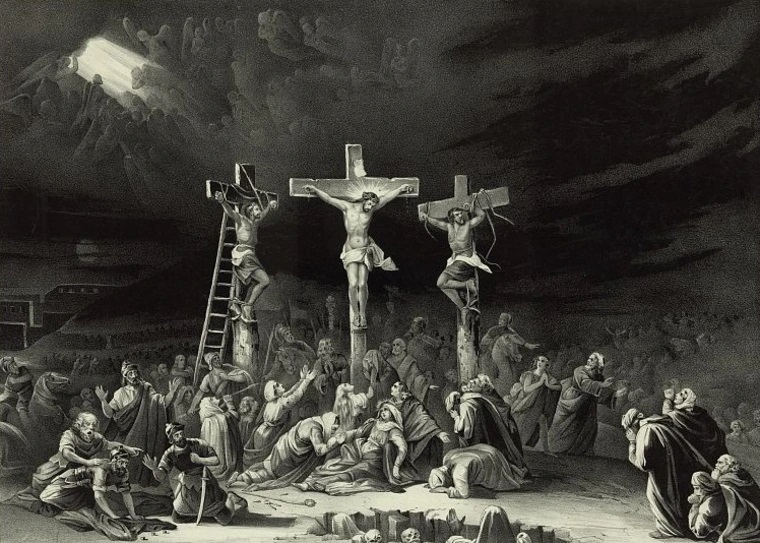
Another image depicts Good Friday. Again, no Jesus. But a moment of reflection determines His location. It is finished (John 19:30). The cross at the center is empty. Jesus is in the sealed tomb to one side. The rest of the portrait reveals a blackened sky (Matthew 27:45), the Father’s hand extended as He gives Jesus over as payment for Sin (Romans 8:32), a torn temple curtain (Matthew 27:51), dice used for casting lots (Matthew 27:35), the centurion’s helmet reverently removed in the presence of God’s Son (Matthew 27:54), a wilting flower (Isaiah 40:8, Romans 8:22) beside other rich images relative to the Lord’s powerful sacrifice. Displayed most prominently are the words, “Father, forgive them” (Luke 23:34). These are the first of the seven last words Jesus spoke from the cross. I just preached on these particular words two weeks ago. Giselle was there. She heard the reason they’re first. Amid the gory details, the forgiveness of sins rests at the heart of the terrifying but butier event. That’s why Jesus is doing what He’s doing. He’s winning our forgiveness. It’s His goal. The “them” isn’t just the people attacking Him. It’s us, too. And He never loses sight of us throughout the ordeal. This sentence leads His final string of sentences, serving as the heart for each.

Giselle gets this.

The last image I’ll talk about is incredibly rich. It’s Giselle’s portrait of Easter. Again, no Jesus. But by now, I think I get Giselle’s broader theme, intentional or unintentional. First of all, while we can’t see Him, the risen and ascended Christ has promised, “Behold, I am with you always, to the end of the age” (Matthew 28:20. But more important to the Easter narrative’s cadence, Jesus is always a step ahead of His beloved. In other words, the Lord is always out in front, accomplishing what none of us could or would if left to ourselves. We can only follow and discover His wonderful work. Here, in particular, the tomb is open. The sun is shining. The flowers are blooming beneath a beautiful blue sky. Scribed across the skyline are the words announcing what He’s already done, “He I Risen Allauilla!”

Now, before you criticize Giselle’s spelling, give the eight-year-old artist her due. She’s already proven her masterful ways. Did she really misspell some words, or did she find a way to avoid using one in particular since we’re still in Lent? As many who celebrate Lent already know, tradition sets the word aside until Easter. We don’t sing, say, or write it. (Notice, I didn’t use it in this paragraph.) Also, notice it’s not “He is risen,” but “He I risen.”

Okay. She probably misspelled both words. Nevertheless, here’s a chance to apply interpretation born from what’s already been a faithful demonstration of the Gospel. The words she gave us, even if by accident, are asking to be mined more deeply.

Start with “He I risen.” That’s easy. Jesus and Giselle. That’s John 14:19. Because He lives, she will live also. As far as the other, when I saw “Allauilla,” I saw Latin. My Latin is more than rusty, but I think a case could be made for “Alla uilla!” to be translated as “Come on, to the village!” Thinking this way, remember, everything Giselle has presented so far was born from childlike faith listening to and receiving God’s Word. Staying the course, “Come on, to the village!” seems awfully familiar to Easter. If not, then you’ve forgotten Matthew 28:5-8. It’s there we read:

The angel said to the women, “Do not be afraid, for I know that you seek Jesus who was crucified. He is not here, for he has risen, as he said. Come, see the place where he lay. Then go quickly and tell his disciples that he has risen from the dead, and behold, he is going before you to Galilee; there you will see him. See, I have told you.”

Do you know what I’d say in a moment like that? “Alla uilla! Come on! Let’s go to wherever Jesus is going and find Him!” And sure enough, Jesus is found on the way to the village of Emmaus (Luke 24:13-35) and then again later that same day in the upper room in Jerusalem (Luke 24:36-49).

Giselle has given me so much through these images. I’ll cherish them until I meet face-to-face with the One who inspired them. That being said, I hope you realize how significant the investment for faith made in this little girl has been, not only by her faithful parents but by a congregation intent on preserving the pure preaching and teaching of God’s Word and the right administration of the Sacraments. A church holding to this is invaluable. A Christian school serving as an extension of such a congregation is priceless. I’m absolutely sure that’s Our Savior Evangelical Lutheran Church in Hartland, Michigan. Behold Giselle’s demonstration and know the labor among us is not in vain.

Maturity

I’ve been thinking that churches without lectionaries (which, in part, help lead through seasons) are really missing out, especially during Lent. Lent is an incredible time for spiritual maturation. Indeed, it’s supposed to be. It’s deliberately solemn. It’s intentionally reflective. The Christian Church aims herself during Lent in ways that she doesn’t at other times of the year.

Although, no matter the season, she doesn’t play by the world’s rules while doing this. She can’t. And why? Because the Church is bound to the Lord’s course for maturity. Here’s what I mean.

For Lent in particular, one of its chief aims is to pull down our defenses. It labors to explode the barricades we put around ourselves. Sometimes these barriers are erected to hide our real selves from others. In other words, we don’t want people to know how rotten we truly are. Perhaps they’re guarding an unholy self-righteousness that cannot see its own faults. In that sense, maybe they’ve been built to protect secret behaviors we just can’t bring ourselves to categorize as sinful because deep down inside, we know if we call them what they are, that means we’ll have to change.

Sometimes we just don’t know why the barricades are there. Maybe something dreadful happened to us, and now we’re guarded. Perhaps they’ve been learned from people who were nothing short of bad examples.

No matter what builds or supports our defenses, Lent is a flamethrower aimed at a paper house. It’s a wrecking ball, and with each of its concussive blows, more of humanity’s need for a Savior is revealed until, finally, we’re standing at Good Friday’s cross surrounded by rubble.

This is good. It’s all part of Christian maturity’s process—a course of spiritual development that involves admitting who we are at our epicenters—our dreadful nature and the need to see it wholly overthrown. It is a humble embracing of God’s truths—terrible or comforting—rather than boldly holding to one’s deceptive self.

In short, it takes spiritual maturity to admit to Sin and, thereby, to be found confessing it. In some ways, worldly maturity means reaching self-sufficiency. It means reaching the end of one’s life and, alongside Sinatra, saying, “I did it my way.” I heard that song played at a funeral. It made me sad. Christian maturity means steering clear of doing things our way. It means being utterly dependent upon Christ, upon doing things His way. Lent brings this into incredible focus. It reminds us that Sin is our way. And then it shows us the One hanging on Good Friday’s cross. It shows Him hanging there, not for Himself, but for us. This is His way, and it saves us.

In a way, Christ indicates this humble maturity in Matthew 18:1-6. It’s there He claims that the greatest in the kingdom of heaven are the ones who humble themselves like children. In other words, when a Christian grows up—as he matures spiritually—he will be less like a self-sufficient, independent adult and more like a child whose trust must be placed externally. Childlike faith won’t resist truth’s hand. It won’t see it as invasive. Like a terrified child, fearful of this world’s monsters, it knows its own inadequacies and calls to the One who can provide what’s needed. Relative to humanity, this means rescue from the sinful predicament that keeps mankind in bondage to Death.

Lent helps cultivate this awareness. It helps take strides toward this kind of maturity.

Pulitzer Prize-winning writer Saul Bellow once said, “A man should be able to hear, and to bear, the worst that could be said of him.” Ten minutes on social media and Bellow would have labeled us as an immature society. In a way, Lent agrees with him. Spiritual maturity braves accusation, not just from others, but from God Himself. It knows it can be wrong. And yet, Lent’s undertow—a gripping current leading to the cross—reminds the Christian just what it is that enables a believer to admit to the hard news and be preserved through it.

The Gospel—the good news that we have not been left to our dreadfulness. Jesus, the Son of God, has been given over for our rescue.

Indeed, God wants us to know the depths of our very real need. In fact, it’s His love that carries the dreadful communication to us. In other words, He shows us our Sins because He cares. But then, He nails its solution to a cross. Right there, pinned to its splintery beams, we behold God’s love in the flesh. This love changes us. It enables us to confess our deepest dependence and cling to the only One who can provide what’s needed.

Regardless of the season, this is the heart and soul of the Church’s message. But if you miss it the rest of the year, it’s all but on steroids during Lent.

My prayer is that Lent is leading you in this way. If you’ve taken a chance to immerse yourself in it, I’m sure, like me, you’ve learned it certainly is capable.

The Mists are Lifted

timelapse cloudscape with bright sun shining with clouds passing.

If you were ever to borrow my copy of Charles Dickens’ classic novel Great Expectations, one hundred and sixty-seven pages into it—nearly at the end of chapter 19—you’d discover the following line underscored in pencil: “Heaven knows we need never be ashamed of our tears, for they are rain upon the blinding dust of earth, overlying our hard hearts.” Dickens scribbled those words into the protagonist’s mind. Pip is his name. Well, his nickname, that is. If you were to read a little further along, you’d find more of Pip’s thoughts underlined in pencil, leaving clues to his sadness. Riding along in a coach, he ponders, “I was better after I had cried, than before—more sorry, more aware of my own ingratitude, more gentle.” And then Dickens tells us plainly the avenue Pip used to discover his painful awareness: Pip was deliberating “with an aching heart.”

In other words, sadness was not necessarily Pip’s enemy, but instead, a tool for discovering something better, a more honest sense of “self.” And the honesty led to more sunlit possibilities. Less than a paragraph later, Dickens uses the last lines of the chapter to demonstrate this literarily. He concludes, “and I went on. And the mists had all solemnly risen now, and the world lay spread before me.”

Like Dickens, Henry Wadsworth Longfellow captured a similar aspect of sorrow in his poem “The Rainy Day.” In between a few short lines describing intense grimness, he hints at the winds and rains as useful for clearing away lifeless debris. Resting there, he knows something far better behind the clouds, something promising. And so, he ends the poem accordingly:

Be still, sad heart! and cease repining;
Behind the clouds is the sun still shining;
Thy fate is the common fate of all,
Into each life some rain must fall.
Some days must be dark and dreary.

Dickens and Longfellow are onto something here. Being the season of Lent, their intuition is useful, even if only to describe the human condition relative to the hope God gives. For Dickens, sorrow leading to honest confession discovers hope. For Longfellow, a hopeful heart can see through the inevitable clouds and know something better is most certainly hovering there.

These are Christological things, and the scriptures speak very clearly to them.

For starters, Christians know the difference between attrition and contrition—that is, the difference between sorrow for getting caught and a heart that aches because we sinned against someone we truly love. Attrite sorrow produces shameful excuses intent on preserving what’s most important—the self. Contrition can’t bear the sadness it has brought to someone else, and its only aim is to fix it, while at the same time being willing to bear the consequences owed for the crime. Attrition is selfish sorrow. Contrition is sorrow born from love.

King David, a man who knew both forms, wrote by divine inspiration that “the sacrifices of God are a broken spirit; a broken and contrite heart, O God, you will not despise” (Psalm 51:17). But he didn’t jot those words before informing his readers that the “Lord is near to the brokenhearted and saves the crushed in spirit” (Psalm 34:18). In other words, God stands as close to the desolate sinner as anyone can. He is there. And He brings hope, the kind of hope that has a name—Jesus Christ. Through the person and work of Christ, hope takes shape beside us—for us—laboring to win our rescue from Sin’s despairing darkness, changing our attrite hearts into contrite ones.

God promised He’d do this. He announced, “I will give you a new heart, and a new spirit I will put within you. And I will remove the heart of stone from your flesh and give you a heart of flesh” (Ezekiel 36:26). That’s incarnational language. That’s the heart of the God-man Jesus replacing our hearts of stone. With this Gospel-infused heart, we have ears to hear, know, and be comforted when the Lord says, “Peace I leave with you; my peace I give to you. Not as the world gives do I give to you. Let not your hearts be troubled, neither let them be afraid” (John 14:27); or “Take my yoke upon you, and learn from me, for I am gentle and lowly in heart, and you will find rest for your souls” (Matthew 11:29). We know what He means by these things.

He means He has won our salvation. The peace between God and Man that none of us could win has been accomplished by the Son of God on the cross. He has taken our sorrowful and burdensome yoke, placed it on His own shoulders, and given to us His yoke of righteousness. Recreated by this wonderful Gospel, as we face off with the winds and rains inherent to Sin, Death, and Satan—all sadness-inducing things they’d use to impose despair—a contrite heart is a hopeful one, and it stands ready to meet these turbulent accusations knowing that God stands right beside the confessor ready to give love as no one in this world ever could or would.

For the sorrowful, behind this world’s clouds, there’s always sunlight. Bearing the knowledge of forgiveness, the mists are lifted, and new life lay spread before us. Christ is its embodiment.

Again, today is the First Sunday in Lent. Whether the first or last Sunday, all of this is a part of Lent’s message. Listen carefully. It’s there. Know that in your penitential sorrow, a light is beaming. And even as it might appear to be snuffed out at Calvary, know it’s on the cross that it beams most brightly. Your hope is fulfilled in the death of Christ for you. And His resurrection—oh, the glorious resplendence of Christ’s power over Death—is the proof!

For Dust You Are

The imposition of ashes on Ash Wednesday is accompanied by the admonition to “remember that you are dust, and to dust you shall return.”

It has already begun—the seasonal bemoaning of Ash Wednesday. As always, some call it and its ceremony—the imposition of ashes—a liturgical innovation, as if the Church had just started employing the practice last week. Since similar liturgies for the “Day of Ashes” can be found on the scene as early as the eighth century, the Gregorian Sacramentary being one particular source, it’s hardly an innovation. What’s more, when one discovers Early Church Fathers casually prescribing ashes as a sign of repentance—as though such prescriptions were normal—it’s likely the ceremonies themselves can be found among the first Christians.

Still, when this escape hatch won’t open, the next angle is the apparent counterintuition of Matthew 6:1-6, 16-21, which, so strangely, is the appointed Gospel reading for Ash Wednesday. I say “strangely” because it’s a reading that appears to discourage Christian pieties observable to others. Ash Wednesday, if it’s done right, certainly isn’t discreet. It smears an ashen cross right in the middle of its participants’ foreheads. That must be what Jesus means in the text.

I guess what I can’t figure out is if the critics truly believe the rites and ceremonies of Ash Wednesday are bad practices. Maybe it’s as simple as particular churches having never done it before. Perhaps that’s true because they simply strayed away over time. Or perhaps they exchanged ancient liturgies and their aesthetics for things deemed more modern. I mean, the phrase “historic rites and ceremonies” just sounds so primitive—as though we Christians see ourselves as distinct from the surrounding world, as having our own culture and vernacular. Besides, ashes are not easily scrubbed clean from coffee cups and stadium seating cushions.

Or perhaps instead, somewhere deep down inside, there’s an exceptional fearfulness of the event’s deeper stare into the human soul—a gaze that’s far heavier, far more personal, than so many other pious practices they already employ the rest of the year. Kneeling is a Christian posture that demonstrates, among other things, the distinction between the Creator and the creature. We kneel in humility because God is great, and we are not. Kneeling, and then smearing ashes on one’s face, takes that posture into much deeper strata. It is far more than a juxtaposition. It makes visible what the one kneeling is owed. But before I go there, let’s stay with Matthew 6.

I should ask, do you volunteer at a soup kitchen? Well, apparently, Matthew 6:3 says you should only give in that way if you can sneak in and out without being seen. If not, do not do it. How about making the sign of the cross, folding your hands, and praying before eating your meal at a public restaurant? It sure seems that Matthew 6:6 prohibits such things, reserving such behaviors for one’s closet.

I suppose I could go on. In fact, I will. All of chapters five through seven in Matthew’s Gospel comprise Jesus’ infamous “Sermon on the Mount.” Remember, a reader (or listener) doesn’t arrive at Matthew 6’s content without first traveling through Matthew 5, which includes verses 13-16, a text encouraging the public demonstration of one’s Christian faith through word and deed, all to steer onlookers to the one true God who can save them.

But if I trust the wisdom of the Ash Wednesday nay-sayers concerning Matthew 6, it sure seems as though chapters five and six are in conflict. That is unless the Lord’s words in Matthew 6 mean something else entirely—words showing the distinction between genuine faith’s expression and works-righteousness leading to damning hypocrisy.

Honestly, I think if the Ash Wednesday critics dug a little deeper into the Lord’s words in Matthew 6, they’d marvel at how such a seemingly contradictory reading could be chosen for such a day, especially since, at first glance, it does appear to swim against Ash Wednesday’s thrust. Moreover, they might even see how such a reading, adorned by Ash Wednesday’s penitential shadows, leans into the very first reading Christians will hear four days later. Genesis 3:1-21 is the Old Testament reading appointed for the First Sunday in Lent. There, believers will hear the fateful words so stunningly embodied by Ash Wednesday’s instinctive momentum. Because of Sin’s terrible grip, we are reminded that each of us will “return to the ground, for out of it you were taken; for you are dust, and to dust you shall return” (Genesis 3:19). Forward from that moment in history, dust and ashes would be stark reminders of Death’s wage, first earned in the Garden in the beginning.

The thing is, if you somehow miss that essential part of Christianity’s teaching throughout the rest of the year, Ash Wednesday just won’t allow it. You can’t leave its classroom without its message painted on your face.

It’s a quick guess, but if I remember correctly, there were about 2,000 years between Adam and Abraham. Of course, if I’m wrong, I’m sure someone will correct me. But whatever the time frame, long after Eden’s events, Abraham approached God with a humble awareness of what he truly deserved: Death. How do I know? Because in Genesis 18, Abraham called himself “dust and ashes” (v. 27). In other words, God’s words to Adam were so piercing they could not be shaken loose by the believers who came after him. Dust and ashes had become a visible reminder of what awaited everyone. Abraham knew his mortal fate relative to the initial curse announced in Eden, and he knew it was not only inevitable but also world-encompassing. Others throughout the Bible’s pages knew and spoke similarly. Job is one (Job 30:19). Solomon is another (Ecclesiastes 3:20). In fact, Solomon quotes Genesis 3:19 almost word for word. In Matthew 11:21, Jesus commends by example the imposition of ashes as relative to repentance. How could He not? Again, His faithful prophets did. Joel called for it (Joel 2:12-18). Jeremiah did, too (Jeremiah 25:34). Jonah saw Nineveh’s king implore his entire kingdom to do it as a sign of sorrow (Jonah 3:6).

In every instance, the ashes marked humanity’s bondage to Sin coupled with sorrow and the admitted need for rescue from Death—the need for God’s mercy. That was at the heart of Abraham’s petition. He approached God, first admitting his ashen worthlessness. But he dared to make a request at all because he knew God to be merciful. That’s what he was pleading—to spare Sodom from absolute annihilation if a handful of righteous could still be found there. And because Abraham was right about God, the Lord promised to be merciful. Unfortunately, Sodom proved its inevitable fate in destruction.

I don’t want to ramble on too long. Suffice it to say that Ash Wednesday is not an event swallowed by doom and gloom. It’s also not something born from and marked by hypocritical self-righteousness. Instead, it’s carried along by hope, not in the self but in Jesus. It divides Law and Gospel in the most extreme ways. We’re marked in ash—marked for Death. But that mark is in the shape of a cross. We are not left without help, without rescue. We’re told God acted. Jesus is the promise’s fulfillment given to Adam in Genesis 3, just four verses before God described Sin’s unfortunate consequences. Adam didn’t meet the bad news without having first been awash in the good news, the Gospel. He met the consequences equipped with a divine promise. Ash Wednesday demonstrates this, and it does so viscerally. Its entire message is that Christ bore the deathly burden of dust and ashes. He went to war with Death and its terrible powers and won. “The last enemy to be destroyed is death” (1 Corinthians 15:26), Paul said. And just as Ash Wednesday doesn’t stop at Death’s identification but instead carries its participants to the Gospel, so does Paul continue, “Thanks be to God, who gives us the victory through our Lord Jesus Christ” (1 Corinthians 15:57).

I suppose if pastors want to forgo Ash Wednesday, withholding the imposition of ashes from their people—and with it, the timeless benefits of such Law and Gospel piety demonstrated throughout biblical history—they’re free to do so. The practice is not mandated among the churches. Here at Our Savior in Hartland, we intend to stay the course, just as we’ve done for the past 68 years. In fact, there will be a brief “Imposition of Ashes” service for all the school children (and anyone else who wants to attend) on Wednesday morning at 8:10 a.m. After that, I’ll get into my car and take Word and Sacrament and the ashes to any of the shut-ins who’d desire them. Later that same night, at 7:00 p.m., the congregation will gather for the Ash Wednesday Divine Service.

The imposition of ashes will be more than accessible here at Our Savior.

That being said, as the Christians depart any or all of these services, the critics can feel free to think of us however they’d like. Although, we’ll be too busy wandering around our lives silently proclaiming that Christian piety still exists in this world. In other words, yes, there are still people in this world who believe they are filthy sinners in need of rescue—and that rescue was won by the Son of God on a cross. And as with any silent demonstration of genuine Christian devotion, maybe, just maybe, it will become something else.

“Hey, you have some dirt on your face.”

“Oh, I forgot about that. It’s not dirt. It’s ash. Let me tell you why it’s there.”

Momentum

It’s been a busy week around here. Much has happened.

Henry David Thoreau said, “Success usually comes to those who are too busy to be looking for it.” That sounds nice. And perhaps it’s true. Still, it’s a gamble. Discovering oneself overcome by busyness, both reflection and recalibration are probably needed. Socrates knew as much, which is why he mused, “Beware the barrenness of a busy life.” In other words, just because you’re busy doesn’t mean you’re doing anything genuinely worthwhile or productive.

My wife, Jennifer, has been treating Madeline and Evelyn to episodes of “I Love Lucy.” I’ve missed out. Why? Because I’ve been too busy. It’s likely Lucille Ball would understand my reason. She allegedly said, “If you want something done, ask a busy person to do it. The more things you do, the more you can do.” She was describing momentum. Right now, my studies require incredible momentum, the kind that must be established and maintained. I’m capable of multitasking, and yet, I’ve noticed that if I slow down, get distracted, or become busy with something other than the reading and writing at hand, I get frustrated and produce less in almost every task across the board. For the record, I wrote a little more than seventy single-space pages of material this past week. That number doesn’t include two sermons, an editorial, or even this eNews, for that matter.

In your way, it’s likely you know what I’m describing. When you’re on a roll, things come more easily. Yardwork, remodeling, paperwork, you name it. Pace is important. It’s getting into the rhythm that’s hardest. For example, it’s no secret I despise exercising. If slamming my head in a door and walking on a treadmill both produced the same health results, I’d choose the door-slamming. But since I’m pretty sure head trauma burns far fewer calories than walking, the treadmill it must be. Even so, making my way to the treadmill is like walking the Green Mile. And once I get to the dreadful torture device, the sixty seconds it takes to put on my walking shoes, climb aboard, and then press the start button is nothing short of an Olympic-sized chore.

But once I get going—once momentum is built and I meet a reasonable stride—an hour on the treadmill seems like nothing. In fact, I discover I’m energized enough for a quick go at pushups, sit-ups, and planks. In other words, I find the strength for other things, not to mention my body feels better, and because I didn’t choose the head-slamming method, my skull is unbruised and pain-free.

I suppose one reason I’m sharing these rambling thoughts this morning is that we’re at the edge of Lent. Being more or less literarily exhausted by this past week, I’ll keep this shorter than usual, offering two things to consider.

Firstly, thinking Christologically and devotionally, Lent is a penitential time—a time for reflection, fasting, and spiritual recalibration. Its solemn color—the deepest violet—is a clue to this. Solemnity can influence. It can steer. By Lent’s prodding, one can find a way back into a healthy regimen of corporate worship, Bible study, and devotional self-care. If you’ve fallen prey to worldly busyness that leaves little time or energy for the God who loves you, Lent can be good for you. Beginning with Ash Wednesday, the six weeks that follow will involve a spiritual “exercising” of sorts. The human heart and mind will be immersed in what Saint Paul calls “the word of the cross” (1 Corinthians 1:18) in ways relatively unmatched by the rest of the Church Year. And as the routine progresses from one week to the next, momentum builds until finally meeting its stride in Holy Week and the Triduum—the great “Three Days” of Maundy Thursday, Good Friday, and the Vigil of Easter. It’s there a Christian realizes (if he or she hasn’t already) the great goodness to be had by a seemingly dreadful regimen—the cross’s dripping mess; a bludgeoned, bloody, and weakened Savior pinned to its gibbet; a terrible black sky palling the whole scene, leaving one to wonder if anything Christ said and did produced anything of value. Indeed, Easter’s stride says, “Absolutely! Everything He said was true! His resurrection is proof. By the power of the Holy Spirit through this Gospel, I have the strength to go on—to flex the muscle of Christ’s divine love until my last breath!”

Secondly, while the word “Lent” might carry some gloomier baggage for many, it’s actually a word of hope. Its root is an Old English word meaning “springtime.” Its Dutch and German crossovers mean “longer days.” In other words, inherent to Lent’s momentum is not necessarily a spiritual drudging through misery. Instead, its heart is set on counting down to the perpetually sunlit springtime of new life. Again, Easter—the festival day that proves the promise of heaven will be the longest, most wonderful summer day for all who believe in Jesus, the One who conquered the eternal night of Death on the cross!

And so, my point is twofold. Firstly, take advantage of Lent. Use its regimented traditions of fasting to your benefit. Let them help you build momentum toward a steady stride of faithfulness for the rest of the year. And secondly, do this knowing that even as building momentum may be challenging, remember your goal and then be blessed by its stride. The longer days, blossoming trees, bright-beaming sun filling pleasant days—all these things are hints to the world to come, and Lent and Easter display the scene magnificently.