
Unbroken Consistency

Before Jennifer and I were married almost 28 years ago, we attended pre-marital counseling sessions with our pastor. Rev. Dr. Jon Vieker conducted them. I was serving alongside him as his DCE (Director of Christian Education) at St. Mark Lutheran Church in West Bloomfield, Michigan, at the time. On occasion, Jennifer recalls a question he asked during one of the sessions. It went something like, “Do you sometimes feel like Chris’s personality is different among the congregation than it is when it’s just the two of you?”

Thankfully, Jennifer declared with confidence, “Not at all!” Interestingly, I think she remembers that question more than the others because she gets asked similar questions by folks here at Our Savior in Hartland, Michigan. They want to know if the guy in the pulpit and at the front of the Bible study class is the same around the dinner table or changing a tire on his Jeep.  When the question is posed again, thankfully, her answer remains the same today. Although I’m guessing it sounds a little more like, “He’s still the same doofus in public that he is in private.”

Admittedly, every relationship has its nuances. Unique personality traits emerge among close friends and remain subdued among first-time acquaintances. Still, there’s nothing more troubling than knowing a person’s truest self, only to see it transform into something completely different when others are around.

I know people who are this way, and it bothers me more than most. In my own circles, I know a pastor who is well-beloved as a theologian and scholar, and yet, behind closed doors, he’s the first to break confidences and share every dreadful detail about others he does not like. I know a public figure who carries the same prestige before crowds, and yet, in private messages or by phone, he is unendurably condescending, as though he’s the parent and I am the child.

I know everyone is flawed. This is true because everyone is thoroughly infected by sin. I certainly know I fit into the “everyone” designation. Nevertheless, if I were to categorize everyday human dreadfulnesses, I’d put habitual duplicity near the top of my list of off-putting flaws. A duplicitous person is incredibly hard to trust.

This is true because you can never be sure the version you’re experiencing is real—or worse, if any of the versions actually are. This kind of shifting personality can cause others to walk on eggshells, constantly second-guessing conversations and motivations. It’s difficult to build meaningful relationships with someone who wears different personas depending on the audience. Why is this? Because integrity, which is little more than honesty and consistency stirred together, is the bedrock of trust. Without this, suspicion can take root. Concerning the pastor I mentioned, I sometimes wonder: Regardless of what he says to me in friendly conversation, is the moment genuine, and if not, then what is he saying about me when I’m not around? That kind of unpredictability doesn’t just strain relationships. It poisons them.

Those who know me best will attest to Thomas being my favorite apostle. I think this could be true, in part, because for all his flaws, he wasn’t duplicitous. He was as genuine as genuine gets. When Thomas questioned the Lord’s resurrection, he didn’t pretend otherwise to save face. He said plainly, “Unless I see in his hands the mark of the nails… I will never believe” (John 20:25). Even better, his demand expects a non-duplicitous Savior. He expects Jesus to be exactly who He said He’d be—crucified, risen, and real—someone Thomas could touch and, once again, embrace. And when Jesus meets him in that upper room of honest inquisition, Thomas doesn’t deflect or backpedal. He doesn’t hide his unfortunate disbelief behind a persona of, “Yeah, well, I actually did know all along you were alive.” Instead, he confesses his surprise with even more excitement than his doubt. “My Lord and my God!” he cries out (John 20:28).

When I visit with other accounts that mention Thomas, I think this authenticity shines through. All along, the disciples often present personas of boldness. But in John 11, when Jesus speaks of returning to Judea, a place where He’ll almost certainly be captured and killed, the disciples express hesitation, fearing their own deaths, revealing they’re not as tough as they like to put forward. But not Thomas. He alone says, “Let us also go, that we may die with him” (v. 16). That’s not theatrical courage. It’s unbroken loyalty.

Authenticity matters. And so, I suppose in the end, that’s really what I’m aiming for—not just as a pastor, but as a man, a husband, a father, a grandfather, a friend, and a neighbor. I want to be the kind of person who doesn’t require others to guess which version of me they’re going to get. I want to be the same guy in the pulpit that I am when I’m elbow-deep in a personal struggle or riding high on joy’s sunlit upland. In other words, onlookers will know I believe what I’m preaching and teaching, and not just in public, but when no one else is around and every moment in between.

Of course, none of us can present such things with unblemished or unbroken consistency. We are all awfully imperfect. Still, by faith, believers cling to the One who is perfect—Jesus Christ—the One who is the same yesterday, today, and forever (Hebrews 13:8). Holding fast to Him, we can shed our masks. Besides, He already knows us better than we know ourselves. For me, there’s great peace in knowing this. It means I don’t need to stage my persona, but I can confess my transgressions honestly. When there’s not a minute to perform, there’s every minute to behold and follow the One who never wavers, never plays a fictitious role, and never fails to be precisely who He promised to be.
Easter 2025

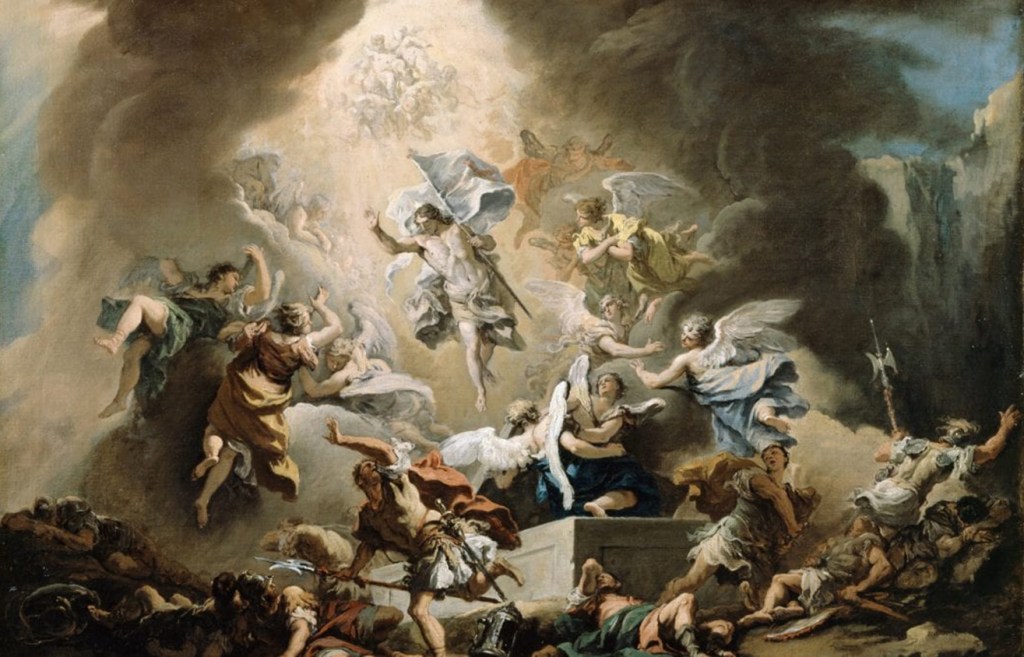
What else is there to say except, “Christ is risen!” Indeed, He is no longer dead but alive, and because this is true, Death no longer holds sway for those who put their faith in Him!

But there’s more to the Lord’s resurrection than knowing Death is no longer our brutal master. Now that He has throttled and subdued it, the fear Death seeks to impose upon every man, woman, and child continually is now rendered silly. We no longer have any reason to fear Death, and so Saint Paul can say full-throated, “For me to live is Christ, and to die is gain” (Philippians 1:21). He can call out with certainty, “Death is swallowed up in victory. O death, where is your victory? O death, where is your sting? The sting of death is sin, and the power of sin is the law. But thanks be to God, who gives us the victory through our Lord Jesus Christ” (1 Corinthians 15:54-57).

Even better, the risen Lord Himself can say to Martha at Lazarus’s tomb, “I am the resurrection and the life. Whoever believes in me, though he die, yet shall he live, and everyone who lives and believes in me shall never die” (John 11:25-26).

But that’s not all Jesus said to her. Before calling her brother from his tomb, He asked Marth a final question, “Do you believe this?” (v. 26). Doing so, He looks to her while also looking up from the page at all of us, prompting a moment of contemplation. In other words, just what does it mean for you that, through faith in Jesus, Death can never claim you? The answer isn’t a lonely point on the Christological map. It is a vast frontier of wonderfulness that reaches into life in this world with an aim for the world to come.

Its topography is comprised of valleys and mountain peaks, bogs and beaches, deserts and dense forests. Steering into and through each, it understands that if Christ has conquered Death, then what else is there to fear in any circumstance? The same power that shattered the grave empowers God’s people to withstand all tyrannies and endure every terror the mortal world could ever think to conjure. Even further, a life lived in the resurrection of Christ is capably bold. It does not cower before worldly powers or bow to the culture’s demands. It does not shrink from faithfulness to the Word of God but instead stands up straight, lifts its head, and keeps an eye open for the One who is coming again in glory to judge both the living and the dead.

Indeed, the frontier of faith is lived fearlessly. Again, if Death holds no claim, then neither do its troubling underlings of persecution or suffering or loss. They may shake their fists in a rage, threatening trouble. But the threats will forever be empty. Christ is risen! Everything else is decaying transience.

Now, the Church—God’s people—marches forward toward the final and eternal day when everything else reaches its expiration. We go there, not in trembling hesitation, but with the confidence of battle-hardened soldiers who know the war has already been won, and have been, all along, awaiting the victory celebration with their King.

Christ is risen! Do you believe this? I do. Therefore, let the world (and everything in it) threaten me as it sees fit. My hope is in Jesus, the conqueror. I will not be silenced, stilled, or afraid.

Good Friday 2025

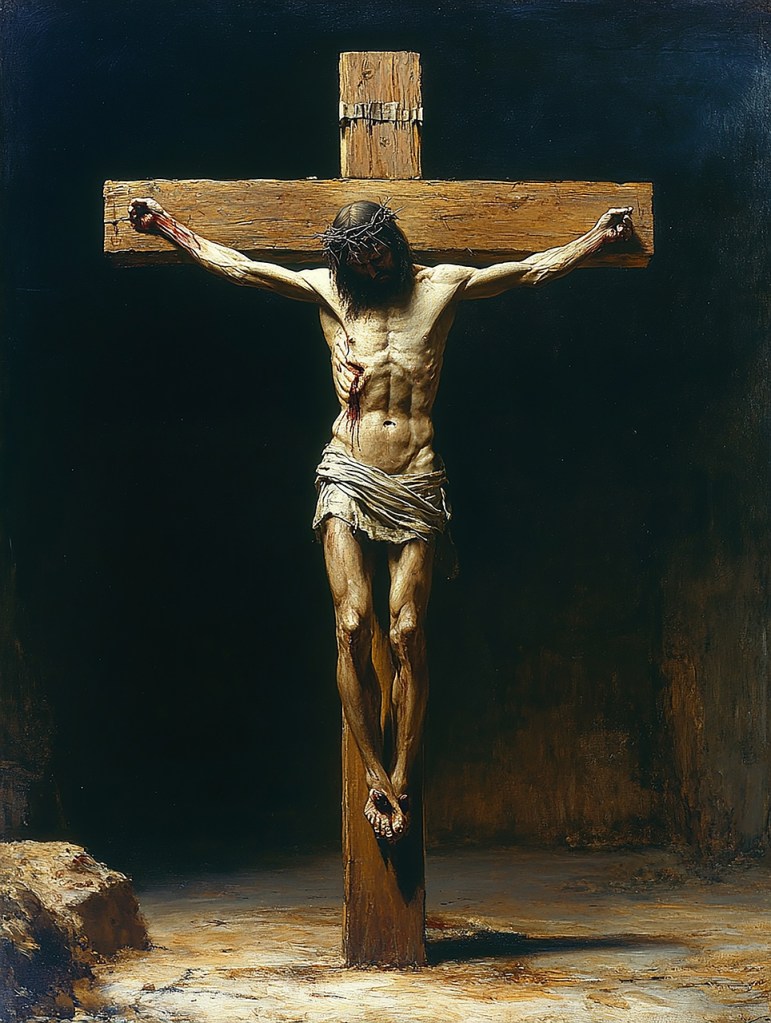
Today, the Church remembers with solemn devotion the day our Lord stormed into and invaded the enemy’s territory with great power. The invasion certainly didn’t look very commanding. In fact, it appeared dreadfully weak and pathetically insufficient. A bloodied and beaten man nailed to a cross, his head hanging low while gurgling His final words through strained breaths.

Behold, the Conqueror.

The world scoffs at such things. It looks to the cross and sees little more than a long-forgotten event that may or may not have happened. If it did happen, it certainly wasn’t anything of consequence. Consequential conquerors—genuine victors—are not captured and killed. They certainly do not submit to their captors and die willingly.

And yet, all around the world, Christians gather on Good Friday in somber reverence. They kneel in humility before their crucified King. They do so with a bizarre mixture of holy sadness and joy. The sadness comes as they acknowledge this King is innocent—that He’s paying a price He does not owe. We owe it. We’re the guilty ones. And yet, He suffers this world’s sin, bearing it fully, taking it into Himself in every way (2 Corinthians 5:21), and He does so for those who can only be counted as enemies for their crimes (Romans 5:6,10). The joy comes as they understand and embrace that He does this because He loves them. The joy emerges from a Gospel that declares He does what He’s doing without any strings attached. He does not hand the believer a bill for services and say, “Now, you owe me.” He does what He does by grace, and He bestows the merits of this world-altering effort from a heart of love.

Only the eyes of faith can see what Jesus is doing on Golgotha’s hill for what it is and receive the merits. Only the eyes of faith can behold the Lord’s divine love being poured out in a way that defeats Death at its own game. Only the eyes of faith can behold the suffering servant as the valiant destroyer of Sin and Satan—as the One turning back a world trapped in dreadfulness and ushering in the life to come. Only the eyes of faith can look upon this holiest act in all of history and desire faithfulness to the One who gave His everything for everyone.

My hope for you on this sacred day of days is that, as you have the opportunity, you’ll join your Christian family in worship. Go to the house of the Lord. Join with the multitudes of believers who know the immensity of sin’s cost and yet rejoice in the payment being made by the only One strong enough to make it—the Conqueror, Jesus Christ—the Son of God and Savior of the world.

Judas Was Not There

It’s Maundy Thursday. It’s an important day for the Church. It is the day our Lord instituted His Holy Supper, establishing and giving His very body and blood for the forgiveness of sins. It is the night He stooped to wash His disciples’ feet, demonstrating an immeasurable love for sinners. It’s also the beginning of His Passion—the night of betrayal, sorrow, and the deep descent into suffering for the sake of the world.

Unfortunately, on this day every year, I notice that folks on social media lean into the premise that Judas was present at the Lord’s Supper. They do this for various reasons, one of which is support for the practice of open communion. Essentially, their point is that everyone is welcome at the Lord’s table, even unbelievers.

Not only does Saint Paul speak rather crisply to this issue in 1 Corinthians 10 and 11, but my sense is that the premise actually arises from more of the pop-spiritual mushy Jesus perspective than the Jesus who demands order among the holy things (1 Corinthians 14:33). The mushy Jesus lets everything slip by, preferring your comfortability. He’s always friendly. He certainly doesn’t accuse or offend. He doesn’t draw lines and say, “Whoever is not with me is against me” (Matthew 12:30). He doesn’t overturn tables (Luke 19:45-46). He doesn’t rebuke anyone for approaching sacred things in an unworthy manner (Matthew 7:6, 23:16-22).

In truth, the mushy Jesus is more mascot than Messiah—an ever-smiling accessory to whatever people already believe. Unfortunately, faith in that particular Jesus isn’t going to end well (Matthew 7:21-23).

The real Jesus is the Lord of the Church. Even as He loves us as no one ever could, He still mandates reverence. He establishes objectively true things, instituting with clarity and consequence (1 Corinthians 11:27-29). He draws sharp lines between belief and betrayal, between holy and profane (Matthew 10:33). That’s the Jesus who is present on Maundy Thursday. That Jesus doesn’t accommodate disorder among the holy things. If anything, He exposes and names it, even though the observing disciples may not have fully understood what was happening.

Back in 2017, I worked the controversial topic of Judas’ presence at the Lord’s Supper into a whisky review at AngelsPortion.com. I just reread what I wrote. I’d say it was sufficient for that moment’s task. Still, there’s more I could’ve said. I want to take some time to lay it out in a fuller way.

For starters, the open/closed communion debate is vast. Here, I’m simply addressing the “Judas was there” premise. The simple truth is, he wasn’t. Judas left before the institution of the Lord’s Supper. The Gospel writers, when read together, give a coherent timeline. With that, relative to the open communion debate, the premise falls flat.

In John 13:18–30, Judas is identified as the betrayer and then leaves. That happens before the Supper is instituted in Matthew 26:26–30 and Mark 14:22–26. But what about Luke? I’ll get to that in a second. But again, the sequence is pretty straightforward: John 13—Jesus identifies Judas; Judas departs. Matthew 26 and Mark 14—Jesus institutes the Supper after Judas is already gone.

Now, before going any further, there are four things we should keep in mind. First, it’s important to distinguish between the Passover meal and the Lord’s Supper. Yes, Judas was there at the start of the Passover meal. That’s when Jesus handed him the dipped morsel of bread (John 13:26–27). But after Judas left, Jesus transitioned from the Old Covenant Passover to the New Covenant meal—the Lord’s Supper.

Next, the dipped morsel is not proof that the Lord’s Supper had already begun. In context, the dipped morsel is a symbolic gesture that occurred during the Passover meal. In this instance, Jesus did it to signal who the betrayer would be. Interestingly, the action wasn’t an unusual one. It was a familiar gesture during a shared meal, typically meant as a motion of kindness. Reading the other accounts, that’s how the observing disciples appear to have interpreted it. For us, knowing what’s about to happen, the fact that Jesus does this to Judas shows the depth of the Lord’s profound heartbreak at that moment.

Third, some folks might point to Luke 22:14-23, where the Supper and the betrayer are mentioned together (“But behold, the hand of him who betrays me is with me on the table” v. 21). Folks might single this verse out as supporting Judas’ attendance during the institution. However, not only does this not fit the order, but as most students of the Bible know, Luke tends to arrange material by theme rather than sequence. This mention is a reflective comment, not a timestamp, and it by no means contradicts John’s incredibly detailed chronology. Luke’s inspired literary point emphasizes betrayal as central to the night’s dreadful events.

Fourth, logistics matter. Judas wasn’t a supervillain with superspeed or teleportation powers. If he had stayed through the entire meal and then followed Jesus and the disciples to Gethsemane, he would have had to backtrack into the city, find and organize the temple guard, and return to the garden, all without being seen and without any Gospel writer thinking to mention it. That defies both common sense and the plain reading of the text.

In the end, I think John 13:30 settles it: “So, after receiving the morsel of bread, he immediately went out. And it was night.” Judas left immediately. He did not stick around for the institution of the Lord’s Supper. Any suggestion that he was present is in error.

To close, I hope this brief survey helps you. I had some time this afternoon to tap it out, and so I thought, “Why not?” even if only to equip you for conversations that might turn in this direction. As you might expect, it does happen to me on occasion. Of course, that goes with the pastoral territory. Pastors are called to be “stewards of the mysteries [sacramentum] of God” (1 Corinthians 4:1).

Reverence Is A Hard Thing

I write and share the following because it happened yesterday during our Palm Sunday Divine Service. Admittedly, it does happen occasionally throughout the year. However, it is most prevalent during the Christmas and Easter seasons. What happened? Allow me to explain it this way.

Reverence is a hard thing. I say this because it requires a unique balance of self-awareness and others-focus that the sin-nature does not naturally possess. The sin-nature takes what it believes it deserves. It situates its environment to suit its comfortability and is enraged when it must accommodate something else. It abhors barriers, especially the creedal kinds that protect from self-destruction. It chafes against authority, despises order, and scoffs at sacredness.

Reverence respects the environment into which it has entered, knowing it does not deserve to be there but instead was invited. Reverence is humble. It bows. It quiets the self. It does so to learn, which is far more than merely taking in information. It desires betterment. And so, it listens before it speaks and measures its words with care. It sees holiness and does not demand immediate access but observes with trembling gratitude. It acknowledges mystery and does not rush to assume it understands.

Reverence is hard because it calls a person to submit—to kneel when he would rather stand, to cover his mouth when he would rather impose opinions, and to adore when he would rather be adored.

That said, if you walk into a stranger’s house irreverently demanding what is the family’s to receive and are refused, you are the offender, not the offended. It is the same when you visit a church with which you are not in altar fellowship. The Lord’s Supper is not a right to be presumed but a gift to be received in unity of confession (1 Corinthians 10:14-24; 11:23-29). Reverence understands this. It does not stride to the rail unexamined or uninvited. It does not treat holy things as common, nor does it force participation where spiritual bonds have not been established.

Irreverence, however, is quick to call the stewardship (1 Corinthians 4:1) of these things unkindness and to label fidelity as arrogance (Galatians 1:10). It reframes faithful creedal boundaries as barriers and assumes hospitality demands compromise. But the Church—her doctrines and practices—is not ours to reshape (Hebrews 13:8-9; 1 Timothy 3:15). She is Christ’s (Ephesians 5:25-27)—and reverence knows this. It approaches with open hands, not grasping or demanding fists. Reverence waits until it can say “Amen” with integrity (1 Corinthians 14:16), because it knows that to kneel and receive without understanding is not only dishonest, it is dangerous (once again, 1 Corinthians 11:29).

Reverence is hard because it requires restraint in a doctrinally shallow American Christendom obsessed with the “self.” But it is precisely this restraint (established by the Holy Spirit) that helps human hearts receive what God gives on His terms. It trusts that the faith once delivered to the saints (Jude 1:3) is sufficient, and it takes seriously the apostolic call to “stand firm and hold to the traditions” handed down (2 Thessalonians 2:15). Reverence is not offended by these things, but accepts them as gifts meant to preserve and protect the Church in every age. And so, while the sin-nature storms out of a worship service offended that the pastor refused it communion, offering instead a brief blessing and an opportunity to chat afterward, reverence kneels and receives the blessing with gratitude, and then looks forward to the post-service conversation with a man intent on maintaining faithfulness rather than perpetuating spiritual harm.

Go With Jesus

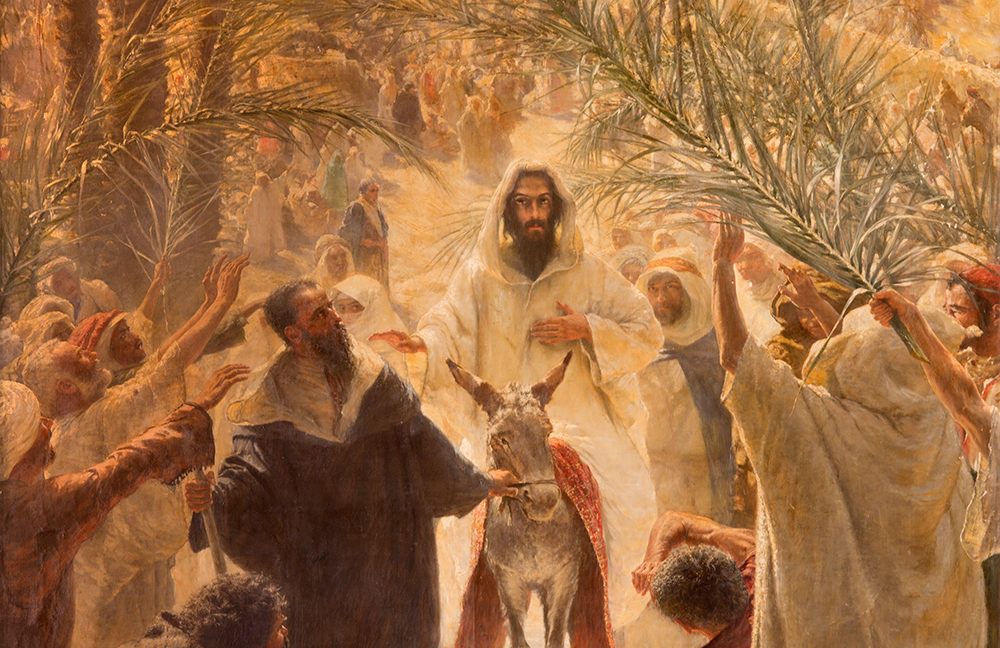
For the Church, Holy Week begins today. Christ is in His final approach. The excitement is thick. The gates are open. Nothing obstructs His entrance. The crowds have gathered. Their songs of Hosanna ricochet and resonate from the narrow pathway’s structures. Some have laid one of their few possessions on the road. A colorful mosaic of cloaks paves His way. Others scurried up nearby trees and then down again, having cut palm branches to share. The people wave them in celebration. Men, women, and children—all are praising His arrival. His disciples go before and after the Lord. A donkey carries Him.

Why isn’t He smiling? Why are His eyes bloodshot and swollen? The Gospel writer, Luke, tells us the celebration within the city had already begun on the outside road going down from the Mount of Olives. Making His way, Jesus came to a place before the city’s entrance where He could see Jerusalem in its fullest landscape. Luke records:

“As he approached Jerusalem and saw the city, he wept over it and said, ‘If you, even you, had only known on this day what would bring you peace—but now it is hidden from your eyes. The days will come upon you when your enemies will build an embankment against you and encircle you and hem you in on every side. They will dash you to the ground, you and the children within your walls. They will not leave one stone on another, because you did not recognize the time of God’s coming to you’” (Luke 19:41-44).

The Lord sees what the onlookers cannot, and He is troubled. They hoot and they holler without the slightest awareness of the peace He comes to exact. He’s traveling into and through the “hour and the power of darkness” (Luke 22:53) that erupts when He’s arrested and beaten, when the people will call for His sentencing and death. For them, at this moment, He is a bread king. They’re expecting Him to ride through and into the courts of the powerful—to rid Jerusalem of the Romans and restore Israel’s might among the nations. But that’s not what He has come to do. He is in His final approach toward something magnificently gruesome, and few, if any at all, will know what’s happening when it finally arrives. Oh, its dreadful midpoint on Golgotha’s hill. The ground will shake, the sky will become nighttime at noonday, the temple veil will tear, the rocks will split, and tombs will open, and still, they will not see. A centurion and a handful of guards will exclaim, “Surely, this man was the Son of God” (Matthew 27:54, Mark 15:39, Luke 23:47), but the rest will leave the horrific scene wagging their heads in disgust.

There’s more Jesus sees in that panoramic moment coming down from the Mount of Olives. He knows more as He rides into and through the crowds. He weeps because of it. He knows that a demonstration of the Last Day’s unbearable judgment for unbelief is coming. It will be awful, and yet, it will be little more than an atom-sized ember of rejection’s blue-hot reward, a recompense He does not want to bring.

In the very near future, in A.D. 70, Emperor Titus, the Caesar, will surround and level the city. The historian Flavius Josephus would one day describe the aftermath:

“Now, as soon as the army had no one left to kill or to plunder because no one was left to be objects of their fury (for they would not have spared any had there remained more work to be done), Caesar gave orders that they should now demolish the entire city and temple… much of the wall as enclosed the city on the west side, this wall was spared, in order to afford a camp for the remaining garrison. The towers were also spared, in order to demonstrate to posterity what kind of city it was, and how well fortified, which the Roman valor had subdued; but for all the rest of the wall, it was so thoroughly laid even with the ground by those that dug it up to the foundation, that there was left nothing to make those who came to see believe it had ever been inhabited. This was the end which Jerusalem came to… a city otherwise of great magnificence, and of mighty fame among all mankind” (Wars VII:1-4).

And so, Jesus weeps this first day of Holy Week. His Lenten travelers weep with Him. But our tears are a strange amalgamation of sorrow and joy.

We cry with our Lord in His sadness. We cry for those who remain in darkness and in the shadow of death. We cry because we know the inevitable wage for sin—eternal Death and separation from God—is entirely avoidable. Christ has made a way through. He has redeemed the world! Still, we cry because we know ourselves. Even as He would have us as friends, in our inherent sinfulness, we are at enmity with God. And so, we know our need. We know, by faith, He does for us what we would never think to do for Him.

But therein lies our Palm Sunday joy. He’s the only One who can do it. He’s the only One who would. And we’re so happy that He did. We watch Him make His way, and we’re thankful. He does not necessarily ride on in majesty because He has to, but because He wants to. He loves His world. He loves all of humanity, and as Saint John will very soon experience and then record from the forthcoming Maundy Thursday night in the upper room, “He loved them to the end” (John 13:1).

The end will very soon be upon Him. Follow Him there. Watch what He does. Listen to His words along the way. Turn an ear toward the cross and hear Him remain completely others-focused until His very last breath.

But how will you watch and listen if you do not follow Him there?

The Word carries you (John 1:1-2,14; Luke 24:27; John 6:68; Isaiah 55:10-11; Romans 10:17; Hebrews 4:12; and others). Do not be divided from it. The Word of God—both the person of Christ and the Scriptures that testify to Him—is what leads believers to the cross, sustains them in faith, and delivers the message that is the power of God unto salvation that reveals the depths of Christ’s love (Romans 1:16).

Let it carry you now. Let it lead you through the hosannas and into the coming darkness, that you would not be found unbelieving, but believing, that you would ultimately see—really see!—and rejoice in the light of His resurrection victory. He went there for you. Go with Him and see.

Here at Our Savior Evangelical Lutheran Church in Hartland, we have opportunities every day in Holy Week to be carried by God’s Word through the Lord’s Passion—Holy Monday, Holy Tuesday, Holy Wednesday, and Maundy Thursday at 6:30 pm, Good Friday Tre Ore at 1:00 pm and Tenebrae at 6:30 pm, Holy Saturday’s Great Vigil of Easter at 6:30 pm, and of course, the Resurrection of Our Lord, Easter Sunday, at 9:30 am.

Now, if I might make a suggestion. Please take a chance and share this eNews message with someone you care about.

To the person who just received it: If you don’t have a church home—a place and a people among whom you can regularly receive and give the care of God’s blessed Word—if ever there was a time to consider finding one, Holy Week is that time. You’ll know the theological heart of a congregation from the way it navigates the Lord’s Passion. Beyond this encouragement, there are other things to know. First, the Scriptures mandate this fellowship; it is not optional (Hebrews 10:24–25, Acts 2:42, 1 Corinthians 12:25–27, and others). And speaking practically, look at the titles of Paul’s Epistles. They are written to congregations in places like Ephesus, Corinth, and Rome. Consider the content of each. Apart from teaching,  he provides instruction for good order and sound doctrine in a precise locale—a congregation—established for the Gospel’s perpetuation. Second, and perhaps the best reason to join a faithful congregation: you will be blessed (Psalm 133:1-3, Matthew 18:20, Galatians 6:9–10), just as the Lord has promised.

Don’t Lose Hope

I had an interesting conversation with my soon-to-be 20-year-old daughter, Madeline, a few weeks ago before leaving for the office. Wondering what she had planned, I asked her about her day. She’s in school. She’s also nearing the end of her efforts toward a well-earned private pilot’s license. That particular day, she had a lesson at Bishop Airport, followed by an evening shift at work. Knowing she was close to finishing, I asked her if there was a final test of some sort. She said she’d already aced the knowledge tests but that she’d soon go up with an instructor who, apart from testing and observing her skills, would put her through a barrage of questioning. In her words, she said, “It’ll be like the Great Confession, except it’ll be a lot harder because I didn’t grow up in it.”

First, by Great Confession, she means what I put our young catechumens through prior to Confirmation. In other words, to be confirmed, you must present yourself for interrogation before the congregation, and I’m the chief inquisitor. It happens the Saturday before Palm Sunday, with the Rite of Confirmation occurring the very next day. Essentially, I ask the catechumens questions—a lot of theological questions—and then, if they answer them sufficiently, they must each recite Article IV of the Augsburg Confession. Article IV iterates the doctrine of Justification. It’s crucial that they do this. Justification has been long understood as the doctrine by which the Church stands or falls. If the Church gets the doctrine of Justification wrong, it ceases to be the Church.

This is the Great Confession, and to be confirmed at Our Savior Evangelical Lutheran Church in Hartland, Michigan, you must endure it successfully. Some haven’t, and they weren’t confirmed; not many, but some.

Understandably, the kids preparing for the Great Confession get a little worked up over it. Of course, I’m not questioning them in a way that seeks their failure. I want them to succeed. But I also want them to dig deeply, think through, and confess what they believe before taking their place at the Lord’s altar to confirm that same baptismal faith. Too many kids are confirmed just because that’s what mom and dad want or because that’s just what happens in their church at this age. Not here. There will be kids of various ages, some much younger than you’d expect. There will be kids who’ve been at it longer than others. This year, there are five students. Next year, there could be as many as sixteen. But no matter how many present themselves for examination, none will be confirmed apart from this process. It has proven itself reliable, and I have no plans ever to change it.

To understand why I’m sharing this requires returning to what Madeline said about it that morning a few weeks ago. She is five years past her Great Confession. Still, she remembers it. It was challenging. Still, she claimed that compared to her experience enduring the Great Confession, her final flight exams would be much harder. Again, her words: “It’ll be harder because I didn’t grow up in it.” Her point was that the Christian Faith has occupied her since she was born. This is true not only because she never misses worship and Bible study or because she attended her church’s Christian day school, but because she remains immersed in it all the other moments of her life—having conversations with her family at dinner, in the pool on vacation, out shopping with her mom, riding in the car with dad, and so many others of life’s usual moments. For her, whether it’s the Great Confession with her dad or a stranger’s casual interest, she can confess Christian truths as readily as tying her shoes.

But what about others her age who’ve fallen away? What happened? Perhaps their faith was never truly integrated into their daily lives. Maybe church and doctrine were compartmentalized—reserved for Sunday mornings or the occasional youth event—rather than woven into the fabric of their everyday experiences. Of course, suppose faith is treated as just one activity among many, or worse, a burdensome obligation rather than a life-giving necessity. In that case, it becomes all too easy to set it aside for what seems more important. The world is already relentless in offering distractions and alternatives that seem more appealing or more immediately rewarding. It’s certainly hard to argue the culture’s influence, with its constant noise and competing narratives.

Here’s something else to consider.

A 2020 study in “Education Week” reported that around 27% of public school teachers considered themselves ideologically conservative. Compared with another survey from Pew Research, about half of that same group considered themselves conservative Christians. A conservative Christian is defined as someone who attends worship regularly and believes the Bible is God’s inspired and inerrant Word. The assumption is that anywhere from 10% to 15% of all public school teachers are Bible-believing educators. When you figure that the average student with a bachelor’s degree had as many as 115 different teachers throughout their public school life, it’s likely that only 17 of those teachers were being steered by Christian faithfulness. However, studies also show that most Christian teachers prefer to remain thoroughly neutral, neither teaching to the left nor the right, while ideologically liberal teachers are twice as likely to insert their beliefs into their lessons. When these are the contours of our children’s learning environment, and we figure that a third of their waking life is spent in it, no wonder so many of our children end up in rainbow-colored ditches.

Looking back at what I just wrote, I’m suddenly sensing the strange urge to plan a fundraiser for our own tuition-free Christian school here at Our Savior in Hartland, Michigan. As I said in our recent promotional video, the world needs what we bring to the table. By the way, if you haven’t seen the video, you can view it here: https://www.oursaviorhartland.org/wp-content/uploads/2025/02/our_savior_evangelical_lutheran_school_promo-1440p.mp4.   

Continuing, someone asked me not all that long ago what they should do to help steer their adult child back toward the faith. With a few insights relative to the context, essentially, I gave this person the same answer I give to others who’ve asked the same question.

First, don’t lose heart. The Word of the Lord does not return void (Isaiah 55:11). The seeds of faith, once planted, remain, even if buried beneath the weeds of worldly temptations.

Second, are we talking about a baptized child of God? If so, then instead of despair, parents should almost certainly remain steadfast in prayer, trusting in the Holy Spirit’s work. One of the great things about baptism is the promise associated with God’s name. A child baptized in the name of the Father, the Son, and the Holy Spirit, just as Jesus mandated, is a child upon whom the Triune God’s name has been placed. For starters, in the Old Testament, God explicitly ties His name to the temple, saying that where He puts His name, He promises to dwell (2 Samuel 7:13, 1 Kings 8:29, 1 Kings 9:3, 2 Chronicles 7:16). In Numbers 6:24-27, God’s personal name (YaHWeH) is invoked three times in the Priestly Blessing (unsurprisingly in a trinitarian way), and in so doing, He promises that His name is thereby placed on His people resulting in blessing.

All of this more than carries over into the New Testament theology of baptism. I don’t have time for all of it, but we certainly get the sense in Matthew 28:19-20, Galatians 3:27, and Acts 2:38-39. Even further, just as God placed His name upon the temple in the Old Testament, Saint Paul tells us that God places His name on His people, the baptized Church. We learn this explicitly in 1 Corinthians 3:16-17, 2 Corinthians 6:16, and Ephesians 2:19-22. Even better, this naming extends into the heavenly realms. God’s name is on people there, too, marking them as His own. Revelation 3:12 presents this. Revelation 22:4 does, too. Even better, I think it’s equally interesting that Revelation 7:14 describes these marked believers before the throne as those who “have washed their robes and made them white in the blood of the Lamb.” That’s an interesting way to describe the people upon whom God’s name has been placed. I wonder what it could mean. Perhaps the answer to this rhetorical wondering is given elsewhere, in places like Acts 22:16, for example.

My point: a baptized child bears the Triune God’s name, and God isn’t so easily separated from His name. There’s hope in this divine reality.

Third, I recommend keeping the doors open. Engage them in meaningful conversations about life and faith, and most importantly, model unwavering devotion to Christ. If you go to visit for a weekend, start simply. For example, pray before meals. Make plans to attend worship on Sunday. Invite them to join you in both. Be a fixed point of faithful devotion to Christ no matter where you are or what you’re doing. They’ll see this. And then, keep in mind that the prodigal son returned because he knew where home was fixed, and he knew his merciful father was there waiting (Luke 15:11-32). Likewise, those who have been immersed in the faith, even when they stray, can recall the way home, especially when they see the way home through you.