We conservatives love to grumble about the indoctrination of children. I know I do. And why wouldn’t I? Every other week, there’s another headline about this dreadful thing and that horrible thing happening in a classroom somewhere, followed by another outraged post or podcast about how schools these days are poisoning our children.
Trust me, I get it. I’m frustrated, too. It’s why I do everything in my power to serve and maintain our tuition-free Christian school here at Our Savior in Hartland. I figure that apart from caring for my own family, the best way that I can help is to provide an alternative for the community—and not just a substitute, but something truly exceptional that puts Christ and His Word front and center as the chief interpreter to all that we are and will ever be.
That said, there remains an uncomfortable truth that everyone else out there is afraid to say out loud. Public schools are shaping our children because parents stopped doing it first.
We wring our hands over what the public schools are teaching about sexuality, identity, history, morality, or whatever. But the average Christian home spends more time watching Netflix in one evening than it does talking or teaching about Christ in a year. We shout at the school board about why our children are disrespectful, but the school didn’t raise them. We did, along with that glowing rectangle that’s been in their hands since they were two years old.
There’s a vacuum. The world is only doing what the world does to fill it. That’s not hard to see. Still, we take some strange comfort in blaming a system that’s true to its nature rather than taking a long, hard look at the parent in the mirror. We let the world form our children. And why? I think it’s because we’ve forgotten how. Or perhaps worse, we’ve decided we shouldn’t have to. Moral formation has become a subcontracted task—outsourced first to the church (if we have time to attend one). But for the most part, we leave it to whoever stands in front of the classroom—or the most popular TikTok influencer. And when the results disappoint us, we demand reform.
How about parental repentance first?
I just read a study saying that American parents, on average, will spend ten hours a week driving their kids to sports, at least four hours scrolling social media, and maybe—just maybe—a minute or two discussing what they learned at church—again, if they even go, because only around 22% of Americans attend church weekly. Only 33% attend at least monthly.
I think the truth in all of this is really pretty simple. You cannot demand values you yourself have never been willing to establish and maintain. You cannot expect anyone or anything to build character on a foundation you never laid.
I began this rant talking about public education. If you haven’t figured it out, that was just the lead-in to my frustration. Although, don’t get me wrong. I’m not excusing the failures of public education. It’s a hellscape of dreadfulness in many paces, filled with ideologies that are sending our children into moral and conceptual death spirals that many simply cannot escape. But that’s mostly because they cannot navigate it. Ultimately, that translates into any parental outrage without serious self-examination being nothing more than self-deception.
So, how about this… Before you get an itch in your craw to do all you can to tear down a Marxist curriculum, how about you also work on rebuilding the family dinner table? Before you demand traditional moral character formation in the classroom, how about you monitor the morality of your own mouth and behavior in the living room? Using the F-word in front of the kids, if ever at all, is not good parenting. Sorry to have to break this to you.
And so, before you go off to fight for your kids’ souls in a public forum, how about shepherding those souls at home? If we want a different outcome, we need different parents. Period. It’s not just that the schools stopped teaching our values. It’s that we stopped teaching them first.
I would usually sleep on the cot in my office at the church on a snow-laden day like today. But not this time. I slept in my own bed at home last night.
For one, I prefer to make sure everything remains in good working order throughout the night, namely, that the heat and power continue uninterrupted. I also prefer not to be the only one out on the unplowed roads at 4:00 in the morning. And that’s precisely what they were on the way in. As the years go by, it seems less thought is given to the churches—to the fact that God’s people are still gathering, still trying to make their way to worship. I get the sense that Sunday morning simply isn’t factored into anyone’s plans anymore, certainly not the folks deciding what gets plowed first.
Still, in all of Our Savior Evangelical Lutheran Church in Hartland, Michigan’s 70 years, we’ve never canceled a service. Not once. And it certainly isn’t going to happen on my watch. So, rest assured, the lights are bright. The heat is on. The Lord’s gifts of Word and Sacrament will be given, no matter how many gather to receive them.
The holy season of Advent begins today. That means Christmas is coming. And yet, last weekend at an event anticipating Christmas—a Christmas tree-lighting ceremony in downtown Chicago—shots rang out, resulting in one dead and eight seriously wounded. That same night, in Concord, North Carolina, another tree-lighting ended in gunfire. Four were shot. Three of the victims are still in critical condition.
Violence in Chicago is a pretty standard thing. It’s one of the most dangerous cities in America. Concord, North Carolina, not so much. In fact, it ranks among the safest cities in America. Safe or not-so-safe, what makes all of this stand out is the setting. Although Christmas trees no longer mean to most what they’re supposed to mean. The whole point of a Christmas tree is Jesus—or at least it used to be, way back when Christian communities looked to the evergreen as a reminder of life in Christ during winter’s deathly season. But now, it’s little more than a seasonal prop stripped entirely of its sacred center. Still, public tree-lighting ceremonies continue to be celebratory opportunities, and if anything, a warm assumption of community. That’s nice. But it obviously isn’t enough. Not when dreadfulness suddenly intrudes. And in the end, that may be the most sobering point of all. Whether you live in a city known for violence or one praised for its safety, dreadfulness always finds a way in. And then what? I only ask this question having read some of the words from victims’ families, which I’ll get to in a moment.
In the meantime, I’ll simply say that sin can and will fracture anything devoid of Christ. When Christ is removed, wherever He once was is instantly hollow. An empty object is a fragile object. It certainly has no power to restrain real darkness. But that’s because Christ is missing, and He’s the only One who can carry us through times of need. In this sense, last weekend’s violence during the Christmas tree-lighting ceremonies served as a kind of grotesque sermon, reminding all of us how Christological substance is desperately needed in our lives, and how humanity just cannot manufacture it, not even through seasonal civic ceremonies that look and feel nice but in truth are entirely devoid of real meaning. This brings me back to Advent.
For the churches that observe Advent—and I mean, actually observe it—we know the centuries-old pre-Christmas season is by no means hollow. We know its language and sense. It’s a penitential time, one that acknowledges sin’s dreadful grip. And yet, Advent stakes a firm claim in hope as it simultaneously looks backward to the Rescuer who came at Christmas, and also forward to that same Rescuer’s promised return at the end of days. As we Confessional Lutherans tend to say, it’s the kind of hope that knows the fullness of God’s promises in the “right now” but also the “not yet,” all at the same time.
This weird tension is essential to Advent. It names sin honestly. It knows the situation is dire and, therefore, refuses to minimize the brokenness responsible for the violence we saw last weekend. But it does this while anchored in what Christ has done, is doing now, and will continue to do. That’s Christian hope. Christian hope is not some hollow form of vague optimism. That’s what happens at civic tree-lighting ceremonies. Advent’s longing is a deliberate, time-spanning trust that the same Savior who entered history will keep His promises, one of which is to return to set everything right. That makes Advent far more than a season that’s waiting for Christmas, but one filled with holy confidence rooted in history, promise, and unquestionable fulfillment.
That’s a place where only Christians can live.
By the way, this is not a claim of moral superiority. It’s one of theological location. To live in the “right now but not yet” requires faith. Only those who have heard God’s promise in Christ and, by the power of the Holy Spirit, believe, can stand in the middle of that tension without being crushed by it. It is a narrow place. But in its narrowness, there’s a freedom the world cannot replicate. It tries. But it just can’t do it.
Remember, Christians started all this decorating stuff. We decorated evergreens, lit candles, and hung lights. We sang ancient hymns that communicated the Gospel’s backward and forward perspective. We still do it. The world has similar traditions this time of year. It decorates evergreens, puts up light displays, and sings its holiday songs. But between the two spheres is a strict separation. Buffeted only by the world’s empty décor, culture’s residents experience what happened in Chicago and North Carolina, and suddenly, their holiday is tainted with despair. I read an interview with one of the Chicago victim’s family members. The woman being interviewed said she may never celebrate Christmas again. Essentially, the memory is too terrible, and now the holiday is, too.
I get how that could be true, especially when your only framework is a sentimental, once-a-year version of joy tied to things that can be ripped away at any moment. When that’s the case, then any tragedy is enough to make every twinkling light or holiday tune feel forever poisoned.
But from the Christian perspective, with Advent’s Gospel in mind and heart, we light candles and hang lights, not to deny the darkness, and not even because the darkness might be scary. We know it is. But we also have no intention of granting the darkness final authority. We keep singing our joy-filled hymns, not necessarily to cope, as though we’re in some starry-eyed form of denial, but as an act of genuine defiance against sin, death, and the devil. We sing because the Gospel has the upper hand, not the darkness, and we know it. And so, we are perpetually hopeful.
I guess one thing I’m saying is that Christian rituals like these, no matter how the world might twist or imitate them, will forever be Christian property. We own them. And because we know better, they’ll always be acts of resistance rather than seasonal sentiment. The evergreen—a plant that keeps its green even when all life around it has come to a frozen halt—for Christians, it’s a visible confession that death does not have the final word. A candle is not mere ambiance for us. It’s a proclamation that Light has entered the world and cannot be overcome. The hymns are not background music, but instead longstanding confessions of the one true faith that has survived the worst this world could throw at it. In fact, the chief hymn appointed for the First Sunday in Advent is proof alone. “Savior of the Nations, Come” was written by Ambrose of Milan. He lived from 340 to 397. And still, here we are, age after age of dreadful violence and persecution, and we’re still singing this great hymn of incredible hope, one that tells the entire Gospel story in eight beautiful stanzas.
This is proof that we own Advent and Christmas.
And so, while the world scrambles to make sense of yet another demonstration of human awfulness, the Church stands where it has always stood at this time—right in the middle of human ruin, all the while holding tightly to God’s promises. We stand there unshaken, proclaiming that this world’s terrors cannot overcome us. The Light of the World has come and is coming again. We know that everything around us is temporary, yet the forthcoming King and His kingdom are eternal. That divine knowledge shapes the entirety of our reality. And that’s that.
Indeed, the world is experiencing a sentimental countdown to a holiday. But that’s not us. Christians continue taking to a sacred battlefield, knowing the ultimate victory has already been accomplished and that the final victory is at hand. And the churches that observe Advent—and I mean, actually observe it—their senses are being honed to this truth.
Once again, I refuse to let this country’s National Day of Thanksgiving pass by without saying something about it. Indeed, it is precious.
I know some among the clergy ranks see it as negligible. I certainly don’t. This is why Our Savior Evangelical Lutheran Church in Hartland, Michigan, is open for worship on Thanksgiving Day. Not Thanksgiving Eve, but on the very day. Sure, it’s inconvenient for some. There are turkeys to baste, pies to prepare, green bean casseroles to bake, football teams to cheer along, and parades to watch.
Well, whatever.
All those things are a combination of both required and elected responsibilities. And if I’m being honest, they’re really no different than the everyday activities that distract far too many on far too many Sundays throughout the rest of the year. In that sense, while Thanksgiving Day is meant to be different, it really isn’t. I say this assuming that, for you, as it is for me, life is already very loud. Things crowd the calendar. Responsibilities pile up. Family tensions simmer. No matter the scene, life’s wheels keep turning.
But then, suddenly, there it is on the horizon—a special day, one that our nation has set aside—and its whole point is to stop, take a break, and give thanks.
As a pastor, I have to ask on this day, “Why wouldn’t Christians be first moved to give thanks where thanks is actually due?”
I suppose one answer to my question might be, “Well, because even Christians wrestle with their sinful nature.” As I already hinted, gratitude isn’t natural to humanity in general. We’re creatures quick to notice what’s missing but incredibly slow to acknowledge what’s been given. Complaining is easy for us. It actually takes effort to give thanks.
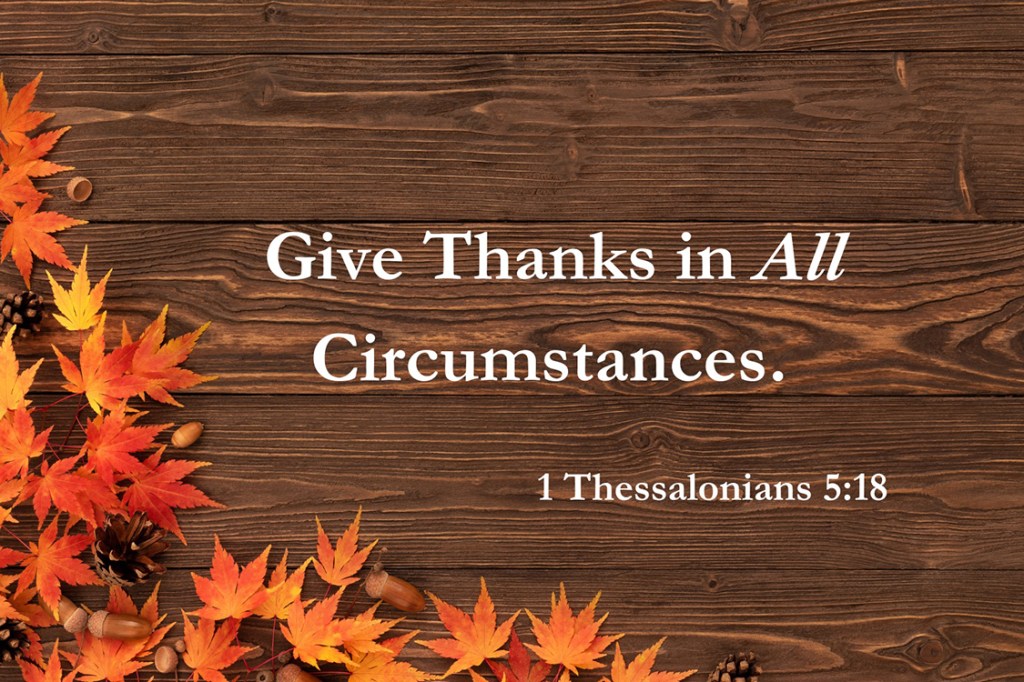
And yet, God’s Word cuts through our excuses with the simple command to “give thanks in all circumstances” (1 Thessalonians 5:18). Not when it’s convenient. Not when everything aligns. But in all things.
I think the word we stumble over most is “all.” The word includes loss. It includes disappointment. It includes the empty chair at the table this year. It includes the prayers that still haven’t been answered the way we hoped. And somehow, in the middle of all these things, God still says to His people, “Give thanks.”
Why? Well, here’s where the world could learn a thing or two from the Christians who make Thanksgiving Day worship a priority.
For Christians, thanksgiving isn’t a denial of life’s very real challenges. For us, in a way, it’s defiance. It’s the otherworldly ability to look straight at the broken pieces of this mortal sphere and insist God is still good. By the power of the Holy Spirit for faith in Jesus, to be thankful, even when things aren’t so good, is to remember that every breath we take is already borrowed. Every blessing is already undeserved. Every single sunrise is a generous gift—a beaming reminder that God’s mercy is new each and every day, even for the stubborn and the weary and, yes, the thankless.
And so, Christians do well to embrace that one day the world actually got right, even if it doesn’t understand its truest significance.
Society has established a day for thanksgiving, a day that provides most, if not all, an opportunity to slip away from life’s busyness, no matter what that looks like or means to those who observe it. Christians have a unique perspective on this opportunity. We know first to gather and to acknowledge the One who holds everything together. That’s really the best byproduct of this day. It’s a moment carved out of the noise to remember that gratitude isn’t a feeling. It’s a confession of something true. The holiday itself is a sneaky opportunity, a countercultural decision to lift our eyes and say, “Thank You, Lord, not because life is perfect, but because Your love is. And in You, I’ll always have everything I need.”
So go ahead and enjoy the food, the family, the football, and whatever else the day brings. But allow me to encourage you to let those things assume their rightful place in line behind the far greater truth that anchors it all—which is that the Lord has given us Himself, and in Him we have more than enough reason not only to seize the day for all that it offers, but to maybe even learn from it to give thanks to the Lord every day.
With that, if you’re nearby and your church isn’t offering a service, feel free to join us here at Our Savior in Hartland. The Divine Service begins at 10:00 AM.
It’s somewhat troubling that Black Friday and Cyber Monday come before Giving Tuesday.
That said, in a consumer-driven society, I suppose the order makes perfect sense. We are trained first to ask, “What can I get?” Only afterward are we prompted to ask, “What can I give… and only from what I have leftover?” The calendar simply reflects the catechism of modern culture.
Gratification first. Generosity later, if we can afford it.
I’m not much for Black Friday or Cyber Monday. But that’s only because I’m not much of a consumer in general. I have everything I need with my Lord, and He more than takes care of me through my family, church family, and friends. And I never really paid much attention to Giving Tuesday because I already give all year long to the Godly efforts that I appreciate. Still, I wonder about the captivating allure of Black Friday and Cyber Monday. I mean, when it grabs hold each year, is anyone really able to pretend to be surprised by the emptiness that follows the binge?
I suppose from another perspective, there’s an even more profound irony when Black Friday’s demands are placed beside some of the excuses I hear for missing worship. “9:30 in the morning is just too early,” some will say. “Sunday mornings are hard with the kids.” These are the same voices that find no difficulty in rolling the whole family out of bed at 3:15 AM, piling into the car with thermos’s and sandwiches in hand, and standing outside Walmart at 4:00 in the morning for a discounted television or another of the store’s newest gadgets—all of which have expiration dates, whether or not they realize it.
In other words, the body that is almost always too exhausted for time with the One who sustains for eternity somehow finds new strength for everything else it wants to do, especially time at the altar of consumerism, a wobbly platform adorned with things guaranteed to pass away.
I get why the world would be this way. I just don’t understand why it would be this way among people who claim Christ. After this thought popped into my mind, I did a little digging. Giving in churches has declined by almost 20% in the last four years. At the same time, economists are forecasting that Americans will spend over $1 trillion on holiday purchases, food, decorations, and such. This is a 4% increase over last year. Strangely, when the reward is eternal, inconvenience is a burden. When the reward is temporally material, inconvenience becomes the mission.
That contrast should disturb us, because it reveals something uncomfortable about what we truly value. We do not lack time. We lack priorities. We do not lack energy. We lack direction. We do not lack devotion. We’ve simply elected to kneel at the wrong altar.
Returning to where I started, the order of things certainly betrays this. Just looking at the calendar, we learn Black Friday and Cyber Monday come first. Giving Tuesday comes last, maybe even as an afterthought. Or perhaps worst of all, it’s sandwiched in as a moral concession once our carts are full and our credit cards are strained. It almost feels like a kind of cultural penance—a small charitable gesture meant to balance out a few days in a row of extreme indulgence.
I guess part of what I’m saying is that giving was never meant to come after getting. What’s more, time with Christ in holy worship was never meant to be an optional convenience. With that, I suppose, the true disorder is not in the world’s calendar. It is in the hearts that steer away from what’s Godly to follow that calendar.
While this past week was a little jagged, it really wasn’t anything out of the ordinary for a guy like me. Each week brings its own challenges. Each is filled with opportunities for people to take hold of something and run it into the weeds. That said, I still feel more like talking about something harmless.
And I know just what to share. I was telling Jennifer the story yesterday while we were out and around town together.
Just the day before, while walking to the center of the chancel to begin Matins with our day-school children, I noticed a ladybug on the floor. It stood out. It was a small red dot in a sea of taupe tile heading away from me when I approached. At first, I paid it no mind, except to avoid stepping on it. There were plenty of other things happening in the space before the service began. Pages turning and pews creaking. Not to mention it was Grandparents Day for our school, so the noise was a little more than usual. A ladybug hardly registered.
We began the Office of Matins. The people sang. The liturgy rose and fell in its usual way. A few minutes in, when it came time to sit for the Hymn of the Day, I looked down again. There it was, only now it had traveled nearly twenty feet, journeying straight toward where I was sitting behind the pulpit.
Throughout the hymn, I watched it advance across the tile—slowly, down and then up again through grout lines, seemingly unbothered. Almost determined. Eventually, it reached my shoe. I tried to keep singing. But at the same time, I watched this little thing pause, as if considering its options. And then, suddenly, it climbed aboard. It climbed up onto my shoe and kept heading north. I reached down to tuck my pant leg against my leg so it wouldn’t end up crawling somewhere it shouldn’t. I even shook the pant leg a little to get it to drop back to the floor. But apparently, its presence wasn’t up for negotiation. And so, up the outside of my pant leg it went.
A little more than halfway up my shin, it did something unexpected. It turned in a tiny circle, as though settling itself, and then stopped. That was it. No more wandering. No more exploring. It just stopped. Seemingly content, it stayed put throughout the rest of Matins. In fact, it stayed with me back to my office. It stayed for over an hour as I answered a few emails, made a few phone calls, and then headed out for the rest of the day’s business. Eventually, before leaving the building, I nudged it gently onto the fake palm tree in the corner of my office, figuring its tenacity should be rewarded. Indeed, it had earned a safe place to relax nearby.
That was the end of our little fellowship. I checked the palm tree this morning, but couldn’t find the little guy. Nevertheless, the brief interaction’s memory remains.
I suppose what really stayed with me was its simple insistence on getting to me. As I said, it was headed away from me at first. But then it’s as if it turned to follow. No hesitation. No sign of fear. No instinct to keep at a safe distance. It just crawled across the nave floor until it reached me. And there it stayed.
You know me. You know I’m already looking at this insignificant moment through the lens of the Gospel. Peering through the promises of God, that tiny act of creaturely persistence starts to take on a clearer shape. It’s not that the ladybug somehow found me interesting. It was that, in a space full of motion and sound, it kept a straight course. It didn’t dart sideways. It didn’t steer away when shoes scuffed past it. It simply took aim at one fixed point and then stayed the course.
That steadiness is what matters to me right now, especially in light of the conversations I’ve had this past week about so many different things, some of which led to some unfortunate hand-wringing. It was all very loud sometimes. But that’s more likely to happen in a world where folks react to the noise first and then reconsider the substance later. And then along the way, others get swept into the churn, too. People interpret “likes” as devoted association to one side or the other, rather than the actual content of the messages shared. Social media is toxic in that sense.
But beneath all the commentary, the same question keeps surfacing—at least for the Christians. It’s simply this: Where do Christians anchor themselves when the world becomes chaotic and full of crosscurrents?
That’s where the ladybug wanders back into view. It’s not a theological illustration. Again, through the Gospel’s lens, it’s seen as more of an unexpected reminder of something simple.
The road is uneven before us. We are surrounded by noise, too. Arguments. Opinions. Warnings. Accusations. Some of it is legitimate. Some of it is dreadfully misguided. All of it can be harmful, that is, if it’s allowed to distract.
And heaven knows that none among us are immune to drifting into darker places insulated by sin’s shady perspectives—opinions we think are godly but really aren’t. We end up there because it’s so easy to get pulled sideways by personalities, controversies, or as I said before, the pressure to simply react—to justify one’s position and oneself for the sake of saving face or protecting our own, not necessarily to learn, or to shore up one’s rightness or turn away from error.
In other words, we can get caught up in these things, all the while drifting from Christ and, maybe, never even noticing we’ve drifted until we’ve hit the self-destruct button on a friendship.
But the place we’re meant to be all along—close to Jesus—is not unclear. He has already planted Himself within reach. His Word, His sacramental gifts, His promises, His crucified and risen presence for sinners. Ultimately, the task is not to maneuver around every controversy perfectly, or even successfully. The task is to stay oriented toward Him. To know, even as He’s already with us in the truest sense, still, there is that Christian desire to move closer to Him in the noise, to cling to Him in the confusion. And when we have Him, just stay. Don’t let go. Hold onto Him and go with him where He goes. Eventually, He’s going to nudge you into a place of eternal rest from the busyness. But until then, stay put and hold on.
I suppose that’s the point I eventually came back to, and it’s one far more fitting for us, God’s people, than for the tiny creature that accidentally taught it.
Stay near Jesus. Keep toward Him, even when the world is noisy and uncertain, whether the ground is level or suddenly pitching low and then high—those moments of distraction that seem to come out of nowhere during life’s regular moments. Draw close to the One who has already drawn close to you. Don’t wander. Don’t negotiate terms. Don’t look for somewhere “better.” Hold onto Him. And then, just stay. Nestle in and stay. Because the safest place for any creature in God’s world is with Jesus.
A ladybug on a tile floor reminded me of that. And maybe, no matter what your week was like, it can be a reminder for you, too.
For the record, I’d say my essential premise was not necessarily about being for or against observing the holiday, but rather that many Christians seemed more than willing to simply surrender the event to the secular world entirely, having somehow been taught that it wasn’t the Church’s to begin with—that it was a pagan holiday that the Church tried to baptize. And yet, in truth, it’s really the other way around. Halloween came from the Church’s sanctified imagination and was later hijacked by paganism. It was Christian, but then it was emptied of its Christian meaning and filled with the world’s nonsense.
That right there—the hollowing out of something holy until only the shell remains—maybe that’s the more critical point. I say that because it describes far more than just All Hallows’ Eve. It’s a pattern for our age.
In other words, we live in a world that memorializes things but forgets the reason we memorialize them in the first place. We still hang lights at Christmas, but fewer folks seem to remember that Christ, the light of the world, is the reason for those lights. We still gather for weddings, but we do so assuming that marriage is humanity’s idea. It isn’t. God started it. It was His idea. Nevertheless, holy spaces are exchanged for thematic wedding venues, and favorite rock songs replace sacred hymnody that proclaims marriage’s sanctity. I suppose even beyond the Church’s doors, we celebrate plenty of other civic holidays we no longer understand. Plenty have told me they appreciate Memorial Day, not for its solemn character, but because it extends their weekend.
All around us, the forms remain, but the meanings are gone.
But this is how the world works. It doesn’t always destroy. Sometimes it rewrites in order to repurpose. It keeps the rituals but drains them of their truth. It keeps the beauty but forgets beauty’s essence.
Here’s my concern. It sure seems like Christians are more often tempted to retreat in these situations. Overwhelmed by how corrupt something has become, rather than fight to take it back, they figure the only possible solution is to surrender the field and move on. I know folks who won’t wear a rainbow on their clothes because LGBTQ Inc. has hijacked the symbol.
But God’s people own that symbol. It’s ours. Still, it seems we’re more inclined to surrender it than reclaim it.
That’s precisely how we lost Halloween. And it’s how we’re losing nearly everything else.
For the record, one of the clearest places to see this is in worship. Somewhere along the line, the Church decided that the way to reach the world was to mimic it—that the key to filling the pews was to empty the sanctuary of everything that made it sacred. And in the process, the Church’s worship—its highest demonstration of theology—was rebranded as a form of evangelistic enticement, something meant to attract rather than feed. But that’s never been worship’s purpose. Worship’s purpose is not to entertain the unbeliever or to market the faith (Ecclesiastes 5:1-3; John 4:23–24; Galatians 1:10), but to carry Christians into a place where time and eternity meet—where God tends to His people personally, giving them the gifts of forgiveness that sustain them (Ezekiel 34: 11-16; Matthew 26:26–28; Luke 24:30–32; 1 John 1:9; Revelation 7:9–12).
The tragic irony is that in chasing cultural appeal, we lost something the world needs from us: transcendence. When the Church stops sounding like the Church and starts echoing the culture, she ceases to be a holy and distinct refuge from the noise.
But again, this isn’t merely about worship styles. It isn’t even a critique of instruments or melodies. It’s about forgetting where these good and holy things came from in the first place. The world borrows and bends what it never built. The world didn’t invent most of what it claims to have invented. It didn’t invent marriage. It didn’t invent human sexuality. It didn’t invent justice. It didn’t invent what’s beautiful. It didn’t invent charity. It didn’t invent education. All of these things are fruits from God’s soil, and as a result, are, by right, crops to be harvested from Christianity’s garden. I was just talking with a dear friend this past Tuesday about how the university itself began in cathedrals. It was a place to learn truth as an extension of God. Now the very institutions that exist because of the Church’s intellectual legacy would rather burn incense to the self and its ideologies than bow the knee to the actual Truth made flesh that made their existence possible.
Or take art. I shared with that same friend how the world still paints, sings, sculpts, and builds. But holy moly, it sure seems like it no longer knows why. For example, while walking on the treadmill recently, I was watching a documentary about the 80s band Devo. Essentially, the band members claimed to be a consolidation of art, music, film, and social commentary. At one point in the movie, a founding member noted how one of their goals was to rid the world of Christian influence. Then an audio clip from an early interview played. That same bandmate could be heard saying, “We never said we were opposed to the Church. We just said we’d rather have cancer than Christianity.”
I didn’t keep watching for much longer. It struck me that music, something meant to elevate the soul, is so easily wielded by the culture as a weapon to offend that same soul. Art, which once imitated divine order and beauty, is now used to desecrate. Masterpieces are defaced. Blasphemy is called boldness. Ugliness is praised as authenticity. Chaos is paraded as radical creativity. For me, these are just proofs that when God is removed from something, it doesn’t become better or, as some would insist, freer. It becomes grotesque.
Now, I don’t want to wander too far here, so I suppose part of my point is that anything emptied of holiness can only go in one direction. It can only collapse into mockery. This trajectory worsens wherever Christians give up ground in retreat.
And by the way, when I used the term “paganism” before, I didn’t mean people dancing around in robes in the woods performing animal sacrifices. I meant a worldview that cannot stand true transcendence. Paganism, ancient or modern, is really just an older name for what we now call secularism. Secularism is paganism in modern clothes. That said, it’ll forever be the same naked humanity trying to exist in creation apart from its Creator.
And that, I think, is why Christians must be very selective when counting their losses and choosing retreat. Every time the world steals something sacred—every time it hollows out what was ours and paints it in its own colors—our response shouldn’t necessarily be to abandon it. We should first consider how to reclaim and refill it. We should labor to turn the world back to what it once knew.
Marriage belongs to God, and so we do what we can to turn the world toward that truth. Life belongs to God, and so we head to the front lines intent on taking back that ground. Beauty, truth, and everything else I mentioned already belong to Him. And even when the world tries to rewrite the definitions, it can’t escape the reality that every good thing it holds remains a gift from a gracious Lord who “gives daily bread to everyone without our prayers, even to all evil people,” as Luther explains in the Fourth Petition of the Lord’s Prayer in his Small Catechism.
So, thinking back on what I wrote earlier this week about Halloween, maybe the appropriate follow-up question isn’t, “How did Halloween become what it has become?” Perhaps we should be asking, “Why do we continue to let the world steal all our stuff?”
Yes, the world has a way of spoiling things. Still, I tend to think that Christianity has a remarkable ability to let that happen. But there’s another, even better ability we possess. We have been empowered to re-sanctify what the world spoils. I mean, if we can take a cross—a dreadful device of torture and death—and put it into our sanctuaries as a foundational symbol of Christianity itself, we can figure out how to snatch back the rainbow from the LGBTQ mafia. I’d say we can even go wandering through the darkness on a cool October night dressed like a scary monster, all the while laughing in the devil’s face as we take back All Hallows Eve.
That’s our heritage—to reclaim, to remind, to re-infuse the sacred into what’s been stripped bare. Because in the end, the world can only paganize what God first sanctified. And if that’s true, then the call to the Christian forces shouldn’t be “Retreat!” but rather “Charge!” And by God’s grace, it’ll be ours to capture and reclaim.
You’ll rarely find me ready to admit that my brain has run dry of words. And yet, the busyness of the past few days was as a black hole pulling into its twirling mass every last particle of my energy, and with it, not just thoughts that popped into my mind that typically become a few paragraphs here and there, but also the will to actually form them. It was a kind of gravitational pull toward emptiness—a reminder that even those of us who trade in words can find ourselves staring at a blankness that feels alive, swallowing thought after thought.
For me, in order to reconcile all the supposed “good ideas” I may have lost to the void last week, I think the point is not necessarily to fear the situation, but to recognize it as part of the cycle. In one sense, it was a pause before creation, a stillness from which the next torrent of keyboard taps would eventually emerge.
And those taps are happening right now.
I should say I do remember one random thought from last week that managed to stay with me. It might seem silly in the scheme of things, but since it’s the only thing that comes to mind right now, I’ll share it.
There was a moment while driving when I wasn’t sure if I still liked Star Wars. Yeah, weird. I’m the guy in your feed with a life-sized Darth Vader in his basement. I also have a Stormtrooper costume on display, one that was sent to me by the gent at Shepperton Studios in England who designed the original molds for the 1977 film. The trooper is armed with a holstered E11 blaster and all standard-issue equipment. I have some, but not all, of my original Star Wars toys from the 80s, too. My AT-AT stands beside my bar. The Millennium Falcon hangs by wires from the ceiling above it, with Vader’s TIE fighter in pursuit of an escaping Han and Chewy. Among countless eye candies scattered throughout the space, I can assure you, I’m no ordinary Star Wars fan.
But here’s the thing.
Perhaps that strange realization that startled me while driving was because, for most of my life, the Star Wars saga has been a wellspring of imagination and awe. But since Disney took over, what was once rich and expansive has now been drained of its mystery. It seems almost every corner of the galaxy is retooled and franchised into ideological submission, and now a void is staring back. Disney’s current trajectory—with its insistence on imposing LGBTQ, Inc.’s nonsense, combined with prioritizing quantity over wonder, and spectacle over soul—has transformed a universe once supercharged with myth into a factory line of shallow narratives, each one closing doors instead of opening them.
Thinking this through right now on my keyboard, I suppose my disenchantment isn’t necessarily a betrayal of my younger self, but a natural response to watching a beloved story collapse into an insatiable gravitational pull, leaving me waiting for the emptiness to let go, and for creation to feel alive again.
That said, this is simply where we are as a culture.
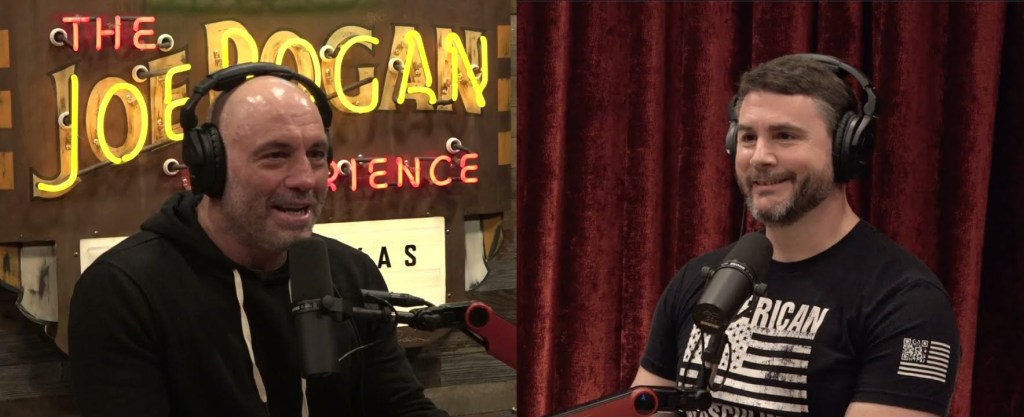
And if that sounds abstract, it isn’t. The point has faces and names. Just last night, sitting at my dining room table with Dr. James Lindsay and Chloe Cole, our conversation turned to this very thing—the strange willingness of our age to normalize what is gross, confused, or destructive, while shunning what is good, true, and beautiful. We agreed that the inversion isn’t accidental. It’s become a cultural reflex. In so many ways, the very same pattern that gutted Star Wars—trading mystery for ideology, and reverence for rebellion—now governs how society decides what deserves its affection.
It’s a pattern that doesn’t stop at Hollywood or politics. It seeps into everything, showing itself to be a symptom of something far deeper.
I guess what I’m saying is that we live in an age where tradition—what’s sacred—is no longer cherished, but instead repackaged until nothing generationally transcendent remains. In other words, we’ve been slow-burning the inherent wonder that makes most anything worth loving in the first place. What has happened to Star Wars is a cautionary tale in that sense. It mirrors what we’ve done to our own world—draining meaning for sellable content, trading soul for profit or popularity, and leaving ourselves with universes that look full but feel strangely empty.
Again, that said, you may not like what I’m going to say next… but… well, whatever.
I’d say the Church in America has not escaped this same gravitational pull, especially when it comes to worship. More and more, mainstream evangelicalism mirrors the same logic that gutted Star Wars—a reliance on endless production, flashy effects, and emotional manipulation designed to keep an audience engaged rather than a people fed. The holy spaces have become stages, and the pastors are little more than TED Talk speakers. The liturgy, if there is one, is a syrupy playlist of songs that repeat the same three lines twenty times, sometimes without even mentioning the God the people claim to worship. Every moment must be filled with lights, sound, and extraneous distractions.
I have a theory about this.
Not long ago, I saw a video from a megachurch memorial service. The pastor was speaking, but just over his shoulder, in clear view of the camera, a keyboardist played soft music the entire time. Why?
The theatrics of emotional manipulation. What is theater without its soundtrack?
Unfortunately, this wasn’t anything unique. It’s just one example of a wider pattern in megachurch (and smaller wannabe megachurches) culture where reverence is replaced with stagecraft. My theory is that these churches deliberately avoid reverence—with its quiet, cruciform ponderance—because it risks exposing how thin they are in substance. We’re told they’re attempting to be relevant, but it looks and feels suspiciously like entertainment—like franchising—running the sacred through the machinery of consumer demand. Just as Disney ruined Star Wars by trading the mythical for market share, churches are trading the sacred for the secular, reverence for relevance, mystery for marketing, and the otherworldliness of what’s holy for trendiness. The tragedy is that in trying to be accessible (which proponents of the “attractant model” insist is necessary), they end up being disposable—thin words paired with even thinner ditties that fade with the next generation. Christianity becomes a gathering of generic platitudes that stir the senses for a moment but leave the soul unanchored for the moments to come.
But unlike Star Wars, what I’m describing isn’t fiction. It’s the very lifeblood of the Church being stripped of its substance and wonder and, ultimately, sold back to us as theater.
The plain truth is that churches that adopt this theology and practice are not the ones that survive the fires of time. I said as much during my speech at yesterday’s conference. Charlie Kirk agreed with me. Dr. James Lindsay affirmed that he did, and primarily because both know that history has long proven it. History shows these forms of religiosity rise for a time, swelling in number and noise, but like fast food, they fill a generational moment, ultimately leaving that generation’s people malnourished. And when the next cultural storm hits—whether persecution, political upheaval, or even just the slow burn of the same societal disillusionment that we’re experiencing now—the thin scaffolding of lights and slogans simply cannot hold. And again, why? Well, it’s the same inversion we talked about in my dining room last night—the reflex to applaud what deforms and to yawn at what sanctifies, which leaves people brittle precisely when meaning is most needed.
Simply put, syrupy Christianity isn’t up to the challenges brought by real suffering. In those moments, people actually need the God who is holy, transcendent, and present where He promised to locate Himself.
By the way, I have a theory about this, too. I think that in the end, the even more profound tragedy isn’t that churches like the ones I’ve described eventually disappear, but that in their wake they leave generations who think they’ve “tried” Christianity, when in truth they’ve only tasted a diluted version of it. And so, they walk away, not only from Christ, but from a franchise built in His name that they mistakenly think He commissioned. In other words, people having a false impression of what Christianity actually is, that, I fear, is a far greater problem than the fading cultural mythos of even something as beloved as Star Wars.
You may or may not agree with me. That’s okay. In the end, though, I suppose what matters is not whether the Church can keep pace with the culture or stay in step with the latest trend, but whether we are anchored to something that can actually withstand the storms. The world can afford for Star Wars to become disposable entertainment. It cannot afford for the Church to follow suit. When churches trade away their sacred identity—when they sacrifice reverence for relevance—they train their people to crave sugar instead of bread. When famine comes, they starve. What the world needs is not another franchise in God’s name, but the God who breaks into our shallow emptiness, exchanging this world with the sacredness of the world to come. Strip that away, and you may have a show. Keep it, and you have a Church. And that is the difference between extinction and endurance.
There it is again—that word. Autumn. Or “the fall.”
Isn’t it interesting how the season that leads into the deathliness of winter carries the same title as the moment the barrier between this world and sin was ruptured? I’m not surprised. With Autumn comes an increase in darkness. For me, that’s its most unfortunate part. I’m an early riser. In late spring through to summer, the sun awakens with me—sometimes even a little before me. I’ll be just opening my eyes, and I’ll see its radiance already beginning to sketch out the horizon behind our home. It’s as though if I started walking toward it, I’d eventually go over its edge and tumble into its embrace.
But those days are fleeting. The sun won’t rise today until 6:59 AM. In winter’s depth, it’ll be closer to 8:00 AM.
Can you tell my seasonal affective disorder is taking hold? It happens every year at this time, and I can’t even begin to describe the internal war I wage against it—how I crave sunshine and its warmth, and how I have to equip myself for the 285-day stretch that Michiganders go without it.
To take the edge off the long grayness, I find it’s best to distract myself. That means pouring myself into other things. It means doing so with deliberate focus on Christ. In the quieter, free-thinking moments like this one, it means an even deeper examination of my surroundings through the lens of the Gospel.
For example, since I’ve already mentioned the word “fall,” thereby having wandered into the realm of homonyms—words that are spelled the same but have different meanings—how about the word light? It’s a homonym, too. It describes not only the brilliance that scatters the darkness, but also the opposite of heaviness. How does the Gospel reflect on this?
Easy. Christ offers us rest, ensuring us His burden is light (Matthew 11:28–30). He also says, “I am the light of the world” (John 8:12). In English, the word light bears two different meanings, and yet can combine to reveal the fullness of our Lord. He’s the radiant burden-bearer who dispels all darkness.
For another mental distraction, take the word cross. It is the shape of suffering, and it is also the action of being “crossed”—to oppose, to offend, to stir wrath. Indeed, the cross of Christ offends the world (1 Corinthians 1:18, 23), even as it saves the world (Galatians 6:14). It will forever frustrate me when I hear or read the words of Christians saying how we should focus less on the cross. Fewer sayings are more ignorant when poured from a believer’s lips.
The word grave is a homonym, too. It’s the tomb that holds a body, yes, but it’s also a word we use for something serious that demands our attention. Christ’s tomb demands our attention. While ultimately empty of His body, it was not empty of meaning. It was a serious thing that Christ suffered, died, and was placed in a grave that, in the end, could not hold him. The grave, something usually filled with death, was emptied of death (Luke 24:1–6; 1 Corinthians 15:54–57).
These layered words remind us that God wastes nothing relative to His Gospel, not even language. I appreciate this. And for a guy like me, especially during fall and winter’s depths, words provide the best distractions. As far as I’m concerned, they are open windows letting in the sun, so long as I’m paying attention.
It is here that I find a meaningful connection to someone who is, perhaps surprisingly, a human homonym: Dr. James Lindsay. He is an avowed agnostic, which means he does not share the faith that undergirds my life. Still, he’s a friend, and he’s someone who knows words. More importantly, he knows how words have been twisted, redefined, and repurposed in our age to smuggle in new creeds and new “gospels.”
James knows a lot about a lot. In particular, he’s a skilled troublemaker among secularists. For one, he uses his expertise in Marxism and, most especially, Gnosticism, to show elitists their inherent foolishness. He bears a thoroughness in this regard that very few can rival. Best of all, he understands Gnosticism’s modern offspring—“woke” ideology—better than most Christians do. He understands how, like the ancient Gnostics, today’s ideologues claim access to a kind of hidden knowledge that ordinary people cannot see until they are “awakened.” He points out how the language of “wokeness” mimics the Gnostic division of the world into the enlightened and the unenlightened, the knowers and the blind.
In Gnosticism, the material world was seen as corrupt and evil, something to be transcended through secret knowledge. In the same way, the woke framework teaches Marxist materialism underpinned by the belief that society is systemically corrupt—shot completely through with oppression, privilege, and hidden power structures—and that only through redistribution and initiation into its special vocabulary can one begin to see the truth. The Gnostics divided people between the “spiritual” and the “carnal.” The woke do the same, dividing people between the “oppressed” and the “oppressors.” Both set up hierarchies of purity and enlightenment that, ironically, only end up deepening divisions between the haves and the have-nots.
And just as the Gnostics denied the goodness of creation and the incarnation of Christ, woke ideology denies the givenness of created reality—especially in matters of the body, sexuality, and identity—recasting even biological facts as oppressive constructs.
Men can be women and women can be men. In fact, both can be neither, both, or something altogether yet undiscovered. It’s a spiritual thing—an identity thing—accessible in a sphere of understanding that only the truly enlightened can enter.
James knows all of this stuff inside and out. This is why his voice is so important. He has traced these parallels with clarity. And while he does not confess Christ, he’s more than an expert witness relative to things Christians need to know. He helps Christians see that the battle we are facing is not new. The names have changed. The vocabulary is updated. But the heart of the heresy—the very same things Saint Paul and Saint John wrote against in the New Testament (Colossians 2:8–9; 1 Timothy 4:3; 1 Corinthians 15; 1 John 4:2–3; 2 John 7; John 1:14)—remains the same.
That said, it’s right about this time every year that the criticisms begin arriving at my door for inviting speakers like James to participate in our annual “The Body of Christ and the Public Square” conference. But my reply is always the same: First, don’t get your panties in a bind. It’s a conference. Second, if I were on trial for murder, my chief concern wouldn’t be whether the expert witnesses testifying on my behalf were Christians. I’d want the best in the field. And regardless of anyone’s pious pomposity, Christians are not experts in everything. And when someone like Dr. James Lindsay has peered into the shadows of false religion, having tracked the corruption of language and belief as intently as he has, ignorant Christians like me should listen. Regardless of his confession, God is clearly using his talents in a very particular way.
I’m guessing He’s using our friendship in a particular way, too.
And so, let the critics rage. They will anyway, no matter the speaker. Personally, I think it’s some sort of weird jealousy. But that’s another eNews message for a different day. In the meantime, let them scoff. My answer will remain the same. The situation before us is too urgent to waste time on pious posturing. The woke gospel is nothing less than old Gnosticism with a fresh coat of paint, and it is devouring our institutions, our families, and even our churches. If a man like James Lindsay can map these lies with surgical clarity—and his map is accurate—then shame on those who throw stones and plug their ears because they dislike the messenger. Even Saint Paul quoted the pagan poets and philosophers when their words were true (Titus 1:12 [from Epimenedes’ Cretica]; and Acts 17:28 [a combination from Aratus’ Phaenomena and either Epimenedes’ Cretica or Cleanthes’ Hymn to Zeus.])
In other words, truth is not less true because it comes from an uncomfortable source, nor does it lose its weight when it is shouted down by a mob with good intentions.
In the end, God has always used unlikely instruments to shame the wise and awaken the complacent. In my humble opinion, we don’t need any more critics hiding behind pews. We need a few more folks on the field, willing to see, to listen, and to do the heavy lifting. The fall is here. The nights are long. But Christ is the Light—and the darkness will not overcome Him.
I’m sure you’ve heard about the shooting in Minneapolis by now. I waited to write something until this morning, if only because I wanted more information first. But now I know the dreadful details in full.
A 23-year-old man, Robert Westman—his transgender name, Robin—opened fire during Annunciation Catholic School’s morning mass. Two children are dead. Eighteen more were wounded.
Why did he do it?
Well, he left a thorough manifesto behind. The theme scribbled through its pages: hate. He hated Trump. He hated Christians. It seems he hated anyone unwilling to embrace and perpetuate his dysphoric condition. Strangely, he wrote of hating children. He fantasized about killing them, ultimately writing across his weapon, “This is for the children,” and “Where is your God?”
I heard political commentators asking last night, “What normal person dreams of killing the most vulnerable among us?” I thought to myself, “Well, abortion and transgender rights are fundamental planks in the progressive left’s platform. With that, the hatred of children is not as strange as it might sound.”
I say that because, within these ideological places, a devilish concoction is being brewed.
First, someone like Robert likely grew up learning that life in the womb is disposable, therefore making him more than capable of interpreting children outside the womb with the same diminished value. Then mix in a child’s natural lack of acceptance for things that are obviously ridiculous. In other words, children see things with a kind of uncluttered honesty—able to distinguish a man from a woman without mental gymnastics or political jargon. I can imagine that when Robert went out and around as “Robin,” children stared. Children do that when they see something weird. Understanding this, it’s not that hard to see why Robert, a deranged transgender, would hate and therefore target them. Anyone who can pierce through self-made illusions and preferred confusion with the plain light of truth becomes, by nature, an enemy.
And then, of course, relative to truth, we’d expect him to hate Christians. In these situations, that detail never surprises me.
The question he wrote on his gun’s magazine—“Where is your God?”—isn’t surprising either. That same question echoes through history whenever tragedy strikes. The psalmist wrote, “My tears have been my food day and night, while they say to me continually, ‘Where is your God?’” (Psalm 42:3). Evil has always taunted God’s people, daring us to believe that He is absent, indifferent, or even nonexistent when trouble comes. It is Satan’s go-to sneer. It is his preferred avenue for mockery.
But what Satan tends to forget is that the One inside of us is so much stronger than the one in the world (1 John 4:4). And so, the witness of God’s Word, and therefore, Christ himself, remains something far different than what this godless world would propose.
By the power of the Holy Spirit at work in us for faith, given through the Gospel (Romans 1:16), a Christian knows God is by no means absent. He is in no way blind. The Gospel proclaims (and imputes the capability to believe) that at the cross of Jesus, we see God in the flesh entering into our suffering, bearing the fullest weight of sin and death (Isaiah 53:4–6; 1 Peter 2:24). The question, “Where is your God?” finds its answer there: our God is with us, even in the valley of the shadow of death (Psalm 23:4; Matthew 1:23). He is not far off—He is present, even grieving, and ultimately, redeeming this confused and fallen world (John 11:35; Revelation 21:4).
The hope Christians bear in these moments is not that evil will never strike, but that evil will never own the last word (John 16:33; Romans 8:18). Christ’s resurrection is the exclamation point of Christian hope. Death itself has been defeated (1 Corinthians 15:54–57). And now, through all moments of darkness, Christ—the light of the world—forever shines, and the darkness cannot overcome Him (John 1:5).
For a time, this may be incredibly difficult for the families and friends of Annunciation Catholic School’s community to grasp. It may be difficult for many of us, too. Still, that’s the hope we’re given. It’s also the message we’re charged with bringing. Indeed, Christ is the answer to Westman’s question. Christ is the answer to every question that requires hope. That’s because in Jesus, we behold a God who comes near (John 1:14), who suffers with us (Hebrews 4:15), and who promises to make all things new (Revelation 21:5).
May God bless and keep you in this as you pray for and serve the victims of this tragedy. But don’t stop there. Jesus declared, “Love your enemies and pray for those who persecute you” (Matthew 5:44). That command is never easy, but it is essential. It reminds us that no one is beyond the reach of God’s mercy, and that our battle is not against flesh and blood but against the powers of darkness (Ephesians 6:12).
So while you pray for grieving families and a wounded community, also pray for those on the left who are already blaming conservative Christians for Westman’s actions, directing their ire at “conservative intolerance” or whatever. Pray that the light of Christ would break through their foolishness. Pray that God’s mercy might yet turn their visceral hatred into genuine repentance. Pray that the Gospel would consume their confusion and instill faith.
Because only the love of Christ can truly silence the enemy’s mockery and answer once and for all the question, “Where is your God?”
The news out of Mystic, Texas, was shocking. The flash floods brought more than water. They brought terrible sadness. I just checked. As of only a few hours ago, forty-three people are dead. Fifteen of them are children. The Associated Press article I was reading reported that “27 girls from Camp Mystic, a riverside Christian camp for girls in Hunt, Texas, still were unaccounted for about 36 hours after the flood.”
There’s something especially jarring about the death of children. It’s a primal ache. The little ones among us are meant to be protected. I can only imagine how helpless the parents of those children are feeling right now. They sent them to camp, expecting them to return. But in the middle of the night, a cabin of eight-year-olds was swept away.
Tragedies like this awaken something deep in us. They are reminders that being an adult is, in part, about standing guard. Even when, as children, we resisted the watchfulness, something changed the moment we became parents ourselves. We began to understand. We realized that protecting children is one of the most fundamental callings written into the human frame.
At least, you’d think it was. It seems more and more that this essential truth has been blurred by design. It seems that deliberate choices are being made by adults that not only fail to protect children but actually drop them right into the rising ideological deluge, insisting it’s for their good, even as the current pulls them under.
A long-time friend of mine, Martha, stopped by my office this past Wednesday while in town on business. It was good to see her. We spent a little over an hour catching up.
When it comes to what’s going on in the world, she’s a lot like me. She wonders how things got so backward. At one point along the way, we touched briefly on the recent U.S. Supreme Court decision upholding the Tennessee law. Essentially, the law bans transgender hormone treatments and surgeries for minors. I was glad for the 6-3 decision. Martha was, too. At its core, the law is a step toward protecting children from irreversible harm.
I mentioned to her in passing that Michigan has similar legislative efforts in motion. For example, House Bill 4190 would prohibit doctors from prescribing hormones or puberty blockers to minors. It also bans gender reassignment surgery on kids. My friend, Jason Woolford, is the one behind this worthwhile piece. He is an example of someone willing to step into the gap and defend children where others hesitate. I don’t think I mentioned the like-minded Senate bills that would criminalize healthcare providers while giving parents the right to sue for damages. One is Senate Bill 291.
These are all noble efforts, for sure. Still, I told Martha that someone should at least consider drafting a bill identical to Tennessee’s law. Make it word for word. I realize that with Governor Gretchen Whitmer at the helm and the Democrats controlling the State Senate, it’s unlikely that anything will get through and become law. Nevertheless, a shift in power could be on the very near horizon. And so, push the identical bill. Tennessee’s law has already been stress-tested in the nation’s highest court.
I’m sure not everyone agrees with this approach. Some might argue that simply copying another state’s legislation overlooks the subtleties of Michigan’s political landscape. I wonder if that’s part of the problem. Perhaps we’ve become too concerned with tailoring bills to conciliate rather than to confront. In fact, the longer I stand at the intersection of Church and State, the more convinced I become that we’re overcomplicating things. Too often, bills are laced with endless nuances, providing this exception and that concession, all in hopes of pleasing as many as possible, and yet resulting in the legislation being neutered before it even reaches the Governor’s desk. The more I see this, the more I question whether the bill drafters truly grasp the dangers posed by the ideologies they’re supposedly trying to address.
Chiseling away at devilish ideologies is virtuous, but only insofar as truth continues to meet squarely against anti-truth. To do this requires both unwavering clarity and legislative precision. When it comes to radical gender ideologies in particular, anything else risks the grotesqueness embedding itself deeper into our schools, our medical systems, our laws, and our souls.
Now, I should probably steer preemptively into two critiques I expect to receive from what I’ve just written.
First, I have plenty of friends in government who’ll step from my seemingly simple-mindedness, calling me naïve—that I don’t know how things work in Lansing, or, bigger still, Washington, D.C. I expect that assessment. And to some extent, they’d be right. However, I would respond by saying that if political realism leads to bills that ban surgery but affirm the worldview behind it, even if only a little, then perhaps a little naïveté is exactly what’s needed.
That said, rest assured, I’m not ignorant of the legislative process. I am aware that the political world involves negotiation, committees, amendments, and such. Rest assured also that I’m not necessarily an absolutist. Like Jesus during His earthly ministry, I’m more of an incrementalist. Indeed, divine absolutism will eventually play out, and everyone everywhere will know when it does (Philippians 2:10–11). On that day, “He will judge the nations with justice and the peoples with equity” (Psalm 98:9). Meanwhile, the Lord didn’t reach into this world, taking upon Himself human flesh, and instantly demanding complete comprehension from those He encountered (John 1:9-14). He preached, He taught, and He walked with people (Luke 24:27; Matthew 4:23; John 3:2). He led them step by step into His identity and truth—patiently, deliberately, and with perfect clarity (Mark 4:33–34; John 16:12–13).
But take note: He did this, never compromising truth’s substance for the sake of palatability (John 6:60–66).
That’s the balance I prefer. I want to do everything I can to move the ball down the field, avoiding any plays that risk giving up ground. In other words, incrementalism must never become appeasement. I’ve seen how the slow erosion of truth so often hides behind the phrase “what’s politically possible.” Refusing to give ground is the only respectable posture.
But that means we must first understand and then acknowledge just how backward things are. Until we do, we’ll remain a society that embraces madness, the kind that creates bills that still allow exceptions in some instances for surgically mutilating its citizens under the banner of compassion.
The second thing I should probably steer into is likely to come from a now former friend (unfortunately) who I can hear saying something like, “Look, no one wants to see kids suffer. But we need to get the government out of this altogether. We need to let families and doctors make these deeply personal decisions without government interference.”
And that, right there, is a big part of the problem.
Even apart from Christianity’s boundaries, personal liberty has never equated to moral neutrality. Liberty understands that truth exists and that citizens must be free to seek, speak, and live according to that truth without fear of coercion or punishment. But liberty untethered from truth is no longer liberty—it’s radical individualism. When radical individualism invokes the Declaration of Independence’s “pursuit of happiness” phrase to justify the mutilation of children, then freedom has become a twisted version of itself. We end up using our nation’s founding documents, not in pursuit of truth, but as permission-granting sources for redefining it. And again, it’s the children who pay the highest price for such redefinitions. They are both the battlefield and the collateral.
“But that’s more or less a spiritual argument, Pastor Thoma.”
In a sense, yes. But so is the counterargument. Right now, the prevailing narrative in our world says that someone can be “born in the wrong body.” Having spent enough time around Dr. James Lindsay, I’ve realized this is a deeply Gnostic concept—one that severs the soul from the body and declares the physical form irrelevant or even hostile to the true self.
The Christian faith insists otherwise. Body and soul are not at war but in union, created by God in perfect harmony (Genesis 2:7). Our Lord took on flesh, not as a costume to be shed, but as the very substance of our redemption (John 1:14). Christ’s incarnation affirms the goodness of the human body—male and female—as God designed it (Genesis 1:27). To mutilate that body in the name of self-actualization is not compassionate liberation. It’s a spiritual act, and a desecrating one at that (1 Corinthians 6:19–20). To slice away organs or pump anyone, child or adult (because age does not sanctify the level of one’s error), with cross-sex hormones in pursuit of an impossible transformation is not compassion or the pursuit of happiness. It is bodily harm, sanctified by pseudo-Gnostic jargon cloaking a lie, one that is easily detected in Natural Law (Romans 1:25).
Ultimately, I hope that future generations will look back on this time in America as a dark age. I hope everything that’s happening relative to so-called “gender-affirming care” will be remembered with the same horror as lobotomies. Whether such somber reflection will ever occur, I don’t know. What I do know is that a generation of legislators did not defeat slavery with bills that allowed “grandfather” exceptions.
There’s one more critique I should probably address before wrapping up, mainly since much of this has focused on gender dysphoria.
Per usual, I will be accused of hatred for what I’ve written. I will be told that I just don’t understand and that I am invalidating someone’s identity. Someone may even wield dissenting Supreme Court Justice Sonia Sotomayor’s argument that my position is nothing short of advocacy for suffering.
To that, I suppose I might say, “Yes, I am advocating for suffering. Just not the kind you think.”
I’m advocating for what we Lutherans call the “Theology of the Cross,” a path marked by humility, struggle, and self-denial. It’s what Jesus meant by saying, “If anyone would come after me, let him deny himself and take up his cross and follow me” (Matthew 16:24). The one following Jesus is less interested in worldly accommodation, but instead, is inclined to suffer all things, even suffering against internal desires, rather than be separated from Him and His redemptive work on the cross. All this stands in stark contrast to the world’s “Theology of Glory,” which seeks affirmation and comfort at any cost.
Every human being is born with backward desires. That’s the reality of sin. Taking up the cross in life’s combat, some fight against lust. Others wage war against drinking. Others fight dysphoric tendencies. Right now, we live in a culture more inclined to affirm and celebrate these disorders rather than restrain them. Still, Christ bids us to follow Him, not the “self.” It is not dangerous or unloving to say this. It is, however, unloving to affirm a lie, and it’s risky to give it room.
In the end, I expect to be called hateful for my positions. However, in every aspect of life, the courage to suffer for the sake of truth is the only way forward. It’s the best levee for holding back the water. That’s because its strength lies in a divine kind of love that brings truth, even when it costs something. Look to Jesus on the cross and see for yourself. There, love and truth are not in conflict but are inseparably joined—and in the most wonderfully protective way.







 Cruciform Stuff