I turned fifty-two years old yesterday. Rather than celebrating, I managed to get food poisoning the day before and spent most of yesterday enduring it. Unfortunately, I’m still dealing with it today. Not good.
Oh well. Fifty-two. For some, I’m still a spring chicken. They hear that number and think, “I wish I were turning fifty-two.” On the other hand, some of the children in our church’s school hear it and think I’m very nearly a funeral’s guest of honor. In a sense, both are admitting that time is short or, as Yeats so famously said, “From our birthday, until we die, is but the winking of an eye.”
Indeed, time is brief—abruptly so.
I don’t know about you, but as I get older, especially on my birthday, I experience a tension of sorts. There’s a strange pushing and pulling between anxiousness and contentment. I’m anxious because I know it’s very likely I’ve passed the halfway point of my life, and when I compare that knowledge with what the next fifty years are likely to bring—marriages, grandchildren, great-grandchildren, gatherings with an ever-increasing Thoma family, and so many other joyful things—I want so much to share in as much of those times as possible. And yet, I know my end will come during or before many of those times’ beginnings, so I probably won’t.
I know Jennifer feels the same way. We’ve talked about it, sometimes with tears. And while it’s not a constant topic of conversation, when we do find ourselves wandering along this garden path of discussion—our joints popping and our muscles getting sorer than they used to—there’s a contentment to be had by the surrounding flora. Life will forever be so much more than what we see in the distance. It’s here and now, and its slowly unfurling blossoms are just as splendid as its flowers in full bloom.
Birthdays are nice. And yet, I wonder sometimes if it is better simply to celebrate life without the numbers. I mean, if calendars were no more, would I even know my age? I suppose what I would know is that through faith in Christ, whether twenty-two, fifty-two, or ninety-two, I’m God’s child, and I live by His grace alone. Indeed, it would be for me to know that the “steadfast love of the Lord never ceases; his mercies never come to an end; they are new every morning” (Lamentations 3:22-23). Indeed, Christians live each day’s unfurling hope, and “we do not lose heart. Though our outer self is wasting away, our inner self is being renewed day by day” (2 Corinthians 4:16).
For the believer, Saint Paul describes another tension here—a better tension of “right now but not yet.”
For Paul, hope longs for a particular future even as it owns and exists in that very future right here and now. Another way to think of it is that Christians, while mortal, do not enter eternity when they die. They are in it right now. Baptized into Christ Jesus and believing in Him, eternity has already begun. Sure, we see our bodies wasting away as though time is running out. In a purely mortal sense, it is, and with its wasting away goes all the hopes and dreams tied to this world’s timeline. However, Paul noted previously in 1 Corinthians 15:53-54 that mortality is already swallowed up and owned by immortality, or quite literally in verse 53, that which is “death-like” (θνητὸν) must “eventually put on” (ἐνδύσασθαι) and be seen and exist in “deathlessness” (ἀθανασίαν).
That’s the “not yet” future that we own and exist in right now.
Just like everyone else, I’m wasting away with each birthday. I know that whatever mortal futures are in store for the forthcoming Thoma generations are something I won’t see or experience. However, the outward undoneness that seems to suggest I’m only getting further and further from that future simply cannot keep pace with the inner renewal being worked within me by the power of the Holy Spirit for faith. This renewal is sourced from the horizon of eternal life with Christ. Faith has already situated me in and for a time and place outside of time where all the generational blooms in my Christian family that I didn’t see in this life will be gathered into a splendid bouquet of grandeur at the table of the Lamb’s high feast. I’ll be surrounded by generations that I never walked or talked with in this life, and yet we were already bound together by faith for eternity and destined for an incredible family reunion.
Until then, I intend to enjoy as many of the blooms and forthcoming blossoms as the Lord allows, giving thanks to God for all of it.
The feeling is always the same. The day after the conference here at Our Savior, there’s a lingering sense of exhilaration and anticipation. For most in attendance, I’d say the exhilaration erupts not only from the opportunity to meet people they usually only see on TV but also from a newfound passion to engage in the world for the sake of preserving our nation’s founding ideals, which is nothing less than the societal context Saint Paul insists that Christians pray for and intercede to maintain (1 Timothy 2:1-6). He said we do this so that “we may lead a peaceful and quiet life, godly and dignified in every way” (v. 2). But to what end? Again, Paul helps us, writing that such a context “is good, and it is pleasing in the sight of God our Savior” (v. 3) because He “desires all people to be saved and to come to the knowledge of the truth” (v. 4).
All of this is to say that when religious liberty is secure, the freedom to preach and teach the most important message the world has ever known is more widely available. And what is that message? Paul tells us: “For there is one God, and there is one mediator between God and men, the man Christ Jesus, who gave himself as a ransom for all, which is the testimony given at the proper time” (vv. 5-6).
There’s an excitement that comes with playing a role in this preservative action, especially when it so often seems at every turn that Christians have their backs up against the wall. Of course, we’re not inserting ourselves because we somehow think God needs our help to maintain His world. We engage because He invites us to. Interestingly, the same Gospel we’re supporting has already moved us to love Him in ways that embrace His invitations, no matter where they may lead. Luther referred to this Spirit-driven compliance as a believer’s duty. In his explanation of the First Article of the Apostles Creed in the Small Catechism, he wrote that in response to God’s “divine goodness and mercy, without any merit or worthiness in me… it is my duty to thank and praise, serve and obey Him.”
Indeed, this is most certainly true. And so, we do.
I talk with a lot of people at our conference every year, and each conversation is an enlightening one. I learn something from every person I meet. One particular takeaway from this year’s conversations happened after everything had concluded and we were cleaning up. I spoke with a woman who expressed feeling helpless to change things for the better in America. But no sooner than she said this did she thank God for what she received from our conference, describing it as superbly educational and, thereby, motivational. And then, as if wrestling with her own premise while speaking, she found herself insisting that even the slightest, most insignificant effort to engage has a way of eclipsing that helpless feeling.
I grew happier as she spoke. Why? Because without even referencing it, she essentially reiterated the conclusion to the speech I’d given only a few hours prior. She was even now digesting what was said and talking herself toward the realization that faithful engagement comes in different shapes and sizes. The size and shape are determined by God and the gifts He gives.
Stepping from this point of origin into the public square, worry’s inevitable hopelessness is overshadowed by hope’s possibilities born from God’s gracious care.
That’s what I meant at the beginning of this note when I mentioned the lingering sense of exhilaration and anticipation. Again, the exhilaration comes from getting into the game and playing hard. The anticipation is the perpetual hopefulness that, while I might not be the best player by any worldly league’s standards, God still put me on His team. His squad is not made from this world’s muscle. If you doubt this, consider Saint Paul’s perspective in 1 Corinthians 1:26-30:
“For consider your calling, brothers: not many of you were wise according to worldly standards, not many were powerful, not many were of noble birth. But God chose what is foolish in the world to shame the wise; God chose what is weak in the world to shame the strong; God chose what is low and despised in the world, even things that are not, to bring to nothing things that are, so that no human being might boast in the presence of God. And because of him, you are in Christ Jesus, who became to us wisdom from God, righteousness and sanctification and redemption, so that, as it is written, ‘Let the one who boasts, boast in the Lord.’”
Paul isn’t just implying that each and every Christian is on God’s team by faith, lest any of us think that our salvation is based on deeds. He’s also making sure we understand that to look in the mirror and determine one’s value or potential for service to His kingdom according to worldly standards is to make a grave error. God doesn’t work that way. If He did, then the innocent Son of God would not have been given over to death for the sins of the guilty. He’d have left us behind right after the events in Eden, inevitably allowing us to get what we deserve. Instead, Jesus, the epitomizing demonstration of God’s backward way—God’s Son pinned to a cross in what appears to be pathetic weakness—is the mightiest of death blows to Sin, Death, and Satan.
This Gospel is itself the muscle and skillset that outmaneuvers our wisest and strongest opponents. It strengthens its team to suffer the heaviest tackles while still getting up and getting back into formation. It is, by all means, the best play in God’s playbook—the one that, since the beginning of time, Satan and his knuckleheads just can’t seem to figure out how to stop.
We are on God’s team. We didn’t get there by trying out. He baptized us into our respective positions. He has endowed us with what’s necessary for making a difference. And so, we play as hard as we can. We use the gifts God has seen fit to grant us, putting them to work to move the ball down the field toward the goal.
The after-conference conversation I mentioned began with a sense of individual irrelevance and ended with courageous invigoration. For as challenging as it is to assemble and administer a conference like ours, I’ll be forever glad that we do it if only to be reminded that, as the saying goes, where there’s one, there are another five. In other words, my momentary conversation partner—a relatively small woman by human measurements—was by no means the only one refreshed for gameplay. And the thing is, if God continues maneuvering as He does (which I know He will), the world is never going to see this tiny but divine juggernaut coming.
At the men’s Bible study in my home two weeks ago, we wandered into a momentary discussion concerning the necessity of sound doctrine. I don’t remember how it happened. We’re currently studying the Book of Acts, and I think it came up while making our way further into Chapter 2. I do remember that it stirred something from Luther’s Bondage of the Will, which I did my best to recall. Here’s what Luther wrote:
“Christians must know for sure what they believe and must witness to their belief. Therefore, if you take away that certain affirmation so that Christians are no longer sure of what they believe, they have ceased to be Christians, and you have taken away their faith. For the Holy Spirit is given to them from heaven in order that He may sanctify the hearts of the faithful and make them firm and sure in their witness to Christ so that they will live and die for it. And is not this the greatest certainty if I stand so firmly by my yes that I am ready to die for it? Yes, it is. The Holy Spirit is no skeptic. He has not written an uncertain delusion in our hearts, but a strong, great certainty, which does not let us waver, and may it please God, will not let us waver, but praise be to God, makes us as sure as we are that we are now alive and that two and three make five.”
My favorite line in the paragraph is, “The Holy Spirit is no skeptic.” Of course, He isn’t. When you know truth in its entirety, there are no in-between spaces of uncertainty. You can move along unfettered, assured that what’s true is true and what’s false is false.
Indeed, the Holy Spirit does not wrestle with ambiguous skepticism.
Part of Luther’s essential point was, first of all, that Christians are only Christians because the Holy Spirit has been given to and abides in them for faith. That said, the faith the Holy Spirit brings isn’t a garment sewn from flimsy fabric. It isn’t a wobbly dwelling built from fragile materials. It certainly isn’t formed from ever-shifting human opinion. It is constructed from divine, knowable, and affirmable doctrines that, no matter the world’s erratic ideas, remain steady and true. Take these doctrinal foundations away, and faith becomes shaky. In fact, Luther warns that without them, faith ceases to exist entirely. That’s what he meant when he said, “Therefore, if you take away that certain affirmation so that Christians are no longer sure of what they believe, they have ceased to be Christians, and you have taken away their faith.”
What does this free-floating anti-dogma ignorance look like in real-time?
Well, it translates into a societal context in which people are susceptible to beliefs that sound Christian doctrine steers to avoid. They become capable of believing pretty much whatever they want while still considering themselves faithful. And I’m not just talking about some of the more ridiculous things, like thinking that people become angels when they die, which I intend to mention during this morning’s sermon. I mean some truly dreadful things that separate them from God altogether—like denying the Holy Trinity or rejecting the premise that Christ was God in the flesh.
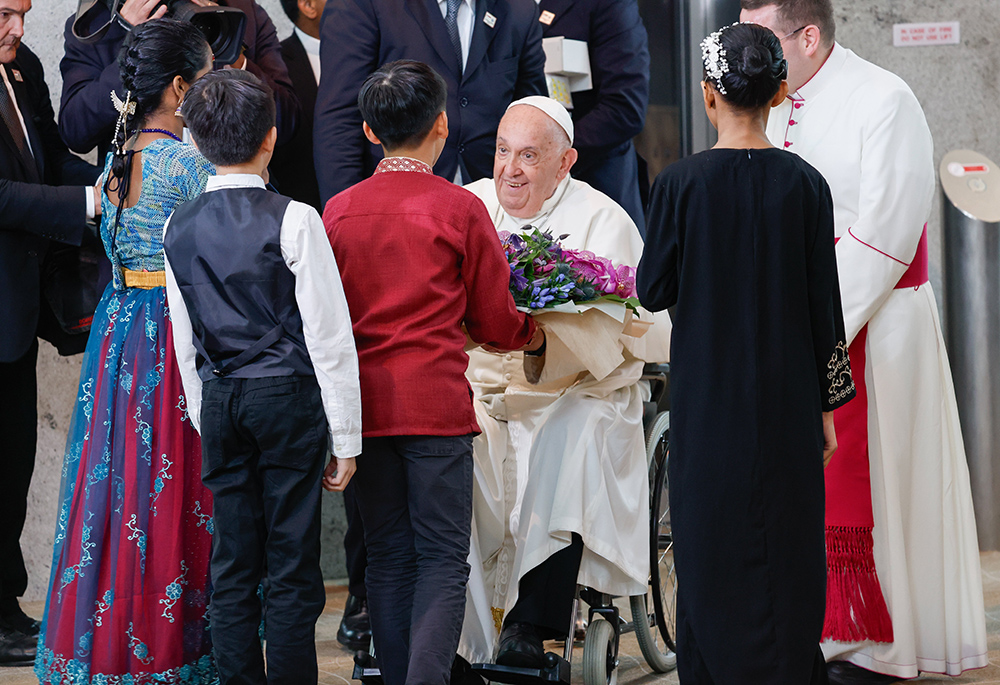
Self-constructed Christianity has other dreadful potentials, too. It produces people who believe abortion is something about which Christ smiles. It mistakenly prattles on social media that Jesus forbade judging anyone or anything. It heralds innumerable genders while encouraging irreversible surgeries for children. Speaking of children, it produces a pope fit for a millstone (Matthew 18:6) as he tells a young boy in Singapore that “all religions are a path to God… and each of us has a language to arrive at God. Some are Sheik, Muslim, Hindu, Christian, and they are different paths to God.”
Regardless of how Pope Francis’ handlers are spinning what he supposedly meant to say, his actual words measured against sound biblical doctrine proved themselves the heresy of religious pluralism, which rejects the essential teaching that Christ is the only way of salvation (John 14:6). Christians do not subscribe to religious pluralism. However, there may be one young boy in Singapore who does now, especially since he heard it from someone who’s supposed to know for sure.
Thinking about last week’s Epistle reading from Ephesians 4:1-6 appointed for worship here at Our Savior, I think Saint Paul indirectly weighed in on these things when he wrote, “I, therefore, a prisoner for the Lord, urge you to walk in a manner worthy of the calling to which you have been called…” (v. 1). Paul says three things here.
First, he insists on faithful abidance in “the calling to which you have been called.” In other words, you’ve been called to something—the Christian faith. That something has a walkway—faithful doctrine. Walk accordingly in it. When you wander past its edges, repent, and go back because the terrain beyond ends in destruction (Matthew 7:13-14).
Second, the walking is to be done in a worthy way. In one sense, it is demonstrative. People will see and hear. A young boy in Singapore saw and heard. Therefore, Paul instructs Timothy, “Watch your life and doctrine closely. Persevere in them, because if you do, you will save both yourself and your hearers” (1 Timothy 4:16).
Finally, Saint Paul already implied from his own situation, which he mentions specifically in Ephesians 4:1, that walking according to our calling could get a Christian into trouble. Behold, Paul was a prisoner for doing what he was even now urging his readers to do.
But here’s the thing.
Neither ease nor trouble affected the stepping stones of sound doctrine for Paul. The path was the path. What’s true was true, and what’s false was false. And so, he walked, and his faith was secure. In fact, it was armor-like. It could lean into and withstand the enemy’s thrusts along life’s way. It became fortress-like. Its resident could stand at the walls and confess truth before the barraging legions that surrounded it, even when standing where the enemy could see him meant imprisonment and eventual death.
Luther’s life was similar. Our lives are, too. And yet, together we have, as Luther described, a faith that is not an “uncertain delusion,” but instead, is a “strong, great certainty, which does not let us waver….” We can bear whatever the world brings our way, even a death sentence, and still retain the same kind of unshakeable trust in Christ that’s as simple as believing that “two and three makes five.” Indeed, that’s a simple analogy Luther made. And yet, it’s profoundly powerful. Even better, it’s unarguably true.
Lying to others is wrong. Lying to oneself is deadly. These were just a few of several recurring thoughts I experienced while watching the film Gender Transformation: The Untold Story, which the Life Team here at Our Savior in Hartland, Michigan, presented during a public forum this past Friday. Our world is right now living the dreadful compounding of lie upon lie to others and to self concerning God’s magnificent design of male and female.
But here’s the thing. While perhaps not as conspicuously awful or with such unalterably horrible results as the deceit presented in the film, we all lie to others and ourselves. If we believe we don’t, then we’ve already proven we’re self-deceived.
I think one reason we end up self-deceived is because of the way we so often prefer to process reality. We have interpretive filters. We experience something, and as we do, rather than its meaning simply being its meaning, we wittingly or unwittingly recraft it to fit us more comfortably.
For example, have you ever said something you intuitively knew was hurtful, and even as you meant the words to cut your opponent, when they did, to protect yourself from feeling bad, you insisted he or she misunderstood you? That was an interpretive filter you used. Specifically, it’s called gaslighting. Most folks might say gaslighting is more others-deceptive than it is self-deceptive. Perhaps. Either way, it’s a self-insulating barrier preventing what’s real from getting through as it should.
But enough psychoanalysis. The better exercise is figuring out why things are this way and what to do about it.
The “why” is easy. The Bible says it’s because of Sin (Psalm 51:5, Romans 3:23-24, Ephesians 2:3, etc.). Concerning self-deception, Saint John digs into the why’s soil and discovers the contaminant’s results, writing, “If we say we have no sin, we deceive ourselves, and the truth is not in us” (1 John 1:5). Paul digs beside John and finds more ruined soil: “For if anyone thinks he is something when he is nothing, he deceives himself” (Galatians 6:3). Shovel in hand, James hops into the hole and discovers the same, adding: “But be doers of the word, and not hearers only, deceiving yourselves” (James 1:22).
Again, the why is easy. But now, the harder part. What do we do about it?
I have two things to say in this regard. The first is Christological. We must always start with Christ and His Word.
As John, Paul, and James went deeper into the strata, other discoveries were made. Right after discovering Sin’s potential for self-deception, John also found the fertile soil of God’s gracious invitation, noting, “If we confess our sins, [God] is faithful and just to forgive us our sins and to cleanse us from all unrighteousness” (1 John 1:9). Paul found something else, too. Back in Galatians 3:11, he wrote, “Now it is evident that no one is justified before God by the law, for ‘The righteous shall live by faith.’” James made the same discovery. After nudging his readers from complacency, urging them to be more than just hearers but also doers of what the Lord desires, he dusted off a glistening stone etched with the words “the perfect law, the law of liberty” (James 1:25), which is James’ rhetorical way of pointing his readers to Jesus, the One who is the law’s perfection, the One who sets us free from the law’s burden so that we can be those who not only hear His Word but keep it (Luke 11:28).
While the three dig deeper still, the Psalmist arrives singing a faith-filled work song, one that asks God for help against deceit. The Psalmist sings, “Put false ways far from me…” (Psalm 119:29), and “Save me, O Lord, from lying lips and from deceitful tongues” (Psalm 120:2).
The second thing I want to say is as practical as it is Christological. Essentially, the Gospel nuggets are enough for faith (Romans 1:16). The faith it produces results in repentance. That’s what it does. The word “repent” (μετανοήσατε) literally means to turn around and go the other way—to change the direction of one’s mind or purpose. From a human angle, repentance is incredibly self-analytical. It wants to rid itself of faulty filters. It wants to remove anything that might deceive the self. It wants to boil things down to their mineral elements, see what’s actually there, and fix what’s broken.
For example, consider the following scenario.
Let’s say one of my daughters was troubled about something and asked for a moment of my time, but I reasonably replied, “I’m sorry, honey, but maybe later. I just don’t have time right now.” I had a sermon to write. I had a phone call to make. I had a meeting to attend. Repentance removes the filters and sees the situation for what it is. Relative to this situation, among the long and varied list of things a person should do, repentance understands the role of priority. And so, it hears what was said as, “I’m sorry, honey, but you’re just not a priority to me right now.”
Saying it that way doesn’t feel so good. That’s true, in part because of repentance’s natural direction. Remember, repentance is a reversal. The process of going one way becomes one of moving in the opposite direction. As a preacher, I think there’s more than one way to experience this reversal’s impact. Similar to exchanging the phrase “I don’t have time” for “you’re not a priority,” the same astonishing swap is possible when we invert our language, saying out loud the opposite of what’s actually true. Here’s another example.
I mentioned to Jennifer last week that one day, I’m going to preach a sermon in which everything I say is the exact opposite of what the listeners would expect me to say. The reason? It’s one thing for the average pew-sitter to make excuses for sinful behavior. But what if those same excuses were being commended from the pastor’s mouth? I can only imagine the congregation’s response to me preaching that presence in worship isn’t all that important. How startling would it be to hear me say from the pulpit that fidelity to Christ is just as important as fidelity to all the other things taking up space on our calendars? Would there be wide eyes as I say there’s nothing wrong with putting God’s Word in the back seat on occasion? Would there be gasps when I say God knows we sometimes need a break from Him and that He’s perfectly content playing second fiddle in our lives?
I’d go on and on, never once saying what you’d expect from a Christian pastor. I think the language reversal would be overwhelmingly eye-opening. Like telling my daughter she’s not a priority, it just wouldn’t feel right.
The people here at Our Savior will undoubtedly know if and when I attempt this. Until then, think about what you’ve read so far. Ask yourself, “Do I have interpretive filters that make lying to myself easier? Do I shield myself with excuses that do little more than keep me comfortable doing the things I know I shouldn’t?” If the answer is yes, then contemplate the dangers of insulating yourself in this way and repent. Turn around and go the other way. If the answer is no, then consider that you may already be self-deceived and don’t know yourself as well as you think you do. And then, as with the first answer, repent.
Grace is an amazing thing, especially when you are fully aware you need it and yet, in every way, are undeserving of it. If you don’t know what I mean, then the only thing I can think to say is that you’re a textbook narcissist who’ll never know grace’s fuller impact because you sense no need for it. That’s unfortunate. Most normal people know the downcast feeling of causing harm. Most folks likely even sense the need to admit it. When they’re all alone with their thoughts, they experience the familiar urge to ask themselves, “Why did I do that? What on earth was I thinking?”
It’s also likely that most normal people know the overwhelming exhilaration that comes from expecting retribution but receiving grace instead. I’ve certainly had my share of moments when, whether in a flurry of imposed frustration or I was just being me, I acted in ways I later regretted. I said something I wish I hadn’t. I did something I wish I hadn’t. I remember once saying something to one of my children that I felt so bad about later that I nearly couldn’t sleep for a week. I felt so terrible afterward. Still, on the very same day of my crime, there was no lack of love bestowed upon me by the one I hurt. I was treated graciously, even hugged, long before a lowly father’s sad heart materialized with a verbal apology.
Yes, grace—undeserved kindness—is an amazing thing. When you experience it, you’re different afterward.
I read somewhere that grace is proof that a person means more to you than what he or she did to you. I suppose that’s another way of saying you love them no matter what. Mark Twain wrote something somewhere about how forgiveness is the fragrance a flower leaves on the boot that crushed it. If I had the power to recraft Twain’s words, I’d swap “forgiveness” with “grace.” Grace and forgiveness are two very different things. Grace—undeserved kindness—can be extended to both the penitent and the impenitent. Forgiveness is the actual removal of sin from the sinner (Psalm 103:12). God won the whole world’s forgiveness through the person and work of Jesus. It’s there and available. Penitent faith receives it. A person who is not penitent sees no need for forgiveness. In that sense, it remains apart from him. In the meantime, grace more than sets and maintains the stage for it. When we show grace, we’re showing patient love. We’re making it so that when penitence emerges, we’re ready to bestow the kind of forgiveness that knows the full removal of guilt and the beginning of a brand new day.
Lots of folks disagree with me on this point. They point to texts like Matthew 6:15, Ephesians 4:32, and so many others. I would argue they’re missing the penitent undertow of the texts. In other words, these texts understand we ought never to withhold forgiveness from anyone desiring it. If they request forgiveness, we give it, no matter if we think the penitence is real or fake.
There’s an element of this in Jesus’ answer to Peter’s question about how many times he was required to forgive a penitent brother. “Lord,” he asked, “how often will my brother sin against me, and I forgive him? As many as seven times?” Jesus essentially responds by saying people who ask for it get from us as much as they want. “I do not say to you seven times, but seventy-seven times” (Matthew 18:21-22). That’s hyperbole. It means we never stop doling it out.
In Luke’s version of the same narrative, Jesus turns the challenge back upon the forgiver. He says, “Pay attention to yourselves! If your brother sins, rebuke him, and if he repents, forgive him, and if he sins against you seven times in the day, and turns to you seven times, saying, ‘I repent,’ you must forgive him” (Luke 17:3-4). The point here is that we should determine our own motives in the exchange. We’re not in the business of reading a person’s heart. We’re not the ones to determine if the person genuinely desires reconciliation. We’re also not in the business of making it hard for someone to be forgiven. No matter how mad at them we may be, or how much we want to get them back for their crimes, or what we think their motives might be, we get out of forgiveness’ way. We stand infinitely ready to forgive, no matter how many times they reach out to us for it.
That said, can forgiveness be given to someone who sees no need for it or, worse, rejects it outright? Knowing that human-to-human forgiveness is to be an imitation of God’s forgiveness, is that how it works between us and God (Colossians 3:13, Matthew 6:14-15)? The text from Luke 17:3-4 assumes no. John 20:23 assumes no, too, saying, “If you forgive the sins of any, they are forgiven them; if you withhold forgiveness from any, it is withheld.” The doctrine of excommunication taught in Matthew 18:15-18 and Titus 3:10-11 assumes the same. So does 1 John 1:8-9.
“But what about the Lord’s words from the cross?”
Even the Lord’s words to His Father from the cross to “forgive them for they know not what they do” (Luke 23:34) is not an insistent decree that those who were murdering Him in absolute unbelief should somehow be granted the privilege of skirting unbelief’s result. For starters, the word here for forgive is ἄφες, and it’s equally translatable in this context as “dismiss” or “disregard.” In fact, a language scholar and commentator I trust, R.C.H. Lenski, wrote concerning this verse:
“‘Forgive’ is not expressive enough: ‘remit,’ ‘dismiss,’ ‘send away’ render the true sense. The object is not stated but is plain from the added clause: dismiss ‘what they are doing.’”
Essentially, Christ is asking His Father to be what He already knows He is: gracious. He is asking Him to put aside His wrath at this moment, knowing full well that if there was ever a time for wrath, it was now. Still, the Lord tearfully pleads for the Father to look away, to dismiss what they’re doing, to let this one go by unpunished.
By the way, grammatically, the pronoun “them” refers to the Roman soldiers performing the crucifixion. They’re its antecedent, not the Pharisees and crowd demanding the Lord’s torture and death. That’s no small detail.
In the end, this is not complicated. Christ did not upend what we know of forgiveness. He simply continued doing what He always did during His earthly ministry. He was gracious, continuously showing concern for others before the self. On the cross, He unwaveringly emitted this others-focused grace perfectly, wanting the Father to look away, perhaps even giving His fiercest enemies time to come to their senses. Again, why? Because the Lord knows better than all of us the truest nature of Sin. He knows that humanity is influenced and held captive by something we cannot fully grasp. Indeed, far too often, we do not know what we do.
I think some of my theological critics—the ones who will say I’m mistaken in this regard—believe as they do more so because pop psychology’s understanding of forgiveness has been so ingrained in our post-modern psyche. For many therapists, forgiveness is more about personal healing and the ability to move on with a normal life. For example, forgiveness has come to mean that to get beyond a traumatic marriage, a woman must learn to forgive her abusive husband. I read a story last spring about a mother who confronted her son’s smirking murderer in court, saying, “I forgive you for what you’ve done.” The killer was by no means sorry. In fact, he was glad he did it. Can he lay claim to the forgiveness she offered? No.
But her grace can be imposed on him, whether he wants it or not.
The mother can pray for her son’s killer, asking the Heavenly Father to grant him what’s necessary to come to his senses and repent. She can write Gospel-rich letters to him in prison, knowing that the Gospel is “the power of God unto salvation” (Romans 1:16). She can visit him in prison, too, and share that Gospel face-to-face. She can show him that, as a human being, he means more to her than what he did to her son. That’s grace, and it smears a perpetrator’s filthy bootheel with the kind of scent that can lead a person to the One who, ultimately, bestows the only kind of compassion capable of instilling repentance and faith (Matthew 5:13-16, 43-45; John 13:35).
I’m sure you have situations in your life to which this little rambling might be applied. We all do. The Lord knows we’re neck-deep in a political season that’s going to require a lot of grace between so many. Of course, to those who wrong you, don’t be a pushover. Make sure they know what they’ve done. Beyond that, be gracious, and then step back and see what happens. You may be surprised. There may come a time when you hear them say with sincerity, “I’m sorry.” And because you were still immersed in grace’s patience, what a joy it will be to say, “I forgive you.”
Those who know me best are not surprised each year by my autumn discontent. The leaves fall, and with their pixie-like twirling, so goes a portion of my enthusiasm. Add to this autumn’s brisk breezes and its chilled and misty rains pulling down more and more of the landscape’s adornments, and it’s as if an unseen prison guard is escorting me to a dank and lightless cell. Michigan’s naked oak, maple, and dogwood trees surround and stretch skyward as its bars. My sentence? Six to eight months in the sunless cold.
I’m summer’s boy, and that’s that.
The thing is, I know it. And because I know it, I can war against the returning urge to pack up and move closer to the equator. Although, that reminds me of something. I had a phone conversation yesterday morning with one of our forthcoming conference speaker’s assistants. As is typical of many conversations, I was asked about the current weather. I was sure to mention my disdain for autumn and winter. The young woman I was talking with jokingly said she remembered hearing that space aliens appear to visit warmer regions more so than cold, which means my chances of abduction increase the closer to the equator I get. I told her I thought I’d heard the same thing from one of Joe Rogan’s podcast guests.
Familiar with Rogan, she noted his fascination with aliens, and then, to further the friendly conversation, she asked what I thought about the topic. I told her that while I appreciate sci-fi cinema, I don’t spend much time thinking about aliens, that is unless we’re talking about the millions of illegals crossing our southern border.
“What if they’re real, though?” she asked. “Then what?”
I knew what she meant. Even though we both considered the topic a relatively silly one, I could tell she had given it some thought. She wondered what the discovery of sentient beings from beyond our solar system might mean for Christianity. I think about lots of things, but I don’t spend much time thinking about things like this. Nevertheless, it certainly was an opportunity to shift gears in the way Saint Peter anticipated when he urged that we be “prepared to make a defense to anyone who asks you for a reason for the hope that is in you” (1 Peter 3:15).
My initial thoughts were that if extraterrestrial life was ever discovered, first, I don’t think its existence would obliterate Christianity in the ways so many atheists and agnostics assume. Faith doesn’t work that way. It’s far sturdier than onlookers may realize, and history proves it. Christianity has been through the proverbial ringer, the kind of turbulence that has undone so many other religions, and yet, it’s still here, and it’s encompassing the globe’s entirety. Extraterrestrial life’s existence would be interesting, but it would not disprove or smother Christianity. Of course, my ultimate baseline for saying this is that Christianity is true and all other religions are false. Truth withstands—falsehood crumbles.
From there, I went ahead and admitted to the widely held belief that alien encounters are likely spiritual in nature—but not the good kind. They’re probably demonic. I think Tucker Carlson believes this, too, which makes us kin to this perspective.
I know how that sounds, of course. It sounds relatively backwater. Nevertheless, I shared it openly. And so, you can see how unconcerned I am for being labeled “backwater.” So much of who I am and what I do so often gets that label, anyway. I believe a man cannot be a woman. For many, that’s the old way, the ignorant way. I believe all abortions are murder. That’s indeed becoming an outdated premise. It’s fashionable nowadays to grind both early and late-term infants into hamburger. I believe sin is actual. I believe Jesus was God in the flesh. I believe He suffered, died, and rose from the dead to rescue me from sin. To the onlooking culture, anyone believing these things is considered an intellectual dullard clinging to ancient myths and their accompanying superstitions.
Again, as you can see, I’m far more bothered by autumn and winter than I am by derogatory labels.
“For conversation’s sake,” she continued, wanting something more, “what if we actually discover they aren’t demons but real beings from another solar system? What then?”
Accepting her premise purely for discussion’s sake, I restated my initial premise. For me, it wouldn’t change anything about my faith. But then I went a little further. I told her just how important God’s Word is to me—that I believe every bit of it. I’m not a “Tim Walz” Lutheran.
Walz believes that while the Bible contains worthwhile but negotiable principles, it is, by no means, the inspired Word of God. In his view, we can take and leave whatever it says as we choose. I don’t believe that at all. I certainly believe it is far more than a guidebook. I absolutely believe it is divinely inspired. It is God’s revelation to man concerning salvation, and Jesus is the epicentral purpose of both its Old and New Testaments. I also believe the Bible is inerrant and immutable. It does not contain mistakes, and its doctrines do not change. If we find what we think is a mistake, then we’re not understanding it correctly. If any of its teachings don’t fit well with our time, culture, or modern understanding, then too bad. The Bible shapes us; we do not shape it. When God gave it through His inspired writers, He knew future generations would be reading it, and therefore, it applies to all of them.
Drenched in these qualities, the Bible sure does tell us a lot about God. He’s just. He’s loving. He’s redeeming. He’s not far away from us, but near. He cares. He creates. Concerning His work as the divine Author, one thing I can say for sure is that God is incredibly imaginative. Limited only by His nature, He can make whatever He wants. He’s God. And by limited, I mean things He cannot do, such as sin. Apart from that, look around at the countless varieties of life on Earth if you doubt His creativity. With every new documentary Jennifer and I watch (because most other shows are garbage), we’re both amazed to learn about new creatures we never even knew existed.
There’s something else I know relative to this. Within the Bible’s pages, God shows mankind to be His most prized work. In all the cosmos, He claims us as His beloved. That doesn’t mean we’re the only creatures He loves (Matthew 6:25-34). His love isn’t limited to us and nothing else. He loves and cares for the birds of the air and the lilies of the field, too (Matthew 6:25-34). It means that even as the birds and lilies are trapped alongside us in this sinful world, He didn’t take upon Himself human flesh and die to save them. His sights were set on us. He died to save us. Our rescue was His love’s aim. Our redemption was the purpose for His suffering and death. That’s a whole different kind of love—an extraordinary love, by comparison.
All of this together means two things to me. First, if we ever discover that aliens exist, God made them. I can say that because I’m in concert with all the Christians who’ve knowingly or unknowingly implied it for generations in the Nicene Creed. Together, we’ve been announcing God as the “maker of heaven and earth, of all things visible and invisible.” In other words, He made everything we can see and everything we can’t see, everything we know, and everything we are yet to discover.
Second, if there are aliens, like everything else God made, He loves them. Beyond that, all sci-fi-becoming-reality speculation ends for me.
Why am I sharing all this? Well, because it came to mind this morning, that’s why. Remember, I mentioned before that this whole conversation seemed a little silly. That’s because I think it is. It was a transitional interaction designed to carry two people from an introduction to the business at hand. But looking back, I can see its benefit. I was given the opportunity to think through and express my hope. Moreover, by measuring one of the strangest topics out there against Christianity’s deepest convictions, faith and its relationship to God’s inspired, inerrant, and immutable Word were hardened, not rattled.
In the end, no matter what’s going on around us, a Christian holds to the Bible as the sole source for faith, life, and practice. That’s because the Gospel of salvation through Christ is its core. Trust in this eternal truth is the fuel for Saint Paul’s confidence as he writes, “For I am sure that neither death nor life, nor angels nor rulers, nor things present nor things to come, nor powers, nor height nor depth, nor anything else in all creation, will be able to separate us from the love of God in Christ Jesus our Lord” (Romans 8:38-39).
Understand that “space aliens” fits into Paul’s phrase “nor anything else in all creation.”
The piece I wrote a few weeks ago about the Olympic boxers, unlike most others I’ve written, had me feeling less like I’d shared my thoughts concerning a troubling situation and more like I’d turned over the detritus of our culture’s forest floor. You know what happens when you kick over a rotten log, right? The creatures living in its decay suddenly scatter. Some scurry to find other dank places to dwell, aware that they’ve been discovered. However, the more territorial residents attack their rot’s disturber. That also happened in this instance.
The initial disturbance brought a steady stream of hate-filled termites with caps-locked keyboards and the foulest vernacular. I spent a good part of the week that followed blocking content and profiles from hundreds of “tolerant” intolerants. So much for my typical “post and ghost” policy. Although, I suppose it’s good that I hadn’t yet turned off notifications for the post. I was able to run a measure of defense.
For the most part, they swarmed me through private messaging. They chirped and trilled and clicked their usual angry sounds, calling me ignorant, bigoted, and so many other names adorned with vile adjectives. Thankfully, their stingers were words and nothing more.
I experienced only one venomous spray that seemed to invite conversation, even as I knew how that conversation might go if I engaged. So, I didn’t. All the others were colorfully uninviting. Few were spelled correctly. Seriously, if you’re going to speak viciously, the least you can do is run your savagery through Grammarly. It would appear far too many believe the word “bigot” has more than one “g.”
The grammatical ignorance was enough for me to turn off overall messaging access. After deleting a number of equally vicious remarks, I also changed the comment access for the post.
There was one private message that interested me, but only because it seemed to capture the hive logic used by so many of the others. Concerned by a relatively inconsequential detail the person thought was inaccurate, the message read something like, “If you can’t even get this one thing right, then you don’t deserve to call yourself a reverend.”
Two things about this.
First, imagine if one mistake—real or supposed—was enough to strip any of us of our livelihoods or identity completely. Of course, some mistakes, even simple ones, can have life-altering consequences. Something as simple as forgetting to use your turn signal can result in someone’s death. But the reality is that most often, our typical mistakes don’t produce those results. They’re merely incidentals along life’s imperfect way, all serving as reminders of a deeper need, a deeper incapacity in Sin. That said, there’s a reason that forgetting to put the milk carton back into the refrigerator isn’t a punishable crime. In the scheme of things, it’s not important.
But imagine if it was a punishable offense. Imagine if such a simple slip was enough to condemn you. I had a professor in my doctoral program who accidentally parsed a Greek verb incorrectly in the comments on one of my papers. Being attuned to language, especially in what has become an overly-emojied society, I remember such errors, and so I remember the mistake vividly. However, did the error prove his credentials empty? By it, did he forfeit all rights to the title “professor”? The cancel-culture insects perpetuating society’s rot would say yes.
Second, they’d say yes because forgiveness is not a part of their world. Whatever falls to the dark forest floor is eaten. But forgiveness drops light into the darkness. Indeed, its light offends the dark spaces ruled by death and decay. Still, forgiveness—the Gospel’s divine lifeblood—is meant for and goes into these spaces. It goes there understanding everyone’s dreadful imperfections while announcing promises that draw all toward the sunshine of God’s grace—a grace that gives mistake-makers what they do not deserve. Mercilessness and condemnation comprise the Gospel’s anti-nature. It is the sum and substance, the body and soul, of cancel culture. One mistake, one misstep apart from rot’s narrative, brings irrevocable imprisonment.
If this describes you, then I dare to offer two more diagnoses.
First, likely, you are so ideologically captured that you’ve become incapable of receiving information and navigating disagreements in ways beneficial to societal stability. I’m convinced one of the inevitable demonstrations of ideological imprisonment is when one is entirely oblivious to self-contradiction. An ideologically captured person willfully embraces two incompatible or inconsistent premises simultaneously and yet cannot see their incompatibility. What does that look like in real time? Well, one example might be the group “Queers for Palestine.” Homosexuality is illegal in Palestine, and I’m guessing these folks missed the news story about the 25-year-old gay Palestinian man whose decapitated torso was found in the West Bank city of Hebron. Another example might be the folks praising Kamala Harris for potentially being the first female president while also pummeling anyone who dares define what a woman is. They inevitably target with vitriol someone like me who boils the definition down to its mineral elements—the science of XY and XX chromosomes. These same people do this while demanding that folks “trust the science.” How can this be? Because when someone is ideologically captured, the only consistency that matters is one’s subscription to the narrative. Everything else, even facts, becomes pliable, and if not pliable, then irrelevant or labeled as misinformation.
Second, cancel-culture tactics prohibit the exchange of ideas, resulting in societal rot. Cancel-culture’s goal is to ostracize, boycott, and crush others into silence because of their opposing viewpoints. By default, this hinders open discussion and the free exchange of ideas. Why? Because humans are survivalists. When onlookers see a person viciously canceled for expressing his or her views, no matter how controversial or disagreeable they may be, others become fearful of speaking freely. Such an environment produces rot, which is the gradual decline or decay of essential values and mechanisms that bind a thriving society together. In a cancel culture, society suffers and inevitably comes undone because it loses the ability to challenge ideas or events that require refining or preservation.
If you are inclined to cancel others, then I encourage you to reconsider your heading. For as virtuous as you might believe yourself to be, to work this way is to be a part of the problem, not the solution. Are your ideas better? Put them into the arena for testing. We’ll see. However, if there’s one thing I know, it’s that natural law—God’s beautifully designed framework for life in this world—will always be the final determiner, even if society makes an epic mistake. Natural law will forever trounce a man who jumps from a three-story building because he’s ideologically convinced he’s a bird. Natural law promises him a painful landing. Natural law will forever complicate the biology of a person undergoing hormone therapy because he believes he was born in the wrong body. No matter how many surgeries he might have, his chromosomes and everything they’re in place to determine will never be or do anything other than what their design requires. Natural law will do what it’s constructed to do, and we’ll always be kept within its boundaries, even when we believe otherwise.
To conclude, I’ll simply say this—and maybe consider it a basic rule of thumb. If you find yourself resorting to insults, threats, or unhinged attempts to go after and silence others entirely, you might pause to consider whether your position is as strong as you think it is. Another thing to keep in mind: Truth doesn’t fear scrutiny; it thrives on it. And in the end, it will win. In one sense, that’s why Christians will always have the upper hand in life. We already know we’re mistake-makers, and yet, we’re attached to the One who is the way, the truth, and the life. The entirety of this spectacular trifecta comes together in the Gospel. Christians live in the sphere of forgiveness. Jesus lives there, too. He is the “way” of forgiveness. He is forgiveness’s epicentral “truth.” He is forgiveness’s best result—eternal “life”!
By faith, we know these things, and we’re more than familiar with the wonderful byproducts of this grace. The blessings of humble repentance stirred by an overabundance of forgiveness given by God are not lost on us. We’re glad for the newfound ability to amend our lives and share that same forgiveness with others. Ultimately, these are spirit-freeing mechanisms for courage and confidence. They lift believers above rot’s capture to the grace-drenched treetops, where we can see the world as it truly is and be quite comfortable describing what we see.
Every family is a symphony. Every member is a skilled musician with a unique instrument in hand. Every moment is a song, and every word is a note carrying its melody. Early last week, the Thoma family’s ensemble just grew by one performer. Preston Michael took his seat among us, and as you might imagine, for this grandpa, his promise is most rapturous.
I got to meet him the day after he was born. His dad—my son, Joshua—introduced us. I didn’t get to greet Preston properly, though. He’s currently in the NICU, and he’ll likely be there for a few more days. Nevertheless, at the time, his wriggling fingers, crinkly nose, and peeking glances were silent greetings that sang straight into my heart—a kind of resonance that only children and the angels who guard them can produce (Matthew 18:10). I finally got to hold him yesterday, and what a joy it was.
I can promise you that I intend to be the kind of grampa whose hug is felt long after I’ve let go.
With Preston’s birth came an in-rushing of familiar sensations. The day after he was born, Joshua and I talked about it while Jennifer and Lexi went down the hall for a turn with him. We spoke as only fathers can. I wondered aloud something like, “When you were born, I remember experiencing a particular sensation. It was a sudden awareness—almost a presence—something I felt like I could reach out and touch if I wanted to.” I told Joshua that when I first saw him, I knew everything in my life would be different, that nothing would ever be the same again, and that whatever happened from here on out, I was all in for him. I loved him. He was family.
Joshua confirmed the sensation. I’m not surprised. I imagine that, for most parents, the moment their child arrives—finally intersecting with the world in a touchable way—it is an event like none other. In a sense, even though the Earth still revolves around the sun, there’s a shift in gravity’s center. The child becomes the middle, a luminescent joy around which all other planets must spin. Indeed, as it was when I first became a father, it was the same for Joshua. Everything was different now, and no matter what the future held, trusting Christ, Josh knew it was going to be incredible.
We both admitted it wouldn’t be easy. In that moment, roles reverted. I was the dad again, and he was the son, with both of us recalling the challenges as we knew them. We acknowledged times when Josh made life more complicated and times when I wasn’t the best parent I could’ve been. Still, we returned to where we started. There we were, acknowledging that the lack of ease doesn’t negate the joy of parenting. If anything, it serves to remind us even more of family’s wonderfulness.
I’ve always believed that while God has fashioned some indescribably splendid things, of them all, family is one of His best. He brings two very different people together, a man and a woman, and from their union, life! However, not just human life (which, of course, is the wonder above all others), but instead the actual experience of living—the lived reality of vocation and recreation and relationships and all the things that a human experiences. The thing about family, however, is that while we’re out and about in the world living, even as that same world will so often be vicious and unforgiving, there will always be a group of people—a place—where living assumes love and where the cardinal rule of governance is forgiveness. In other words, God has designed the human family to be reminiscent of Himself. When everything around you is coming undone, or when you’ve been as unlovable as you can be, there will be someone willing to take you in, forgive you, and continue to love you.
The writer George Bernard Shaw, while he was a philosophical and spiritual mess, managed to get something right when he wrote that “family is but an earlier heaven.” In a way, Christians know at least two deeper truths in this.
First, we know that marriage, the institution that establishes families, is a glorious image of the Gospel itself. Saint Paul described marriage as a mysterious representation of something much grander: the relationship between Christ and His bride, the Church (Ephesians 2:32). Go anywhere else in Paul’s writings, and you’ll see this relationship is what it is because of the forgiveness won and exacted by the Groom, Jesus.
Second, we know family can at least be an atom-sized glimpse of heaven because, as I mentioned before, love and forgiveness are a family’s glorious essentialities. This is to say, the Gospel of Christ’s life, death, and resurrection show us a family established by grace born from devoted love. Born into this by baptism into faith, heaven becomes our rightful home. As believers, we’re those whose robes have been washed and made white in the blood of the Lamb (Revelation 7:14). By this, we belong, not because of anything we’ve done, but because of what God has done for and to us.
In short, God adopted us as His children (Galatians 3:26, Romans 8:14-15). He made us family. And now, no matter where His believers are from or what scars their pasts inflicted, God always takes in His family.
I don’t know what Preston’s future holds. But I do know he’s been born into a family that loves him, one that knows its frailties, and because of those insufficiencies, things won’t always be easy. And yet, God stands at the podium. With baton in hand, He’s conducting with grace-filled movements, coaxing from His white-robed orchestra such lovely sounds. It’s a divine composition of His care, ringing out melodies that sound like “I love you,” and “I’m sorry,” and “I forgive you,” and “It’s good to see you,” and “I’m glad you’re home,” and so many more. Preston now has a seat on this stage, and like everybody else in the orchestra and audience, I can’t wait to hear him play.
I’m guessing you’ve heard the saying, “Things are not always as they seem.” Truer statements have been made throughout history. Still, this is one worth remembering, especially now that artificial intelligence (AI) has become so prominent.
Relative to images of people, to gauge their authenticity, I’ve learned to look at the hands. It seems AI has difficulty creating human hands. There was an image of Trump going around not that long ago that seemed quite real. He was on his knees in prayer in a dimly lit church. It was defended as authentic and promoted with the byline, “This is what we want in a president.” Agreed, a praying president would be nice. The only problem is that the man in the picture had twelve fingers. I’ve shaken hands with President Trump. If he had such alien-like hands, I’m sure I would’ve noticed. Although a twelve-fingered, non-woke, pro-life extraterrestrial that affirms two genders, believes in secure borders, promotes religious liberty, and understands Critical Race Theory and Socialism as the devilish ideas they are, well, I might actually vote for such a creature.
I read an article several months ago about how 20 million of the 200 million writing assignments submitted in schools last year were as much as 80% AI-generated. That’s not good, especially since many of the assignments were university and research-level work. With this as education’s trajectory, could it be that, as a society, we’re not progressing but regressing? I wonder how many of those assignments were submitted in Michigan. U.S. News & World Report shared that Michigan is currently number 41 in education in the United States. Florida is number 1. Go figure.
Within the last year, I’ve seen occasional Facebook advertisements for sermon-generating software from a company called SermonAI. I’ve started reporting it to the Facebook overlords as sexually offensive. Why? Because there isn’t a “perverse” option, and when it comes to perverted behavior, a pastor preaching a sermon written by a machine seems pretty weird. Even if the resulting sermon’s content is good, it certainly stirs concerns relative to a pastor’s call. I mean, Jesus didn’t call ChatGPT to stand in His stead and by His command. He called a human man. He called a pastor.
A few weeks back, Elon Musk shared an AI-generated video of Kamala Harris. I half-laughed and half-cried through the whole thing. With a near-perfectly generated voice, the machine said things most already knew to be true. It confessed to knowing about Biden’s cognitive decline for many years, admitting the debate in June as proof the charade was over. It admitted to being a woke DEI candidate, which, technically, Harris already admitted during a sit-down conference conversation in 2017, saying, “We have to stay woke. Like, everybody needs to be woke. And you can talk about if you’re the wokest or woker, but just stay more woke than less woke.”
For clarification, woke means things like accepting that men can get pregnant, that the only way to conquer racism is with more racism, and that it’s reasonable to put people in jail for thought crimes. If you don’t know what thought crimes are, you should look up the term, especially if you have plans to travel to England.
The AI software even mimicked Harris’ word salad tendencies, which are the rambling go-nowhere speech patterns she often falls into during unscripted Q and A sessions. I looked up “word salad” to see if it had any clinical references. It does. It’s sometimes referred to as jargon aphasia, and across multiple sources, it appears to happen for one of three reasons. First, it’s an actual disorder, and the person speaking cannot communicate sensibly. Second, it can result from anxiety medication usage. Third, it’s a narcissistic defense mechanism. People in positions of authority who don’t know what they’re talking about will do it to make their listeners think they do. There’s no question Harris is a top chef when it comes to word salads. I’ll leave it to you to decide which of the three reasons fits.
While you’re deciding, one of my favorite Harris word salads involved an attempt at off-script intellectualism during a speech at Howard University. After some toothy cackling, Harris turned solemn, attempting intellectual eloquence, “So, I think it’s very important, as you have heard from so many incredible leaders, for us at every moment in time, and certainly this one, to see the moment in time in which we exist and are present, and to be able to contextualize it, to understand where we exist in the history and in the moment as it relates not only to the past but the future.”
What? That demonstrated genuine cognitive depth akin to a twelve-fingered Trump.
I could go on, showing how this message’s first premise haunts us. Indeed, things are not always as they seem. Knowing this, discernment is necessary. However, to get there, study is required. For example, did Trump really say that there’d be a bloodbath if he didn’t win the forthcoming election in November? Yes, he did. But what did he mean by it? Was he talking about a violent uprising, as the Democrats and media keep insisting, or was he referring specifically to the economy and the effects of certain trade agreements relative to American auto manufacturers? For the proper context, skip the baiting headlines and find the actual speech. You’ll have everything you need to decide.
How about the plot to kidnap Michigan’s Governor Whitmer? Was it really the brainchild of right-wing extremists? Look into it. Having graduated from the FBI Citizen’s Academy in June and experienced first-hand the Bureau’s prejudice against conservatives, I found it interesting that many in the extremist group were actually FBI informants or agents. The others were mostly exonerated. Those who weren’t—the handful who pled guilty—also pled entrapment, insisting they never would have come up with the idea, let alone acted on it, had it not been for the government’s influence. In other words, they were set up. Considering the timeline and its significance, the notably stalwart-against-right-wing extremism, Gretchen Whitmer, was handily re-elected, and both legislative chambers flipped from Republican to Democrat. A massive shift like that hasn’t happened in Michigan since 1983. It seems awfully Reichstag-like. What do I mean by that? Search “Reichstag Fire.” Even the first few paragraphs of the Wikipedia article will tell you everything you need to know.
How about the inconceivable idea that Planned Parenthood, as a commercial gimmick, might provide free abortions during the Democratic National Convention in Chicago next week? “That’s blatantly untrue,” were one friend’s stern online words. “That’s spreading misinformation!” Except, it isn’t. A Planned Parenthood branch—Green Rivers in Saint Louis—announced they’re taking their mobile clinic to Chicago, where they’ll park during the convention. “Here we come, Chicago!” they tweeted joyfully. “Our mobile health clinic will be in the West Loop… Aug 19-20, providing FREE vasectomies & medication abortion. EC [emergency contraception] will also be available for free without an appointment.” The post included a link for online reservations.
How about an easier one—a question that requires no investigation but instead begins with mere sensibility?
Should I trust the science? Should I get this vaccine and take that pill and wear this mask and have that procedure performed simply because the doctors and scientists—the experts—said I should? I wouldn’t even buy shoes without doing some research. I certainly wouldn’t do it simply because the shoe salesman—the product expert—said so.
In all things, investigate, discern, and then act. For Christians, the ultimate motivation for this is faithfulness to and alignment with God’s will. That’s the Bible’s uncomplicated direction. And why? Well, for one, only God truly has our best interest at heart. Therefore, we ought not to prefer above God those who can kill the body but cannot kill the soul (Matthew 10:28). We ought not to live in alignment with the world in ways that contradict His Word and trade away our eternal future (Mark 8:34-38). We must be “wise as to what is good and innocent as to what is evil” (Romans 16:19). Indeed, in all things, “we must obey God rather than men” (Acts 5:29).
Knowing this, we dig deeper. Inspired by the Holy Spirit, King Solomon urged, “The heart of him who has understanding seeks knowledge, but the mouths of fools feed on folly” (Proverbs 15:14). Fools post images of 12-fingered Trumps, vehemently arguing the image is real. Hosea insisted, “Whoever is wise, let him understand these things; whoever is discerning, let him know them; for the ways of the Lord are right, and the upright walk in them, but transgressors stumble in them” (Hosea 14:9). Saint John warned that Christians ought to test each spirit before believing it (1 John 4:1). Still, people blanketly believe that as an ELCA Lutheran, Tim Walz is a genuine Lutheran Christian. ELCA Lutheranism is more cult than Christian. It is in no way Lutheran. Genuine Lutheranism does not deny God’s Word is inspired, inerrant, and immutable. Genuine Lutheranism does not support nor promote abortion, transgenderism, social causes that fundamentally reject the Gospel while allowing cities to burn, and all the other leftist ideologies Walz and his beloved ELCA endorse.
The writer to the Hebrews described mature Christianity as the kind with “powers of discernment trained by constant practice to distinguish good from evil” (Hebrews 5:14). Saint Paul reminded the Church in Philippi to pursue the kind of love for God and one another that abounds in “knowledge and all discernment, so that you may approve what is excellent, and so be pure and blameless for the day of Christ” (Philippians 1:9-10). He said the same thing with fewer words in 1 Thessalonians 5:21, writing, “But test everything; hold fast what is good.”
I’ve already gone on long enough, and I think you get the point. So, how about I close with this?
Things are not always as they seem. Therefore, investigate. Become familiar with the characters’ names and the mechanisms’ histories. Read a transcript on occasion. Watch a congressional hearing. Read a little about the actual differences between LCMS and ELCA Lutheranism. Consider the various details you just can’t get in a two-paragraph article or a 30-second news clip. Finally, make sure you’ve answered your own nagging questions about whatever it is you’re investigating. Those questions may actually be unspoken warnings to keep digging.
When you’re finally ready, act. Put your knowledge to work. I’ve heard it said that knowledge must be put where people will trip over it. The Bible speaks similarly, noting that those who have the Word of God and the knowledge it gives will practice it. Those who do not ultimately deceive themselves in ways that could result in their unfortunate judgment (James 1:22, 2 Peter 2:21-22, Hebrews 10:26-30).
Investigate, discern, and then put your knowledge to work. Start tripping people with knowledge. And not only the identifiable (and beneficial) boundaries of right and wrong, truth and untruth, but also the better facts of sin and grace—namely, the life, death, and resurrection of Christ for the world’s rescue. As a Christian who knows stuff, you may only be working part-time if that’s missing from your efforts.
If you’ve ever been to my office, then you know I have a palm tree. Jennifer bought it for me as a Christmas gift last year. It’s fake, of course, mainly because I’m no horticulturist. Even a cactus will see me coming and take its own life. Nevertheless, real or fake, the tree rises from my office’s corner, a few of its frons reaching toward and over my desk. I like it. It looks real enough for its purpose, which is to help with the winter doldrums.
I wrote a few years ago in an AngelsPortion.com post about wanting to grow a live palm tree here in Michigan. If you’re interested, you can read about it here. I researched the different kinds, eventually learning there is one capable of withstanding occasionally colder climates. Unfortunately, in this case, natural law reestablished itself. For starters, a palm tree that can withstand occasionally colder climates is not the same as one that can withstand cold climates. Occasionally colder and regularly cold are two very different things. The former assumes more warmth than chill. The latter understands the opposite. Michigan is not just occasionally colder than places like Florida. It’s cold, and it can be so for long periods—as many as eight months. I think the way I described it in the post was that snow does not exist in Michigan; instead, Michigan exists in snow.
I grew up in central Illinois. It gets cold there. It has snow, too. I read C.S. Lewis’ The Lion, the Witch, and the Wardrobe as a kid, and I’ve since reread it to my children as an adult in Michigan. There is the following moment in the volume between Mr. Tumnus and Lucy, which reads:
“It is winter in Narnia,” said Mr. Tumnus, “and has been for ever so long….”
As a kid, I don’t remember reading that line and thinking, “Ugh, just like Illinois.” Maybe that’s because I thought a lot differently about winter as a child. I can assure you I absolutely do remember reading the story to my son, Joshua, and thinking, “Narnia must be located somewhere here in Michigan.”
I won’t drone on about this anymore. You already know my love affair with summer. Relative to real and fake palm trees, however, there is at least something to be mined from my complaint. Maybe think of it this relatively simple way.
A human with XY chromosomes, even as he may suffer characteristics or physical abnormalities that make him appear feminine, is a male, and as is usually the case, his baseline capabilities native to his chromosomal standard, if left to develop, will prove predominant. In the same way, a human with XX chromosomes, while she may suffer from abnormal masculine attributes, is a female, and her developmental trajectory will inevitably prove it.
Lin Yu-ting and Imane Khelif, two individuals with XY chromosomes who unsurprisingly dominated the female Olympic boxing scene and ultimately fought one another for the gold, are artificial palm trees in Michigan. To this very day, even after suffering the typical progressive rhetoric, the International Boxing Association (IBA) insists they are men, having disqualified them from participating in IBA-sanctioned bouts. Yu-ting and Khelif were tested chromosomally, and the results were unquestionable. They are men. Both were given the opportunity to appeal the results. Yu-ting did not. Khelif did at first but then withdrew the appeal.
Why? Because a second test, like the first, would have doubly certified both are artificial palm trees—fake women—and they do not belong in women’s sports.
“Then why were they allowed to compete in the Olympics?”
First, you’re asking why the same organization that gave us an opening ceremony awash in transgenders with uncovered genitalia parodying Da Vinci’s “The Last Supper” would allow men pretending to be women to compete in female sports. That alone should answer your question. The International Olympic Committee (IOC) was infected by the woke mind virus years ago, and gender has long since lost its meaning among its members. Second, while the IBA determines gender through testing, the IOC’s only gender determination comes from what’s printed on an athlete’s passport.
“But it’s not that simple, Pastor Thoma. These athletes are human beings suffering from a rare condition.”
And yet, strangely, these poor, marginalized human beings suffering from a rare condition handily destroyed every female boxer from every other country, eventually competing for gold in their individual weight divisions. What an underdog story this is. Or isn’t.
With respect, I’m not buying that argument. I’m convinced the “rare condition” discussion was popularized and used as a pity-generating excuse to make more room for gender confusion, especially since it didn’t emerge until much later in the controversy—and it was never fully substantiated. In addition, the IBA and its doctors—collectively, the recognized worldwide boxing authority—outright rejected the premise relative to women’s sports. Instead, they insisted XY boxers would always put XX boxers in danger. That’s no small thing.
Still, as blurry or unsubstantiated as the excuse may be, let’s say these men actually do have an abnormal condition. My response would not change, except maybe to say their condition saddens me. Such is sin’s dreadful fingerprint upon human flesh. Nevertheless, a person with no arms, for as unfortunate as his condition might be, cannot participate in an arm-wrestling competition. That is his lot. I have a terrible back. There are things I cannot do that others can. This is a thorn for me. I plead daily for relief. And yet, Saint Paul teaches: “I was given a thorn in my flesh, a messenger of Satan, to torment me. Three times I pleaded with the Lord to take it away from me. But he said to me, ‘My grace is sufficient for you, for my power is made perfect in weakness’” (2 Corinthians 12:7-9). Paul carried on in his lot, unable to be or do anything other than what he was.
If Lin Yu-ting’s and Imane Khelif’s conditions prevent them from competing, then so be it. It’s tragic, but it’s a tragedy that exists within reality, and we all bear thorns that prevent us from one thing or another in that sphere.
And so, yes, it really is that simple. Behold the XY’s innate advantage over its XX counterpart. Blow after blow, it asserts its natural physical dominance over its female opponents, and it does so to the women’s danger. To micromanage and ultimately convolute the issue through supposed transgender or intersex equality excuse-making only demonstrates a cultural infection that threatens to uproot far more than women’s sports. It threatens humanity’s future.
A real palm tree will not grow in a Michigander’s front yard. If you see one, it’s fake. It does not belong.









 Cruciform Stuff