Eerily Applicable: The Screwtape Letters

Moving into the summer months, there is a transition that occurs here at Our Savior in Hartland. We move from a typical Sunday School arrangement into what we call “Family Sunday School.” The typical Sunday School structure is as you’d suspect. The adults gather for study with the pastor, while the children are shepherded according to their appropriate grade levels to classes taught by an adult volunteer joined by one or more assistants. When summer comes around, we gather adults and children together for study, with each lesson being taught by the pastors, seminarians, and others. Last summer we studied the liturgy. In summers before that we studied our Lord’s passion, the biblical themes of our congregation’s stained-glass windows, and plenty of other worthwhile topics. This year we’ll be trying something a little different. We’ll be visiting with ten of the thirty-one letters in C.S. Lewis’ book The Screwtape Letters.

If you’re unfamiliar with the book, just know it’s a stranger bit of Christian fiction, the kind that only the brilliant author of the Chronicles of Narnia series could summon. Although, I hesitate to call this unique work by Lewis fiction. In a way, its point is genuine. It observes the Christian faith through the eyes of a demon named Screwtape. An uncle to Wormwood and an undersecretary in hell, Screwtape is writing to his nephew, offering his best advice for accomplishing the condemnation of Wormwood’s “patient,” a young man in England during World War II.

I’ve read the book several times over the years, usually a few letters at a time, and only as the urge to turn a few pages surprised me. I’ll be starting this summer study, which begins today. I’ll introduce the book’s characters before handling the Preface and Letter 1. From there, I’ll turn over the remaining sessions to others throughout the summer. I’ll wrap it all up in August. Along the way, we’ll do our best to make the material graspable to all, even the youngest among us. The book does dig relatively deep. This means it will take a little extra effort to bring the kids along. That being said, I’m not one to impose upon children a list of inabilities foreign to them. In fact, I have a feeling they’ll understand far more than any of us may expect. Besides, Christ Himself reminds us that when we grow up, we need to be more like them than adults, especially when it comes to the things of faith (Matthew 18:1-6).

In preparation for this morning’s effort, there is a line in Letter 1 which reads, “The trouble with argument is that it moves the whole struggle on to the Enemy’s own ground.” By the “Enemy,” Screwtape means God. Screwtape continues advising Wormwood that it’s best to keep his patient away from the exchange of opposing viewpoints, primarily because it involves genuine contemplation, and genuine contemplation is the potential pathway to discovering objective truth. An honest handling of objective truth can only lead to the divine. Equally, Screwtape discourages courteous discussion. In other words, keep it as a heated exchange of little more than emotional declarative statements fed by the distractions of what he refers to as “real life,” namely, what interests the patient personally. “And don’t let him ask what he means by ‘real,’” the undersecretary demon makes clear. This is to say, let him define reality in whatever ways he wants to. This is the essence of the old proverb, “Devil take the hindmost.” It describes someone serving his or her own self-interests at the expense of what’s right or wrong, true or untrue.

These things being the content of just the first letter (and the doorway to all the others), already the reader can see how timelessly insightful C.S. Lewis is for revealing hell’s tactics. He wrote this book eighty years ago, and yet, when we compare it to what’s happening in our world today, it seems a much more recent editorial.

Not much has changed. And why? Well for one, I suppose Satan appreciates consistency, knowing not to fix what isn’t broken. In a way, his appreciation of consistency reveals his devilish hypocrisy, too. What I mean is that it’s a nod to the only things that truly are consistent: God and His natural law. By nature, creation is bothered by shifting inconsistency, but instead takes comfort in reliability. Just ask a preschooler, someone who is the epitome of natural law at work in humanity. Try swapping story time with craft time on the schedule. You’ll learn very quickly the innate urge to abide by the natural order of things. In fact, you’ll learn it takes some pretty smooth talking to steer away from it.

Again, part of Lewis’ point is that honest observation and genuine discussion have the potential for revealing these consistent boundaries—at least that they actually exist. When one realizes objective truth exists (as Lewis makes abundantly clear in his book Mere Christianity), the likely endpoint is, at a minimum, an acceptance not only of God’s existence, but an embracing of Him as the wellspring of these truths.

Of course, Christians equipped with the Word of God already know the deepest of all these things, which is the two-fold thread woven into and through the entirety of objective truth’s fabric. It’s God’s gracious warning of our dreadful condition—our unalterable predicament in Sin (Romans 3:23). And yet, He pierces the hopeless situation with the bright-beaming light of His love, revealing to us that He has sent and accomplished the solution to this humanly unsolvable problem. He sent His Son, Jesus Christ, who by His incarnation became one of us and atoned for the Sin of the whole world (1 John 2:2).

Interestingly, Screwtape references his disdain for Christ’s incarnation right away in the first letter. Referring to the patient’s humanity, he reminds Wormwood, “Remember, he is not, like you, a pure spirit. Never having been a human (Oh that abominable advantage of the Enemy’s!) you don’t realize how enslaved they are….” Amazingly, Screwtape speaks to humanity’s bondage in Sin while at the same time expressing frustration that Jesus, out of great love, stepped into it, submitting Himself to the same bondage.

As the book goes on, these types of theological premises expand. As they do, we get an inside look at just how frustrating they are to the old evil foe, Satan. At the same time, we become more attuned to the vile tactics he uses for obscuring our view of God’s loving effort to save us. As you get deeper into the book, I guarantee you’ll sense their familiarity.

And so, if you haven’t already, I encourage you to read The Screwtape Letters. It’ll be well worth your while. Although don’t be surprised if you suddenly find yourself being distracted from reading it. Again, even though it’s technically fiction, I doubt the devil is too appreciative of it. It’s far too accurate a depiction for his liking.


It’s Complicated

Have you ever had one of those moments when you suddenly realized you’d matured in your understanding of something? Usually, the process of mental maturity is a gradual one, moving along so slowly that you don’t necessarily realize the things you are realizing. Every now and then I’ll observe what feels like sudden realizations with my kids. They’ll use a word they’ve never used before, or they’ll ask a question in a way that proves a much deeper awareness of a certain subject. In those instances, it’s as if I saw them leap from one of life’s steppingstones to the next. I enjoy such moments. They’re milestone flashes for any parent.

I rarely notice these moments in myself. I usually just move along knowing what I know. Of course, I’m always learning as I go, and as my knowledge base grows (or is cultivated), God willing, I’m faithfully employing every fiber of its muscle as possible. Still, there are those moments when I realize I’ve changed, that I’m not processing things as before. I’ll give you an example.

Today, Our Savior in Hartland celebrates the Festival of the Holy Trinity. Each year, Holy Trinity Sunday is an opportunity to meet with the wonderful, and yet ungraspability, of our Triune God. Hopefully other churches are blessed to do the same. I suppose they need to care about such things, first. We certainly do. Following along with the historic lectionary, we’re always so incredibly blessed to wade into certain occasions that eventually pull us into the deeper waters of divine truth. We’re not guided by the “sermon series” whims of clergyfolk who, perhaps being huge fans of Star Wars, want to spend the whole summer donning various costumes from the nine films all the while complicatedly imposing the Gospel upon each.

For as interesting as that sounds… (yawn). But hey, you do you, I guess.

Anyway, having revisited the texts appointed for today, most especially John 3:1-17, I realized I’ve become someone geared toward and appreciative of simplicity. In other words, I used to be someone prone to spinning my wheels in the mud of over-analysis. Nowadays, I’m comfortable seeing things through very simple lenses, and the simplicity is providing a clarity of sight about complex things that I don’t recall having before. Of course, I’m not saying that life doesn’t require contemplation. It does. What I’m saying is that with the Gospel for faith as the essential interpreter for pretty much everything, I experience what the Lord described in Matthew 18:1-6, which is a childlike sense.

Interestingly, John 3:1-17 is a reminder that while our God may be thoroughly unsearchable in His being, He really isn’t that hard to figure out. In short, sin is real and identifiable. It is condemnable. Everyone on the planet is infected by it. But God’s desire toward sinful man is one of love. It really is that simple. He loves us and wants for our salvation. It’s only when we complicate His desire for our rescue communicated straightforwardly by His Word that we complicate His desire’s reach into the world, sometimes negating it altogether. Nicodemus proves this repeatedly as he attempts to interpret Jesus’ words according to his reason. Doing so complicates his grasp at holy things and produces some pretty ridiculous conclusions, even one statement about climbing back up into his mother’s womb to be reborn, which seems almost a snide poke at Jesus’ simple preaching.

Thinking about all of this, I can’t help but recall what the month of June has become—LGBTQ+ pride month—along with all the denominations of Christians around the world who’ve somehow reasoned their way into believing God’s okay with the lifestyle.

The Bible is by no means unclear regarding God’s displeasure for the LGBTQ+ sexual ideology. It also doesn’t deny God His rightful due as the supreme determiner of right and wrong. In other words, when we stand before the throne on the Last Day, it will be according to His standards, not ours. What He considers godly and ungodly will be counted as such. Nevertheless, there is an aspect of the sinful nature that tries to wiggle free from God’s definitions so as not to be counted guilty for sinful behaviors we’d prefer to overlook or maintain. When we do this, the baseline of God’s Law appears cloudy—is made complicated. We no longer believe we’re doing anything wrong because, well, life in this world isn’t that easy to compartmentalize, right? The Bible might present itself in clear terms, and yet, there are plenty of reasonable explanations for people being the way they are and doing what they do. Surely, God understands this and is likely to be flexible with His boundaries. I mean, perhaps people were born a certain way—with certain inclinations—and if God created them, surely He won’t be justified in condemning what He created. 

When we complicate our thinking this way, not only do we lose sight of God’s right and wrong, but the Gospel He put in place to meet it becomes clouded, too. In other words, if the LGBTQ+ lifestyle is not as God describes it in His Word, that is, it does not have God’s Law leaning against it, then two things in particular must be true. Firstly, God’s Word cannot be trusted—or at a minimum, we appear to have the freedom to take from it what we want and to forget about the rest. Secondly, it seems logical that the Jesus described by the scriptures as the Word made flesh—the One who came to save us from real, genuine, inescapable Sin—isn’t to be trusted, either, or again at a minimum, He isn’t as necessary in certain circumstances as we suspected. Saint Paul said that God’s Law has no hold on righteousness (Galatians 5:16-26). So, if I’ve convinced myself that what I’m doing isn’t sinful, but rather is acceptable to God, I won’t for a second believe I need a Savior’s rescue from it.

That’s not good. To do this is to deceive oneself and confuse truth (Romans 1:25, 1 John 1:8). What’s more, it’s an overly complicated and eternally terminal way to interact with God.

I say keep it simple—or as I discovered myself whispering alongside Saint Jerome this morning, “O, holy simplicity.” Honor God’s Word as reliable and true, and then stick with His definitions. Trust His desires, not yours. If you’re at all like me, when you keep things simple, being sure to view things through the lens of the scriptures, desiring to align with God’s desires, you’ll often discover the cultural fog beginning to dissipate, and with it, the fear of facing off with just about everything that might crawl out from beneath its cover.

Unguarded

Even though summer doesn’t technically arrive until mid-June, for many, it has already begun. School is out. Graduations are underway. Schedules become shapeshifters ready to consume each newly liberated hour the season promises. I don’t know what this means for you, but for the pastor of a church with a school it means arranging my day in a way that gets me to the office much earlier in the morning than usual with the hope that I can find my way home by mid-afternoon. Doing this allows time I don’t normally have with the family before needing to venture out for anything church-related in the evenings.

As it is every summer, I intend to use a portion of the morning’s quiet time for reading. Hardly moved by the criticism of my fellow pastors, I rarely spend much time in the summer with anything distinctly theological, but instead, whatever is enjoyable in the moment. Although, technically everything is theological—or better yet, Christological. I’ll give you an example.

I’ve already started my summer wanderings by picking away at a collection of letters from Charles Lamb, an essayist and poet of remarkable style from the late 18th and early 19th centuries. I stumbled upon the compilation in Google Books while looking for something else.

One thing is for sure, you can learn a lot by reading from a historical character’s personal correspondence. Not only do you discover the superficial things relative to culture—such as favorite foods, pastimes, manners, colloquialisms, and the like—but you learn quite a bit about the person’s hidden qualities. For instance, a rather famous Samuel Taylor Coleridge wrote a letter to Lamb, one in which he described summer setting in “with its usual severity.” Coleridge’s point was to complain about England’s unfortunate (but not unusual) coolness in May and June. Apparently, he didn’t like it. Interestingly, Lamb didn’t acknowledge Coleridge’s complaint in his reply, but instead carried on about how the painter who’d recently completed a portrait of Lamb had captured him in “one of those disengaged moments… when the native character is so much more honestly displayed….”

From what I know of Coleridge, which is that he was a delightfully expressive man, one who could hardly be characterized as a complainer, Lamb’s words to his friend seemed almost out of place. Or better yet, if they were intended as a subtle response to a very wise Coleridge, then they were pointed. In other words, they appeared to suggest that just like everyone else, the real Coleridge could be betrayed by an unguarded moment. For as beloved as Coleridge was by the public for his eloquent appreciation of all things, his secret dislike for English summers slipped through to Lamb.

Whether or not this was Lamb’s point isn’t exactly clear. Still, I have the nagging sense it was. Either way, like everything else in life, it can be viewed through theological lenses. In this circumstance, it first serves as a reminder that no one is perfect. It’s also a lesson to the would-be narcissists among us. For as complete as one might appear to be, the unguarded moments eventually come around, and when they do, our incompleteness breaches the surface. And this is a good thing. It brings about the opportunity for honest confession—the opportunity to recognize one’s need for rescue from Sin’s deathly grip.

Lamb wrote something else of interest in his reply to Coleridge. Having included a small facsimile of the portrait with the letter, he scribbled, “Whatever its pretensions, I know it will be dear to you, towards whom I should wish my thoughts to flow in sort of an undress rather than in the more studied graces of diction.”

Did you pick up on Lamb’s inference? He offered two things that, if thinking theologically, are likely to resonate with Christians. The first is that no matter our failings, we can be counted as dear to one another. This is true because God’s grace is holding us together as the body of Christ (1 Corinthians 12:27). With this as the connective tissue for our friendships, the second thing Lamb said becomes incredibly clear. He notes his hope for genuine honesty between he and Coleridge—that the things troubling, worrying, or haunting either of them can be made bare, rather than remaining guarded by a “studied” carefulness with words. This means as brothers and sisters in Christ, we don’t need to hide our real selves, as though needing to project an image of having it all together. We don’t even have to exist in a way that stays within the easy boundaries of cordiality. Instead, we can be real friends—folks ready to walk together through both the complete and incomplete parts of life.

In short, Lamb implies what the rest of us already know by King Solomon’s words, “For if they fall, one will lift up his fellow. But woe to him who is alone when he falls and has not another to lift him up!” (Ecclesiastes 4:10). This is the epitome of Proverbs 27:17, which reads: “Iron sharpens iron, and one man sharpens another,” and certainly it’s at least a molecule in the Lord’s formula fueling the encouragement to “consider how to stir up one another to love and good works, not neglecting to meet together, as is the habit of some, but encouraging one another, and all the more as you see the Day drawing near” (Hebrews 10:24-25).

My prayer for you today, and always, is that you will remain part of a Christian church family that truly enjoys such collegiality. We can do no better than to be surrounded by genuine Christian friends as much as possible, knowing full well that a “friend loves at all times, and a brother is born for adversity” (Proverbs 17:17).

Crucification?

I mentioned a few weeks back that I’ve been watching old episodes of “Knight Rider.” I must say again that it’s great fun, not only for the horrible special effects and equally terrible dialogue but also for the 80s reminiscence it stirs. I say this mindful of a recent episode in which KITT, the show’s futuristic talking car, insisted on Christ as the only sensible reason for celebrating Christmas. Even better, a little further into the episode, Michael Knight, the main character, casually assumed out loud to another character that anyone unfamiliar with the contents of the Bible must be part of a very strange minority.

I found those perspectives refreshing. Although, when I returned to real life, I suddenly found them disheartening, having realized we’ve drifted far from such comfortable vantages. Today’s ethos makes 80s TV show language feel more like the vernacular of an alien planet than an echo of earthly history. If you think I’m exaggerating, then consider the Gallup poll from the 1980s that determined a little less than 75% of Americans were biblically literate. In 2021, the number came in at around 11%. That’s not an annoying but nevertheless inconsequential sign that we’ve lost our national footing in this regard. It’s an indication we’ve gone over the cliff and are in free-fall.

A passing conversation I had about two weeks ago with our Kantor, Keith Vieregge, comes to mind. We were talking about how so many words in the English language are mauled with regularity. When someone says “supposebly” in our presence, there’s a good chance we’re cringing internally. But it gets worse. Keith mentioned how words are being completely reconfigured, having recently heard the word “conversate” used in place of “converse”—as in, “The teacher needed to conversate with the parents regarding their child’s behavior.” I agreed and then volleyed with the made-up word “crucification,” which I’d recently seen used in place of “crucifixion” in an online forum.

So, where am I going with this? Well, I suppose one point of intersection is that not only are we thoroughly lacking in biblical literacy, but with our current culture’s reworking of words, we may discover breakdowns in the fundamental transmission of the Bible’s contents. Anyone who cares about language will tell you that when words become confused, the only way forward is chaos. I mean, consider the current confusion regarding gender. The terms “man” and “woman” mean different things to different people. In relation, the word “sex” no longer refers solely to biological gender and reproduction processes. It has become ideological, and as a result, no longer holds a firm footing for easy communication. I proposed not all that long ago that the practice of confusing terms spilled over from academia’s already-poisoned river into the streams and creeks of America when Bill Clinton, in response to a question in front of a grand jury while under investigation for perjury, said rather ridiculously, “It depends on what the meaning of the word ‘is’ is.” Clinton went on to mumble almost unintelligibly, “If the—if he—if ‘is’ means is and never has been, that is not—that is one thing. If it means there is none, that was a completely true statement. Now, if someone had asked me on that day, are you having any kind of sexual relations with Ms. Lewinsky, that is, asked me a question in the present tense, I would have said no. And it would have been completely true.”

What a rambling word-salad of ridiculousness. If we don’t know how to properly handle the two-letter verb “is,” we’re in big trouble.

This reminds me of something else.

There is a memorable line in act 2, scene 3 of Macbeth that reads, “Confusion now hath made his masterpiece.” If you know the story, then you’ll remember these words being spoken after Macbeth murders Duncan, the King of Scotland. The point is to communicate the impending chaos on the horizon for a rulerless kingdom. When no one is in charge—when there’s no certainty for direction—things come undone very quickly. Maybe this line applies to 21st-century communication, too. When the crispness of language is murdered, regardless of the unkillable nature of objective truth, the ability to actually transmit objectively true things becomes untenable, burdened by the absence of universally accepted fundamentals.

Take for example the important topic of marriage. Marriage, and the families it produces, are the fundamental building blocks of every society throughout history. In a simple way, without the hardened commitment established by marriage, societies would dissolve into little more than chaotically self-indulgent gatherings overflowing with orphans. But how can you talk about marriage in any meaningful way if the variables of its equation are undefinable?

“Marriage is to be between a man and a woman,” someone might say.

“I agree with you,” is the possible reply of a transgender woman married to a man.

But they don’t agree on marriage. A transgender woman is a man married to another man, and by such a combination, cannot begin to meet the basic parameters of natural law God has cemented into marriage, one of which is the procreation of children. The frustrating breakdown here leads to giant tech companies, with all seriousness, creating emojis of pregnant men. It leads to schools teaching children gender dysphoria is something to celebrate along with phrases like “birthing person.”

In short, words matter. What’s more, holding the line on their structures and meanings matters, too.

Truth be told, I’m only sharing with you what came to mind after reading Proverbs 21:23 during my devotion this morning. The text reads, “Whoever keeps his mouth and his tongue keeps himself out of trouble.” I suppose the text is somewhat relative to the direction of my thoughts. The word used in the text for “keep” (שֹׁמֵ֣ר) means more than just to control something. It means to guard it for the sake of preserving it. A commentary I visited with this morning compared the guarding to someone who cares about the language they use, inferring someone who says “no more than is right and fitting.” This is both contextual and residual. In other words, aware of the precise meanings of words, a righteous person also knows the long-term damage that comes when those words are misused. Misuse leads to confusion. Confusion can result in a tangling that brings incredible harm.

Come to think of it, Jesus spoke to these things in a way when He said in Matthew 5:37 to let one’s yes be yes and one’s no be no. In context, the Lord is referring to taking oaths. But His broader teaching is not only to understand what is meant by the terms but to be so certain about them that you can speak with simplicity in a way that has binding strength. You can say “yes” and be fully invested in your answer, or you can say “no” and never feel the tug to question your resoluteness.

I don’t know about you, but on my part, I’m not only doing everything I can to be careful with language but to protect the terms that make communication through language of any value, especially as it meets with God’s Word. I don’t want confusion anywhere near the Gospel. Confusion, as John Milton chimed so poetically, brings nothing less than “ruin upon ruin, rout upon rout.”

Musk, Depp, and the Final Court

There’s quite a lot happening in the news these days. Do you have some time this morning for thoughts on some of it? Go get some coffee, because I have a few.

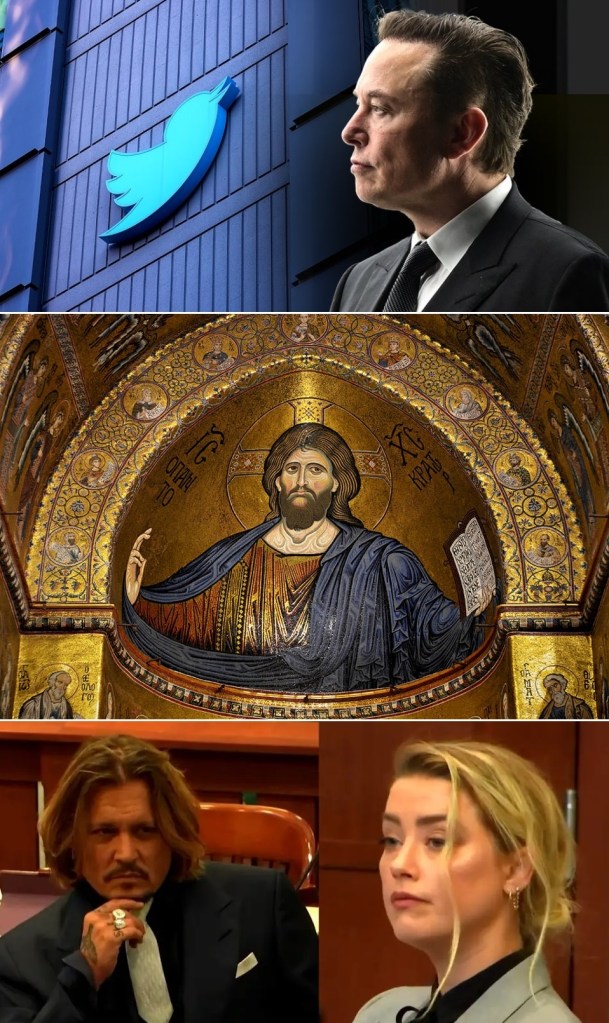
Elon Musk’s offer to buy Twitter was accepted. Admittedly, this was a bright-beaming ray of sunshine in my newsfeed. A few more beams poked through the dreariness of April’s war between chill and warmth when I saw the mainstream media folks throwing fits on live TV over Musk’s stated intentions, which were, essentially, that he wanted Twitter to be a true public forum for free speech. An important lesson here: the folks at MSNBC, CNN, and other such drivelous news agencies betrayed their ideological innards when they became enraged over Musk’s determination to halt the banning and shadow-banning of alternative points of view (namely, conservative viewpoints) so that genuine conversation can once again occur.

I mentioned online earlier this year—much to the repulsion of some—that I was starting to admire Elon Musk. This is one reason why. He may be eccentrically different from me in so many ways, and yet, he seems to have a good grasp of certain fundamentals that matter, one of which is the First Amendment. Yes, the Gospel will go forth with or without the freedom of speech. Still, the First Amendment is in alignment with Saint Paul’s concern in 1 Timothy 2:1-3, which includes engaging in the public square for the sake of maintaining a civil context that preserves the freedom to preach and teach Christ crucified. That being said, we should be on the side of anyone pulling for the First Amendment.

Interestingly, a few days after Musk’s purchase was announced, the Biden administration established the DGB or the “Disinformation Governance Board.” Hmm.

Political Commenter, Steven Crowder, pointed out another notable government in history that did the same thing: The Nazi Party. Crowder didn’t mention the Nazi board by name, but students of history will remember it as the Reich Ministry for Public Enlightenment and Propaganda (Public Relations). It was established in 1933, not long after Hitler came to power. Its stated goal was to “protect” Germans from disinformation. Joseph Goebbels was the ministry’s director. If you’ll recall, Goebbels was a principal architect of the “Final Solution,” that is, the extermination of the Jews. In other news, and perhaps strangely relevant, Holocaust Remembrance Day was this past Thursday in Israel. The whole country came to a literal standstill to remember the six million Jews murdered by the Nazi regime. I watched a video of the event. It was eerie; cars stopped on the freeways and their occupants standing outside the vehicles perfectly still. On the sidewalks, people stopped mid-stride, as if frozen. Maybe someone could do a quick PowerPoint presentation on this at the next DGB meeting.

Anyway, I could go deeper into this, but let’s just say for now that I hope Musk’s effort with Twitter is a success. What’s more, I may even rejoin the platform. I left Twitter a few years ago not only because I was being shadow-banned, but because Twitter was taking it upon themselves to delete my followers. I had several thousand, and then one day the number was cut by half. The very next day, the remaining followers were cut by half, again—and so on. On top of that, the “cancel” brigades were becoming exceptionally wily with my account. Believe it or not, the final straw for me was when Donald Trump’s account was permanently canceled, while Ali Khamenei, the supreme leader of Iran (and visceral sponsor of global terrorism and hatred toward America and Israel), his account was preserved. It remains to this day.

I’m also hoping that what Musk is doing with Twitter makes the folks at Facebook at least a little bit contemplative, if not nervous. Facebook owns Instagram. Right around the time I left Twitter, I was permanently banned from Instagram for posting a meme that stated men are men and women are women. Someone reported my post as hate speech. I was jettisoned from the platform. I tried opening another account a few weeks ago, but somehow, they knew it was me. I received messages reminding me I’d been banned permanently for violating platform policies.

I’m not so worried about this stuff, which I’ll get to the reason for in a moment.

So, what else is in the news?

Well, believe it or not, I’ve also been following the court case between Johnny Depp and Amber Heard. I don’t normally care all that much about celebrity trials, however, this one caught my attention. Why? Because while we hear so much about abusive (toxic) masculinity (i.e., the “Me Too” movement, and other default mantras), Johnny Depp was insisting on an alternate narrative. After a bit of reading, my gut began telling me we were finally seeing a man in Hollywood push back against abusive femininity. Having listened to several hours of the broadcasted trial (which is far less than the content of what I’ve read), I’m definitely rooting for Depp. He isn’t perfect by any means. He’s wrestled with drugs and alcohol. He’s been a neglectful father on far too many occasions. Admittedly, He’s been a lousy husband. But among these things, he’s never been one to abuse a woman. He appears to be the kind of man who, when verbally and physically abused, will never respond in kind—even if it means being belittled daily or having one’s fingertip sliced off.

Heard, on the other hand—someone who was known by her bodyguards to destroy Depp’s personal belongings, put feces into his bed, and whose friends testified that she hit them, too, for seemingly no reason—has been tested psychologically and deemed quite the opposite. I’m not surprised. Her documented behavior is hard to explain away, no matter how skilled the attorney may be. Perhaps worse, a recording played before the court proved her willingness to abuse Depp all the while hiding behind the current Hollywood (and dare I say, worldwide) mentality that men are, by default, toxically abusive and overlording. Heard’s recorded words were chilling. She implied that everyone would believe her before ever believing Depp simply because he’s a man and she’s a woman. In other words, he should just expect by default that her testimony would be considered true and his would not. She accentuated her arrogance by insisting that no judge or jury would ever side with a man in such a case, saying, “Tell the world, Johnny, tell them ‘I, Johnny Depp, a man, I’m a victim, too, of domestic violence… And see how many people believe or side with you.” When asked by his lawyer about his response to Heard’s taunting, Depp said rather simply, “I said, ‘Yes, I am.” What he meant was that he was, in fact, a man who was also a domestic abuse victim.”

Depp’s lawyer described Heard’s behavior as gross bullying—the kind that was only fed by Depp’s already burdensome sadness over his failings. It reminded me of Publius Syrus’ words: “Cruelty is fed, not weakened, by tears.” Indeed, Depp was already hurting. Heard used the tears of that hurt to increase her cruelty’s potency.

Shannon Curry, a clinical psychologist, testified against Heard using the term “code 36” to assert she has a personality disorder. Curry described this code, saying, “The 36 code type is very concerned with their image, very attention-seeking, very prone to externalizing blame to a point where it’s unclear whether they can even admit to themselves that they do have responsibility in certain areas.” She went on to say Heard is self-righteous, judgmental, and full of rage, with all these characteristics emerging from a deep, inner hostility. I think one place to see this is in the difference between Depp’s defamation suit and Heard’s countersuit. Depp is suing Heard for $50 million, which is what he believes he’s lost as a high-profile actor now considered toxically unemployable by most film studios. Sounds fair. Heard, however, is countersuing for $100 million, which is Depp’s total worth. In other words, Depp wants justice. Heard wants to completely decimate Depp. When someone can’t just walk away, but rather seethes with the desire to destroy another person’s life completely, that speaks volumes about what’s going on inside them.

As I said, I’m rooting for Depp. Equally, I’m hoping that the judge mandates for Heard to get treatment. Although, narcissistic personality disorders like hers are hard to cure, mostly because the one bearing them typically refuses to admit to needing help. Either way, and as I like to say on occasion, “The divine lights always come on in the end,” which means, do and say what you want now, but remember, the time will come for settling scores. That’s why I mentioned earlier that I’m not so worried about being slighted or maligned. God, namely, Christ Himself, will be the Pantocrator occupying the bench in the only courtroom that matters. It’ll be just as the Creed declares: “And He will come again with glory to judge both the living and the dead, whose kingdom will have no end.” He’ll settle things according to His standards, not ours. And no matter how right anyone thought they were, His “right” will be the final rule of measurement for all things and all people of all time.

That might sound scary to some. It probably should. That’s the benefit of God’s generous forewarnings. However, it doesn’t have to be menacing. Through trust in the person and work of Jesus Christ, believers can only ever be found guilty of one thing: saving faith. Jesus said as much in John 16:8-11 regarding the work of the Holy Spirit. He mentioned that when the Holy Spirit comes, He will bring three distinct counts of conviction. Jesus said the Spirit would convict the world “concerning sin and righteousness and judgment…” (v.8). The conviction in sin is an easy one. Jesus explained this will happen to those who “do not believe in me” (v. 9). In short, unbelievers remain trapped in sin. Skipping ahead to the last one mentioned—judgment—the Lord takes direct aim at the devil, saying that we can count on final judgment being leveled against Satan once and for all. It’s right in between verses 9 and 11 that the Lord says the Holy Spirit will convict “concerning righteousness, because I go to the Father, and you will see me no longer” (v. 10). In other words, we can’t see Jesus, and yet, we believe. These words Jesus is speaking on Maundy Thursday sound an awful lot like the ones He spoke to Thomas a few days later on Easter Sunday:

“Jesus said to him, ‘Have you believed because you have seen me? Blessed are those who have not seen and yet have believed’” (John 20:29).

The points here: Firstly, saving faith is only possible by the power of the Holy Spirit. Secondly, on the Last Day, all believers in Christ will be accused and found guilty of faith in Jesus before the highest court in heaven and earth. And so, if you’re going to be convicted of anything before God, let it be that.

Between you and me, knowing my many failings, I’m counting on God’s justifying promise found in the life, death, and resurrection of His Son, Jesus. Confessing my sins and clinging to His righteousness, even as things could be rough in this life, I know everything is going to be okay for the next when the divine lights come on and all is revealed.

Apologizing to Thomas

There is the rather elementary saying that one thing leads to another. It’s elementary because it’s true, and I have the perfect example to share.

You may or may not know this, but I’m a fan of 80s and early 90s sci-fi and horror films. I’ve seen them all, both the A and the B list—from Academy Award winners like “Silence of the Lambs” to straight-to-VHS gems like “Attack of the Killer Tomatoes.” Watching them now, I have to say that many are still very good. They’ve stood the test of time. Others were trash before they ever became a script, and they remain trash long afterward. The special effects were terrible, often intentionally. The dialogue was just as bad. It’s easy to tell that many were made just to be made. Trust me, “Friday the 13th” could have been put to rest after “Part IV, The Final Chapter.” Still, they gave us seven more and an attempted reboot. The same goes for the “A Nightmare on Elm Street” series. “Dream Warriors,” the third movie in the series, was the last of the franchise’s serious attempts. But the thing is, even the cringe-worthy sequels remained great fun. Their hokeyness only made the good films seem better.

Not long ago I was watching a documentary series called “The Movies that Made Us.” One episode focused on James Cameron’s masterpiece “Aliens.” Anyone who’s been in my basement will confirm the film as an absolute favorite of mine. I mean, it did win seven Academy Awards, one of which was for best visual effects.

Anyway, after watching the documentary, I did a little reading about James Cameron. In comparison to his accomplishments, I was fascinated with his beginnings. Interestingly, after seeing “Star Wars” on the big screen, he was inspired to leave his job as a truck driver and take aim at making movies in Hollywood. Personally, I’m glad he took the chance.

Reading about his life, I came across a TV interview he did with a California news station in what I believe was the early 2000s. During the interview, he said something along the lines of, “If your goals are set ridiculously high and then you fail, you’ll already be well past everyone else, having failed well above everyone else’s successes.”

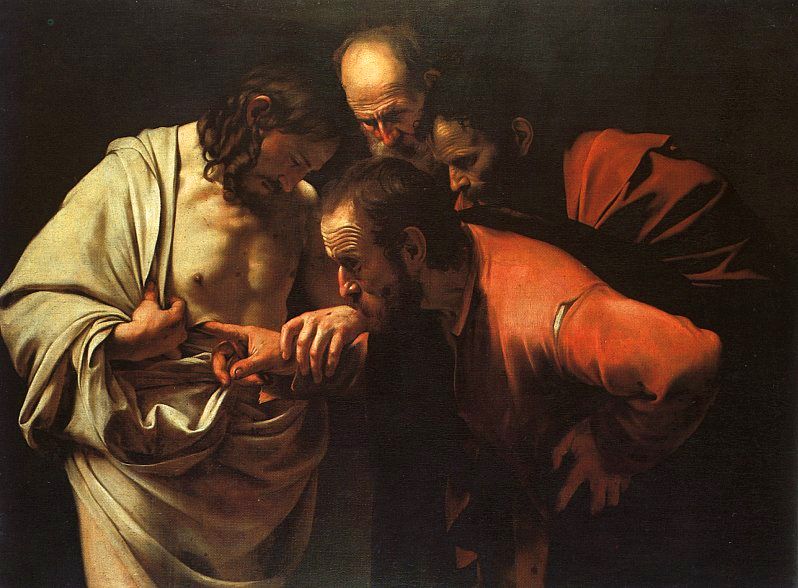
Remember how I said one thing leads to another? Well, here’s why I said it. That comment reminded me of the disciple Thomas. By the way, apart from Jesus, Thomas is the most important character in the resurrection narrative from John 20:19-31, which is also the appointed Gospel reading for the Second Sunday of Easter. Essentially, Thomas is the one who continues even now to get a bad rap for doubting the Lord’s resurrection. But the thing is, his seemingly greatest failure was far above the successes of everyone else in the bunch. Here’s what I mean.

All the disciples deserted Jesus. Peter denied the Lord. Still, it would appear that after the crucifixion and burial, all but Thomas were gathered together in the upper room. The narratives say this happened because the disciples were afraid of what the Jews would do to them, too. But where was Thomas? I’m willing to bet that the answer is assumed by the ease with which the disciples retrieved him after the Lord’s first resurrected appearance among them. They went to where they knew they’d find him—at home. Thomas went back to his life, apparently having already accepted his fate concerning a failed messiah.

But Jesus hadn’t failed. And so, the disciples went to Thomas to tell him the Lord had risen. What were Thomas’ words in reply?

“Unless I see in his hands the mark of the nails, and place my finger into the mark of the nails, and place my hand into his side, I will never believe” (John 20:25).

These words prove Thomas’ failure was well above everyone else’s successes. While everyone else was stowed away in fear and asking questions bent on self-preservation, Thomas had subscribed to his fate. But he did this bearing the embers of a faith that was asking for the only proof Jesus had ever promised to give. In other words, Thomas knew (whether consciously or subconsciously) that his faith could only be rekindled when he met a living Jesus with crucifixion wounds.

I was asked a few weeks ago who I’d like to meet first in heaven. Apart from the Lord Himself, and then my brother, I hope to meet Thomas. I intend to apologize to him on behalf of any human in history who ever used the title “Doubting Thomas” to describe him. Indeed, Thomas’ failure was well above the rest of our so-called successes. In the darkest hour of Good Friday and Holy Saturday’s deepest confusion, Thomas was asking the right questions. Everyone else was asking for personal safety. Thomas was asking to see the One who would eventually say by Revelation 1:18, “I died, and behold I am alive forevermore, and I have the keys of Death and Hades.” He believed as Saint Paul would eventually preach foundationally: faith in Christ crucified and raised (1 Corinthians 1:23, 15:1-26).

If only we could be as clear-sighted for receiving the risen Christ as Thomas, who is also the same one who gave what is perhaps one of the most moving confessions of joyful faith ever recorded in the scriptures. When Thomas took the strangest of chances at rejoining his fellow disciples in the upper room, the Lord gave Thomas what he asked for—the opportunity to touch His wounds. And again, what were Thomas’ words?

 “My Lord and my God!” (John 20:28).

I dare say that as we so often live our lives beneath a shroud of deeper doubt than even that of Thomas, not trusting that the Lord will care for us as He’s promised, there will come the day when the Lord shows us His wounds in the glories of heaven—wounds that will forever be the proof of His triumph in and over all things. I’m guessing there’s a good chance we’ll sound a lot like that one disciple with the millennia-long bad reputation.

They Saw Jesus

He is risen! He is risen, indeed! Alleluia!

There is a special sort of energy to this saying, isn’t there? When a believer says it, there is a sense of the world spinning in the opposite direction, as if what was once undone is now being turned back, as if our view of Eden has become a little less blurry.

Amen. The resurrection of Jesus changes everything.

“He is risen” is the cheering of the Church of all ages. She sings out to the world in praise of her Savior who died, and yet, did not fall short of His goal, no matter the apparent dreadfulness of the Good Friday wreckage. Jesus gave Himself over into Death. He did it willingly and without our asking. He turned His face toward the events with an unmatchable steadfastness, and like a juggernaut, He could not be stopped. He pressed through and into Death’s deepest hideousness, ultimately defeating it for all time from the inside.

Saint Paul makes clear for those who may still be wondering what the resurrection has to do with God’s plan of redemption, saying, “The last enemy to be destroyed is death” (1 Corinthians 15:26). He says this so his readers will know there’s nothing left to be accomplished between sinners and God. Christ has done it all.

How do we know? Indeed, Paul warns of the concern if Christ hasn’t been raised, having already announced, “And if Christ has not been raised, your faith is futile and you are still in your sins” (15:17).

But Christ has been raised. Paul is a witness. And not only Paul but hundreds of others were visited by the bodily-resurrected Jesus (15:3-8). Would Paul lie? Would he trade his life of promise and ease for prison and execution? Would they all lie? Would they all be able to maintain such deception, keeping the story straight among such a large number? Perhaps like Paul, when the lives of these firsthand witnesses, and the lives of their families, were found teetering at the edge of grisly death, with their only safety being found in recantation, would courage built on a lie be able to see them through the moment?

Of course not, because they saw Jesus.

So, rejoice. It’s all true. Christ is risen, and your Easter faith is secure. You have staked a claim in the Lord who faced off with Death and won. His labor removed your Sin, and His resurrection victory justified you before the Father (Romans 4:25), granting to you the first-fruit spoils of eternal life (1 Corinthians 15:20).

God bless and keep you in this peace, not only today but always.

Sure of His Courage

There is the saying that goes something like, “Until it matters, no man can be sure of his courage.” I appreciate those words. Indeed, one can hardly be considered courageous from ease’s protective tower. Knowing this, I suppose that’s why each year on Good Friday, the words by the Gospel-writer Mark to describe Joseph of Arimathea are piercing. Each year they find their way deeper into my contemplation of the Lord’s sacrificial death on the cross.

It’s not long after the Lord’s final breath that we read:

“And when evening had come, since it was the day of Preparation, that is, the day before the Sabbath, Joseph of Arimathea, a respected member of the council, who was also himself looking for the kingdom of God, took courage and went to Pilate and asked for the body of Jesus” (15:42-43).

Why are these words so resonant? Because they describe a man who, for the most part, has kept his faith in Jesus an unchallenged secret. And why would he do this? Because as a member of the Sanhedrin—the primary human force in opposition to Jesus—Joseph knew what would happen to him if it was ever discovered. He and his family would be utterly undone economically, socially, and religiously. But then suddenly, none of these things appear to matter anymore. Mark writes that Joseph “took courage,” having been moved to act beyond the boundaries of his fears and request custody of the Lord’s body from Pilate.

What caused this? He witnessed the death of His Savior, Jesus.

The actual deed—the very intersecting act of God’s redeeming plan in this world—that’s what sits at the heart of faith. Joseph saw it. Whether or not he fully understood what had happened, it would certainly appear that his faith knew the significance of the gory details. In that moment, his faith became a daring powerhouse more than ready to flex the divine muscles the Holy Spirit had granted it. It moved him to go before Pilate and do something that would very soon thereafter become public knowledge.

What does this mean for us?

If anything, it means none of us ought to take Good Friday for granted. It means there’s something to be said for a day that’s spends itself thinking on the epicentral event of our Lord’s work to win us back from Sin, Death, and the power of the devil. It means if ever there was a day for doing something that might unmask our oft-hidden commitment to Christ—such as missing an extra-curricular activity or asking for time off from work to attend worship—Good Friday is that day. In one sense, that’s what the Greek word for “took courage” (τολμήσας [tolmēsas]) insinuates. At its root, it means to take a chance, to dare, to be bold in a way that lowers one’s defenses, maybe even in a way that provokes evil to attack.

Joseph took courage. He did this knowing that to do so could result in trouble. But he did it, anyway. Maybe you can, too. You certainly have less to lose than Joseph, even if only to give up some time to attend one of the two services occurring here at Our Savior in Hartland, Michigan. The Tre Ore service occurs at 1:00pm, and the Tenebrae service is at 7:00pm. I’m preaching at both, and I can’t wait to do so.

God bless and keep you by His grace.

Credibility

I coined a phrase a few years back, one I’ve never heard anyone else say. Since its realization, I share it with regularity among the students in my theology and catechetical classes, both young and old. It almost always comes up while studying the 8th Commandment and its explanation in Luther’s Small Catechism.

Before sharing it with you, I think the best way to tee up the phrase’s instantaneous formation in my mind is to compare it with the process of information transference in the film “The Matrix.” If you’ve seen the film, then you’ll know what I mean. In one scene, Neo doesn’t know Kung Fu. In the very next, he’s a Kung Fu master. Everything necessary was instantaneously downloaded to his brain.

In my case, the phrase came to me in the middle of realizing a troubling situation had grown beyond my abilities to solve it. All along the way, my intentions were good, even Godly. I had followed the Word of God the best I knew how. I’d maintained confidences. I’d spoken to the right church leaders. I’d reached to both friend and foe alike through steady communication, all along the way doing what I could to navigate toward peaceful shores. But things didn’t work out as I’d hoped. The harder I tried, the worse things seemed to get, eventually coming undone altogether. As it would go, there was one moment when I knew I’d become infected by the undoneness.

It happened in a small meeting room in our school. It involved me and three other people. In short, what started as a calm conversation became heated, and at one point in the fray, a rather nasty word was used to describe my wife, Jennifer. Almost without hesitation, I rose from my seat, put my finger in the face of the person who’d spoken the word, and with a shout, I warned that if such a word used to describe my wife ever passed through the lips of that individual again, the results would be unforgettably severe.

In all my twenty-three years in ministry, that was the first and last time I ever lost my cool and shouted at anyone.

Unfortunately, the room and its uninsulated door are along a primary thoroughfare for church and school staff traffic, and it just so happened that a longtime staff member was passing by the room. Having no idea what I said or why I said it, but only that it was me who was shouting, the word spread quickly among my detractors, serving as evidence that I was a ruthless dictator more than capable of measuring the pastoral office against others in a threatening way. Less than a day later, when I realized what that single moment had produced among the people I was attempting to bring to repentance, a thought surged into and through me as if I’d touched an electrified wire. I was alone in my office when I heard my voice say as if in conversation, “Chris, your reputation is the only thing you own that everyone else keeps for you. Guard it.”

Since that moment, I fight for my reputation and the integrity that underpins it as if they were gold. Say something nasty to me. No problem. Post derogatory comments about me across the span of social media. I’ll brush it off and continue forward. But recast my credibility in a way that undermines my ability to serve, and things are going to get rough between us. Why? Well, not only because God’s Word describes pastors as ones who must be above reproach (1 Timothy 3:2), or because one of the lessons I’ve learned in ministry is that the people willing to exert energy in this way must be dealt with firmly, but primarily because, as I already said, if my credibility becomes questionable, who am I to bring God’s authoritative Word of correction to anyone? For example, who am I to say that shouting at someone in anger is sinful if I live my life doing the same thing? With that, I’m a firm believer that one’s credibility is tied to his or her own integrity; or as I was moved to write on social media this past week in response to Will Smith smacking Chris Rock, “An act’s integrity is relative to the moral soundness of the one performing it.” I wrote this because Will Smith hit a man who insulted his wife, Jada. And yet, Will Smith lives in an open marriage, meaning he and Jada allow one another to have sex with others. Because of this, I’d say Will Smith has very little credibility when it comes to defending his wife’s honor.

This is an incredibly important thing for all of us to consider as sometimes we, too, discover ourselves required to rebuke someone else’s behavior in defense of what’s right. What’s more, it has me thinking about something else.

Do you remember that commercial from the 80s in which a mother shouts at her son after discovering drug paraphernalia in his room? Essentially, she asks him in a rage where he got the stuff, but more importantly, how he learned about any of it. Frustrated by her hypocrisy, the boy shouts back, “I learned it from you!” The camera then pans and refocuses on her bedroom, revealing a bag of marijuana beside an ashtray full of ashes. For as hokey as the acting in the commercial was, the message was stingingly true. If you’re doing it, you have no credibility for dissuading a child from doing it, too. And this matters to more than just drug use. If you are willfully living together with someone outside of marriage, don’t be surprised or angry if your child does the same one day. And if you try to dissuade them from doing it, what can you say to them when they reply, “I learned it from you”? Not much, that’s for sure. The list goes on from here. If you swear a lot, don’t be surprised or angry when your children swear a lot, too. If you speak abusively to your spouse, don’t be shocked when your daughter-in-law reveals the man she married, your son, is verbally abusive to her.

By now, I’m guessing that some, if not all of you have already whispered to yourself something that sounds a little like, “But I’ve done these sorts of things, so what credibility do I have for steering anyone else toward what’s right?”

Well, the answer to this is relatively simple. When your sinful deeds are your only history, then you have no credibility. However, when through confession and absolution your sins are snatched away from you for all time, having been instantaneously consigned to the shoulders of Christ through faith in His sacrifice on the cross, you are no longer who you were before. Things begin again. You are remade. Or better yet, re-created as one whose credibility is not his or her own history, but Christ’s. Such newness has no baggage, at least nothing God could ever conjure up to use against you. Don’t believe me? Listen to the Psalmist speak of God’s forgiveness in a remarkable way, saying, “As far as the east is from the west, so far does he remove our transgressions from us” (103:12). Just as potently wonderful, God reminds us by His Word that when He forgives us, He also forgets the sins completely (Hebrews 8:12). Do you know what that means? It means that the only way for God to recall them will be for us to remind Him. And why? Because He looks upon us through the blood of His Son. He sees us adorned in the white baptismal garment of His love fashioned from the threads of the Law-fulfilling credibility of Christ’s perfect righteousness (2 Corinthians 5:21; Galatians 3:27; Revelation 7:14).

Knowing this, no matter what you’ve done, through humble contrition met by God’s mighty redemption, you can say to an onlooker accusing you of having no credibility due to the same sins, “I was wrong. I shouldn’t have done that. It was a sin against God and the ones involved. I know this. Thanks be to God that my Lord paid the price for this and all my failures by His death and resurrection. Now, by the power of His Holy Spirit, I want to be faithful to Him. This faithfulness moves me to want to warn you from falling into the same destructive traps I fell into. I don’t want that for you in the same way Jesus doesn’t want that for you.”

Believe it or not, such a confession can be disarming.

Of course, even such sincere communication might not win the heart of someone holding tightly to his or her transgressions. Trust me, I get it. And yet, that’s where the right handling of God’s Word, the divine courage promised to believers by that same Word, and the viscera for trusting that God will bless your efforts for faithfulness all come into play.

I need to remind myself of this regularly, especially as one who works to guard his own credibility with ferocity. The fact remains that no matter how hard I try, I won’t always succeed. I’m a sinner. But through genuine confession resulting in absolution, the script gets flipped and I can keep on keeping on. As I do, I know there will always be people out there laboring to defame me, doing all they can to bring me into the same state of despair and lostness in which they dwell. In the end, I don’t have to take it sitting down. But I also know that no matter what happens, ultimately, God’s forgiveness cements my credibility to Christ. With that knowledge, my work becomes less about trusting myself, and more about being confident in Christ, the One who’s always running point. From my perspective, that’s an impenetrable place from which to launch an offensive against this world and its terrible armies.

I’m Not Buying It

I probably shouldn’t admit to it, but I’ve been watching TV, mostly Netflix, far more than I should these days. Honestly, I should be working on homework, or perhaps, looking ahead to the sermon texts for Holy Week and Easter. I have a couple of papers coming due at that time, so it would be wise to get a jumpstart on sermon preparation. The problem is, by the time I roll into the garage most evenings, the level of my zeal only seems capable of a routine involving a two-finger pour of whisky, a seat beside Jennifer, and an hour-long visit before bedtime with TV shows of the past.

For the record, our current reminiscence is Knight Rider.

I loved Knight Rider as a kid. Watching it now, I can attest to the terrible acting, not to mention the very little effort that appears to have been placed on the scripts and special effects. Apart from the real reason Jen and I have gravitated toward such shows, we’re also watching them for amusement. The dialogue is hilariously hokey. The storylines are riotously worse. And as I hinted, the special effects are often laughable. Take for example a particular scene that sees K.I.T.T., the artificially intelligent car, driving itself into a parking lot. As K.I.T.T. comes to a stop beside Michael Knight (played by David Hasselhoff), it’s easy enough to see that the car isn’t driving itself, but instead, the driver’s seat has been removed, and a man dressed to look like the seat is in its place. The man’s hands can be seen on the steering wheel.

Jen and I rewatched and laughed at that scene a few times.

In another episode, Michael gets shot in his left shoulder. While pursuing the bad guys, he covers the wound with his right hand. The scene shifts to the dashboard as K.I.T.T.’s blinking voice indicator encourages him to go to the hospital. The scene turns back to Michael still nursing the wound, except now it’s on his right shoulder and he’s using his left hand.

We re-watched that scene a couple of times just for fun, too.

I suppose apart from the humor, nostalgia is the real reason we started watching the show. We long for the days when television scriptwriters, directors, and producers knew better than to allow certain words or behaviors to be portrayed as normal. We miss the time when shows had a clearer understanding of right and wrong, truth and untruth, good and evil. I say this thinking that perhaps like me, you were troubled by the news that a man won the women’s NCAA 500-yard freestyle championship. Yes, you read that sentence correctly. A man won the women’s title. And by the way, a man won the distinction of USA Today’s “Woman of the Year.” Yes, you read that sentence correctly, too. And so, how are these things possible? Well, Lia Thomas (formerly Will Thomas) and Rachel Levine (formerly Richard Levine) are both transgender females. Or is the term “transgender male”? I don’t know, anymore. It’s becoming rather difficult to keep pace with the latest wokisms being imposed upon us by this Sin-sick world.

But for all I don’t understand, what I do know is that Lia Thomas, someone who is dominating women’s competitive swimming, and Rachel Levine, Joe Biden’s first and favorite choice for Assistant Secretary for Health, are both biological males in every way. For starters, I can say this because when Thomas and Levine die, if their mortal remains were ever exhumed, two male skeletons would be discovered. How do I know this? Because, apart from the fact that these two men’s biologics are written into every bit of their DNA (the distinction being that male DNA contains one X chromosome and one Y chromosome, while female DNA contains two X chromosomes), but also that without some seriously inventive reconstructive surgery, a male’s bone structure is very different from a female’s. In other words, gender isn’t a system of belief. It is an objective, biological fact, no matter the clothes worn, or the hairstyle donned.

You may dress yourself to look like the seat of a car, but you aren’t a car’s seat. You need special effects and the world of fantasy to be a car’s seat.

Interestingly, Joe Biden’s Supreme Court nominee, Judge Ketanji Brown Jackson, was asked this past Tuesday by Senator Marsha Blackburn, “Can you provide a definition for the word ‘woman’?” Jackson’s answer: “No, I can’t. I’m not a biologist.”

Three quick observations in this regard. Firstly, Jackson is a woke progressive Democrat. There’s no hiding that fact. She’s on record for stating such things rather proudly. Secondly, if the term “woman” is undefinable to anyone other than biologists, then how do we know for sure she holds the honor of being the first black woman nominated to the Supreme Court? Even further, why is everyone everywhere using feminine identifiers like “she” and “her” when referring to her? Lastly, for as much as she wants to allow for truth to be anything to anyone, her answer affirmed gender is rooted in biology rather than an individual’s perception of “self.” If it weren’t this way, her answer would’ve been, “No, I can’t. I’m not a psychiatrist.”

Still, Thomas and Levine continue believing themselves to be women, which, as it meets with basic human autonomy, is tolerable to some extent. I suppose this is true in the same way that mental illnesses must be mildly accommodated during treatment. However, the problem is no longer that they’re convinced of something that isn’t true, but that they’re insisting the rest of us believe and live according to this untruth, too. Thomas has imposed his fantasy upon the entirety of women’s sports to the detriment of genuine female athletic achievement. Levine, on the other hand, has not only forced his fantasy on the entire nation, but as one of the first-face representatives of health science, he embodies the acceptance of pseudoscience. Perhaps worse still (albeit expected), the LGBTQ militia, along with its compliant voters and media, are jackbooting through America insisting that we allow ourselves to be assimilated into the mental constructs of these two very confused men. And if we refuse—if we speak up, if we push back, if we share opinions counter to the acceptable ones—we’re labeled as loveless bigots worthy only of cancellation. You should read some of the things that have been written about Senator Blackburn since Tuesday’s hearing. It’s telling if not also frightening.

For the record, I’m not buying into it. I discourage you from buying into it, too.

Last Sunday was a powerful day for understanding this here at Our Savior, especially considering the Epistle lesson from Ephesians 5:1-9, which is a text that doles out uncomplicated instructions to Christians for handling situations of sexual immorality. After six descriptive verses, in verse 7, Paul speaks prescriptively:

“Therefore do not associate with them.”

In the Greek text, the word translated as “associate” is συμμέτοχοι(symmetochoi). However, I’m not so sure “associate” is the best interpretation. συμμέτοχοι means “co-partaker.” “Associate” conveys a simple connection to someone or something, but συμμέτοχοι implies a link that includes willful engagement and active participation.

Verse 7 sounds like Saint Paul’s way of saying, “Don’t buy into it.” I’d say he gave us a hint to his seriousness in this regard when he back in verse 3 that sexual immorality “must not even be named among you.” The word for “named” is ὀνομαζέσθω (onomazesthō), which carries the sense of not even mentioning such things out loud. Paul wants Christians to stay as far from sexual immorality as is humanly possible, which means we shouldn’t even leave the slightest impression we might be okay with it. Instead, we are to give a clear enunciation of truth while also making an effort to bring the errant back into the boundaries of God’s moral and natural laws. Paul aims in this direction for a reason. Right after warning against being co-partakers, he reminds Christians in verses 8 and 9:

“For at one time you were darkness, but now you are light in the Lord. Walk as children of light, for the fruit of light is found in all that is good and right and true.”

Paul’s words echo the words of Jesus in Matthew 5:14-16. He teaches that because of who we are in Christ (Matthew 5:14-16), we can bring the light of goodness, rightness, and truth right into the middle of the darkness. Continuing to verse 11, we hear Paul add:

“Take no part in the unfruitful works of darkness, but instead expose them.”

It’s not a Christian’s role to be silent, but rather we are called to expose the darkness. How is darkness exposed? Light. When the lights are shining, darkness is dispelled. When the lights are hidden, darkness maintains its grip.

The photo I’ve shared here, especially the uppermost image, hints at everything said so far. In it, the three young ladies who competed against Thomas have elected not to be associated with Thomas’ meritless victory. I like that image a lot. I may even get it framed. Why? Because these girls have earned my respect. Risking their reputations, they’ve communicated the difference between right and wrong in a stunningly visual way. They’re not being cruel. They’re not being bigoted. They’re conveying truth adorned with smiles to a confused and erring media that’s applauding a confused and errant man.

I’m hoping these girls, their families, and all their friends will continue along in stride with Saint Paul’s words, eventually finding the courage to put their concerns into words.

I ask the Lord for this courage almost every day. I ask Him regularly to provide the same courage for you, too. I know so many of you are enduring challenging situations in your own families, friendships, and workplaces. As you stand in the middle of these things, I pray the Lord will strengthen you to be lights in the darkness, not seeking to disown anyone, but instead, to beam brightly for all the truth of God’s Law and Gospel—both His loving warning against Sin and His incredible promise of forgiveness and restoration through faith in Jesus Christ.