You’re receiving this very early, I know. All I can say is that it’s been somewhat of a rough week, and this morning bears very little difference. I’ve been dreadfully sick for most of it.
I haven’t been this sick in a while. Also, when I have been unwell, I don’t remember past illnesses taking this long to overcome. Typically, I can bounce back in a day or two—at the absolute worst, three days. With a proper regimen of hot showers, Tylenol, whisky, and rest, I can usually turn things around relatively quickly, enough so that I don’t miss much. But I lost this whole week, from Monday to Sunday. And a few more days at home are undoubtedly in the cards.
I turned 51 this past Thursday. I spent the day wrestling with the same cerebrum-searing headache, body-riddling aches, and lung-tearing cough that I’d had since Monday evening. I did manage to visit a doctor on Friday morning. No COVID. His diagnosis? More or less what I’ve already told you. I’m sick.
That’ll be twenty dollars.
That said, I am willing to admit I’m not dying, although I’m not yet willing to say I’ll make it to 52. Of course, only the Lord knows for sure.
I suppose as I get older, I should expect my body to be less resilient. That’s part of Saint Paul’s point when he wrote that “our outer self is wasting away” (2 Corinthians 4:16). However, it’s not easy to accept, especially when mankind’s propensity is to see himself other than as he is. In other words, what I see in the mirror doesn’t match my self-perception. In many ways, I still feel like an unstoppable twenty-something, and I live as though “old age” will always be thirty years older than whatever age I might be at any moment. This past week was a reminder of just how untrue that perception is. Truth be told, it reminded me that I’m likely well into the last half of my life. Another truth be told, that feeling caught me off guard. That must have been the surprise Trotsky meant when he said something about how old age is the one thing that happens to a man that he least expects.
What I’m saying might seem negative, but I don’t necessarily mean to take it in that direction. Yes, I’m forever coming undone and realizing it more daily. Still, there remains a distinguishing reverence to getting older. God gives a kindly nod to it when he describes the grey hair of his eldest believers as a “crown of glory” (Proverbs 16:31) and when He acknowledges, “Wisdom is with the aged, and understanding in length of days” (Job 12:12). And Paul didn’t end his description with “wasting away.” He continued that “our inner self is being renewed day by day.” Perhaps inspired by texts like these, we’ve been blessed with lyrics from the likes of Joseph Campbell, who scribbled so eloquently:
As a white candle In a holy place So is the beauty Of an aged face.
I think one of the most sublime thoughts on aging came from King David. His words are relatively simple. Still, they make for an insightful observation that he could only understand in his sunset years. He wrote by divine inspiration, “I have been young, and now am old, yet I have not seen the righteous forsaken” (Psalm 37:25).
His point is an easy one. Every age promises its challenges. Nevertheless, the Lord remains faithful. Young or old, He is with us. He will never leave nor forsake His people (Hebrews 13:5). This is a saying we can trust whether we’re 3 or 93. But when you really think about it, only the 93-year-old has the genuine perspective to comprehend and confirm it. The aged among us can look back across the expanse of life’s plentiful years to recall the events they were sure would destroy them but didn’t.
As is always the case following our “The Body of Christ and the Public Square” conference, I took some time to read the event evaluation forms submitted by the attendees. As in previous years, most took the time to fill one out, offering uplifting commendation and valuable information upon which to reflect. From the hundreds submitted, only three or four betrayed humanity’s jagged propensity to demand something beyond normal. In other words, every crowd always has a miserabilist or two. One shrew’s comment-pocked page threatened not to return if we didn’t upgrade the chairs to ones with cushioning. Another I received by email insisted that the event would be better if we offered a menu, perhaps expanding our food options to include pasta and possibly providing a more comprehensive array of desserts. I replied, “Thanks for the suggestions.” But that was after I typed and deleted, “That’s a great idea. And since we’ve decided to upgrade all our chairs to recliners, we thought we might hire some foot masseuses to go from attendee to attendee. There’s certainly nothing better than kicking back in a La-Z-Boy at an in-person conference with tier-one speakers while getting a foot massage and eating red velvet cake.”
Seth Dillon reminded the audience that foolishness needs to be ridiculed. Regardless of what some would say, foolishness needs pushback from equally foolish humor. He reminded his listeners that we often miss opportunities to redirect people away from untruth when we meet their folly with seriousness. By treating them seriously, we imply their ideology is worthy of consideration. If a man insists he is a woman, while mindfulness is necessary lest we underestimate the societal dangers, ridiculing the ideology is also an essential part of the resistance. Thus, Seth’s company, The Babylon Bee. The Babylon Bee is devoted to making fun of ideological idiocy—or, as Seth put it, he’s a professional troll.
We talked a little about this in the Sunday morning adult Bible study following the event. The story of Elijah and the Prophets of Baal came up. Elijah ridiculed the prophets, taunting them mercilessly. When you read his words in the biblical Hebrew, you know just how crass Elijah’s words were. Saint Paul does the same in Galatians 5:12, mocking the Judaizers who demand circumcision as a requirement of faith. When you can, look at what Paul says the Judaizers should do to themselves. It isn’t polite, but it is funny.
I told the Bible study group I intend to do more trolling. I’m certainly capable.
Regardless, I had something else on my mind when I sat down to tap on the keyboard this morning, most of which began forming last night during a dinner conversation with friends. There was another thread of commentary I discovered in several of the commending evaluation forms. Essentially, folks pleaded that I do more advertising in the churches, explaining that they only heard about the event from friends or shared social media posts.
Apart from my social media efforts, I sent direct mailings to 240 churches across three states. Less than twenty were returned as undeliverable. Each mailing had a brief letter of explanation and one (sometimes more) 11” x 17” color poster advertising the event’s particulars. Of the four-hundred-plus attendees, twelve were pastors from congregations that had either received those mailings or didn’t receive one only because they knew me personally and were promoting it on their own. Admittedly, I don’t know how many attendees were there due to those men.
The first thing I should say is that I know pastors are busy. I am one. If you knew my schedule, you’d think I own a teleportation device or I’ve somehow figured out how to clone myself. Just glancing at my schedule right now, I can assure you that every day is pretty much spoken for until Christmas Day. After Christmas, I have four days free before it all starts again. Anything added to the schedule until then is little more than fanciful dance moves employed to fill in its fast-fleeting cracks.
Second, I know that when it comes to anything sent to a congregation communicating events like ours, most folks in that congregation will only learn about it if their pastor chooses to share it. He’s the gatekeeper to such information, and rightly so. He’s deciding what goes on the bulletin board and what doesn’t. He’s deciding what gets shared in the announcements or newsletter and what doesn’t. Speaking for myself, such decisions often happen when I first get the information. If it’s a letter, I open the envelope, scan it, and either keep it or toss it into the trash. Then, I move on to the next item. If it’s an email, I read it. If I intend to pursue it, I tag and save it. If not, I delete it and move on.
More to my point. It’s not that I didn’t sufficiently advertise in the churches. It’s that the pastors withheld the information. Their reasons? I don’t know. At least, I should say I don’t know for sure. I have my suspicions.
If you watch the video of the panel discussion from our recent event, you’ll observe a question directed to the group that resulted in a near-unanimous expression of optimism. I said “near-unanimous” because I chose not to answer. Essentially, each panel member agreed that the tide is turning in America. People are waking up and pushing back against radicalized school boards, LGBTQ Inc.’s jackboot agenda, and countless other issues tearing at the fabric of this great nation. As the microphone was passed from panel member to panel member, you’ll notice James Lindsay leaning toward me to speak. He asked if I wanted to respond. I said no. Keep watching. You’ll see we spent those next few moments whispering to one another. I told him I agreed that things were looking better. People are sick and tired of leftists seizing control of and destroying everything. However, that’s not what I see among pastors in the Church. From my perspective, my circle continues to shrink. As a pastor intent on leading God’s people toward faithful engagement in the public square, I’m becoming more and more of an island unto myself. I’m going to shoot straight on why I think that is.
On the one hand, it could be because my reach is increasing. With that, I’m running into what has always been a more significant percentage of pastors holding an absolute separationist view of Church and State, which ultimately betrays a thin understanding of genuine American history and a weak grip on the Two Kingdoms doctrine. More will come on this when I finish my doctoral work.
I also get the sense there may be an inhibitive spirit of competition in the Church. In other words, promoting another congregation’s event, especially a prominent one, makes the pastor feel as though he could be doing more. Depending on what that pastor does all day, I won’t say if that feeling is right or wrong. I’ll just say I think it’s there. And it’s dangerous. Faithfulness is required, not achievement. But faithfulness is by no means lazy.
I most suspect pastors withhold the information because they are simply doing what people fearful of losing their jobs do. It could be as simple as knowing that if they hang a poster promoting an educational event that any one of their parishioners misinterprets as offensive, they might make enemies.
As a pastor, I know what happens when enemies are made in a congregation. People transfer to another congregation or self-dismiss. Attendance goes down. Giving goes down. And who gets blamed? I do. Please know that I’ve long since lost concern for these dynamics. In fact, after unsuccessful attempts at reconciliation, I’ve taken the lead on showing particular folks the door. In short, I know I’ll always teeter at the edge of offending people when it comes to preaching and teaching the Word of Truth, maintaining church discipline, defending the congregation’s identity, and preserving her integrity. Of course, I’m not trying to offend anyone. I don’t associate with any pastors who are trying. But it does happen. I’ve accepted that fate, and as a result, the Lord continues to bless these efforts in ways I only wish I had time to describe.
Many pastors haven’t accepted that fate. And the fear is crippling. It keeps them holding to far easier things while preventing them from helping their people navigate the harder things—the all-consuming dreadfulnesses destroying human lives, both physically and spiritually. Doing this, those pastors become caricatures of Hosea’s divine accusation: “For with you is my contention, O priest…. My people are destroyed for lack of knowledge; because you have rejected knowledge, I reject you from being a priest to me” (4:4,6).
I told Dr. Lindsay later that night while sharing samples from my various whiskeys that I’ve long since begun weaponizing this pastoral fear. Knowing that pastors are terrified of their people, I’ve turned to reaching their people. If the pastors are afraid, I’ll use that fear, not in a sinister way, but in an encouraging one. In other words, I urge the people visiting from other congregations to encourage their pastors to get in the game and lead the way. I plead with them to do this, first doing what they can to create opportunities for their pastors to use the skills they already possess. For example, folks could call the local paper and ask about sharing a portion of their pastor’s latest sermon as an editorial. When the paper’s editor agrees, ask the pastor to send it. Put the pastor right out in front of an issue. Another example might be for church members to invite their pastor to speak at a community event, such as a Right to Life rally, School Board meeting, or an education forum. Perhaps a parishioner might arrange for his pastor to be the invocator before a congressional session in the state capitol building.
It’s not exactly the same, but this reminds me of my whisky epiphany in the early 2000s. It took a deliberate introduction to a few fine whiskies during an out-of-the-ordinary visit to London, England, to realize I had strange facilities for sensing things in drams that others could not. Like most anything else, once a pastor realizes he has additional skills he never even considered relevant to his typical duties, it’s like a light switch being flipped on. Of course, most of his efforts occur in the Kingdom of the Right—the Gospel’s kingdom. Still, when he discovers that some of those same efforts meet with the Kingdom of the Left—the civil domain—he goes about his work with a broader awareness and a more profound capability for his vocation. Together, these only add to his service, and they do so in ways that serve the Gospel rather than detract from it.
I’ll keep working in this way. It continues to result in more and more Christians stepping up to push back. Perhaps along the way, more pastors will have no choice but to join their people—and maybe even lead them. We certainly need what they’ve been put in place to bring.
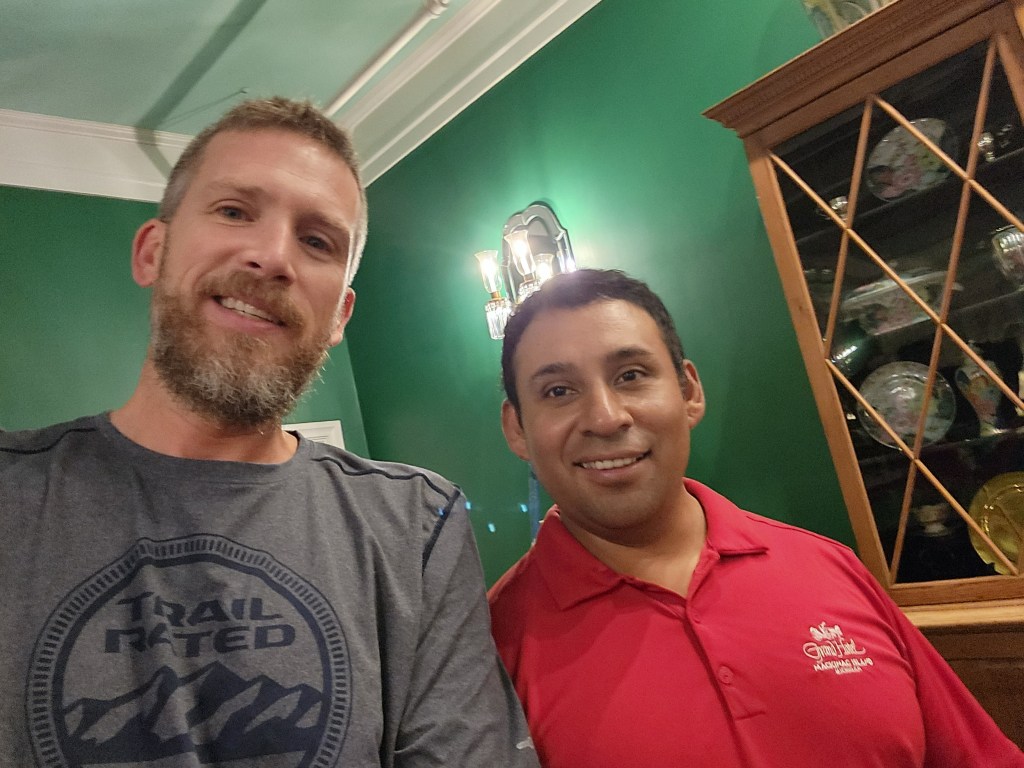
I’m writing this note from the lobby of the Grand Hotel on Mackinac Island. I was one of the invited speakers at the Michigan Republican Party’s leadership conference. In truth, I almost didn’t feel like writing this, mainly because when I crept from my room at 5:00 a.m., not only did I discover I was the only guest awake in the whole place (as you can see from the photo), but the landscape was entirely void of coffee. If there’s one thing I require before typing this early morning note, it’s coffee.
Now, for a relative story before moving on to something else.
Carlos, a man traveling through and cleaning the lobby light fixtures, greeted me warmly. I asked if he knew where I might find a cup of the elusive brew. His apologetic answer: None would be available until 6:30. Downcast, I situated myself in a chair to begin typing. However, barely a moment passed before Carlos, having just climbed a ladder to start cleaning a chandelier, descended that same ladder and invited me to the workers’ cafeteria. He poured me a fresh cup of the elixir I so desperately craved. Of course, I expressed my deepest gratitude, and after chit-chatting for a few minutes, I promised Carlos that no matter what I decided to write, I’d be sure to mention his kindness.
Thanks, Carlos. As is often the case, God is gracious to me through others. Sometimes, something as simple as a cup of coffee and a moment of kindly conversation is the glorious proof. And now, on to something else.
At the present moment, it would seem I’m sitting not all that far from where the character Richard Collier slept while trying to meet his love interest, Elise McKenna, in the film Somewhere in Time. Christopher Reeve played Collier. Jayne Seymour was Elise. I’ve seen the movie and appreciate both actors. This being my first visit to the Grand Hotel, I can see why the filmmakers chose the location. Few places compare, especially when displaying the reverence that tradition is due. The Grand Hotel is a moment in time no longer accessible yet seemingly still visible.
Men are not called guys or bros but gentlemen. Women are nothing less than ladies. In stride with these standards, there are rules. The rules maintain while at the same time catechizing. Gentlemen or ladies are forbidden from classless attire. None may don mid-riff baring tops or sleeveless shirts. Why? Because modesty is extolled, and public displays of sensuality are dissuaded. Sweatpants and cut-off shorts will see you sent to your room to change. For what reason? Because self-attentiveness and its production are lauded, while slothfulness should be no respectable person’s way. After the 6:30 p.m. hour, what was politely casual must reach even higher. In all corners of the hotel, suits and dresses are expected for adults. Any attending children must wear the same.
I’m fascinated by this. For a guy like me who sometimes spends his energy writing and speaking about things relative to these lessons, it’s just short of magical. It makes me wonder how the hotel’s management has continued to get away with doing it for so long, especially since such practices are contrary to the nature of the world in which we currently live. Few get away with telling anyone else what they can or cannot do. All are free to be, do, and say whatever they want without consequence. Moreover, men are not men, let alone gentlemen. They’re women. Women are not women, let alone ladies. They’re men. Few are willing to contest this. Even fewer, if any, are eager to pinpoint morality’s demonstration genuinely. A young girl’s parents smile as she receives her diploma wearing little more than a stripper’s dress. A young man’s parents shout expletive-adorned congratulations from the audience to their son. Show more skin, not less. Say whatever you want as loudly as you want. Be a self-serving individual, not an others-minded part of a community.
Indeed, the Grand Hotel is somewhere else in time. Or maybe a completely different world altogether.
In a roundabout way, it reminds me of what I’m seeing happen to northern Michigan’s trees as summer turns the corner into autumn and eventually winter. It won’t be long before Michiganders will see with their own eyes a divided cosmos. One day, we’ll climb into our beds, the scenery beyond our chilly windowpanes completely unobstructed. The next, we’ll awaken to a thickly covered landscape blanketed in drifting snow, the phone ringing for some of us with school cancellation news.
It’ll be like crossing from one world to another, both having different rules.
Inherent to winter’s rules is the awareness that while the season can be beautiful, it can also be perilous. Mindful of these dangers, a winter’s drive can be calming. Playing in the snow can be joyful. A walk in the woods can be refreshing. Doing any of these things as though the rules don’t apply—as though one’s preferences will be best—could cause terrible things to happen. A winter’s drive at 80 miles per hour could kill you and others around you. Building a snowman with your bare hands could result in frostbite and permanent nerve damage. Walking through the wintry woods wearing your favorite summer clothes could end in frozen death. For anyone denying these realities, a person willing to step up and enforce rules is an asset.
I experienced a combative conversation a few weeks ago. The person called more or less to let me know what a horrible person I was for saying publicly that certain behaviors were indeed sinful. According to this person, I had no right to impose morality on anyone, especially since I am just as imperfect as everyone else. This is a typical argument many make and often aim at the clergy. She went on to say that she’d never think of imposing morality on anyone. I asked her if such thinking applied in her home with her children. She stuttered a little at that point. She did everything she could to make “yes” her answer, explaining how she raised them to be free thinkers unbound by legalistic principles. I asked what she would have done if her daughter had come to her, admitting she intended to kill a friend at school. Would she say her daughter was wrong, that killing someone was against the rules? Her answer was one of avoidance: “My daughter would never do that. Because of the way I raised her, she’d know better.”
“So, there is such a thing as ‘better’? What or who established that better standard, and why does it appear to apply to everyone, including you?”
The conversation didn’t proceed much further. I didn’t expect it would, anyway. And by the way, I wasn’t trying to win an argument. There’s no winning in such situations. There’s only giving a faithful witness while enduring. Still, I suppose this came to mind because of what I’ve said here. If we establish our own standards apart from reality, not only will we discover ourselves in conflict with natural law, but we’ll never be able to see beyond ourselves what’s actually true. Perhaps worse, we’ll never know what it’s like to be part of a community held together by that truth—a group naturally built to outlast all others.
Still, there’s another angle to this that comes to mind.
While the rules here in the Grand Hotel’s world do not apply to the mainland’s rules, both are held by the same standards, whether or not they acknowledge it. Summer or winter, right is right, and wrong is wrong. They may look different by context, but they’re rooted in truth, and they are what they are. One day, everyone will realize this. In a sense, it’ll be like the scene I described before. You’ll close your eyes in one world and open them in another. When you do, you’ll realize that human standards never applied in either. Instead, there was all along a deeper standard—God’s standard. It will be the only standard of measurement at that moment. A world of people choosing unbridled sensuality, gender confusion, and so many other dreadful standards will finally discover if they were right in their cause. They’ll learn, in a sense, if the Grand Hotel’s rules were better than Walmart’s.
Thankfully, we have Christ. He’s the hope we have for that inevitable day. He’s the One who forgives us of anything that might make that day a dreadful one (Luke 21:28). He’s also the One who gives His Holy Spirit so that we are remade into those who desire His will and ways, not our own (Romans 5:5; Galatians 5:22-23). That’s important. When I want what I want, the Spirit fights that fleshly inclination, making it so that I prefer instead what Christ wants. I want what Christ wants because, by faith, I know it will always be better. It is a higher standard. According to Saint James, it’s the law of liberty (James 1:18,25-27)—the freedom from sin’s guilt and the liberty to live according to God’s way of righteousness (2 Corinthians 3:17). This is a change in eternity’s conversation. In Christ, I don’t have to keep God’s rules perfectly to save myself. Jesus did that. But now, through faith in Him, I want to keep his rules. I know they’re good. In fact, I know they’re not just better but the best.
School is back in full swing. I know this not only because I see youthful academia’s vibrant commotion swirling into, through, and around every square inch of this church’s school building but also because I can most certainly hear it. Summertime is a quiet time around here. Autumn is not. It’s audibly occupied.
Perhaps the most notable sound is the laughter. Melancholy stands little chance when gleeful children are laughing. And the younger the child, the more potent his or her laughter is. A laughing baby is a room’s own sunshine. Anyone caught in the child’s sparkling beams will be swept up into laughter, too. Even a deaf person will experience it. That’s because a laughing child isn’t just heard but sensed. Anyone unmoved while children are laughing is either unconscious or paralyzed. There can be no other explanation.
Laughter is nuanced, though, isn’t it? It arrives in multiple carriages. I’ve always believed you can learn a lot about people by what they find funny. Life provides plentiful opportunities for humor. Laughing is healthy (Proverbs 15:15, 17:22). Still, a man drawn to filthy humor, laughing at sexually explicit, curse-word-laden comedy rather than disgusted by it, tells you something about him. Unfortunately, there is no age restriction relative to laughter’s sinister side. A playground of happy children running and jumping is one thing. A child who shoves another child and then points and laughs at her scraped knee is another. In such moments, laughter betrays humanity’s darker inclinations.
Since I’m already pondering these dichotomous things, I think smiles work the same way.
Speaking only for myself, a smile offered by a random passerby almost always brings me joy. No matter how I feel before receiving it, a chance smile can only nudge me toward better spirits. I don’t have to know why the person did it. The act is all that was needed.
This changes in other circumstances. Parents know it. While one child endures a parent’s reprimand, a nearby sibling smiles. Something else is happening in those moments. Through the character Donalbain, Shakespeare describes such scenes intuitively, saying, “There’s daggers in men’s smiles.” Sometimes, a smile communicates a gladness for our demise.
I suppose this means that a smile can also serve as a veil. It can be inexact or precise. A person trying to hide disappointment might do so through a passive smile. Staring, arms crossed, and tapping one foot, a smiling wife communicates disgust with her husband’s announced plans for a guys’ night out on her birthday.
The Bible doesn’t say much about God smiling. At least, I don’t know of texts that speak specifically of God smiling. Many folks use the phrase “God smiled on me,” and there are plenty of texts in which His smile might be implied. For example, the Aaronic Benediction in Numbers 6:24-26 comes to mind. There, God promises to shine His face on His people. This certainly has the sense of God’s gracious smile accompanying His compassionate care. Still, the word for shine (אוֹר) really only means to illuminate. In that sense, knowing that Christ is the Light of the world, I’m more inclined to say that God smiles on His people through His Son. Jesus is God’s friendliest glance and kindliest gesture. To see Jesus is to know God’s desire that we would be His friends, not His enemies.
On the other hand, the Bible does tell us that God laughs. Unfortunately, the Lord’s laughter is typically stirred by human foolishness. Indeed, we can be a funny bunch. King David describes sinful humanity’s pompous bellowing and God’s subsequent amusement (Psalm 59:7-8). In other words, God will sometimes laugh (שָׂחַק) at the ones who believe (as the saying goes) they’re “all that and a bag of chips” before Him. These same people tend to act viciously against God’s people, often thinking they’ve gotten the upper hand on us. As a result, God laughs, knowing a final day for vindication is coming (Psalm 37:12-13).
Whether smiling or laughing, the one thing we need to know is that God is not rooting for our destruction or doom (Ezekiel 18:32; Ezekiel 33:11; 1 Timothy 2:4-6; 2 Peter 3:9; Titus 2:11). With that, He does not find enjoyment in our pain. He does not grin at our sadness. He does not delight in losing us. It hurts Him as nothing we’ll ever fully know. This brings us back to Jesus.
God smiled at us at Golgotha when He frowned at Jesus, giving His Son over and into Sin’s deepest dreadfulness. God did this to make us righteous (2 Corinthians 5:21). He did this so that we would, by faith in Christ’s sacrifice, know the truest joys found only among heaven’s laughter (Philippians 3:20-21; Romans 6:23).
There’s indeed nothing like the laughter of children. However, nothing will compare to the ruckus made by the joyful children of God wandering the halls of eternal life’s mansion (John 14:2).
Genuine, joy-filled smiles.
Triumphantly authentic laughter.
By the person and work of Jesus Christ, these are guaranteed, and it’ll be impossible not to join in when you get there.
Christ said rather plainly, “Let what you say be simply ‘Yes’ or ‘No’; anything more than this comes from evil” (Matthew 5:37). His point was relatively uncomplicated. When communicating, do so before the divine stage lights standing upon the planks of honesty and integrity. Observing the Lord’s words, perhaps R. C. H. Lenski said it best:
“The man whose heart is true to God utters every statement he makes as though it were made in the presence of God before whom even his heart with its inmost thought lies bare. With a heart thus pledged to truth, his lips will find no need to add anything to his ‘yea’ and ‘nay.’
Unfortunately, some folks use language more so to conceal than communicate. They use it to move away from the truth rather than draw closer. To do this, they bury their actual purposes beneath rhetorical devices. But these devices are far different from others. As someone who uses rhetorical devices regularly, I assure you that most writers employ language devices to help readers, not confuse them. They want what they’re writing to be clear, memorable, and above all else, profitable. But there are other devices—sinister ones—meant to confuse communication. They’re more so meant to distract and evade rather than confront and clarify. Chances are you’ve participated in conversations demonstrating these devices. They’re the kind of exchanges that make simple discussions frustratingly unbearable, making a plain question with an easy answer confusingly distorted.
Thankfully, these devices are relatively easy to detect. They’re typically abrasive and often little more than ad hominem in nature. Unfortunately, however, they almost always prove powerfully gravitational. In other words, they draw a person into unnecessary defensive positions, ultimately shifting the burden for answers from the evader to the questioner. I’ve experienced this before—relatively recently, in fact. Following a series of social media postings maligning my efforts in the public square, I reached out to one of the more influential culprits after I’d noticed a particular post had been deleted. I think I know why it was scrapped. Still, I wanted to know for sure. I began the private message by asking from curiosity why the post had disappeared. Before offering an explanation, he replied, “You’re curious? We’ll see if it is just curiosity.”
His tenor was readily detectable, but the evasive distraction was trickier. The blurring occurred when he met my question with a question, one that focused on my intention rather than my words.
You’ll end up on your heels if you’re not paying attention in such conversations. You’ll miss that by reversing the flow in this way, the objective nature of the original inquiry is made subjective and ultimately framed as suspiciously disingenuous and justifiably unanswerable. With this one rhetorical play, the one being approached for answers has established many potential escape routes, each capable of leading away from what he would prefer not to acknowledge.
Indeed, it is as Homer described: “The tongue of a man is a twisty thing.”
Sadly, not much can come from such dialogue. The mind is already made up, and the conversation’s end is already established. The best advice would be to keep it short, bowing out graciously and trying again at a different time. That’s certainly within the boundaries of God’s will. Indeed, even as our Lord insists that we work things out as soon as possible (Matthew 5:25-26, 18:15)—and Saint Paul insists similarly, warning that we ought not to let the sun set on our anger (Ephesians 4:26)—still, we are instructed to labor patiently (2 Timothy 4:2). And so, we do.
Inevitably, I’ll be back. I struggle to let things like this go, especially when I’m dealing with someone I once held in such high regard. Until then, I suppose there’s one final lesson to be learned from all this. It begins with a confession.
Some people can’t have a conversation with others—not a real conversation, that is. Why? Because they’re very nearly immobilized by self-absorption. It’s hard to hear others when you’re only willing to listen to yourself. When I’m around people like this, I feel like fighting—not with fists, but with words. Unfortunately, I rarely experience this urge because I genuinely want to help reform the person’s behavior. I realized this last week after a friend gifted me a quotation by George Santayana. He sent the words as reassurance, encouraging me not to worry and reminding me that people always get what’s coming to them in the end. I know what he was trying to do, and it was a noble gesture. But the words didn’t help. They accused me instead. Santayana wrote, “To knock a thing down, especially if it is cocked at an arrogant angle, is a deep delight to the blood.” In other words, it makes a person feel good to collapse a prideful person’s self-importance.
I agree. It does. And to feel that way is the worst kind of arrogance. It’s to believe that mercy belongs only to me.
Is that what Christians are to be about? Is someone else’s doom supposed to be an option noted in our reconciliatory schematic?
No.
Sure, there are times and places for teaching arrogant people a much-needed lesson. Interestingly, even as Christians are not to be pushovers, the lesson often gets taught with or without our help. God has His way of sorting these things out. In the meantime, the Christian’s immediate goal is not an opponent’s doom. Instead, “so far as it depends on you, live peaceably with all” (Romans 12:18). Vengeance is not our job. Therefore, Saint Paul continues, “Beloved, never avenge yourselves, but leave it to the wrath of God, for it is written, ‘Vengeance is mine, I will repay, says the Lord’” (v. 19).
But again, delivering a shattering blow to an arrogant opponent brings intoxicating delight to the blood. This means we’ll need help overcoming this powerful form of self-righteousness. Divine help is the only kind that can do it. I recommend two things. Firstly, confess your own failings and be absolved by God’s wonderful Gospel. By this, you’ll remember your needs are just as great as everyone else’s, and you’ll be ready to meet an opponent with grace-filled words. Secondly, before reaching out to the opponent, go to your knees in prayer. Ask God to crush your haughty spirit. Even further, plead with Him to give you the courage to reach out with the right words at the right time. You want to be brave. You want to approach when the time is best. You want to restore, not destroy.
One final thought: Remember Saint Paul’s introductory phrase, “So far as it depends on you….” Don’t forget those words. Indeed, the other person plays a vital role in the effort. Still, so far as it depends on you, be faithful. Do your part. Don’t worry about the rest. God already has all of it well in hand, and He’ll work the results for the good of those who love Him. That’s His promise.
This summer has been and continues to be a challenging one. I don’t intend to bemoan my circumstances. Neither am I pleading for a reprieve from the arrayed struggles. I’m simply relaying that I do not expect to look back on the summer of 2023 with any measure of fondness. It has been busier than busy, sometimes crueler than cruel, and occasionally sprinkled with some enjoyably restful moments. Our time together in Florida was one. Taking Evelyn to see a NASCAR race was another. In between, far too many negatives filled the gaps.
As I said, I don’t mean to complain. Complaining accomplishes nothing. Muscle through and do; that’s more my way. Complaining invites excuses and accepts defeat. Ask Jennifer. I don’t accept defeat too well, but mostly because there almost always seems to be a way to succeed. You just need to find it. The adage rings true that you can either be a part of the problem or a part of the solution.
Part of acknowledging any challenging situation means admitting to what’s really going on behind the scenes in this world. Sin is a very real thing, and it has infected everything. I should not be surprised when the season I look forward to more than any other becomes something to endure rather than enjoy. Sin will do that. God certainly doesn’t promise immunity from tragedy to His Christians—at least not in the way the name-it-and-claim-it charlatans of this world suggest.
On the contrary, He assures us we’ll experience trouble. Jesus said as much to His disciples, saying, “In the world you will have tribulation” (John 16:23). But He didn’t end His words there. He continued, “But take heart; I have overcome the world.” Here the Lord promises His care. He promises to give us what we need to endure. Saint Paul echoed the same, writing, “God is faithful…he will provide the way of escape, that you may be able to endure it” (1 Corinthians 10:13).
While He gives what’s necessary to each believer as He knows best, as you can see, there’s something He sets before the whole world: the Gospel—absolute hope through faith in Christ and the promise of eternal rest apart from sin’s terrifying grip. That hope is endurance’s fuel. Interestingly, Christian endurance produces some pretty neat behaviors. For example, in times of trouble, when I discover myself stretched to my emotional extremities, I become attuned to the humor in seemingly humorless things. Just this morning, my backpack on my shoulder, my rolling bag in one hand, and a cup of coffee and my keys in the other, I attempted to use my foot to open my office door only to lose my balance and stumble forehead-first into its solid oaken barrier.
It hurt. How I managed to fumble like that, I don’t know. Still, I laughed because it was ridiculously funny.
Over the years, I’ve come to realize that the man who can laugh at whatever befalls him demonstrates a type of lordship over this world. From the Christian perspective, he proves a Job-like verve capable of saying, “The Lord gave, and the Lord has taken away; blessed be the name of the Lord” (Job 1:21). He can speak along with King David who wrote so daringly, “The Lord is my light and my salvation; whom shall I fear? The Lord is the stronghold of my life; of whom shall I be afraid? (Psalm 27:1). He can be at peace because he “is not afraid of bad news; his heart is firm, trusting in the Lord (Psalm 112:7). He’s already asked and answered himself, “What can flesh do to me?” (Psalm 56:4).
Nothing. Everything sin has corroded is passing away. “Behold,” the Lord said, “I am making all things new” (Revelation 21:5).
With this trustworthy Word from our gracious Savior, bad news is a toothless beastie, tragedy is a pinprick, catastrophe is a mouse’s shadow, and heartbreak is a wound needing little more than a Band-aid. All this is true because, as Saint Paul wrote so plainly, we are justified before God by faith in Jesus Christ (Romans 5:1). The endgame has already played out on Calvary’s cross. Now, everything is endurable by the power of the Holy Spirit at work within us. I’d say, maybe even laughable. Paul explains:
“Therefore, since we have been justified by faith, we have peace with God through our Lord Jesus Christ. Through him we have also obtained access by faith into this grace in which we stand, and we rejoice in hope of the glory of God. Not only that, but we rejoice in our sufferings, knowing that suffering produces endurance, and endurance produces character, and character produces hope, and hope does not put us to shame, because God’s love has been poured into our hearts through the Holy Spirit who has been given to us” (Romans 5:1-5).
In conclusion, please don’t think I’m making light of anything you might be enduring right now. I’m not. And neither is our Lord. I’m merely setting a point of origin for steering into all of it. You have hope. God said so.
Those of you who read these meanderings regularly will know that I struggle at summer’s end every year. It’s not so much that the longed-for season of effortless schedules is leaving (although this summer has been anything other than easy), but instead, it’s that the sun begins making less time for us. Moving into autumn, the sun makes drastic changes to its schedule. For one, it gets up late and goes to bed far earlier. Some of us will go days without experiencing its presence, traveling to and from the office in the pitched blackness of its absence. On an occasionally cloudless day, you’ll see it pass by the window—but only if you have a window. If not, it’ll be as if the sun used to exist but does so no longer.
My stomach turns just thinking about it.
Jen posted something on social media last week. It was a snippet from our family’s after-dinner cleanup. Essentially, Evelyn asked, “Momma, did you know there is something called S.A.D.? It’s when people get very sad when summer ends.” She was referring to Seasonal Affective Disorder. And before she even finished her testimony, I was already answering, “Yes. And would you like me to explain it to you?” I wasn’t being snarky. The moment was a jesting one. However, looking back on the moment, I wonder if she planted the question. She knows how disjointed I become in the perpetual darkness of the sun’s absence. I get the feeling she asked Jennifer the question to spare me a momentary cloud while also showing me she is paying attention and understands. She’s like that. She’s mindfully caring.
It usually takes me a few weeks to get into autumn’s rhythm. In fact, by the time I discover myself finally beginning to appreciate fall’s colorful detonation, the snow arrives and covers it. Gripping summer’s absence tightly, I put myself at a disadvantage, resulting in being a step behind other opportunities for joy. Admittedly, I am forever learning a lesson from these things.
Honestly, absence is a tricky thing. John Dryden said that when you love someone or something so much, an hour of absence is like a month, and a day is like a year. Jennifer and I were talking about this one night last week before bed. She mentioned that family dinners will soon be very different. She’s right. Like a curious organism, absence will grow. Right now, dinners together as a family are quintessential to our lives. We do everything we can to ensure all six of us attend. But life’s seasons are changing. Soon six will be five, five will be four, and then four will be three. And then it’ll just be Chris and Jen. For the Thoma family, that’s a big deal. We’re knitted very closely together. When one is absent, it’s as if the world has suddenly become strangely uninhabited.
I get it. At least, I’d better get it. The day is surely drawing near when Chris and Jen will be Chris or Jen. Some of you already know what I’m talking about. Absence—the experience of being apart and missing that person so incredibly much—can be devastatingly palpable. I miss the sunshine during winter. Still, that’ll be nothing compared to an empty nest—or Jen’s empty chair. Personally, and in a selfish way, I hope my chair is found vacant first.
Having said these things, there’s something else to the topic of absence. Christians know what it is.
For some, absence means loss. Not just any kind of loss, but permanent loss, as if the person they miss is forever out of reach. One of my favorite texts from God’s Word is “The last enemy to be destroyed is death” (1 Corinthians 15:26). I like it because it serves as a capstone statement to Paul’s previous preaching in the chapter that Christ has conquered all things, and by His resurrection, the seemingly impossible obstacle that brings ultimate separation—Death—has itself been massacred and tossed aside in the cosmic contest for our eternal future. As a result, no other enemy stands between us and our God. Christ saw to it. His resurrection proved it handily. From this vantage, one of Death’s offspring—permanent human separation from God and each other—is included in the list of enemies defeated by Christ’s work. In other words, because of Christ’s victory against Death, Christians can’t really even speak of a loved one who died in the faith as absent in the sense of being lost or gone for good. Those who are no longer with us, while absent from us, are not absent from the Church’s eternal fellowship. This means we’ll be with them again in person. Right now, they’re with Christ, and according to His plan, their time of physical separation from us is already on a trajectory of reversal. Their mortal absence might indeed stir sadness. Still, we really can’t justify the kind of sadness relative to permanent absence or being lost. The absence is not permanent. Believers are with Christ in His nearest presence. And if you know right where a person is, how can he or she be lost?
Indeed, in natural time, the sun goes away during autumn and winter. Likewise, the day is coming when either I’ll be without Jen or she’ll be without me. But only for a time. The spring and summer sun will return. Believers won’t be apart from our loved ones who’ve died in the faith for long. Soon enough, there will be an eternal sunrise in an unending time of togetherness outside of time. That’s Christ’s promise to His faithful. Until then, the faithful have another powerful guarantee. The same risen Christ vowed He would never leave or forsake us (Hebrews 13:5). He promised He is with us always, even to the end of all things (Matthew 28:20). That promise meets with right now. While ten thousand sermons could be preached on either of these two texts, all with unique renditions of Christ’s beautiful assurances, each would bear a common thread of consequence: You’ve been won by the person and work of Christ, and now, by faith, no matter what, you are never alone. Interestingly, you can be confident of this because of something Christ cannot do. He cannot break His promises, and therefore, He cannot be absent from those who are His own.
To close, remember these two things during autumn’s darker days, whether that autumn is seasonal or human: Human absence is not our forever, and in Christ, you are never alone.
Did your mother ever tell you it’s rude to stare? I’m pretty sure mine did. Granted, it was typically an instruction given relative only to people. Parents experience an entirely different form of concern when their children sit and stare at nothing. Good thing I’m the only parent in the entire building right now. Here I sit, staring out my office window. Although, I am not entranced by a strange-looking person, nor am I being drawn into a void of nothingness. Instead, a reasonably hefty groundhog is wandering around outside my window doing whatever groundhogs do. He appears to be busy scurrying and popping up and scurrying again. At one point, he popped up to look in my window. We saw each other. I said hello and told him he looked well-fed. He dropped back down to scurry away, only to pop up again as if to say, “Same to you, buddy.”
There are plenty of other things I should be doing right now. For one, I should be tidying up my sermon for this morning. It’s written, but it isn’t ready. And yet, I’m watching a groundhog. It’s not as if I haven’t seen one before. Or that groundhogs are all that interesting. It’s something else. It’s more that feeling one gets on occasion. I’m guessing you know the one. You begin looking at something, and after a time, you realize you’re locked on it in a lazy stare. You’re not necessarily interested in whatever you’re observing. You’re just looking. And as you do, you leave yourself for a moment.
Have you ever been doing this when someone suddenly asked you a question? One way to know it’s happening is that it takes several seconds to realize you’ve been asked a question and then a few more seconds to answer. And when you give a somewhat disjointed reply (because you began speaking while climbing back into yourself mentally), the person doesn’t thank you but inquires, “Are you okay?” I suppose it wouldn’t be out of order to respond, “Everything’s fine. I just stepped away from the control panel for a moment.”
Returning to the fact that I’m staring at the local wildlife when I should be working on my sermon, I get the sense that staring at someone can’t be all that bad. The Gospel reading for today is Mark 8:1-9. As Jesus directed the hungry multitude to sit, I imagine His disciples were staring at Him. Aware of the dire situation, they’d already asked Him, “How can one feed these people with bread here in this desolate place?” (v. 4). Rather than initiating a food search, the Lord instructed them to stay right where they were. That was weird. It invited astonishment, the kind that could easily become staring because it didn’t want to miss what might happen next.
My wife, Jennifer, is a gifted photographer. She’ll never admit it, but she has a visual sense about her that few others do. It’s a sense that employs staring—not the lazy kind I admitted to this morning, but the intently honed kind. Jennifer can spot things among casual scenery that most others will miss. Genuine photographers have this skill. Painters and poets do, too. They see things that others miss and then lock onto them. They look without flinching, observing the microscopic details. They learn by staring. They know a glimpse isn’t enough. They know you must look intently to truly see. By looking this way, they know they’ll be led to better, more substantial things.
When it comes to Jesus, this should be everyone’s rule. He’s worth far more than a superficial glance. Everything He says, everything He does, you don’t want to miss. There’s a purpose in all of it, and it’s entirely for His onlookers. That’s one reason any seasoned preacher will admit that even the most uncomplicated Gospel narrative can provide a lifetime of sermons. Every little detail relative to Jesus’ person and work—every single motion and word in every single context or conversation—aims for the miracle of humanity’s salvation. That salvation, and all its accessory minutia, must be examined and preached. To do so is to connect with the instance being studied and be prepared to understand other instances.
For example, observing Jesus here in Mark 8:1-9, I imagine that later on in the upper room on Maundy Thursday, when the Lord took the bread, gave thanks, and then broke and gave it to His disciples (just as He did with the multitudes in the wilderness), there were words and actions used that the disciples had seen before. It was an entirely different context, yet it was reminiscently similar. At a minimum, having paid close attention in the wilderness with the starving crowds, they’d know the Lord’s ability to take a single piece of bread in hand and, prior to giving it to anyone else, make it so much more than before He touched it. In the wilderness, one piece in the palm of His hand became five, and then ten, and then thousands upon thousands, enough that the uneaten leftovers filled seven baskets. Surely, a single morsel in the Lord’s Supper, surely a tiny sip from the Lord’s chalice, could be more than well-wishing symbolism. Certainly, Jesus can take hold of mundane things and extend their potential beyond human faculties for reason or comprehension.
Either way, these things are lost on those who are only willing to give Jesus a superficial glance, one that assumes it can sufficiently sort Him out in a drive-by interaction, ultimately considering Him to be just one spiritual guru among many. You can’t just pop up for an occasional peek, fitting him into your scurrying, and expect to be called a Christian. It’s better to stop and stare. You should watch Him closely. You should listen to Him carefully. You should mind what He’s doing, and as He does it, hang onto His every word (Luke 19:48).
Knowing that Christ is the Word made flesh, the same rule naturally applies to the Holy Scriptures. God’s Word is more than worth an irregular glance. Luther is the one who said, “If you picture the Bible to be a mighty tree and every word a little branch, I have shaken every one of these branches because I wanted to know what it was and what it meant.” In a mere practical sense, for Luther, a tree is a tree—until you examine it. When you stare into its branches with investigative eyes, you’ll see far more than a forgettable object with a trunk and green stuff growing out of it. You’ll discover details. You’ll see one branch leading to another—flowering adornments reaching out from countless stems covered in intricately contoured surfaces. You’ll find things living among the tree’s branches, lively creatures that call the tree home.
By the way, I think most pew-sitters can tell the difference between a pastor preaching from a drive-by glance at Jesus and one who has stopped to stare at Him. It’s not only revealed by the preacher’s care with words, but by the details his words are in place to carry. Telling the listeners about a tree is nothing compared to using words that lift them from the earth to set them into its branches. A tree remains an inconsequential construct until the preacher examines and then introduces you to it. That’s a reality relative to language.
Having said that, I should get back to the sermon-writing effort. In the meantime, consider your own willingness to stop and stare at Jesus. Is He of more interest to you than an occasional visit to church? Driving by, is He more than just another object decorating your intellect’s limited landscape? Is His value for life in this world and the next far more substantial than your rarely-opened Bible would betray? I hope so.
How about this? Pick a narrative from any of the four gospels. Long or short, read the same narrative every day for a week. After each textual visit, take some time to savor it. Think about what you read. Let yourself stare into it for a while. Do this with the same text each day for a week, taking a moment to jot down something you notice with each visit. My guess is that each interaction will provide a unique “something.” You might not understand the something right away. Still, you will have taken it in. And you’ll likely recall it right in the middle of another narrative somewhere else that may lead you toward understanding it. You may even begin to notice particular trajectories, ones that lead you from simple uses for water, food and drink, and so on, to other, more substantial truths—ones suggesting that there may be more to faith’s origin than you knew; or there may be more to baptism than you first thought; or there may be more to the Lord’s Supper than the one-size-fits-all church or the meme-assembled theologies have taught you.
It feels like the summer is flying right by. Thankfully, I do have things to show for it. I’m certainly not wasting time.
As a parent, I keep on my kids about things relative to time. For example, I occasionally remind them in my own way that someday will eventually become today, and unless you’ve planned accordingly, what today requires will be entirely inaccessible. A person simply cannot live without thinking of the future.
In some discussions with my kids, I try to steer them toward calculating one’s self-sufficiency relative to backup plans. In other words, you cannot always rely on other people. They will let you down. In the same way, you cannot always count on the things you think you can count on. Things wear out and break. Apart from syncing to a cloud-based drive, it’s why I have two external hard drives, each backing up from my computer’s working drive every four hours. It’s why I always bring my laptop to my church office every Sunday morning. If my office computer has problems, I can use my laptop to write and send the eNews and, if necessary, finish my sermon and the service prayers. It’s also why I’ve learned how to use my cell phone as a hotspot. If the internet is down on Sunday morning, I can still get this eNews message sent. It’s also why I have a second printer in my office. If the office printer is down, I can still print anything I might need in a pinch.
I didn’t always live my life this way. But I do now. A few unfortunate circumstances over the years taught me just how right Ben Franklin was when he said that failing to prepare is to prepare to fail. As a result, I do what I can to have a backup plan. Most often, I have two, and sometimes, even three.
I don’t mean to say that the future is controllable. It isn’t. Only the Lord knows what will or will not be, and plenty of people have prepared for the future in every imaginable way, only to suffer future-shattering tragedies beyond their control. For all my planning, I once showed up to the office on a Sunday morning and, attempting to print my sermon manuscript, discovered the office printer was down, the ink in my second printer had dried up, and I had zero replacement cartridges. I had to write it by hand. Twenty-eight years ago last week, my twenty-four-year-old brother Michael was killed in a car accident. Here I sit today, still astounded that he’s not around. His absence was something my family and I never expected.
Simple or grand, even when you prepare, tomorrow is never for sure.
I read a portion from Luther this morning in which he wrote, “Christ has not freed us from human duties but from eternal wrath.” He goes on to say that even as we strive and prepare, the only certainty we’ll ever truly have is situated in Christ. Faith receives that certainty. It can receive it because it understands what laboring in this fallen world as a responsible human being means, even when we know everything we’re doing could be for naught and could all come crashing down. Before it even begins a task, faith admits to human brittleness and life’s uncertainty. From there, it plods along diligently, knowing that you win some and you lose some. Faithfulness, not success, is key. It can live this way because its mortal future isn’t its final future. It is secure in Christ for a future beyond all futures. Destruction is not the last word for believers, not because we worked hard or devised a plan to avoid Sin’s inevitable wage, but because God had a plan for carrying us through it. He enacted that plan in Jesus, the God-man in whom faith is placed.
Relative to this, Christians do work hard. And they plan. Leaning on Luther, he mentions God’s gifts of reason and sense in his explanation of the First Article of the Creed in the Small Catechism. Our reason and our senses make these things possible. But remember, as Christians prepare, they measure their futures by looking through Gospel lenses. Faith doesn’t make plans apart from looking to Christ. Faith does not plan a vacation without planning a way to be present in worship while away. Faith does not invest financially without mindfulness for Christ and His bride, the Church. Faith considers the Gospel’s perpetuation for future generations when voting today. Faith plans, all in faithfulness to Christ and the benefit of the neighbor.
Again, do the plans always succeed as we intend? No. Remember: faithfulness to Christ, not success. Faithfulness to Christ is blessed. Saint Paul assured us that “all the promises of God find their yes in Him” (2 Corinthians 1:20). Of course, that truth is a theme throughout God’s Word (Proverbs 28:20, 1 Thessalonians 5:23-24, 2 Thessalonians 3:3-5, and others).
By the way, by blessing, God is not promising health, wealth, and other sorts of earthly things. Again, He promises the future beyond all futures—the eternal reward that’s inedible to moths, out of reach to thieves, and impervious to Death itself (Matthew 6: 19-20, 25-33). When a person has this divine schematic (God’s greater plan for an eternal future) in one’s pocket, what terrors can threaten with any real significance?
There aren’t any. And the ones that try are toothless. Read Romans 8:31-39, and you’ll see.
Indeed, Luther was right to measure all our future concerns and their subsequent plans against God’s promises in Christ, referring to all of it collectively as “true freedom” and then continuing that “no man can value it high enough. For who can express what a great thing it is that a man is certain that God is no longer angry with him and will never be angry again, but for the sake of Christ is now, and ever will be, a gracious and merciful Father?”
I hope you don’t mind, but I have marriage on the brain this morning. Jennifer and I will celebrate our 26th wedding anniversary this week.
I don’t know about you, but the further we travel into marriage’s future, the more content it seems we are to let the occasion be the occasion amid life being life. In other words, we’ll likely go out for dinner to celebrate, but we’ll also just as likely stop at Walmart on the way home for milk, cereal, toilet paper, or anything else a family of six might need. It sounds inconsequential, I know. Some people celebrate by going on trips. Others spend lavish amounts on gifts. That’s not really our way. Last year, we hoped to get away for a few days (since it was our 25th anniversary), but too many other things prevented us from doing so. Several weddings were scheduled, the English District Convention occurred, Vacation Bible School unfolded, and a whole host of other obligations landed on us. We barely managed to sneak away for dinner on a day close to our actual anniversary.
In the end, I think Jen and I have realized that no matter what we might do to celebrate, one exceptional day, while nice, can never really outmatch the everyday blessings we enjoy. Theodor Seuss Geisel—better known as Dr. Suess—was close to describing what I mean when he said, “You know you are in love when you don’t want to fall asleep because reality is finally better than your dreams.” I get his point. There’s very little that exceeds love’s discovery. In its moments, life and its possibilities exceed imagination.
One problem with Geisel’s words is that they don’t completely emerge from emotion’s shifting realm. I’d be on board if he defined reality as a willingness to completely spend oneself for the other in both good and bad times. That would better describe the profound mystery of marital love. It’s one reason why the traditional marriage vows include phrases like “for better, for worse, for richer, for poorer, in sickness and in health….” By the way, in my experience, people who choose to write their own marriage vows, typically turn them into syrupy emotional goo, ultimately missing the mark on what the vows are designed to communicate. For the record, don’t even think about writing your own vows if you want me to preside over your wedding. The longstanding traditional ones are more than sufficient, mainly because they do a fine job of communicating a commitment to something other than self. Two phrases, in particular, cement this commitment: “till death us do part” and “according to God’s holy will.” The previous phrases of the vow set reality’s tempo, acknowledging that there will be good times and bad times. These two insist that emotional love—purely human love—is not equipped to navigate real life to its very end. But love aligned with God’s will is. Love aligned with God’s will can stare death in the face.
Jesus told us straightforwardly what God’s will is. He said, “For this is the will of my Father, that everyone who looks on the Son and believes in him should have eternal life, and I will raise him up on the last day” (John 6:38-40). These words are not far from Jesus’ gentle description to Nicodemus of why God would send His Son in the first place: “For God so loved the world, that he gave his only Son, that whoever believes in him should not perish but have eternal life. For God did not send his Son into the world to condemn the world, but in order that the world might be saved through him” (John 3:16-17).
God knew that human love would be forever insufficient. Loving God and neighbor rightly—the Law’s strict demand—would never be met. But God’s love can do it. And so, that same love moved Him to send His Son. Christ fulfills the demand by His perfect life according to the Law and His sacrificial death on the cross. Jesus demonstrates that God’s love is a perfectly committed, selfless love. It insists that no matter what’s required, the self will never mean more than one’s beloved, even if it means completely emptying itself of all divine prerogatives and going down with the ship in death. Christ did this. And why? Because He loves you. This love is epicentral to His will. Taking a spouse “according to God’s holy will” is to pledge that God’s redeeming love—His forgiveness—will be the marriage’s template. When this is true, a marriage can steer through and around obstacles that might otherwise terrify human love.
But still, there’s more.
Regardless of what the culture believes, God established marriage. He owns it. As such, and whether anyone realizes it, His will naturally permeates its design. First and foremost, marriage is to be a divine snapshot of the Gospel. Saint Paul says as much, describing marriage as a mysterious image of Christ, the Groom, and the Church, the bride—an otherworldly relationship established and maintained by impenetrable commitment. It begins with the One who submits Himself to the death of deaths for the bride. Empowered by that Gospel love, it results in the bride submitting herself in all things, not as one cruelly shackled to an overlord, but as one who loves the Groom for all that He is and has done to make her His own (Ephesians 5:1-2, 22-33).
In a natural law sense, God’s inherent will remains. Marriage is the essential building block of every society throughout human history. The union of one man and one woman—inseparably committed and typically producing children—provides worldwide stability. Everything necessary for an ordered perpetuating society can be found within marriage’s boundaries. Saint Paul hints at how important societal order is when he instructs Timothy to pray for and intercede with the authorities put in place to manage it. He insists Christians do these things so that “we may lead a peaceful and quiet life, godly and dignified in every way. This is good, and it is pleasing in the sight of God our Savior, who desires all people to be saved and to come to the knowledge of the truth” (1 Timothy 2:2-3).
Paul’s point: God wants societal order so that the Gospel will spread.
Marriage not only stabilizes societies, but it is a fundamental conduit in each for communicating the Gospel from one generation to the next. When a society’s marriages begin steering away from God’s holy will—when devotion to self overtakes commitment to spouse and children, when marriage’s biological components become confused, when its sanctity becomes negotiable or irrelevant—the blocks begin to crumble, and the conduits fracture. When that happens, the Gospel—the message of the only kind of love that lasts into and through death—begins slipping into obscurity, eventually securing societal doom.
As I said, Jennifer and I will celebrate 26 years next week. We’ll likely celebrate by doing something special together. Still, even if we don’t—even if life suddenly gets in the way—the marriage won’t be any lesser than before. This is only true because the marriage is “according to God’s holy will.” With His love ordering each of our days, the inevitable road through a reality of good and bad, fading physicality, and unpredictable emotional seasons will continue to prove far better than dreams. It’s the kind of love that finds itself just as refreshed and content holding hands in the breakfast cereal section at Walmart as it does in a classy restaurant.







 Cruciform Stuff