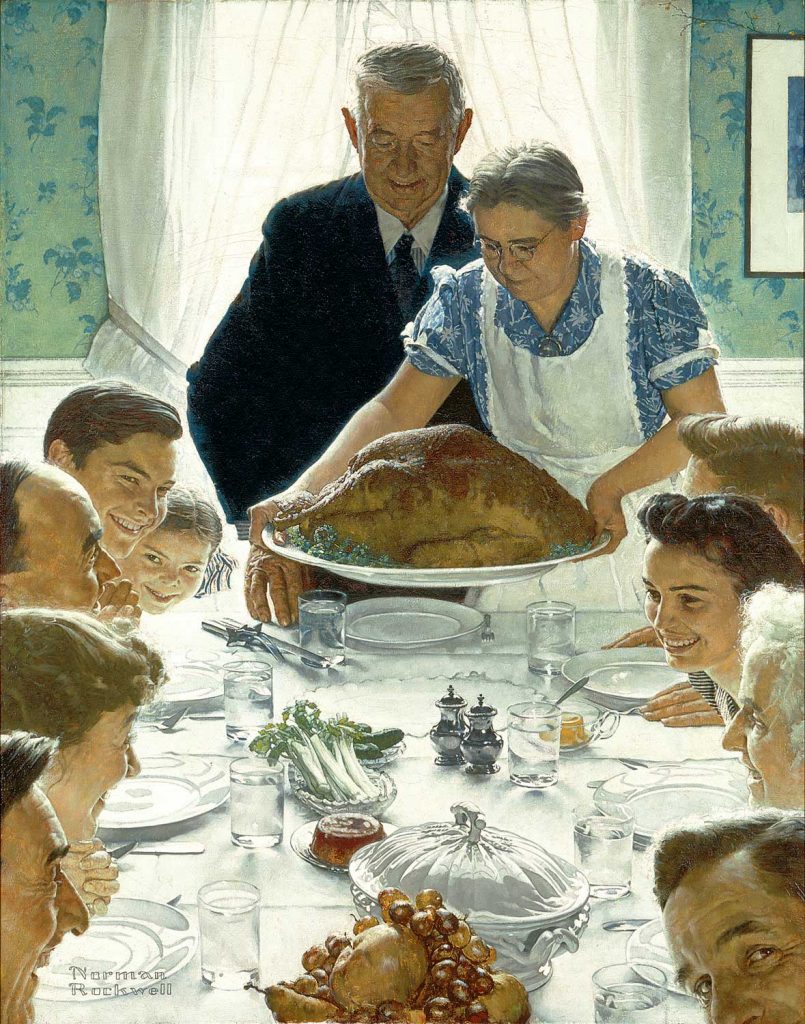

The Eve of Thanksgiving

I’m guessing you know what I mean when I say the Thanksgiving holiday has a unique sense about it. Regardless of autumn’s shrouded frigidity, Thanksgiving remains bright and warm, as if the sun leaned closer to the earth for just this one day.

I say this knowing full well that family gatherings at Thanksgiving can be a mishmash of dynamics. I also know from casual reading that division in families from this or that issue is at an all-time high. For some, family get-togethers are more taxing than enjoyable. Still, I meant what I said. Thanksgiving has a unique sense about it. And it’s good.

It’s good, not because the Thanksgiving feast is the meal all other meals only wish they could be. For the pessimists among us, it’s not good because it only happens once a year. Thanksgiving is as it is because of its point: no matter where we’ve come from, where we’re going, where we are right now, what we’re experiencing, or who we’re with, we can be thankful. Thanksgiving’s point is gratitude.

Relative to families, someone once said genuine gratitude is only possible when the memories stored in the heart conquer those in the mind. I don’t know who said it. And yes, I suppose the saying is somewhat Hallmark card-like. Still, I’m fond of the thought, even if only for how I prefer to interpret it, which, as you might expect, is through the Christian lens.

Admittedly, the human heart and mind are both sin-stained in every way. And yet, Christians know something beyond this fact, especially when it comes to the Holy Spirit’s work in us through the Gospel for faith. We understand what Ezekiel meant when he spoke for God, saying, “I will give you a new heart and put a new spirit within you” (Ezekiel 36:26). We know what Jeremiah meant when he shared the similar promise, “I will give them a heart to know Me, for I am the Lord; and they will be My people, and I will be their God, for they will return to Me with their whole heart” (Jeremiah 24:7). We know what Saint Paul meant when he insisted, “Therefore, if anyone is in Christ, he is a new creature; the old things passed away; behold, new things have come” (2 Corinthians 5:17). Paul’s words in Romans 5:5 are not lost on us, either. We know what he meant when he wrote, “And hope does not put us to shame, because God’s love has been poured into our hearts through the Holy Spirit who has been given to us.”

Filtering the adage through these biblical truths, I suppose I like it because it implies that genuine gratitude is out of reach to mental calculation. In other words, as humans, we remember things. Those things shape and reshape us. Remembering how people have treated us—what they’ve done to help or hurt us, whether they’ve behaved as friends or foes—these become the variables we ponder in the calculations of relationship mathematics. And like any equation, sometimes the resulting product is positive. Sometimes, it’s in the negative.

Through the lens created by the Bible texts I shared, the phrase “memories stored in the heart” seems to hint at a different sort of math, an involuntary, grace-filled action uninhibited by human sensibility. It sees things through the Gospel. It understands annoying family members more so as family than annoying, and it’s thankful for them. It knows the time required to prepare a massive meal is exhausting, and yet it’s grateful for the opportunity to serve the ones it loves who’ll be gathering at the table to eat it. Some of those people haven’t been all that nice in the past. Still, it knows that kindness will always be sweeter than malice. It stands on its tiptoes, ready to reconcile. It’s hopeful for it to happen and gives thanks when it discovers itself stumbling into uncomfortable moments that are all but begging for it to be enacted.

In short, the memories of a Christian heart are the memories of Christ. The Holy Spirit puts them there. They are the remembrances that Christ, even when we were utterly unlovable, loved us to the end (John 13:1). They remember that even while we were still sinners, He gave Himself over entirely into Death’s perpetual night (Romans 5:8). They retain the incredibly crucial sense that we are just as needful of Christ’s merciful love as the screwed-up people sitting beside us at the Thanksgiving Day table, and with that, we belong together.

These Christian heart memories stir genuine gratitude, even when gratitude seems nonsensical and maybe even a bit foolish.

My prayer for you this Thanksgiving is two-fold. First, I hope you’ll begin your Thanksgiving Day by going to worship. There’s no better way to be equipped with Godly gratitude than by receiving Christ’s gift of forgiveness through the administration of His Word, both in its verbal and visible forms. Here at Our Savior, the service begins at 10:00 a.m. I hope to see you.

Second, I hope the memories stored in your Christian heart will conquer those in your mortal mind, and as a result, your Thanksgiving Day celebration with family will indeed be brighter and warmer, as if the sun leaned closer to wherever you are standing even if only for this one day.

Marriage’s Yoke

There’s no other way to say it except that the Thoma family has been stretched too thinly for several months. With homeowner insurance claims hovering since the beginning of summer and a schedule so robust that not even a nine-day week could accommodate all the demands, speaking only for myself, there’ve been times when all I could do was sit and stare at my mental horizon, wondering what else might appear on its ridge intent on challenging me to a duel.

Of course, there’s always someone or something willing to try.

I’m glad I have Jennifer. I’m thankful for my kids. When I’m slipping, Jennifer’s there. When she’s exhausted, I’m there. When we’re both spent, the kids are there for both of us.

Thankfully, most of our house-related issues were restored in time to receive visiting family and friends for our son Joshua’s wedding this past Friday. We certainly were hopeful that things would come together in time. Had they not, I suppose the only appropriate response would’ve been, “Oh well. What can you say? What can you do?”

Either way, what a joy the event was! And how blessed we are to formally welcome his wife, Lexi, into the Thoma family and name. I say “formally” because Jennifer, Madeline, Harrison, Evelyn, and I have long since considered Lexi as a part of the family, ever so glad that God nudged her toward the necessary “yes” that would forever cement her to our lives. Even before yes or no were choices, setting the dinner table assumed preparing a place for Lexi, too, whether or not she could be there. That’s what a family does.

Joshua and Lexi already know these crucial family dynamics. However, they know them from a more youthful perspective. They’re now learning them from a Genesis 2:24 perspective. Indeed, Joshua remains a son, and Lexi remains a daughter. And yet, they’ve become their own family, the next generation. With this comes the fantastical joys and hum-drum drudgeries of husband and wife, and if God grants it, fatherhood and motherhood. If she didn’t already know it, Lexi was immersed this past Friday in what Heywood Broun meant when she said something about how men can build bridges across impossible chasms and throw railroads across barren landscapes and yet have the needs of a child when attempting to sew on a button. Joshua’s learning trajectory is similar. He just walked into an entirely new sphere of existence, one permanently and intimately familiar with Nietzsche’s tongue-in-cheek comment that when God created Eve, boredom was officially ended.

Suppose things go as they typically do in this life. If so, Joshua and Lexi are about to experience the kinds of things their parents have experienced. They’re about to endure insurance claims, emotional overextensions born from bursting schedules, and all the demands that can make life both exhilarating and acidic simultaneously. But here’s the good part. Like Jennifer and me, they’re in it together, yoked sturdily by Christ.

During the father-of-the-bride speech at the wedding, Mike, Lexi’s dad, shared a unique exchange between them not long after she and Josh began dating. I figure this gives me a moment’s license. I remember a conversation with Joshua in our kitchen a couple of weeks before he asked Lexi to marry him. It wasn’t necessarily a crossroads moment. It was a father and his adult son talking about married life, something that was clearly on Joshua’s mind. I remember Joshua was sitting on the counter near the sink. I was sitting on a stool near the island. Along the way, I commended him and Lexi for doing things rightly; that is, they were resisting the world’s temptation to live together outside of marriage. I know I said more than a few times how proud I was of them. I encouraged him to keep resisting, to continue in faithfulness to Christ. Faithfulness to Christ, no matter how out of pace with the world it might be, is always the better way (Luke 5:1-11). I encouraged him to continue rebelling against the culture’s marital preferences, especially those that, again, often seem so sensible.

I remember him being somewhat surprised by the core of the conversation, especially if his goal at that moment was to get a sense of how I might respond if he told me he would soon ask Lexi to marry him. I told him that when it comes to marriage, our society is backward. Unfortunately, lots of Christians have bought into the backwardness. Not only does the world think it makes sense for a couple to test-drive one another sexually before committing, but it insists that before marrying, each should get a few years of solo life under their belts, too. Moreover, before ever even thinking about proposing to a special someone, each should secure careers promising financial stability and multiplying assets, be free of student debt, maybe even own a home, and so many other ridiculously mammonous things that have nothing to do with the promises God weaves into holy marriage.

And so, I took a chance.

“You’re both pretty much on your way in life, right?” I asked.

“Yeah,” he replied.

“It’s not like you don’t know where you’re going or what you’re hoping to do, right?”

“Yes.”

“So, how about this instead?” I continued, “Is Lexi the one God chose for you, and are you certain you’re the one God chose for her?”

“Absolutely. I have no doubt.”

“Is she a prize you’d give anything and everything to win over and over again through good times and bad for the rest of your life?”

“Absolutely.”

“Is Christ at the very heart and soul of who you want to be as a husband and father? Do you want Christ at the center of your marriage, and does Lexi want to be and do the same?”

“Absolutely.”

“Then, what are you waiting for?”

“Well, of course, we’ve talked about marriage, but we need to finish coll—”

“—Why not finish college together?”

“And we should probably make sure—”

“—Whatever comes your way, why not steer into it together? Whatever you need to get in place, why not build it together?”

I kept going, reminding him that Christians use the term “yoke” relative to marriage for a reason. Sure, we use it because the Bible uses it. But again, that’s because the Bible uses it for very good reasons. Each of the reasons understands Christ Himself as the yoke. Beyond this, the image becomes quite practical. To be yoked is to be paired—bound by something to someone in a way that keeps two individuals laboring together. This is true not only so that the pair holds the same pace, both pulling in the same direction, neither getting too far ahead nor behind the other. The yoke is there for the harder moments, too. When the day is at its darkest, and the task is most challenging—when the ground is uneven and bemired, when the job requires so much more than what an individual can muster alone, when a person becomes exhausted, eventually stumbling and falling—marriage’s yoking means someone will be there to lend strength and help lift you to your feet. And not just anyone, but someone the Lord, as the very yoke, is actively binding to you.

This is not the world’s understanding of the marital yoke. The world’s view is a self-invested and often quite cynical one. It chimes with Montaigne that wedlock “is a cage: the birds outside despair to get in and those within despair to get out.” As such, it insists on absolute individualism unrestricted by any yoke whatsoever. And if an individual happens to fall prey to marriage, according to its confused mentality, you don’t even have to marry a human. Some guy married his laptop a few years ago. Another woman married her cat. Some guy in Japan married a robot. The world’s view of marriage is incredibly skewed. It’s more about what someone or something else can do for me to make me happy.

Now, don’t get me wrong. Marriage is designed to bring delight. The Lutheran Rite for Holy Matrimony affirms that God ordained marriage “so that man and woman may find delight in one another.” But again, by delight, the world means the taking kind, not the giving kind. When one can no longer provide what the other considers valuable for taking, the relationship’s so-called “love” grows cold, and the marriage comes undone.

A marriage built on self-sacrifice, of being outwardly invested in and for another person—as seeing him or her as a prize you’d give anything and everything to win over and over again through good times and bad for the rest of your life, just as the Lord looked on His fallen creation in an utterly selfless way—such a marriage has something others do not.

It has muscle for the long game.

By muscle, I mean it has Godly devotion, humility, and forgiveness. By long game, I mean the marriage will have everything it needs to make it through the impossible moments and, ultimately, find itself fulfilling the vow “until death us do part.” It’ll do this, landing at heaven’s doorstep unscathed. Well, maybe not unscathed. It’ll have its scars. But only the soldiers who’ve endured the battles have scars.

If this is the divinely mature framework already in place between two young people in love—real, Godly love—what’s the point in waiting? They’re already a million miles past the world’s marital intellect or capability. More than that, they have what it takes to be a bright-beaming and resilient example of what marriage can and should be.

Joshua and Lexi are young. So what? I’m not the least bit worried about them. Honestly, and as I shared in the wedding sermon, my only real concern is what the eventual grandkids (if God so allows) will call me. I can imagine Jennifer being okay with the classical title “Grandma.” I had something else in mind for me. Imagine if you can…

“Good morning, Billy,” the first-grade teacher might say to the little one flanked by and holding hands with Jennifer and me on Grandparents Day at his school. “Who are these two you brought with you today?”

“This is my Grandma and Sensei!”

A Turkey Flag

Turning left out of my subdivision, a few houses down on the left, there’s a home with a flagpole bracket attached to a tree in the front yard. The homeowners change the flag with the seasons. In the spring, they have a more flowery flag. On the approach of Christmas, the flag is appropriately festive. At other times, the flag demonstrates team pride, flapping their favorite football or baseball team’s symbol and colors in Linden, Michigan’s breezes. Right now, the flag is taking aim at the forthcoming Thanksgiving holiday, displaying a bright-eyed and smiling turkey character surrounded by all the Thanksgiving feast’s usual food suspects. Across the front of these things, in colorful letters, are the words, “Be thankful!”

Of all the flags this home displays, the first time I saw it, I laughed. I’ll tell you why in a moment. However, the more I thought about it, the more the flag became my favorite in the homeowner’s collection. It isn’t my favorite because I appreciate the style of cartoony banners it exhibits. I’m fond of it for its deeper message.

If you’ll allow me an extra minute or two, I’ll offer its explanation this way.

I know plenty of stories from Christian history, but what immediately comes to mind is one I just shared in passing with my wife, Jennifer, and my daughter, Madeline, this past Friday. It’s the story of Antonio Herrezuelo and his wife, Leonore. Herrezuelo was a lawyer in 16th-century Toro, Spain. He and Leonore had converted to Lutheranism, joining the secretive congregation of only seventy Christians in Valladolid. Relative to the times, this was, by nature, dangerous. The Reformation’s contention was in full bloom, and so was the Spanish Inquisition, which, as you may know, was an already well-established conquest intent on purifying the Church through brutality.

As the account would go, the little congregation was discovered, and all its members were accused of heresy—that is, they were accused of believing as Luther believed, which is that one is justified by faith apart from works of the law (Romans 3:28). At this point, accounts begin to differ somewhat. Some say that nearly all the church’s members recanted to save their lives. Other reports say that many did not. Either way, what’s common to most accounts is that as a principal nobleman in the region, Herrezuelo, along with thirteen others of similar status, was imprisoned and brutally tortured. In the end, only Herrezuelo maintained without recanting.

Leonore was kept separate from her husband throughout the ordeal. One account records that eventually, the two stood together before a final court of inquisition. The tribune interrogator is the only one among the court who spoke, and he did so with merciless brevity. He offered the couple what were essentially three choices. First, they could recant immediately and accept imprisonment, trusting that perhaps, in time, a pardon might be granted. Second, if any hesitation occurred relative to their recantations, they would be shown mercy, but only in that they’d be strangled to death before being burned at the stake. In other words, when asked, an immediate recantation was required. Third, if they refused to recant altogether, they would straightway be burned alive.

The interrogator turned first to Leonore and demanded, “What will you do?” Her words were soft between trembling gasps. “I will recant,” she said.

“Repeat it for God and Emperor!” the inquisitor fiercely demanded.

“I recant,” she said, this time with more fervor.

Without pause, the same question was put to Antonio, who, at that moment, stood captured in a frozen stare at Leonore. Prompted again, this time more vehemently, Antonio turned to his ferocious questioner. Still stunned by his wife’s words, it’s said he gave barely an intelligible slur, tearfully offering, “I cannot. I cannot recant.”

He was not asked a second time. A motion from the chief inquisitor stirred the guards to immediate action. Antonio was shuffled from the room to the nearby square. Another account depicts Antonio reprimanding his wife as he left. Others do not. Others portray a man led to a pine post on a readied platform at the center of a town swelling with as many as 200,000 onlookers. Tied to the post still nubbed and sap-sticky from branches hastily pruned for the event, a blindfold was added. Antonio’s last words were an unrelenting plea to his wife, “Leonore! I thank God for you! Please return to Christ, my love!”

Unable to see, he called in every direction, doing all he could to shout above the taunting noise from the gathered spectators, some even crowding the rooftops. Indeed, and surprisingly, Leonore heard him.

“Please return,” he continued crying. “We will be united together in heaven!” Annoyed by his persistence, one guard shoved a burlap wad into his mouth. For good measure, another stabbed him with a spear.

After a ceremony that included an hour-long sermon against the so-called heresy of salvation by grace through faith alone, the fire was set. The flames were stoked. Dreadful moments passed, and Antonio was dead.

Still in prison several years later, Leonore called to the guards from her cell early one morning. She requested an audience with a magistrate. Eventually, a court representative arrived. With the same quivering voice as years before, she informed her visitor, first, of her thankfulness for her husband’s steadfast faithfulness to Christ at his death, and second, she expressed gratefulness to Christ for His continued grace measured against even her dreadful betrayal. With that, she demanded her visitor send word that she had rescinded her recantation.

The message was delivered. Leonore was judged, condemned, and executed the next day.

It’s said she whispered to her executioner as he tied her to the post, “My first words to Antonio will be, ‘I have returned to our Jesus, my love.’” Her last words were, “Oh, give thanks to the Lord, for He is good, for his steadfast love endures forever.’”

So, what does this have to do with the flag adorning the tree around the corner from my subdivision’s entrance—the one with a smiling turkey?

The story I just shared has both of its victims giving thanks when thankfulness seems wholly inappropriate. When you think about it, a turkey is the one guest at the Thanksgiving Day feast who is killed, cooked, and eaten. And yet, there he is on the flag announcing to every passerby, “Be thankful!” Again, for as cartoony as the banner is, this is an extraordinarily rich image. It is a Christian image.

A lot is happening in America right now; there are some incredibly dreadful things. For one, Christianity is more than being pushed further and further into the shadows of criminalization. People are considered backwater bigots for holding to the truth of God’s Word. As this devolution continues, the temptation increases among us to ask, “What, exactly, is there to be thankful for?”

Many churches don’t offer a Thanksgiving Day service. That’s unfortunate. We do here at Our Savior. In case you’re interested, it happens on Thanksgiving Day at 10:00 a.m. Interestingly, one of the appointed texts for the day is the same as Leonore’s last words. At some point during the liturgy, God’s people will sing, “Oh give thanks to the Lord, for he is good, for his steadfast love endures forever” (Psalm 107:1). Why would we sing these words? Well, it isn’t because of what we see occurring in the world around us or because of what we must endure day after day. Instead, it is because of what we know by faith.

By the power of the Holy Spirit at work in believers for faith, even as everything around us may be coming undone—even as the fires of persecution rage, as we are betrayed, slandered, unjustly maligned, and brutally mistreated by the powers and principalities of this fallen world—we can and will be thankful to the Lord. Why? Because the most insurmountable of all insurmountables was conquered by Christ. He defeated Sin, Death, and the powers of hell for us. By His person and work, through faith in Him, we’ve been made His own. Knowing this, let the world kill, cook, and eat us. From among all on this transient blue ball hanging in space, we’re the only ones with an otherworldly viscera enabling us to lay our heads on the chopping block the same way we’d lay them on a pillow to rest. We can close our eyes in peace, knowing we are not inheritors of this world. We are inheritors of the world to come (Matthew 25:34, Luke 12:32, Romans 8:17). For a believer to live is to do so beneath Christ’s gracious benediction, no matter what we suffer. For a believer to die is not loss but gain beyond measure (Philippians 1:21).

Remember this. And when you forget it, may God be so gracious as to remind you. He reminded me this past week while driving past a flag with a turkey on it.

Similar is Not the Same

I should begin by saying I learned a valuable lesson a few years ago, one about which my family is often obliged on occasion to remind me. The reason it came to mind this morning is that it was brought up this past week during the Thoma family dinner discussion. I suppose if I share the lesson and its value with you, I’ll inevitably betray a measure of my own foolishness relative to it. In other words, if I tell you what I discovered, you’ll learn something about me I’d typically prefer to remain hidden. Therein lies a general problem with humanity. We’re all faulty. And yet, we’re often unwilling to let anyone else know just how faulty we are.

This puts me in a jam. It’s not that I’m required to reveal every misdeed I’ve ever committed. But I have written and said on countless occasions that the people I trust the most are the ones who can admit when they’ve done wrong. I believe confessing one’s failings takes genuine courage, the kind that needs no witness to confirm it. It’s honest and brave in public and private.

Conversely, the folks inclined to deny or defend their errors are the ones I typically keep at arm’s length—especially the ones who’ve convinced themselves they can do no wrong. If they cannot be honest with themselves, how can they be honest with me? If they cannot admit to the truer nature of their imperfections, how can they ever take hold of the treasures brought by repentance, faith, and the amending of Sin?

Repentance makes things better. Amending is betterment’s glorious display.

This brings me back to where I started. I learned a valuable lesson some time ago, one uncovered by way of personal failure.

As the story goes, my son, Joshua, was four or five years old. He was sick, and I was at home caring for him. Lunchtime arrived. And what is the universal remedy for anyone of any age suffering from illness? Chicken noodle soup. And so, that’s what I fixed him. Well, sort of. I went to the cupboard to retrieve the magic elixir, but alas, there was none. But we did have a can of crème of chicken soup.

“I suppose that’s close enough,” I thought. But it wasn’t, and I am forever scarred by the poor parenting moment.

No sooner than Josh tasted the soup did he start gagging as though he would vomit. He didn’t have the flu. He had a bad cold. But an observer would’ve thought I was trying to put him into the flu’s orbit.

The lesson learned: Even with the littlest details, it is a fantastic delusion that “similar” could ever be equal to “same.” Crème of chicken soup is by no means chicken noodle soup. Regardless of their occasional reminders, my family may or may not know that I apply this lesson to my life with regularity. For example, I was rewiring the lights above the pool table in our basement a few weeks ago, and at one point along the way, I needed a smaller twist connector for holding some wires together than what I had within reach. Ready to simply apply the larger twist connector, I whispered to myself, “Crème of chicken soup is not chicken noodle soup,” and then I searched for the right-sized connector.

Perhaps not as big a deal as it is continually made out to be, this relatively insignificant blip on my life’s timeline remains a parable of sorts. We more than live our lives thinking that similar is the same. We tell our spouses we love them without actually showing it. We avoid attending worship, figuring we can just pray and read our bibles at home. We claim a pro-life position while supporting self-proclaimed pro-life candidates who believe abortion is an option within the first trimester. A man dresses as a woman and is in every way accommodated as one. Similar is not the same, and if anything, to live as such is to embrace logical and empirical contradictions. It is a logical contradiction to believe that red can also be blue, and as such, red is a viable substitute for blue. It is an empirical contradiction to act as though a penguin is a feasible substitute for a carrier pigeon.

Logically, red will never be blue. Logically, the mandate to study the scriptures is not the same as the mandate to be present among the worshipping fellowship. Logically, love spoken is not the same as love displayed. Empirical evidence proves penguins are flightless. Empirical evidence shows it’s a human child from the moment of conception. Empirical evidence proves men cannot menstruate.

Crème of chicken soup is not chicken noodle soup.

There’s one particular aspect of orthodox Christianity that the Bible presents unequivocally. I’d say Psalm 25:5 enunciates it reasonably well: “Lead me in your truth and teach me, for you are the God of my salvation.”

Christians desire truth. Not something similar to truth. We want actual truth. We want God’s truth. And not only do we want it, but we want to be immersed in it, and we want Him to teach it to us continually. And why? Because He is the God of our salvation. His truth saves.

Thankfully, truth has been revealed. The Word of God—the Bible—is truth. Christians stake a fundamental claim there because they know that the Savior, Jesus Christ, is the Word made flesh (John 1:14). To hold fast to His Word as truth is to hold fast to Him, the same One who announced that He is the way, the truth, and the life, and the only viable avenue to the Father (John 14:6). Another way—something similar but not the same—will only ever be a half-truth and unable to save us. Who among us would want half-truths, anyway? Who would accept a glass of water with even the tiniest drop of urine mixed into it?

Similar is not the same. We want and need the real deal. Anything less is crème of chicken soup and won’t measure up.

Wasting Away

You’re receiving this very early, I know. All I can say is that it’s been somewhat of a rough week, and this morning bears very little difference. I’ve been dreadfully sick for most of it.

I haven’t been this sick in a while. Also, when I have been unwell, I don’t remember past illnesses taking this long to overcome. Typically, I can bounce back in a day or two—at the absolute worst, three days. With a proper regimen of hot showers, Tylenol, whisky, and rest, I can usually turn things around relatively quickly, enough so that I don’t miss much. But I lost this whole week, from Monday to Sunday. And a few more days at home are undoubtedly in the cards.

I turned 51 this past Thursday. I spent the day wrestling with the same cerebrum-searing headache, body-riddling aches, and lung-tearing cough that I’d had since Monday evening. I did manage to visit a doctor on Friday morning. No COVID. His diagnosis? More or less what I’ve already told you. I’m sick.

That’ll be twenty dollars.

That said, I am willing to admit I’m not dying, although I’m not yet willing to say I’ll make it to 52. Of course, only the Lord knows for sure.

I suppose as I get older, I should expect my body to be less resilient. That’s part of Saint Paul’s point when he wrote that “our outer self is wasting away” (2 Corinthians 4:16). However, it’s not easy to accept, especially when mankind’s propensity is to see himself other than as he is. In other words, what I see in the mirror doesn’t match my self-perception. In many ways, I still feel like an unstoppable twenty-something, and I live as though “old age” will always be thirty years older than whatever age I might be at any moment. This past week was a reminder of just how untrue that perception is. Truth be told, it reminded me that I’m likely well into the last half of my life. Another truth be told, that feeling caught me off guard. That must have been the surprise Trotsky meant when he said something about how old age is the one thing that happens to a man that he least expects.

What I’m saying might seem negative, but I don’t necessarily mean to take it in that direction. Yes, I’m forever coming undone and realizing it more daily. Still, there remains a distinguishing reverence to getting older. God gives a kindly nod to it when he describes the grey hair of his eldest believers as a “crown of glory” (Proverbs 16:31) and when He acknowledges, “Wisdom is with the aged, and understanding in length of days” (Job 12:12). And Paul didn’t end his description with “wasting away.” He continued that “our inner self is being renewed day by day.” Perhaps inspired by texts like these, we’ve been blessed with lyrics from the likes of Joseph Campbell, who scribbled so eloquently:

As a white candle
In a holy place
So is the beauty
Of an aged face.

I think one of the most sublime thoughts on aging came from King David. His words are relatively simple. Still, they make for an insightful observation that he could only understand in his sunset years. He wrote by divine inspiration, “I have been young, and now am old, yet I have not seen the righteous forsaken” (Psalm 37:25).

His point is an easy one. Every age promises its challenges. Nevertheless, the Lord remains faithful. Young or old, He is with us. He will never leave nor forsake His people (Hebrews 13:5). This is a saying we can trust whether we’re 3 or 93. But when you really think about it, only the 93-year-old has the genuine perspective to comprehend and confirm it. The aged among us can look back across the expanse of life’s plentiful years to recall the events they were sure would destroy them but didn’t.

Accepting My Pastoral Fate

As is always the case following our “The Body of Christ and the Public Square” conference, I took some time to read the event evaluation forms submitted by the attendees. As in previous years, most took the time to fill one out, offering uplifting commendation and valuable information upon which to reflect. From the hundreds submitted, only three or four betrayed humanity’s jagged propensity to demand something beyond normal. In other words, every crowd always has a miserabilist or two. One shrew’s comment-pocked page threatened not to return if we didn’t upgrade the chairs to ones with cushioning. Another I received by email insisted that the event would be better if we offered a menu, perhaps expanding our food options to include pasta and possibly providing a more comprehensive array of desserts. I replied, “Thanks for the suggestions.” But that was after I typed and deleted, “That’s a great idea. And since we’ve decided to upgrade all our chairs to recliners, we thought we might hire some foot masseuses to go from attendee to attendee. There’s certainly nothing better than kicking back in a La-Z-Boy at an in-person conference with tier-one speakers while getting a foot massage and eating red velvet cake.”

Seth Dillon reminded the audience that foolishness needs to be ridiculed. Regardless of what some would say, foolishness needs pushback from equally foolish humor. He reminded his listeners that we often miss opportunities to redirect people away from untruth when we meet their folly with seriousness. By treating them seriously, we imply their ideology is worthy of consideration. If a man insists he is a woman, while mindfulness is necessary lest we underestimate the societal dangers, ridiculing the ideology is also an essential part of the resistance. Thus, Seth’s company, The Babylon Bee. The Babylon Bee is devoted to making fun of ideological idiocy—or, as Seth put it, he’s a professional troll.

We talked a little about this in the Sunday morning adult Bible study following the event. The story of Elijah and the Prophets of Baal came up. Elijah ridiculed the prophets, taunting them mercilessly. When you read his words in the biblical Hebrew, you know just how crass Elijah’s words were. Saint Paul does the same in Galatians 5:12, mocking the Judaizers who demand circumcision as a requirement of faith. When you can, look at what Paul says the Judaizers should do to themselves. It isn’t polite, but it is funny.

I told the Bible study group I intend to do more trolling. I’m certainly capable.

Regardless, I had something else on my mind when I sat down to tap on the keyboard this morning, most of which began forming last night during a dinner conversation with friends. There was another thread of commentary I discovered in several of the commending evaluation forms. Essentially, folks pleaded that I do more advertising in the churches, explaining that they only heard about the event from friends or shared social media posts.

Apart from my social media efforts, I sent direct mailings to 240 churches across three states. Less than twenty were returned as undeliverable. Each mailing had a brief letter of explanation and one (sometimes more) 11” x 17” color poster advertising the event’s particulars. Of the four-hundred-plus attendees, twelve were pastors from congregations that had either received those mailings or didn’t receive one only because they knew me personally and were promoting it on their own. Admittedly, I don’t know how many attendees were there due to those men.

The first thing I should say is that I know pastors are busy. I am one. If you knew my schedule, you’d think I own a teleportation device or I’ve somehow figured out how to clone myself. Just glancing at my schedule right now, I can assure you that every day is pretty much spoken for until Christmas Day. After Christmas, I have four days free before it all starts again. Anything added to the schedule until then is little more than fanciful dance moves employed to fill in its fast-fleeting cracks.

Second, I know that when it comes to anything sent to a congregation communicating events like ours, most folks in that congregation will only learn about it if their pastor chooses to share it. He’s the gatekeeper to such information, and rightly so. He’s deciding what goes on the bulletin board and what doesn’t. He’s deciding what gets shared in the announcements or newsletter and what doesn’t. Speaking for myself, such decisions often happen when I first get the information. If it’s a letter, I open the envelope, scan it, and either keep it or toss it into the trash. Then, I move on to the next item. If it’s an email, I read it. If I intend to pursue it, I tag and save it. If not, I delete it and move on.

More to my point. It’s not that I didn’t sufficiently advertise in the churches. It’s that the pastors withheld the information. Their reasons? I don’t know. At least, I should say I don’t know for sure. I have my suspicions.

If you watch the video of the panel discussion from our recent event, you’ll observe a question directed to the group that resulted in a near-unanimous expression of optimism. I said “near-unanimous” because I chose not to answer. Essentially, each panel member agreed that the tide is turning in America. People are waking up and pushing back against radicalized school boards, LGBTQ Inc.’s jackboot agenda, and countless other issues tearing at the fabric of this great nation. As the microphone was passed from panel member to panel member, you’ll notice James Lindsay leaning toward me to speak. He asked if I wanted to respond. I said no. Keep watching. You’ll see we spent those next few moments whispering to one another. I told him I agreed that things were looking better. People are sick and tired of leftists seizing control of and destroying everything. However, that’s not what I see among pastors in the Church. From my perspective, my circle continues to shrink. As a pastor intent on leading God’s people toward faithful engagement in the public square, I’m becoming more and more of an island unto myself. I’m going to shoot straight on why I think that is.

On the one hand, it could be because my reach is increasing. With that, I’m running into what has always been a more significant percentage of pastors holding an absolute separationist view of Church and State, which ultimately betrays a thin understanding of genuine American history and a weak grip on the Two Kingdoms doctrine. More will come on this when I finish my doctoral work.

I also get the sense there may be an inhibitive spirit of competition in the Church. In other words, promoting another congregation’s event, especially a prominent one, makes the pastor feel as though he could be doing more. Depending on what that pastor does all day, I won’t say if that feeling is right or wrong. I’ll just say I think it’s there. And it’s dangerous. Faithfulness is required, not achievement. But faithfulness is by no means lazy.

I most suspect pastors withhold the information because they are simply doing what people fearful of losing their jobs do. It could be as simple as knowing that if they hang a poster promoting an educational event that any one of their parishioners misinterprets as offensive, they might make enemies.

As a pastor, I know what happens when enemies are made in a congregation. People transfer to another congregation or self-dismiss. Attendance goes down. Giving goes down. And who gets blamed? I do. Please know that I’ve long since lost concern for these dynamics. In fact, after unsuccessful attempts at reconciliation, I’ve taken the lead on showing particular folks the door. In short, I know I’ll always teeter at the edge of offending people when it comes to preaching and teaching the Word of Truth, maintaining church discipline, defending the congregation’s identity, and preserving her integrity. Of course, I’m not trying to offend anyone. I don’t associate with any pastors who are trying. But it does happen. I’ve accepted that fate, and as a result, the Lord continues to bless these efforts in ways I only wish I had time to describe.

Many pastors haven’t accepted that fate. And the fear is crippling. It keeps them holding to far easier things while preventing them from helping their people navigate the harder things—the all-consuming dreadfulnesses destroying human lives, both physically and spiritually. Doing this, those pastors become caricatures of Hosea’s divine accusation: “For with you is my contention, O priest…. My people are destroyed for lack of knowledge; because you have rejected knowledge, I reject you from being a priest to me” (4:4,6).

I told Dr. Lindsay later that night while sharing samples from my various whiskeys that I’ve long since begun weaponizing this pastoral fear. Knowing that pastors are terrified of their people, I’ve turned to reaching their people. If the pastors are afraid, I’ll use that fear, not in a sinister way, but in an encouraging one. In other words, I urge the people visiting from other congregations to encourage their pastors to get in the game and lead the way. I plead with them to do this, first doing what they can to create opportunities for their pastors to use the skills they already possess. For example, folks could call the local paper and ask about sharing a portion of their pastor’s latest sermon as an editorial. When the paper’s editor agrees, ask the pastor to send it. Put the pastor right out in front of an issue. Another example might be for church members to invite their pastor to speak at a community event, such as a Right to Life rally, School Board meeting, or an education forum. Perhaps a parishioner might arrange for his pastor to be the invocator before a congressional session in the state capitol building.

It’s not exactly the same, but this reminds me of my whisky epiphany in the early 2000s. It took a deliberate introduction to a few fine whiskies during an out-of-the-ordinary visit to London, England, to realize I had strange facilities for sensing things in drams that others could not. Like most anything else, once a pastor realizes he has additional skills he never even considered relevant to his typical duties, it’s like a light switch being flipped on. Of course, most of his efforts occur in the Kingdom of the Right—the Gospel’s kingdom. Still, when he discovers that some of those same efforts meet with the Kingdom of the Left—the civil domain—he goes about his work with a broader awareness and a more profound capability for his vocation. Together, these only add to his service, and they do so in ways that serve the Gospel rather than detract from it.

I’ll keep working in this way. It continues to result in more and more Christians stepping up to push back. Perhaps along the way, more pastors will have no choice but to join their people—and maybe even lead them. We certainly need what they’ve been put in place to bring.

Somewhere in Time

I’m writing this note from the lobby of the Grand Hotel on Mackinac Island. I was one of the invited speakers at the Michigan Republican Party’s leadership conference. In truth, I almost didn’t feel like writing this, mainly because when I crept from my room at 5:00 a.m., not only did I discover I was the only guest awake in the whole place (as you can see from the photo), but the landscape was entirely void of coffee. If there’s one thing I require before typing this early morning note, it’s coffee.

Now, for a relative story before moving on to something else.

Carlos, a man traveling through and cleaning the lobby light fixtures, greeted me warmly. I asked if he knew where I might find a cup of the elusive brew. His apologetic answer: None would be available until 6:30. Downcast, I situated myself in a chair to begin typing. However, barely a moment passed before Carlos, having just climbed a ladder to start cleaning a chandelier, descended that same ladder and invited me to the workers’ cafeteria. He poured me a fresh cup of the elixir I so desperately craved. Of course, I expressed my deepest gratitude, and after chit-chatting for a few minutes, I promised Carlos that no matter what I decided to write, I’d be sure to mention his kindness.

Thanks, Carlos. As is often the case, God is gracious to me through others. Sometimes, something as simple as a cup of coffee and a moment of kindly conversation is the glorious proof. And now, on to something else.

At the present moment, it would seem I’m sitting not all that far from where the character Richard Collier slept while trying to meet his love interest, Elise McKenna, in the film Somewhere in Time. Christopher Reeve played Collier. Jayne Seymour was Elise. I’ve seen the movie and appreciate both actors. This being my first visit to the Grand Hotel, I can see why the filmmakers chose the location. Few places compare, especially when displaying the reverence that tradition is due. The Grand Hotel is a moment in time no longer accessible yet seemingly still visible.

Men are not called guys or bros but gentlemen. Women are nothing less than ladies. In stride with these standards, there are rules. The rules maintain while at the same time catechizing. Gentlemen or ladies are forbidden from classless attire. None may don mid-riff baring tops or sleeveless shirts. Why? Because modesty is extolled, and public displays of sensuality are dissuaded. Sweatpants and cut-off shorts will see you sent to your room to change. For what reason? Because self-attentiveness and its production are lauded, while slothfulness should be no respectable person’s way. After the 6:30 p.m. hour, what was politely casual must reach even higher. In all corners of the hotel, suits and dresses are expected for adults. Any attending children must wear the same.

I’m fascinated by this. For a guy like me who sometimes spends his energy writing and speaking about things relative to these lessons, it’s just short of magical. It makes me wonder how the hotel’s management has continued to get away with doing it for so long, especially since such practices are contrary to the nature of the world in which we currently live. Few get away with telling anyone else what they can or cannot do. All are free to be, do, and say whatever they want without consequence. Moreover, men are not men, let alone gentlemen. They’re women. Women are not women, let alone ladies. They’re men. Few are willing to contest this. Even fewer, if any, are eager to pinpoint morality’s demonstration genuinely. A young girl’s parents smile as she receives her diploma wearing little more than a stripper’s dress. A young man’s parents shout expletive-adorned congratulations from the audience to their son. Show more skin, not less. Say whatever you want as loudly as you want. Be a self-serving individual, not an others-minded part of a community.

Indeed, the Grand Hotel is somewhere else in time. Or maybe a completely different world altogether.

In a roundabout way, it reminds me of what I’m seeing happen to northern Michigan’s trees as summer turns the corner into autumn and eventually winter. It won’t be long before Michiganders will see with their own eyes a divided cosmos. One day, we’ll climb into our beds, the scenery beyond our chilly windowpanes completely unobstructed. The next, we’ll awaken to a thickly covered landscape blanketed in drifting snow, the phone ringing for some of us with school cancellation news.

It’ll be like crossing from one world to another, both having different rules.

Inherent to winter’s rules is the awareness that while the season can be beautiful, it can also be perilous. Mindful of these dangers, a winter’s drive can be calming. Playing in the snow can be joyful. A walk in the woods can be refreshing. Doing any of these things as though the rules don’t apply—as though one’s preferences will be best—could cause terrible things to happen. A winter’s drive at 80 miles per hour could kill you and others around you. Building a snowman with your bare hands could result in frostbite and permanent nerve damage. Walking through the wintry woods wearing your favorite summer clothes could end in frozen death. For anyone denying these realities, a person willing to step up and enforce rules is an asset.

I experienced a combative conversation a few weeks ago. The person called more or less to let me know what a horrible person I was for saying publicly that certain behaviors were indeed sinful. According to this person, I had no right to impose morality on anyone, especially since I am just as imperfect as everyone else. This is a typical argument many make and often aim at the clergy. She went on to say that she’d never think of imposing morality on anyone. I asked her if such thinking applied in her home with her children. She stuttered a little at that point. She did everything she could to make “yes” her answer, explaining how she raised them to be free thinkers unbound by legalistic principles. I asked what she would have done if her daughter had come to her, admitting she intended to kill a friend at school. Would she say her daughter was wrong, that killing someone was against the rules? Her answer was one of avoidance: “My daughter would never do that. Because of the way I raised her, she’d know better.”

“So, there is such a thing as ‘better’? What or who established that better standard, and why does it appear to apply to everyone, including you?”

The conversation didn’t proceed much further. I didn’t expect it would, anyway. And by the way, I wasn’t trying to win an argument. There’s no winning in such situations. There’s only giving a faithful witness while enduring. Still, I suppose this came to mind because of what I’ve said here. If we establish our own standards apart from reality, not only will we discover ourselves in conflict with natural law, but we’ll never be able to see beyond ourselves what’s actually true. Perhaps worse, we’ll never know what it’s like to be part of a community held together by that truth—a group naturally built to outlast all others.

Still, there’s another angle to this that comes to mind.

While the rules here in the Grand Hotel’s world do not apply to the mainland’s rules, both are held by the same standards, whether or not they acknowledge it. Summer or winter, right is right, and wrong is wrong. They may look different by context, but they’re rooted in truth, and they are what they are. One day, everyone will realize this. In a sense, it’ll be like the scene I described before. You’ll close your eyes in one world and open them in another. When you do, you’ll realize that human standards never applied in either. Instead, there was all along a deeper standard—God’s standard. It will be the only standard of measurement at that moment. A world of people choosing unbridled sensuality, gender confusion, and so many other dreadful standards will finally discover if they were right in their cause. They’ll learn, in a sense, if the Grand Hotel’s rules were better than Walmart’s.

Thankfully, we have Christ. He’s the hope we have for that inevitable day. He’s the One who forgives us of anything that might make that day a dreadful one (Luke 21:28). He’s also the One who gives His Holy Spirit so that we are remade into those who desire His will and ways, not our own (Romans 5:5; Galatians 5:22-23). That’s important. When I want what I want, the Spirit fights that fleshly inclination, making it so that I prefer instead what Christ wants. I want what Christ wants because, by faith, I know it will always be better. It is a higher standard. According to Saint James, it’s the law of liberty (James 1:18,25-27)—the freedom from sin’s guilt and the liberty to live according to God’s way of righteousness (2 Corinthians 3:17). This is a change in eternity’s conversation. In Christ, I don’t have to keep God’s rules perfectly to save myself. Jesus did that. But now, through faith in Him, I want to keep his rules. I know they’re good. In fact, I know they’re not just better but the best.

Smiles and Laughter

School is back in full swing. I know this not only because I see youthful academia’s vibrant commotion swirling into, through, and around every square inch of this church’s school building but also because I can most certainly hear it. Summertime is a quiet time around here. Autumn is not. It’s audibly occupied.

Perhaps the most notable sound is the laughter. Melancholy stands little chance when gleeful children are laughing. And the younger the child, the more potent his or her laughter is. A laughing baby is a room’s own sunshine. Anyone caught in the child’s sparkling beams will be swept up into laughter, too. Even a deaf person will experience it. That’s because a laughing child isn’t just heard but sensed. Anyone unmoved while children are laughing is either unconscious or paralyzed. There can be no other explanation.

Laughter is nuanced, though, isn’t it? It arrives in multiple carriages. I’ve always believed you can learn a lot about people by what they find funny. Life provides plentiful opportunities for humor. Laughing is healthy (Proverbs 15:15, 17:22). Still, a man drawn to filthy humor, laughing at sexually explicit, curse-word-laden comedy rather than disgusted by it, tells you something about him. Unfortunately, there is no age restriction relative to laughter’s sinister side. A playground of happy children running and jumping is one thing. A child who shoves another child and then points and laughs at her scraped knee is another. In such moments, laughter betrays humanity’s darker inclinations.

Since I’m already pondering these dichotomous things, I think smiles work the same way.

Speaking only for myself, a smile offered by a random passerby almost always brings me joy. No matter how I feel before receiving it, a chance smile can only nudge me toward better spirits. I don’t have to know why the person did it. The act is all that was needed.

This changes in other circumstances. Parents know it. While one child endures a parent’s reprimand, a nearby sibling smiles. Something else is happening in those moments. Through the character Donalbain, Shakespeare describes such scenes intuitively, saying, “There’s daggers in men’s smiles.” Sometimes, a smile communicates a gladness for our demise.

I suppose this means that a smile can also serve as a veil. It can be inexact or precise. A person trying to hide disappointment might do so through a passive smile. Staring, arms crossed, and tapping one foot, a smiling wife communicates disgust with her husband’s announced plans for a guys’ night out on her birthday.

The Bible doesn’t say much about God smiling. At least, I don’t know of texts that speak specifically of God smiling. Many folks use the phrase “God smiled on me,” and there are plenty of texts in which His smile might be implied. For example, the Aaronic Benediction in Numbers 6:24-26 comes to mind. There, God promises to shine His face on His people. This certainly has the sense of God’s gracious smile accompanying His compassionate care. Still, the word for shine (אוֹר) really only means to illuminate. In that sense, knowing that Christ is the Light of the world, I’m more inclined to say that God smiles on His people through His Son. Jesus is God’s friendliest glance and kindliest gesture. To see Jesus is to know God’s desire that we would be His friends, not His enemies.

On the other hand, the Bible does tell us that God laughs. Unfortunately, the Lord’s laughter is typically stirred by human foolishness. Indeed, we can be a funny bunch. King David describes sinful humanity’s pompous bellowing and God’s subsequent amusement (Psalm 59:7-8). In other words, God will sometimes laugh (שָׂחַק) at the ones who believe (as the saying goes) they’re “all that and a bag of chips” before Him. These same people tend to act viciously against God’s people, often thinking they’ve gotten the upper hand on us. As a result, God laughs, knowing a final day for vindication is coming (Psalm 37:12-13).

Whether smiling or laughing, the one thing we need to know is that God is not rooting for our destruction or doom (Ezekiel 18:32; Ezekiel 33:11; 1 Timothy 2:4-6; 2 Peter 3:9; Titus 2:11). With that, He does not find enjoyment in our pain. He does not grin at our sadness. He does not delight in losing us. It hurts Him as nothing we’ll ever fully know. This brings us back to Jesus.

God smiled at us at Golgotha when He frowned at Jesus, giving His Son over and into Sin’s deepest dreadfulness. God did this to make us righteous (2 Corinthians 5:21). He did this so that we would, by faith in Christ’s sacrifice, know the truest joys found only among heaven’s laughter (Philippians 3:20-21; Romans 6:23).

There’s indeed nothing like the laughter of children. However, nothing will compare to the ruckus made by the joyful children of God wandering the halls of eternal life’s mansion (John 14:2).

Genuine, joy-filled smiles.

Triumphantly authentic laughter.

By the person and work of Jesus Christ, these are guaranteed, and it’ll be impossible not to join in when you get there.

A Twisty Thing

Christ said rather plainly, “Let what you say be simply ‘Yes’ or ‘No’; anything more than this comes from evil” (Matthew 5:37). His point was relatively uncomplicated. When communicating, do so before the divine stage lights standing upon the planks of honesty and integrity. Observing the Lord’s words, perhaps R. C. H. Lenski said it best:

“The man whose heart is true to God utters every statement he makes as though it were made in the presence of God before whom even his heart with its inmost thought lies bare. With a heart thus pledged to truth, his lips will find no need to add anything to his ‘yea’ and ‘nay.’

Unfortunately, some folks use language more so to conceal than communicate. They use it to move away from the truth rather than draw closer. To do this, they bury their actual purposes beneath rhetorical devices. But these devices are far different from others. As someone who uses rhetorical devices regularly, I assure you that most writers employ language devices to help readers, not confuse them. They want what they’re writing to be clear, memorable, and above all else, profitable. But there are other devices—sinister ones—meant to confuse communication. They’re more so meant to distract and evade rather than confront and clarify. Chances are you’ve participated in conversations demonstrating these devices. They’re the kind of exchanges that make simple discussions frustratingly unbearable, making a plain question with an easy answer confusingly distorted.

Thankfully, these devices are relatively easy to detect. They’re typically abrasive and often little more than ad hominem in nature. Unfortunately, however, they almost always prove powerfully gravitational. In other words, they draw a person into unnecessary defensive positions, ultimately shifting the burden for answers from the evader to the questioner. I’ve experienced this before—relatively recently, in fact. Following a series of social media postings maligning my efforts in the public square, I reached out to one of the more influential culprits after I’d noticed a particular post had been deleted. I think I know why it was scrapped. Still, I wanted to know for sure. I began the private message by asking from curiosity why the post had disappeared. Before offering an explanation, he replied, “You’re curious? We’ll see if it is just curiosity.”

His tenor was readily detectable, but the evasive distraction was trickier. The blurring occurred when he met my question with a question, one that focused on my intention rather than my words.

You’ll end up on your heels if you’re not paying attention in such conversations. You’ll miss that by reversing the flow in this way, the objective nature of the original inquiry is made subjective and ultimately framed as suspiciously disingenuous and justifiably unanswerable. With this one rhetorical play, the one being approached for answers has established many potential escape routes, each capable of leading away from what he would prefer not to acknowledge.

Indeed, it is as Homer described: “The tongue of a man is a twisty thing.”

Sadly, not much can come from such dialogue. The mind is already made up, and the conversation’s end is already established. The best advice would be to keep it short, bowing out graciously and trying again at a different time. That’s certainly within the boundaries of God’s will. Indeed, even as our Lord insists that we work things out as soon as possible (Matthew 5:25-26, 18:15)—and Saint Paul insists similarly, warning that we ought not to let the sun set on our anger (Ephesians 4:26)—still, we are instructed to labor patiently (2 Timothy 4:2). And so, we do.

Inevitably, I’ll be back. I struggle to let things like this go, especially when I’m dealing with someone I once held in such high regard. Until then, I suppose there’s one final lesson to be learned from all this. It begins with a confession.

Some people can’t have a conversation with others—not a real conversation, that is. Why? Because they’re very nearly immobilized by self-absorption. It’s hard to hear others when you’re only willing to listen to yourself. When I’m around people like this, I feel like fighting—not with fists, but with words. Unfortunately, I rarely experience this urge because I genuinely want to help reform the person’s behavior. I realized this last week after a friend gifted me a quotation by George Santayana. He sent the words as reassurance, encouraging me not to worry and reminding me that people always get what’s coming to them in the end. I know what he was trying to do, and it was a noble gesture. But the words didn’t help. They accused me instead. Santayana wrote, “To knock a thing down, especially if it is cocked at an arrogant angle, is a deep delight to the blood.” In other words, it makes a person feel good to collapse a prideful person’s self-importance.

I agree. It does. And to feel that way is the worst kind of arrogance. It’s to believe that mercy belongs only to me.

Is that what Christians are to be about? Is someone else’s doom supposed to be an option noted in our reconciliatory schematic?

No.

Sure, there are times and places for teaching arrogant people a much-needed lesson. Interestingly, even as Christians are not to be pushovers, the lesson often gets taught with or without our help. God has His way of sorting these things out. In the meantime, the Christian’s immediate goal is not an opponent’s doom. Instead, “so far as it depends on you, live peaceably with all” (Romans 12:18). Vengeance is not our job. Therefore, Saint Paul continues, “Beloved, never avenge yourselves, but leave it to the wrath of God, for it is written, ‘Vengeance is mine, I will repay, says the Lord’” (v. 19).

But again, delivering a shattering blow to an arrogant opponent brings intoxicating delight to the blood. This means we’ll need help overcoming this powerful form of self-righteousness. Divine help is the only kind that can do it. I recommend two things. Firstly, confess your own failings and be absolved by God’s wonderful Gospel. By this, you’ll remember your needs are just as great as everyone else’s, and you’ll be ready to meet an opponent with grace-filled words. Secondly, before reaching out to the opponent, go to your knees in prayer. Ask God to crush your haughty spirit. Even further, plead with Him to give you the courage to reach out with the right words at the right time. You want to be brave. You want to approach when the time is best. You want to restore, not destroy.

One final thought: Remember Saint Paul’s introductory phrase, “So far as it depends on you….” Don’t forget those words. Indeed, the other person plays a vital role in the effort. Still, so far as it depends on you, be faithful. Do your part. Don’t worry about the rest. God already has all of it well in hand, and He’ll work the results for the good of those who love Him. That’s His promise.

Goodbye, Summer

This summer has been and continues to be a challenging one. I don’t intend to bemoan my circumstances. Neither am I pleading for a reprieve from the arrayed struggles. I’m simply relaying that I do not expect to look back on the summer of 2023 with any measure of fondness. It has been busier than busy, sometimes crueler than cruel, and occasionally sprinkled with some enjoyably restful moments. Our time together in Florida was one. Taking Evelyn to see a NASCAR race was another. In between, far too many negatives filled the gaps.

As I said, I don’t mean to complain. Complaining accomplishes nothing. Muscle through and do; that’s more my way. Complaining invites excuses and accepts defeat. Ask Jennifer. I don’t accept defeat too well, but mostly because there almost always seems to be a way to succeed. You just need to find it. The adage rings true that you can either be a part of the problem or a part of the solution.

Part of acknowledging any challenging situation means admitting to what’s really going on behind the scenes in this world. Sin is a very real thing, and it has infected everything. I should not be surprised when the season I look forward to more than any other becomes something to endure rather than enjoy. Sin will do that. God certainly doesn’t promise immunity from tragedy to His Christians—at least not in the way the name-it-and-claim-it charlatans of this world suggest.

On the contrary, He assures us we’ll experience trouble. Jesus said as much to His disciples, saying, “In the world you will have tribulation” (John 16:23). But He didn’t end His words there. He continued, “But take heart; I have overcome the world.” Here the Lord promises His care. He promises to give us what we need to endure. Saint Paul echoed the same, writing, “God is faithful…he will provide the way of escape, that you may be able to endure it” (1 Corinthians 10:13).

While He gives what’s necessary to each believer as He knows best, as you can see, there’s something He sets before the whole world: the Gospel—absolute hope through faith in Christ and the promise of eternal rest apart from sin’s terrifying grip. That hope is endurance’s fuel. Interestingly, Christian endurance produces some pretty neat behaviors. For example, in times of trouble, when I discover myself stretched to my emotional extremities, I become attuned to the humor in seemingly humorless things. Just this morning, my backpack on my shoulder, my rolling bag in one hand, and a cup of coffee and my keys in the other, I attempted to use my foot to open my office door only to lose my balance and stumble forehead-first into its solid oaken barrier.

It hurt. How I managed to fumble like that, I don’t know. Still, I laughed because it was ridiculously funny.

Over the years, I’ve come to realize that the man who can laugh at whatever befalls him demonstrates a type of lordship over this world. From the Christian perspective, he proves a Job-like verve capable of saying, “The Lord gave, and the Lord has taken away; blessed be the name of the Lord” (Job 1:21). He can speak along with King David who wrote so daringly, “The Lord is my light and my salvation; whom shall I fear? The Lord is the stronghold of my life; of whom shall I be afraid? (Psalm 27:1). He can be at peace because he “is not afraid of bad news; his heart is firm, trusting in the Lord (Psalm 112:7). He’s already asked and answered himself, “What can flesh do to me?” (Psalm 56:4).

Nothing. Everything sin has corroded is passing away. “Behold,” the Lord said, “I am making all things new” (Revelation 21:5).

With this trustworthy Word from our gracious Savior, bad news is a toothless beastie, tragedy is a pinprick, catastrophe is a mouse’s shadow, and heartbreak is a wound needing little more than a Band-aid. All this is true because, as Saint Paul wrote so plainly, we are justified before God by faith in Jesus Christ (Romans 5:1). The endgame has already played out on Calvary’s cross. Now, everything is endurable by the power of the Holy Spirit at work within us. I’d say, maybe even laughable. Paul explains:

“Therefore, since we have been justified by faith, we have peace with God through our Lord Jesus Christ. Through him we have also obtained access by faith into this grace in which we stand, and we rejoice in hope of the glory of God. Not only that, but we rejoice in our sufferings, knowing that suffering produces endurance, and endurance produces character, and character produces hope, and hope does not put us to shame, because God’s love has been poured into our hearts through the Holy Spirit who has been given to us” (Romans 5:1-5).

In conclusion, please don’t think I’m making light of anything you might be enduring right now. I’m not. And neither is our Lord. I’m merely setting a point of origin for steering into all of it. You have hope. God said so.