What’s on Your Mind? Well, Fear Not.

What’s on your mind this morning? Something likely is. Or better said, “somethings.” On my part, I just got some weightier news this morning, and so I have a lot on my mind. Still, I’ll try to keep this light, practical, and worth your while.

For starters, I’m overjoyed by President Trump’s inauguration. And his speech—wow! What an indictment of the Biden administration, even as the former president and his associates were sitting just over Trump’s left shoulder. Trump’s words were bold in the best way. While listening to the speech, I tried to imagine what Biden, Inc. was thinking. Considering what Trump said, I’m sure several in the bunch were just wondering how much longer it would be until they could leave.

I was also overjoyed this past week by President Trump’s pardoning of the pro-life protesters who were jailed last year. One of them, Heather Idoni, lives in my hometown of Linden, Michigan. She’s a 60-year-old grandmother who was indicted and sentenced by the Biden Justice Department to two years in prison for protesting at an abortion clinic. However, sentencing came only after having already sat in jail for five months. As you’d guess, the pro-abortion opponents have falsely accused this gentle woman, a mother of five and adoptive mother of ten, of outlandish viciousness. But then again, the Devil is a liar. Abortion is his holiest sacrament. He will do what he must to protect it.

Nevertheless, Heather was freed on Friday. Praise God for this. I’ll be talking with her soon. I indeed wonder what she was thinking while in prison. When it comes to someone willing to go to jail for faithfulness to Christ, such a person’s innermost thoughts are worth knowing. Knowing what I know about her, I suspect she kept her thoughts occupied by God’s Word and prayer.

I read an article a couple of weeks ago reporting that most folks have 6.5 thoughts per minute and around 6,000 every day. I only found the article because I was reading a different study about how 47% of our average awake time is spent free-thinking or daydreaming. The remaining 53% is spent being task-oriented. What I found interesting about the results is that the more people daydreamed, the less happy they were.

I didn’t believe that at first—until I thought about it for a moment.

A quick scan of the societal landscape will reveal a humanity that’s in constant distress. Most statistics point to rising rates of anxiety and depression across most demographics, particularly youth. Perhaps worse, the increase in these rates appears to be speeding up rather than slowing down. If that’s true, it makes sense that the more free time people have to wander around in their own heads, the more open they are to bombardment from the dreadful thoughts already living there. People who spend less time doing this—folks who keep busy actually doing something—they’re happier people. I guess there’s something to Henry Ward Beecher’s saying that it “is not work that kills men; it is worry. Worry is rust upon the blade.”

I don’t suffer from depression. But I know people who do. Although, I should correct my self-examination. As I’ve shared before, I’m all but certain I struggle with Seasonal Affective Disorder (SAD). Happiness is much harder for me during the winter months. That said, whether summer, fall, winter, or spring, I spend a lot of time in thought, and I can say that few, if any, of the supposed 6.5 thoughts that happen every minute involve anxiety or sadness. I do have negative thoughts. However, they rarely outweigh or overwhelm what I would consider as my essential human wondering at the world around me. My thoughts certainly don’t outmatch my imagination, whether I’m working on a task or daydreaming. In fact, I get the sense my brain doesn’t really care what I’m doing or not doing. It’s going to wander all over the place, looking for whatever is most interesting.

In other words, I can be working on something important while at the same time catching myself thinking about something else absurdly innocuous. For example, while changing my grandson Preston’s diaper a few weeks ago, a rather messy one requiring skill and precision, I remember wondering how many diapers I’ve likely changed across all four of my children. Thousands upon thousands, I’m sure. From there, I thought about how I used to time myself to see how long the diaper changes took and how proud I was when I’d beat my record. By the time I finished getting Preston back into the bottom half of his sleeper, I was thinking how ridiculous the Star Wars universe would seem in hindsight when artificial intelligence is eventually given complete control over all future cars, fighter jets, and such. Star Wars spaceships, the most technically advanced crafts ever delivered from the human imagination—ones that can cross galaxies—still require pilots. The Millennium Falcon is nothing without Han Solo and Chewbacca.

I thought about all those things while changing my squirming grandson’s diaper and singing the made-up song “Everyone Loves Butt Cream.”

Conversely, my daughter, Evelyn, is absolutely enamored with her new nephew. She wants to hold, play with, and love on Preston all day long. But she won’t change his diaper. She’s terrified by the task. When confronted with the prospect, all she can think about are the risks of getting dirty in ways she’s not willing to experience. And so, when it’s time to change Preston’s diaper, she runs for the hills.

In a way, that illustrates another interesting dynamic in human thinking. Evelyn’s hesitation highlights how thinking rooted in anxious fear can result in a type of physical paralysis, ultimately affecting a person’s ability to engage in what everyday life requires. I suppose that’s one of the real dangers of depression. People become so burdened that they can barely do anything. Depression keeps people locked in a room with an uncomfortably low ceiling. They find themselves held down by the task’s worrisome details before they can even get started, while others can walk into a messy situation with enough emotional overhead to be reasonably unaffected by any potential messes.

Looking back at what I’ve just written, there’s one more thing that comes to mind in all of this.

Part of the reason a diaper change is no big deal to me is because I’ve done thousands of them. The whole process is more than familiar. This fact resonates with Michel de Montaigne’s famous words, “Familiarity confounds all things. It makes the most natural and uncommon things seem ordinary.” In part, his point is that familiarity can be effectually beneficial. Relative to diaper changes, familiarity made the activity’s grossness almost unnoticeable, maybe even fun enough to sing a made-up song.

In light of everything mentioned so far, here’s an equation worth pondering: First, what if there was a way to take some of the free-thinking time that comprises 47% of our lives and convert it to task orientation? Second, what if I told you there is plentiful research showing that the people who regularly immerse themselves in worship and Bible study are much happier, more hopeful, and have better mental health?

In other words, could it be that deliberateness plus familiarity might equal something better? Of course, I’m going to consider all of this through the lens of God’s Word. I’m also thinking back to Heather Idoni’s time in prison and her likely immersion in God’s Word.

I didn’t know until recently that the phrase “Fear not” appears 365 times in the Bible. When I did learn this important fact, an obvious “first thought” came to mind: there’s one “Fear not” for every day of the year. That said, imagine what it would be like to hear God say to me through His Word every day, “Fear not.” Imagine what it would be like to hear Him tell me every day why I needn’t be afraid. Old Testament or New Testament, the epicentral purpose of His Word is to give Christ—the One who is our comfort and courage against every fearful thing this world might try to throw at us.

I suppose one of the funnier things about all this is that secularists will agree with my previous equation’s premise, except their first suggestion would be to occupy oneself with golf or woodworking or whatever. Those aren’t bad things. But if there’s any particular framework in which to anchor our thinking deliberately, Christians already know that the biblical framework is the best one. Using our free-thinking time immersed in God’s Word, we have what our hearts and minds need for waging war against the sinful flesh and its anxious thoughts leading to despair. We find the promises of God there, and with those promises comes the assurance of God’s perpetual grace in every time of need.

Now, before I wrap this up, there’s something I should mention. Golf doesn’t bring me joy. I don’t enjoy woodworking, either. But there is something I like to do on occasion. After I’ve changed Preston’s diaper, I’ve been known to go looking for Evelyn. When I find her, I’ll ask her to throw the diaper away for me while tossing it at her. She usually screams and runs away. Indeed, when burdened by the doldrum-inducing winter, tossing a diaper at my screaming daughter brings me great joy.


Summary and Summery are Kin

A couple of weeks ago, before venturing into Michigan’s dreadful mid-winter cold to retrieve our daughter, Evelyn, from basketball practice, Jennifer called to me, asking, “How do I look?” I came around the corner from the living room to see she looked the winter part. Hat, gloves, and coat—all were in place, as they should be. All except for one detail. She was sockless and wearing her summer flip-flops.

“You look summery,” I said, implying a momentary sense of a far better season’s intrusion.

“It’ll be a quick trip,” she replied, “and I won’t be getting out of the car.”

“Good idea,” I said. “I love you.”

“I love you, too,” she replied, the door closing behind her.

Returning to what I was doing before, I thought how “summery,” a made-up word used to infer summer’s fresh, bright, and relaxed feeling, bore no audible difference to the noun “summary,” which is a word tinged with brevity. In other words, a summary is short. It’s a fuller portion of information distilled into its essential parts, ultimately telling us in brief only what we need to know.

Unfortunately, my mind, already suffering from Seasonal Affective Disorder (SAD), followed my disorder’s doldrums down into a moment of frustration. I thought that summery and summary are kin here in Michigan. Indeed, summers in Michigan are short. They so often feel like barely a synopsis of the season’s essential parts—the warmth, clear blue skies, sunshine, and all that makes summer so wonderful. What other states enjoy at full-throttle for four or five months, we barely get three, if that. I’ve mentioned before that Michigan is one of the states with the fewest number of sunny days. And setting aside for a moment the Upper Peninsula, where it’s entirely possible to have a foot of snow until the end of May, here in the Lower Peninsula, where I live, we’ve had snow dumped on us in the middle of May. Sure, it’s gone just as soon as it arrives. But it has happened. Back in 2016, we had an inch of snowfall on May 15. I remember because I was driving in it, and I recall questioning my geographical life choices.

But enough of my bemoaning about Michigan. As I said, when the door closed behind Jennifer, my SAD kicked in. I have to work hard to overcome those moments. That said, something else happened when I left home the following day.

Before leaving for the office, I sat down at the kitchen table and told Jennifer, “You know, I’m tired of this. I’m going to sit here and drink coffee until the sun comes up, and then, I’ll go.” I went on to explain that I’m thoroughly exhausted by leaving home and returning home in the darkness. This time, I was going to wait for the sun to rise before doing anything. I called out to our Google Home device, “Hey, Google, what time does the sun rise today?”

“The sun will rise today at 8:17 AM,” she answered.

It was 6:30 AM. Still, I insisted I wouldn’t leave until I saw the sun’s rays. Five minutes later, when I stood up to go anyway, Jennifer admitted to wishing she were a betting woman. She knew that sun or no sun, I’d change my mind and muscle through. And so, I grabbed my things, kissed her goodbye, and left.

That morning, I decided to shake things up a little and take a slightly different route, one that had me joining southbound US-23 just a little further north than usual. I’m glad I did because I saw something I wouldn’t have typically seen, and it was refreshingly recalibrating.

On the east side of the highway and just beyond the safety fencing, someone decorated a small evergreen tree with Christmas lights. Being on the highway’s right-of-way, I’m sure no one owns the tree. Not to mention, the tree is quite some distance from any of the area’s surrounding houses. With that, it’s a mystery how the little tree has electricity. Still, there it is, out in the middle of nowhere, all by itself beside the highway, piercing the perpetual Michigan darkness with its twinkling colors.

I had a thought when I saw it.

For as dark as things may seem sometimes, there’s Christmas right out in the middle of all the humdrum. There it is, a beaming reminder of the incarnation of God’s Son for my rescue. Because of His person and work, none of what’s filling the surrounding shadows of this world’s winter is forever, only the divine summer of Christ and my eternal future with Him.

At 70 miles per hour, I didn’t get to see the tree for very long. Within seconds, it was in my rearview mirror until, eventually, it was gone. In that sense, it was only a brief prompt, a summary glimpse of a summery illustration. But what it summarized in that moment was vast and powerful. Against a sunless landscape draped in the blistering chill of Sin, Christ’s arrival remains fixed. He came, and when He did, He turned back the rulers and authorities and the cosmic powers of this present darkness against which we wrestle (Ephesians 6:12). Defeating those dreadful specters, he gave “light to those who sit in darkness and in the shadow of death” (Luke 1:79).

Passing this tree is now my usual route. Whether I’m coming or going in the dark, I want to see it. I like that it’s there, and I’m thankful to whoever is keeping it lit. It’s as if the tree, with its branches glistening cheerfully and waving in the highway winds, is saying to every passerby, “Rejoice! Christ was born for you!”

Reverend Doctor Advent

The Advent season is upon us. Not Christmas, but Advent.

“So, what’s the difference?”

Well, there’s a big difference, actually. A person can understand the difference by first admitting that not all teachers are human. Seasons are professors, too. If we’re paying attention, even the earth’s varying seasons teach us something. Ralph Waldo Emerson described summer as a time that teaches us to swim and to drink in the wild air, which is to say, it’s a time for getting out and occupying creation. Conversely, John Steinbeck noted that the value of summer is best known in the depth of winter. Shakespeare added to the wintry lesson, “Here feel we the penalty of Adam, the season’s difference; as, the icy fang.” In other words, we can blame the devilish serpent and Adam for winter.

Again, seasons teach.

I’ll add that the Christians who jump straight from Thanksgiving to Christmas without experiencing the season of Advent are truly missing out on something extraordinary.

Advent means “coming.” When you know someone or something is on the way, you prepare. No small part of the Advent season’s purpose is to stir thoughtful anticipation and to refresh Christianity’s two-fold longing for the arrival of Christ. Here’s what I mean by “two-fold.”

If an Advent pilgrim is paying attention, he’ll first sense Advent’s deep concern for a savior from the perpetual nighttime of Sin and Death. He’ll notice the season’s explicit call to contemplate this unfortunate predicament, and he’ll be urged to look toward a little city with a manger. He’ll be prompted to prepare for Jesus, the One whose incarnation was the very inbreaking of God to save us. He’ll also notice an underlying promise: the One who first came in lowliness won’t return in the same condition. The next time He comes, it will be in glory as the divine Judge over all things. When He returns, He’ll set all things right and take His people to be with Him forever.

Advent ponders these two arrivals. The season is in place to help us, mainly because if left to ourselves, we’ll be enticed toward the first of the two—and this will happen for all the wrong reasons. Setting aside the reality that we are not inheritors of this world but of the world to come, we’ll begin to see Christmas for everything that it isn’t—an opportunity to accumulate things. It becomes little more than a glittering season of commercialism, inevitably resulting in fast-fleeting joy. Advent, by contrast, is designed to exchange the superficial for the depth of a divine event—the breathtaking moment when God actually entered our world to fulfill His promise of salvation, claiming us as His own, and inaugurating a hope and a future that extend far beyond what this temporary world could ever promise or give.

By the way, I should interject and say it’s entirely fine to put up a Christmas tree, string lights on the front porch, and decorate our homes in jolly anticipation during Advent. Some would disagree. I’m not one of those folks. The Thoma family put up their festive decorations the weekend before Thanksgiving. For one, we had to. It was the only weekend we’d all be around to help accomplish it. Besides, I’m not so rigid as to think these traditions are incapable of adding to the anticipation. They can help prompt the warmth and expectation I mentioned. Still, even as the Christmas tree twinkles and the tiny Dickens-like villages adorn our fireplace mantles, Advent calls us to make sure our hearts remain focused on something that glistens with a brighter shine. Advent’s appointed lessons keep our gaze steady, reminding us that everything we see—the tree, the lights, the gifts we receive at Christmas, whether wrapped or unwrapped—all have an expiration date on them. We might not be able to see it, but it is there. Indeed, this world is passing away (1 John 2:15-17, Matthew 6:19-20, James 4:14, 1 Corinthians 7:31, and the like), and while the surrounding décor might represent a sense of our joy, it’ll only ever be a hint at the unsurpassed joy Christ brought in His birth and will bring again in its fullest at the Last Day.

Advent zeros in on these things. It whispers to the soul, “Prepare in this world for the next. Prepare not just your home but your heart.” It readies us for Jesus, the Divine Gift that does not fade, the Hope that does not diminish, and the Joy that is truly everlasting.

A Hope-filled Sprig

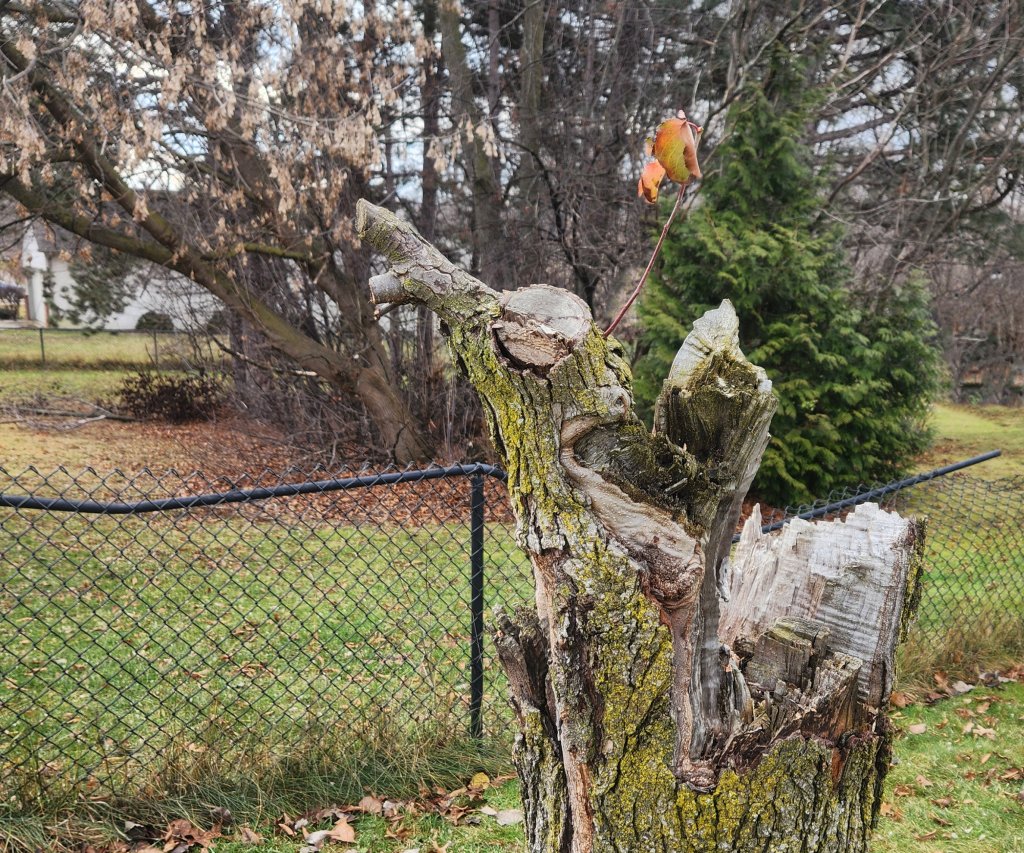
There’s a tree in a yard just down the street from my home that toppled twice this past year during two separate storms. The first was a windstorm that swept through last spring. By the time the ruckus had passed, one of the three stems ascending from the tree’s primary trunk broke free and crushed a nearby fence. The second gale was a late summer thunderstorm that brought equally powerful wind. When it finally quieted, the other two stems had fallen and destroyed another portion of the same fence. All that remained was a four-foot trunk with a splintered top.

It wasn’t long after either storm that the property owners cut and removed the debris, eventually leaving what is now a grayed and seemingly dead stump. I drive past it every day. For me, even in its obtusely pathetic state, the stump has faded into the neighborhood’s landscape, becoming something I no longer even notice.

But then one day last week, I did notice it. Even in mid-winter, it had a shoot growing from its top. Astounded, I circled back around and stopped to take a picture.

I’m not an arborist. Still, I know most deciduous trees in Michigan hibernate in winter. Essentially, they go to sleep at the end of summer. They slip into their dormancy stage, locating their essential nutrients in their roots. Doing this helps to keep them healthy and ready to bloom again in the spring. That’s why the leaves fall in autumn. The trees are shutting down the supply lines to everything but the roots, starving its skyward limbs and keeping the food where it’s needed most.

But this tree is not sleeping. It’s awake and growing in winter. Wearing only a slightness of green on one of its two leaves, a passerby can see by its sprig that it’s struggling against the elements. Its tiny, outstretched appendages are tinged with shades of autumn’s hues. Still, there it is, pushing up from a seemingly lifeless trunk, attempting to snatch every bit of Michigan’s occasional wintertime sunlight.

While barely anything at all, it’s an inspiring scene. Against the bleakest landscape, while everything else around it has given up and gone to sleep, it is awake, as if reaching up from hope’s nutrients with an unwillingness to forfeit.

Seeing this, as a Christian, I suppose my first inclination was to experience echoes of Isaiah 11:1, which reads, “There shall come forth a shoot from the stump of Jesse, and a branch from his roots shall bear fruit.” Isaiah’s words are forward-looking. They refer to Jesus. He is the One who, even as all mortal muscle for rescue was beyond spent, arrived bearing life. There He is. God did not leave us. He acted. He sent His Son, just as He said He would. Hope against all hope has been fulfilled. The Son has brought new life into what seemed to be Death’s dooming winter. And joy of joys! From His person and work, branches emerge and grow where no one thought they could. And this happens no matter life’s seasons, each shoot bearing extraordinary fruit (John 15:5).

I had a before-worship conversation on New Year’s Day with the chairman of our Board of Elders, Harry. Analyzing the societal landscape, we predicted that the forthcoming year would likely be far bumpier than the previous one. For the record, we weren’t being pessimistic but realistic, and in a sense, we were admitting to our need for the fruits that can only be plucked from Christ’s tree. In the New Year, we’re going to need the fruits of love, joy, peace, patience, kindness, goodness, faithfulness, gentleness, and self-control (Galatians 5:22-23). We’re going to need fortitude, the kind that wholeheartedly owns the title “Christian” (James 1:2-4; John 16:1-4). We’re going to need endurance (Romans 5:1-5). We’re going to need wisdom, the kind that can’t be duped by evil disguised as good (Ephesians 5:15-17). We’re going to need persevering strength to follow Jesus when doing so might appear to make very little sense (Hebrews 12:1; Luke 5:4).

We’ll need to be hope-filled sprigs against this world’s dismal backdrop (Romans 15:3).

But there’s another thought to be had. As a perpetual watchman for summer, the tree’s lonely sprig was a “consider the lilies of the field” moment (Matthew 6:28). It had me thinking about how God loves and cares for His people. Taking the stump’s picture, I spoke out loud to myself, “Storms will come, people will cut down the lilies, but nothing can stop spring from coming.” Christians will know what I meant.

No matter how the world rages, God’s promises will not be stopped (Romans 8:31-39). He’s caring for us now. As He does, we know the springtime of eternal life is coming. This means that even in the face of persecution and Death, believers have a limitless wellspring of hope. Like the stump’s sprig, what the world might expect from us in the darker moments is not what we’ve been recreated to do. The world will bear down on us with icy impositions, expecting that we’ll shrink into self-preserving hibernation. But instead, we reach up to the heavens as sprigs in winter. We stretch out in stark contrast to the surrounding world, bringing even the littlest bit of color into the sin-sick grays of this passing world.

We endure when enduring seems impossible.

This is my continued prayer for you in the New Year. God grant it.

Imperishable, Undefiled, and Unfading

One would think I should’ve been a weatherman because I’m so obsessed with the seasons. Although, it isn’t an obsession. It’s frustration. I live here, but I’m not meant for this climate, especially not the back-and-forth Michigan is currently enduring.

I dare say even the ones who adore autumn in this state will know what I’m talking about. The days are becoming wildly different.

I suppose one way to describe this is to say that, indeed, summer is over, and as a faithful doorman, autumn is watching for winter, preparing to hold open the gates when it arrives. Until then, autumn fidgets. It keeps opening and closing the door, stepping out to scan the horizon for winter’s caravan, and then stepping back inside again to watch and wait. By this, autumn stirs wildly different weather, sometimes all in one day.

Again, Michiganders will know what I mean. One moment, the sky is clear, and the sun is shining, warming all within reach of its bright array. It’s as if August locked the door, barring September and its followers from entering. But with little more than a glance to the horizon, thick clouds are invited over and into view. The door is thrown open. The sun is nudged away, its beaming warmth exchanged with chilly darkness and drizzling rain. In other words, to endure Michigan’s autumn means to be in August one minute and then October the next. One moment, the sky’s sapphire happiness is vast and cheerful. The next, you’re in deep space, a hundred million miles from our solar system’s star.

But then winter finally arrives, and that’s that—no more confusion.

I began by saying I’m not meant for this climate. I mean that in more ways than one. Interestingly, one of those ways, in part, explains why I’d never willingly leave Michigan. In truth, physically, I’m suited for Florida. My body feels better when I’m there. My back feels better. I have fewer migraines. However, God put me in Michigan. This is where my vocation’s muscle is flexed. I’ve come to realize my vocation—my combined roles as a husband, father, pastor, and the like—are less about location and more about devotion. I really can live just about anywhere when I’m confident that God has me right where He wants me. Where He puts me is a part of what He wants for me. What He wants leads to eternal life (John 6:40), which is eternity’s joyful location—an inheritance far beyond this life’s comforts.

When a Christian trades interest in this life’s comforts for the joy of the life to come, it’s incredible what can be endured. This world, steeped in its undoneness, is seen for what it is. Still, even as we endure, it’s amazing how the sun perpetually shines when, by faith, you know you’re not an inheritor of this world but of an altogether different sphere.

Saint Peter referred to this inheritance as “imperishable, undefiled, and unfading, kept in heaven for you” (1 Peter 1:4). He went on to say that this remains true, even as we are “grieved by various trials, so that the tested genuineness of your faith—more precious than gold that perishes though it is tested by fire—may be found to result in praise and glory and honor at the revelation of Jesus Christ” (vv. 6-7). Luther explained:

“This means that our hope is not set on possessions or an inheritance present here on earth, but we live in the hope of an inheritance which is at hand and which is incorruptible, and which is undefiled, and that does not fade away. We possess this good eternally, only we cannot see it yet. … All things that are on earth, even though they may be as hard as iron and stone, are perishable and cannot last. Man, as he grows old, grows ugly; but the eternal good does not change, but remains fresh and green forever. On earth, there is no pleasure so great that it does not pall in time. We see that men grow tired of everything, but this good is of a different nature.” (Luther’s Works, Weimar Edition, 12:269.)

“…there is no pleasure so great that it does not pall in time.”

In this life, the seasons change. The cold moves in. The clouds pall the landscape. The light dims. And yet, eternal life’s season—our inheritance—remains unphased. It’s ready and waiting (John 14:2-6). It stands sturdy and cheerful and sure, beaming brightly beyond this world’s veil of tears (James 1:17). What’s more, as Luther remarked, not only do we know this, but we own its resplendence right now. “We possess this good eternally,” he wrote, “only we cannot see it yet.” It’s true. Our mortal eyes cannot see heaven’s glory. But faith sees it. And it’s aware that the light feeding heaven’s extraordinary brilliance—Jesus Christ—is alive with us right now, and He’s radiating luminously through us to a darkened world in dreadful need of rescue (John 8:12; Matthew 5:14-16).

For Christians, when life in this world becomes attuned to this hope-filled future, there’s little that the temporal darkness can disrupt. Knowing I’m not an inheritor of this world—that my time here is quite temporary—I see everything this life throws at me differently. More importantly, courage for faithfulness to Christ, my Savior, is within reach every moment of every day (Ephesians 6:10).

Having said all this, I need to be clear. I still intend to live in Florida one day. If God intends it, it’ll happen. Until then, I’m where I need to be.

Complaining

As I type this, a bag sits on the chair across from my office desk. The bag has puzzles inside. I don’t know who placed it there, but I’m assuming it to be a kindly gesture by someone who knows my family likes such things. Somewhat of a betrayal of my observational skills, I think the bag was delivered to my office this past Wednesday. I can’t say for sure, mainly because last week was a bit of a blur. A lot happened in a very short period. Some of it was easy. Other parts were more challenging. All of it is in the Lord’s hands. It’s His church. We can all sleep easier knowing that.

I should say that as grateful as I am for the gifted puzzles, unfortunately, I do have one concern about the bag. It is adorned with a wintry scene bearing a smiling snowman. Above the frosty gent are the words, “Let it snow!” Again, thank you to whoever gave us the puzzles. What a treat! Nevertheless, I need you to know I’m going to burn this bag once my family removes the thoughtful gifts in its keep. I dread the snow and everything that comes with it. I say, keep the snow upstairs in heaven’s attic, and instead, let the warm sunshine continue to gild the grassy summertime landscapes down here.

Summer is better. Summer is my thing.

Of course, this isn’t to be. Anything I might call “my thing” is never really mine to control. Nothing is. Even the things I might consider autonomic—something like breathing—will one day cease. I won’t be in control at that moment. And so, for as much as I want summer to remain, winter is coming. Beyond that, there’s no use in complaining about it—even though I’m pretty sure I will continue to do so.

Technically, I have no right to complain. I live in Michigan, a tundra-like state. I do so by choice. Well, maybe not by choice. I blame my wife, Jennifer. She’s from Michigan. I met her, fell in love, and I stayed here because I wanted to be where she was. Thankfully, God saw fit to put me into a congregation I dearly love. Or perhaps better stated, I’d die for the people of Our Savior in Hartland, Michigan. Considering Joe Biden’s recent speech, it seems that’s becoming less a rhetorical statement and more a possibility.

Still, if I had the magical ability to lift Our Savior Lutheran Church and all its people from the earth and set them down on a gulf-kissed shore in Florida, I would. The place would look nice with some pineapple trees in our gardens and a few palm trees by our bell tower. I know I’m a stickler for stewardship, but if anyone suggested during a congregation meeting that we install a pool, I’d probably go for it. I mean, why not? Hey, trustees, what do you think?

But as I said, I have no right to complain. Come to think of it, at a base level, none of us has a right to complain about discomforting things we experience in this world. These things exist because of Sin. Sin is our fault, and complaining about it is a bit like turning on the stove, putting our hand in the flame, and then whining that we were burned. Besides, in the grand scheme of things, the One to whom we’re most likely directing our complaints—God—isn’t responsible for Sin. The fact that He handled it anyway says something about Him.

He loves us.

That brings something else to mind this morning: the Complaint Psalms—Psalms such as 3, 31, 44, 64, 142, and others. The Psalms of Complaint certainly are good examples of divinely inspired writers whining to God. That being said, such Psalms assume a few things.

Firstly, they assume a distinction between good and bad complaining. Bad complaining is often described in the scriptures as grumbling. Grumbling is the negative bemoaning that happens when our attention is more set on self than Christ. We want what we want. When we don’t get it, we complain. Perhaps worse, we end up blaming God for our woes rather than trusting in His divine care. I think good complaining—biblical concern—is different. God expects His people to complain to Him. He expects us, like Him, to be bothered by Sin’s darkly products. If we’re not expressing our concern in some measure for Sin’s grip on humanity and its dreadful horribleness unfolding in the lives of every man, woman, and child across the planet, then we’re far denser than we might give ourselves credit. This same assumption understands faith. It understands, firstly, that God is ready to hear the cries of His people; and secondly, we go to Him because He’s the only One capable of doing anything about Sin. Yes, we can complain about the ungodliness of abortion. We can even get involved, doing everything we can to stop it. Still, God is the only One who will see to its permanent demise. This leads to another assumption about good complaining: the anticipation and expectation of God’s love. We know God will always be ready to exchange our concern with His comforting Gospel—the wonderful proclamation of our deliverance from Sin through the person and work of Christ and the promise to strengthen us for meeting the challenges that stirred our concern in the first place.

He loves us. He hears us. He’s with us. He enlightens and empowers us, using the momentum of our Godly concerns to work through us in His world.

Still, as with the rest of God’s Word, the Complaint Psalms are in place to herald Christ. They meet with the Sin problem, being sure to dole out the only hope that can soothe our visceral concerns. Take a look at some of the Psalms I mentioned above. They never leave the complainer without hope.

I’m not so sure my complaining about snow fits into the category of good griping. While I’m burning the snowman bag, I’ll reflect on what I do know—which is that if it’s the Lord’s will, He’ll see me through another season that more than taxes me holistically. This world—His world—will continue to spin. Winter will become spring. Summer will return after that. All along the way, He’ll take both my bad and good complaints and put His faithful Word before me—both His Law and Gospel. He’ll give His Law to reveal my sinful selfishness and His Gospel to forgive and strengthen me for being His trusting child who engages in the surrounding world.

In all, I’d say that will forever be a pretty good gig for whiners like me.

Summer is Coming

In case you were wondering, at the time of this writing, there are 184 days until the first official day of summer. You might think I’m saying this because I’m already exhausted by winter. The only problem with your assumption is that winter doesn’t officially begin for two more days. Technically, we’re still in the fall.

Interestingly, to say “still in the fall” is to speak a phrase with more than one connotation, and no matter which you mean, the evidence of its actuality is there in support.

Take a look outside. The trees are bare. The leaves are scattered and damp beneath a recent layer of snow. The air is frigid. The sky is palled with clouds. There’s no arguing that the earth’s current position in relation to the sun is more than a few spins on the planet’s axis away from summer—half a year, to be exact. For me, this is a tiresome knowledge that can only be moderated through artificial means or by deliberate distraction. I keep a sun light in my office. Its light is weirdly simulated, but in the middle of a soul-dampening season that sees the sun disappearing completely sometimes as early as 5:00pm, it helps, even if only a little. In tandem, I stay busily distracted. I find that if I’m not thinking about the sky’s blue potential, I’m not necessarily missing it, and I’m less affected by its current grays.

Of course, there’s another meaning to “still in the fall” that we shouldn’t overlook. It hearkens back to the terminally unfortunate moment recorded in Genesis 3; that swift instant when, through self-inflicted grievousness, Mankind destroyed God’s perfect creation and positioned himself as far from God as physically and spiritually possible. The evidence mirroring this fall is plentiful. It’s all around us, sometimes subtly, and other times obviously. But either way, it is as discoverable as the seasonal image I described before.

It was subtly visible to me a few nights ago while working on a puzzle with Jennifer and the kids. We’d finished a 1,000-piece puzzle, and after a day or so of admiring the fruits of our long-suffering work, within a few minutes, we’d taken it apart and put it back in the box. In other words, what took days to complete was destroyed in seconds. Similarly, it was obvious to all of us by what happened in Mayfield, Kentucky, a town founded in 1824 and home to countless generations of families. In only a few minutes, the town was all but wiped from the map by a tornado.

To be “still in the fall” means that we exist in a world that continues to prove, not only that it is horribly infected by the destructive powers of Sin and Death, but that both it and its inhabitants are completely impotent against being consumed by them. It’s a place where this often plays out in subtle, but sinister, reversals. It’s a place in which one can claim Christianity, but be perfectly fine with cohabitation. Or perhaps cohabitation is admittedly offensive, but so is telling a Christian he or she is a walking contradiction for claiming Christ but only attending worship at Christmas and Easter. This same world is a place in which the bad we hear about someone is easily believed and the good is suspicious. It’s a place where lies easily outpace what’s objectively true. It’s a place where devout self-interest outguns concern for the neighbor. It’s a place in which one little disagreement can cause long term relationships and everything that goes with them to fall like leaves from an autumnal tree, having become completely disposable. It’s a place in which so many things unfold before us as reminders that this world exists in darkness, and no matter how hard we try, there’s no man-made light that can pierce its blanketing madness. There’s no artificial distraction vivid enough to keep its dreary sorrows apart and contained.

Only the real summer sun will do.

The official season of fall will end in a few days. When it does, we’ll cross over into the deathly hibernation of winter. It’s appropriate for Christmas to arrive at this precipice. Right in the middle of a downward dismalness anticipating and becoming Death, a Son is born. And not just any son, but rather the One God promised to send who would free Mankind from Sin, Death, and the devil’s ghastly grip (Genesis 3:16). Only this Son will do. He is God in the flesh. He is the incarnational invasion of God’s summertime love for a dying world filled with inert sinners. His presence is the incontestable assurance of a springtime restoration leading to eternal life—which He intends to be fully realized in the summer-like joy of paradise.

Jesus of Nazareth is this Gospel Son.

I suppose I should end by pointing out that our lives are not absent these wonderful Gospel images during the fall and winter. Sometimes obvious, and sometimes subtle, they’re there. An evergreen is a perfect example. Something that has become an emblem of Christmas, evergreen trees and bushes are subtle reminders accessible to us no matter the season. They remain thickly verdant with life all year long—just like a Christian’s hope born from the promise fulfilled in the Christ-child of Bethlehem. But then there are the obvious snapshots of the Gospel, too: the Word taught and proclaimed, the Absolution of Sins, Holy Baptism, the Lord’s Supper. Although, “snapshot” is probably not the best word to explain these things. These wonderful gifts of God are far more than images. They are tangible invasions of the most holy God—moments He has instituted, moments doused in the divine forgiveness that not only serves us while we are “still in the fall,” but also in place to prepare and then tie us to the promise of an eternal future in God’s heavenly summer.

I pray you will remember these things as you make your way into the Christmas celebration—and the rest of the Church Year, for that matter. Know that God loves you. Know that the Savior born of Mary is the proof. Know by this wonderful celebration that the winter of Sin and Death is not permanent. Summer is coming.

It’s Really Not That Complicated

I pray all is well with you and your family as we dive deeper into the darker and colder months of the year here in Michigan. Those who know me best will agree that the further we go toward the seemingly sunless frigidity of winter, the more I’ll long for the clear blue skies and richly warm sunshine of summer. For me, summertime is not only a period for physical and mental rejuvenation, but it carries in its streaming rays a much simpler mode of life. Winter brings snow, extra layers of clothing, scraping windshields, shoveling and salting walkways—all of this just to go from one place to the next. For many, it means doing all of it in the dark, only to return home later that day in the same pitched shadows, with barely an opportunity in between to enjoy unobstructed sunshine.

Summer, on the other hand, is simpler. It means waking with the sun already nudging you with its warmth. It means walking directly to the car unhindered, driving to work in the sunlight, and returning home again with the same gleams of wellbeing caressing your face. It means after-dinner hours enjoying that same heavenly light and the beautiful landscape that light so effortlessly highlights for our viewing pleasure.

Winter has a sense of complication. Summer feels much easier.

Speaking of complicated versus easy, while at the same time still thinking about the events of our recent “The Body of Christ and the Public Square” conference, I’ve noticed from conversations with folks in attendance that no small number come to the event expecting the extraordinary woes of our day to be met with extraordinary solutions. And yet, when the emotion that’s almost always mixed in gets stripped away, it’s discovered that the problems themselves are often less complicated than we expected. In truth, the answers to the concerns are usually just as simple, requiring only the stamina of living every day according to one’s values, as opposed to formulating complex strategies that will, at some point, require brute force muscle.

In other words, our hearts and minds expect the astonishing when what we need is usually quite ordinary.

I more than hinted to this in my speech. I noticed Abby Johnson, Candace Owens, and Charlie Kirk all said more or less the same thing in theirs. And why? Because it’s true. While we like to complicate things, more often than not, the solutions we need are usually very simple.

That logic applies to salvation, too.

For starters, it’s not beyond us to complicate what God has done to win our forgiveness. Perhaps we find ourselves making deals with Him, promising to do this or that, all the while hoping that He’s figuring into His calculations our good deeds against our bad. Or maybe we try to avoid Him altogether, figuring we’ll never measure up to His expectations, ultimately finding ourselves in despair. But God’s simple reply to all of this is that His Son’s sacrifice on the cross was enough. No deals are necessary. No calculations are required. No need to avoid His presence. All is well between God and Man through the person and work of Jesus Christ. Believe this and all will be well with your eternity.

On the other hand, perhaps we look to our God expecting fantastical displays and magical deliverances. We ask to hear His voice. We pray for a sign. We expect a miracle. But in the end, His reaching to us occurs by way of very ordinary things. He gives us a book filled with the promises of His love (Hebrews 4:12; 2 Timothy 3:16-17; Psalm 119:105). He sends us the Good News of our rescue through the preaching of a less-than-spectacular servant—a pastor (Romans 10:14-15). He claims us as His own by combining His Word with water to wash us clean in the blood of the Savior (Matthew 28:19; Romans 6:3-10; Galatians 3:27), and He attaches a promise to what He does there, saying, “And behold, I am with you always, to the end of the age” (Matthew 28:20). He makes His presence among us, bringing even more of His wonderful love by means of commonplace food items—bread and wine (Matthew 26:17–29; Mark 14:12–25; Luke 22:7–38; 1 Corinthians 11:23-29).

I could go on and on, but I think you get the idea, which in the end, is that your God doesn’t want you wrestling with the complication of uncertainty. He wants to assure you of His love through the life, death, and resurrection of Jesus. He wants you to be uncomplicated by the fetters of sinful human tendency, which as I said, bears the potential for making something very easy into something very hard.

My advice: Look to the cross. Be reminded of the holy One who hung there. Rest assured that what He did on that cross was the most extraordinary act of God wrapped up in the unsettling usualness of a common criminal’s death. But there amid the agony and bloody sweat, among the excruciating sighs, and finally, by His dying breath, your complicated account was settled with God. Through faith in His sacrifice on your behalf, your eternal balance reads, “Amount due: $0.00.”

Believe this. It really is that simple.

“Let Us Run the Race…”

As always, I pray all is well with you and your family, and that as we make our way toward summer, you are beginning to receive some relief from winter’s grip.

When I say grip, I mean it. Michigan winters are long. I grew up in central Illinois. Until I moved here in 1994, I was ignorant to the fact that it’s all but guaranteed that eight of Michigan’s twelve months will deliver a measure of frigidity. It’s a truth that tips its bowler cap reminiscently to the British notion that there’s only one way to ensure summer in England and that’s to have it framed and hanging in the living room.

And yet Michiganders press on, we endure, knowing that when summer does finally arrive in our state, there will be few other places in America that can capture our hearts for home in comparison.

Although, “endure” is an interesting word to use in relation to something we love, isn’t it?

As a pastor, even as I’ve needed to endure troubling people, places, and things, I’ve also been on the scene to watch other people endure, too. About thirty-six hours ago I was sitting at gate B16 in the McNamara Terminal at Detroit Metropolitan Airport on my way to St. Louis, and across the way at gate B15 was a family enduring their restless two-year-old. Come to think of it, we were all enduring the toddler. I’m sure they love their son, but I have to imagine that in that particular moment they were doing what they could to get through the oncoming hours of travel, ultimately hoping for the peace that comes with arriving at their final destination—which appeared to be Knoxville, Tennessee.

Observing those folks (not gawking, of course), I’d say they were doing a stellar job of receiving the disdain-filled stares of the folks around them, while at the same time managing their own inclinations to put a red tag on the kid and check him as extra baggage at the door of the plane before boarding because they knew they wouldn’t get away with stuffing him into the overhead bin.

I’ve learned over the years that the way people endure struggle often reveals more about them than the actual thing being endured. I was reminded of this rather vividly earlier this week when I was called to the scene of an unexpected death. There were family members of the deceased who claimed faith in Christ, and yet were completely inconsolable—more so than I’ve ever seen before—wailing and calling out that life was now over, that all hope was lost, that God was their enemy, that they hated Him, that He was punishing them even as they’d been so faithful to Him in church attendance and prayer and giving. (For the record, I found out later after talking to their pastor they weren’t actually as faithful as they’d claimed.)

Over the course of the hour after I arrived, other Christian family and friends arrived, too. I didn’t learn of their faith in Christ by asking, but instead beheld them embracing the inconsolable ones and offering them the reassurance that hope was not lost, that God was not doling out injustice, that He was not scheming to harm or destroy them.

To be clear, I’m not belittling anyone’s moment of grief. I’ve been in and around it enough to know that it’s different for everyone. And besides, it truly was an unfortunate scene. Still, when it comes to relationship status, I’d say that for the most part, everyone in the room held equal shares of the burden of the moment. But for some reason, one group in particular seemed capable of finding their way in the darkness, of believing that even amid the coldness of Death, the summer of eternal life through faith in Christ was approaching on the horizon. They were proving a deep trust that the sadness would eventually pass, that the Day of Days was coming. It was only a matter of time. Armed with this knowledge, they were going to press forward displaying a different kind of grief, one that emitted hope and was capable of shepherding others in the same.

Paul said something about this in 1 Thessalonians 4:13-14:

“But we do not want you to be uninformed, brothers, about those who are asleep, that you may not grieve as others do who have no hope. For since we believe that Jesus died and rose again, even so, through Jesus, God will bring with him those who have fallen asleep.”

Those who fall asleep in Jesus are brought along with Him. In the moment of their passing, no matter how dark it might seem to be, they are immediately carried to where He is. This is true by virtue of His unarguable power over Death.

Saint Paul’s words are Easter words. Easter owns them. I’m here to tell you that it’s no coincidence that God established Easter in the springtime. Spring steps forth from the grave of winter with its heart set toward summer, the sunlit upland of new life in full bloom.

Until then, indeed, the need to endure is rarely an easy thing. Just look around. But as you do, I’d caution those of you expecting to discover nothing but hopelessness unfolding throughout the world that you’ll likely see Christians continuing to prove the engine of endurance being fed by the Gospel of hope. History itself testifies to this. In a sense, you are enjoying the benefits of this verity. Fellowship in the Christian congregation you call home exists in part because the Christians who were tossed into dens filled with lions endured. The faith you are laboring to pass along to your children and grandchildren continues because Christians staked by Nero endured. The Bible—the Word of God for faith is even now in your hands because the Apostles who went out with a willingness to be crucified—even upside down—endured. The world has continued year after year to pit itself against Christianity, and yet countless generations continue in the way of salvation. Why? Because that which is the power of God unto salvation—the Gospel (Romans 1:16)—continues to endure, just as the Lord said (Matthew 16:15-20). And so, like those who’ve gone before us, we are not fearful as the world is fearful. We do not grieve as the world grieves. We do not endure unpleasantness and struggle and suffering and pain as the world endures. We have hope. We have that which has reached into us from the divine spheres and kindled our hearts with the warmth of a joy that can withstand the temperatures of mortal struggle that fall below freezing.

We know the summer of eternal life is coming. It’s not that we think it’s coming, but rather by the power of the Holy Spirit alive in us, we know it. That being true, and all of our senses being so attuned by faith to this Gospel reality, we cannot help but invest in its inevitability, ultimately letting it be visible to the people around us.

I know I don’t always do this as I should, which is why I need to continue to prepare.

I don’t know about you, but I dedicate time in the spring to preparing for summer. I clean up the yard. I trim back bushes. I prepare flower beds. I test sprinkler heads. I swap the snow blower in the garage with the lawn mower in the shed. (Michigan being what it is, sometimes I learn that I’ve made the swap a little too early.) I do countless things to make sure all is in order. I’m sure the Christians who are faithful in worship will make the appropriate connection here. They don’t need help understanding that because Christ fully accomplished our redemption, there isn’t anything we do for God that somehow plays a part in winning the unending summer of heaven. And yet, they also understand that the same Savior calls for us to prepare. He urges us to a readiness that doesn’t doze off so easily, but rather remains aware, that actively engages in order to keep itself well-stocked and complete for the Day’s arrival when we will be brought into Christ’s presence (Matthew 24:42-44; 25:1-13 ).

Christians know that holding “unswervingly to the hope we profess” means “drawing near to God” where He locates Himself (Hebrews 10:22-27). They know God’s divine prompting for readiness means being with Him in worship, together with other Christians, to receive as one like-minded, supportive, and believing family His gifts of Word and Sacrament that feed the flame of faith for running the race (Hebrews 12:1-2) and enduring until the end (James 1:12).

The Wind Just Keeps On Blowing

Isn’t it strange how we do what we do as humans, and still the earth just continues to spin, doing what nature does?

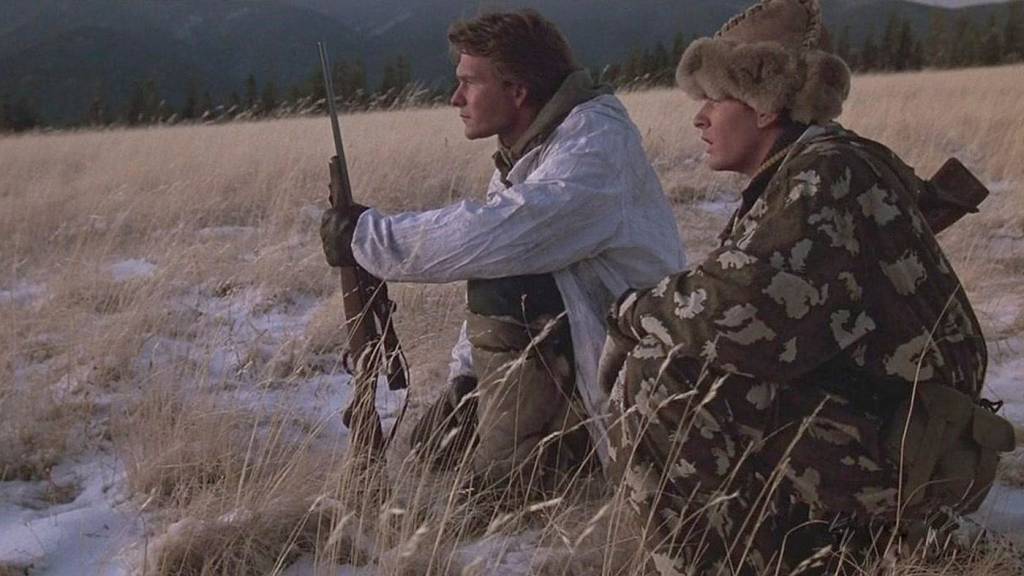
I live in Michigan where it can get pretty cold in the winter. But just a few days ago, the wind chill was registering at -35 degrees, and because so many were forced to run their furnaces non-stop, the entire state was facing a natural gas crisis of catastrophic proportion. The whole scene reminded me of a line in one of my favorite movies as a kid, Red Dawn. During a brief moment of quiet from what has already been a long and exhausting war to take back their home soil from invading forces, the character Matt says to his older brother Jed:

“It’s kind of strange, isn’t it, how the mountains pay us no attention at all? You laugh or you cry, and the wind just keeps on blowing.”

The wind just keeps on blowing.

During those very cold days, while I managed to make it out and around to visit a few folks, I found it necessary to be home with my family to help tend to their needs. During the quiet times, I took the opportunity to do something I’ve been meaning to do for a very long time.

I tackled the ever-piling messages in my email inbox.

I spent an entire afternoon reading through countless email notes, many new and just as many old. I saved some. I deleted most. To be honest, across three accounts, I deleted no less than six hundred or so.

There was one older message I discovered that I decided not to delete—and I don’t think I ever will.

The message I saved was from a dear friend, Lorraine Haas. She sent it on January 26 of 2017, and it was in response to the eNews she’d received the day before. Little did I know that a few weeks later I’d be preaching and presiding at her funeral.

The thing is, Lorraine responded to almost every single eNews message she ever received from me. Had I kept all of her messages throughout the years, I’d have hundreds. And what was common to them all (at least the ones related to what I would initially send to her) is that, firstly, she commented on this or that news item, making sure that I knew that she’d read the entire email; and secondly, by her words, she was sure to have a brightness of commendation for all the great things the Lord was allowing her home congregation to do. She was a perpetual encourager of the Gospel. She knew all of the volunteers and staff were working as hard as they could to accomplish the mission, and with that, she never spoke a negatively critical word.

Well, I should probably rephrase that. She never spoke a negatively critical word by way of an email. In private, face to face, and with a little bit of whisky in our glasses, she more than shared her mind on things. I always knew what mattered to Lorraine. But still, the written word remains for far longer than the spoken word. I’m pretty sure Lorraine knew that, and so whatever she put into print, you could be assured that it would always be an uplifting bit of phraseology meant to make your day better and not worse.

This particular (and unfortunately only remaining) email I kept from Lorraine was very short. I share it with you exactly as I received it. Visiting with it, I know why I’ve kept it sitting in my inbox for so long. It’s only a few sentences long, but it’s a tome of God’s grace.

And the Lord be with You also dear Pastor. May God Bless and Keep You, with Courage and Strength in the coming Day. He loves You, and Me and our Church. His Church! Blessings dear Pastor, and to your dear Family! Lorraine

It’s kind of strange, isn’t it, how the mountains pay us no attention at all? You laugh or you cry, and the wind just keeps on blowing.

Actually, no. The mountains, as sturdy as they are, will pass away. The winds of this world will eventually cease. The laughing and crying of this life will one day be left to the archives of what once was. But the Word of the Lord stands forever. Even now, by way of an email sent by a friend who died years ago, that Word of the Gospel alive in her continues to breathe life into a guy like me—and now into you, too.

It’s as if it reaches to us from the sphere of the divine. In a sense, it does.

Analyzing her sentences, I sometimes wonder if she capitalized words for the same reason I capitalize certain words. I do it in sermons all the time. I tend to capitalize words that are either incredibly important or are in some way an extension of God’s divine work. For example, in a sermon, I always capitalize the letters “d” and “s” in the words “death” and “sin.” I capitalize them because they’re no small thing to us. They’re dreadful powers in this world. If they weren’t, then Jesus’ work on the cross would be less needful to any of us. Equally, I’ll sometimes capitalize words like “redeem” or “love” or “salvation,” especially when they are connected to the person or work of Jesus.

I could be overanalyzing Lorraine’s note, but I wonder if she did the same thing for similar reasons. For example, she capitalized words like “bless” and “keep.” She also emphasized the first letters of “courage” and “strength.” Most interestingly, she capitalized the words “day,” “you,” “me,” and “church.” Why? Well, as peculiar as it may seem, I’d say that each of those words is an offshoot of the vine of Christ. He blesses and keeps us. The courage and strength we need from day to day come from Him alone. And with that, each one of those days belongs to Him. Each one holds the promise of His great love that is carrying you, me, and the whole Church to the Last Day.

With this perspective, go back and read Lorraine’s message one more time. Take it in carefully. I’m sure you’ll get a sense of the ever-living faith that surpasses all understanding, a faith built upon and strengthened for eternal resonation by the powerful Word of God that keeps hearts and minds in Christ Jesus; a Word so powerful that, in fact, not even death can silence it.

Yes, the wind just keeps on blowing. But the war will eventually end. And when it does, when the wind rustles its last leaf, we’ll be gathered into the nearer presence of Christ. In that place, we’ll see all those who’ve died in the faith—all those for whom we’ve shed a tear while the mountains looked on with disinterest and the breezes continued to blow.

I’ll see Lorraine again.

Most importantly, we’ll all see our Lord, the Giver of Life, and it’ll be a face-to-face encounter. Until then, as long as I can help it, I’m never going to delete that email from Lorraine. I’m going to store it away with a few others that are like it that I’ve received from another dearly departed friend, Reverend Dr. Jakob Heckert. As Gospel-driven notes, these messages are far too valuable as divine sources of encouragement to end up in the virtual trash bin.