
Slipping Into Error

I’m sure you already know this, and yet, just in case you don’t, Israel launched preemptive strikes against Iran’s nuclear sites on Thursday. As expected, Iran responded. It was reported in the news that we knew those strikes were coming, even as America was attempting to broker a peace deal with Iran. However, Iran appeared to be doing what Iran always does, which is to make every excuse for not securing peace. Meanwhile, Israeli and American intelligence agencies reported that Iran was only days away from having enough enriched uranium to build a minimum of fifteen nuclear weapons, only one of which would be needed to turn Israel to glass. Used against the United States, millions here would die.

Is any of this news reporting accurate? Is the media telling us what’s true? It’s hard to tell these days.

On one hand, Iran’s supreme leader, Ali Hosseini Khamenei, has said they would pursue nuclear independence. He also said as recently as 2023 that “Death to America is not just a slogan. It is our policy.” And of course, Iran—the largest state sponsor of terrorism in the world—has made it a priority to rid the world of the Jews. That’s not breaking news. That’s an open and longstanding fact. What’s more, Iran’s desire for Israel’s destruction, some have said, is the only truly unifying principle that keeps the nation together. A largely tribal nation, Iran would likely come entirely undone if not for its leaders’ radical Islamic ideology.

On the other hand, nearly everything the news reported about COVID turned out to be false. Masks and social distancing absolutely did not accomplish anything, except to decelerate development in generations of children. It turns out that ventilators made the sick worse. Ivermectin, the Nobel Prize-winning medication prescribed to humans for decades, was negatively labeled a “horse dewormer” and called dangerous, ultimately getting doctors who knew better and prescribed it into heaps of trouble. And yet, it turned out to be wholly sufficient for treating the illness. If a person added vitamin D to his regimen, he would be good to go. Conversely, most news outlets insisted that the vaccine would protect from infection. They streamed Biden’s thank-you to the vaccinated while warning the unvaccinated to expect “a winter of severe illness and death.” And yet, the opposite was true. In fact, the rates of unexpected deaths have seen a sharp increase only among the vaccinated.

I read an article this morning from CBS News saying that the FDA is insisting Pfizer and Moderna “expand the warning labels on their COVID-19 vaccines about the risk of a possible heart injury side effect linked to the mRNA shots, primarily in teen boys and young men.” It goes on to talk about unusual spikes in myocarditis. A peripheral article warned of the same, but then added strange cancers and other diseases to the list of concerns, conditions that were never as prominent until after the COVID vaccines and boosters were so widely administered. One particular example shared was that sudden athlete deaths were off the charts by comparison to pre-COVID statistics.

By the way, I should say I’m not surprised by the vaccine results. Dr. Mary Talley Bowden was recently on Joe Rogan’s podcast, and she mentioned that we now have five years of data stacks confirming the vaccine’s dangers. She essentially noted that anyone who received the vaccine is now, in a sense, permanently rewired—because what the news called a vaccine isn’t a vaccine. It’s an mRNA injection. It’s gene therapy. Gene therapy rewrites DNA. Vaccines, in theory, are designed to prompt and arm the body’s immune system. Gene therapy is designed to manipulate the body’s very DNA. It works at a genetic level.

Still, the public’s response to COVID proved how quickly fear and misinformation can bend entire societies—even churches—toward error. I say this as so many churches, even after the lockdowns, continued to forbid worshippers through the door unless they were masked, vaccinated, and sat two rows apart. This is an absolute violation of God’s Word, regardless of the government’s mandates! The same patterns are playing out again, just under different headlines.

However, I didn’t start writing this morning with COVID-19 on my mind. I was more concerned about the possibility of war. More precisely, I was thinking about how easily things come undone—or how easily human beings can steer into falsehood—when our handling of source material is faulty.

Concerning everything I’ve described so far? I suppose the only answer I can give is to say, “Read, read, and read some more.” As Christians, I encourage you to do this, remembering three things in particular.

First, understand that skimming content is rarely helpful. Dig in and digest, reading from various sources in order to get a topic’s fullest spectrum of perspectives. Second, pitch everything you read against the Word of God. In other words, let everything you take in pass through the filter of Scripture. God’s Word shapes our opinions, not the other way around. Third, make sure your doctrine is sound. Doctrine doesn’t just articulate what we believe about salvation. It provides necessary boundaries, becoming a primary tool for discerning everything we see and experience. If you claim the Bible, and yet your theology depends on the modern nation of Israel going to war with Iran as a fulfillment of end-times prophecy before Christ can return, then it’s likely the first two recommendations weren’t heeded. In other words, first, you aren’t all that familiar with the Bible’s actual contents; and second, your opinion has become your strongest filter. As a result, your doctrinal compass is misaligned, and you’re destined only to distort the source material—the Bible.

Now, I say this as someone who’s spent a lot of time wrestling with how theology and the public square intersect, particularly through the lens of Church and State, or the doctrine of the Two Kingdoms. What we believe about God’s rule and our role in the world carries consequences, both for faithfulness and for clarity during incredibly confusing times.

Be aware that confusion has a way of hardening into error.

You may have already noticed from what I wrote earlier about Israel and end-times prophecy that one particular distortion in times like these is Christian Zionism. It’s a theological framework that merges biblical language with modern political expectations, often assigning messianic significance to the nation of Israel. This confusion leads many to misapply sacred titles and divine promises in ways that seem patriotic or spiritually inspiring, but ultimately are biblically reckless and incredibly dangerous.

For example, Israel’s current offensive has been dubbed “Operation Rising Lion.” An online friend posted on Saturday an image of a lion with an Israeli flag blended into its face. The tagline read, “The Lion of Judah has risen.” The image made me cringe. Yes, I support the nation of Israel’s right to protect itself from annihilation. Still, the nation of Israel is not the Lion of Judah. The phrase “Lion of Judah” belongs to Jesus Christ alone (Revelation 5:5). Furthermore, it was posted by someone who assumes the modern nation of Israel still carries an unbroken divine mandate, simply by virtue of its geography or ethnicity.

To believe and confess this is to upend the fuller testimony of Scripture. It replaces Christ-centered fulfillment with nationalistic nostalgia and, in doing so, distorts God’s promises and perpetuates grave theological error.

This kind of misreading reflects the same pattern I’ve addressed already. Whether it’s Iran’s deception or the media’s COVID narratives, when we abandon faithfulness to God’s Word, we can only lose our bearings in life’s fog. Reality becomes distorted, and we are just as vulnerable to being swept away by falsehood as anyone else.

Of course, whenever someone challenges the notion that modern Israel holds a unique divine status, the charge of antisemitism isn’t far behind. Even as someone who supports Israel’s right to defend itself, I’ve borne that charge. But the accusation misses the mark entirely. I’ve written before that it is by no means antisemitic to say (alongside Saint Paul, the inspired writer and chief apostolic interpreter of Christ and the Old Testament Scriptures) that Christians are the “Israel of God” (Galatians 6:16). The Israel of God is not ethnic or a localized nation. Saint Peter clarifies it is “a chosen people, a royal priesthood, a holy nation, God’s special possession…” (1 Peter 2:9–10). And again, Saint Paul writes, “If you belong to Christ, then you are Abraham’s seed, and heirs according to the promise” (Galatians 3:29); and “For not all who are descended from Israel are Israel. Nor because they are his descendants are they all Abraham’s children… it is the children of the promise who are regarded as Abraham’s offspring” (Romans 9:6–8).

Children of the promise—Christians—are regarded by God as Abraham’s true offspring. Like Abraham, they believe in the promise (Genesis 15:6; Romans 4:3; James 2:23). And what is the promise? The One who was promised—Christ (Galatians 3:16; Luke 1:54–55; Luke 1:31–33; Acts 2:29–31; Hebrews 8:6–13; Romans 15:8–9; 2 Corinthians 1:20; and countless other texts). All who look to Christ in faith will be saved (John 6:38–40) and brought into the new Jerusalem—eternal life (Revelation 21–22; Psalm 46:4–5; Isaiah 65:17–19; and others).

To say that only believers in Christ are saved and given eternal life is not antisemitic, but it is fundamental to Christian theology, and it does show Christian Zionism’s error. If it were antisemitic, then the apostles were antisemites for believing and declaring, “Salvation is found in no one else, for there is no other name under heaven given to mankind by which we must be saved” (Acts 4:12). What’s more, Christ Himself would be an antisemite for saying in absolutist terms, “I am the way, and the truth, and the life. No one comes to the Father except through me” (John 14:6); and, “Whoever believes in [God’s Son] is not condemned, but whoever does not believe stands condemned already because they have not believed in the name of God’s one and only Son” (John 3:16–18).

It is right and godly to defend and protect anyone and everyone from persecution or attack. Long before the events of this past week, Iran and its proxies had launched over 500 ballistic missiles into Israel. Christians should support restraining Iran. To do so is to love one’s neighbor as oneself. But that doesn’t change the fact that Christian Zionism is a dangerously confused theology—a dreadfully miscalibrated doctrine—that must be avoided, if only because it corrupts the Gospel that can save everyone in both Israel and Iran.

I suppose in the end, my main point is to say that if Christians are not vigilant—biblically, and therefore doctrinally—we will find ourselves swept along by narratives that feel righteous but stand in contradiction to God’s revealed truth. Whether it’s the media rewriting science or Christians assigning eternal significance to things that do not deserve it, the temptation to trade discernment for ideological capture is only ever a step away.

This is why being in God’s Word is so important. I encourage you: make it a part of your everyday routine. And as I said, don’t skim. Even better, don’t search the Scriptures just to find proof texts that reinforce your existing political views or cultural assumptions. Instead, go there to be corrected, shaped, and grounded. Go there for truth. Go there to find Christ. He is enough, and His Word is sufficient. And the Church—His true Israel—must live and speak as though both of those things are actually true.

Truth’s Longer Road

I’ve noticed that when people share what I write, they often do it with the caveat, “Be warned, this is a long read.” I smile when I see that.

I should preface by saying (as I have in plenty of past articles) that to learn anything, more than snippet-reading is required—or as I said in my 2/12/25 article about active and passive learning, “Genuine learning isn’t lazy. It’s an active process. It takes work…. Most often, controversial or challenging topics are not easily digestible. They take a little extra work, especially if the intent is to understand the argument and then formulate a barrier of truth relative to it.”

Sixty-second reads and meme-learning may be all we think we have time for. Still, it just won’t do. You have to dig in and examine the strata. I tend to believe that when a society prefers only the easy reads, we’re in trouble. Ideological capture only increases, along with the inability to engage in dialogue, resulting in divisions deepening.

Let me show what I mean.

A friend of mine shared a recent NBC article on his timeline. It is a perfect example of how selective framing, couched in brevity, presents an incomplete argument that ultimately hinders understanding and furthers the divide.

You can read the article here:

https://www.nbcnews.com/politics/congress/speaker-mike-johnson-floats-eliminating-federal-courts-rcna197986

Now, before I get into this, I don’t want you to think that every short article is inherently dishonest. Shakespeare indeed said, “Brevity is the soul of wit.” But perhaps better, wisdom produces wit. Wisdom doesn’t become the substantive force that it is by feeding off of nothing but sugary catchphrases and ideological sayings. More in tune with my point, I’m saying that brevity requires the omission of complexity, and when that happens, because we’re already working with inherent beliefs, a reader’s ideology naturally fills the void.

Considering the article at hand, for starters, keep in mind that the opening sentences in any article are the ones that typically establish its tone. The first and second sentences do this. But starting with the second: “It’s the latest attack from Republicans on the federal judiciary….” The word “attack” is an emotionally loaded term. It implies irrational aggression. In other words, the Republicans are not engaging with the judiciary as though it is good. They are attacking it with the intent of tearing it down altogether. With this at the article’s beginning, the topic is already buried by negative connotations, ultimately undermining neutrality. This is precisely what’s lost in snippet culture. The tone is set with a single word rather than requiring a fuller explanation that shows why that word is appropriate. Without considering these implications more deeply, when this happens, a reader can absorb the writer’s bias without even knowing it. If the writer provides reasoning, it’s harder to trick the reader. It may even become harder to trick himself.

With that, before going further, I should go back to the article’s first sentence, which begins, “Facing pressure from his right flank….” This implies Speaker Johnson isn’t acting on principle. He’s certainly not employing constitutional reasoning. Instead, he is being pressured by extremists—the “right flank.” This sets the stage for the reader to assume (as the article leads them along) that Johnson and others are by no means doing what they’re doing because they genuinely believe and can prove that the courts are overreaching. This is ad hominem in the mineral sense. It dismisses someone’s fuller argument based on presumed motivation rather than engaging with the argument itself. There’s a reason people use ad hominem attacks. Doing so creates a narrative imbalance. But what happens to that imbalance when the bones of the argument are given more flesh? Again, it becomes a lot harder to trick a reader when they have more of the details.

Another observation might be that the article quotes Johnson, who said, “We do have the authority over the federal courts….” However, this is essentially all you get. Rather than exploring or explaining the GOP’s constitutional reasoning, their entire argument is undercut and reframed as nothing more than extremism-fueled overreach with a sprinkling of political theater. This is an example of selective omission. Anyone familiar with debate tactics and language will attest that debaters/writers do this for the same reason ad hominem is used: to create narrative imbalance. What would happen to this imbalance if the constitutional reasoning were presented, even in part?

Something else I noticed, while it could be considered speculative on my part, sure was suspect. The author uses snippets of Republican voices to show disunity within what is, in reality, an incredibly unified party right now. For example, there’s the following selective quotation: “Sen. Josh Hawley… said eliminating a district court would create ‘massive backlogs.’” He’s probably right. But knowing Hawley, that’s likely not all he said. Even further, for balanced reporting, why not include dissenting Democrats who have criticized judicial overreach or supported curbing judicial activism? While not directly supporting Johnson here, someone like Senator Fetterman has pushed back against his own party on similar rhetorical excesses. But no such nuance is offered. We’re left with a false dichotomy by contrast, using only Republican critics to discredit other Republicans without showing similar disagreement from the other side. Imagine if the broader argument—the similar concerns from Democrats—were included in the article.

But that would take more time to read.

Continuing on, I think the greatest disservice given by this short article was the apparent lack of equivalent historical framing concerning Johnson’s mentioning of Congress eliminating courts in 1913 and 1982. Some facts are included, but only briefly and in a way that relies on the already established premise of irrational hostility. Doing so, the article completely distances those previous eliminations from the current efforts, teeing up the implication, “But that was entirely different back then,” or worse, that Johnson is saying, “Well, they did it so why can’t we?” This is another crucial omission of some essential information. The reader is given minimal historical context to assess whether what’s happening right now is genuinely unprecedented or not.

These are just a few examples among many in this article. Indeed, when it comes to information that can actually help a reader understand the issue, this article is thin. Realistically, it is pure speculation, riddled with logical fallacies meant to keep ideological silos intact. It may resemble journalism, but it functions like slanted editorializing. And its ultimate goal is not to keep a reader informed concerning a complex issue that affects him. It is to show that Republicans are extremists and Democrats are reasonable.

Admittedly, both sides do this. Still, if more information were provided—if the article wasn’t flawed from the beginning, designed in snippet fashion—the reader might be able to form a more reliably accurate conclusion, even if the article is clearly biased.

And so, returning to my original premise, this is why long reads matter. This is why my notes are longer than most. I want to think the issues through. I don’t necessarily know where I’ll end. Nevertheless, I try to give ample space for nuance, context, and complexity—things that snippet-writing simply can’t hold. On the flip side, the deeper a reader can go, the more equipped he is to challenge a writer’s faulty logic while at the same time navigating various issues with greater discernment. In an age of curated outrage packaged in sixty-second reads, longer reads foster more thoughtful engagement. Besides, we can’t always get along with less information; sometimes we need more. And the thing is, I don’t think truth minds the long road. I think it only asks that we keep walking.

Truth Always Has Its Day

The Thoma family wandered into a discussion about President’s Day this past week at dinner. The nerd that I am, I interrupted the conversation with, “Did you know that Presidents’ Day is not the official name of the holiday?” I went on to nerdily explain that since its inception in the 1880s, it’s only ever been officially recognized legislatively as “Washington’s Birthday.” It wasn’t until the 1960s that a bill was introduced to move all federal holidays to Mondays, and one of the discussion points was to combine Abraham Lincoln’s birthday (February 12, which many states were already celebrating) and Washington’s birthday (February 22, which the whole country had long been celebrating) into a standard date. The combination was successful, becoming the third Monday in February. However, the name change for the holiday failed to pass. Officially, it’s still on the books as “Washington’s Birthday.”

I went on to ask, “Do you know why Congress ultimately failed to associate Lincoln’s name with the holiday formally?” I knew the answer to this question because I’d read some of the congressional floor discussions that encapsulated the essential argument.

As expected, there remained a strong ideological and regional opposition to Lincoln from southern Democrats. While the nation’s 16th president was revered by pretty much all of the northern states, he was still controversial throughout most of the South, even a hundred years after the Civil War. Essentially, and almost unanimously among Democrats, there remained a harbored resentment for Lincoln relative to the war and the national reconstruction that followed. In short, he wasn’t as beloved as you’d think, and it was often instinctual for the Democrats to slight his legacy whenever the opportunity presented itself.

As a result, while the bill’s consolidation efforts succeeded, any on-the-books remembrance of Lincoln failed. That said, the nation’s citizens adopted the name “Presidents’ Day” anyway, and when promoting and celebrating it, both Washington and Lincoln are almost always represented in its imagery. Stop by a furniture store that’s having a President’s Day sale. You’ll likely see images of Lincoln and Washington in its promotional posters.

I like that this is true. It speaks volumes. It’s a nod toward history’s eventual disregard for a government’s ideological foolishness, and it’s a defiant wink to the nitwits at the helm.

The Christian Church understands this contentious existence well, especially when it comes to its holidays. It seems the historical revisionists and liberal progressives have forever attempted to forget Christ, doing what they can to reshape or redefine the origins of Christian holidays. One needs only to consider Christmas and the forthcoming Easter celebration. Year after year, the Church anticipates attempts to impose confused narratives that diminish these holidays’ Christian foundations. In the end, the perpetrators only end up betraying their real intentions: an innate hatred for Christ; at least, it’s betrayed to those of us who’ve studied Christian history. That same history displays a pattern. Christ’s opponents either repackage His celebrations as pagan festivals or distract from them with secular innovations, coming up with goofy activist holidays like Kwanza.

And yet, despite these seemingly never-ending efforts, the revisionist interpretations put forth by truth’s opponents never seem to catch on. Human beings continue to celebrate Christmas as the birth of Christ and Easter as His resurrection, just as they have for centuries upon centuries. Across the world, they still say “Merry Christmas” and call to one another with “He is risen!”

While not precisely the same, this tendency is at least somewhat reflected in the Presidents’ Day celebration. No matter how much the overarching goodness inherent in Lincoln’s efforts was deliberately opposed, the American people appeared to know better, and as a nation, we have instinctively maintained a healthier understanding of the holiday, even calling it by its unofficial and ultimately rejected name.

I suppose one particularly worthwhile angle emerging from today’s rambling is that some things, it seems, are too deeply ingrained in the fabric of tradition and truth to be rewritten by ideological trends. Indeed, truth always has its day.

Are we experiencing this right now as a nation? Maybe. It sure seems like President Trump, a man who was accosted by unjust lawfare for years, is having his day. Musk and the Department of Government Efficiency certainly are having their day relative to long-hidden deviance in government. But that’s just it. Truth has a way of resurfacing and pushing back against worldly foolishness. This should be no surprise for Christians. Truth’s strength figures into our hope. Indeed, Jesus already told us, “For nothing is hidden that will not be made manifest, nor is anything secret that will not be known and come to light” (Luke 8:17). And so, whether in the Church’s steadfast preservation of its holy days or in the American people’s instinct to honor history rightly, truth remains a feisty contender. It refuses to be buried beneath the agendas of the moment.

I find this to be somewhat comforting. I know I live in a world bent on obscuring what is good, hoping to reshape reality itself. It calls a man a woman. It prefers workers based on gender (if they can figure out how to define it) and skin color rather than skill. It rewards liars and penalizes honesty. That said, history continues testifying that such efforts eventually fall short.

Again, this doesn’t surprise Christians. We have God’s Word, and so we know the “grass withers, the flower fades, but the word of our God will stand forever” (Isaiah 40:8). We know we “are afflicted in every way, but not crushed; perplexed, but not driven to despair; persecuted, but not forsaken; struck down, but not destroyed” (2 Corinthians 4:8-9). In other words, we know God’s Word remains, His truth prevails, and His people endure.

Applying this to life, whether it be the remembrance of faithful leaders, the celebration of our Lord’s birth and resurrection, or the whole of the very Gospel itself, no earthly power can rewrite what God has already written or undo what God has done. Jesus said, “It is finished” (John 19:30). And it is.

Truth Does Not Fear Scrutiny

The piece I wrote a few weeks ago about the Olympic boxers, unlike most others I’ve written, had me feeling less like I’d shared my thoughts concerning a troubling situation and more like I’d turned over the detritus of our culture’s forest floor. You know what happens when you kick over a rotten log, right? The creatures living in its decay suddenly scatter. Some scurry to find other dank places to dwell, aware that they’ve been discovered. However, the more territorial residents attack their rot’s disturber. That also happened in this instance.

The initial disturbance brought a steady stream of hate-filled termites with caps-locked keyboards and the foulest vernacular. I spent a good part of the week that followed blocking content and profiles from hundreds of “tolerant” intolerants. So much for my typical “post and ghost” policy. Although, I suppose it’s good that I hadn’t yet turned off notifications for the post. I was able to run a measure of defense.

For the most part, they swarmed me through private messaging. They chirped and trilled and clicked their usual angry sounds, calling me ignorant, bigoted, and so many other names adorned with vile adjectives. Thankfully, their stingers were words and nothing more.

I experienced only one venomous spray that seemed to invite conversation, even as I knew how that conversation might go if I engaged. So, I didn’t. All the others were colorfully uninviting. Few were spelled correctly. Seriously, if you’re going to speak viciously, the least you can do is run your savagery through Grammarly. It would appear far too many believe the word “bigot” has more than one “g.”

The grammatical ignorance was enough for me to turn off overall messaging access. After deleting a number of equally vicious remarks, I also changed the comment access for the post.

There was one private message that interested me, but only because it seemed to capture the hive logic used by so many of the others. Concerned by a relatively inconsequential detail the person thought was inaccurate, the message read something like, “If you can’t even get this one thing right, then you don’t deserve to call yourself a reverend.”

Two things about this.

First, imagine if one mistake—real or supposed—was enough to strip any of us of our livelihoods or identity completely. Of course, some mistakes, even simple ones, can have life-altering consequences. Something as simple as forgetting to use your turn signal can result in someone’s death. But the reality is that most often, our typical mistakes don’t produce those results. They’re merely incidentals along life’s imperfect way, all serving as reminders of a deeper need, a deeper incapacity in Sin. That said, there’s a reason that forgetting to put the milk carton back into the refrigerator isn’t a punishable crime. In the scheme of things, it’s not important.

But imagine if it was a punishable offense. Imagine if such a simple slip was enough to condemn you. I had a professor in my doctoral program who accidentally parsed a Greek verb incorrectly in the comments on one of my papers. Being attuned to language, especially in what has become an overly-emojied society, I remember such errors, and so I remember the mistake vividly. However, did the error prove his credentials empty? By it, did he forfeit all rights to the title “professor”? The cancel-culture insects perpetuating society’s rot would say yes.

Second, they’d say yes because forgiveness is not a part of their world. Whatever falls to the dark forest floor is eaten. But forgiveness drops light into the darkness. Indeed, its light offends the dark spaces ruled by death and decay. Still, forgiveness—the Gospel’s divine lifeblood—is meant for and goes into these spaces. It goes there understanding everyone’s dreadful imperfections while announcing promises that draw all toward the sunshine of God’s grace—a grace that gives mistake-makers what they do not deserve. Mercilessness and condemnation comprise the Gospel’s anti-nature. It is the sum and substance, the body and soul, of cancel culture. One mistake, one misstep apart from rot’s narrative, brings irrevocable imprisonment.

If this describes you, then I dare to offer two more diagnoses.

First, likely, you are so ideologically captured that you’ve become incapable of receiving information and navigating disagreements in ways beneficial to societal stability. I’m convinced one of the inevitable demonstrations of ideological imprisonment is when one is entirely oblivious to self-contradiction. An ideologically captured person willfully embraces two incompatible or inconsistent premises simultaneously and yet cannot see their incompatibility. What does that look like in real time? Well, one example might be the group “Queers for Palestine.” Homosexuality is illegal in Palestine, and I’m guessing these folks missed the news story about the 25-year-old gay Palestinian man whose decapitated torso was found in the West Bank city of Hebron. Another example might be the folks praising Kamala Harris for potentially being the first female president while also pummeling anyone who dares define what a woman is. They inevitably target with vitriol someone like me who boils the definition down to its mineral elements—the science of XY and XX chromosomes. These same people do this while demanding that folks “trust the science.” How can this be? Because when someone is ideologically captured, the only consistency that matters is one’s subscription to the narrative. Everything else, even facts, becomes pliable, and if not pliable, then irrelevant or labeled as misinformation.

Second, cancel-culture tactics prohibit the exchange of ideas, resulting in societal rot. Cancel-culture’s goal is to ostracize, boycott, and crush others into silence because of their opposing viewpoints. By default, this hinders open discussion and the free exchange of ideas. Why? Because humans are survivalists. When onlookers see a person viciously canceled for expressing his or her views, no matter how controversial or disagreeable they may be, others become fearful of speaking freely. Such an environment produces rot, which is the gradual decline or decay of essential values and mechanisms that bind a thriving society together. In a cancel culture, society suffers and inevitably comes undone because it loses the ability to challenge ideas or events that require refining or preservation.

If you are inclined to cancel others, then I encourage you to reconsider your heading. For as virtuous as you might believe yourself to be, to work this way is to be a part of the problem, not the solution. Are your ideas better? Put them into the arena for testing. We’ll see. However, if there’s one thing I know, it’s that natural law—God’s beautifully designed framework for life in this world—will always be the final determiner, even if society makes an epic mistake. Natural law will forever trounce a man who jumps from a three-story building because he’s ideologically convinced he’s a bird. Natural law promises him a painful landing. Natural law will forever complicate the biology of a person undergoing hormone therapy because he believes he was born in the wrong body. No matter how many surgeries he might have, his chromosomes and everything they’re in place to determine will never be or do anything other than what their design requires. Natural law will do what it’s constructed to do, and we’ll always be kept within its boundaries, even when we believe otherwise.

To conclude, I’ll simply say this—and maybe consider it a basic rule of thumb. If you find yourself resorting to insults, threats, or unhinged attempts to go after and silence others entirely, you might pause to consider whether your position is as strong as you think it is. Another thing to keep in mind: Truth doesn’t fear scrutiny; it thrives on it. And in the end, it will win. In one sense, that’s why Christians will always have the upper hand in life. We already know we’re mistake-makers, and yet, we’re attached to the One who is the way, the truth, and the life. The entirety of this spectacular trifecta comes together in the Gospel. Christians live in the sphere of forgiveness. Jesus lives there, too. He is the “way” of forgiveness. He is forgiveness’s epicentral “truth.” He is forgiveness’s best result—eternal “life”!

By faith, we know these things, and we’re more than familiar with the wonderful byproducts of this grace. The blessings of humble repentance stirred by an overabundance of forgiveness given by God are not lost on us. We’re glad for the newfound ability to amend our lives and share that same forgiveness with others. Ultimately, these are spirit-freeing mechanisms for courage and confidence. They lift believers above rot’s capture to the grace-drenched treetops, where we can see the world as it truly is and be quite comfortable describing what we see.

A True Friend

I learned something about friendship last Saturday while driving to give a presentation in Plymouth. I suppose I already knew it innately. However, I’d not yet formed the thought in a graspable, and therefore shareable, way.

Essentially, I had to be up and doing (as Longfellow would say) before everyone else in my home that day. And so, I crept through my morning routine lest I awaken the multitudes who’d finally been granted a Saturday morning to sleep in. Having showered and dressed, the sun just beginning to share its intentions, I kissed my still-sleeping wife, Jennifer, and left. I returned to our bedroom several minutes later to retrieve a forgotten item. Jennifer was now awake and scrolling through her preferred newsfeed. I grabbed the overlooked item, kissed her screen-lit cheek, and left for the day.

About fifteen minutes into my journey, I called Jennifer. The conversation went something like this:

“Hello?”

“It’s just me,” I said. “I took a chance you hadn’t gone back to bed.”

“No, I’m awake,” she replied. “Everything okay?”

“Yeah,” I said. “I was just thinking about something.”

“What’s that?”

“I’m glad my first visit with Chris Pratt was in Guardians of the Galaxy rather than watching him in Parks and Recreation with you and the kids.” The night before, my family and I had just finished the final episode in a several weeks-long binging of the mentioned television show.

“Why do you say that?”

“Because I become endeared to characters I like and the people who play them,” I explained. “And then I expect certain things from their performances. If I had known the character Andy Dwyer before Star-Lord, I would’ve expected certain behaviors from Star-Lord, and I might not have enjoyed Pratt in the role as much. Instead, I brought Star-Lord to Andy Dwyer and not Andy Dwyer to Star-Lord. I guess I’m saying it was just better for me that way. It was better to meet Star-Lord before meeting Andy Dwyer.”

“Okay,” she said hesitatingly, yet still sounding just as happy to be an audience for my relatively useless observation as she is with the more essential aspects of my life. “I can see how that might be true.”

“Yeah, so that’s all I wanted to say.”

“Well, be careful on the road.”

“I will.”

“What time will you be home?”

“I’m not sure,” I said. “I’ll call when I’m on my way.”

The conversation became a tender goodbye, and I continued my drive.

So, what does this have to do with a lesson in friendship? Well, Jennifer once again showed me that she’s more interested in simply talking with me than in the content of the conversation. I had absolutely nothing of value to share, and I could’ve just as easily kept my thoughts to myself. Still, I wanted to call her and tell her what I was thinking, even if it was ridiculous. Something assured me I could. In a simpler sense, it’s not necessarily the subject that matters between genuine friends. It’s the friendship itself that matters. When that’s true, hearing the other person’s voice can easily become so much more important than what they say.

But there’s something else about genuine friendship that I’ve learned along the way with Jennifer. Sometimes, what’s said (or done) must eclipse that comfortable sentiment. One of friendship’s chief responsibilities is honesty. Far too many unfortunate proverbs are being shared about how a true friend accepts you for who you are. When I see a decorative wall print that says something like that on the shelf in a store, I tend to turn it around backward or hide it in a stack of nearby pillows. No one needs to see it. Unrestricted acceptance of any and all behavior is not the definition of a true friend. Genuine friendship cares enough to communicate truths that you may resist acknowledging on your own. A genuine friend—someone who truly cares about you—will risk everything, even your wrath, to steer you toward truth. Indeed, “faithful are the wounds of a friend” (Proverbs 27:6). Knowing our world and the ever-strengthening gravity of its dreadfulness, none of us should be without such a friend.

All of this came to mind because as I reached for a book on my shelf this morning, I accidentally bumped a nearby greeting card, which resulted in several toppling over and cascading to the floor. Rather than putting them back, I gathered more from across multiple shelves, eventually putting them into a box in a cabinet where I keep such things. When I opened the box’s lid, a handwritten note from a former friend was on top. I won’t share the details, but just know the friendship ended badly. What I will say is that its final discussion had to happen. I made the painfully necessary phone call. He needed to hear that he’d wandered too far beyond the borders of faithfulness to Christ and was teetering at the edge of a dangerous ideological cliff. Ultimately, he cursed my concerns and jumped. It’s been several years since we’ve spoken. I sent him a note a few years back, but nothing came of it. Likely, I’ll never hear from him again. Admittedly, when I discovered and read the note, I could hear his voice behind its scribbled words. I realized I missed it. The content of our conversations was vast and sometimes pointless. But when he spoke, I listened, not necessarily because of what he was saying, but because I liked being his friend.

Perhaps the better lesson learned from this morning’s rambling is this: Don’t throw away the friends who care enough to tell you the truth. Apart from the Lord and His Word, they’re your next greatest asset for navigating and enduring a world doing its level best to pull you toward destruction. With that, there’s a reason God’s Word commends friendship, offering that “two are better than one…. For if they fall, one will lift up his fellow. But woe to him who is alone when he falls and has not another to lift him up” (Ecclesiastes 4:9-10). There’s a reason Saint Paul encourages us to “bear one another’s burdens, and so fulfill the law of Christ” (Galatians 6:2). There’s a reason he rejoices in the mutual encouragement that comes from faith exercised relative to the self and others (Romans 1:12). There’s a reason Solomon writes so uncomplicatedly, “One who is righteous is a guide to his neighbor, but the way of the wicked leads them astray” (Proverbs 12:26), and that “oil and perfume make the heart glad, and the sweetness of a friend comes from his earnest counsel” (Proverbs 27:9), followed by the well-worn advice that “iron sharpens iron, and one man sharpens another (Proverbs 27:17).

We don’t need coddlers. We need honest friends. And if we’re so scandalized by the truths they tell us, ultimately resulting in us tossing them from our lives like spoiled meat, we’re likely the problem, not them. This means we need to have and be the kind of friend who is ready to hear others confess their faults and willing to let them show us ours. To be a friend like that takes the type of hardshell humility that only the Holy Spirit can bestow. By hardshell humility, I mean the meekness that can handle its own reflection because it understands its need while knowing the One who met it—Jesus Christ—the greatest friend any of us will ever know (John 15:12-15).

Confronting our failings is never easy. Ash Wednesday is this week, and if ever there was a time to confront our dust-and-ashes nature (Genesis 2:7, 3:19, and 18:7), it’s then. As you do, remember Jesus, the perfect friend. He steered straight into this world’s awfulness, risking everything, even His life, to make you His own. Any friend who’s willing to give up his own self-security to save you from something dangerous is precisely the kind of friend you need. A friend like that certainly isn’t disposable but indispensable.

Again, Lent is soon upon us. Many people give up something for Lent. May I make a suggestion?

Set aside the defenses you’ve constructed around your easily bruised ego, fear of the truth, and ridiculous fragility. Own up to your strayings and rejoice that God’s love was manifested to you by His Word given in the Scriptures and demonstrated through friends who care. His warning against Sin is an essential proof of His concern. Don’t write Him off. He didn’t want to leave you ignorant of your condition, and He has more to tell you. You are not lost. Christ has come. By His life, death, and resurrection, the debt of your sins has been paid. Through faith in Jesus, you receive the merits of His work and are set free from your failings.

A friend who deals in these things is a friend indeed.

Similar is Not the Same

I should begin by saying I learned a valuable lesson a few years ago, one about which my family is often obliged on occasion to remind me. The reason it came to mind this morning is that it was brought up this past week during the Thoma family dinner discussion. I suppose if I share the lesson and its value with you, I’ll inevitably betray a measure of my own foolishness relative to it. In other words, if I tell you what I discovered, you’ll learn something about me I’d typically prefer to remain hidden. Therein lies a general problem with humanity. We’re all faulty. And yet, we’re often unwilling to let anyone else know just how faulty we are.

This puts me in a jam. It’s not that I’m required to reveal every misdeed I’ve ever committed. But I have written and said on countless occasions that the people I trust the most are the ones who can admit when they’ve done wrong. I believe confessing one’s failings takes genuine courage, the kind that needs no witness to confirm it. It’s honest and brave in public and private.

Conversely, the folks inclined to deny or defend their errors are the ones I typically keep at arm’s length—especially the ones who’ve convinced themselves they can do no wrong. If they cannot be honest with themselves, how can they be honest with me? If they cannot admit to the truer nature of their imperfections, how can they ever take hold of the treasures brought by repentance, faith, and the amending of Sin?

Repentance makes things better. Amending is betterment’s glorious display.

This brings me back to where I started. I learned a valuable lesson some time ago, one uncovered by way of personal failure.

As the story goes, my son, Joshua, was four or five years old. He was sick, and I was at home caring for him. Lunchtime arrived. And what is the universal remedy for anyone of any age suffering from illness? Chicken noodle soup. And so, that’s what I fixed him. Well, sort of. I went to the cupboard to retrieve the magic elixir, but alas, there was none. But we did have a can of crème of chicken soup.

“I suppose that’s close enough,” I thought. But it wasn’t, and I am forever scarred by the poor parenting moment.

No sooner than Josh tasted the soup did he start gagging as though he would vomit. He didn’t have the flu. He had a bad cold. But an observer would’ve thought I was trying to put him into the flu’s orbit.

The lesson learned: Even with the littlest details, it is a fantastic delusion that “similar” could ever be equal to “same.” Crème of chicken soup is by no means chicken noodle soup. Regardless of their occasional reminders, my family may or may not know that I apply this lesson to my life with regularity. For example, I was rewiring the lights above the pool table in our basement a few weeks ago, and at one point along the way, I needed a smaller twist connector for holding some wires together than what I had within reach. Ready to simply apply the larger twist connector, I whispered to myself, “Crème of chicken soup is not chicken noodle soup,” and then I searched for the right-sized connector.

Perhaps not as big a deal as it is continually made out to be, this relatively insignificant blip on my life’s timeline remains a parable of sorts. We more than live our lives thinking that similar is the same. We tell our spouses we love them without actually showing it. We avoid attending worship, figuring we can just pray and read our bibles at home. We claim a pro-life position while supporting self-proclaimed pro-life candidates who believe abortion is an option within the first trimester. A man dresses as a woman and is in every way accommodated as one. Similar is not the same, and if anything, to live as such is to embrace logical and empirical contradictions. It is a logical contradiction to believe that red can also be blue, and as such, red is a viable substitute for blue. It is an empirical contradiction to act as though a penguin is a feasible substitute for a carrier pigeon.

Logically, red will never be blue. Logically, the mandate to study the scriptures is not the same as the mandate to be present among the worshipping fellowship. Logically, love spoken is not the same as love displayed. Empirical evidence proves penguins are flightless. Empirical evidence shows it’s a human child from the moment of conception. Empirical evidence proves men cannot menstruate.

Crème of chicken soup is not chicken noodle soup.

There’s one particular aspect of orthodox Christianity that the Bible presents unequivocally. I’d say Psalm 25:5 enunciates it reasonably well: “Lead me in your truth and teach me, for you are the God of my salvation.”

Christians desire truth. Not something similar to truth. We want actual truth. We want God’s truth. And not only do we want it, but we want to be immersed in it, and we want Him to teach it to us continually. And why? Because He is the God of our salvation. His truth saves.

Thankfully, truth has been revealed. The Word of God—the Bible—is truth. Christians stake a fundamental claim there because they know that the Savior, Jesus Christ, is the Word made flesh (John 1:14). To hold fast to His Word as truth is to hold fast to Him, the same One who announced that He is the way, the truth, and the life, and the only viable avenue to the Father (John 14:6). Another way—something similar but not the same—will only ever be a half-truth and unable to save us. Who among us would want half-truths, anyway? Who would accept a glass of water with even the tiniest drop of urine mixed into it?

Similar is not the same. We want and need the real deal. Anything less is crème of chicken soup and won’t measure up.

A Commendation

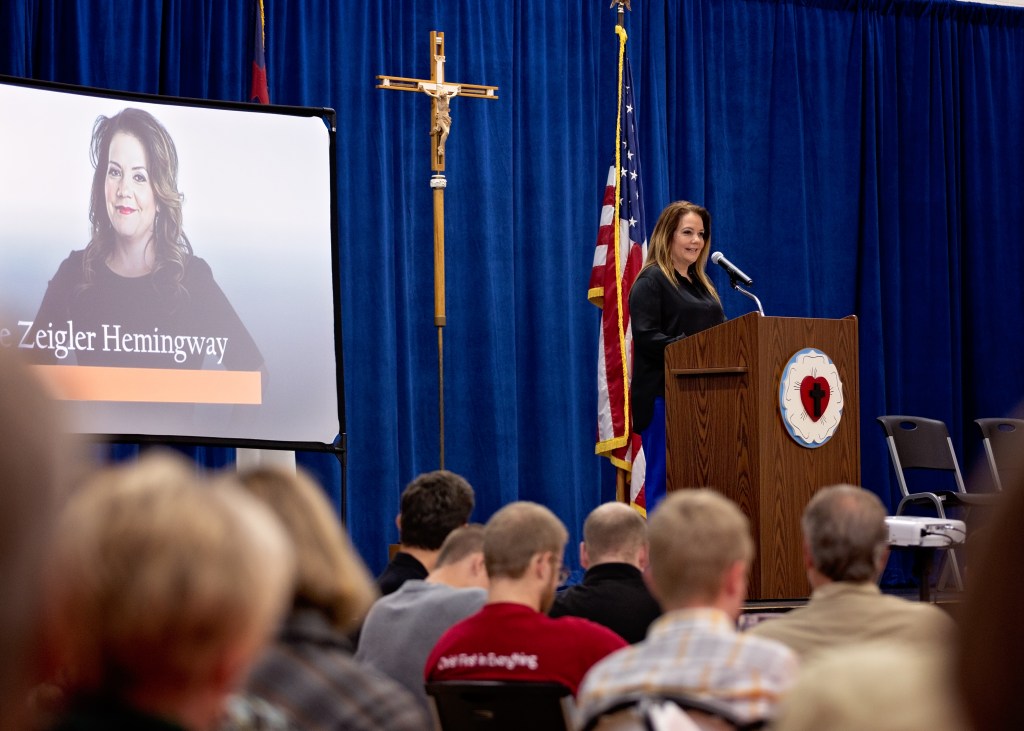
A Commendation to God’s People at Our Savior in Hartland

————–

I must confess that our “The Body of Christ and the Public Square” conference (which we just enjoyed yesterday) is both a highlight and a burden for our lives each year. It’s a burden because much work is necessary for its success. We plan all year for a single day’s labor. Precious time and resources are given. Sweat is spent. In short, it does not happen unless we fully put our backs into it. For me, its burdens include occasional verbal beatings from friends and foes alike. To be clear, I’m not complaining. This is one of the price tags attached to the chances I take. Thomas Jefferson said something about how anyone who assumes a public role must inevitably consider himself public property. I get it. Anyone putting himself out for public consumption should expect to be chewed on from time to time. I certainly get my fair share.

Pondering the highlights, I assure you that our conference efforts always prove themselves well worth the exertion. Over the last ten years, spanning twenty educational events, big and small, this congregation’s determination to communicate a right understanding of Church and State engagement has been unquestionably fruitful across countless denominational boundaries. Without being too bold, I dare say the handful of Christians who call Our Savior in Hartland, Michigan, their church home has influenced local and national landscapes in ways few other churches of a much larger size can claim. This isn’t boasting. It is a fact. God has used these efforts to effect significant change while holding the line on what’s good.

Along those same lines, I suppose it isn’t far from some who volunteer at the event to thank God for the unique opportunities to work alongside guest speakers most folks only know from a distance. For example, my son and future daughter-in-law shepherded Riley Gaines through her time with us, ensuring she made it to and from the event. I can understand the excitement of being near one of history’s boldest. Even better, something must be said for building genuine relationships with national policy architects and influential newsmakers. After the conference, I spent a few hours at my basement bar with Dr. James Lindsay. We chatted about anything and everything—politics, philosophy, theology, you name it. It was indeed an exceptional time, feeling more like minutes than hours. We parted company as new and better friends, intent on reconnecting whenever we might find ourselves within one another’s vicinity.

Of course, as starstruck as anyone might be with these folks, we don’t idolize them. If there’s anything I’ve learned from these relationships, they are people like the rest of us. Nevertheless, I also know that to live according to the tenets of faith (1 Timothy 2:2-6), ultimately protecting the Church’s freedom to preach and teach the Gospel apart from the shadows, these people are part of the calculus in twenty-first-century America. They’re included in Saint Paul’s phrase “πάντων τῶν ἐν ὑπεροχῇ”—all who are in high positions (1 Timothy 2:2). To influence them is to influence the public square and, as a result, to have a role in steering the outcome of the game. To what end? Again, to the preservation of what Saint Paul continues to describe in verses 2 through 4: “that we may lead a peaceful and quiet life, godly and dignified in every way. This is good, and it is pleasing in the sight of God our Savior, who desires all people to be saved and to come to the knowledge of the truth.”

We’ve been blessed with those relationships as an organization, so we form, maintain, and enjoy them accordingly.

As the pastor at Our Savior, I’m glad for God’s people here. Seeing your vigor in all of this certainly makes me smile. Moreover, your joy in the task is one of the reasons I’ll likely continue to take the punches. Your joy brings me joy. Truly. You’re forever proving their commitment to Christ. For one, you’re miles beyond mere words. You’re not willing to simply rah-rah from the bench, saying to those who need help, “Be warm and well fed” (James 2:16-17). You’re in the game, and you’re playing hard. With or without accolades, you’re moving the ball down the field in ways that serve even your detractors and will resonate for generations.

Unfortunately, as I’ve already hinted, we often do this to our peril. I’ll give you an example.

I had a conversation yesterday with someone who, no matter how gently she explains religious liberty’s benefits to her liberal family members, is viciously attacked as a mean-spirited and bigoted conservative who wants to force her opinions on others. I did what I could to encourage her. Apart from sharing God’s Word relative to the matter, at one point, I shared a thought Ralph Waldo Emerson once penned. He wrote about how there will always be a certain meanness to conservatism. Unfortunately for conservatism’s opponents, the meanness always comes bearing superior logic and facts. In other words, it brings truth. Relative to her conversations with family members, confining someone with anything will always seem restrictive, inhibiting, and mean. Still, as mean as truth’s confinement might seem, it’s good.

What’s more, the only people we should trust are the ones calling to us from within truth’s boundaries. Those people are not trying to keep us from living; they’re beckoning us to a life endowed with the greatest access to truth’s arsenal of facts—to what makes truth true. As biblically conservative Christians, we have this in spades.

Quite simply, truth—whether it be moral or natural law—is unphased by opinion; or, as I heard first-hand from Ben Shapiro long before it ever became a bumper sticker, facts don’t care about your feelings.

This congregation gets it. You know it isn’t an easy road. Still, it’s a road you want to travel because you know the One who is Truth in the flesh—Jesus Christ. He is the way of eternal life. Those who cling to Him have been set free from Sin’s foolish desires to trust anyone or anything beyond truth’s borders. You want others to know this, so you do what you can to preserve the Church’s freedom to preach and teach it. Our conference is one way you do this.

By the way, we’re already taking aim at next year’s effort. As was mentioned yesterday at the conference’s end, it looks as though Tucker Carlson will be with us in October of 2024. And Jim Caviezel is in tow for an after-Easter event of some sort. I haven’t sorted the details yet, but rest assured that I will.

Genuine Friends

I know I’ve broached the subject of friendship before, but I’ve been wondering lately what constitutes a genuine friend. So many in history, most especially the philosophers, have attempted to define the term “friend.” Cicero called a friend a “second self.” Aristotle said so famously that a friend is a “single soul dwelling in two bodies.” I think his is one of the better depictions. This is about as close as it gets to what I was feeling when I asked Jennifer to marry me. I knew that without her, I was only half of what God made me to be.

Of course, the poets serve us just as well. Ralph Waldo Emerson’s reminder that “the only way to have a friend is to be one” has adorned the walls of elementary school classrooms for who knows how long. Jaques Delille insisted that while fate chooses our family, we choose our friends. There is great truth in that statement, along with the reminder that both fate (tongue-in-cheek) and free will have a sense of humor. Anaïs Nin wrote with incredible profoundness that a “friend represents a world in us, a world possibly not born until they arrive, and it is only by this meeting that a new world is born.” This is profound in the sense that so much of who and what we are, both good and bad, would never have been stirred into existence without the prompting of others. Perhaps that’s why Marie de Sévigné warned, “True friendship is never serene.”

If we’re willing to be honest, we can agree with her. Indeed, friendships can be a source for some of the most joyful times we’ll know this side of the grave. They also hold the potential for some of the most agonizing moments we’ll ever experience, some resulting in painful and penetrating wounds that injure in ways few other things can.

I mentioned at the beginning I’ve been wondering lately what makes for a true friend. Perhaps more precisely, I’ve been wondering which hurts more, a friend standing against me or a friend who deceives me.

I suppose before even arriving at such a question, it pays for Christians to be mindful of the caliber of the ones we’d call friends—that is, what they believe, the language they use, how they live, and so many other determiners. And, yes, this is being judgmental. Even Saint Paul warned pragmatically that “bad company corrupts good character” (1 Corinthians 15:33). Paul had good reason to write these words, especially since one of God’s wisest—King Solomon—already insisted a thousand years prior with the same practicality, “Whoever walks with the wise becomes wise, but the companion of fools will suffer harm” (Proverbs 13:20), and “Make no friendship with a man given to anger, nor go with a wrathful man, lest you learn his ways and entangle yourself in a snare” (Proverbs 22:24-25). In other words, no matter how secure in your identity you might believe yourself to be, the ones we surround ourselves with will influence us. They will change us. Since this is true, let the ones we call friends be inclined toward righteousness, not unrighteousness.

And so, back to my question. It’s one worth answering, not necessarily in a theoretical sense, but because no matter how hard we try to do what Paul and Solomon suggest, we’ll always find ourselves in broken relationships. We’re human, and all humans are broken, which means practical self-analysis is always a good thing. In this regard, I’m still wondering which is worse, an opposing friend or a deceptive friend?

I’m of the mind that a lying friend is likely to generate the most pain. Being lied to or about harms in ways other sins cannot. On the other hand, a friend taking a position against me might be doing so for my good. Again, Solomon, having a good grasp on the nature of Godly friendship, reminded that wounds caused by a true friend are faithful and worthy of our acceptance (Proverbs 27:6). Having never read any of the books, that reminds me of something I saw in the only “Harry Potter” movie I’ve ever watched. An element of this truth found its way into a scene in which the character of Dumbledor, while awarding house points at the end of the film to a young boy, said something like, “It takes courage to stand against one’s enemies. It takes more to stand against one’s friends.”

Not as profound as Solomon, J.K. Rowling’s point is still a good one. Faith at work through genuine self-analysis will discern the dimensions of the offending friend. What he’s saying, is it leading you to Christ? If so, give thanks to the Lord for his courage. He cares enough to put himself in harm’s way, namely, the possibility of your rageful retribution. Now, repent and amend. On the other hand, is what he’s saying coming from ill-intent designed to lead you away from Christ and into harm? Are his words being crafted to give credence to his own Sin? If so, mark and avoid him. He’s not a friend—at least not in this particular episode.

By contrast, a deceptive friend—one who betrays or dupes those closest—is a completely different story. A deceptive friend has parentage, namely, the devil (John 8:44). Such a friend grows gross tendrils, all reaching out in countless directions with moldable excuses, all designed to preserve the self. I feel sorry for this kind of person. Self-analysis seems beyond his or her reach. I suppose I have equal sorrow for the people ensnared by such folks, especially since there’s little examination needed for deciding if the behavior is good or bad. It’s bad. If you can’t see it, then your deceptive friend has changed you, just as Paul and Solomon warned.

And so, what to do?

Well, for starters, align with truth, putting your trust in the One whom Solomon fore-described as sticking closer to you than a brother: Jesus (Proverbs 18:24). No one knows us like our siblings. No one knows us like the divine sibling, Jesus. Let Him be your lens for observation. Holding fast to Him, remembering His description of the truest compatriot (epitomized in Himself) as the one who lays down His life for his friends (John 15:13), you’ll have all you need for discerning a true friend from a false one. Finally, heartened by your friendship with the greatest Friend, Jesus, enjoy the newfound freedom for facing off with the sinful world around you. Enjoy the Spirit-endowed voice of faithfulness to call out and gather other allies into your collegium, shouting as Iachimo did in Shakespeare’s Cymbeline, “Boldness be my friend! Arm me, audacity!”

A friend with the bold audacity for faithfulness to Christ, no matter what, is the best kind to have and be. Although, if you find yourself averse to such people, it might be time for self-analysis, that is, if you haven’t been changed by others in a way that has made you incapable of such things (1 John 1:8-9).

Truth Can Win

I’m guessing you heard the news about Jussie Smollett. He’s an actor who claimed he was attacked by two white men in Chicago because he’s both black and gay. He said they hit him, used bigoted slurs, put a noose around his neck, poured an unknown substance on him, and shouted, “This is MAGA country!”

Almost as soon as his story made the news, he was the golden child of the Democrats and the progressive Left who, together with their partners in the mainstream media, were doing all they could (and still are) to frame conservative America as deeply intolerant and unforgivably racist. Suddenly, Smollett’s relatively less-than-profound career had found powerful traction. He became a prominent guest at events, went on talk shows, and was even granted a primetime interview with ABC News’ Robin Roberts.

I watched the interview. Smollett cranked up the emotion and Roberts fawned, almost grotesquely. It was hard to watch, and not because I sympathized with him, or because I felt shame for being a conservative, but because something wasn’t right with Smollett’s story. Like so many others who watched it, I didn’t believe what he was saying. The thing is, much of the law enforcement community involved with the situation disbelieved him, too. Still, a few higher ranking officials in Cook County managed to pull enough strings to shield their celebrity friend from any attempts to reveal what was, even in their minds, looking to be a hoax.

Eventually, the tables turned. A fair-minded prosecutor was presented with the evidence, namely, that the men involved in the supposed attack were not even white, but black, and Smollett actually hired them. As it would go, Smollett was charged with six counts of orchestrating a hate crime against himself. Last week, the case and its facts unfolded before twelve jurors, and on Thursday, Smollett was found guilty of five of the six counts. Truth defeated untruth.

But it almost didn’t, which I’ll get to in a moment. First, I’ll let you in on a little secret—and I’ll bet it’s one to which others who do what I do for a living would likely nod in agreement.

It’s likely the reason I choked on the believability of Smollett’s interview with Robin Roberts is because pastors are pretty good at spotting liars.

If the job is being done right, no small portion of a pastor’s time involves interfacing with the underbelly of Sin’s grossest offenses. Lies rule in this realm. In one sense, this is true because the devil, the father of lies (John 8:44), labors tirelessly to maintain this dimly lit kingdom. Pastors know this. They know he uses lies like a model maker uses glue, connecting this and that misshaped part to create a seemingly insurmountable monstrosity that’s eventually found capable of hiding truth in its shadow. Still, I won’t place all of the blame on him. Even without his crafty influence, sinful humanity is more than capable of maintaining a kingdom of deceit. The Sin-nature is a powerful wellspring that feeds every human being’s ability to lie to others, and perhaps most disturbingly, to lie to oneself. What’s most troubling about this tendency is not only that it so often demonstrates itself with a twisted joyfulness—as if to suggest that without the ability to lie, humanity would be overcome by boredom—but that lying seems to be the first thing people will do to acquire what he or she wants, or to defend what he or she already believes.

Again, if pastors are doing their jobs, it’s likely they know the telltale signs of deception. They know the signs because they’ve heard and seen the same forms of dishonesty in countless situations. For example, all too often the man who confesses to having fallen out of love with his wife eventually proves he’s had eyes for another woman all along. He didn’t fall out of love. He lied to justify his desires and get what he wanted. Pastors see this all the time. Another example that repeats itself: It’s not uncommon for disgruntled church members to blame their unhappiness (or non-existence) on the pastor or a fellow member of the church community, landing on just about anything they’ve done or said as cold, unloving, or offensive. In my experience, the disconnect usually has to do with the wayward person’s desire to embrace an ideology or behavior contrary to God’s will and Word. It’s only after the pastor and church community have spoken truthfully to the errant Christian about the dangers of his or her living that the trouble begins. It’s then that the ones reaching with the truth are no longer counted as friends, but rather as unloving accusers. And yet, they’re not unloving. That’s a lie. They’re being faithful to both God and neighbor. They’re seeing a fellow Christian in need, and rather than closing their hearts to the opportunity for expressing God’s loving concern, they act. As Saint John points out, they epitomize love “in deed and truth” (1 John 3:17-18). On the contrary, the one who stubbornly refuses the truth is living in a perpetual darkness ruled by lies (1 John 1:6-9).

I could go on and on sharing similar examples, but I promised an explanation to my previous comment about truth nearly losing to untruth in the Jussie Smollett situation. What I meant is that if those who knew the facts had decided not to go the extra mile for truth, had those who were bothered by the lie being guarded by the people in power chosen to remain silent, an already monstrous narrative of untruth would have gained a deeper footing in America. But honest people took a chance at confronting dishonesty. They took a chance at offending the false narrative. They pursued truth, and truth won.

We can learn from these nameless advocates.

By their diligence, a deception was uprooted, and justice was served. What’s more, the blast radius of truth’s detonation revealed the scoundrels intent on weaponizing the lie. Thankfully, those frauds were silenced. Whether or not those same people are dealing honestly with themselves when it comes to public opinion, I don’t know. I will say that until they come clean, they’ll continue to simmer in their own foolishness in a glaring way. In other words, if I were Robin Roberts, or any of the other liberally progressive automatons who condemned anyone who questioned the verity of Smollett’s story—and this includes Joe Biden, Kamala Harris, and countless other ever-droning agendizers in government, Hollywood, and mainstream news and entertainment outlets—I’d apologize to America soon, all with the hope that my gushing foolishness would be soon forgotten. I’m sure the social media giants at Twitter, Facebook, and YouTube are certainly doing whatever they can to help scrub the crime scenes.

In the end, my real hope is that the shame these people are experiencing will not only shepherd them toward honesty, but will encourage them to measure their responses in the future. Admittedly, my hopes are not high in these regards.

So, why bring any of this up? Well…

A man is a man. A woman is a woman. Stand up to the lies that claim otherwise. Maybe take a chance and write a letter to the NCAA. Push back against their woke policies allowing transgenders to hijack women’s sports, ultimately stealing away so many well-deserving female athletes’ aspirations. The Smollett case has shown us that truth can win.

A person is not inherently evil because of the color of his or her skin. Fight in your communities and school districts against the deceptive race theories that claim otherwise. Go to the school board meetings. Call your local representatives. Do these things knowing truth can win.

An unborn child is a unique person, both dignified and worthy of life. Muster as much muscle as you can against the pro-choice devilry that would call this untrue. Get involved with your local Right to Life chapter. Give of your time and treasure to the cause. Be present at the gates of a Planned Parenthood to pray. Do this. As we’ve seen, truth can win.

Again, I could go on and on with this. The list of topics that would benefit from truth’s pushback is long. And yes, it also includes much of the pseudo-science that’s driving so much of what Americans are being required to endure these days. Against these looming deceptions, know that truth is forced into the shadows when those who are to be its hands, feet, and voice remain quietly indolent. Perhaps worse, truth teeters at the edge of burial when we wait for someone else to act.

I suppose in conclusion, whether any of us chooses to engage on behalf of truth, we can all rest assured that truth won’t settle for our disregard indefinitely. It certainly won’t forever tolerate those in the Christian community who, having been offended by it, take their marbles and go somewhere else. As I’ve said on countless occasions from the pulpit here at Our Savior, eventually the Last Day will come and the divine light switch will get flipped. In the bright-beaming streams of Christ’s return, even as every human being alive and dead will be found on their knees paying homage to the approaching King of Kings, all will see and know what is true and what isn’t. Joy or regret will be the two available emotions as all deceptions are stripped away and the final standards of judgment are laid unquestionably bare. By God’s grace at work through His revealing Word right now, Christians are equipped for that day. Through faith in Christ—the One who is truth in the flesh (John 14:6)—we are not only rescued from the perils of Sin and the regret it brings, but we are given hope for that moment of moments. Just as wonderfully, we are changed to know and desire truth in the here and now (John 8:32; James 1:18), and we are equipped by the Holy Spirit to protect and defend what is true (1 John 4:6).

By that same Gospel of deliverance in Christ alone, be strengthened to stand for truth. I say this knowing that if anyone is truly destined for the job, indeed, it’s Christians.