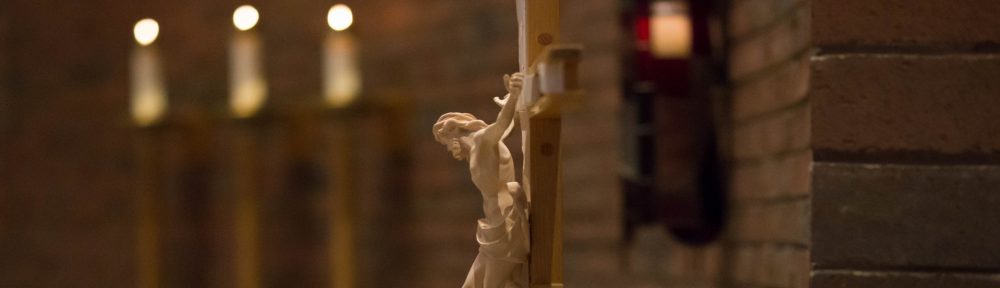
A Hope-filled Sprig

There’s a tree in a yard just down the street from my home that toppled twice this past year during two separate storms. The first was a windstorm that swept through last spring. By the time the ruckus had passed, one of the three stems ascending from the tree’s primary trunk broke free and crushed a nearby fence. The second gale was a late summer thunderstorm that brought equally powerful wind. When it finally quieted, the other two stems had fallen and destroyed another portion of the same fence. All that remained was a four-foot trunk with a splintered top.

It wasn’t long after either storm that the property owners cut and removed the debris, eventually leaving what is now a grayed and seemingly dead stump. I drive past it every day. For me, even in its obtusely pathetic state, the stump has faded into the neighborhood’s landscape, becoming something I no longer even notice.

But then one day last week, I did notice it. Even in mid-winter, it had a shoot growing from its top. Astounded, I circled back around and stopped to take a picture.

I’m not an arborist. Still, I know most deciduous trees in Michigan hibernate in winter. Essentially, they go to sleep at the end of summer. They slip into their dormancy stage, locating their essential nutrients in their roots. Doing this helps to keep them healthy and ready to bloom again in the spring. That’s why the leaves fall in autumn. The trees are shutting down the supply lines to everything but the roots, starving its skyward limbs and keeping the food where it’s needed most.

But this tree is not sleeping. It’s awake and growing in winter. Wearing only a slightness of green on one of its two leaves, a passerby can see by its sprig that it’s struggling against the elements. Its tiny, outstretched appendages are tinged with shades of autumn’s hues. Still, there it is, pushing up from a seemingly lifeless trunk, attempting to snatch every bit of Michigan’s occasional wintertime sunlight.

While barely anything at all, it’s an inspiring scene. Against the bleakest landscape, while everything else around it has given up and gone to sleep, it is awake, as if reaching up from hope’s nutrients with an unwillingness to forfeit.

Seeing this, as a Christian, I suppose my first inclination was to experience echoes of Isaiah 11:1, which reads, “There shall come forth a shoot from the stump of Jesse, and a branch from his roots shall bear fruit.” Isaiah’s words are forward-looking. They refer to Jesus. He is the One who, even as all mortal muscle for rescue was beyond spent, arrived bearing life. There He is. God did not leave us. He acted. He sent His Son, just as He said He would. Hope against all hope has been fulfilled. The Son has brought new life into what seemed to be Death’s dooming winter. And joy of joys! From His person and work, branches emerge and grow where no one thought they could. And this happens no matter life’s seasons, each shoot bearing extraordinary fruit (John 15:5).

I had a before-worship conversation on New Year’s Day with the chairman of our Board of Elders, Harry. Analyzing the societal landscape, we predicted that the forthcoming year would likely be far bumpier than the previous one. For the record, we weren’t being pessimistic but realistic, and in a sense, we were admitting to our need for the fruits that can only be plucked from Christ’s tree. In the New Year, we’re going to need the fruits of love, joy, peace, patience, kindness, goodness, faithfulness, gentleness, and self-control (Galatians 5:22-23). We’re going to need fortitude, the kind that wholeheartedly owns the title “Christian” (James 1:2-4; John 16:1-4). We’re going to need endurance (Romans 5:1-5). We’re going to need wisdom, the kind that can’t be duped by evil disguised as good (Ephesians 5:15-17). We’re going to need persevering strength to follow Jesus when doing so might appear to make very little sense (Hebrews 12:1; Luke 5:4).

We’ll need to be hope-filled sprigs against this world’s dismal backdrop (Romans 15:3).

But there’s another thought to be had. As a perpetual watchman for summer, the tree’s lonely sprig was a “consider the lilies of the field” moment (Matthew 6:28). It had me thinking about how God loves and cares for His people. Taking the stump’s picture, I spoke out loud to myself, “Storms will come, people will cut down the lilies, but nothing can stop spring from coming.” Christians will know what I meant.

No matter how the world rages, God’s promises will not be stopped (Romans 8:31-39). He’s caring for us now. As He does, we know the springtime of eternal life is coming. This means that even in the face of persecution and Death, believers have a limitless wellspring of hope. Like the stump’s sprig, what the world might expect from us in the darker moments is not what we’ve been recreated to do. The world will bear down on us with icy impositions, expecting that we’ll shrink into self-preserving hibernation. But instead, we reach up to the heavens as sprigs in winter. We stretch out in stark contrast to the surrounding world, bringing even the littlest bit of color into the sin-sick grays of this passing world.

We endure when enduring seems impossible.

This is my continued prayer for you in the New Year. God grant it.

New Year’s Day, 2024

Did you make any New Year’s resolutions? I did. I do every year. I decided on this year’s resolution a few days before Christmas, so in a sense, I’ve had the chance to test-drive it here and there.

I don’t know if, how, or why you decided on yours, but two things in particular modeled for mine. The first was Saint Paul’s encouraging words, “Rejoice in hope, be patient in tribulation, be constant in prayer” (Romans 12:12). The second was Michigan’s dismal climate. We don’t get much sun from October to March, and so I’m perpetually watching for stray sunbeams piercing the dreary grays. If I’m paying close enough attention, I can usually spot two or three throughout the day. Like atmospheric phantoms, they come and go. On occasion, one descends through a nearby window. When it does, I’ll sit right in the middle of it. It’s a rejuvenating opportunity, even if only for a moment. 

Together, these two things stirred a New Year’s resolution to find at least three positives in any perceived negative situation and, from among those three, if possible, to discover at least one opportunity for making life better. It might sound like a complicated resolution compared to exercising or cutting back on sweets. All I can say is that as I get older, I want to continue being the kind of person who’s happier to see the New Year arrive than to see the current year leave. To do this, I know I need to bring something with me into the New Year, and it can’t be the old self. The old self gets tired. The new self in Christ brings hope, patience, and prayer.

One thing is for sure: my newest resolution was pressure tested days before the clock struck midnight on December 31st.

I woke up this past Wednesday with a whole day of nothing facing me. That’s right. I had nothing to do but rest. The only task owed to the day was to take the artificial palm tree Jennifer bought me for Christmas to my office at the church. I planned to set it just beyond my desk where I could see it daily.

But my restful do-nothing day was foiled.

I started the day plinking away at what would become the sermon for this morning’s Divine Service. I did this awaiting my turn in the shower. Once Jennifer was done, and because I was still typing, she cleaned the bathtub, filling it with hot water before giving it a good scrub. Afterward, it was my turn in the bathroom.

My shower was ice cold.

I thought at first that Jennifer had used up the hot water while cleaning the tub or that perhaps one of the kids was actually awake and had showered, too. Strangely, the urge to visit our water heater in the basement storage closet emerged. And so, I did. Sure enough, it was dead, and its contents were just beginning to leak out onto the floor. I shut off the water supply, and while Jennifer began moving our closet belongings to other locations, I called a local heating and cooling company that we trusted. I learned they could be out by 4:30 p.m. for an estimate but likely couldn’t perform the installation until two or three days later. Still, I scheduled the appointment and then went to work helping Jennifer.

Once done, we sat together in the living room, calculating our fate. We were looking at a post-Christmas expense of about $2,000 and a couple of days of traveling back and forth to Jennifer’s mom’s house for showers.

Sigh.

“How many gallons is our water heater?” Jennifer asked, tapping on her mobile phone.

“Fifty,” I replied.

“How tall is it?”

“Right around fifty-five inches.”

“How wide?”

“About twenty inches.”

“You know, Home Depot has two in stock. They’re a little shorter and wider, but we could get one today. If we buy it and you do the installation, we could save about a thousand dollars.”

A moment passed.

“I’ll get my coat. Call upstairs to Harrison. He’s going with me.”

Harrison and I spent the next few hours removing the old water heater and installing a new one. We were done by 4:30 p.m. Had we kept the appointment, the repair man would’ve been arriving just in time to congratulate us.

What does this story have to do with my New Year’s resolution? For starters, everything about the situation was deflating. Not to mention I didn’t want to spend the entirety of what would be one of my only free days in a year doing what I was about to do. However, I’d already chosen my New Year’s resolution, and as such, I was ready to steer into the effort with hope, patience, and prayer, all the while looking for the moment’s sunbeams. And I found plenty.

The first ray of sunlight was that I actually had an entirely uninterrupted day to do the job. Second, we discovered the problem before it could cause significant damage to our basement. Third, we couldn’t necessarily afford $2,000, but we could afford $1,000. Fourth, a relatively warm day for the end of December, Wednesday was near-perfect for doing the work. The outdoor tasks would’ve been a messy struggle if it had been cold and snowy. I can only imagine having to uncoil and drag a frozen hose inside to drain the water heater; or attempting to dolly the rusted beast out through the basement door, likely struggling to ascend the side yard’s treacherously icy slope to get the appliance to the street, and then do the same in reverse with the new water heater, surely tracking the outside’s elements indoors.

As you can see, at least four sunbeams were streaming through a relatively cloudy scenario. I had resolved to find only three.

But what about the opportunity for rejuvenation? Well, that’s an easy one, too. Harrison and I worked on the job together, spending much-needed father-and-son time accomplishing something beneficial to the family.

In short, it was a struggle, but with my sights set in the right direction, it was a good day.

Ralph Waldo Emerson once wrote that every day can be the best day of the year. As a Christian, I agree. A Christian’s “every day” has Christ. With Christ, there’s always hope, no matter the challenge. Even better, we have access through prayer to the Creator of the cosmos, the One who promises to listen and respond, ultimately ordering all things, good or bad, for the salvific benefit of those who are His own by faith (Romans 8:28).

I already know these things. Still, I intend to be deliberate in my awareness of them in the New Year. I will find these sunbeams in a world intent on shrouding faith’s joy.

Having said all this, if you are yet to make a New Year’s resolution, feel free to steal mine…or the one I mentioned in yesterday’s note. Either way, trust me when I say that the New Year has only just begun, yet the peace that comes with a heart settled in this way is sure to pay dividends all along the way.

God bless and keep you by His grace!

New Year’s Eve, 2023

What I’m about to share happened while waiting in line at the Ace Hardware near my home a few days before Christmas. Jennifer and I stopped there for some miscellaneous items. Essentially, the visit went as follows:

Finishing the sale and handing the man in sleep pants his receipt, the youthful cashier said with a smile, “Thanks for coming in. And Merry Christmas.”

His trajectory already toward the door, the man stopped mid-stride and turned back, pausing long enough to stir concern among us for what he might say.

“Ma’am,” he started, “thanks for saying that.” But before relief could form in any of us, he continued, “You know, I’m so G*# D@*%ed tired of people saying ‘Happy Holidays’! It’s Christmas, for cryin’ out loud! People need to stop with the ‘Happy Holidays’ %*@# and say ‘Merry Christmas’!”

Nodding to the elderly woman in line behind him as if expecting her agreement, he looked back to the cashier. “Keep it up,” he said, walking backward toward the door. “You’re doin’ God’s work.”

Forcing her smile, the cashier replied, “Thanks again,” followed by an equally strained, “Merry Christmas.”

The elderly woman was visibly bothered. And why wouldn’t she be? She comes from a strange and alien land by comparison. Where she’s from, they don’t speak that way to one another, let alone adorn Christmas in vernacular sludge. I’m an inhabitant of a similar land, often considering myself a part-time resident of the 21st century. In many ways, I only visit out of necessity. I said as much to the woman in line.

“I’m not from that man’s world.”

She knew what I meant, responding, “Me either.”

Before I go any further, it might surprise you that I’m skipping over the man’s vocabulary choices. That seems too easy. You already know that his defense of “Merry Christmas” was an obnoxious contradiction in terms (Romans 12:1-2). Instead, I prefer to approach the event from a less obvious angle: the man’s sleep pants.

For starters, I know that 21st-century culture prides itself on self-pleasing individualism. That pride sometimes produces a desire to buck the system. Admittedly, bucking the system is sometimes required. But that’s not necessarily self-pleasing individualism. It can sometimes be a response born from the knowledge of right and wrong. God’s Law is written on our hearts (2 Corinthians 3:3), and if a person digs deeply enough, he’ll know when to abide and when to push back. Examining the strata, he’ll also discover that societies have their written and unwritten rules. It might not seem all that important, but I’m pretty sure an unwritten rule common to most is that what a person wears to bed is not what he or she should wear in public. The rule has little to do with what a person may or may not find most comfortable. Instead, it deals with liberty’s responsibility, namely, one’s role relative to context and the people in it.

No, sleep pants in specific public settings aren’t inherently wrong. A person wrestling with illness might be found wearing them at a doctor’s office. But that same person, healthy or sick, would not wear them to a court appearance or wedding.

Why?

Most normal folks don’t need to be told the answer, which proves the unspoken rule—the innate standard that fosters and preserves dignity, resulting in mutual respect. In its simplest and most broad-sweeping form, it knows that a society of conscientious and dignified citizens makes life better for everyone. More precisely, it understands that personal liberty does not mean a person is free to do whatever he or she wants. Liberty comes with responsibility. A society of citizens who think they can be, do, and say anything they want without consequence is doomed to act in ridiculous and contradictory ways. It’ll end up insisting that men can be women and women can be men, and it’ll expect everyone to agree. On the road toward doom, it will have increased its production and acceptability of crass scenarios like the one in Ace Hardware. That was a snapshot of the confused self-centeredness that acts without any concern for the people around it, that paradoxically slathers the dignified greeting “Merry Christmas” with the foulest words any world’s vocabulary can afford and then, unsurprisingly, nods to others, expecting them to praise its irreverence as noble.

What foolishness.

A new year begins tomorrow. An online friend shared the following quotation: “Every year, you resolve to change yourself. This year, resolve to be yourself.” I don’t know who spoke those words initially, but I disagree. I don’t want to settle for being myself. I want to be better than myself. This isn’t only for my benefit but for yours, too.

I’ve written plenty about how New Year’s resolutions are a good practice. Every year, I attempt to make personal changes. I do this because I know myself. I know I’m incredibly flawed. And so, by faith, I’m less inclined to remain settled in these flaws. I want to fight them (Galatians 5:16-18). I want to be better. I want to reach higher, just as Saint Paul encouraged: “If then you have been raised with Christ, seek the things that are above, where Christ is, seated at the right hand of God. Set your minds on things that are above, not on things that are on earth” (Colossians 3:1-4).

However, remember: “Whoever walks with the wise becomes wise, but the companion of fools will suffer harm” (Proverbs 13:20). In other words, to change, sometimes one’s surroundings must first be changed.

Thinking about the man at Ace Hardware, if I could make a resolution for him, it would be to spend a little time each day with citizens of the alien worlds owned by the elderly woman behind him in line. I’d have him binge-watch I Love Lucy or Bonanza instead of the drivel on Netflix. Or better yet, I’d send him to Dickens and Twain, to Austen and Fitzgerald. I’d send him to places where men respected shop clerks and the elderly, where men were women’s protectors, where language mattered, and so on. I’d send him to those distant realms for a few moments each day of the forthcoming year.

I don’t know what the effects might be. Still, it couldn’t hurt. I know someone who once spent a year in England and returned with the hint of a British accent and afternoon tea as routine. We become that in which we immerse ourselves.

Since we’re talking about it, how about this for a New Year’s resolution?

If you’re a Christian who’s been apart from your church family for a while, imagine how you’ve changed since you’ve been away. Now, imagine the benefits of returning. Imagine the eternal value of regular visits with the Gospel of Christ’s wonderful forgiveness. By extension, I’ll bet it wouldn’t be long before certain tendencies were traded away as strangely foreign. Receiving a steady diet of Christ’s forgiveness (which God’s Word promises will produce fruits of faithfulness [Galatians 5:22-23]), a person is bound to stumble into agreement with Saint Paul’s instruction to “not be conformed to this world, but be transformed by the renewal of your mind, that by testing you may discern what is the will of God, what is good and acceptable and perfect” (Romans 12:2). That same person will likely align with Paul’s instruction to “stand firm and hold to the traditions that you were taught by us, either by our spoken word or by our letter” (2 Thessalonians 2:15), and to “let no corrupting talk come out of your mouths, but only such as is good for building up, as fits the occasion, that it may give grace to those who hear” (Ephesians 4:29).

Who knows? Either way, it’s worth considering. And may I suggest giving it a try in the New Year?

Christmas Day, 2023

Merry Christmas to you and your family!

One of the Bible’s principal thrusts is not only that humanity needs saving but that we occupy a dreadfully weary world. A simple glance at the surrounding world measured against an honest self-inventory will more than reveal just how much we need Christmas.

When I say we need Christmas, I suppose I mean at least two things.

First, I’d say Christmas brings refreshment to the world. It’s nice to have at least one day during the year when, for the most part, even our society expects people to think of others before themselves. The longstanding practice of Christmas gift-giving demonstrates this.

Although, it is true that people wrap and give gifts for various reasons or occasions. Still, if an unfamiliar onlooker required an explanation for the gift, the giver would unhesitatingly explain its purpose, whether to celebrate an anniversary, birthday, or whatever. With such an explanation comes the assumption that everyone giving gifts at the gathering is doing so for the same reason. One of the oldest Christmas traditions is to give gifts. No matter what anyone believes concerning the holiday, there’s no denying that a Christmas gift remembers Christmas. Ultimately, to remember Christmas is to honor Christ, intentionally or unintentionally.

Christians do so intentionally. That’s why churches aren’t bare on Christmas Day. At least, they shouldn’t be. I dare say Our Savior Evangelical Lutheran Church in Hartland, Michigan, will have people in its pews who know the second reason the world needs Christmas.

The kind of people who venture out on Christmas Day intent on gathering in worship know full well that the point of Christmas isn’t gift-giving. This is true because they have a better sense. This sense—faith—knows that if our hearts aren’t set on the gift of Christ, we’ll never be satisfied by anything we might discover wrapped and resting beneath a Christmas tree. Unsurprisingly, the folks bearing this better sense manage to keep the Christmas vigil into and through this weary world’s less glittery days. This is true because they know and believe all year long alongside Saint Paul, who wrote “that Christ Jesus came into the world to save sinners…” (1 Timothy 1:15). They rejoice each day alongside Saint John, who insisted that “the reason the Son of God appeared was to destroy the works of the devil” (1 John 3:8). They know their need for rescue from the all-consuming powers of darkness no mortal in history has ever been able to conquer. Christmas observes this world’s timeline and says, “This is when it began.” It celebrates with precision the One who stepped into this world’s dreariness to begin the impossible feat. It marks the One who came to give us far more than seasonal refreshment. He came to win eternal rest from Sin, Death, and Satan’s dreadful curse.

Yes, Christmas is refreshing. Yes, Christmas is traditionally celebrated through gift-giving. But Christians know there’s far more to it than these things.

Interestingly, when it comes to Jesus, Christians know the gift-giving order will always be reversed at His divine party. We’ll gather in His house for worship. As we do, the Gospel gifts of life and salvation won by the Christmas Savior are abundantly showered upon us. It’s the only birthday party where the One being celebrated gives cosmically grander gifts than the attendees could ever afford or even think to bring.

Indeed, we need Christmas. Thankfully, we have it. And you’ve been invited to its tremendous festival. The Gospel of Christ’s life, death, and resurrection for your redemption is not only the gift but also the invitation. By the power of the Holy Spirit at work for faith, receive it—and then act on it! Attend the party! Rejoice with the One who put aside His divine glory, choosing instead the lowly confines of a manger, ultimately foreshadowing His forthcoming work as the suffering servant. Celebrate with the One who did all of this for you! In all my years as a pastor, I’ve never met anyone who regretted coming to the Lord’s Christmas celebration.

Again, Merry Christmas to you!

Christmas Eve, 2023

Merry Christmas to you!

A favorite moment in the Church Year for many, Christmas Eve, is upon us. It’s beloved for plenty of reasons. For many, Christmas is little more than a break from work or school or, perhaps, an obligatory time for family gatherings and feasting. For faithful Christians, it’s so much more. It’s a day among days bearing a unique sense of awareness. It enjoys the best dimension of family togetherness and the greatest feast. It’s Christmas—or, more precisely, the Christ-mass! Believers gather to celebrate the beginning of God’s inbreaking through the person and work of Christ (Greek Χριστός). Christians have known for centuries that the best way to do this is by assembling at the divine table of the Lord’s Supper (Latin Missa), doing so fully aware that the same gracious Lord who gives Himself there was once an infant in a manger destined to redeem the world by submitting His very body and blood into Death for our forgiveness.

Christians know the Christmas event deserves reverent contemplation. One of the best ways to reflect is through Christian hymnody. Christmas is most certainly a time for singing some of the best-loved in Christian tradition. “Silent Night, Holy Night.” “From Heaven Above to Earth I Come.” “Angels We Have Heard on High.” “O Come, All Ye Faithful.” “Hark! The Herald Angels Sing.” Time has tested these musical portraits, and they’ve never been found wanting.

Those who know me best will know I have favorite hymns. During Lent, “Stricken, Smitten, and Afflicted” gets me in the gut. I cannot navigate past its third stanza without shuddering. It’s there the hymnographer, Thomas Kelly, puts on paper what my Christian soul knows, but my fleshly self so easily forgets. He rhymes that Sin and Death are powerful specters haunting my every moment, and in the bloody dreadfulness of the cross, I can rightly reckon their fullest cost, ultimately paid by Christ. See for yourself. Those who know the ghostly tune will be hard-pressed not to hum as they read.

Ye who think of sin but lightly
Nor suppose the evil great
Here may view its nature rightly,
Here its guilt may estimate.
Mark the sacrifice appointed,
See who bears the awful load;
’Tis the Word, the Lord’s anointed,
Son of Man and Son of God.

During Holy Week, namely Good Friday, “Sing My Tongue the Glorious Battle” is a must. With our pipe organ thundering through the stratosphere, we steer straight into the fracas of Sin’s stronghold. We don’t go meekly. Jesus is the meek One here. He is this way for us. We follow in confidence, finding ourselves on Golgotha’s bloody soil, our innards becoming a strange mixture of sadness and joyful assurance as we look upon the One who is Himself the victor and the emblem of triumph:

Sing my tongue, the glorious battle;
Sing the ending of the fray.
Now above the cross, the trophy,
Sound the loud triumphant lay;
Tell how Christ, the world’s redeemer,
As a victim won the day.

I have favorite hymns for every season of the Church Year. Interestingly, when I set them side by side, I notice something familiar to all of them: they’re in acute alignment with Saint Paul, who insisted, “We preach Christ crucified” (1 Corinthians 1:23). As each hymn carries along, eventually, there’s a moment when the hymn writer lays bare for his audience the brutal reality of Christ’s death for our redemption. In other words, no matter what appears central to a particular Church season’s thrust, the crucifixion of Jesus Christ for mankind’s rescue will always be the seed from which it sprouts. Typically, you’ll find what I’m describing right in the hymn’s middle. Not always. But usually. A favorite hymn we’ll sing tonight, the lullabying “What Child is This,” is no different.

Only three stanzas long, its middle stanza leaves the quiet splendor of Bethlehem, reaching instead for Golgotha’s brutal moments. It interprets the Lord’s strange arrival in lowliness through the bloodstained lens of what He came to endure. What’s more, He didn’t do it for Himself. He did it for us. He, the silent Word, is even now pleading for us. Again, see for yourself:

Why lies He in such mean estate
Where ox and ass are feeding?
Good Christian, fear, for sinners here
The silent Word is pleading.
Nails, spear shall pierce Him through,
The cross be borne for me, for you.
Hail, hail the Word made flesh,
The babe, the son of Mary!

Tonight at Our Savior Evangelical Lutheran Church in Hartland, Michigan, stanza two of “What Child is This?” will be handled far differently musically from stanzas one and three. The second stanza’s words require tones that rearrange a pew sitter’s insides and very nearly rattle the roof. Why? Not only because Christmas itself deserves it but because the message—the Gospel—deserves it. And these words will get what they require. Why wouldn’t they? The historical moments they describe converged into a final moment that shook our planet on its axis, causing the rocks to split (Matthew 27:50-51).

I hope that you’ll experience this thundering message for yourself. Go to church. Join your Christian family in celebration of the Christ-child’s birth. Know He came to save you. Rejoice alongside the angels at His arrival. Heaven has pierced Earth’s veil. God has come. He didn’t send a representative. He became human flesh and dwelt among us (John 1:14). He came Himself. Believe this. On the tiptoes of childlike faith, look into the manger and see this great work’s beginning. By that same faith, see in His tiny eyes a distant cross. He’s already looking there. He has you in mind. Indeed, you mean that much to Him.

Merry Christmas!

Pieces of the Puzzle

Did you know there’s an aspect of human development called childhood amnesia? I didn’t. At least, not until I went looking for information on childhood memory formation. Essentially, childhood amnesia is as it sounds. So many things happened to us when we were little that we just cannot remember. As we grow, a pool of various experiences becomes more and more accessible to memory recall. Scientists used to think that this happened around the ages of seven or eight. Now they believe it happens much earlier, closer to two or three years old.

And so, here’s what prompted my memory-formation search.

The Thoma family enjoys assembling puzzles. On occasion, Jennifer will fetch one from our shelved collection and dump it on the island in the kitchen. Within minutes, one, two, three, and then all of us are digging through the fragments, looking for the most important startup pieces—the edge pieces. The 1,000-piece puzzle currently occupying our countertop is one I had custom-made as a Christmas gift for the family a few years ago. It’s a wintertime family image taken in front of some pine trees at our former home. The kids were still very young at the time. For perspective, Evelyn is now fourteen. She was a toddler, barely three years old, when the photo was taken.

While assembling herself in the puzzle, Evelyn mentioned that she remembered the image’s moment well. To prove her recollection, she described the event in detail. She remembered Jennifer using one of our old wooden barstools as a camera stand. She remembered her mother taking test shots to sort out the camera’s timer. She remembered snuggling into Harrison beside her. Her ability to recount the details was impressive.

Standing beside her at the puzzle, I attempted silently to conjure my earliest memories. The first that came to mind was sitting in worship at Trinity Lutheran Church in Danville, Illinois. I remember sitting next to my brother, Michael, near the front. I remember flipping through the pages of a book with a red cover. I remember wondering why the people around me said they were “hardly sorry” for their sins. As it would go, that was the 1941 edition of The Lutheran Hymnal, and the word wasn’t “hardly” but “heartily.”

Another that came to mind was being in the bed of a truck at a drive-in. I don’t remember the movie that was showing. Although, I remember explorers, an island, and dinosaurs. It wasn’t King Kong. Kong is hard to forget. If I had to guess, it was The Land that Time Forgot, a film that was instinctively familiar when I discovered it on TV as a Sunday matinee. Concerning the drive-in, I remember a magnificent screen, an expanse of cars, and the tinny sound from a tiny speaker.

There are more memories I could share. I’m sure you have your own, too. What struck me about mine and Evelyn’s is that our earliest memories felt like primitive echoes of who we are today. For example, when it comes to family, Evelyn is all in. She loves her family. If we plan to do anything, the discussion is irrelevant if the whole family cannot participate. This rule remains even now that Josh is married. Interestingly, one of Evelyn’s first memories is a family event captured in a photo. Relative to my first conjurable memories, I’m a Lutheran pastor, and I absolutely love movies, especially the kinds meant to scare.

It’s no secret that a person’s childhood experiences are foundational. Like the puzzle Evelyn and I were putting together, they’re crucial pieces to what will become a more complete picture. I suppose I’m speculating that a child’s first memories mark childhood experiences that had incredibly formative power.

This past week, I had these things in mind while rehearsing with our school children for the children’s Christmas service. The kindergarten and first-grade students, the children who are likely emerging from the amnesia stage right now, sat closest to me. I watched them. As I did, I wondered which among them might have as a first memory what they were currently experiencing. Would any among them remember the twinkling décor adorning every corner of their church’s massive worship space? Would they recall the church’s mighty pipe organ lifting their joyful voices to the very threshold of heaven? Would they one day reminisce about how they were so excited to sing “Joy to the World” that they kept singing too soon? Would they remember their teachers whispering at times, “Just wait, not yet,” gently quieting them for the appropriate moment to start singing? Would little Isabella, a first-grader sitting where she could spy Pastor Thoma behind the Christmas tree, remember how he smiled and winked at her every chance he could and how she smiled so brightly back? 

I hope so.

One thing is certain, though. Children kept from such things won’t have these memories. Ever. And this doesn’t just apply to the more fanciful time of Christmas. It’s true all year long. If parents don’t bring their children to church, it should be expected that a desire for Christ and His gifts will be foreign to their future selves. In other words, it’s more likely the puzzle pieces at the edge of their identities will border a future image that doesn’t include Jesus.

Unfortunately, it’s during these crucial developmental stages that parents are most tempted to stay away from worship. Apart from the dreadful poison of outright unbelief, what would keep a Christian parent from bringing their children to the Lord’s house? Well, that’s an easy one. It’s the struggle. Every parent who has (or had) toddlers knows it. Indeed, the toddling stage is simultaneously the most demanding, and yet, the most fertile.

I wrote a piece in 2020 after seeing something occur during Sunday morning worship here at Our Savior in Hartland. It was the all-too-familiar scene of a young mother wrestling with her toddlers. In short, she got more of a cardio workout in worship that day than she could have at the gym. Still, for as wild as the scene may have been, she was an inspiration to many. I told her as much, being sure to give her glowing encouragement. The very next day, I wrote and posted the note to parents I’ve included below. If you’d like to read (and share) the original, you may do so by clicking here. I ask one thing of you, though. As you read it, keep the “first memories” thought in mind. Remember that every minute of the day for our little ones has first-memory potential. Make it so that times with Jesus in worship will be more than one of them. Make sure they start with these pieces of the puzzle.

___________

Dearest Christian Parents struggling with little children during worship,

I know you feel like a mess on Sunday mornings.

I know you feel like every resonating sound in the church nave is coming from your pew. I know you feel like every eye is aimed at you in disgust. I know you feel like everything you are doing is useless and that the little ones in your care just can’t seem to settle in. I know you feel like you’re not getting anything from worship because you’re just too busy doing everything you can to ensure your children and, perhaps, the people in your immediate blast radius are getting the barest scraps between fidgety whines.

I know you feel overwhelmed—like the struggle is never-ending. I know you’re often teetering at the edge of calling it quits before you even roll out of bed.

But don’t.

Know that your children belong right where they are. Sure, take the kids out when it’s clear they need recalibrating, but get them back into the service as soon as you can. Do this knowing that you’re being faithful. Know that the struggle will end one day, and as you venture toward that day, your kids need you to do what you’re doing right now. Know that your gracious God promises to bless your every effort all the way there.

Know that you are being fed in worship. It may not feel like it but know that you are. Know that all of us—an assembly of people with countless distractions unavailable to human senses—are gathered by faith into the presence of our gracious Savior, assured that His reaching into us with His loving kindness hardly depends on our acumen. Again, rest assured, He’s at work there for you just as much as He is for everyone else in the room.

Finally, you need to know that your pastor is rooting for you. I’ve got your six. I’m watching the folks watching you, and if I ever get the sense they have forgotten what it was like to be in your shoes, I’ll be there in a heartbeat to remind them of the Lord’s words to “Let the little children come to me and do not forbid them,” and to steer them to the familiar relief they experienced when others gave encouragement rather than scowls.

Again, don’t give up. Your laboring—worked by the Holy Spirit for faithfulness to Christ and in love for your children—is by no means in vain.

With gladness, appreciation, and admiration, Your Pastor

A Springtime Sprig

I don’t mean to distress anyone within my relative vicinity. Still, I read that Michigan is number seven on the list of cloudiest states in the U.S. Apparently, 43 other states in the union have more sunshine than we do. Parsing the details, Michigan averages only 65 bright-beaming days during its 365-day trek around the sun. This means that 82% of our year is shrouded in gray.

I shared this information with the 7th and 8th-grade students in my Tuesday morning religion class. Within seconds, a handful spoke of their parents’ open disdain for Michigan’s seemingly unfair allotment of gloomy days. One even said something like, “My dad is like you, Pastor Thoma. He wants to live in Florida.”

Every year at this time, I feel compelled to communicate just how much I crave sunshine. I’ve never been officially diagnosed, and yet, having read the Cleveland Clinic’s definition of Seasonal Affective Disorder (SAD), I sometimes wonder if I bear some of the condition’s determiners. The affliction is “triggered by the change of seasons and most commonly begins in late fall. Symptoms include feelings of sadness, lack of energy, loss of interest in usual activities, oversleeping, and weight gain.”

I think I do experience a heightened sense of melancholy through the autumn and into the winter. I believe the dreariness causes less interest in a number of things I might usually enjoy. I don’t necessarily oversleep. My body is its own alarm clock. I go to bed. I wake up. I get started with my day. I would gain weight if I didn’t wage a conscious war against the gloom through exercise. However, I struggle to care much about exercising during the winter months. I often feel so drained that I don’t even want to look at the treadmill. It isn’t this way in the spring or summer.

A more pronounced sadness, check. Lack of energy, check. Loss of interest in usual activities, check. Three of five. Uh oh.

The clinic’s definition continues that “seasonal depression gets worse in the late fall or early winter before ending in the sunnier days of spring.”

“The sunnier days of spring.” That sounds nice. But that’s a long way from where we are on the calendar. Technically, December 1 was the first day of winter, even though many put winter’s beginning at the solstice on December 21. Either way, winter is just beginning here in Michigan. Its frigid clock has been tightly wound. Its chilled hands are ticking steadily from one number to the next. It will be some time before the clock slows, its time having eventually run out.

But it will run out.

I appreciate poetry. Relative to my doctoral studies, I’ve been reading a lot more of it. James Riley was thinking clock-like when he wrote of winter, “O, it sets my heart a-clickin’ like the tickin’ of a clock, when the frost is on the punkin and the fodder’s in the shock.” In other words, his heart’s hopeful timepiece begins ticking when he sees winter’s frosty specter beginning to pall the landscape, covering the pumpkin fields and the shocked fodder (the dried cornstalks bundled together and propped). He knows winter is coming, but he also knows it won’t be a forever thing. It has limited time to employ its dreadfulness.

I visited my dear friend, Sue, in the hospital this past Tuesday. Somehow, the details concerning Michigan’s cloudiness ranking came up. She doesn’t mind winter as much as I do. Still, she was surprised. During our time together, I read to her the Gospel lesson appointed for the Second Sunday in Advent: Luke 21:25-36. After reading it, we considered the Lord’s words. Along the way, I was reminded of another poet’s observation. Percy Shelley jotted, “If winter comes, can spring be far behind?” I shared Shelley’s rhetorical question with Sue.

“No, it can’t,” she replied. We smiled together.

Ah, the sunnier days of spring—those easing days when the naked landscapes become green again, teasing the forthcoming and golden expanse of summer, a time we both thoroughly enjoy.

But no matter what the poets say, Jesus truly calibrates our perspective.

Relative to my feelings for winter, I’m in good company. Jesus more than nodded to winter as a symbol of this world’s sin-plagued drudgery in the text from Luke 21. Referring to His return in glory on the Last Day, He instructed His disciples, “Look at the fig tree, and all the trees. As soon as they come out in leaf, you see for yourselves and know that summer is near” (vv. 29-30). Crucial to His point, like winter’s grim unpleasantness, this world’s current season of undoneness is not permanent. Jesus is coming back, and when He does, He will make all things new (Revelation 21:5), bringing with Him the spring and summer seasons of eternal life. If we lose sight of this, even the tiniest springtime sprig can serve as a Gospel reminder.

As someone who takes extra Vitamin D and keeps a sun lamp on the shelf beside his desk to help defend against the gravity of winter’s gloom, I do well to keep certain things in mind. In a broad sense, no matter what’s happening, I must remember that Christ has not abandoned me in some cosmic orphanage, having left me to fend for myself. He has promised His presence and the joy that comes with it (Matthew 28:20). He insists He will never leave nor forsake me (Hebrews 13:5). While I await His return in glory to bring me into His nearest presence, even if my deceptively sinful emotions have me somehow feeling forsaken, I can look to the cross. That’s the springtime (literally) sprig above all other sprigs emerging from the earth. When I see the cross, I can rejoice with childlike gladness. Perhaps this is what Edgar Guest meant when he rhymed:

“Spring’s greatest joy beyond a doubt
is when it brings the children out.”

The spring and summer of eternal life will bring God’s children out from this gray world’s wintry seclusion into the bright days of unending joy. How do I know this? Because Jesus said so, and His Word is sure. Look back at Luke 21:25-36, and you’ll see. Just after He directed our attention to the fig tree, He reminded us that all things will pass away, yet His words won’t (v. 33).

Believe Him. Be comforted by Him. He meant what He said; we can take Him at His word. This world’s wintry bondage will end. A divine spring and summer will arrive. It’s only a matter of time.

Filling and Trimming Your Lamp

The introduction in the current draft of my sermon for this morning includes a warning. I offer the warning because, sometimes, the deepest intention of a particular portion of God’s Word isn’t so gentle with its recipients. Sometimes, it’s razor-sharp, cutting us in ways we’d prefer it wouldn’t.

This morning’s Gospel reading appointed for the Last Sunday in the Church Year—the parable of the Ten Virgins in Matthew 25:1-13—is one such text. It steers into and ends with some words that Jesus has warned in other texts He’ll inevitably use on the Last Day. To have them directed at oneself would be to experience terror above all terrors. Time will have run out. All bets will be off the table. The divine lights of God’s standards will beam with unmatchable brightness, incinerating all disbelief or untruth. Nothing will be hidden. Those who are prepared will be welcomed into eternal glory. With chilling brevity, He will look to others—the unprepared—and say, “I do not know you.”

This whole scenario carries in its pocket a particularly crucial assumption. As the Creeds have long maintained, when Jesus returns, He will do so as the divine Judge, saying yes to some and no to others during eternity’s first few moments.

For some, this is an uneasy image. Why? Because it opposes everything human sinfulness prefers of its gods. It meets a certain kind of Christian, too. The Jesus embraced by some in American Christianity is mushy, being more than willing to let us shape Him to fit our preferences. He doesn’t get annoyed when we twist His Word. He’s not the least bit uneasy when we muddy His natural law. He isn’t so bothered when we skip worship Sunday after Sunday, arguing that we can be His people on our own time and our own terms. He’s certainly not going to be so arrogant as to tell us we’re wrong—that we’re headed for destruction. The Jesus some prefer could never bring wrath, only hugs. He doesn’t decide what’s good or bad. He lets us decide. And then, no matter what we choose, He smiles with satisfaction that we’ve done what makes us happy and pursued personal fulfillment.

The Gospel reading for this morning would say, if this is your Jesus, you’re done for. Or, more akin to the parable’s intention, you’re unprepared to meet the real Jesus on the Last Day.

I’ll say that today. It’ll be tough to hear, even for me. Why? Because I’m no different than the folks in the pews. I’m so often a self-interested sinner.

We’re all in this together.

Something I won’t specifically say in the sermon but will share with you here is that Jesus often measured His hardest words against hypocrites, which is probably why only a few paragraphs after this parable, the reader discovers, “Then the chief priests and the elders of the people gathered in the palace of the high priest, whose name was Caiaphas, and plotted together in order to arrest Jesus by stealth and kill him” (Matthew 26:3-4). Jesus regularly pointed to these men as being those who, and they knew it. This parable about preparedness certainly has hypocrisy in mind.

Preparedness is impotent without self-reflection. The whole point of readiness is genuine self-honesty. It asks, “What do I know is true about my situation and condition? What, where, and how will I acquire what I need to be prepared?” It’s not far from Jesus’s point that Christian endurance will be one of self-reflection resulting in repentance and faith. Christians will know by faith to confess, be absolved, and recalibrate—to continually refill and trim our lamps.

On the other hand, hypocrisy is the absolute manifestation of self-deceit. It lives a dangerously duplicitous existence, believing it has enough of what it needs in itself. It believes one thing, most often for self-exemption, while being something altogether different.

Examples of hypocrisy are all around us. We all do it. A perhaps minor, yet still relevant, example that comes to mind concerns a photo I posted on Facebook of our family’s nativity scene. One or more kids and I will add various action-figure characters from around our home to the display each year. We’ll put Star Wars characters, aliens, you name it, all standing at attention before the Christ-child cradled in Mary’s kindly arms. We do this mindful of Christ’s return at the Last Day, paying closest attention to Saint Paul’s Advent nod to the Lord’s return in Philippians 2:5-11:

“Have this mind among yourselves, which is yours in Christ Jesus, who, though he was in the form of God, did not count equality with God a thing to be grasped, but emptied himself, by taking the form of a servant, being born in the likeness of men. And being found in human form, he humbled himself by becoming obedient to the point of death, even death on a cross. Therefore, God has highly exalted him and bestowed on him the name that is above every name, so that at the name of Jesus every knee should bow, in heaven and on earth and under the earth, and every tongue confess that Jesus Christ is Lord, to the glory of God the Father.”

Paul just told us that Jesus, the Son of God, crossed from the divine sphere to ours in absolute humility, His trajectory being that of the cross. A nativity scene teaches these things. Christ arrived in lowliness, emerging from the Theotokos among animals that feed from a manger. Advent—a time when someone might set up a nativity scene—makes visual the message’s connective tissue. Traditional churches celebrating Advent will know the season’s historic purpose is to rejoice in the Lord’s first coming while penitently anticipating His return. It’s no wonder that, after noting the incarnation and death, Paul moves straightway to the events of Last Day. Our nativity scene has these things in mind. It knows the incarnation. By its traditional characters, it knows the Gospel texts that make clear His purpose (Luke 1:26-38, 2:8-18; Matthew 1:18-25, 2:1-12; John 1:1-14). By the stranger figures we add (which, when choosing them, admittedly, sprinkles in some humor), it understands Paul’s conclusion, which is that everything—visible or invisible, angel or demon, believer or unbeliever, all human fictionalities and all absolute truths, all things in heaven and on earth and under the earth—will bend in submission to the crucified and risen Christ at the Last Day. Prepared or unprepared, all will call Him Lord.

Again, I posted a picture of our nativity scene on Facebook. I even added the relevant text from Saint Paul’s letter to the Philippians. Shortly thereafter, a fellow pastor who enjoys trolling me added a sarcastic comment (which I deleted) implying that by putting fictional characters into the scene, I was making unholy that which is holy, and thereby insinuating Jesus Himself was fictional.

That’s a stretch, even for some of my worst critics.

My point here: It was a hypocritical response on his part, especially since he’s no stranger to enjoying Babylon Bee memes portraying Jesus saying things He didn’t say. By the way, I see those articles and laugh, too. Why? Firstly, because I have a sense of humor. Secondly, what I see, while out of the ordinary on the surface, has a far deeper meaning, pointing to something truthful. That’s how satire works. However, since the Babylon Bee’s fictional words are attached to Jesus as a direct quotation, sometimes even in a way that might be offensive to some, is the image making unholy and mythical that which is holy and true? No. But again, you need to be capable of genuine self-reflection that can see one’s beliefs and actions rightly. Devout hypocrisy cannot do this. It holds blindly to its own agenda, unable to see anything else, often resulting in an equally devout hatred for others—just like the Chief Priest and elders in Matthew 26:3-4.

At the end of the parable, Jesus says, “Watch therefore, for you know neither the day nor the hour” (Matthew 25:13). The Greek word used for “watch” is γρηγορεῖτε. It’s an imperative verb. It means to stay awake. But it doesn’t just mean to wake up and pay attention. It means to remain alert, ever ready, and on one’s tiptoes, looking to the horizon. Jesus chose this word because His aim is vigilant preparedness.

At its center, preparedness means faith in Jesus. But Jesus’s parable included many more details than the flickering flame of faith. He also spoke of a mindfulness that acts. This action starts with self-reflection. The wise virgins began and stayed there. The foolish virgins didn’t.

Again, and indeed, the Lord makes clear that faith in Christ saves. The arriving bridegroom identifies the wedding party by its lighted lamps, and they are the ones ushered into the wedding feast. But don’t forget the rest of the parable’s details. Don’t lie to yourself. Admit to your tendency to believe one way but live another. Then, go to church. Fill your lamps with the oil of God’s merciful love through Word and Sacrament—the preaching and administration of the Gospel in its verbal and visible means. You’ll hear the Lord’s instruction to be ready and be immersed in the bountiful gifts that make it so.

The Eve of Thanksgiving

I’m guessing you know what I mean when I say the Thanksgiving holiday has a unique sense about it. Regardless of autumn’s shrouded frigidity, Thanksgiving remains bright and warm, as if the sun leaned closer to the earth for just this one day.

I say this knowing full well that family gatherings at Thanksgiving can be a mishmash of dynamics. I also know from casual reading that division in families from this or that issue is at an all-time high. For some, family get-togethers are more taxing than enjoyable. Still, I meant what I said. Thanksgiving has a unique sense about it. And it’s good.

It’s good, not because the Thanksgiving feast is the meal all other meals only wish they could be. For the pessimists among us, it’s not good because it only happens once a year. Thanksgiving is as it is because of its point: no matter where we’ve come from, where we’re going, where we are right now, what we’re experiencing, or who we’re with, we can be thankful. Thanksgiving’s point is gratitude.

Relative to families, someone once said genuine gratitude is only possible when the memories stored in the heart conquer those in the mind. I don’t know who said it. And yes, I suppose the saying is somewhat Hallmark card-like. Still, I’m fond of the thought, even if only for how I prefer to interpret it, which, as you might expect, is through the Christian lens.

Admittedly, the human heart and mind are both sin-stained in every way. And yet, Christians know something beyond this fact, especially when it comes to the Holy Spirit’s work in us through the Gospel for faith. We understand what Ezekiel meant when he spoke for God, saying, “I will give you a new heart and put a new spirit within you” (Ezekiel 36:26). We know what Jeremiah meant when he shared the similar promise, “I will give them a heart to know Me, for I am the Lord; and they will be My people, and I will be their God, for they will return to Me with their whole heart” (Jeremiah 24:7). We know what Saint Paul meant when he insisted, “Therefore, if anyone is in Christ, he is a new creature; the old things passed away; behold, new things have come” (2 Corinthians 5:17). Paul’s words in Romans 5:5 are not lost on us, either. We know what he meant when he wrote, “And hope does not put us to shame, because God’s love has been poured into our hearts through the Holy Spirit who has been given to us.”

Filtering the adage through these biblical truths, I suppose I like it because it implies that genuine gratitude is out of reach to mental calculation. In other words, as humans, we remember things. Those things shape and reshape us. Remembering how people have treated us—what they’ve done to help or hurt us, whether they’ve behaved as friends or foes—these become the variables we ponder in the calculations of relationship mathematics. And like any equation, sometimes the resulting product is positive. Sometimes, it’s in the negative.

Through the lens created by the Bible texts I shared, the phrase “memories stored in the heart” seems to hint at a different sort of math, an involuntary, grace-filled action uninhibited by human sensibility. It sees things through the Gospel. It understands annoying family members more so as family than annoying, and it’s thankful for them. It knows the time required to prepare a massive meal is exhausting, and yet it’s grateful for the opportunity to serve the ones it loves who’ll be gathering at the table to eat it. Some of those people haven’t been all that nice in the past. Still, it knows that kindness will always be sweeter than malice. It stands on its tiptoes, ready to reconcile. It’s hopeful for it to happen and gives thanks when it discovers itself stumbling into uncomfortable moments that are all but begging for it to be enacted.

In short, the memories of a Christian heart are the memories of Christ. The Holy Spirit puts them there. They are the remembrances that Christ, even when we were utterly unlovable, loved us to the end (John 13:1). They remember that even while we were still sinners, He gave Himself over entirely into Death’s perpetual night (Romans 5:8). They retain the incredibly crucial sense that we are just as needful of Christ’s merciful love as the screwed-up people sitting beside us at the Thanksgiving Day table, and with that, we belong together.

These Christian heart memories stir genuine gratitude, even when gratitude seems nonsensical and maybe even a bit foolish.

My prayer for you this Thanksgiving is two-fold. First, I hope you’ll begin your Thanksgiving Day by going to worship. There’s no better way to be equipped with Godly gratitude than by receiving Christ’s gift of forgiveness through the administration of His Word, both in its verbal and visible forms. Here at Our Savior, the service begins at 10:00 a.m. I hope to see you.

Second, I hope the memories stored in your Christian heart will conquer those in your mortal mind, and as a result, your Thanksgiving Day celebration with family will indeed be brighter and warmer, as if the sun leaned closer to wherever you are standing even if only for this one day.

Marriage’s Yoke

There’s no other way to say it except that the Thoma family has been stretched too thinly for several months. With homeowner insurance claims hovering since the beginning of summer and a schedule so robust that not even a nine-day week could accommodate all the demands, speaking only for myself, there’ve been times when all I could do was sit and stare at my mental horizon, wondering what else might appear on its ridge intent on challenging me to a duel.

Of course, there’s always someone or something willing to try.

I’m glad I have Jennifer. I’m thankful for my kids. When I’m slipping, Jennifer’s there. When she’s exhausted, I’m there. When we’re both spent, the kids are there for both of us.

Thankfully, most of our house-related issues were restored in time to receive visiting family and friends for our son Joshua’s wedding this past Friday. We certainly were hopeful that things would come together in time. Had they not, I suppose the only appropriate response would’ve been, “Oh well. What can you say? What can you do?”

Either way, what a joy the event was! And how blessed we are to formally welcome his wife, Lexi, into the Thoma family and name. I say “formally” because Jennifer, Madeline, Harrison, Evelyn, and I have long since considered Lexi as a part of the family, ever so glad that God nudged her toward the necessary “yes” that would forever cement her to our lives. Even before yes or no were choices, setting the dinner table assumed preparing a place for Lexi, too, whether or not she could be there. That’s what a family does.

Joshua and Lexi already know these crucial family dynamics. However, they know them from a more youthful perspective. They’re now learning them from a Genesis 2:24 perspective. Indeed, Joshua remains a son, and Lexi remains a daughter. And yet, they’ve become their own family, the next generation. With this comes the fantastical joys and hum-drum drudgeries of husband and wife, and if God grants it, fatherhood and motherhood. If she didn’t already know it, Lexi was immersed this past Friday in what Heywood Broun meant when she said something about how men can build bridges across impossible chasms and throw railroads across barren landscapes and yet have the needs of a child when attempting to sew on a button. Joshua’s learning trajectory is similar. He just walked into an entirely new sphere of existence, one permanently and intimately familiar with Nietzsche’s tongue-in-cheek comment that when God created Eve, boredom was officially ended.

Suppose things go as they typically do in this life. If so, Joshua and Lexi are about to experience the kinds of things their parents have experienced. They’re about to endure insurance claims, emotional overextensions born from bursting schedules, and all the demands that can make life both exhilarating and acidic simultaneously. But here’s the good part. Like Jennifer and me, they’re in it together, yoked sturdily by Christ.

During the father-of-the-bride speech at the wedding, Mike, Lexi’s dad, shared a unique exchange between them not long after she and Josh began dating. I figure this gives me a moment’s license. I remember a conversation with Joshua in our kitchen a couple of weeks before he asked Lexi to marry him. It wasn’t necessarily a crossroads moment. It was a father and his adult son talking about married life, something that was clearly on Joshua’s mind. I remember Joshua was sitting on the counter near the sink. I was sitting on a stool near the island. Along the way, I commended him and Lexi for doing things rightly; that is, they were resisting the world’s temptation to live together outside of marriage. I know I said more than a few times how proud I was of them. I encouraged him to keep resisting, to continue in faithfulness to Christ. Faithfulness to Christ, no matter how out of pace with the world it might be, is always the better way (Luke 5:1-11). I encouraged him to continue rebelling against the culture’s marital preferences, especially those that, again, often seem so sensible.

I remember him being somewhat surprised by the core of the conversation, especially if his goal at that moment was to get a sense of how I might respond if he told me he would soon ask Lexi to marry him. I told him that when it comes to marriage, our society is backward. Unfortunately, lots of Christians have bought into the backwardness. Not only does the world think it makes sense for a couple to test-drive one another sexually before committing, but it insists that before marrying, each should get a few years of solo life under their belts, too. Moreover, before ever even thinking about proposing to a special someone, each should secure careers promising financial stability and multiplying assets, be free of student debt, maybe even own a home, and so many other ridiculously mammonous things that have nothing to do with the promises God weaves into holy marriage.

And so, I took a chance.

“You’re both pretty much on your way in life, right?” I asked.

“Yeah,” he replied.

“It’s not like you don’t know where you’re going or what you’re hoping to do, right?”

“Yes.”

“So, how about this instead?” I continued, “Is Lexi the one God chose for you, and are you certain you’re the one God chose for her?”

“Absolutely. I have no doubt.”

“Is she a prize you’d give anything and everything to win over and over again through good times and bad for the rest of your life?”

“Absolutely.”

“Is Christ at the very heart and soul of who you want to be as a husband and father? Do you want Christ at the center of your marriage, and does Lexi want to be and do the same?”

“Absolutely.”

“Then, what are you waiting for?”

“Well, of course, we’ve talked about marriage, but we need to finish coll—”

“—Why not finish college together?”

“And we should probably make sure—”

“—Whatever comes your way, why not steer into it together? Whatever you need to get in place, why not build it together?”

I kept going, reminding him that Christians use the term “yoke” relative to marriage for a reason. Sure, we use it because the Bible uses it. But again, that’s because the Bible uses it for very good reasons. Each of the reasons understands Christ Himself as the yoke. Beyond this, the image becomes quite practical. To be yoked is to be paired—bound by something to someone in a way that keeps two individuals laboring together. This is true not only so that the pair holds the same pace, both pulling in the same direction, neither getting too far ahead nor behind the other. The yoke is there for the harder moments, too. When the day is at its darkest, and the task is most challenging—when the ground is uneven and bemired, when the job requires so much more than what an individual can muster alone, when a person becomes exhausted, eventually stumbling and falling—marriage’s yoking means someone will be there to lend strength and help lift you to your feet. And not just anyone, but someone the Lord, as the very yoke, is actively binding to you.

This is not the world’s understanding of the marital yoke. The world’s view is a self-invested and often quite cynical one. It chimes with Montaigne that wedlock “is a cage: the birds outside despair to get in and those within despair to get out.” As such, it insists on absolute individualism unrestricted by any yoke whatsoever. And if an individual happens to fall prey to marriage, according to its confused mentality, you don’t even have to marry a human. Some guy married his laptop a few years ago. Another woman married her cat. Some guy in Japan married a robot. The world’s view of marriage is incredibly skewed. It’s more about what someone or something else can do for me to make me happy.

Now, don’t get me wrong. Marriage is designed to bring delight. The Lutheran Rite for Holy Matrimony affirms that God ordained marriage “so that man and woman may find delight in one another.” But again, by delight, the world means the taking kind, not the giving kind. When one can no longer provide what the other considers valuable for taking, the relationship’s so-called “love” grows cold, and the marriage comes undone.

A marriage built on self-sacrifice, of being outwardly invested in and for another person—as seeing him or her as a prize you’d give anything and everything to win over and over again through good times and bad for the rest of your life, just as the Lord looked on His fallen creation in an utterly selfless way—such a marriage has something others do not.

It has muscle for the long game.

By muscle, I mean it has Godly devotion, humility, and forgiveness. By long game, I mean the marriage will have everything it needs to make it through the impossible moments and, ultimately, find itself fulfilling the vow “until death us do part.” It’ll do this, landing at heaven’s doorstep unscathed. Well, maybe not unscathed. It’ll have its scars. But only the soldiers who’ve endured the battles have scars.

If this is the divinely mature framework already in place between two young people in love—real, Godly love—what’s the point in waiting? They’re already a million miles past the world’s marital intellect or capability. More than that, they have what it takes to be a bright-beaming and resilient example of what marriage can and should be.

Joshua and Lexi are young. So what? I’m not the least bit worried about them. Honestly, and as I shared in the wedding sermon, my only real concern is what the eventual grandkids (if God so allows) will call me. I can imagine Jennifer being okay with the classical title “Grandma.” I had something else in mind for me. Imagine if you can…

“Good morning, Billy,” the first-grade teacher might say to the little one flanked by and holding hands with Jennifer and me on Grandparents Day at his school. “Who are these two you brought with you today?”

“This is my Grandma and Sensei!”