
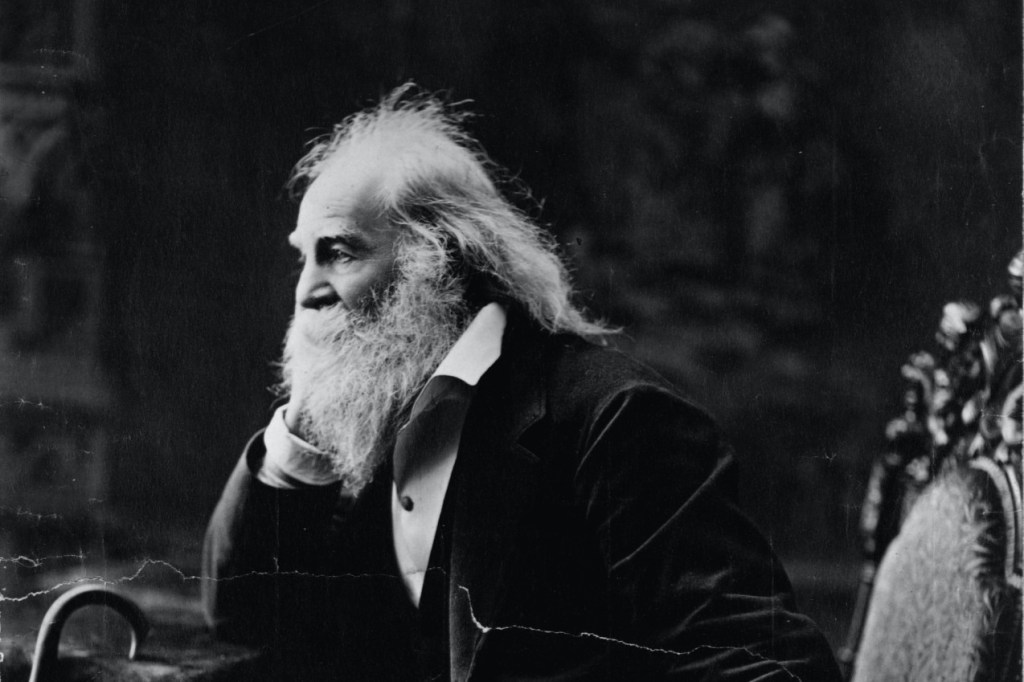
I was gifted a slender volume years ago by a dear member of my congregation. Jeanette is her name. She’s now with the Lord. The book was hers as a child. Its title: “Literary Shrines.” The author, Dr. Theodore Wolfe, scribbled its 217 pages in 1895, but only after traveling to each of the locations he explains.
The book rests on the corner of my bar. Every now and then, I’d pour a two-fingered dram and turn a few pages. As I’ve done so, the book has served its purpose, which was to carry its reader into and through the communities and homes of the better-known among us—Hawthorne, Thoreau, and others.
Having tipped one of the gentler bourbons in my cabinet, I finished the volume tonight. It ended at Walt Whitman’s house in Camden, New Jersey. Dr. Wolfe described the poet’s home at 328 Mickle Street, a “disappointingly unpretentious two-storied domicile…weather-worn and shabby,” he called it, with “W. Whitman” etched plainly on the doorplate.
But something else struck me about this concluding narrative.
Dr. Wolfe was taken to and left at Whitman’s home by a man who knew Whitman. Apparently, everyone in 19th-century Camden knew him. But this conductor, in particular, spoke rather peculiarly. Before leaving Dr. Wolfe to investigate, he said, “You have only to cross the ferry and apply to the first man or woman you meet, for there is no one in Camden who does not know Walt Whitman or who would not go out of his way to bring you to him.” He continued, “I never read a word Whitman wrote. I don’t know why they call him Socrates, but I do know he never passes me without a friendly nod and a word of greeting that warms me all through.”
I liked that.
Firstly, he spoke of Whitman as though he were still alive. I’m not surprised. Such people live well beyond their mortal departure. Secondly, Whitman—a favorite of mine—is described as everything I’d want him to be: kindly, gentle, aware of so much more than himself. Here was a man who more than dwelt among eloquence’s immortal collegium. Still, when you were near, he saw you, and he was interested.
If Walt Whitman, the most influential poet in American history, can have such a legacy, what about any of us?
 Cruciform Stuff