The Thanksgiving Day Nudge

There is something I’m very much looking forward to tomorrow. It’s something for which I am incredibly thankful. Without simply telling you what it is, I think the best way to describe it is to consider its comparisons.

Have you ever been going about your day and stumbled upon something that made you chuckle? I have. Has someone ever told you something that was so intuitively funny that you couldn’t help but laugh out loud? That has happened to me. Have you ever watched a comedy and found yourself in stitches at the outlandish interactions between characters? I have.

All of these are patterns of happiness resulting in happiness’s chief expression: laughter. That said, none of the examples I shared can compare to what will be happening at the Thoma family Thanksgiving Day table. We’ll be laughing. However, the laughter’s source will be far different than the prompts I previously described. It won’t need a joke to coax it. It won’t necessarily be prompted by comedic behavior or a funny story. It’ll just be there. That’s because its prompt is genuine joy, the kind that not only understands the Thanksgiving feast on the dinner table as a gift from the Lord but also because it knows the people gathered at the table as gifts, too.

I’m thankful for this, and I’m looking forward to experiencing it tomorrow after worship. But still, there’s something else.

Whether it’s a holiday feast or just any ordinary day, our family dinners are always very lively. We laugh a lot. Jennifer will sometimes pester me for remaining strangely quiet when it’s happening. For the record, it’s not that I’m disinterested or disengaged from what’s happening. It’s just that I’m often overwhelmed by a profound awareness of God’s goodness to me unfolding in real-time. When this happens, I become very nearly entranced. To snap me out of it, Jennifer abruptly says my name or nudges me with a look. It’s good that she does. If she didn’t, I’d remain fixed in my distant pondering, ultimately missing out on priceless opportunities to actually participate—to interact with these walking, talking gifts of God. Missing out would mean forfeiting the blessings God intends to bestow upon me through them.

I suppose I’m sharing this with you today because the Thanksgiving Day holiday has a way of being a pestering nudge, too, making it worth our attention. Personally, I find it strange that some in the Christian Church would be bothered by a National Day of Thanksgiving being treated by some congregations with the same reverence and devotion that other Christian holidays receive. Here at Our Savior in Hartland, we gather on Thursday, Thanksgiving Day, for a Divine Service at 10:00 AM. We have done so since 1955. And why wouldn’t we? Yes, it’s a civil holiday. Still, for us, it’s just one more opportunity to consider and express gratitude for the many gifts God has given us. We recognize it for the pestering nudge it is—a moment to remember Christian gratitude’s trajectory. In other words, being thankful for God’s gifts (family, togetherness, food, vocation, home, and everything else we have) is not apart from the source of the gifts: God. We don’t sit back and thank Him while forgetting to actually interact with Him. And so, Christians go to church on Thanksgiving Day. Who cares if it’s a civil holiday? It just seems right.

In the Bible, the greatest gift is Christ and His Gospel. God has established a way of distributing the Gospel. Referring to one of the avenues, Saint Paul described the heart of his own preaching by saying it was “to bring to light for everyone what is the plan of the mystery hidden for ages in God who created all things, so that through the church the manifold wisdom of God might now be made known… (Ephesians 3:9-10). What Paul means by “the plan of the mystery” and “the manifold wisdom of God” is not complicated. He means the Good News of the death and resurrection of Jesus Christ for the forgiveness of our sins. Here in Ephesians 3, he makes sure to tell us who has been officially tasked with making sure this Gospel gets into the world. Paul wrote plainly that the manifold wisdom of God is made known through the Church.

This is more than just an abstract point of awareness. It’s an actual point on a map. It’s a place with a table. It’s a place where God promises to be present. You’ve been invited to join God at that place. Certainly, we can take a day devoted to giving thanks, sit back, and marvel at His gifts. But even better, we are called to come and get them, thereby receiving the blessings God intends.

God has invited us to His feast. And so, we go to church (Hebrews 10:24-25). We go to His house. We encourage one another to go. We join Him at His table. We do so surrounded by our Christian family—fellow baptized believers we know and love and cherish. Except at this table, we experience so much more than a holiday meal. We sit with our Lord. He’s there by His verbal and visible Word—the Gospel preached and proclaimed, and the Sacraments administered. We participate in a foretaste of the heavenly feast to come, where fellowship is unbroken and joy is everlasting.

I encourage you to consider joining your Christian family for worship tomorrow morning. Don’t just sit by pondering your thankfulness. Go to the Lord’s house. Engage in the feast. Receive the blessings. Regardless of what some might say, for Christians, the National Day of Thanksgiving can be so much more than a few days off from work or school. It can be assumed into the posture of faith, becoming one more opportunity to taste and see that the Lord is good (Psalm 34:8) and that His mercy endures forever (Psalm 107:1).
The Eve of Thanksgiving

I’m guessing you know what I mean when I say the Thanksgiving holiday has a unique sense about it. Regardless of autumn’s shrouded frigidity, Thanksgiving remains bright and warm, as if the sun leaned closer to the earth for just this one day.

I say this knowing full well that family gatherings at Thanksgiving can be a mishmash of dynamics. I also know from casual reading that division in families from this or that issue is at an all-time high. For some, family get-togethers are more taxing than enjoyable. Still, I meant what I said. Thanksgiving has a unique sense about it. And it’s good.

It’s good, not because the Thanksgiving feast is the meal all other meals only wish they could be. For the pessimists among us, it’s not good because it only happens once a year. Thanksgiving is as it is because of its point: no matter where we’ve come from, where we’re going, where we are right now, what we’re experiencing, or who we’re with, we can be thankful. Thanksgiving’s point is gratitude.

Relative to families, someone once said genuine gratitude is only possible when the memories stored in the heart conquer those in the mind. I don’t know who said it. And yes, I suppose the saying is somewhat Hallmark card-like. Still, I’m fond of the thought, even if only for how I prefer to interpret it, which, as you might expect, is through the Christian lens.

Admittedly, the human heart and mind are both sin-stained in every way. And yet, Christians know something beyond this fact, especially when it comes to the Holy Spirit’s work in us through the Gospel for faith. We understand what Ezekiel meant when he spoke for God, saying, “I will give you a new heart and put a new spirit within you” (Ezekiel 36:26). We know what Jeremiah meant when he shared the similar promise, “I will give them a heart to know Me, for I am the Lord; and they will be My people, and I will be their God, for they will return to Me with their whole heart” (Jeremiah 24:7). We know what Saint Paul meant when he insisted, “Therefore, if anyone is in Christ, he is a new creature; the old things passed away; behold, new things have come” (2 Corinthians 5:17). Paul’s words in Romans 5:5 are not lost on us, either. We know what he meant when he wrote, “And hope does not put us to shame, because God’s love has been poured into our hearts through the Holy Spirit who has been given to us.”

Filtering the adage through these biblical truths, I suppose I like it because it implies that genuine gratitude is out of reach to mental calculation. In other words, as humans, we remember things. Those things shape and reshape us. Remembering how people have treated us—what they’ve done to help or hurt us, whether they’ve behaved as friends or foes—these become the variables we ponder in the calculations of relationship mathematics. And like any equation, sometimes the resulting product is positive. Sometimes, it’s in the negative.

Through the lens created by the Bible texts I shared, the phrase “memories stored in the heart” seems to hint at a different sort of math, an involuntary, grace-filled action uninhibited by human sensibility. It sees things through the Gospel. It understands annoying family members more so as family than annoying, and it’s thankful for them. It knows the time required to prepare a massive meal is exhausting, and yet it’s grateful for the opportunity to serve the ones it loves who’ll be gathering at the table to eat it. Some of those people haven’t been all that nice in the past. Still, it knows that kindness will always be sweeter than malice. It stands on its tiptoes, ready to reconcile. It’s hopeful for it to happen and gives thanks when it discovers itself stumbling into uncomfortable moments that are all but begging for it to be enacted.

In short, the memories of a Christian heart are the memories of Christ. The Holy Spirit puts them there. They are the remembrances that Christ, even when we were utterly unlovable, loved us to the end (John 13:1). They remember that even while we were still sinners, He gave Himself over entirely into Death’s perpetual night (Romans 5:8). They retain the incredibly crucial sense that we are just as needful of Christ’s merciful love as the screwed-up people sitting beside us at the Thanksgiving Day table, and with that, we belong together.

These Christian heart memories stir genuine gratitude, even when gratitude seems nonsensical and maybe even a bit foolish.

My prayer for you this Thanksgiving is two-fold. First, I hope you’ll begin your Thanksgiving Day by going to worship. There’s no better way to be equipped with Godly gratitude than by receiving Christ’s gift of forgiveness through the administration of His Word, both in its verbal and visible forms. Here at Our Savior, the service begins at 10:00 a.m. I hope to see you.

Second, I hope the memories stored in your Christian heart will conquer those in your mortal mind, and as a result, your Thanksgiving Day celebration with family will indeed be brighter and warmer, as if the sun leaned closer to wherever you are standing even if only for this one day.

A Turkey Flag

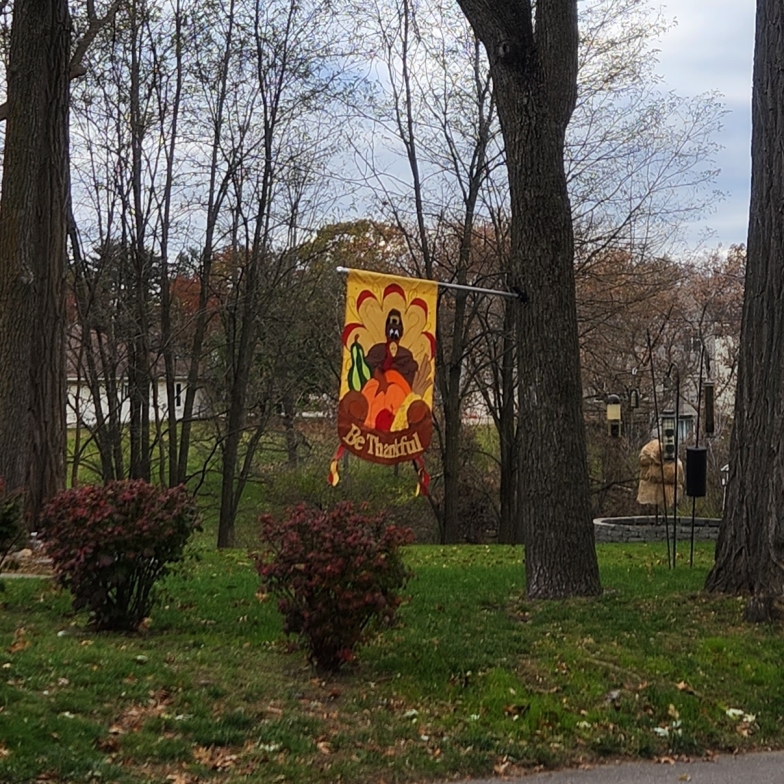
Turning left out of my subdivision, a few houses down on the left, there’s a home with a flagpole bracket attached to a tree in the front yard. The homeowners change the flag with the seasons. In the spring, they have a more flowery flag. On the approach of Christmas, the flag is appropriately festive. At other times, the flag demonstrates team pride, flapping their favorite football or baseball team’s symbol and colors in Linden, Michigan’s breezes. Right now, the flag is taking aim at the forthcoming Thanksgiving holiday, displaying a bright-eyed and smiling turkey character surrounded by all the Thanksgiving feast’s usual food suspects. Across the front of these things, in colorful letters, are the words, “Be thankful!”

Of all the flags this home displays, the first time I saw it, I laughed. I’ll tell you why in a moment. However, the more I thought about it, the more the flag became my favorite in the homeowner’s collection. It isn’t my favorite because I appreciate the style of cartoony banners it exhibits. I’m fond of it for its deeper message.

If you’ll allow me an extra minute or two, I’ll offer its explanation this way.

I know plenty of stories from Christian history, but what immediately comes to mind is one I just shared in passing with my wife, Jennifer, and my daughter, Madeline, this past Friday. It’s the story of Antonio Herrezuelo and his wife, Leonore. Herrezuelo was a lawyer in 16th-century Toro, Spain. He and Leonore had converted to Lutheranism, joining the secretive congregation of only seventy Christians in Valladolid. Relative to the times, this was, by nature, dangerous. The Reformation’s contention was in full bloom, and so was the Spanish Inquisition, which, as you may know, was an already well-established conquest intent on purifying the Church through brutality.

As the account would go, the little congregation was discovered, and all its members were accused of heresy—that is, they were accused of believing as Luther believed, which is that one is justified by faith apart from works of the law (Romans 3:28). At this point, accounts begin to differ somewhat. Some say that nearly all the church’s members recanted to save their lives. Other reports say that many did not. Either way, what’s common to most accounts is that as a principal nobleman in the region, Herrezuelo, along with thirteen others of similar status, was imprisoned and brutally tortured. In the end, only Herrezuelo maintained without recanting.

Leonore was kept separate from her husband throughout the ordeal. One account records that eventually, the two stood together before a final court of inquisition. The tribune interrogator is the only one among the court who spoke, and he did so with merciless brevity. He offered the couple what were essentially three choices. First, they could recant immediately and accept imprisonment, trusting that perhaps, in time, a pardon might be granted. Second, if any hesitation occurred relative to their recantations, they would be shown mercy, but only in that they’d be strangled to death before being burned at the stake. In other words, when asked, an immediate recantation was required. Third, if they refused to recant altogether, they would straightway be burned alive.

The interrogator turned first to Leonore and demanded, “What will you do?” Her words were soft between trembling gasps. “I will recant,” she said.

“Repeat it for God and Emperor!” the inquisitor fiercely demanded.

“I recant,” she said, this time with more fervor.

Without pause, the same question was put to Antonio, who, at that moment, stood captured in a frozen stare at Leonore. Prompted again, this time more vehemently, Antonio turned to his ferocious questioner. Still stunned by his wife’s words, it’s said he gave barely an intelligible slur, tearfully offering, “I cannot. I cannot recant.”

He was not asked a second time. A motion from the chief inquisitor stirred the guards to immediate action. Antonio was shuffled from the room to the nearby square. Another account depicts Antonio reprimanding his wife as he left. Others do not. Others portray a man led to a pine post on a readied platform at the center of a town swelling with as many as 200,000 onlookers. Tied to the post still nubbed and sap-sticky from branches hastily pruned for the event, a blindfold was added. Antonio’s last words were an unrelenting plea to his wife, “Leonore! I thank God for you! Please return to Christ, my love!”

Unable to see, he called in every direction, doing all he could to shout above the taunting noise from the gathered spectators, some even crowding the rooftops. Indeed, and surprisingly, Leonore heard him.

“Please return,” he continued crying. “We will be united together in heaven!” Annoyed by his persistence, one guard shoved a burlap wad into his mouth. For good measure, another stabbed him with a spear.

After a ceremony that included an hour-long sermon against the so-called heresy of salvation by grace through faith alone, the fire was set. The flames were stoked. Dreadful moments passed, and Antonio was dead.

Still in prison several years later, Leonore called to the guards from her cell early one morning. She requested an audience with a magistrate. Eventually, a court representative arrived. With the same quivering voice as years before, she informed her visitor, first, of her thankfulness for her husband’s steadfast faithfulness to Christ at his death, and second, she expressed gratefulness to Christ for His continued grace measured against even her dreadful betrayal. With that, she demanded her visitor send word that she had rescinded her recantation.

The message was delivered. Leonore was judged, condemned, and executed the next day.

It’s said she whispered to her executioner as he tied her to the post, “My first words to Antonio will be, ‘I have returned to our Jesus, my love.’” Her last words were, “Oh, give thanks to the Lord, for He is good, for his steadfast love endures forever.’”

So, what does this have to do with the flag adorning the tree around the corner from my subdivision’s entrance—the one with a smiling turkey?

The story I just shared has both of its victims giving thanks when thankfulness seems wholly inappropriate. When you think about it, a turkey is the one guest at the Thanksgiving Day feast who is killed, cooked, and eaten. And yet, there he is on the flag announcing to every passerby, “Be thankful!” Again, for as cartoony as the banner is, this is an extraordinarily rich image. It is a Christian image.

A lot is happening in America right now; there are some incredibly dreadful things. For one, Christianity is more than being pushed further and further into the shadows of criminalization. People are considered backwater bigots for holding to the truth of God’s Word. As this devolution continues, the temptation increases among us to ask, “What, exactly, is there to be thankful for?”

Many churches don’t offer a Thanksgiving Day service. That’s unfortunate. We do here at Our Savior. In case you’re interested, it happens on Thanksgiving Day at 10:00 a.m. Interestingly, one of the appointed texts for the day is the same as Leonore’s last words. At some point during the liturgy, God’s people will sing, “Oh give thanks to the Lord, for he is good, for his steadfast love endures forever” (Psalm 107:1). Why would we sing these words? Well, it isn’t because of what we see occurring in the world around us or because of what we must endure day after day. Instead, it is because of what we know by faith.

By the power of the Holy Spirit at work in believers for faith, even as everything around us may be coming undone—even as the fires of persecution rage, as we are betrayed, slandered, unjustly maligned, and brutally mistreated by the powers and principalities of this fallen world—we can and will be thankful to the Lord. Why? Because the most insurmountable of all insurmountables was conquered by Christ. He defeated Sin, Death, and the powers of hell for us. By His person and work, through faith in Him, we’ve been made His own. Knowing this, let the world kill, cook, and eat us. From among all on this transient blue ball hanging in space, we’re the only ones with an otherworldly viscera enabling us to lay our heads on the chopping block the same way we’d lay them on a pillow to rest. We can close our eyes in peace, knowing we are not inheritors of this world. We are inheritors of the world to come (Matthew 25:34, Luke 12:32, Romans 8:17). For a believer to live is to do so beneath Christ’s gracious benediction, no matter what we suffer. For a believer to die is not loss but gain beyond measure (Philippians 1:21).

Remember this. And when you forget it, may God be so gracious as to remind you. He reminded me this past week while driving past a flag with a turkey on it.

A Better Season

October has essentially come and gone. November is at the door. With it comes Novembery things. Into the trash, the weeks-old jack-o-lanterns will go. In exchange, some Thanksgiving décor will adorn front porches, bookshelves, and kitchen windowsills. Some among us won’t be able to resist putting out a few Christmas-leaning decorations, not necessarily a fully decorated tree. Maybe just a miniature Dickens-style village here and a snowman character there. Perhaps a wreath on the front door.

Henry David Thoreau called November the calendar’s mite, reminiscent of the gift given by the widow in Mark 12:41-44. He implied it doesn’t give much, but what it does offer—the last yellowing lights of autumn—are “more warming and exhilarating than any wine,” ultimately making it “equal in value to the bounty of July.” I’m not so sure I agree, being the summer man I am. July offers a steady repertoire of pleasantries that few other months can match. Although I suppose following Thoreau’s poetic lead, if I did have to compare November with July, one thought does come to mind. I’d say July gives us one particular day with a splash of color: Independence Day. The annual fireworks celebrations typically conclude with a minutes-long sky-filling grand finale. Autumn renders a far lengthier and much more extravagant array of colors, and November is its grand finale. Until the first snow pulls what’s left of autumn to the ground, November will spend its days bursting with fantastical hues.

The only other real praise I’m willing to give to November is for my wife’s birthday. I’m thankful in that regard.

Still, apart from playing a role in my wife’s entrance into this world, I prefer to look past November. Better yet, I prefer to look past winter altogether. Although, it’s been said that if you’re always looking to the future, you’ll ruin the present. Or maybe it’s the other way around. Either way, the autumn and winter months weigh heavily on me. They have me wishing for sun-beaming warmth pouring down from cloudless skies, days when I need to be more concerned about sunburn than bone-stinging windchill.

As you may already know, I was pretty sick for almost two weeks. I didn’t start feeling like myself again until this past Friday night. I went to bed at 10:30 p.m. and woke up twelve hours later. It was obvious I needed the sleep. I share this because I spent almost every day during this recent illness looking to the future, continually reminding myself, “This is only a season. Another season is coming, a better season. Tomorrow will be better.” This was not an exercise in the power of positive thinking. I would speak this way only after praying to my Lord for the hope He alone can provide. In other words, my regular exercise was one of anticipating something better.

I know I can only reach spring and eventually enter summer once I have first traveled the blustering valley of winter. Similarly, I know I must pass through the harder seasons of mortality before entering something better. But no matter the circumstance, whether the melancholy of actual winter or the failing flesh in sickness, I’ll have no strength to endure anything this world wields against me without the hope Christ provides. And each challenge will be nothing less than a microcosmic image of God’s promised grace in struggle and deliverance for eternal life. This is the ongoing exercise of Christian hope, a challenging but powerful regimen. It not only teaches us to trust that God has us well in hand right now, but it has eyes for a far better tomorrow, one where hope is no longer necessary because it has been completely fulfilled in the glories of eternal life.

Considering Titus 2:13, Luther described it this way:

“But how long shall we wait for that blessed hope? Will it remain but a hope forever, and will it never be fulfilled? No, [Saint Paul] says, our blessed hope will not always remain a hope, but it will eventually be made manifest, so that we shall no longer only hope and wait for it, but what we now believe and hope for will then be made manifest in us, and we shall possess with full certainty what we now await. But meanwhile, we must wait for that blessed hope until it be revealed.” (Sermons from the Year 1531, W.A. 34. II. 117.)

The waiting is the hard part. It’s life’s winter. It’s the season of bodily illness, job loss, dysfunctional families, persecution, and so much more. Still, we know by faith we bear an otherworldly strength that can “rejoice in our sufferings, knowing that suffering produces endurance, and endurance produces character, and character produces hope, and hope does not put us to shame, because God’s love has been poured into our hearts through the Holy Spirit who has been given to us” (Romans 5:3-5).

I pray you are well and enduring whatever the world insists on throwing at you right now. Winter is coming. But it’s only a season. Another season is coming, a better season.

Thanksgiving and God’s Smile

After fifty-two long weeks of travel, having visited all of the distant landscapes of the Church Year, we’ve come full circle and arrived once again at Advent. We’ve come home.

Still somewhat afar off, there’s a plain between us and Advent’s perpetual twilight eve of waiting—an oasis of sorts. It’s always been there. We just didn’t necessarily notice it until a handful of our nation’s most thoughtful carved it from the landscape, cultivated it, and made it a more prominent vista. They named this lush borderland “The National Day of Thanksgiving.”

Strangely, some of the Church Year’s travelers have been long-bothered by the demarcation of this day. Each year at this time, they share their concerns for such a day instituted by this world’s princes and celebrated by the Church. And so, passing through its parcel, they say it doesn’t belong—that the Last Sunday of the Church Year is well enough equipped for delivering us into the new Church Year, and the Day of National Thanksgiving needn’t be one of the Church’s events. I’d say these fellow travelers are right, if only by their humbug commentary they didn’t demonstrate a bizarre disposition against one more opportunity for thankfulness. Doing this, perhaps they prove, even more so, the National Day of Thanksgiving’s necessity.

I agree with them in the sense that thankfulness is already written into each and every stop along the Church Year’s way. This is true because it’s written into the souls of believing travelers by the power of the Holy Spirit through the Gospel. This means thankfulness is a fruit of faith that cannot be kept from sprouting from the soil of the Church’s collective heart, reaching up toward the sunlight of God’s grace, and rejoicing in His wonderfully sustaining love.

As this meets with the National Day of Thanksgiving, perhaps a day set aside and focused specifically on giving thanks works quite well between the Last Sunday of the Church Year and the First Sunday in Advent. The journey has ended, another is beginning, and both are born from the fact that God is always faithful all along the way. In between the two, thankfulness just seems natural. It’s what any normal traveler does when his journey has ended and he’s found himself at home’s doorstep. He does not wisp a thankless sigh, a sound made because he’s annoyed by home’s obligation. He sighs with thankful relief. He’s glad. And so, he falls to his knees—or perhaps he goes right inside to fall into his favorite chair, or into the arms of a loved one—and he gives thanks to the One who took careful notice of each of his steps along the way, being sure to guard and protect him through to the end of one journey, and into the brief respite granted before beginning another.

Saint Ambrose said so exactly: “No duty is more urgent than that of returning thanks.” In a radically individualized society filled with takers, I probably don’t need to explain Ambrose’s words to you.

With that, I say a day set aside that takes aim at thankfulness can do little, if anything, to harm our nation, let alone a Christian, no matter who established it. Besides, Christian thankfulness is already attuned within us. It’s always on the lookout for ways to show itself to a thankless culture. We need it to show itself. It certainly knows how. It knows far better than the world. Again, this is true because Christian thankfulness is powered by the right kind of joy—the kind born from the Gospel of salvation through faith in Jesus Christ. It is well-equipped for seizing every opportunity for gratitude in this life as we await the next. Christian thankfulness exists through sunshine and rain, warmth and cold, happiness and sorrow.

Just imagine how Christian thankfulness must leap for joy when it sees it has its own day on the calendar.

I suppose you don’t need to imagine it. Our Savior in Hartland is not a congregation that ignores the National Day of Thanksgiving. We’re glad for it, and we embrace it. It seems natural to do so. Perhaps even better, it seems only right. Come and see for yourself. Join the thanks-filled gathering of Christians here at Our Savior on November 25 at 10:00am. Join us as we take hold of the National Day of Thanksgiving and use it in a way that makes God smile; which, by the way, doesn’t necessarily mean we’re gathering to give anything to or do anything for Him that He needs. We gather because of what He gives and does, and we have hearts for receiving more. We desire His soul-strengthening gifts of forgiveness through Word and Sacrament ministry. We want to receive this heavenly bounty whenever we can, and after each opportunity, to be sent out by His smile, which is the gracious benediction of His face shining upon us and giving us peace.

Indeed! O, give thanks unto the Lord; for He is good, and His mercies endure forever (Psalm 136:1)!

God bless and keep you, my friends, and may you have a wonderfully happy Thanksgiving. I hope to see you in worship. And, if I do, I’ll have one more reason to give thanks to my faithful God, not only for His grace, but also for your faithfulness.